National News

What we do (and don’t) know about teacher shortages, and what can be done about them

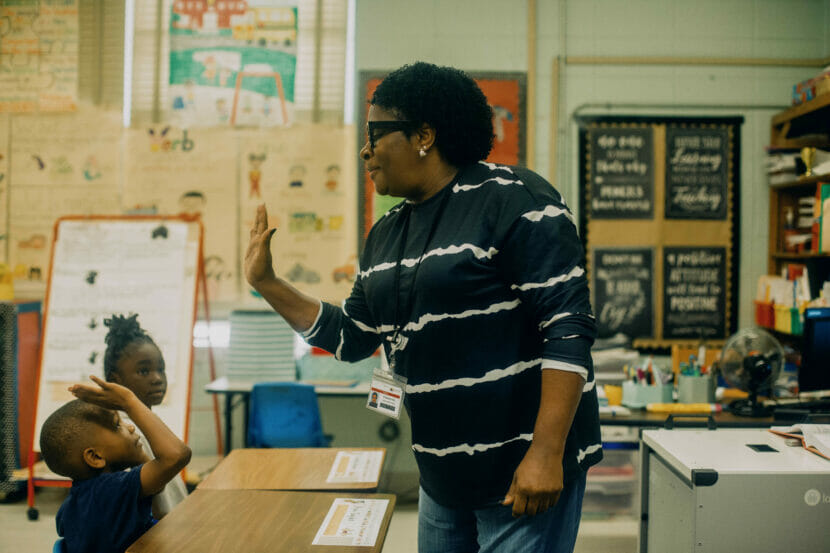
First-grade teacher Kimberly Pate, 52, worked for nearly two decades as a classroom assistant. Through the Mississippi Teacher Residency, she’ll earn a master’s degree plus dual certification in elementary and special education, all at no cost. “How could you pass that up?” she laughs. (Imani Khayyam for NPR)

Wearing an effortless smile and a crisp, gray suit with a cloth lapel flower, Tommy Nalls Jr. projects confidence. Which is the point. In a ballroom full of job candidates, no one wants to dance with a desperate partner. And, as badly as his district needs teachers, Nalls doesn’t want just anyone.

“They have to have this certain grit, that certain fight,” says Nalls, director of recruitment for Jackson Public Schools, in Mississippi’s capital city. “That dog in ’em,’ so to speak.”

On this sun-kissed morning in March, he’s a couple hours north of Jackson, in a ballroom on the campus of Mississippi State University, at a job fair full of soon-to-graduate teachers and school district recruiters from all over the state, and even out-of-state, competing to hire them.

Many districts across the country are grappling with teacher shortages large and small. Limited federal data show, as of October 2022, 45% of public schools had at least one teacher vacancy; that’s after the school year had already begun. And schools that serve high-poverty neighborhoods and/or a “high-minority student body” were more likely to have vacancies.

For several months, NPR has been exploring the forces at work behind these local teacher shortages. Interviews with more than 70 experts and educators across the country, including teachers both aspiring and retiring, offer several explanations: For nearly a decade, fewer people have been going to school to become teachers; pay remains low in many places; and, with unemployment also low, some could-be teachers have chosen more lucrative work elsewhere. Researchers and educators also point to a cultural undertow pulling at the profession: a long decline in Americans’ esteem for teaching.

Educators shared stories of students learning Spanish from computers, and superintendents doing double duty as substitute teachers. But they also shared stories of creative, committed efforts – from San Antonio to Hooper Bay, Alaska – to grow a new generation of teachers, while doing more to make sure veteran teachers want to stay.

Jackson’s story is instructive, if not unique. On average, Nalls says, the district loses 1 in 5 teachers every year. Salaries there start at just $44,000, and, back at the job fair, Nalls has to compete with a suburban Texas district, a few tables over, advertising $58,000.

Jackson’s shortage is also exacerbated by a years-long water crisis and poverty, which can follow students to school in the form of trauma, disruptive behavior and lower test scores. In Mississippi, districts are publicly rated on student performance – a rating novice educators are well aware of. Just a few years ago, Jackson was an F-rated district, and this job fair has plenty of districts with higher salaries and technicolor banners trumpeting their A ratings.

It takes 20 minutes for the first teacher candidate to pause at Nalls’ table.

“I’m looking for a good work environment,” says Kierra Carr, who plans to become an elementary school teacher. “And I just want to have fun with the students, basically.”

“You hadn’t considered ever coming to work and teach in Jackson?” Nalls asks playfully, low-pressure. “Why not?! We’ve got some of the best elementary schools in the state!”

Carr leaves her name and email on Nalls’ interest list, while admitting she has reservations about teaching in Jackson: “It’s kind of scary. I think that’s why most people stray away from teaching there because of what’s been said on the news a lot.”

Nalls leans into these headwinds with patient optimism. Jackson is on the rise, he points out, earning a C rating from the state last year. And he’s proud to make that pitch to the eight candidates he interviews at the fair and the half dozen more who leave their contact information.

“They’re not beating the table down trying to get to Jackson,” Nalls says toward the end of the fair. “But we’re working on that part of it.”

It’s hard to know the size of the problem

“Teacher shortages are poorly understood.” That’s according to a paper published last summer. The reason they’re poorly understood? A profound “lack of data” at the federal- and state-level.

So the paper’s researchers built their own dataset by combing through news reports and the websites of state departments of education. Their conclusion, what they consider a “conservative” estimate of teacher shortages nationwide: at least 36,000 vacant positions and many times more jobs being filled by underqualified teachers. One of those researchers, Tuan Nguyen, shares his data at the easy-to-remember teachershortages.com.

A nationally representative survey, by the RAND Corporation, found that “teacher turnover increased 4 percentage points above prepandemic levels, reaching 10 percent nationally at the end of the 2021–2022 school year.”

It’s important to think of school staffing challenges not as one, national shortage, but as innumerable, hyper-local shortages. Because nationally, “we have more teachers on a numeric basis than we did before the pandemic, and we have fewer students” due to enrollment drops, says Chad Aldeman, a researcher who studies teacher shortages.

“Contrary to popular talking points, there is no generic shortage of teachers,” reads one deep-dive into the available data. “The biggest issue districts face in staffing schools with qualified teachers is… a chronic and perpetual misalignment of teacher supply and demand.”

Some kinds of teachers are consistently in short supply. Jackson Public Schools need special education, science and math teachers. But so does every other district at the job fair.

The misalignment of supply and demand is also geographic and economic, though.

There’s an inequity around teacher shortages

“Some schools are harder to staff,” Aldeman says.
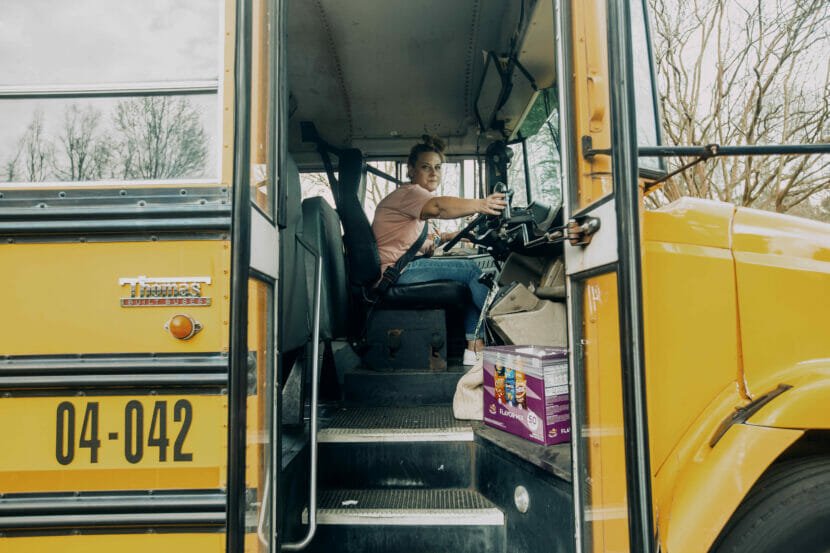
Jennifer Carter earned her master’s degree in December through the Mississippi Teacher Residency. She’s now a special education teacher by day and drives a bus before and after school to make extra money. (Imani Khayyam for NPR)

Many districts “have dozens of teachers applying for the same positions,” Tuan Nguyen explains. “But in a nearby district that is more economically-disadvantaged or has a higher proportion of minority students, they have difficulty attracting teachers.”

In Jackson, the median income of school district households is under $39,000, and 95% of students are Black, after generations of white flight from the district.

It turns out, shortages are a lot like school districts themselves. They often begin and end at arbitrary lines that have more to do with privilege and zip code than the needs of children.

At the job fair, Nalls meets a few candidates who, though they’re from the Jackson area, say they’re more interested in teaching in nearby, more affluent suburban schools.

“It’s the kids that need the most that are getting the least,” says Margarita Bianco, who studies teacher recruitment at the University of Colorado Denver. “And it’s perpetuating an already horrific problem in terms of an opportunity gap between kids of color and their white, more affluent peers.”

Pay and the cost of college also play a role

Given that economically-disadvantaged districts like Jackson are generally hit harder by shortages, the answer to why has to start with money. According to federal data, teachers in the U.S. earned an average of $66,397 in 2021-22. But there are a few wrinkles in that number.

First, it hides enormous variation in school funding and teacher pay from state to state. The average salary in Connecticut, $81,185, may be a comfortable wage, but the average in Mississippi was just $47,162. Keep in mind, that’s not the average starting salary; that’s the average for all public elementary and secondary school teachers in the state.

Salaries can also vary wildly from district to district.

“If I moved down to the district in which I live and taught there, I would probably get a $10,000 pay raise just from switching districts,” says Renee, a veteran high school English teacher in rural Ohio who asked that we not use her last name for fear of reprisal from her district. “We lose a lot of teachers in my district after one, two, three, four years, because if they’re single, especially, it’s not enough money to have even just an apartment by themselves.”

What’s more, after adjusting for inflation, the average teacher’s salary has stagnated since 1990. According to research from the Economic Policy Institute, that means teachers also earned 23.5% less than comparable college graduates in 2021. Even after factoring in other benefits, teacher compensation still lagged other college grads by roughly 14%.

“I’m more educated than my husband,” says Renee in rural Ohio. “I have two master’s degrees and a bachelor’s degree, and I earn way less than he does.”

Renee echoed something NPR heard from many teachers – that she’s tired of hearing school leaders and politicians talk of teaching as “a calling,” while pay remains so low.
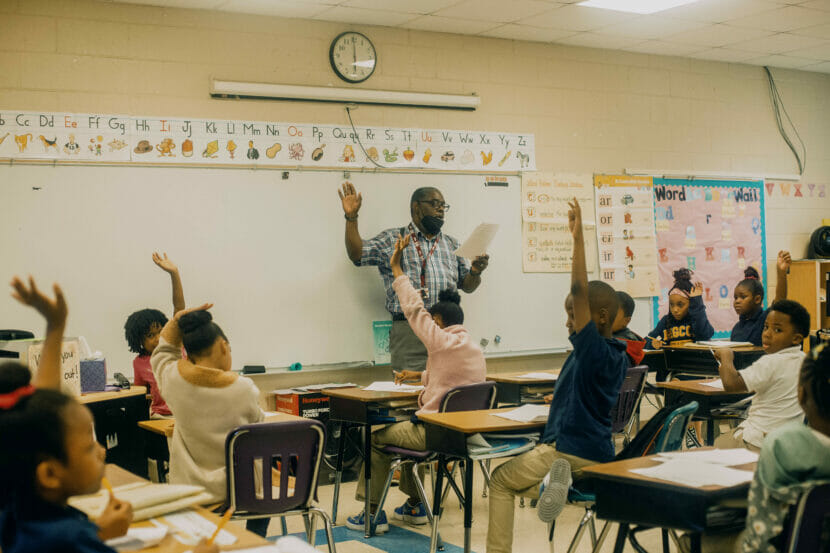
Pastor Dwayne Williams, aka Mister D, started as a substitute teacher, but fell in love with the work and eventually enrolled in the Mississippi Teacher Residency program. Now the 61-year-old is teaching second-graders. “You may not change everybody,” Williams says, “but you can change somebody.”
(Imani Khayyam for NPR)

Yes, she says, “it’s a calling. But it also should be a career.”

There’s also the front-end cost of becoming a teacher. Most places still require at least 4 years of college, and federal data show that, while teacher pay has been stagnant since 1990, the inflation-adjusted cost of college has nearly doubled, from about $15,000 a year in 1990 to $29,000 in 2020.

Making matters worse, federal loan forgiveness programs meant to help teachers shed college debts have made headlines for doing the opposite. The rising cost of college is forcing an uncomfortable cost-benefit analysis on aspiring teachers. Ominously, between 2010 and 2018, enrollment in traditional teacher preparation programs dropped by roughly a third.

One important caveat to that decline, and an early sign of good news, is that since 2018 “the data suggest that things are getting better, not worse,” says researcher Chad Aldeman.

The prestige associated with teaching isn’t what it used to be

Pay, specialty and zip code matter a lot when it comes to local teacher shortages, but Matthew Kraft, who studies teacher hiring and training at Brown University, says subtler, no less important forces are also at work – about how we perceive teaching.

Meaning, do we, as a culture, think teaching is prestigious? Is it a worthwhile pursuit that rewards hard work and earns the respect of peers? Are teachers happy they chose teaching?

“We were stunned by what we found,” says Kraft of the aptly-titled paper “The Rise and Fall of the Teaching Profession.”

Kraft and his colleague studied more than a dozen datasets in an effort to gauge the health of the teaching profession over time. They looked at a nationally-representative poll of high school seniors and multiple job satisfaction surveys of educators themselves.

“Across every single indicator we measure, our findings show that the overall wellbeing of the teaching profession today is at or near historically low levels,” they write.

Perceptions of teacher prestige have fallen in the last decade, they write, “to be at or near the lowest levels recorded over the last half century.”

So too has interest in teaching fallen among high school seniors and college freshmen: “50% since the 1990s, and 38% since 2010, reaching the lowest level in the last 50 years.”

So that’s generations of could-be teachers choosing other paths. What about those who do choose teaching?

“Teachers’ job satisfaction is also at the lowest level in five decades, with the percent of teachers who feel the stress of their job is worth it dropping from 81% to 42% in the last 15 years.”

And that drop is not simply the result of pandemic stress, the researchers write. “Most of these declines occurred steadily throughout the last decade suggesting they are a function of larger, long-standing structural issues with the profession. In our view, these findings should be cause for serious national concern.”

In NPR interviews, former and current teachers offered story after story that echoed these broader findings – that teaching through the pandemic was incredibly difficult, but that many challenges had begun long before COVID-19.

“We have definitely hit a new low,” says Sandy Brumbaum, an elementary school teacher and literacy coach in the California Bay Area, who says teachers have felt micromanaged and disrespected by political efforts at the national, state and district level for years. “When politicians and parents get involved and say, ‘You can’t teach this, and you can’t teach that.’ Like, you’re judged and you’re shamed for how you’re teaching. I think that is demeaning.

In rural Kansas, Chelsey Juenemann has been teaching middle school language arts for most of her 20-year career, but, in November, she told her superintendent she’d be leaving at the end of the school year.

“The view of education, the view of teachers has changed,” Juenemann worries. “There’s not a lot of respect for education and educators. And it just takes it out of you after a while.”

Teachers were once thought of as “heroes,” Juenemann says, echoing generations of polling. “These heroes that make such a difference in children’s lives. And I don’t feel like education and educators are viewed that way anymore.”

“Fix the teacher shortage? Well, how about you have supported teachers,” says Christina Trosper of Knox County, Ky., who’s in her 21st year of teaching. Trosper says, as a high school social studies teacher, the politics around what she can teach have become toxic. “I’ve struggled. I have been ostracized. I have been straight up harassed. I have had death threats.”

But Trosper says she won’t stop teaching. “I f***ing love it. I love it. It is my passion.”

Marie, an elementary school teacher for 10 years in Milwaukee, resigned in summer 2020. She says she loved working with children; it was the lesson-planning on nights and weekends, low pay, tension with some parents and lack of support from school leaders that led her to leave. Marie didn’t want to use her full name because she still sometimes works as a substitute teacher in the district.

“I cried so hard writing that resignation letter,” she says. “I mourned the loss of that part of me and what could have been. And I was really heartbroken because it didn’t have to be like this. Like, education could be good. It could be a good profession. But it just wasn’t for me.”

How some districts are trying to convince people teaching is for them

There is still plenty states and districts can do to better support current teachers and invest in the next generation of educators.
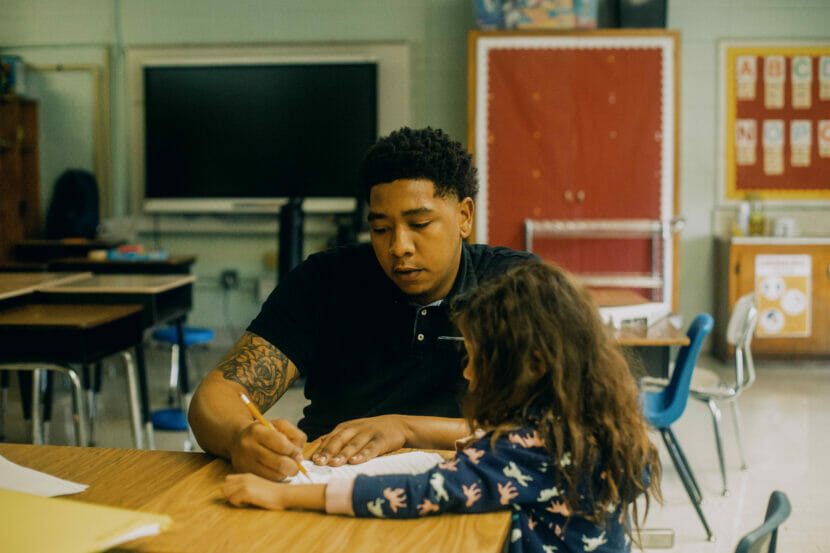
Elementary school teacher Jonah Thomas, 22, is new to the classroom. Later this spring, he’ll earn his master’s in education through the Mississippi Teacher Residency. (Imani Khayyam for NPR)

One option stems from a national movement around Grow Your Own (GYO) programs, in which teacher candidates are cultivated from the local community. The hope is a community member will be more personally invested in the school system, and more likely to stick around.

Drawing teachers from the community also makes it easier for students to see themselves and their life experiences reflected in their teachers.

According to New America, at least 35 states have some sort of GYO policy on the books and/or fund a GYO program. Among those states is Mississippi, where Kimberly Pate now teaches first grade.

Pate, 52, worked for nearly two decades in Jackson’s schools as a classroom assistant.

The pay was “peanuts,” Pate says, “so I was working literally two full time jobs to make ends meet.” With four children of her own, she couldn’t afford to go back to college, to become a fully-licensed teacher. That is, until she was offered a slot in the Mississippi Teacher Residency.

The pitch was hard to believe: In one year, she’d get a fully-paid-for master’s degree from nearby Jackson State University and a better salary. She’d be assigned an experienced mentor at the school where she works (in her case, the assistant principal) to support her. Plus, Pate could keep working full-time while being a student – so she could support her family.

“If it wasn’t a full salary, I don’t think I would be able to do it,” says Pate, who will earn her master’s, plus dual certification in elementary and special education, later this spring. “It’s like, how could you pass that up?”

In return for all of that, Jackson gets a few things. A fully licensed elementary and special education teacher, both in short supply there. Also, a promise from Pate that she will keep teaching in the city for at least three years.

The Mississippi Department of Education is focusing its Grow Your Own efforts in 42 districts across the state that have had the hardest time finding and keeping staff. The Mississippi Teacher Residency stands out for its generosity.

“It’s really a no-cost pathway. It is a Cadillac package,” says Courtney Van Cleve, who heads teacher talent acquisition for the Mississippi Department of Education. “We cover everything: tuition, books, testing fees.”

Originally paid for by a grant from the W.K. Kellogg Foundation, the Residency is now funded with federal dollars, through the Elementary and Secondary School Emergency Relief (ESSER) Fund.

Not only does the program cover the full costs of a master’s degree while allowing candidates to continue working full-time, it is also explicitly intended to diversify the teacher workforce. According to the state, 70% of the program’s residents identify as teachers of color.

“Fewer than 1 in 5 teachers are people of color, but more than half of U.S. students are young people of color,” wrote U.S. Education Secretary Miguel Cardona in a recent op-ed. “We know that our students benefit from being taught by teachers of all backgrounds.”

In Jackson, that means using the Residency program to continue to train and retain teachers of color, including Pate and Jonah Thomas, 22, whose classroom is just down the hall from Pate’s.

“You don’t see too many black male teachers in elementary [school],” says Thomas, who daps up a group of boys at the cafeteria door as he walks to class. “Their father may not be here or their parents may not be getting along, so they’re not seeing their father.”

Thomas says, “I’m here for them. And I can talk to [them] about anything that [they] may be going through.”

Thomas wears a crisp black shirt, the sleeves just short enough to show his brother’s name, Jonathan, tattooed on his right arm. He’s an example of how GYO programs use incentives to reach college grads who might not have even considered teaching. He studied economics in college.

“I was still looking for accounting jobs,” Thomas says, when he heard about the Mississippi Teacher Residency. “If it weren’t for this program, I wouldn’t even be a teacher.”

But he was enticed by the idea, having seen first-hand the power of great teaching.

“I watched my mom teach growing up as a little boy. She treated other kids like they were her kids. Like, I remember being jealous sometimes,” Thomas laughs.

He says taking master’s-level classes while also working in the classroom has been exhausting, but kind of amazing. “Everything that we learned we can apply it to our classroom. Like, we’d have classes sometimes where we may learn Wednesday something we can come to school and apply Thursday.”

Eighteen full-fledged Jackson teachers have already come out of the Residency program, and about as many are on their way.

Kimberly Pate says, if it weren’t for the Mississippi Teacher Residency, she likely wouldn’t be where she is now either, in her own classroom, facing a room full of eager first-graders.

Working on a reading lesson, the children smile on the edge of their chairs, sounding out P-ai-n-t.

It’s hard work, reading. But they know they have Ms. Pate, and she isn’t going anywhere.

Edited by: Nicole Cohen
Visual design and development by: LA Johnson and Ashley Ahn
Research by: Jonaki Mehta
Audio stories produced by: Lauren Migaki
Audio stories edited by: Steven Drummond and Nicole Cohen

Copyright 2023 NPR. To see more, visit https://www.npr.org.

Transcript :

STEVE INSKEEP, HOST:

Almost half of America’s public schools were down at least one teacher this school year. You can blame low pay and politics and pandemic burnout. NPR’s Cory Turner and Lauren Migaki visited a job fair in Mississippi where recruiters were seeking new teachers.

UNIDENTIFIED RECRUITER #1: Hey. I’m from Frisco, Texas. We’re, like, busting out the seams (laughter). So we’re going everywhere to find good teachers.

UNIDENTIFIED RECRUITER #2: We have a lot of openings.

UNIDENTIFIED RECRUITER #3: Math and some science.

UNIDENTIFIED RECRUITER #4: We have a shortage of math teachers.

UNIDENTIFIED RECRUITER #2: Foreign language. Special education.

UNIDENTIFIED RECRUITER #5: High school English.

UNIDENTIFIED RECRUITER #6: So we’re looking for a music teacher. We have…

UNIDENTIFIED RECRUITER #2: Yeah, a little bit of everything.

INSKEEP: Cory Turner shadowed a recruiter for Jackson, Miss.

CORY TURNER, BYLINE: Dr. Tommy Nalls Jr. used to teach high school science in Mississippi’s capital city, Jackson. Now he’s trying to convince a new generation of teachers to do the same.

TOMMY NALLS JR: They have to kind of have that certain grit, that certain fight – like we say, that dog in them, so to speak – where they are tenacious, you know, they fit us.

TURNER: Nalls is head of recruitment for Jackson Public Schools. And even before the pandemic, he had a tough job. On average, the district loses 1 in 5 teachers every year. It doesn’t help that Mississippi ranks near the bottom in teacher pay. And Jackson is embroiled in a years-long water crisis. And then there’s the city’s poverty. It follows children to school in the form of trauma, disruptive behavior and lower test scores. But Tommy Nalls is an optimist. And on this sunny March morning on the campus of Mississippi State, he’s arrived early with a plan.

(SOUNDBITE OF SUITCASE ROLLING)

TURNER: Nalls wears a grey plaid jacket with a blue cloth flower in his lapel. In one hand, coffee – in the other, he pulls a suitcase full of job fair pamphlets and giveaway goodies.

NALLS: I have eight interviews set up this afternoon (laughter).

TURNER: Eight interviews.

NALLS: Eight interviews. My first one starts at 11:30.

TURNER: When he checks in…

NALLS: Good morning.

UNIDENTIFIED PERSON: Hi. Good morning.

TURNER: …Good news. Jackson’s been given a table just inside the doors.

NALLS: Prime real estate.

TURNER: Even now, as the school year winds down, Jackson schools still have 88 vacancies out of about 1,700 teaching positions. To give you a sense of the impact of just one vacancy, we’re going to leave this ballroom for a minute and go to Jackson.

(SOUNDBITE OF DEVICE BEEPING)

TURNER: At Forest Hill High School, home of the Patriots, Principal Torrey Hampton walks fast with a walkie talkie. He’s winded when he shows me around. I ask, how hard has it been to find a qualified Spanish teacher?

TORREY HAMPTON: Still hard. Hadn’t found one yet.

TURNER: And yet Hampton’s walking me to a classroom full of students taking Spanish 2.

HAMPTON: So I had to do what’s best for the children and change the class, but through our online platform.

TURNER: That means when we get to the room, instead of hearing Spanish, we hear this.

(SOUNDBITE OF JAZZY COFFEE’S “RUBBER CATS”)

TURNER: Smooth jazz plays through speakers at the front of the class while students sit at their desks, library quiet.

UNIDENTIFIED STUDENT: This one is…

TURNER: They’re trying to translate English phrases into Spanish through a computer program on their laptops.

Wait, what just happened? I saw a big, red X.

UNIDENTIFIED STUDENT: (Laughter) If you get it wrong, it gives you a chance to try again.

TURNER: How do you like this?

UNIDENTIFIED STUDENT: I think it’s all right. Like, I think it would be better if we actually had a teacher.

TURNER: For much of the past decade, enrollment in teacher training programs dropped nationwide by roughly a third. With fewer new teachers in the traditional pipeline, Jackson has to compete more than ever with better funded suburban districts. So back at that job fair, just listen to these pitches from the competition.

UNIDENTIFIED RECRUITER #7: We are an A-rated district.

UNIDENTIFIED RECRUITER #8: There are a lot of high expectations. And, you know, we are that A-rated school.

UNIDENTIFIED RECRUITER #9: We have a beach that most places don’t have. So…

UNIDENTIFIED RECRUITER #10: Listen; let me talk about the town a little bit. Vicksburg is very close-knit.

UNIDENTIFIED RECRUITER #11: Western Line is family. So everyone really gets to know each other.

UNIDENTIFIED RECRUITER #10: You still got a little bit of shopping that you can do.

UNIDENTIFIED RECRUITER #12: All right. So we have our own health clinic for teachers that’s free. We can reimburse them for if they go and workout.

UNIDENTIFIED RECRUITER #9: We have instructional coaches at every one of our campuses.

UNIDENTIFIED RECRUITER #12: We pay really well. Texas probably pays better than most. Next year, it should be about 60,000.

TURNER: In Jackson, the starting salary is less than 44,000. There’s also those A ratings we just heard about, doled out by the state for things like student test scores and absentee rates. Well, all over this job fair, districts trumpet their A ratings on banners, districts that haven’t had to deal with the poverty or systemic racism that Jackson has. So I asked Tommy Nalls, Jackson’s recruiter, does that bother him?

NALLS: I mean, I’m of the mindset that, hey, if you’re A district, regardless of how you got it, you know, you’re A, you know? Promote that.

TURNER: Nalls proudly points out that Jackson’s gone from an F rating just a few years ago to a high C.

NALLS: We’re going to promote that we’re a C. But one day, just understand and know that our district is going to be right there with you. And we’re going to be able to promote that we did it without all of the resources and without all of the affluence.

TURNER: Nalls faces one more challenge. Most of the candidates here are young white women, which reflects the teaching force nationwide. Jackson’s students, on the other hand, are predominantly Black after generations of white flight from the city. It takes more than 20 minutes for just one teacher candidate to stop at Nalls table. Kierra Carr says she’s hesitant to work in Jackson.

KIERRA CARR: It’s kind of scary. I think that’s why most people stray away from teaching there, because of, like, what’s been said on the news a lot.

TURNER: Nalls does get her attention, though, when he mentions the district is offering a signing bonus.

NALLS: Yeah, for elementary, we do 7,500.

CARR: That sound nice, too.

NALLS: I should’ve led with that, huh (laughter)?

CARR: Yeah, you didn’t say that.

TURNER: While the bonus helps, Nalls says he wants teachers who want to work in Jackson. Later, a trio of promising candidates drop by Nalls’ table, including Sydney Bearden (ph).

SYDNEY BEARDEN: More than ever, we need to show up and show out and show these kids, here I am, dedicating my time to teach you and advocate for you.

TURNER: In the end, I ask Nalls, how would he rate this job fair?

NALLS: Yeah. I would say B, B-plus, not quite an A because they’re not beating the table down trying to get to Jackson. But we’re working on that part of it. But nice, solid fair, good traffic.

TURNER: Tommy Nalls packs up his pamphlets and keychains and readies himself for another job fair and another chance to make his case for the children of Jackson.

Cory Turner, NPR News, Starkville, Miss.

(SOUNDBITE OF DORENA’S “LET US LIVE”) Transcript provided by NPR, Copyright NPR.
Why car prices are still so high — and why they are unlikely to fall anytime soon

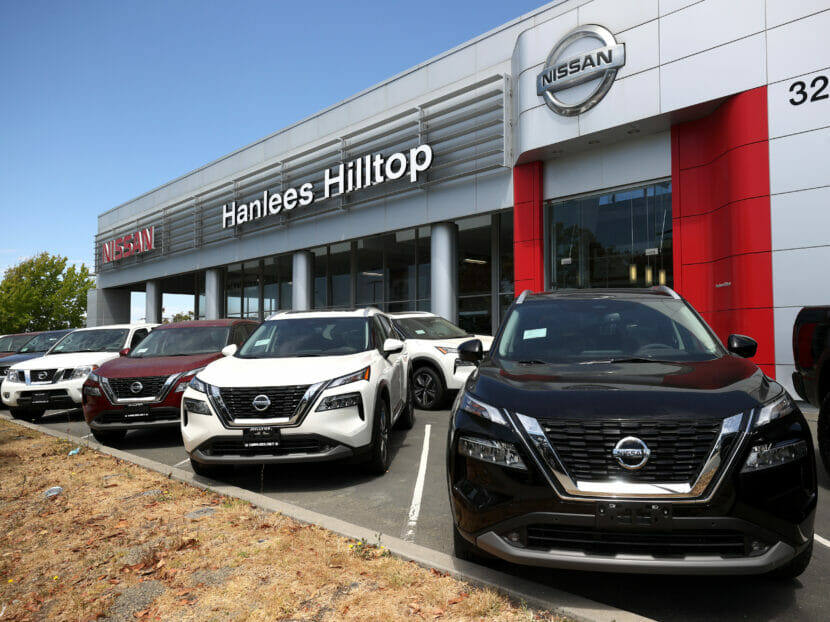
Brand-new Nissan vehicles sit on a sales lot in Richmond, Calif., on July 9, 2021. Car prices surged during the pandemic, and despite coming down from their peak, they still remain higher than a few years ago. (Justin Sullivan/Getty Images)

It has been nearly three years since auto plants around the world started to shut down because of the pandemic.

Yet between the pandemic, an acute shortage of semiconductors and other supply chain snarls, vehicle production has never really returned to normal.

And prices? Hoo boy.

Both new and used prices have stopped skyrocketing. In fact, both dipped slightly in February.

But the average new-vehicle transaction price is still $48,763, according to Kelley Blue Book. Before the pandemic, the average new vehicle sold for $37,876.

At an auto show this year, Noah and India Grabisch of Laurel, Md., were looking at new SUVs, which they liked. But an $86,000 price tag for a Chevrolet Suburban?

Well …

“It looks nice,” India Grabisch said. “But … no.”

The used-car market doesn’t provide much relief either. Retail used-vehicle prices now average $26,510.

And after falling last year, closely watched wholesale prices, a key indicator of where markets are headed, are actually rising again.

Why are prices remaining stubbornly high? Here are a few reasons.

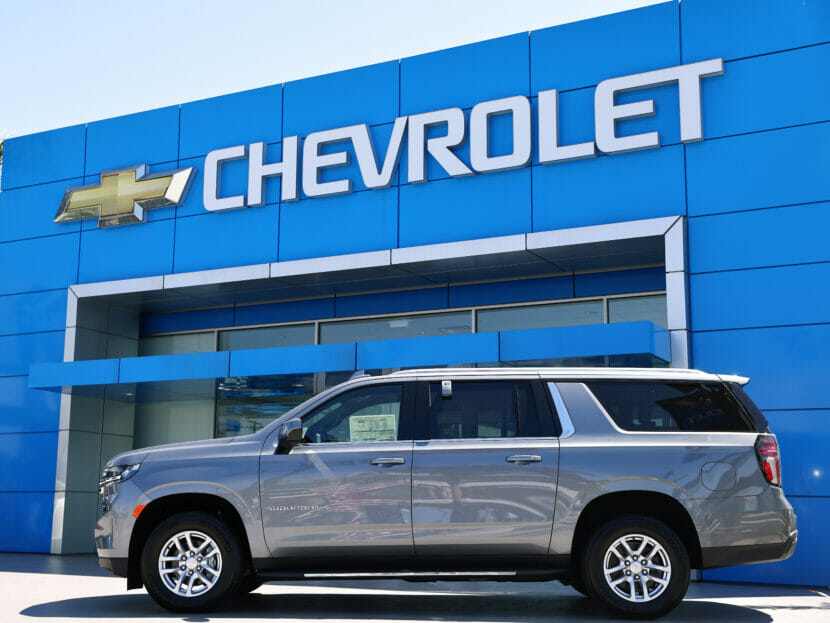
A Chevrolet Suburban is displayed for sale at a dealership in Glendale, Calif., on Aug. 4, 2021. Prices for more expensive cars have risen even higher since the pandemic. (Mario Tama/Getty Images)

Supply chain woes are still reverberating

The semiconductor shortage has gotten much better since 2021, but it hasn’t gone away entirely, and other supply chain snarls continue to periodically disrupt output.

Because of these supply chain problems, the global automotive industry has produced millions fewer vehicles than it would have otherwise.

The supply of new vehicles is starting to improve, but those millions of “missing” vehicles are still gone. Lower supply, higher prices: It’s basic economics.

Which cars are being made? Not the cheap ones

When automakers can’t make as many vehicles as they would like, they prioritize their most profitable cars. Cheap ones get the boot.

Consider what happened at Nissan, which continued to struggle with supply chain challenges throughout 2022. In response, it cut production of one of its cheapest cars, the Nissan Versa, by 78%. Nissan also reduced sales of two other cheap models, the Sentra and the Kicks.

Bigger, slightly more expensive vehicles, like the Altima and the Pathfinder? Nissan boosted production of those.

It wasn’t because of a lack of buyers on the cheap end, says Judy Wheeler, Nissan U.S.’s vice president for sales and regional operations.

“In the last month, we have seen search increase for the Nissan Versa, Sentra and Kicks, indicating a growing interest in this segment among consumers,” she told NPR via email.

She said Nissan intends to build more of those entry-level vehicles when the supply chain permits.

It’s not just Nissan. Across the board, automakers have been focusing on bigger, more luxurious, more expensive vehicles. And the ones they make also tend to be packed with extra features that bump up prices even more.

Fewer cars — and higher prices — are very profitable

The shift in the market has been remarkable, and automakers are in no hurry to reverse course.

Consider just how big the change has been. Cox Automotive crunched the numbers and found that from December 2017 to December 2022, sales of new cars under $25,000 — affordable, by new-car standards — dropped 78% and went from almost 13% of total new-vehicle sales to just under 4%.

Sales of new cars over $60,000, meanwhile, skyrocketed. Those vehicles, costing more than the annual income of the average American, went from 8% of the auto market to 25% of sales.

Because those $60,000 vehicles are significantly more profitable than the $25,000 ones, this shift is very, very lucrative for car companies. And they’re especially focused on fat margins, instead of big volumes, because they’re investing heavily in new electric vehicles (EVs).

“The pricing environment that we’re in right now has been very good, very robust,” General Motors Chief Financial Officer Paul Jacobson told investors on an earnings call last year. “And … running the business for cash flow is critical to help fund our journey in the EV transformation.”

How long can prices stay this high? The Ram TRX, shown at the Chicago Auto Show in February, starts at $86,450. (Scott Olson/Getty Images)

Yesterday’s new cars are today’s used cars …

Three years ago, when production lines started to slow, it affected both the new- and used-car markets immediately. Fewer new cars sent new prices up. That, in turn, pushed many shoppers into the used-car market. And more shoppers in the used market pushed prices up there, too.

But the new-car woes also had a delayed effect on the used-car market — because new cars, obviously, become used cars after some time.

So all those top-of-the line cars that were made in 2021 are now some very nice two-year-old cars, which means even in the used market, the high end of the market is booming.

Meanwhile, because automakers cut production of cheap, no-frill sedans, people looking for cheaper late-model used cars are now out of luck.

“We are firmly in the teeth of an extremely tight used-vehicle market, and that is directly a function of what has happened over the past three years,” says Jonathan Smoke, chief economist at Cox Automotive.

Lonnie Smith, president of the nonprofit On the Road Lending, works to help working families get affordable loans for decent used cars, preferably those still under warranty.

“Typically we’re looking for vehicles that are two to four years old, less than 60,000 miles — a modest type of vehicle,” he says.

Those have gotten so hard to find lately that On the Road got licensed to be an auto dealer so it could buy vehicles at auction — the few cars that fit the bill on dealer lots were getting snapped up immediately.

And the average loan for those cars, which was $13,000 ten years ago, has now risen to $24,000.

Because, well, that’s just the price of a modest used car in America these days.

The Hyundai Ioniq 5 electric vehicle, shown driving inside a convention center at the 2022 New York International Auto Show, starts at around $40,000. Automakers are working to bring down the price of electric vehicles, which currently average $58,385. But in the meantime, they are not producing as many cheap gas-powered cars as they used to. (Timothy A. Clary/AFP via Getty Images)

But there is some hope: EV prices could come down

As the chip shortage eases, automakers say they want to make more vehicles for people who can’t afford top-of-the-line full-size SUVs. But don’t expect a tsunami of $15,000 cars.

“We’re not really expecting to see, you know, this resurgence of inexpensive gasoline-powered vehicles,” says Ed Kim, chief analyst at AutoPacific. “Really where the industry is going is putting in a lot of effort to get more affordable plug-in vehicles out in the marketplace.”

In fact, led by Tesla’s aggressive price cuts, electric vehicle prices are dropping. According to the latest Kelley Blue Book data, they’re down 7.5% year over year, and that’s before federal tax credits (including for used vehicles).

But there are daunting challenges — especially around charging infrastructure — before many car buyers will purchase an EV. And prices have a long way to fall before they’re truly affordable. Investors were recently disappointed when Tesla, which has long promised a cheaper vehicle, did not unveil one.

So cheaper vehicles are on the way. But many of them will be powered by batteries, and they’ll take a long time to get here.

Copyright 2023 NPR. To see more, visit https://www.npr.org.

Maternal deaths in the US spiked in 2021, CDC reports

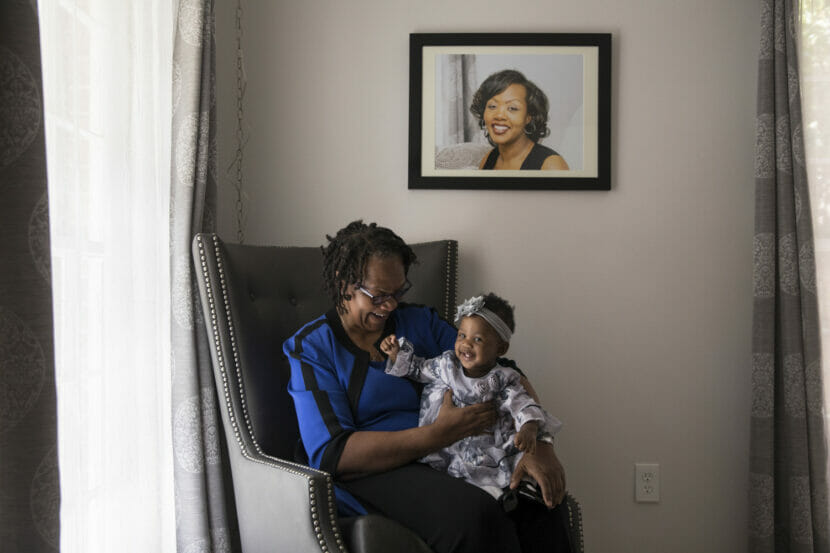
Wanda Irving holds her granddaughter, Soleil, in front of a portrait of Soleil’s mother, Shalon Irving, at her home in Sandy Springs, Ga., in 2017. Wanda is raising Soleil since Shalon died of complications due to hypertension a few weeks after giving birth. (Becky Harlan/NPR)

In 2021, the U.S. had one of the worst rates of maternal mortality in the country’s history, according to a new report from the Centers for Disease Control and Prevention. The report found that 1,205 people died of maternal causes in the U.S. in 2021. That represents a 40% increase from the previous year.

These are deaths that take place during pregnancy or within 42 days following delivery, according to the World Health Organization.

The U.S. rate for 2021 was 32.9 maternal deaths per 100,000 live births, which is more than ten times the estimated rates of some other high income countries, including Australia, Austria, Israel, Japan and Spain, which all hovered between 2 and 3 deaths per 100,000 in 2020.

According to data from the World Health Organization, the maternal mortality rate in high-income nations overall was 12 per 100,000 live births in 2020, while in low-income countries it was 430 per 100,000.

International comparisons of maternal deaths are difficult because of differences in methodology in tracking the data, warns the author of the new U.S. report, Donna Hoyert, a health scientist at the National Center for Health Statistics, at the CDC. But, she notes, the U.S. is “usually not faring all that well” on maternal mortality.

“There is just no reason for a rich country to have poor maternal mortality,” says Eileen Crimmins, professor of gerontology at the University of Southern California. The CDC’s latest compilation of data from state committees that review these deaths found that 84% of pregnancy-related deaths in the U.S. were preventable.

The increase in maternal mortality in 2021 was “seen broadly across different age groups and race and Hispanic-origin groups,” says Hoyert.

She connects the increase in maternal deaths to the COVID-19 pandemic.

“We had some forewarning with the increase between 2019 and 2020 that it looked like maternal mortality rates were increasing during this pandemic period,” she says. “With the overall COVID deaths that occurred in 2021, there was a shift towards younger people, so those would be in the age groups where people would be more likely to be pregnant or recently pregnant.”

She says provisional data suggest the deaths peaked in 2021 and started to go down last year. “So hopefully that’s the apex,” Hoyert says.

Yet some experts worry that other trends around the country could make these figures worse, not better, including abortion restrictions that can delay care for pregnancy complications, and staffing problems at hospitals and closures of rural maternity wards.

The maternal death rate among Black Americans is much higher than other racial groups; in 2021 it was 69.9 per 100,000, which is 2.6 times higher than the rate for White women.

Dr. Veronica Gillispie-Bell, an OB-GYN at Ochsner Health in Louisiana who works with the state’s health department to investigate maternal deaths, says social factors, not biological ones, fuel the racial gap. “We have to address the social factors that either are barriers to accessing care or that make your medical conditions worse coming into the pregnancy,” she says. “This is not just about doctors in the hospital.”

Louisiana is among a group of states working with the Centers for Disease Control and Prevention to improve processes in the health care system to prevent maternal deaths and reduce racial disparities. Gillispie-Bell says she’s optimistic the efforts will pay off, but “it’s not something that happens overnight. It’s going to be a while before we see the benefits of that change.”

Change can’t come soon enough for families whose lives are affected. Wanda Irving’s daughter died from complications of high blood pressure just three weeks after giving birth to a baby girl in 2017. Irving, who has spoken to NPR in the past about her daughter, now runs an organization called Dr. Shalon’s Maternal Action Project to raise awareness of the risks for Black mothers in particular.

Irving’s daughter, Shalon Irving, was an accomplished scientist, working as an epidemiologist at the CDC in Atlanta.

Wanda Irving tears up talking about her daughter’s final weeks. “She had gained 9 pounds in that last week. She was having headaches. One leg was bigger than the other and she said, ‘There’s something dreadfully wrong, can you please check.’ ”

But she kept getting sent home from the hospital even though she was insistent that she needed medical attention. About three weeks after she gave birth, she collapsed at home, and never woke up.

Wanda Irving says her daughter’s death was preventable – she attributes it to racism within the health care system, to doctors ignoring her daughter’s symptoms and health risks.

Irving now lives in her daughter’s house and is raising her granddaughter, who’s now 6 years old, and bright, but struggles with her loss.

“There are days where she totally loses it and she breaks down and she’s in tears,” Irving says, saying her granddaughter will explain why she’s crying by saying, ‘I want my mommy. Can I die to go see my mommy?’ ”

Irving is working to raise awareness of the toll of maternal mortality, she says, because she doesn’t want another little girl or a little boy to grow up without their mother’s love.

“People need to understand the tremendous devastation that is caused by maternal mortality and the loss to society as well as to the families,” she says.

Copyright 2023 NPR. To see more, visit https://www.npr.org.

Transcript :

SACHA PFEIFFER, HOST:

More than 1,200 times in a single year, the miracle of childbirth can go terribly wrong. In each of those cases, the mother died.

STEVE INSKEEP, HOST:

That number does not expose a new problem. Six years ago, NPR’s groundbreaking reporting found that mothers in the richest country on Earth were far more likely to die after childbirth than in other nations. New numbers from the Centers for Disease Control and Prevention show the problem has grown worse.

PFEIFFER: NPR’s Selena Simmons-Duffin is here with more insight on the numbers. Good morning, Selena.

SELENA SIMMONS-DUFFIN, BYLINE: Good morning, Sacha.

PFEIFFER: Tell us more about these CDC findings.

SIMMONS-DUFFIN: Well, this is an annual report from the National Center for Health Statistics, which is part of CDC. It looked at deaths of pregnant women up to 42 days after delivery. And in all, there were 1,205 maternal deaths in 2021. There were increases across all age groups and racial groups, and the overall rate is alarming as well. That’s the number that’s per 100,000 births. The rate of maternal deaths in the U.S. in 2021 was 32.9. That is huge. For comparison, the rate in Australia in 2020 was two deaths per 100,000 births.

PFEIFFER: Do researchers know why there would be such high numbers in the U.S.?

SIMMONS-DUFFIN: I spoke to the author of the study, Donna Hoyert, and she told me that COVID-19 is probably at least partially responsible, and likely that’s both people dying from COVID-19 while pregnant and problems accessing care for other complications because of pandemic disruptions like health care workers shortages.

PFEIFFER: Is anything being done to address this?

SIMMONS-DUFFIN: Well, actually, there have been some new efforts in recent years, although it may take time for those efforts to start bringing the numbers down. I talked to Dr. Veronica Gillispie-Bell. She’s an OB-GYN in Louisiana and investigates maternal deaths for the health department, and she says there are promising signs that awareness is improving. She was invited to speak at the White House and testify in Congress.

VERONIA GILLISPIE-BELL: I do think there’s so much more attention being paid and more people looking for the solutions.

SIMMONS-DUFFIN: And she also made note of the racial disparities in today’s report. The maternal death rate is highest among Black women. It’s nearly three times higher than the rate for white women.

PFEIFFER: You know, Selena, we’re talking about numbers and data here, but it’s worth saying out loud that every time a woman dies during or after childbirth, that means a newborn left behind.

SIMMONS-DUFFIN: Yeah. I mean, it is heartbreaking. I talked about these numbers with Wanda Irving. In 2017, her daughter, who was actually an epidemiologist at CDC in Atlanta, got really sick a few weeks after giving birth.

WANDA IRVING: She had gained nine pounds. She was having headaches. One leg was bigger than the other. And she said, there’s something dreadfully wrong. I don’t understand. Will you please check?

SIMMONS-DUFFIN: She went back to the hospital again and again, but kept getting sent home. And about three weeks after she gave birth, she collapsed at home and died. So Wanda Irving now lives in her daughter’s house and is raising her granddaughter, who’s now 6 years old. And she’s bright but struggles with her loss.

IRVING: And she breaks down, and she’s in tears. And it’s like, what’s wrong? That’s like, I want my mommy, and, you know, can I die to go see my mommy?

SIMMONS-DUFFIN: Irving now runs an organization called Dr. Shalon’s Maternal Action Project. She says she doesn’t want another little girl or little boy to grow up without their mother’s love.

PFEIFFER: That’s NPR’s Selena Simmons-Duffin. Selena, thank you, and thanks for looking at the people behind these numbers.

SIMMONS-DUFFIN: Thank you. Transcript provided by NPR, Copyright NPR.
Federal judge in Texas hears case that could force a major abortion pill off market

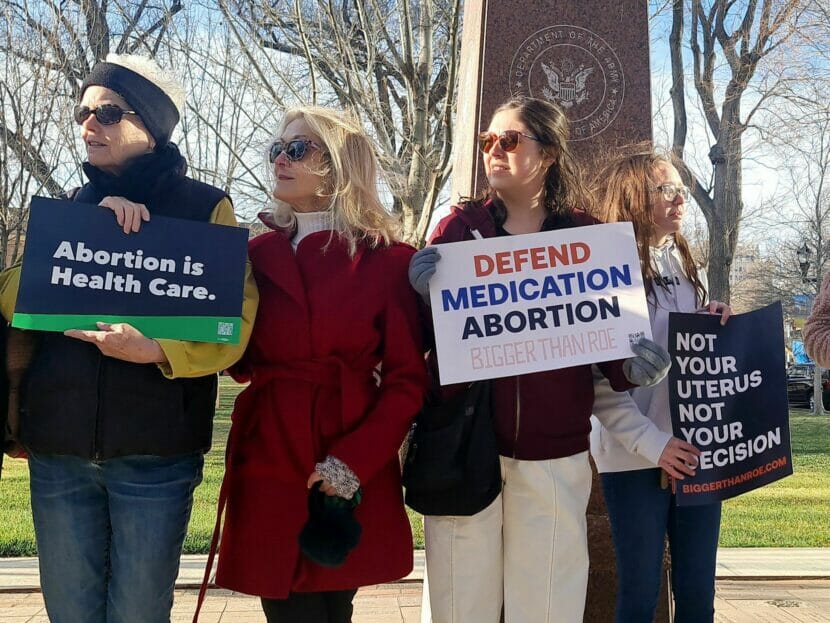
Abortion rights advocates gather in front of the J. Marvin Jones Federal Building and Courthouse in Amarillo, Texas, on Wednesday. U.S. abortion opponents are hoping to get a national ban on a widely used abortion pill through their lawsuit against the FDA. (Moises Avila/AFP via Getty Images)

Was the FDA wrong to approve a drug that’s used in nearly all medication abortions in the U.S. — and should the drug, mifepristone, be taken off the market? Those questions are being argued in court Wednesday, in a case heard by controversial federal judge Matthew Kacsmaryk in Amarillo, Texas.

If the case succeeds, it could have sweeping repercussions — for abortion clinics and patients across the nation, as well as for the FDA’s drug-approval process. At least 25 states have filed amicus briefs in the case.

Here’s a guide to what’s at stake in the lawsuit:

What will happen Wednesday?

Each side will have two hours to present their arguments. The judge could rule at any time after hearing the two sides.

The anti-abortion groups say the FDA used a flawed process to approve the medicine; they also say it should not have increased the term in which the drug is approved for use: In 2016, the agency changed its guidance allowing use in the first 10 weeks of pregnancy, up from seven weeks.

The FDA says it approved the drug more than 20 years ago after “a thorough and comprehensive review of the scientific evidence presented and determined that it was safe and effective for its indicated use.”

What could the judge do?

Kacsmaryk has a few options, from leaving the drug on the market to restoring rules around mifepristone that the Biden administration recently eased. Those changes include allowing mifepristone to be mailed or dispensed by retail pharmacies.

The judge could order a halt to either or both of those practices. Or he could order the FDA to take the drug off the market altogether.

Whatever he decides, the ruling will likely be appealed, and it’s very possible the case will end up before the Supreme Court.

Abortion opponents sued the FDA in November

The case is titled Alliance for Hippocratic Medicine v. U.S. Food and Drug Administration. A number of abortion opponents are part of the lawsuit, which is led by attorneys from the conservative group Alliance Defending Freedom.

They claim the drug was improperly approved, and that the rules around it have grown too lax. They’re asking a federal judge in Amarillo, where this case was filed, to overturn the FDA approval.

The defendants are represented by attorneys from the Justice Department, along with Danco Laboratories, a mifepristone manufacturer.

What is mifepristone?

It’s an abortion pill that the FDA first approved more than 20 years ago as part of a two-drug protocol that’s used to end pregnancies in the first trimester. Major medical groups like the American Medical Association have concluded that it’s safe and effective.

Political debate over the drug intensified after the Supreme Court’s ruling in Dobbs v. Jackson Women’s Health Organization that reversed decades of precedent guaranteeing abortion rights.

Two other dynamics are also in play: In recent years, medication abortion has become the dominant form of abortion U.S. providers perform. And in states with abortion restrictions or in remote areas, it’s often easier for people to access the medication, rather than a surgical, method of abortion.

Who is the judge?

Kacsmaryk was appointed by former President Trump in 2019. He has longstanding ties to conservative religious groups, and his critics accused the group behind this lawsuit of judge shopping — filing their case in a venue they view as friendly to far-right views.

“It’s no accident that the complaint was filed in Amarillo,” Elizabeth Sepper, a University of Texas at Austin law professor, previously told NPR, adding that the plaintiffs “know they have a very sympathetic ear” in Kacsmaryk.

Because of the way the federal courts work here, Sepper said, it was a virtual certainty that Kacsmaryk would be assigned to the case.

The judge made news in December when he ruled in favor of a man who filed suit trying to stop federal family planning clinics in Texas from dispensing contraception to minors without their parent’s permission. He said he was a Christian, and the possibility that a clinic would give birth control to his teenage daughters violated his religious beliefs. Kacsmaryk agreed.

Public access to the hearing is limited

Wednesday’s proceeding will be livestreamed — but on audio, not video, and only to another federal courtroom, in Dallas. Under threat of sanctions, it’s forbidden to record or rebroadcast the hearing, a court filing notes.

Even before Wednesday’s hearing, there were clashes over public and press access.

A coalition of media groups filed an objection on Monday after The Washington Post reported that Kacsmaryk sought to delay public notice of the hearing date from appearing in the court docket until late Tuesday, in an apparent bid to limit the size of protests and press at the courthouse. The judge also reportedly told lawyers in the case not to share details about the hearing.

Such a delay violates the First Amendment, the media outlets said in their court filing, adding that it harms people across the ideological spectrum who are interested in the case.

“The Court cannot constitutionally close the courtroom indirectly when it cannot constitutionally close the courtroom directly,” the objection states.

Shortly after that filing, Kacsmaryk ordered notice of the hearing to be posted to the court’s public docket.

Copyright 2023 NPR. To see more, visit https://www.npr.org.

It’s Equal Pay Day. The gender pay gap has hardly budged in 20 years. What gives?

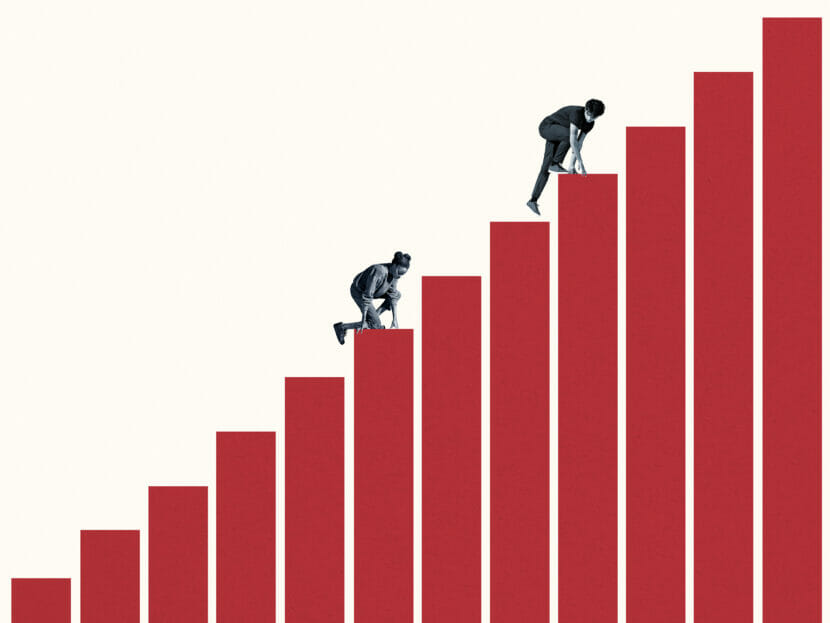
Women earn about 82 cents for every dollar men make, according to the U.S. Government Accountability Office. That means on March 14, women’s pay catches up to what men made in 2022. (Klaus Vedfelt/Getty Images)

Tuesday is Equal Pay Day: March 14th represents how far into the year women have had to work to catch up to what their male colleagues earned the previous year.

In other words, women have to work nearly 15 months to earn what men make in 12 months.

82 cents on the dollar, and less for women of color

This is usually referred to as the gender pay gap. Here are the numbers:

– Women earn about 82 cents for every dollar a man earns
– For Black women, it’s about 65 cents
– For Latina women, it’s about 60 cents

Those gaps widen when comparing what women of color earn to the salaries of White men. These numbers have basically not budged in 20 years. That’s particularly strange because so many other things have changed:

– More women now graduate from college than men
– More women graduate from law school than men
– Medical school graduates are roughly half women

That should be seen as progress. So why hasn’t the pay gap improved too?

Francine Blau, an economist at Cornell who has been studying the gender pay gap for decades, calls this the $64,000 question. “Although if you adjust for inflation, it’s probably in the millions by now,” she jokes.

The childcare conundrum

Blau says one of the biggest factors here is childcare. Many women shy away from really demanding positions or work only part time because they need time and flexibility to care for their kids.

“Women will choose jobs or switch to occupations or companies that are more family friendly,” she explains. “But a lot of times those jobs will pay less.”

Other women leave the workforce entirely. For every woman at a senior management level who gets promoted, two women leave their jobs, most citing childcare as a major reason.

The “unexplained pay gap”

Even if you account for things like women taking more flexible jobs, working fewer hours, taking time off for childcare, etc., paychecks between the sexes still aren’t square. Blau and her research partner Lawrence Kahn controlled for “everything we could find reliable data on” and found that women still earn about 8% less than their male colleagues for the same job.

“It’s what we call the ‘unexplained pay gap,'” says Blau, then laughs. “Or, you could just call it discrimination.”

Mend the gap?

One way women could narrow the unexplained pay gap is, of course, to negotiate for higher salaries. But Blau points out that women are likely to experience backlash when they ask for more money. And it can be hard to know how much their male colleagues make and, therefore, what to ask for.

That is changing: a handful of states now require salary ranges be included in job postings.

Blau says that information can be a game changer at work for women and other marginalized groups: “They can get a real sense of, ‘Oh, this is the bottom of the range and this is the top of the range. What’s reasonable to ask for?'”

A pay raise, if the data is any indication.

Copyright 2023 NPR. To see more, visit https://www.npr.org.

Transcript :

LEILA FADEL, HOST:

Today is Equal Pay Day. The date, March 14, is the day of the year when women’s pay finally catches up to what men made last year. In other words, women have to work an extra 10 weeks to be compensated equally. NPR’s Stacey Vanek Smith looks at why the pay gap persists.

STACEY VANEK SMITH, BYLINE: For a lot of people, there is a moment when they realize just how unfair pay can be. For Bridget Frey, that moment happened at her first job at a tech company. One of her fellow workers had gotten their hands on a list of everyone’s salaries and posted it online.

BRIDGET FREY: A site that was called F***ed Company.

VANEK SMITH: (Laughter).

FREY: I don’t know if I can say the actual name.

VANEK SMITH: Frey says what struck her more than anything was that what people got paid did not seem to have anything to do with their skills, their title or how hard they worked.

Did it seem random?

FREY: Yes.

VANEK SMITH: There was no obvious logic, just this big gray area.

FREY: There was a lot of gray. And then, gee, it seems like certain groups of people are more impacted by that ambiguity, by that gray space.

VANEK SMITH: Groups like women – the gender pay gap. So women earn about 82 cents for every dollar a man earns. For Black women, it’s about 65 cents. For Latina women, it’s about 60 cents. That pay gap has basically not budged in 20 years, but a lot of other things have. More women now graduate from college than men. More women graduate from law school. Roughly half of medical school graduates are women. So how has the pay gap not changed?

FRANCINE BLAU: Well, you know, that’s the – in my day, it was the $64,000 question.

VANEK SMITH: Francine Blau is an economist at Cornell. She has spent years studying the gender pay gap. She says one of the biggest factors is child care. Women will shy away from really demanding positions or will work just part-time in order to be able to care for their kids.

BLAU: Switching occupations or firms to those that are more family friendly but perhaps pay lower wages.

VANEK SMITH: And many will leave the workforce entirely. For every woman at a senior management level who gets promoted, two women leave, the majority citing child care. But even accounting for all of this and just about everything else, Blau found women still earn less, about 8% less for the same job.

BLAU: What we call an unexplained pay gap.

VANEK SMITH: One remedy here is negotiation. But Blau says women are very likely to experience backlash when they ask for more. And also, it can be hard to know how much to ask for. Part of that is changing. A handful of states now require salary ranges be included in job postings so people can more easily get information that in the past relied on moments like a renegade worker creating a tell-all website. Bridget Frey says she has carried that moment forward in her career.

FREY: Something that stayed with me when I eventually became a manager, just sort of this visceral understanding of how unfair these things can be and not wanting that to happen on my watch.

VANEK SMITH: Frey is now the chief technology officer at online real estate brokerage Redfin, and pushed the company to have transparent salary ranges for every position. She says the less gray area there is, the closer to equal pay can become.

Stacey Vanek Smith, NPR News. Transcript provided by NPR, Copyright NPR.

What to know about the Silicon Valley Bank collapse, takeover and fallout

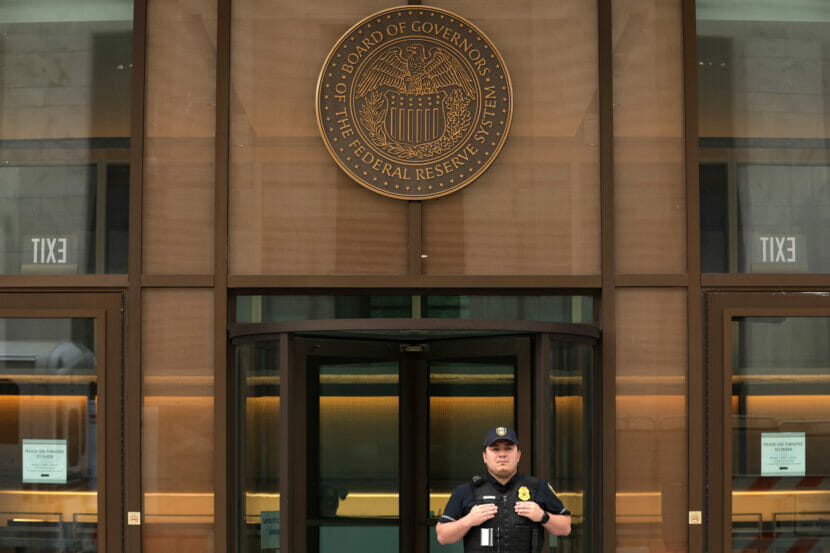
The Federal Reserve has made funds available to other banks in an effort to prevent any other collapses in the financial industry. (Alex Wong/Getty Images)

Silicon Valley Bank, which catered to many of the world’s most powerful tech investors, collapsed on Friday and was taken over by federal regulators, becoming the largest U.S. bank to fail since the 2008 global financial crisis.

Then, on Sunday, regulators grew concerned about the financial health of New York’s Signature Bank, largely because of its big exposure to the volatile crypto market.

Now, both banks are both under the control of the Federal Deposit Insurance Corporation, or the FDIC.

Regulators announced the takeovers after what was effectively a run on Silicon Valley Bank late last week when depositors rushed to withdraw tens of billions of dollars worth of deposits.

The collapse has sent shockwaves across the financial industry. Shares of small, regional lenders have been hammered; the bond market has swung wildly; and now, the pressure is on the Federal Reserve to dial back its interest rate increases even as inflation persists.

It’s a lot to keep track of. Here’s what to know.

What was Silicon Valley Bank?

Although it wasn’t a megabank like Goldman Sachs or JPMorgan Chase, Silicon Valley Bank had punched above its weight during its 40-year history.

Based in Santa Clara, Calif., SVB’s clients included venture capital firms, startups and wealthy tech workers. It had become a major player in the tech sector, in which it successfully competed with bigger-name banks.

“They really developed a niche that was the envy of the banking space,” said Jared Shaw, a senior analyst at Wells Fargo. “They are able to provide all the products and services any of these sophisticated technology companies, as well as these sophisticated venture capital and private equity funds, would need.”

Among its clients were tech and tech-adjacent companies like Roku, Roblox and Vox Media. (It turns out that this concentration in the tech sector was key to its demise.) But it remained little known outside of tech circles — until this past week.

Why did Silicon Valley Bank collapse?

Silicon Valley Bank’s business had boomed during the pandemic as tech companies flourished. The bank’s customers filled its coffers with deposits totaling well over $100 billion.

In 2021, when interest rates were at record lows, the cash-rich SVB invested billions of dollars into long-term U.S. Treasury bonds. Those bonds, which are backed by the U.S. government, are generally considered to be safe, modest investments. But they pay out in full only when they’re held to maturity; otherwise, long-term bonds risk losing value if interest rates rise.

Which is, of course, exactly what happened in 2022, when the Federal Reserve began to aggressively raise interest rates in an effort to rein in rampant inflation. Those rate increases hurt the value of government bonds, including those held by SVB.

“The problem was they weren’t worth 100 cents on the dollar, because they were long-term interest rates. Interest rates went up. They had to sell them at a discount,” said Douglas Diamond, a professor of finance at the University of Chicago, in an interview with NPR. “And it could have been avoided if the supervisors had said, ‘Look, we realize interest rates might be going up.’ ”

This wasn’t a problem so long as SVB had no need for the cash. But the tech sector as a whole also took a downward turn in recent months, and companies increasingly began to withdraw their deposits from the bank.

In order to make good on those withdrawals, SVB had to sell part of its bond holdings at a steep loss of $1.8 billion, the bank said last week. That announcement spooked the bank’s clients, who got worried about SVB’s viability, and then proceeded to withdraw even more money from the bank — a textbook definition of a bank run.

On Thursday alone, clients raced to collectively withdraw an attempted $42 billion in deposits, and SVB’s share value dropped by more than 60%. By midday Friday, SVB had been taken over by the FDIC.

Traders on the floor of the New York Stock Exchange on Monday. Bank stocks, especially for regional banks, slumped after the takeover of SVB and Signature Bank. (Michael M. Santiago/Getty Images)

What does this mean for other banks?

Other banks are not so precariously positioned as SVB was with its bond investments and exposure to the tech industry. Still, the bank run sparked concerns about the banking sector as a whole. Since last week, shares of all kinds of lenders, including the big banks, have sagged.

Other banks seen as potentially sharing some of the same risks as SVB saw their stock values plunge Monday, including First Republic Bank down more than 60% and Western Alliance Bancorp down nearly 50%. Investors feared that other lenders, especially smaller and regional ones, would suffer a similar surge in withdrawals and would struggle to meet the redemptions.

Even traditional banks have taken a hit: JPMorgan is down more than 7% since last week, while Wells Fargo and Bank of America were both down more than 15%.

Earlier last week, Silvergate, a California-based bank that caters to the cryptocurrency industry, announced plans to unwind its operations.

And on Sunday, regulators took over Signature Bank, a New York-based institution that expanded into the crypto industry in 2018 and saw $10 billion in withdrawals on Friday after SVB’s troubles began. Crypto has been hit hard since last year.

Long-term, analysts say the broader banking sector is still likely to be healthy.

Bank analysts at Morgan Stanley said in a note late last week that SVB’s troubles “are highly idiosyncratic and should not be viewed as a read-across to other regional banks.”

“We want to be very clear here,” they wrote. “We do not believe there is a liquidity crunch facing the banking industry.”

Wells Fargo analyst Shaw also said other banks were hit by panic selling. “It’s really just a fear that has gripped the market, and is sort of self-perpetuating at this point,” he said.

What happens next for people who had ties to SVB and Signature Bank?

Federal officials say that all customers of SVB will have full access to their deposits — even accounts that held more than $250,000, the limit of FDIC insurance. Accounts holding greater than that amount made up the vast majority of accounts at SVB. The move essentially guarantees the $175 billion that was in customer deposits at SVB.

Deposits at Signature Bank will also be backstopped, they said. Operations at both banks resumed Monday, allowing account holders access to their funds.

That means that companies who relied on cash deposits at SVB for their day-to-day operations — to make payroll, for instance — should be able to carry on as normal.

Shareholders and some debtholders will not be protected, the FDIC says. Senior management has been removed from their jobs.

What happens next for everybody else?

Federal officials are taking measures to prevent a “contagion” from spreading to other banks. “The banking system is safe,” President Biden said in remarks Monday morning. “Your deposits will be there when you need them.”

The Federal Reserve Board has made funding available to other institutions to help shore up their cash reserves, a move that should help to stave off a catastrophic run at another bank.

Still, markets reacted strongly on Monday. The U.S. stock market was up and down over the course of the day. Government bonds rallied, sending their yields lower as investors sought safe investments.

The impact was felt most in the 2-year Treasury yield, which generally reflects investors’ expectations of where interest rates are headed. That yield has dropped an entire point, from just over 5% to just under 4%, since the middle of last week.

All of this is happening just ahead of a Federal Reserve meeting next week, at which the Fed will announce whether it will raise its benchmark interest rate yet again.

The Fed’s rapid interest rate increases over the past year have helped to slow inflation. But the increases have also devalued bond holdings, like the kind SVB invested in by the billions and helped cause its collapse last week.

Before the SVB collapse last week, markets had expected the Fed to raise interest rates by half a percentage point at its March meeting. Now, with the Fed under some pressure to ease the increases, those expectations have retreated.

“Clearly, we don’t know the results of all of the recent, very rapid increases other than what we’ve started to see in the banking sector. And I think it really behooves the Fed to step back and just see the results of their handiwork before possibly making things worse,” said Barry Ritholtz, chairman of Ritholtz Wealth Management, in an interview with NPR.

Copyright 2023 NPR. To see more, visit https://www.npr.org.

Site notifications
Update notification options
Subscribe to notifications