National News

Businesses face more and more pressure from investors to act on climate change

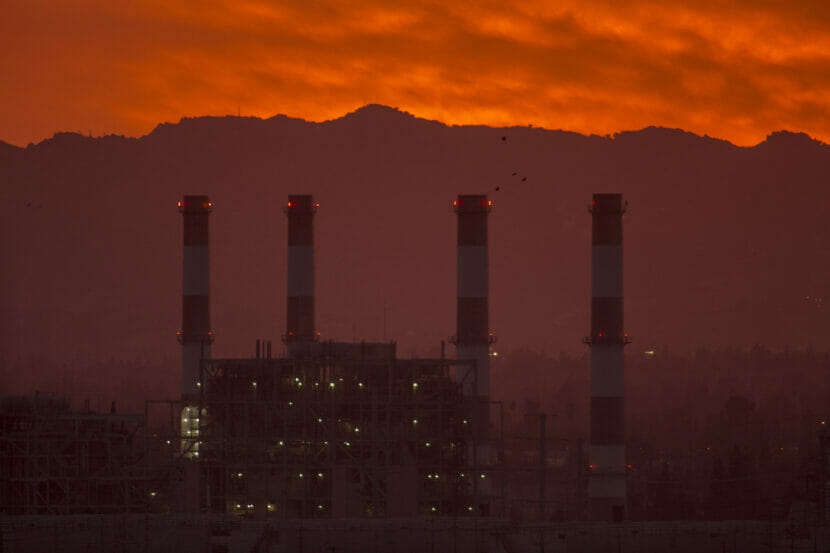
To avoid some of the worst impacts of climate change, greenhouse gas emissions need to be eliminated or offset by midcentury, according to the United Nations. To get there, activist investors say banks and insurance companies need to account for the emissions they contribute to by underwriting and investing in fossil fuel infrastructure like this natural gas plant in California. (David McNew/Getty Images)

Every spring, shareholders in publicly traded companies get to weigh in on how they’re run. It’s a chance for investors to vote on proposals to shape corporate policies for things like executive pay and political spending. But as the Earth heats up, annual shareholder meetings have become a battleground for activist investors who are pressing companies for more aggressive action on climate change.

This year, shareholders filed around 540 proposals as of mid-February asking companies to address environmental, social and corporate governance issues, according to Proxy Preview. Resolutions focused on climate change accounted for about a quarter of this year’s total, with the number increasing by about 12% from the same point in 2022.

Investors want to know how companies are contributing to rising temperatures, and what they’re doing about the problem. They’re calling for executives and corporate boards to set targets for cutting greenhouse gas emissions, and then to report on their progress. And they want to know how businesses plan to keep making money as industries are reshaped by the push to cut emissions.

The message to companies is, “set targets, issue plans, give us clear disclosure,” says Kirsten Snow Spalding, who leads investor initiatives at Ceres, a nonprofit focused on sustainability. “And all of it is about, how are you addressing the risks and moving towards the opportunities?”

Are shareholder proposals working?

Most resolutions are non-binding, but just introducing them has proven to be an effective tool for activist investors. Last year, shareholders withdrew a record 110 proposals that were focused on climate change after they struck deals with companies, according to Ceres. Another 15 climate resolutions that went to a vote at various corporations won majority support from shareholders.

“The trend toward climate action is really on the rise,” Spalding says.

But the pace of corporate change is slower than activists would like — and what climate science shows is needed. Scientists working for the United Nations say the planet is on track for catastrophic warming that will cause more extreme weather. Heat waves, droughts and floods that are fueled by climate change are already inflicting severe economic damage and killing and displacing people around the world.

Some of the worst impacts could be avoided by quickly cutting emissions. Right now, though, emissions aren’t falling. Activists say a lot of companies aren’t doing enough to address the threat, despite pressure from investors.

People wade past stranded trucks on a flooded street in Bangladesh. Experts say climate change is increasing the frequency, ferocity and unpredictability of floods. (MAMUN HOSSAIN/AFP via Getty Images)

Activist shareholders focus on emissions that are hard to measure

Chubb Ltd., a big insurance company, is one of the businesses that activist investors are targeting this year.

Chubb is already cutting its own greenhouse gas emissions. But, like other insurers, the company doesn’t directly produce a lot of emissions. However, some of its clients do. So, Chubb says it’s limited its underwriting and investing in coal and oil sands. And the company said in March that it will require clients in the oil and gas industry to cut emissions of methane, a potent greenhouse gas.

But the company’s recent methane initiative was met with a shrug from a leading shareholder advocacy group called As You Sow. It noted that a lot of oil and gas companies already have their own plans to reduce methane emissions.

“I don’t ever like to say this, but it feels a little bit like window dressing — that they are attempting to convince investors that they’re taking action,” says Danielle Fugere, president of As You Sow. “But because they aren’t measuring, they aren’t disclosing, we don’t have a way to measure the effectiveness of those actions.”

As You Sow filed a shareholder proposal last year asking Chubb to publish a report on whether and how it plans to measure and cut greenhouse gas emissions connected to its underwriting, insurance and investing activities. The group wants Chubb to make commitments that align with the Paris Agreement’s goal of limiting global warming to 1.5 degrees Celsius by the end of the century. To do that, all greenhouse gas emissions need to be eliminated or offset by 2050.

A majority of Chubb’s shareholders backed the proposal. But the company said it didn’t know how to “reasonably measure” emissions from the entities it insures. As You Sow and other activists filed a similar proposal this year that’s set for a vote at Chubb’s annual meeting in May.

“Insurers’ activities can contribute to systemic climate risk to the global economy, investor portfolios, and insurers’ profitability,” the activist investors say in the proposal.
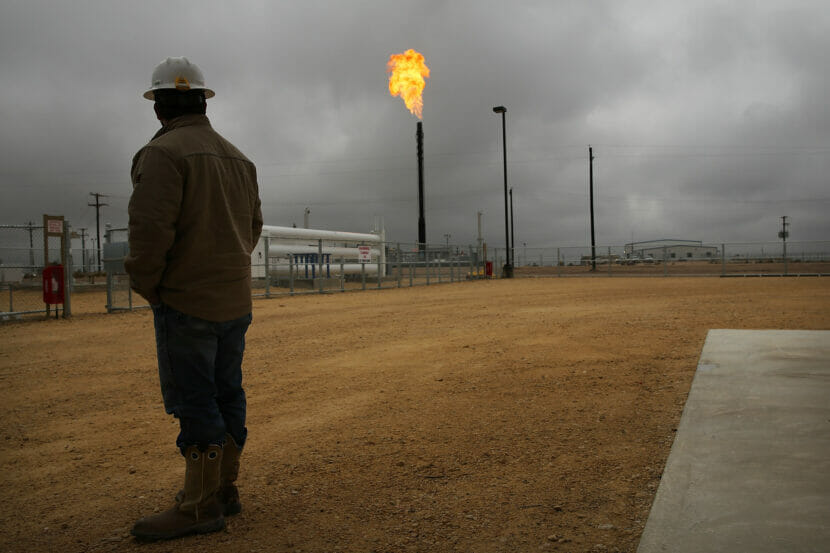
Flared natural gas is burned off in Texas. Chubb recently said it’ll require oil and gas clients to reduce emissions of methane, a greenhouse gas and the main component of natural gas. However, shareholder activists say many oil and gas companies already have plans to cut methane emissions, and that it’s unclear what impact Chubb’s policy will have. (Spencer Platt/Getty Images)

How one company is responding to a shareholder resolution

Chubb is urging investors to vote against the resolution. The company didn’t make anyone available to NPR for an interview. It said in a recent filing to the Securities and Exchange Commission (SEC) that there’s still not a “well-established and widely accepted” way to measure emissions from all its customers.

Methods for measuring these so-called Scope 3 emissions aren’t perfect, but more than 3,300 companies reported theirs anyway in 2021.

“Chubb shares the proponent’s goal of achieving a net zero economy by 2050,” the company said in a recent filing to the SEC, referring to As You Sow. “We disagree that forcing Chubb to set targets related to the emissions produced by its insureds, rather than Chubb’s own emissions, would advance that goal.”

Chubb is planning more investments in “alternative energy and clean tech,” the company said in a climate report last year, and it says its underwriting practices are encouraging companies to move away from using the dirtiest fossil fuels.

It’s unclear if most Chubb shareholders will vote again this year for the company to make a plan to cut emissions from its various business activities.

Mainstream investors want climate proposals tailored to individual companies

While the number of shareholder resolutions focused on climate change has been increasing, support, on average, fell last year for those that went to a vote at annual meetings. Ceres says average support dropped to about 32% from 42% in 2021 amid a global energy crisis and rising inflation.

Paul Washington, who leads The Conference Board ESG Center, a sustainability think tank, says the decline was also driven by concerns that proposals were too prescriptive and might interfere with how companies are run. Investors were also less willing to consider shareholder resolutions when companies had their own climate strategies. He says those same factors are at play this year.

“I think there’s still a strong interest [in] climate from mainstream investors,” says Washington. “But they are taking a more case-by-case approach to what climate strategy makes sense for a particular industry and a particular company.”

Copyright 2023 NPR. To see more, visit https://www.npr.org.

Judges’ dueling decisions put access to a key abortion drug in jeopardy nationwide

Mifepristone is part of a two-drug protocol that a recent study showed was used in 98% of medication abortions in 2020. (Allen G. Breed/AP)

Federal judges in two states issued contradictory decisions Friday evening that could drastically impact access to a drug used in nearly all medication abortions in the U.S.

In Texas, U.S. District Judge Matthew Kacsmaryk ruled that the Food and Drug Administration improperly approved the abortion pill mifepristone more than 20 years ago. A coalition of anti-abortion rights groups called the Alliance for Hippocratic Medicine sued the FDA last year. The judge ordered to FDA to stay its approval and gave the government seven days to seek relief from an appeals court.

Within hours of that decision, U.S. District Judge Thomas O. Rice issued a ruling in a separate case in Washington state. That lawsuit filed by a coalition of Democratic attorneys general in 17 states and the District of Columbia sought to block the FDA from pulling the drug from the market.

Rice’s decision blocks the FDA from “altering the status quo and rights as it relates to the availability of Mifepristone.”

Washington state Attorney General Bob Ferguson told NPR on Friday that he believes the judge’s ruling could make it possible for patients in those states to continue using mifepristone for abortion in the short term — even after the Texas decision takes effect in seven days.

It’s not clear how each judge’s decision will impact the other, and both cases are likely to end up before the U.S. Supreme Court.

Hours after the Texas ruling, the Justice Department appealed to the U.S. Court of Appeals for the Fifth Circuit, which has a reputation for being a conservative jurisdiction. The Justice Department says it is also reviewing the decision in Washington state.

President Biden said the ruling in Texas could have widespread consequences. “If this ruling were to stand, then there will be virtually no prescription, approved by the FDA, that would be safe from these kinds of political, ideological attacks,” the president said in a statement.

“It is the next big step toward the national ban on abortion that Republican elected officials have vowed to make law in America,” Biden added.

Anti-abortion rights groups hailed the Texas decision. “By illegally approving dangerous chemical abortion drugs, the FDA put women and girls in harm’s way, and it’s high time the agency is held accountable for its reckless actions,” Erik Baptist, senior counsel with Alliance Defending Freedom, said in a statement.

Mifepristone was approved by the FDA in 2000 for use in combination with a second drug, misoprostol. More than half of all abortions in the United States are done using medication, as opposed to a surgical procedure, and the two-drug combination was used for 98% of them in 2020, according to the Guttmacher Institute.

In its lawsuit, the coalition of abortion rights opponents said the protocol was improperly approved by the FDA. The group had asked Kacsmaryk, who was appointed by President Trump and has longstanding ties to conservative religious groups, to overturn the approval.

The decision in that lawsuit comes three weeks after Kacsmaryk held a hearing in Amarillo in a courtroom that had room for only a few dozen members of the public and the press. No recording or public livestreaming was permitted.

Nationwide implications

Abortion providers nationwide say they’ve been preparing to rely on another medication abortion regimen using misoprostol alone. Misoprostol is prescribed primarily for ulcers, and is already widely used off-label for other gynecological purposes in the United States.

Research suggests the single-drug regimen is somewhat less effective and often causes additional side effects. But the World Health Organization says the method, which has been used internationally for decades, can be safe and effective at the appropriate dosage.

The decision likely will mean uncertainty and confusion for doctors and patients, says Farah Diaz-Tello, senior counsel with the reproductive rights legal advocacy group If/When/How.

“People who are seeking an abortion with pills … are going to find it much more difficult to do so, especially in the time period as providers figure out what they’re going to be able to do,” she says. “So I think we’re going to see an immediate exacerbation of the crisis of access that already started in June of 2022” with the U.S. Supreme Court decision last year in Dobbs v. Jackson Women’s Health Organization, which overturned decades of abortion-rights precedent.

Diaz-Tello predicts more people will look to induce their own abortions without medical supervision, using medications obtained online or in other countries. She also worries about the risk of increased scrutiny of patients seeking medical care for emergency complications from either self-managed abortions or miscarriages.

She says there are no state laws to her knowledge that require healthcare providers to turn in patients suspected of inducing an abortion, but she worries the ruling will fuel confusion and misinformation.

“I am worried that … that is going to translate into a misunderstanding that is going to lead to the criminalization of people who end their pregnancies,” Diaz-Tello says.

Dueling decisions

The implications of the Texas ruling is complicated by the outcome of the Washington state lawsuit.

Amanda Allen, senior counsel and director for the The Lawyering Project, which supports abortion rights, says the two courts “could come out with two very conflicting orders, and they could impose very different obligations on the FDA that would be very untenable for the FDA to try to reconcile.”

Allen says the FDA could decide to issue guidance for prescribers about how to interpret the rulings. But she says such a conflict between the federal courts might well end up before the U.S. Supreme Court.

Copyright 2023 NPR. To see more, visit https://www.npr.org.

California salmon fishing slated to shut down this year due to low stock

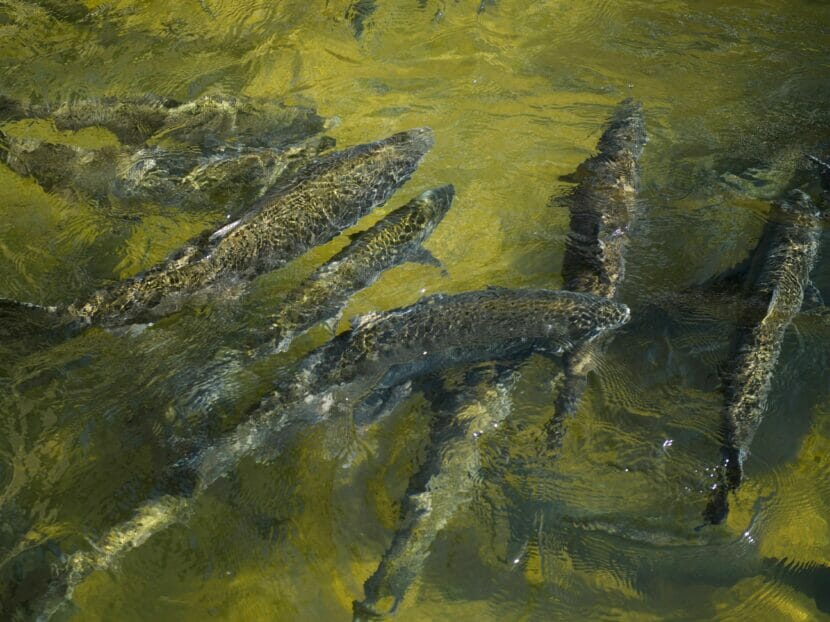
Chinook Salmon swim up a fish ladder at the California Department of Fish and Wildlife Feather River Hatchery just below the Lake Oroville dam during the California drought emergency in 2021. (Patrick T. Fallon/AFP via Getty Images)

Chinook salmon fishing off the California coast will be called off until next spring in anticipation that a near-record-low number of fish will return to the state’s rivers to spawn.

The recommendation was made by the Pacific Fishery Management Council, a federal commission that oversees West Coast fisheries. It will need to be approved by the National Marine Fisheries Service by May 16.

The measure, unseen in 14 years, would temporarily ban both commercial and recreational salmon fishing in the state. Much of the fishing off the coast of neighboring Oregon would also be canceled until 2024.

Chinook salmon are the “largest and most highly prized” of all the salmon in the Pacific ocean, according to the council. But over the years, the species has become increasingly endangered as a result of drought, heat waves and agriculture.

The decision to cancel the salmon fishing season is expected to take a toll on the $1.4 billion fishing industry, which supports 23,000 jobs in the state.

“The economic impact of closing a good portion of the west coast ocean salmon fishery will negatively impact the people that participate in the fishery, and the small businesses in coastal communities that rely on the salmon fishery,” Merrick Burden, the council’s executive director, said in a statement.

2009 was the last time salmon fishing was halted in the region

Salmon depend on clean and cold water, particularly in rivers and streams where they migrate and spawn. But there is less of it as a result of California’s extreme drought. Farming and grazing, which tend to contaminate waterways with sediments and chemicals, have also taken a toll on fish.

Federal researchers predict that fewer than 170,000 adult fall chinook salmon will return to the Sacramento River this year — which is one of the lowest forecasts recorded since 2008. Similarly, fewer than 104,000 are expected to reach the Klamath River — which is the second lowest estimate since such research began in 1997.

The last time that the region shut down its salmon fishing season to help the population recover was in 2009. At the time, about 122,200 adult fall chinook salmon were forecast to return to the Sacramento River.

The Klamath River fall-run chinook salmon were declared overfished in 2018. According to federal researchers, the Sacramento River fall chinook salmon are also approaching an overfished condition.

“This is a decades-long trend, and the past few years of record drought only further stressed our salmon populations,” Charlton H. Bonham, the director of the California Department of Fish and Wildlife, said in a press release about the findings.

At large, about 23 out of the 31 genetically distinct kinds of salmon and trout in California are at risk of going extinct sometime in the next century, according to a 2017 report published by the University of California, Davis, and the conservation group California Trout.

The recent wetter weather in California has been “good news,” fishery scientists described earlier this week. Federal and state agencies are also working on the largest river restoration and dam removal project in the country’s history at the Klamath Basin in California to help recover the salmon population.

Amy Souers Kober, a spokesperson for American Rivers, which monitors dam removals and advocates for river restoration, estimates that more than 300 miles of salmon habitat in the California river and its tributaries would benefit.

Copyright 2023 NPR. To see more, visit https://www.npr.org.

Check out the deepest-swimming fish ever caught on camera

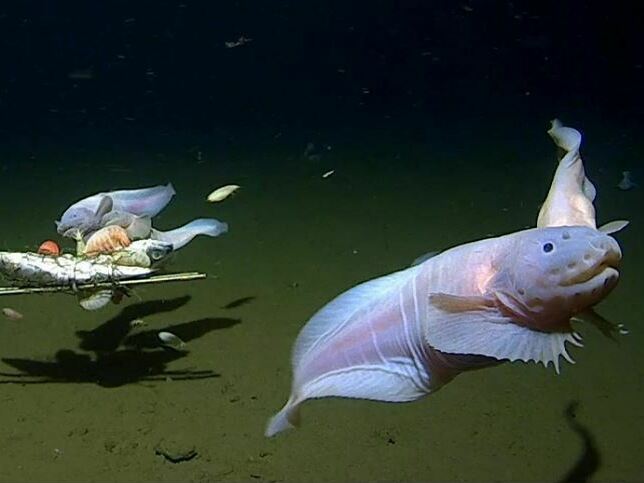
An image shows snailfish swimming around a baited camera more than 27,000 feet below the surface in the Izu-Ogasawara Trench off the coast of Japan.
(University of Western Australia)

Those who’ve wondered what lurks in the dark depths of the ocean have a new answer.

Scientists working off the coast of Japan say they’ve managed to capture images of the deepestswimming fish ever caught on camera.

The unknown snailfish species, of the genus Pseudoliparis, was recorded swimming in the Izu-Ogasawara Trench at a depth of 8,336 meters — or more than 27,000 feet down.

“We have spent over 15 years researching these deep snailfish; there is so much more to them than simply the depth, but the maximum depth they can survive is truly astonishing,” University of Western Australia professor Alan Jamieson said in a press release.

The fish was recorded during an August 2022 mission to several trenches around Japan, which included teams from the Minderoo-UWA Deep Sea Research Centre and Tokyo University of Marine Science and Technology. The trip was part of a decade-long study of the world’s deepest fish populations.

Researchers released video footage from baited cameras that show several of the whitish-blue deep-sea fish swimming by. The particular fish that holds the record for the deepest ever found was a small juvenile.

On the same trip, researchers collected two snailfish from traps in the Japan Trench at a depth of 8,022 meters, which they believe to be the only fish caught deeper than eight kilometers.

“The Japanese trenches were incredible places to explore; they are so rich in life, even all the way at the bottom,” Jamieson added.

According to Guinness World Records, the previous record for the deepest fish was a Mariana snailfish (P. swirei) observed at 26,831 feet in the Mariana Trench in the western Pacific on May 18, 2017.

Copyright 2023 NPR. To see more, visit https://www.npr.org.

6 things to know about heat pumps, a climate solution in a box

James Tucker got an efficient heat pump for his home near Oakland, Calif., last year. Now homeowners can get new credits for heat pumps from federal climate legislation. (Julia Simon/NPR)

Sales of super-efficient electric heat pumps are rising, now overtaking sales of gas furnaces in the U.S. But what are heat pumps? And why do some call them a key climate solution? Here are the answers to your most burning heat pump questions.

What is a heat pump and how does it work?

The name “heat pump” is a bit of a misnomer, says Kevin Kircher, assistant professor of mechanical engineering at Purdue University who works with the Center for High Performance Buildings.

“A lot of people dislike the name ‘heat pump’, right? ‘Cause it doesn’t really convey, you know, the full range of what the machine can do,” he says.

Heat pumps can work for both heating and cooling. Kircher says you can think of a heat pump as an air conditioner that can also work backwards. The highly efficient machines use electricity and refrigerants to cool air on hot days.

In the winter, even if the outdoor air is cold, it’s still normally warmer than the refrigerant inside the heat pump, Kircher says. So the refrigerant can absorb bits of heat from the outdoor air and bring it inside to warm your home.

What are the climate benefits of heat pumps?

The fact that heat pumps use electricity is a big reason why governments around the world see them as a key climate solution, says Yannick Monschauer, energy analyst at the International Energy Agency in Paris. That’s because heat pumps can replace gas furnaces, and the electricity they run on is increasingly powered by renewables, Monschauer says. Reducing gas usage in homes also reduces leaks of methane, a potent planet-heating gas.

Fossil fuel-based heating still accounted for 45% of global heating equipment sales in 2021. But if governments like the US and the European Union meet the targets laid out in climate legislation like the Inflation Reduction Act and REPowerEU, heat pumps could significantly slash planet-heating fossil fuel use in buildings, Monschauer says.

“We see that heat pumps could bring down global CO2 emissions by half a gigaton by the end of this decade,” he says. “So that is comparable to the annual emissions of Canada.”

James Tucker with his heat pump that replaced his old gas furnace. (Julia Simon/NPR)

Will the government help me pay for it?

Last year’s federal climate legislation offers new economic incentives for homeowners to install heat pumps, says Steven Nadel, executive director of the American Council for an Energy-Efficient Economy, a research organization working on saving energy. An IRS spokesperson tells NPR that the new credits can translate to up to $2000 for efficient heat pumps bought after January 1, 2023. If you buy a new heat pump, Nadel says to keep your receipts for reference for next year’s tax season. If you bought a heat pump in 2022 you can get credit for this upcoming tax season, but the previous incentive was smaller, up to $500, the IRS says.

Some states and some utilities also give rebates for efficient heat pumps. Nadel says you should check with your utility to see if there are programs available in your area.

As for renters, it’s also possible to get credits for appliances like efficient heat pumps according to the IRS.

Do heat pumps actually work in cold temperatures?

Earlier generations of heat pumps didn’t work as efficiently in freezing temperatures, but Monschauer says there’s been great improvements in technology.

“In the coldest parts of Europe we also have the highest shares of heat pumps. So in Norway, for example, 60% of the households are equipped with heat pumps. And in Sweden and Finland it is also 40%. So it’s definitely proven that it’s possible.”

The heat pump systems commonly found in Scandinavian homes do not need to run on backup fossil fuels, Monschauer says.

Not all heat pumps sold in the U.S. work well in the coldest weather. It’s important that you consult with an installer who is familiar with heat pumps, and make sure to find a machine that’s most efficient for your weather, Nadel says.

“In a cold climate that gets below 20 degrees Fahrenheit fairly often, you should look into getting into an Energy Star cold climate certified heat pump,” Nadel says, referring to a U.S. government program that makes markers for efficiency.

Heat pumps can work for both heating and cooling. You can think of a heat pump as an air conditioner that can also work backwards. (Julia Simon/NPR)

Can heat pumps save money?

Because heat pumps move heat around instead of burning fossil fuels for heat, they are more efficient than gas furnaces. And while heat pumps are typically more expensive on the front end, the savings come over time when you end up spending less on gas, says Brian Rees, a heat pump installer at Bryant Air Conditioning & Heating Company in Lincoln, Nebraska.

Rees says the cost savings are what attract his customers to heat pumps, “It’s more about hitting their pocketbook,” he says. “It’s more about what’s going to save them money in the long run, and heat pumps will do that.”

Kircher says you can also save money if you can buy a heat pump for both your heating and cooling needs. “It’s typically cheaper than buying a gas furnace plus an air conditioner,” he says.

Are there downsides to heat pumps?

Like refrigerators or air conditioners, heat pumps use refrigerants. The primary refrigerants commonly used in heat pumps are called hydrofluorocarbons, or HFCs, says Duncan Callaway, associate professor of Energy and Resources at UC Berkeley. These HFCs have high global warming potential if they’re released into the atmosphere, Callaway says.

That’s why it’s critical that heat pump installers make sure that those refrigerants don’t leak and are disposed of properly, he says.

“We need well-trained technicians that sort of understand the importance of collecting that refrigerant and not letting it emit into the atmosphere,” Callaway says.

Kircher also notes that researchers are currently working on developing refrigerant substitutes for HFCs that can drastically reduce climate impacts.

Copyright 2023 NPR. To see more, visit https://www.npr.org.

After 50 years, a Florida aquarium plans to return Lolita the orca to her home waters

Officials announced Thursday plans to return Lolita — an orca that has lived in captivity at the Miami Seaquarium for more than 50 years — to its home waters in the Pacific Northwest. Here, trainer Marcia Hinton pets Lolita, a captive orca whale, during a performance at the Miami Seaquarium in Miami, March 9, 1995. (Nuri Vallbona/AP)

Nearly five decades after being captured and held in the Miami Seaquarium, Lolita the orca will finally be able to return to the Pacific to live out the rest of her days.

During a news conference Thursday, the Miami Seaquarium announced its plans to move the nearly 5,000-pound killer whale — who was initially called Tokitae, or Toki — to her original home in the waters of the Pacific Northwest.

And after years of growing pressure from animal rights activists calling for Lolita’s release from the Miami aquarium, officials announced their plans for the “process of returning [Lolita] to her home waters.”

The news conference was held in part by Miami Seaquarium, the Florida nonprofit Friends of Lolita and the philanthropist and owner of the NFL’s Indianapolis Colts, Jim Irsay.

“This is a very special day,” Eduardo Albor, CEO of the Dolphin Company, said during the news conference. “It is amazing to see how many things you can achieve in one year when actions take place of words.”

The Seaquarium signed a deal with Friends of Lolita to relocate the orca, in addition to receiving financial assistance from Irsay.

“I’m excited about being part of Lolita’s journey,” Irsay said. “Ever since I was a little kid I’ve loved whales, just loved whales because [of] the power, the greatness of them and how gentle they are.”

Irsay told reporters that the cost to relocate Lolita could be a “big number,” as officials haven’t disclosed a specific budget or number tied to her relocation. As of now, the plan for Lolita is to build her an ocean sanctuary with netting, where she will receive constant care from trainers.

“She’s lived this long to have this opportunity and my only mission … is to help this whale to get free,” Irsay said.

Lolita was captured from the Pacific coast near Seattle nearly 50 years ago at the age of 4. The orca, who is believed to be 57 years old, was finally able to retire last spring from exhibition shows under an agreement with federal regulators.

She is currently the oldest orca to be held in captivity.

Over the last decade, animal rights groups have held demonstrations and filed lawsuits seeking to improve Lolita’s conditions at the Seaquarium. Members of the Lummi Nation near Bellingham, Wash., have even threatened to sue for her release.

Copyright 2023 NPR. To see more, visit https://www.npr.org.

Site notifications
Update notification options
Subscribe to notifications