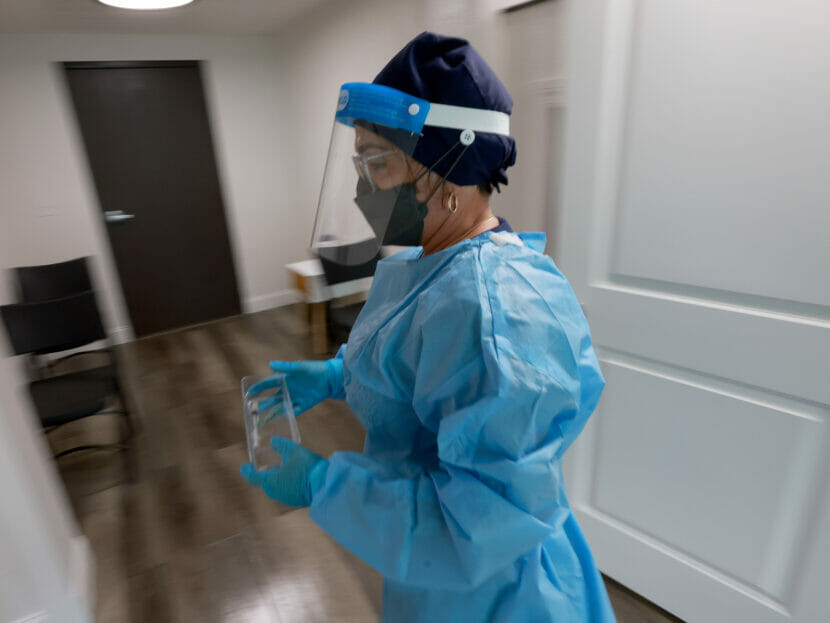
Miriala Gonzalez, a registered nurse in Miami, carries a monkeypox vaccine. A new survey highlights major concerns from nurses nationwide regarding future staffing levels in hospitals. (Joe Raedle/Getty Images)
Close to a third of nurses nationwide say they are likely to leave the profession for another career due to the COVID-19 pandemic, a new survey from AMN Healthcare shows.
This level is up at least seven points since 2021. And the survey found that the ongoing shortage of nurses is likely to continue for years to come.
About 94% of nurses who responded to the AMN Healthcare survey said that there was a severe or moderate shortage of nurses in their area, with half saying the shortage was severe. And around 89% of registered nurses (RNs) said the nursing shortage is worse than five years ago.
Nurses aren’t optimistic about the future, either. At least 80% of those surveyed expect that to get much worse in another five years, the report shows.
Unions representing nurses have long warned about the problem facing the profession, said National Nurses United President Deborah Burger and President of SEIU Healthcare 1199NW Jane Hopkins. Both women are also RNs.
“It’s a critical moment in our time for nurses. The country needs nurses. We are very short and we are feeling very worried about the future of their work,” Hopkins said.
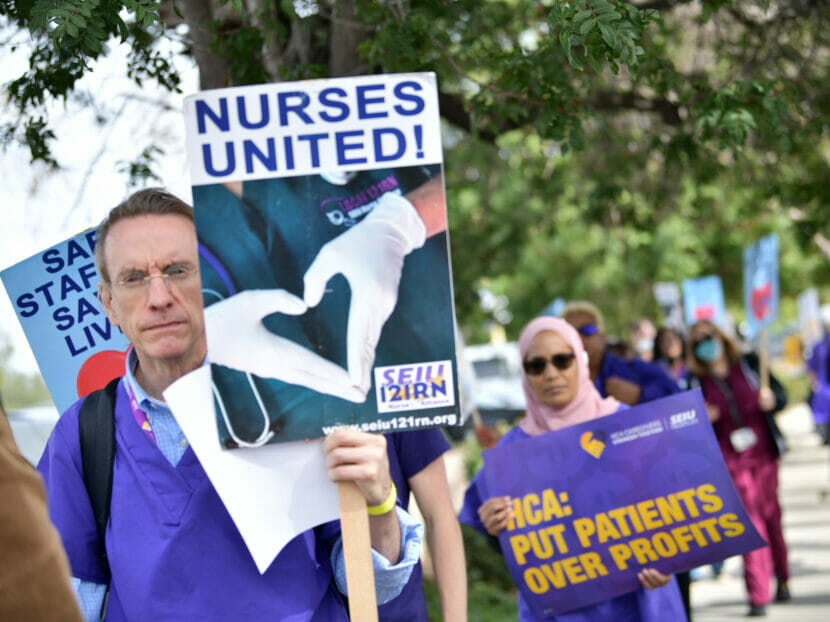
Nurses, other healthcare workers and members of the Service Employees International Union rally for better staffing levels at West Hills Hospital on January 12, 2023 in West Hills, California. (Araya Doheny/Getty Images for SEIU)
The COVID-19 pandemic certainly exacerbated problems, but short staffing was an issue even before then, Burger and Hopkins said.
“The staffing crisis didn’t just happen. It’s been around for years. Unions have been sounding the alarm that organizations were putting profits before patients,” Hopkins said. Employers “had cut staffing so bad, that there was no room for flexibility.”
She said she hears from members that they rarely have time to eat lunch or use the bathroom during their shifts.
Low staffing has a dangerous trickle-down effect, Burger said. It leads to a heavier workload, more stress and burnout for the remaining staff, as well as a negative impact to patient care.
The AMN Healthcare survey findings indicated younger generations of nurses were also less satisfied with their jobs compared to their older counterparts.
But even before the pandemic, the younger generation had signaled they were done with nursing, Hopkins said. “First and second year nurses were leaving the profession at a higher rate because it’s not what they expected. This escalated during the pandemic,” she said.
Across generations, a higher percentage of nurses also reported dealing with a greater deal of stress at their job than in previous years, the survey said. Four in five nurses experience high levels of stress at work — an increase of 16 points from 2021.
Similarly, a higher level of nurses reported feeling emotionally drained from the 2021 survey — up at least 15% in two years (62% to 77%).
One source of that stress? Nurses are also experiencing an increasing level workplace violence in the hospitals, Burger said.
“Nurses don’t feel safe in many of the hospitals around the country. And we’ve heard horrendous stories. That also gets tied back into short staffing,” she said.
Nurses have been fighting for better working conditions
This discontent among staff has deeper implications for hospitals and other organizations across the country.
In January, around 7,000 nurses in New York went on strike over a contract dispute with hospitals in the city. The nurses were looking for higher wages and better working conditions. This strike forced several hospitals to divert patients elsewhere.
Vox reported in January that nurses and other healthcare workers have frequently gone on strike in recent years. In 2022, eight of the 25 work stoppages involving 1,000 or more workers in the U.S. were done by nurses.
The AMN Healthcare survey similarly recommended that health care providers create safer working environments and broader regulatory changes to make meaningful differences.
Burger was more direct.
“Stop studying it and start actually legislating. Congress knows that they need to do something,” Burger said.
“It’s concerning that there’s a lot of hand wringing,” she said, but nothing is being done.
Copyright 2023 NPR. To see more, visit https://www.npr.org.
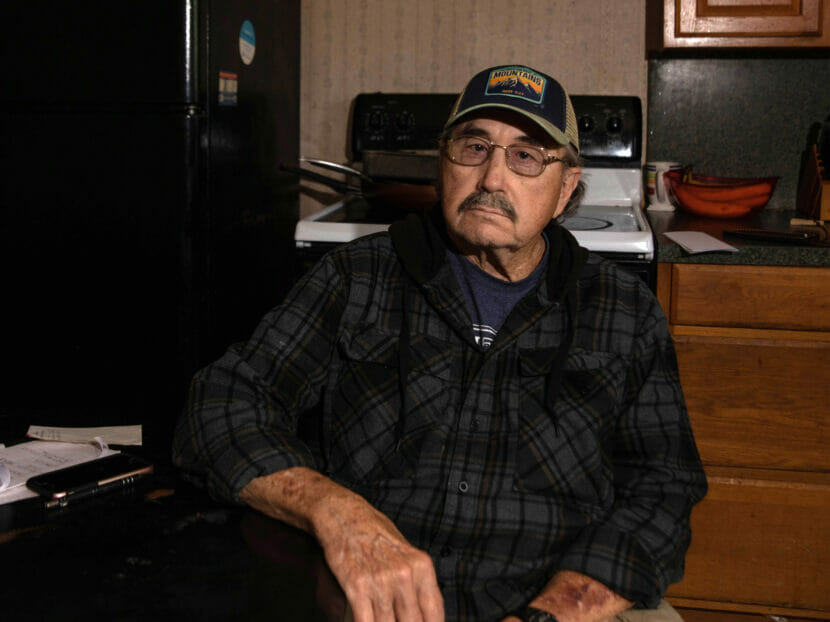
Larry Jordan, 74, served 38 years in an Alabama prison and is in poor health now. One reason the U.S. trails other developed countries in life expectancy, experts say, is that it has more people behind bars and keeps them there far longer. (Charity Rachelle/KFF Health News)
After spending 38 years in the Alabama prison system, one of the most violent and crowded in the nation, Larry Jordan feels lucky to live long enough to regain his freedom.
The decorated Vietnam War veteran had survived prostate cancer and hepatitis C behind bars when a judge granted him early release late last year.
“I never gave up hope,” says Jordan, 74, who lives in Alabama. “I know a lot of people in prison who did.”
At least 6,182 people died in state and federal prisons in 2020, a 46% jump from the previous year, according to data recently released by researchers from the UCLA Law Behind Bars Data Project.
“During the pandemic, a lot of prison sentences became death sentences,” says Wanda Bertram, a spokesperson for the Prison Policy Initiative, a nonprofit that conducts research and data analysis on the criminal justice system.
Now, Jordan worries about his longevity. He struggles with pain in his legs and feet caused by a potentially life-threatening vascular blockage, and research suggests prison accelerates the aging process.
2 million Americans in jail or prison
Life expectancy fell in the United States in 2021 for the second year in a row, according to the Centers for Disease Control and Prevention. That decline is linked to the devastating effect of covid-19 and a spike in drug overdoses.
Some academic experts and activists say the trend also underscores the lasting health consequences of mass incarceration in a nation with roughly 2 million imprisoned or jailed people, one of the highest rates in the developed world.
A Senate report last year found the U.S. Department of Justice failed to identify more than 900 deaths in prisons and local jails in fiscal year 2021. The report said the DOJ’s poor data collection and reporting undermined transparency and congressional oversight of deaths in custody.
Thousands of people like Jordan are released from prisons and jails every year with conditions such as cancer, heart disease, and infectious diseases they developed while incarcerated. The issue hits hard in Alabama, Louisiana, and other Southeastern states, which have some of the highest incarceration rates in the nation.
Behind bars far longer
A major reason the U.S. trails other developed countries in life expectancy is because it has more people behind bars and keeps them there far longer, says Chris Wildeman, a Duke University sociology professor who has researched the link between criminal justice and life expectancy.
“It’s a health strain on the population,” Wildeman says. “The worse the prison conditions, the more likely it is incarceration can be tied to excess mortality.”
Mass incarceration has a ripple effect across society.
Incarcerated people may be more susceptible than the general population to infectious diseases such as covid and HIV that can spread to loved ones and other community members once they are released. The federal government has also failed to collect or release enough information about deaths in custody that could be used to identify disease patterns and prevent fatalities and illness inside and outside of institutions, researchers says.
Over a 40-year span starting in the 1980s, the number of people in the nation’s prisons and jails more than quadrupled, fueled by tough-on-crime policies and the war on drugs.
The changes have come too late and not gone far enough to curb the worst effects on health, some researchers and activists for reform say.
Still, no one has proven that incarceration alone shortens life expectancy. But research from the early 2000s did show the death rate for people leaving prison was 3.5 times higher than for the rest of the population in the first few years after release. Experts found deaths from drug use, violence, and lapses in access to health care were especially high in the first two weeks after release.
The enactment in 2000 of the Death in Custody Reporting Act, and its reauthorization in 2014, required the DOJ to collect information about deaths in state and local jails and prisons.
The information is supposed to include details on the time and location of a death, demographic data on the deceased, the agency involved, and the manner of death.
But a recent report from the Government Accountability Office found that 70% of the records the DOJ received were missing at least one required data point. Federal officials also lacked a plan to take corrective action against states that didn’t meet reporting requirements, the GAO found.
The deficiency in data means the federal government can’t definitively say how many people have died in prisons and jails since the covid-19 pandemic began, researchers say.
“Without data, we are operating in the dark,” says Andrea Armstrong, a professor at the Loyola University New Orleans College of Law, who has testified before Congress on the issue.
Armstrong says federal and state officials need the data to identify institutions failing to provide proper health care, nutritious food, or other services that can save lives.
The DOJ did not make officials available for interviews to answer questions about the GAO report.
In a written statement, agency officials said they were working with law enforcement and state officials to overcome barriers to full and accurate reporting.
“The Justice Department recognizes the profound importance of reducing deaths in custody,” the statement said. “Complete and accurate data are essential for drawing meaningful conclusions about factors that may contribute to unnecessary or premature deaths, and promising practices and policies that can reduce the number of deaths.”
Department officials said the agency is committed to enhancing its implementation of the Death in Custody Reporting Act and that it has ramped up its efforts to improve the quality and quantity of data that it collects.
The DOJ has accused Alabama, where Jordan was incarcerated, of failing to adequately protect incarcerated people from violence, sexual abuse, and excessive force by prison staff, and of holding prisoners in unsanitary and unsafe conditions.
One of the longest sentences in Alabama history
Larry Jordan, a Vietnam War veteran, survived prostate cancer, hepatitis C, and a potentially life-threatening vascular blockage while incarcerated in Alabama. (Charity Rachelle /KFF Health News)
Jordan served 38 years of a 40-year sentence for reckless murder stemming from a car accident, which his lawyer argued in his petition for early release was one of the longest sentences in Alabama history for the crime. A jury had found him guilty of being drunk while driving a vehicle that crashed with another, killing a man. If he were convicted today instead, he would be eligible to receive a sentence as short as 13 years behind bars, because he has no prior felony history, wrote Alabama Circuit Judge Stephen Wallace, who reviewed Jordan’s petition for early release.
With legal help from Redemption Earned, an Alabama nonprofit headed by a former state Supreme Court chief justice, Jordan petitioned the court for early release.
A few months later, Jordan says, he had surgery to treat a vascular blockage that was reducing blood flow to his left leg and left foot. A picture shows a long surgical scar stretching from his thigh to near his ankle.
The Alabama Department of Corrections refused an interview request to answer questions about conditions in the state’s prisons.
Jordan says his vascular condition was excruciating. He said he did not receive adequate treatment for it in prison: “You could see my foot dying.”
KFF Health News, formerly known as Kaiser Health News (KHN), is a national newsroom that produces in-depth journalism about health issues and is one of the core operating programs at KFF — the independent source for health policy research, polling, and journalism.
Copyright 2023 Kaiser Health News. To see more, visit Kaiser Health News.
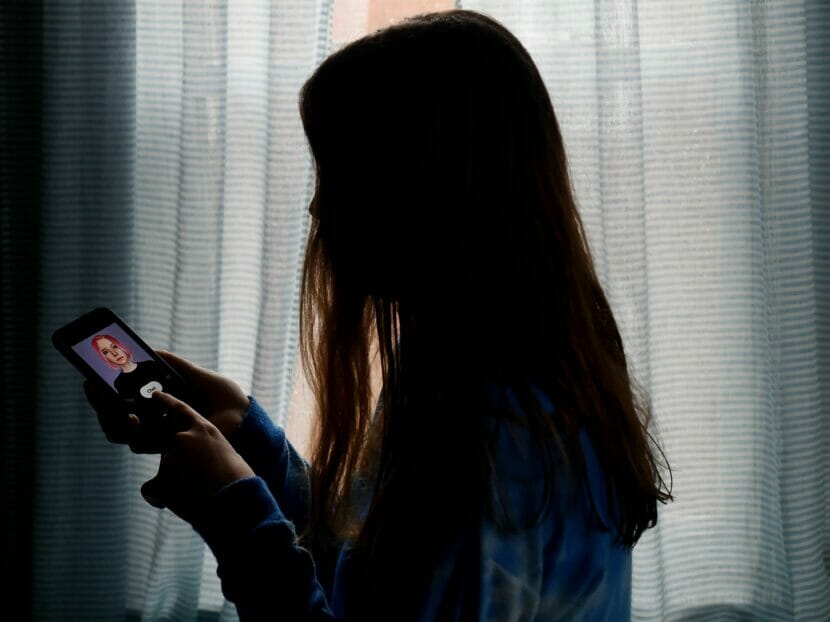
For years, the research picture on how social media affects teen mental health has been murky. That is changing as scientists find new tools to answer the question. (Olivier Douliery /AFP via Getty Images)
Back in 2017, psychologist Jean Twenge set off a firestorm in the field of psychology.
Twenge studies generational trends at San Diego State University. When she looked at mental health metrics for teenagers around 2012, what she saw shocked her. “In all my analyses of generational data — some reaching back to the 1930s — I had never seen anything like it,” Twenge wrote in the Atlantic in 2017.
Twenge warned of a mental health crisis on the horizon. Rates of depression, anxiety and loneliness were rising. And she had a hypothesis for the cause: smartphones and all the social media that comes along with them. “Smartphones were used by the majority of Americans around 2012, and that’s the same time loneliness increases. That’s very suspicious,” Twenge told NPR in 2017.
But many of her colleagues were skeptical. Some even accused her of inciting a panic with too little — and too weak — data to back her claims.
Now, six years later, Twenge is back. She has a new book out this week, called Generations, with much more data backing her hypothesis. At the same time, several high-quality studies have begun to answer critical questions, such as does social media cause teens to become depressed and is it a key contributor to a rise in depression?
In particular, studies from three different types of experiments, altogether, point in the same direction. “Indeed, I think the picture is getting more and more consistent,” says economist Alexey Makarin, at the Massachusetts Institute of Technology.
A seismic change in how teens spend their time
In Generations, Twenge analyzes mental health trends for five age groups, from the Silent Generation, who were born between 1925 and 1945, to Gen Z, who were born between 1995 and 2012. She shows definitively that “the way teens spend their time outside of school fundamentally changed in 2012,” as Twenge writes in the book.
Take for instance, hanging out with friends, in person. Since 1976, the number of times per week teens go out with friends — and without their parents — held basically steady for nearly 30 years. In 2004, it slid a bit. Then in 2010, it nosedived.
“It was just like a Black Diamond ski slope straight down,” Twenge tells NPR. “So these really big changes occur.”
At the same time, around 2012, time on social media began to soar. In 2009, only about half of teens used social media every day, Twenge reports. In 2017, 85% used it daily. By 2022, 95% of teens said they use some social media, and about a third say they use it constantly, a poll from Pew Research Center found.
“Now, in the most recent data, 22% of 10th grade girls spend seven or more hours a day on social media,” Twenge says, which means many teenage girls are doing little else than sleeping, going to school and engaging with social media.
Not surprisingly, all this screen time has cut into many kids’ sleep time. Between 2010 and 2021, the percentage of 10th and 12th graders who slept seven or fewer hours each night rose from a third to nearly one-half. “That’s a big jump,” Twenge says. “Kids in that age group are supposed to sleep nine hours a night. So less than seven hours is a really serious problem.”
On its own, sleep deprivation can cause mental health issues. “Sleep is absolutely crucial for physical health and for mental health. Not getting enough sleep is a major risk factor for anxiety and depression and self-harm,” she explains. Unfortunately, all of those mental health problems have continued to rise since Twenge first sounded the alarm six years ago.
“Nuclear bomb” on teen social life
“Every indicator of mental health and psychological well-being has become more negative among teens and young adults since 2012,” Twenge writes in Generations. “The trends are stunning in their consistency, breadth and size.”
Across the board, since 2010, anxiety, depression and loneliness have all increased. “And it’s not just symptoms that rose, but also behaviors,” she says, “including emergency room visits for self-harm, for suicide attempts and completed suicides.” The data goes up through 2019, so it doesn’t include changes due to COVID-19.
All these rapid changes coincide with what, Twenge says, may be the most rapid uptake in a new technology in human history: the incorporation of smartphones into our lives, which has allowed nearly nonstop engagement with social media apps. Apple introduced the first iPhones in 2007, and by 2012, about 50% of American adults owned a smartphone, the Pew Research Center found.
The timing is hard to ignore, says data scientist Chris Said, who has a Ph.D. in psychology from Princeton University and has worked at Facebook and Twitter. “Social media was like a nuclear bomb on teen social life,” he says. “I don’t think there’s anything in recent memory, or even distant history, that has changed the way teens socialize as much as social media.”
Murky picture becomes clearer on causes of teen depression
But the timing doesn’t tell you whether social media actually causes depression in teens.
In the past decade, scientists have published a whole slew of studies trying to answer this question, and those studies sparked intense debate among scientists and in the media. But, Said says, what many people don’t realize is scientists weren’t using — or didn’t even have — the proper tools to answer the question. “This is a very hard problem to study,” he says. “The data they were analyzing couldn’t really solve the problem.”
So the findings have been all over the place. They’ve been murky, noisy, inconclusive and confusing. “When you use tools that can’t fully answer the question, you’re going to get weak answers,” he says. “So I think that’s one reason why really strong evidence didn’t show up in the data, at least early on.”
On top of it, psychology has a bad track record in this field, Said points out. For nearly a century, psychologists have repeatedly blamed new technologies for mental and physical health problems of children, even when they’ve had little — or shady — data to back up their claims.
For example, in the 1940s, psychologists worried that children were becoming addicted to radio crime dramas, psychologist Amy Orben at the University of Cambridge explains in her doctoral thesis. After that, they raised concerns about comic books, television and — eventually — video games. Thus, many researchers worried that social media may simply be the newest scapegoat for children’s mental health issues.
A handful of scientists, including MIT’s Alexey Makarin, noticed this problem with the data, the tools and the field’s past failures, and so they took the matter into their own hands. They went out and found better tools.
Hundreds of thousands of more college students depressed
Over the past few years, several high-quality studies have come that can directly test whether social media causes depression. Instead of being murky and mixed, they support each other and show clear effects of social media. “The body of literature seems to suggest that indeed, social media has negative effects on mental health, especially on young adults’ mental health,” says Makarin, who led what many scientists say is the best study on the topic to date.
In that study, Makarin and his team took advantage of a once-in-a-lifetime opportunity: the staggered introduction of Facebook across U.S. colleges from 2004 to 2006. Facebook rolled out into society first on college campuses, but not all campuses introduced Facebook at the same time.
For Makarin and his colleagues, this staggered rollout is experimental gold.
“It allowed us to compare students’ mental health between colleges where Facebook just arrived to colleges where Facebook had not yet arrived,” he says. They could also measure how students’ mental health shifted on a particular campus when people started to spend a bunch of their time on social media.
Luckily, his team could track mental health at the time because college administrators were also conducting a national survey that asked students an array of questions about their mental health, including diagnoses, therapies and medications for depression, anxiety and eating disorders. “These are not just people’s feelings,” Makarin says. “These are actual conditions that people have to report.”
They had data on a large number of students. “The data comes from more than 350,000 student responses across more than 300 colleges,” Makarin says.
This type of study is called a quasi-experiment, and it allows scientists to estimate how much social media actually changes teens’ mental health, or as Makarin says, “We can get causal estimates of the impact of Facebook on mental health.”
So what happened? “Almost immediately after Facebook arrives on campus, we see an uptick in mental health issues that students report,” Makarin says. “We especially find an impact on depression rates, anxiety disorders and other questions associated with depression in general.”
And the effect isn’t small, he says. Across the population, the rollout of Facebook caused about 2% of college students to become clinically depressed. That may sound modest, but with more than 17 million college students in the U.S. at the time, that means Facebook caused more than 300,000 young adults to suffer from depression.
For an individual, on average, engaging with Facebook decreases their mental health by roughly 22% of the effect of losing one’s job, as reported by a previous meta-analysis, Makarin and his team found.
Facebook’s rollout had a larger effect on women’s mental health than on men’s mental health, the study showed. But the difference was small, Makarin says.
He and his colleagues published their findings last November in the American Economic Review. “I love that paper,” says economist Matthew Gentzkow at Stanford University, who was not involved in the research. “It’s probably the most convincing study I’ve seen. I think it shows a clear effect, and it’s really credible. They did a good job of isolating the effect of Facebook, which isn’t easy.”
Of course, the study has limitations, Gentzkow says. First off, it’s Facebook, which teens are using less and less. And the version of Facebook is barebones. In 2006, the platform didn’t have a “like” button” or a “newsfeed.” This older version probably wasn’t as “potent” as social media now, says data scientist Chris Said. Furthermore, students used the platform only on a computer because smartphones weren’t available yet. And the study only examined mental health impacts over a six-month period.
Nevertheless, the findings in this study bolster other recent studies, including one that Gentzkow led.
Social media is “like the ocean” for kids
Back in 2018, Gentzkow and his team recruited about 2,700 Facebook users ages 18 or over. They paid about half of them to deactivate their Facebook accounts for four weeks. Then Gentzkow and his team looked to see how a Facebook break shifted their mental health. They reported their findings in March 2020 in the American Economic Review.
This type of study is called a randomized experiment, and it’s thought of as the best way to estimate whether a variable in life causes a particular problem. But with social media, these randomized experiments have big limitations. For one, the experiments are short-term — here only four weeks. Also, people use social media in clusters, not as individuals. So having individuals quit Facebook won’t capture the effect of having an entire social group quit together. Both of these limitations could underestimate the impact of social media on an individual and community.
Nevertheless, Gentzkow could see how deactivating Facebook made people, on average, feel better. “Being off Facebook was positive across well-being outcomes,” he says. “You see higher happiness, life satisfaction, and also lower depression, lower anxiety, and maybe a little bit lower loneliness.”
Gentzkow and his team measured participants’ well-being by giving them a survey at the end of the experiment but also asking questions, via text message, through the experiment. “For example, we sent people text messages that say, ‘Right now, would you say you’re feeling happy or not happy,'” he explains.
Again, as with Makarin’s experiment, the effect was moderate. Gentzkow and his colleagues estimate that temporarily quitting Facebook improves a person’s mental health by about 30% of the positive effect seen by going to therapy. “You could view that meaning these effects are pretty big,” he explains, “or you could also see that as meaning that the effects of therapy are somewhat small. And I think both of those things are true to an extent.”
Scientists still don’t know to what extent social media is behind the rising mental health issues among teenagers and whether it is the primary cause. “It seems to be the case — like it’s a big factor,” says MIT’s Alexey Makarin, “but that’s still up for debate.”
Still, though, other specifics are beginning to crystallize. Scientists are narrowing in on what aspects of social media are most problematic. And they can see that social media won’t hurt every teen — or hurt them by the same amount. The data suggests that the more hours a child devotes to social media, the higher their risk for mental health problems.
Finally, some adolescents are likely more vulnerable to social media, and children may be more vulnerable at particular ages. A study published in February 2022 looked to see how time spent on social media varies with life satisfaction during different times in a child’s life (see the graphic).
The researchers also looked to see if a child’s present use of social media predicted a decrease of life satisfaction one year later. That data suggests two windows of time when children are most sensitive to detrimental effects of social media, especially heavy use of it. For girls, one window occurs at ages 11 through 13. And for boys, one window occurs at ages 14 and 15. For both genders, there’s a window of sensitivity around age 19 — or near the time teenagers enter college. Amy Orben and her team at the University of Cambridge reported the findings in Nature Communications.
This type of evidence is known as a correlative. “It’s hard to draw conclusions from these studies,” Gentzkow says, because many factors contribute to life satisfaction, such as environmental factors and family backgrounds. Plus, people may use social media because they’re depressed (and so depression could be the cause, not the outcome of social media use).
“Nevertheless, these correlative studies, together with the evidence from the causal experiments, paint a picture that suggests we should take social media seriously and be concerned,” Gentzkow adds.
Psychologist Orben once heard a metaphor that may help parents understand how to approach this new technology. Social media for children is a bit like the ocean, she says, noting that it can be an extremely dangerous place for children. Before parents let children swim in any open water, they make sure the child is well-prepared and equipped to handle problems that arise. They provide safety vests, swimming lessons, often in less dangerous waters, and even then parents provide a huge amount of supervision.
Copyright 2023 NPR. To see more, visit https://www.npr.org.
The number of reported challenges to books doubled in 2022 — and the number of challenges to unique titles was up nearly 40 percent over 2021 — according to data released by the American Library Association’s Office of Intellectual Freedom Monday.
Each year the ALA releases data on books it says have been most often challenged for removal from public and school library shelves. Though the group says it’s not possible to track every challenge, and that many go unreported, the data come through a variety of sources, including news stories and voluntary reports sent to the Office of Intellectual Freedom.
This year’s report includes an expanded list of the 13 books most challenged in 2022, as there were the same number of banning efforts against several of the books. Overall, the ALA says that 2,571 unique titles were banned or challenged.
Lessa Kananiʻopua Pelayo-Lozada, president of the American Library Association, says it used to be that titles were challenged when a parent or other community member saw a book in the library they didn’t like. But times have changed: “Now we’re seeing organized attempts by groups to censor multiple titles throughout the country without actually having read many of these books.”
Pelayo-Lozada says that despite the high challenge numbers, a library association poll shows a large majority of Americans don’t believe in banning books.
Once again this year, Gender Queer by Maia Kobabe, published in 2019, tops the ALA’s list. The graphic memoir follows Kobabe’s path to gender-identity as nonbinary and queer. Most of the books on the list have been challenged with claims of including LGBTQIA+ or sexually explicit content.
There are a handful of titles on the list this year that are new from 2021, including Flamer by Mike Curato, Looking for Alaska by John Green, The Perks of Being a Wallflower by Stephen Choosky, A Court of Mist and Fury by Sarah J. Maas, and Crank by Ellen Hopkins.
Eight of the titles have remained on the list for multiple years.
Most Challenged Books of 2022
Here are the books the ALA tracked as most challenged in 2022 (there was a 4-way tie for #10):
1. Gender Queer by Maia Kobabe — LGBTQIA+ content, claimed to be sexually explicit
2. All Boys Aren’t Blue by George M. Johnson — LGBTQIA+ content, claimed to be sexually explicit
3. The Bluest Eye by Toni Morrison — rape, incest, claimed to be sexually explicit, EDI content
4. Flamer by Mike Curato — LGBTQIA+ content, claimed to be sexually explicit
5. Looking for Alaska by John Green — claimed to be sexually explicit, LGBTQIA+ content
6. The Perks of Being a Wallflower by Stephen Choosky — claimed to be sexually explicit, LGBTQIA+ content, rape, drugs, profanity
7. Lawn Boy by Jonathan Evison — LGBTQIA+ content, claimed to be sexually explicit
8. The Absolutely True Diary of a Part-Time Indian by Sherman Alexie — claimed to be sexually explicit, profanity
9. Out of Darkness by Ashley Hope Pérez— claimed to be sexually explicit
10. Me and Earl and the Dying Girl by Jesse Andrews — claimed to be sexually explicit, profanity
10. This Book is Gay by Juno Dawson — LGBTQIA+ content, sex education, claimed to be sexually explicit
10. A Court of Mist and Fury by Sarah J. Maas — claimed to be sexually explicit
10. Crank by Ellen Hopkins — claimed to be sexually explicit, drugs
Copyright 2023 NPR. To see more, visit https://www.npr.org.
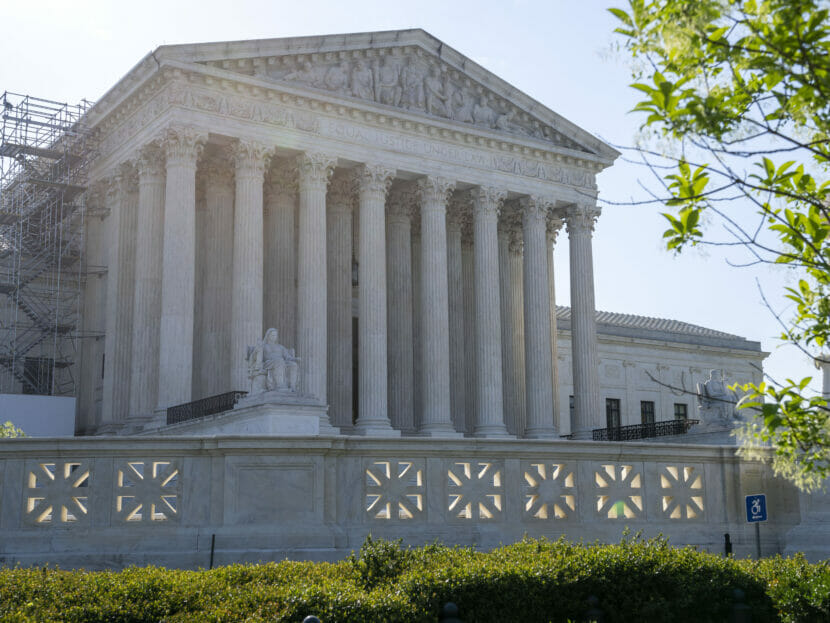
The U.S. Supreme Court on Friday issued a ruling on access to mifepristone, a drug widely used in medication abortions. The case was brought to the high court after a federal judge decided earlier this month that the Food and Drug Administration improperly approved the medication 23 years ago. (Jacquelyn Martin/AP)
The U.S. Supreme Court on Friday blocked lower court decisions banning or limiting the FDA-approved use of the abortion pill mifepristone for the foreseeable future.
But the justices, for now, left the case in the hands of the 5th U.S. Circuit Court of Appeals, which has scheduled oral arguments in the case for May 17. However the 5th Circuit rules, the case will almost certainly end up back at the Supreme Court, with the potential for a decision in the case next term.
The court’s action means that for now at least, the drug will be widely available, at least in those states where abortion is legal for up to 10 weeks into a pregnancy.
Dissenting were Justices Clarence Thomas and Samuel Alito.
In his dissent, Alito argued, “As narrowed by the Court of Appeals, the stay that would apply if we failed to broaden it would not remove mifepristone from the market. It would simply restore the circumstances that existed (and that the Government defended) from 2000 to 2016 under three Presidential administrations.”
President Biden on Friday said that his administration will continue to defend the Food and Drug Administration’s approval of mifepristone, and he called on Americans to elect lawmakers to pass a law restoring abortion rights.
“I continue to stand by FDA’s evidence-based approval of mifepristone, and my Administration will continue to defend FDA’s independent, expert authority to review, approve, and regulate a wide range of prescription drugs,” Biden said in a statement.
“The stakes could not be higher for women across America. I will continue to fight politically-driven attacks on women’s health. But let’s be clear – the American people must continue to use their vote as their voice, and elect a Congress who will pass a law restoring the protections of Roe v Wade,” Biden stated.
The latest legal clash over abortion began April 7 in Texas when U.S. District Judge Matthew Kacsmaryk, a onetime anti-abortion activist, imposed a nationwide ban on mifepristone, declaring that the FDA had improperly approved the drug 23 years ago. Within minutes of that decision, U.S. District Judge Thomas O. Rice in Washington state issued a contrary ruling. In a case brought by 17 states and the District of Columbia seeking to expand the use of mifepristone, Rice declared that the current FDA rules must remain in place.
On April 12, the case became even more procedurally convoluted when the 5th U.S. Circuit Court of Appeals partially pulled back on the Texas ruling from Kacsmaryk. Because the statute of limitations for challenging FDA approval of a drug had long passed, the appeals court ruled that mifepristone could continue to be used up to seven weeks into pregnancy in states where abortion is legal — this despite the fact that the FDA has approved use of the pill for up to 10 weeks into pregnancy.
In addition, the appeals court sought to roll back rules adopted since 2015 that have facilitated access to abortion pills — among them, rules that allow patients seeking an abortion to obtain the pills by mail and rules allowing telemedicine appointments with doctors. Instead, the appeals court sought to reimpose rules not in effect since 2016, such as a rule requiring three in-person appointments for anyone using the drug and a ban on the cheaper generic version of the drug.
There is little likelihood that the appeals court will substantially change its view after oral arguments in the case. Its 42-page preliminary order is based, in part, on the Comstock Act, a law that for generations has not been enforced. Enacted in 1873, the statute sought to prevent the mailing of obscene or lewd materials and to bar the mailing of any substance, article or drug used for birth control or for the purpose of “unlawful abortion.”
Regardless of how the appeals court rules, though, there is certain to be an appeal from the Biden administration, on behalf of the FDA, and Danco Laboratories, maker of the leading brand of mifepristone, Mifeprex. In briefs already filed, they note that medical abortions using pills account for the majority of abortions in the U.S. today. And they cite dozens of studies and clinical trials showing that the drug is exceedingly safe for use up to 10 weeks into pregnancy.
Both the FDA and Danco assert that were the 5th Circuit’s decision to become law, it would create “regulatory chaos across the country.” As Danco put it in its brief, the result would be “an untenable limbo,” not only for Danco, which could not legally market and distribute its drug, but for the FDA, doctors, health care systems and women, some of whom use the drug when they miscarry.
Copyright 2023 NPR. To see more, visit https://www.npr.org.
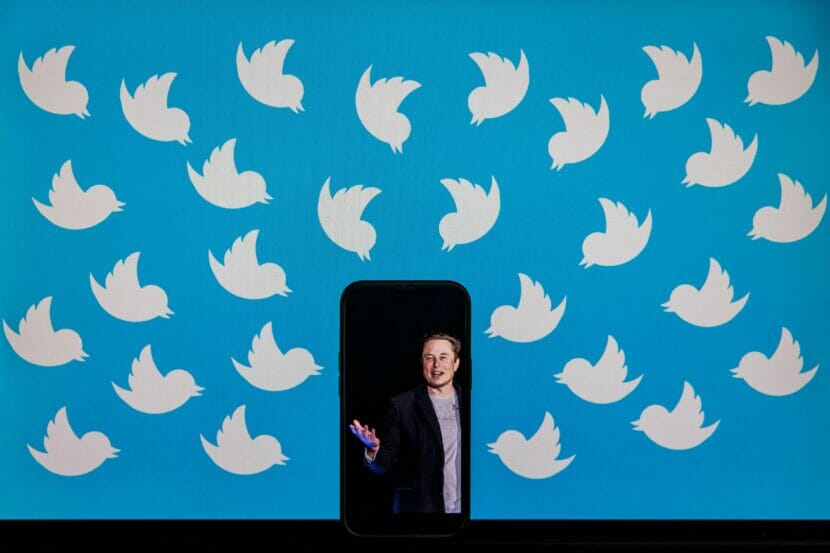
Under Twitter CEO Elon Musk, the company has stopped its previous practice of limiting the spread of tweets from Russian, Chinese and Iranian government media accounts. (Samuel Corum/AFP via Getty Images)
Dmitry Medvedev, a leading government official and former president of Russia, took to Twitter earlier this month to denigrate Ukraine in a post using language reminiscent of genocidal regimes.
And Twitter didn’t stop him.
In his 645-word tweet titled, “WHY WILL UKRAINE DISAPPEAR? BECAUSE NOBODY NEEDS IT,” Medvedev called Ukraine a “Nazi regime,” “blood-sucking parasites” and “a threadbare quilt, torn, shaggy, and greasy.”
The post garnered more than 7,000 retweets and 11,000 likes.
One response, though, asked Twitter CEO Elon Musk why he allowed Russian officials to broadcast tweets like this, especially when they used language often associated with genocide.
“All news is to some degree propaganda,” Musk responded. “Let people decide for themselves.”
Musk’s stance of allowing Russian government posts to pop up freely on people’s feeds has now become company procedure. And it’s a radical departure from the so-called “shadow bans” — or in Twitter parlance “visibility filtering rules” — that were previously placed on those accounts.
NPR has confirmed this was a deliberate decision from within the company.
The previous guardrails on government accounts in Russia, China and Iran have now been removed, according to two former Twitter employees who spoke to NPR on the condition of anonymity for fear of retribution.
“What I understand to have happened is, at Elon Musk’s direction, Twitter’s Trust and Safety Team, or what’s left of it, took a chainsaw to the visibility filtering rules,” said one of the former employees, who was an executive at the company.
The former executive said they learned this information by talking to current employees, former employees and people observing the situation.
Twitter applies “visibility filtering rules” to certain accounts to make sure less eyeballs see those accounts’ tweets.
In the past, the company’s Trust and Safety Team has used them for Russian government accounts and state-affiliated media accounts from countries “that limit access to free information.” Medvedev’s account was included in that cohort, according to the former employee.
Without visibility filtering, these accounts can now be more easily amplified and reach a much wider global audience. The implications could mean an increase of pro-government propaganda across Twitter and lead to real-life consequences for people who disagree with the authorities.
Taking the restraints off state-affiliated media accounts could also lead to more general disinformation on Twitter, said Sarah Cook, a senior advisor at the nonprofit Freedom House who researches China, Hong Kong and Taiwan and authored the report Beijing’s Global Megaphone.
“It’s not just about making the Chinese Communist Party look good. It’s not just about making activists or Hong Kong-ers look bad,” Cook said. “In some cases, it’s also about spreading disinformation about COVID or sowing divisions within Taiwan or the United States.”
Spike in engagement
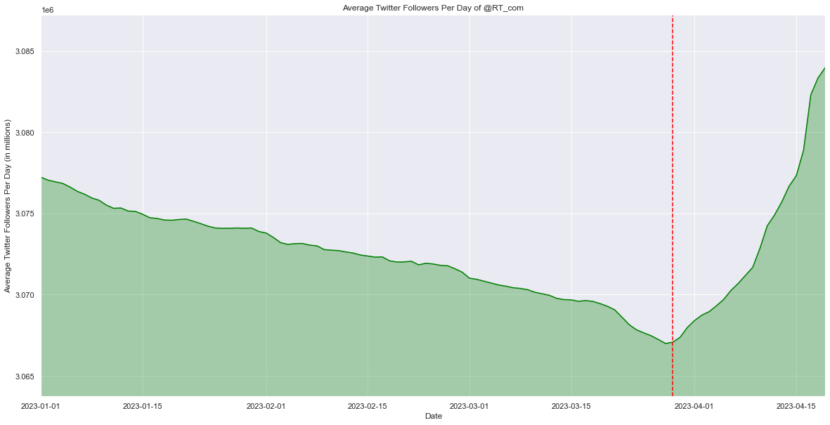
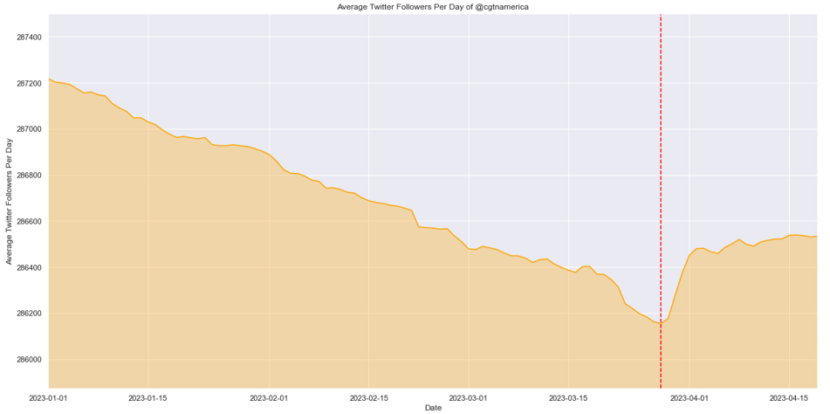
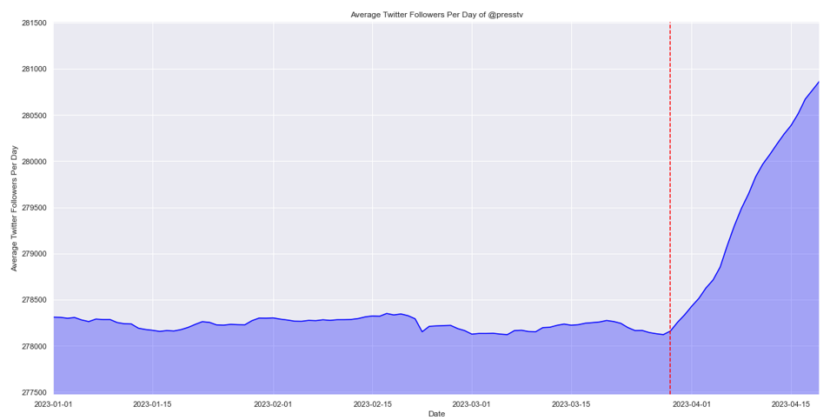
Since Twitter removed the visibility filters on state-affiliated media, researchers have seen a sharp uptick in followers on many of these accounts.
Russia’s English language RT account, @RT_com, saw a sharp increase in followers per day starting around March 28. The red line indicates that date. (Atlantic Council)
In the months prior, these accounts had been “hemorrhaging followers,” the Atlantic Council said.
While not all accounts experienced a spike, the fact that several major ones from three separate governments simultaneously saw rapid gains “strongly suggests a platform-wide algorithmic change.”
On April 6, several days after the uptick began, the group noticed the company’s “Platform Use Guidelines” were quietly amended to remove a sentence saying “Twitter will not recommend or amplify” state-affiliated media accounts.
“This whole episode shows what happens when we cede public debate to tech companies,” said Alyssa Kann, who works for the Atlantic Council’s Digital Forensic Research Lab and reviewed the government accounts.
“When we have the public square in what is effectively one man’s private billionaire playground, I think things like this can happen,” she said.
China’s CGTN America account, @CGTNAmerica, experienced an uptick of average followers per day beginning March 29, after a slow decline. The red line indicates that date. (Atlantic Council)Iran’s PressTV account, @presstv, saw a dramatic spike in followers starting March 29. The red line indicates that date. (Atlantic Council)
When NPR emailed Twitter for comment for this story, the company replied with its usual response to reporters—a poop emoji. Ella Irwin, Twitter’s vice president of product for trust and safety, didn’t respond to a request for comment.
Along with revoking the visibility filtering for government accounts, Twitter has also stopped its previous practice of letting researchers and developers freely access its data through a tool known as API. That means it’s far more difficult for watchdogs to keep checks on the spread of government propaganda on the platform.
The Atlantic Council said it’s now using third-party programs, but they’re not as comprehensive or reliable.
Because of all the changes at Twitter, it said much of the research into state media and other government actors that had once been commonplace just isn’t possible anymore.
“Until Twitter 2.0, this was kind of settled,” said Graham Brookie, the Atlantic Council’s vice president for tech programs. “And it was settled in a bunch of the places around the world where it really matters.”
How it started… how it’s going
When Twitter first launched its visibility filtering system for state-affiliated media accounts in 2020, the Trust and Safety Team consulted with various researchers and human rights groups. The way the filters worked was those accounts labeled state media wouldn’t be recommended or amplified.
For example, if someone wasn’t following RT and typed it into the search bar, the account wouldn’t show up.
After running a controlled experiment, Twitter found the reach of Russian state media tweets decreased by 30% with the filtering. When the company began filtering Russian government accounts at the start of the Ukraine war, it saw engagement per tweet decrease by 25%.
While government officials in Russia, China and Iran have Twitter accounts, access to the site is banned in those three countries. That means ordinary citizens aren’t allowed to voice their opinions and experiences, which can create a lopsided flow of information where governments drown out regular people.
The visibility filtering was meant to fix some of that.
It’s unclear exactly when Twitter stopped the visibility filtering, but, like the Atlantic Council, Voice of America reporter Wenhao Ma first noticed it at the end of March. He did some experiments and found Twitter was automatically recommending to him Chinese state-affiliated media accounts that he wasn’t following.
Just a few days later, Twitter slapped the state-affiliated media label on NPR.
Twitter’s previous policy on state-affiliated media said news organizations that receive state funding but have editorial independence “like the BBC in the UK or NPR in the US” would not be labeled. (NPR gets less than 1% of its funding from the government).
What ensued was a chaotic few days.
In an email exchange, Musk told NPR reporter Bobby Allyn that maybe that label wasn’t accurate. Twitter then changed the label to “government-funded media” and also applied it to PBS and the BBC. As a result, NPR quit Twitter.
Around that time, Twitter adjusted its policy on how it defines “government-funded media” and linked to a Wikipedia page on public broadcasting as its source.
On Thursday night, that policy page disappeared from Twitter’s website. As did the labels from NPR, PBS and the BBC’s accounts.
Labels on Russian, Chinese and Iranian state-affiliated media also evaporated, along with the “Russia government official” label on Dmitry Medvedev’s account.
“We talked to experts and researchers,” said the former Twitter executive. “And now, these decisions get made because Elon Musk sees a tweet from Catturd and decides that’s what Twitter is going to be like.”
“It’s disheartening to see labels that were built to inform people be used as a tactic to mislead,” the former executive added.
Disclosure: This story was reported and written by NPR Tech Correspondent Dara Kerr and edited by Business Editor Lisa Lambert. NPR’s Shannon Bond contributed to this report.Under NPR’s protocol for reporting on itself, no corporate official or news executive reviewed this story before it was posted publicly.
Copyright 2023 NPR. To see more, visit https://www.npr.org.
Close
Update notification options
Subscribe to notifications
Subscribe
Get notifications about news related to the topics you care about. You can unsubscribe anytime.

9(MDEwMjQ0ODM1MDEzNDk4MTEzNjU3NTRhYg004))

9(MDEwMjQ0ODM1MDEzNDk4MTEzNjU3NTRhYg004))
9(MDEwMjQ0ODM1MDEzNDk4MTEzNjU3NTRhYg004))

9(MDEwMjQ0ODM1MDEzNDk4MTEzNjU3NTRhYg004))
9(MDEwMjQ0ODM1MDEzNDk4MTEzNjU3NTRhYg004))
9(MDEwMjQ0ODM1MDEzNDk4MTEzNjU3NTRhYg004))