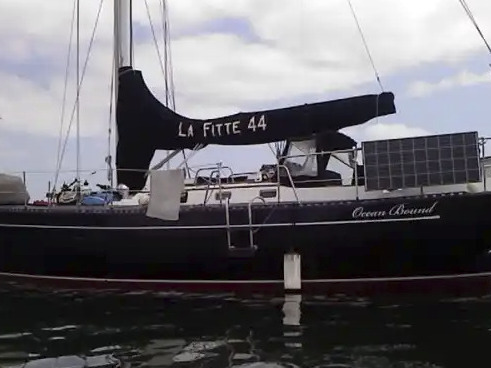
The Mexican Navy searched for three Americans who went missing along with their sailboat off Mexico’s northern Pacific coast. Kerry and Frank O’Brien of Girdwood, Alaska, were aboard the boat with their friend William Gross. They have not been heard from since April 4, according to the U.S. Coast Guard. AP
In a news release Wednesday, the agency said the search was suspended pending “further developments” after SEMAR — the Mexican navy — and the Coast Guard spent roughly 280 hours searching Mexico’s northern Pacific coast.
After searching nearly 200,000 square miles with no sign of the missing passengers and the missing sailing vessel, officials suspended the search.
“SEMAR and U.S. Coast Guard assets worked hand-in-hand for all aspects of the case. Unfortunately, we found no evidence of the three Americans’ whereabouts or what might have happened,” Coast Guard Cmdr. Gregory Higgins said.
The three sailors — identified as Kerry and Frank O’Brien of Girdwood and their friend William Gross — reportedly left Mazatlán, a city on Mexico’s west coast, aboard a 44-foot boat named Ocean Bound on April 4 and were headed to San Diego.
They planned to stop in Cabo San Lucas — roughly 224 miles from Mazatlán — on April 6 to report in before they continued their trip, the Coast Guard said. However, there was no record of the three mariners arriving in Cabo San Lucas nor a check-in of their location.
In an interview with San Diego TV station NBC 7, the family of William Gross told the station they have not lost hope and that he and his sailing companions will be found.
“Our hope is for our Dad, and Kerry and Frank to be sailing into port soon, tired and sore, but safe,” the Gross family said in a statement to the station. “And our hearts certainly go out to the other two families who are being equally impacted during this extremely difficult time.”
Copyright 2023 NPR. To see more, visit https://www.npr.org.
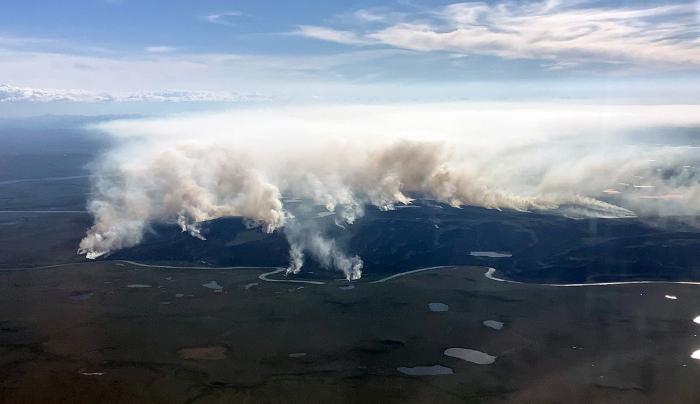
The 2021 Noatak River Fire in the Noatak National Preserve, about 120 miles northeast of Kotzebue. (Photo courtesy of Ryan McPherson, BLM AFS)
Above the Arctic Circle, the community in Kotzebue, Alaska, is watching sea ice disappear as the climate gets hotter. In the Western U.S., firefighters are battling increasingly explosive wildfires driven by hot, dry weather.
Scientists are finding these two extremes could be connected, a sign of how melting ice is causing ripple effects across the planet. You can see images and video from Alaska and California in our visual interactive.
This audio story was edited by Neela Banerjee and Sadie Babits. It was produced by Ryan Kellman.
Copyright 2023 NPR. To see more, visit https://www.npr.org.
Transcript :
MICHEL MARTIN, HOST:
All this week, NPR’s Climate Desk has been looking at the far-reaching effects of melting ice. This story is about two places thousands of miles apart but with an unexpected connection. One is the Western U.S., where wildfires have ravaged communities in recent years. The other is the Arctic Ocean, where vast areas of sea ice are disappearing. These extremes of fire and ice have a surprising link, one that scientists say is getting stronger as the climate changes. Lauren Sommer from NPR’s Climate Desk has the story.
LAUREN SOMMER, BYLINE: It’s early July, 30 miles above the Arctic Circle. And in the small coastal village of Kotzebue, Alaska, kids are swimming.
(SOUNDBITE OF WATER SPLASHING, CROSSTALK)
SOMMER: They launch themselves off a seawall into the ocean. It’s getting late, but it doesn’t matter too much. The sun stays up for 24 hours this time of year. Boats are still speeding by on the open water. But just a few decades ago, this would not be swim season because huge pieces of ice would still be floating by. Most of the year, the ocean around Kotzebue is frozen for as far as you can see. For the Alaska Native people here, ice is a way of life.
CYRUS HARRIS: For the Inupiaq people that’s living along the coastal areas, we’re here for a reason, and that particular reason is the resources out in the waters.
SOMMER: Cyrus Harris grew up around Kotzebue. Like many people here, he relies on hunting and fishing, as has been done for generations.
HARRIS: I’d like to say 70% of my diet is from the lands and waters.
SOMMER: Harris runs the elders traditional food program, where hunters donate food to supply the long-term care facility in town.
HARRIS: On this side, I got…
SOMMER: He opens a big walk-in freezer with caribou, fish and seal.
HARRIS: We’re going to be making fresh seal oil this winter with the…
SOMMER: Bearded seals are an important traditional food, and they’re only nearby for a short time, when the sea ice starts breaking up in the spring. But that hunting season has been getting even shorter, he says, because the Arctic is changing undeniably. It’s warming twice as fast as the rest of the planet.
HARRIS: Our colder temperatures throughout the winter are no longer colder temperatures throughout the winter. Earlier spring thaws, it’s obvious. Late fall freeze up, that’s obvious.
SOMMER: To measure that, Harris and other village elders teamed up with scientists from Columbia University and the University of Alaska Fairbanks. They combined traditional Indigenous knowledge with scientific data and found since 2003, the sea ice breaks up three weeks earlier on average.
HARRIS: If these changes continue to go on as they are, it’s going to be a big challenge for the many of us. It’s going to be a big challenge for the younger generation.
SOMMER: And the changes aren’t just affecting people here.
(SOUNDBITE OF WATER SPLASHING)
ALEX WHITING: The thing about the Arctic is that it only works when it’s cold.
SOMMER: Alex Whiting is environmental director for the Native Village of Kotzebue.
WHITING: So that means when it’s not cold, a lot of things start to become disrupted.
SOMMER: We’re walking on the shoreline at the edge of town. There aren’t any roads beyond here. Kotzebue can only be reached by boat, plane and snowmobile when there’s ice. Whiting says what happens in the Arctic matters because it influences the rest of the planet.
WHITING: The Arctic is a major thermal regulator for the planet, right? It’s a air conditioner for the planet. It drives weather systems.
SOMMER: All that cold at the top of the planet shapes the weather, including weather that’s thousands of miles away.
(SOUNDBITE OF ARCHIVED RECORDING)
UNIDENTIFIED REPORTER: Tonight, wildfires are leaving a trail of destruction amid record-breaking heat in the West.
SOMMER: Scientists are finding that Arctic ice seems to be shaping weather that fuels major disasters, like wildfires.
HAILONG WANG: The change in the Arctic could affect anywhere people live.
SOMMER: Hailong Wang is an Earth scientist at the Department of Energy’s Pacific Northwest National Laboratory. He says this is how it works. When the Arctic Ocean is covered in ice, it’s super bright white, so it’s really good at reflecting sunlight. It acts like a shield. But when there’s less sea ice…
WANG: The ocean can absorb and store more heat from the sunlight.
SOMMER: That heats up the water, which warms the air above it. The warm air forms a weather system, one that’s strong enough to push something you hear about a lot in weather reports – the jet stream. The jet stream is what steers weather across the lower 48.
WANG: The shift of this jet stream can have a big impact on weather events.
SOMMER: Like bringing hot, dry air to the Western U.S. Wang’s research shows this connection from less sea ice to more arid heat in the West is likely to become more common as the climate gets hotter. And it would happen in the fall, a time when hot, dry air is especially dangerous. Mark Macias has seen that firsthand in a wildfire three years ago.
MARK MACIAS: Fire of this magnitude, how fast it moves, you can’t get in front of it.
SOMMER: Macias is a fire captain with the St. Helena Fire Department in Northern California. We’re in a rural part of Napa County, with rolling hills and oak woodlands. In late September of 2020, he and his crew were the first ones here after getting a call about a wildfire. They had already been on high alert because of the weather.
MACIAS: It was windy. There was no humidity.
SOMMER: The wildfire was moving fast. The priority became just getting people out.
MACIAS: It’s a bright orange everywhere. You’re constantly getting burned with embers. Yeah, it’s something.
SOMMER: The Glass Fire, as it was called, exploded, jumping hundreds of acres overnight. The dry air sapped the moisture from vegetation, priming it to burn. Macias spent the next 60 hours straight evacuating people. Eventually, more than 1,500 homes and buildings were destroyed. This isn’t the only fire like this Macias has seen. He and his crew have been called to fight them around California.
MACIAS: It just seems like there’s more of them, more and more of them.
SOMMER: It’s taken a big toll, not just on the local communities but on Macias and the firefighters he works with. He gets choked up talking about it.
MACIAS: You try to do a lot, and it feels like you can’t win. I know that was a huge thing that I’ve talked to with other guys. It’s just like when you just feel like you can’t win, and you’re trying, you know? Those are the tough ones.
SOMMER: There are a lot of reasons wildfires explode into something unstoppable. The land may be overgrown with vegetation or the terrain too steep. But hot, dry weather – fire weather, as it’s known – has been the deciding factor in the most destructive wildfires in recent years. Forecasting this weather and knowing when it could be more common would be a big help for Western states, and that may be a matter of understanding its faraway connection to the Arctic Ocean and its blanket of white ice that’s shrinking more and more.
Lauren Sommer, NPR News.
MARTIN: You can find interactive stories from this series online at npr.org/icemelt. Transcript provided by NPR, Copyright NPR.
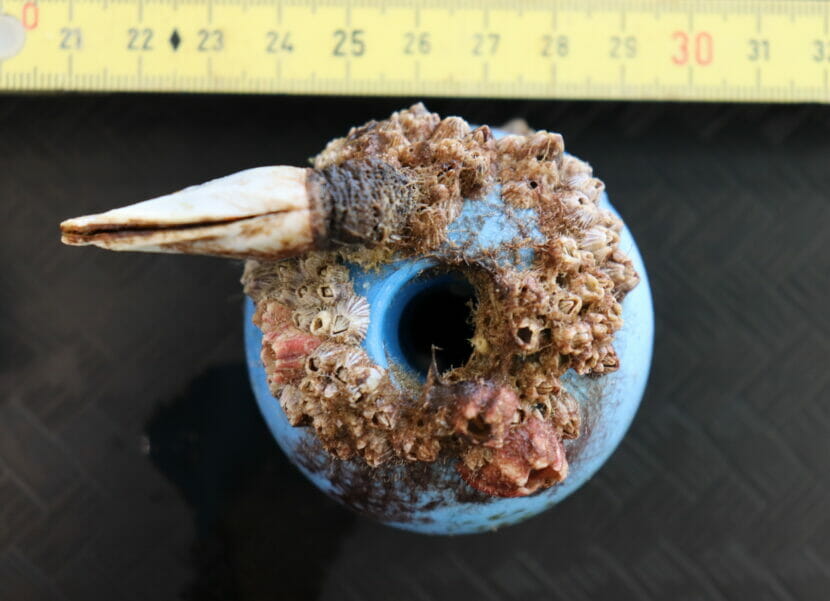
A piece of plastic debris that’s been colonized by both costal barnacles (pink and striped) and a gooseneck barnacle from the open ocean. (Linsey Haram/SERC Marine Invasions Lab)
Scientists studying a giant collection of plastic trash floating in the middle of the open ocean have found some unexpected inhabitants: dozens of marine species that usually stick close to the coast.
Among the plastic debris, the researchers found all kinds of nonnative species, from anemones to worms to little crustaceans.
“To find that many coastal species on a relatively small sample size was shocking,” says Linsey Haram, a marine ecologist who did this research while working at the Smithsonian Environmental Research Center.
The findings, published in Nature Ecology & Evolution, should help overturn the long-held idea that the open ocean is a barrier that most coastal species could never breach.
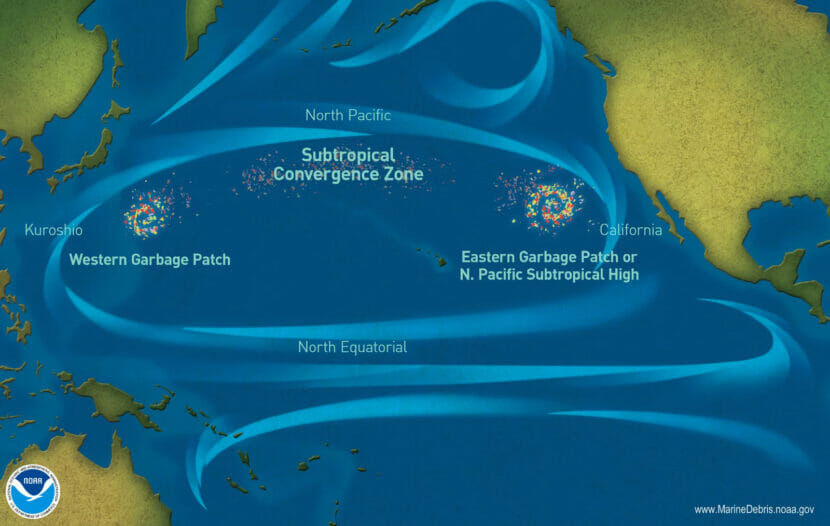
Haram and her colleagues made this discovery after examining 105 items of debris collected from an area known as the Great Pacific Garbage Patch. This region between Hawaii and California has become a giant garbage soup, because currents drag in floating debris that accumulates over time.
Most of the plastic trash from there that was examined by researchers showed signs of being colonized by coastal species.
“As we started going through the plastics, it ended up that we saw coastal species on 70% of the 105 debris items,” says Haram.
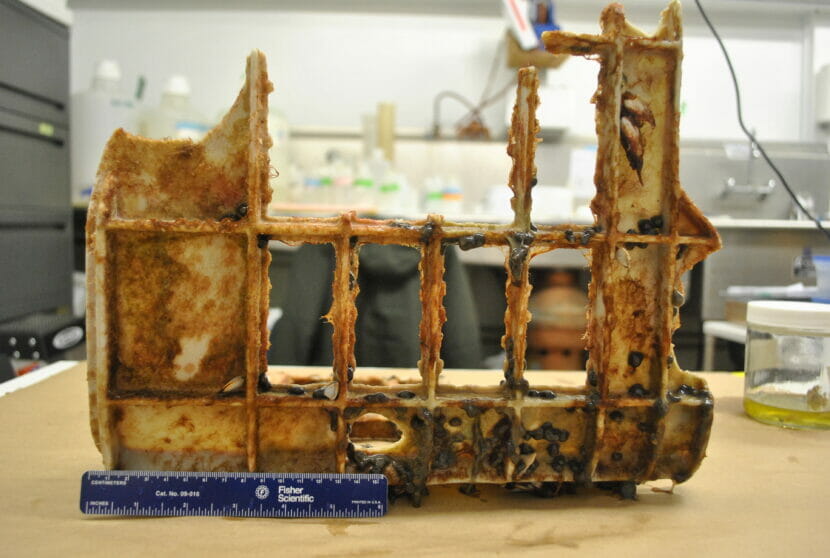
This derelict fish crate found in the Pacific Ocean was home not just to barnacles and other animals that normally live out at sea, but also coastal anemones. (Linsey Haram/Smithsonian)
Even though biologists knew that coastal species can occasionally travel on ships or floating debris, scientists had long thought that coastal species couldn’t live long-term out at sea or establish new communities there.
That’s because differences in temperature, salinity, and the available nutrients found in these two watery environments all seemed like potential deal-breakers.
But the March 2011 tsunami in Japan forced marine biologists to rethink their old assumptions. Identifiable junk from Japan started turning up in places like Hawaii years later, carrying coastal species that had somehow managed to survive.
So Haram and her colleagues decided to sample some of the garbage out in the Pacific, with the help of a nonprofit called The Ocean Cleanup, which had gone out to the Great Pacific Garbage Patch in November of 2018 and January of 2019.
The Earth’s oceans have five “gyres,” which are like whirlpools that pull things in. In each gyre, garbage accumulates in so-called “patches.” The most famous lies between Hawaii and California. (NOAA)
The researchers asked for common plastic trash items like buckets, crates, bottles, household items, ropes, and parts of fish traps. “And then we had a wild-card category, which was if they came across anything that was super weird and interesting but couldn’t necessarily be categorized otherwise,” explains Haram.
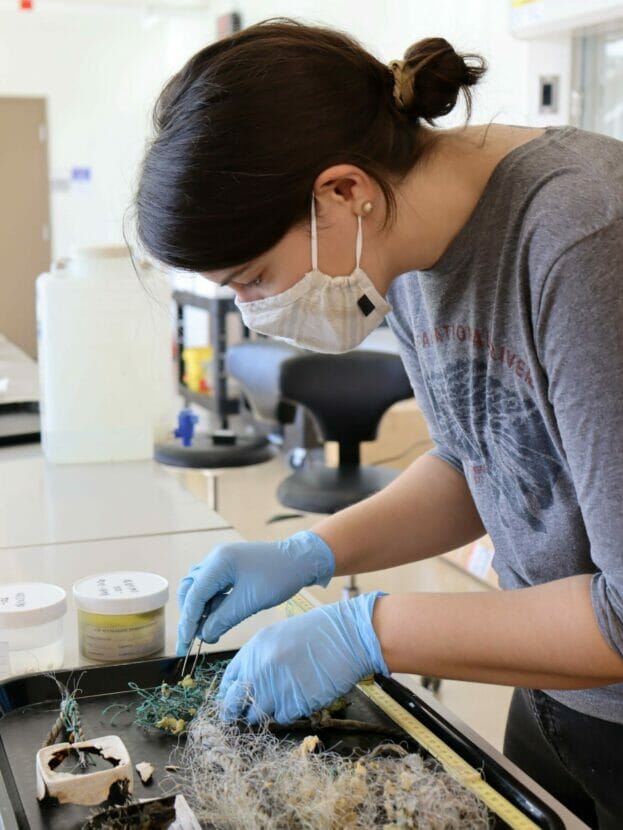
Examining the trash back in the lab, researchers found hundreds of marine invertebrate specimens – and 80% of the species were coastal.
Species already known to live in the open ocean were thriving on the plastic garbage too, says Haram, but “we also saw this very prominent and diverse group of coastal species that honestly, we just wouldn’t have expected to find.”
What’s more, some of the coastal species were reproducing on their makeshift, floating plastic homes. One Japanese anemone, for example, clearly had been making more copies of itself.
Marine ecologist Linsey Haram analyzing sponges and other marine life on plastic debris. (Luz Quiñones/Smithsonian SERC)
“Definitely anemones were the weirdest thing that we saw. We didn’t expect to see them because they didn’t have a very big signature in the Japanese tsunami debris work,” says Haram.
Over two-thirds of the time, there were coastal and open-ocean species living together on the same piece of trash, she says, which means they must now be routinely interacting.
“What that interaction looks like, we’re unsure, but there’s definitely competition for space, right?” says Haram.
The unlikely neighbors also probably compete for food, and may eat each other. The researchers spotted coastal anemones that were eating a kind of purple snail that’s native to the high seas.
The kinds of small creatures examined in this study often serve as food for larger species, so Haram says these findings have possible implications for all kinds of animals higher up the food chain like turtles, fish, and marine mammals.
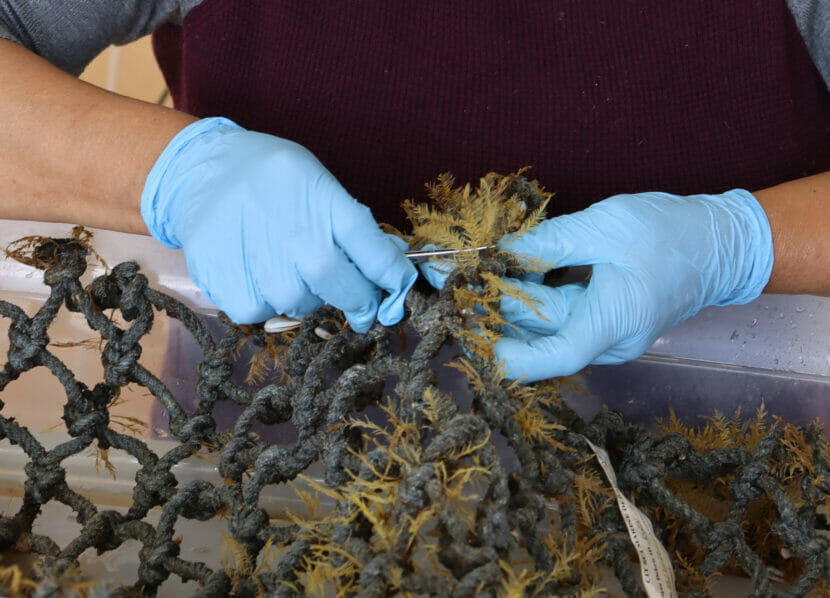
A lab worker at the Smithsonian Environmental Research Center analyzes a net that has been colonized by a mix of coastal organisms and open-ocean organisms. (Linsey Haram/SERC)
“I was surprised that they saw such high numbers of coastal species,” says Sabine Rech, a marine biologist with the Universidad Católica del Norte in Chile, who has studied life on ocean garbage in the South Pacific. “Beyond the surprise, I think the implications could be huge.”
The tsunami event showed that coastal life could survive a long trip at sea, but that was a dramatic, one-off event, she says.
“With the latest research, we see that it’s just something that is normal now, that is happening all the time,” says Rech. “Coastal species are traveling on a regular basis, all the time, away from their habitat.”
That could increase the risk of species finding new places to take hold and become invasive, she says, adding that the idea that coastal species are able to make a go of it out at sea if they just have something durable to anchor onto is “a little revolution” in scientists’ thinking.
“It’s a bit scary,” she says, as well as fascinating.
Rech and her colleagues didn’t see such a diverse array of coastal life when they studied dozens of pieces of debris from the South Pacific, but she says it may be that this is a more harsh, nutrient-poor environment.
On the other hand, says Rech, this study makes her wonder whether the South Pacific really has small numbers of coastal species out there – or if researchers just haven’t found them yet.
“That,” she says, “is what I’d really like to know.”
Copyright 2023 NPR. To see more, visit https://www.npr.org.
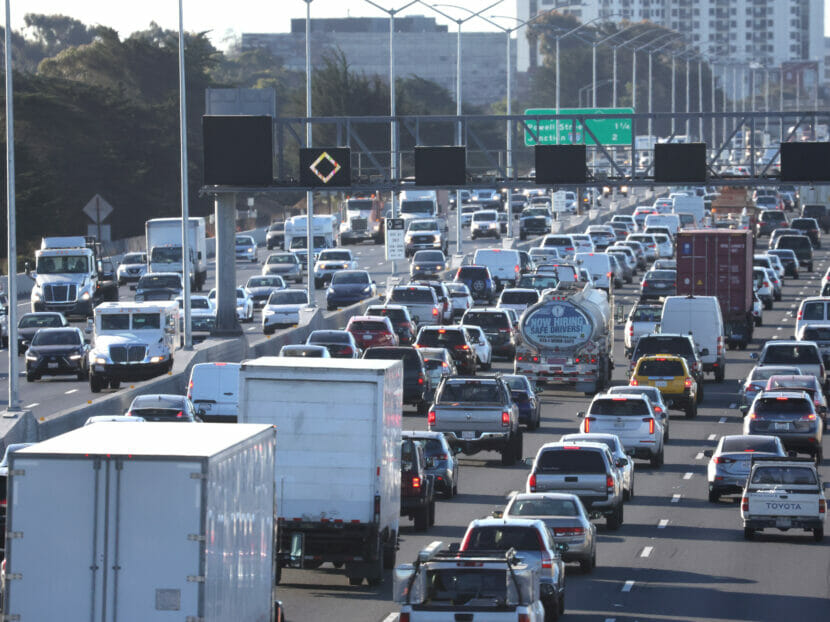
Traffic moves along Interstate 80 in Berkeley, Calif., on Feb. 16, 2022. The Biden administration proposed new tough emission rules so tough it would force auto makers to boost sales of electric cars to meet the requirements. (Justin Sullivan/Getty Images)
The Environmental Protection Agency is proposing its most ambitious new regulations yet for cutting pollution from vehicles.
The overarching goal is not just cleaner cars, but the transformation of the auto industry: The EPA would essentially impose regulatory penalties on companies that do not move quickly enough toward electric cars.
The new standards are so strict that, according to the EPA’s estimates, up to 67% of new vehicles sold in 2032 may have to be electric in order for carmakers to be in compliance.
EPA Administrator Michael Regan says the proposed standards would eliminate 7.3 billion tons of CO2, equivalent to four years worth of the entire U.S. transportation sector, and save lives through reduced air pollution.
He promised the EPA will work closely with labor, the auto industry and green groups to “usher in a new generation” of clean cars.
“We’re going to envision and innovate and achieve this future together,” he said during a call with reporters. “It is well within our grasp. Make no mistake about it.”
Margo Oge, a former EPA official and the chair of the board of the International Council on Clean Transportation, called the regulations “the single most important regulatory initiative by the Biden administration … to really reduce the worst impacts of climate change.”
“The administration is going to make history — if indeed, at the end of the day, they finalize these ambitious standards,” she said in a press conference arranged by the Environmental Defense Fund, an advocacy group.
Before they are finalized, the proposed standards (which include several alternative options) will be open for public comment. They may be revised before they enter into effect. EPA has also proposed new standards for medium-duty and heavy-duty trucks.
Here’s what to know about the proposal.
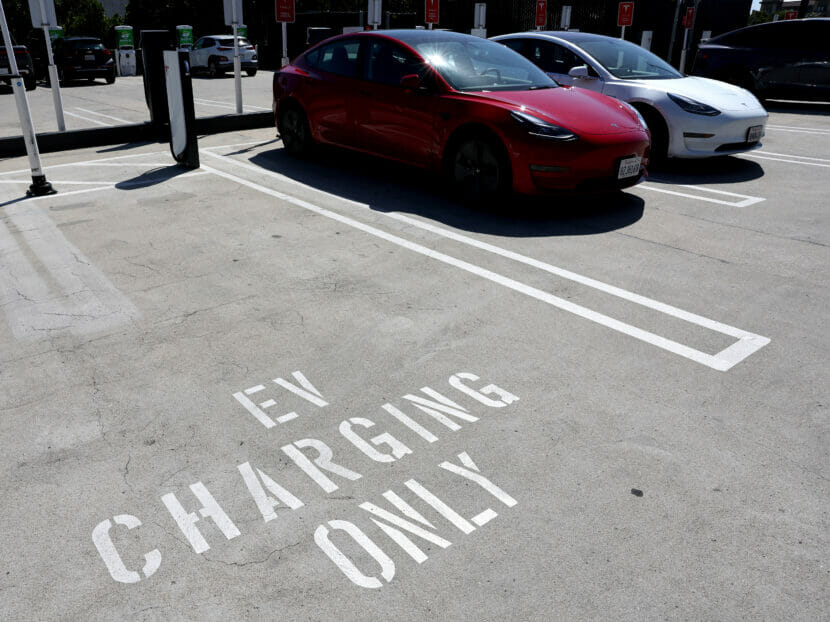
Tesla cars recharge at a Tesla Supercharger station in Pasadena, Calif., on April 14, 2022. The pivot to electric cars depends not only on the automakers ability to produce these cars. It also depends on building the infrastructure needed to support having more electric cars on the roads. (Mario Tama/Getty Images)
What do the standards require?
These proposed standards cover the pollution from vehicle tailpipes — including air pollution that is directly damaging to human health, as well as the greenhouse gases that are fueling catastrophic climate change.
They are separate from the fuel economy standards set by the federal government; new proposals for those rules are expected soon. These are also separate from — and designed differently than — the zero-emission vehicle mandates adopted in California and some other states.
The EPA is not proposing to directly require that 67% of vehicles be zero-emission by 2032.
Instead, it sets a standard for emissions, on average, based on the size and type of vehicle being built. The agency says those new rules are so stringent that it believes companies will need to produce 67% zero-emission vehicles to meet them.
But technically, if automakers came up with another way to meet the rules, they could; the policy is “technology-neutral.”
The new proposed standards would require just 82 grams/mile, on average across a company’s production, by model year 2032. That’s a 56% reduction from the 2026 target.
Exactly one automaker could meet that standard today: Tesla.
Isn’t the auto industry already going electric?
Yes, automakers are already executing a remarkable shift toward electric vehicles, spending hundreds of billions of dollars on new battery plants and production lines.
And the plans companies had already announced were fairly eye-popping.
Ford — which sold 61,575 EVs last year — aims to build 600,000 per year by the end of 2023.
General Motors plans to build a million per year by 2025, an aggressive move from the 39,096 EVs it sold last year.
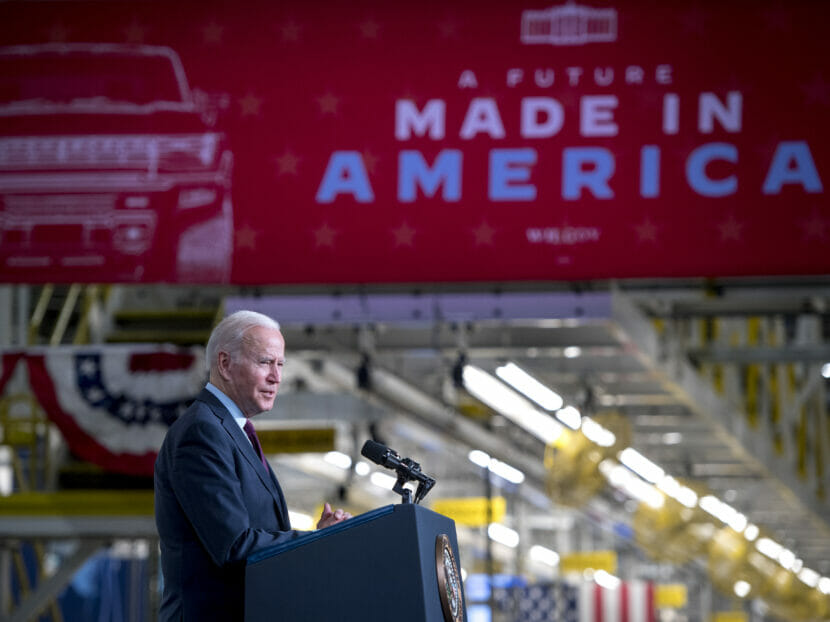
President Biden speaks at the General Motors Factory ZERO electric vehicle assembly plant in Detroit on Nov. 17, 2021. Increasing the adoption of electric cars is a major priority for the Biden administration. (Nic Antaya/Getty Images)
These are all numbers for the North American market, not counting the huge Chinese EV market.
However, companies have different timelines for when they planned to go electric, and many were not publicly planning on being anywhere close to two-thirds electric in the U.S. by 2032.
A number of automakers had balked at President Biden’s previously announced target of having 50% of new cars sold by 2030 be made up of EVs. The EPA proposal is more ambitious — and, unlike that target, it would come with regulatory teeth if it was adopted.
In addition to new rules for cars, trucks and SUVs, the EPA is also proposing standards for medium-duty vehicles, like delivery trucks, and heavy-duty vehicles, like tractor-trailers. If finalized, the EPA predicts these would lead to 50% of buses and 25% of long-haul tractor trailers being electric by 2032.
How will this affect car shoppers?
Some analysts and industry voices are crying foul, saying the EPA is moving unreasonably quickly and would hurt consumers.
The EPA estimates that complying with the proposed rules would add $633 to the cost of making a vehicle in 2027 and about $1,200 per vehicle in 2032.
But drivers would overall save money because EVs are cheaper to operate, the EPA’s analysis found. Car buyers may also benefit from tax credits of up to $7,500.
Overall, the EPA calculates the rules would save the U.S. between $850 billion and $1.6 trillion, including reduced climate change impacts and improvements to health.
Are these rules feasible to implement?
The EPA maintains the rules can be feasibly met, thanks to improving technology and to significant government support for electric vehicles — including loans, grants and tax credits for companies building batteries and electric vehicles, as well as tax credits for consumers buying them.
And it’s certainly true the Biden administration offered many carrots to persuade the auto industry to go electric, in addition to this regulatory stick.
But the auto industry emphasizes that the shift toward electric vehicles requires multiple, simultaneous transformations, including some outside their control.
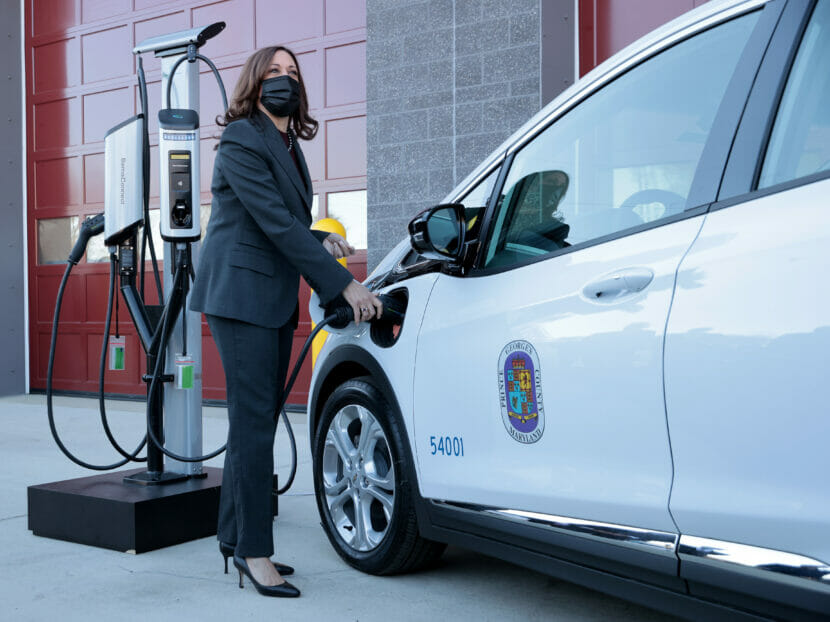
Vice President Kamala Harris plugs an electric vehicle into a charging station in Brandywine, Maryland, on Dec. 13, 2021. The U.S. is spending heavily to build a network of chargers across the country. (Chip Somodevilla/Getty Images)
It’s not currently clear if the world can mine enough minerals or build enough batteries quickly enough to satisfy automakers’ existing production plans, let alone accelerated ones.
Charging infrastructure needs to be built out, as well as the power generation to supply those chargers. Drivers — huge swathes of them, not just a small percentage of enthusiasts or the particularly eco-conscious — would need to embrace a shift away from gas stations and towards chargers.
What’s next?
The proposed regulations will be open for comment, and car makers will likely be very vocal about expressing what they consider they can actually achieve over the next decade.
The proposed rules are also very likely to face a backlash. Republican states, led by Texas, have already sued the EPA over the current version of these vehicle standards, arguing that the body overstepped its authority in crafting those rules with an eye to EV adoption.
And those standards are significantly less ambitious than the rules proposed today.
Notably, the Alliance for Automotive Innovation, the trade group for major automakers, has defended the EPA’s right to set those standards, saying nobody questions the future is electric.
“However this litigation concludes,” the group said in a legal filing, “widespread vehicle electrification is inevitable.”
Copyright 2023 NPR. To see more, visit https://www.npr.org.
Transcript :
MICHEL MARTIN, HOST:
The auto industry is moving towards electric vehicles. The big question is, how fast should it go?
LEILA FADEL, HOST:
Well, the Environmental Protection Agency has chimed in with its answer, which is very fast. The agency just proposed the toughest-ever rules around tailpipe emissions. It’s actually a big push to get the auto industry to focus on electric vehicles. Yesterday, EPA Administrator Michael Regan laid out why.
(SOUNDBITE OF ARCHIVED RECORDING)
MICHAEL REGAN: The stakes could not be higher. We must continue to act with haste and ambition to confront the climate crisis and to leave all our children, like my 9-year-old son Matthew, a healthier and safer world.
MARTIN: As for how the EPA plans to do that, NPR’s Camila Domonoske is here to tell us. Thank goodness. Good morning.
CAMILA DOMONOSKE, BYLINE: Good morning, Michel.
MARTIN: So what exactly is the EPA announcing today?
DOMONOSKE: All right. So these are proposed tailpipe emissions standards. And these tailpipe emissions include both pollution – like smog, right? – stuff that makes people sick – and greenhouse gases. Transportation is the single biggest source of carbon dioxide emissions in the U.S., which is fueling catastrophic climate change. So these are regulations that cover both of these things, and they are about to get, under this proposal, significantly stricter.
MARTIN: So if I have this right, though, Camila, hasn’t the EPA been trying to make cars cleaner for some time now? I’m thinking decades. So what’s different about this?
DOMONOSKE: So the standards are going to take a huge leap in terms of how strict they are. And the way these standards work, it’s not like every single vehicle has to meet the standard, it’s that on average, the whole fleet of cars that a company makes has to meet them. And the new standards are going to be so strict that, hypothetically, a company can meet them however they want. They’re technology neutral standards. That’s what they’re called. But realistically, they’re going to have to make electric vehicles to bring that average down low enough to comply.
Now, I’m going to throw some numbers at you about how many electric vehicles we’re talking. A few years ago, electric vehicles were about 2% of new car sales in the U.S. Right now – 7%. The EPA is looking at 2032 – that’s nine years from now – and they’re envisioning a U.S. where two-thirds of new vehicles are electric.
MARTIN: OK. Wow. So is that even feasible?
DOMONOSKE: At a minimum, it’s really, really hard. It’s not just about making the vehicles, which is its own challenge. It’s having chargers for all of them, electricity to power those chargers. It’s having batteries to put in them. It’s having minerals for those batteries. The challenge here is huge. What the EPA would say is that the government is also providing a lot of support for the transition. There is funding for battery plants and minerals and chargers, right? California and the EU have electric car mandates – slightly different structure, but they have policies that are going to require electric vehicles as well. Lots of companies were going this direction anyway, just not maybe as quickly. So the EPA says if you factor all that in, it is feasible. The auto industry says maybe.
MARTIN: OK. What’s next?
DOMONOSKE: Well, there’s going to be a comment period. These are proposed standards, so expect to hear about feasibility. There will also almost certainly be a political fight – possibly a legal one. The current version of these standards, which is nowhere near as strict, is being challenged in court by red states, led by Texas. One thing that I’ll note as interesting about that – the auto industry has actually chimed in to defend the EPA’s right to set these standards. And they called the shift toward electrification – not necessarily the speed but the overall direction – inevitable.
MARTIN: That is NPR’s Camila Domonoske. Camila, thank you.
DOMONOSKE: Thank you. Transcript provided by NPR, Copyright NPR.
NPR announced it would cease posting to Twitter after the social media platform labeled the nonprofit “Government-funded Media.” (Charles Dharapak/AP)
NPR will no longer post fresh content to its 52 official Twitter feeds, becoming the first major news organization to go silent on the social media platform. In explaining its decision, NPR cited Twitter’s decision to first label the network “state-affiliated media,” the same term it uses for propaganda outlets in Russia, China and other autocratic countries.
The decision by Twitter last week took the public radio network off guard. When queried by NPR tech reporter Bobby Allyn, Twitter owner Elon Musk asked how NPR functioned. Musk allowed that he might have gotten it wrong.
Twitter then revised its label on NPR’s account to “government-funded media.” The news organization says that is inaccurate and misleading, given that NPR is a private, nonprofit company with editorial independence. It receives less than 1% of its $300 million annual budget from the federally funded Corporation for Public Broadcasting.
By going silent on Twitter, NPR’s chief executive says the network is protecting its credibility and its ability to produce journalism without “a shadow of negativity.”
“The downside, whatever the downside, doesn’t change that fact,” NPR CEO John Lansing said in an interview. “I would never have our content go anywhere that would risk our credibility.”
In a BBC interview posted online Wednesday, Musk suggested he may further change the label to “publicly funded.” His words did not sway NPR’s decision makers. Even if Twitter were to drop the designation altogether, Lansing says the network will not immediately return to the platform.
“At this point I have lost my faith in the decision-making at Twitter,” he says. “I would need some time to understand whether Twitter can be trusted again.”
NPR is instituting a “two-week grace period” so the staff who run the Twitter accounts can revise their social-media strategies. Lansing says individual NPR journalists and staffers can decide for themselves whether to continue using Twitter.
In an email to staff explaining the decision, Lansing wrote, “It would be a disservice to the serious work you all do here to continue to share it on a platform that is associating the federal charter for public media with an abandoning of editorial independence or standards.”
For years, many journalists considered Twitter critical to monitoring news developments, to connect with people at major events and with authoritative sources, and to share their coverage. Musk’s often hastily announced policy changes have undermined that. Lansing says that degradation in the culture of Twitter — already often awash in abusive content — contributed to NPR’s decision to pull back.
Musk proves conciliatory and erratic in BBC interview
PBS, which also receives money from the Corporation for Public Broadcasting, and the BBC, which is funded by a uniform license fee charged to British television viewers, are among those whose Twitter accounts were given the same designation.
In the new interview with the BBC’s James Clayton, Musk almost appeared to be seeking a compromise with the journalist. He said Twitter would adjust its labels for the British public broadcaster to “publicly funded.”
“We’re trying to be accurate,” Musk said. “I actually do have a lot of respect for the BBC.” He said the interview offered him a chance to “get some feedback on what we should be doing different.”
When questioned by Clayton, Musk replied that the “publicly funded” label would apply to NPR as well. The change was not made before NPR’s decision on Wednesday morning, however.
The BBC exchange showed Musk as alternately conciliatory and erratic. He also said that he’s sleeping on a couch at work, that he followed through on his promise to purchase Twitter only because a judge forced him to, and that he should stop tweeting after 3 a.m.
“The point is the independence,” NPR leader says
Lansing says Musk is focusing attention on the wrong element of the equation.
“The whole point isn’t whether or not we’re government funded,” Lansing says. “Even if we were government funded, which we’re not, the point is the independence, because all journalism has revenue of some sort.”
NPR’s board is appointed without any government influence. And the network has at times tangled with both Democratic and Republican administrations. For example, NPR joined with other media organizations to press the Obama administration for access to closed hearings involving detainees held by U.S. authorities at Guantanamo Bay. And “All Things Considered” host Mary Louise Kelly stood her ground in questioning then-Secretary of State Mike Pompeo over then-President Donald Trump’s actions in Ukraine despite being berated by Pompeo.
Most of NPR’s funding comes from corporate and individual supporters and grants. It also receives significant programming fees from member stations. Those stations, in turn, receive about 13% of their funds from the CPB and other state and federal government sources.
It isn’t clear that a withdrawal from Twitter will materially affect NPR’s ability to reach an online audience. NPR’s primary Twitter account has 8.8 million followers — more than a million more than follow the network on Facebook. Yet Facebook is a much bigger platform, and NPR’s Facebook posts often are far more likely to spur engagement or click-throughs to NPR’s own website. NPR Music has almost 10 times more followers on YouTube than it does on Twitter, and the video platform serves as one of the primary conduits for its popular Tiny Desk Series.
Musk uses Twitter to question the legitimacy of media outlets
NPR’s decision follows a week of public acrimony, as Musk has used his platform to cast doubt on the legitimacy of major news organizations.
The billionaire, who bought Twitter in October, previously announced he would remove check marks from the accounts of legacy news organizations unless the outlets paid for them. The coveted marks once meant Twitter had verified the authenticity of an account belonging to a news organization, government or public figure. Now, they can be bought through a monthly subscription.
Musk also singled out The New York Times earlier this month, removing its check mark and calling its reporting “propaganda.” Twitter’s communications shop now simply responds to reporters’ emails with poop emojis.
At least three public radio stations preceded NPR to the exits at Twitter: Member stations KCRW in Santa Monica, Calif., WESA in Pittsburgh and WEKU, which serves central and eastern Kentucky.
Fears that Twitter label could endanger journalists
Journalism and freedom-of-speech groups have condemned Twitter’s labels, including PEN, the Reporters Committee for Freedom of the Press and the Committee to Protect Journalists.
“NPR receives public funding, but is not state-controlled, meaning Twitter’s listing could pose risks for journalists reporting from areas where suggestions of government affiliation have negative connotations,” CPJ’s Carlos Martínez de la Serna said in a statement urging Twitter to revisit its decision.
Twitter’s own guidelines previously said, “State-financed media organizations with editorial independence, like the BBC in the UK or NPR in the US for example, are not defined as state-affiliated media for the purposes of this policy.”
That language has now been removed. In addition to NPR and the BBC, Twitter recently labeled the U.S. broadcaster Voice of America as government-funded media. Voice of America is part of the federal U.S. Agency for Global Media. But its editorial independence from government officials — at times hard won — is enshrined by law.
“The label ‘government funded’ is potentially misleading and could be construed as also ‘government-controlled’ – which VOA is most certainly not,” VOA spokesperson Bridget Serchak said in a statement to NPR.
Serchak says VOA will continue to raise the distinction in talks with Twitter as the label “causes unwarranted and unjustified concern about the accuracy and objectivity of [its] news coverage.”
At Elon Musk’s Twitter, unpredictability is the norm
Like so many policy decisions at the social network of late, Musk applied the label to NPR’s Twitter account abruptly. It’s still not clear why he became so animated about the issue.
In his exchanges with NPR reporter Allyn, Musk said he was relying on a Wikipedia page dedicated to “publicly funded broadcasters” to determine which accounts should receive the label.
When pressed for how he justifies the disclaimer considering NPR receives meager funding from the government and has complete editorial independence, Musk veered into conspiratorial territory.
“If you really think that the government has no influence on the entity they’re funding then you’ve been marinating in the Kool-Aid for too long,” Musk wrote to Allyn.
Musk’s push to label the network even ran afoul of the site’s own rules. A former Twitter executive who was involved in crafting the guidelines told NPR that the deciding factor in whether to issue the designation was whether an outlet had editorial freedom. The labels, the former executive said, were intended to give users context that a tweet they are seeing may be propaganda.
The messy deliberations on display in Musk’s email exchanges over labeling NPR’s account are in line with his impulsive leadership style. His changes to the platform often are announced by tweet, with sudden reversals not uncommon, or promised changes never coming to fruition. Because Musk relishes troll-like behavior, there is always a possibility that his pronouncements turn out to be jokes. He has announced that the effective date for the change in the check mark verification system is April 20. The date is an inside joke among people who smoke or consume marijuana.
Disclosure: This story was reported and written by NPR Media Correspondent David Folkenflik and edited by Acting Chief Business Editor Emily Kopp and Managing Editor Vickie Walton-James. NPR’s Bobby Allyn and Mary Yang contributed to this story. Under NPR’s protocol for reporting on itself, no corporate official or news executive reviewed this story before it was posted publicly.
Copyright 2023 NPR. To see more, visit https://www.npr.org.
Liz Southers runs a commercial insulation company in South Florida. She says the company could grow faster if it had access to more credit. (SouthCo Insulation)
Weeks after the collapse of two big banks, small business owners are feeling the pinch.
Bank lending has dropped sharply since the failures of Silicon Valley and Signature Banks. That not only hits businesses. It also threatens a further slowdown in economic growth while raising the risk of recession.
Credit, after all, is the grease that helps keep the wheels of the economy spinning. When credit gets harder to come by, businesses start to squeak.
Take Kryson Bratton, owner of Piper Whitney Construction in Houston.
“Everybody is, I think, very gun-shy,” Bratton says. “We’ve got the R-word — recession — floating around and sometimes it feels like the purse strings get tighter.”
Bratton has been trying to get financing for a Bobcat tractor and an IMER mixing machine to expand her business installing driveways and soft playground surfaces.
But banks have been reluctant to lend her money.
“It’s not just me,” she says. “Other small businesses are struggling with the same thing. They can’t get the funds to grow, to hire, to buy the equipment that they need.”
Missed opportunities
Tight-fisted lenders are also weighing on Liz Southers, who runs a commercial insulation business in South Florida.
Her husband and his brother do most of the installing, while she handles marketing and business development.
“There’s no shortage of work,” Southers says. “The construction industry is not slowing down. If we could just get out there a little more and hire more people, we would just have so much more opportunity.”
Liz Southers and her husband, James Southers, at their business in Florida. Liz Southers says her business would take more assignments, but finding credit is proving difficult. (SouthCo Insulation)
Southers says it often takes a month or longer to get paid for a job, while she has to pay her employees every week. If she had a line of credit to cover that gap, she could hire more people and take on more work. But while her bank has been encouraging, she hasn’t been able to secure any financing.
“They’re like, ‘Your numbers are incredible.'” Southers says. “But they’re like, ‘You guys are still pretty new and we’re very risk averse.'”
Caution overkill?
Even before the two banks failed last month, it was already more costly to borrow money as a result of the Federal Reserve’s aggressive interest rate hikes.
Other lenders are now getting even stingier, spooked by the bank runs that brought down Silicon Valley Bank and Signature Bank.
The Federal Reserve Bank of Dallas surveyed 71 banks late last month, and found a significant drop in lending. Weekly loan data gathered by the Federal Reserve also shows a sharp pullback in credit.
Alex Cates has a business account and a line of credit with a bank in Huntington Beach, Calif.
“We’ve got a great relationship with our bank,” Cates says. “Randy is our banker.”
Cates decided to check in with Randy after the collapse of Silicon Valley Bank to make sure the money he keeps on deposit — up to $3 million to cover payroll for 85 employees — is secure.
People line up outside of a Silicon Valley Bank office in Santa Clara, Calif., on March 13, 2023. in Santa Clara, California. Depositors lined up to retrieve their money even after after regulators rescued the tech-focused lender. (Justin Sullivan/Getty Images)
Randy assured him the money is safe, but added Cates was lucky he renewed his line of credit last fall. If he were trying to renew it in today’s, more conservative climate, Randy warned he might be denied.
“Just because you’re only a 2-and-a-half-year-old, almost 3-year-old business that presents a risk,” Cates says.
As a depositor, Cates is grateful that the bank is extra careful with his money. But as a businessperson who depends on credit, that banker’s caution seems like overkill.
“It’s a Catch-22,” he says. “I’ve got $3 million in deposits and you’re telling me my credit’s no good? We’ve never missed a payment. They have complete transparency into what we spend our money on. But now all of a sudden, we could have been looked at as an untenable risk.”
The broader impact is hard to predict
As banks cut back on loans, it acts like a brake on the broader economy. That could help the Federal Reserve in its effort to bring down inflation. But the ripple effects are hard to predict.
“You want the economy to cool. You want inflation to come back towards the 2% target. But this is a profoundly disorderly way to do it,” says Joe Brusuelas, chief economist at RSM.
And lenders aren’t the only ones who are getting nervous. Bratton, the Houston contractor, has her own concerns about borrowing money in an uncertain economy.
“Even though I would love to have an extended line of credit, I also have to look at my books and say how much can I stomach sticking my neck out,” she says. “I don’t want to be stuck holding a bag if things flip on a dime.”
Copyright 2023 NPR. To see more, visit https://www.npr.org.
Transcript :
AYESHA RASCOE, HOST:
Credit is the grease that keeps the wheels of the economy spinning. And as credit gets harder to come by, some businesses are starting to squeak. NPR’s Scott Horsley reports what the credit crunch, which started even before the collapse of two large banks last month, could mean for the economy as a whole.
SCOTT HORSLEY, BYLINE: Liz Southers runs a commercial insulation business in South Florida. Her husband and his brother do most of the installing. She handles marketing and business development.
LIZ SOUTHERS: There is no shortage of work. The construction industry is not slowing down. If we could just get out there a little more and hire more people, we would just have so much more opportunity.
HORSLEY: But Southers says it often takes a month or more to get paid for a job, while she has to pay her employees every week. She’d like to get a line of credit to cover that gap so she could hire more people and grow the business. But while her bank’s been encouraging, they haven’t put up any money.
SOUTHERS: They’re like, your numbers are incredible. But they’re like, you guys are still pretty new, and we’re very risk-averse.
HORSLEY: Kryson Bratton knows that frustration. She runs a business in Houston that turns recycled materials into driveways, parking lots and those squishy soft surfaces you now find under a lot of playgrounds. Right now, she’s got more work than she can handle.
KRYSON BRATTON: I’m currently telling customers, I can’t touch your job until September. And these are contracted jobs that they’re waiting for me.
HORSLEY: Bratton could move faster and take on more work if she had a Bobcat tractor to handle excavation and a larger machine for mixing materials. But even though she has a nine-year track record, banks are wary about extending additional credit.
BRATTON: Everybody, I think, is very gun-shy. I mean, we’ve got the R-word, recession, floating around. And, sometimes, it feels like the purse strings get tighter. And it’s not just me. Other small businesses are struggling with the same thing. They can’t get the funds to grow, to hire, to buy the equipment that they need.
HORSLEY: The Federal Reserve Bank of Dallas surveyed 71 banks late last month and found a significant drop in lending. It already costs more to borrow money as a result of rising interest rates. And now lenders are expected to get even stingier. After the collapse of Silicon Valley Bank last month, Alex Cates called the bank in Huntington Beach, Calif., where he keeps his business account and has a line of credit.
ALEX CATES: We’ve got a great relationship with our bank. Randy’s our banker. I was just checking in.
HORSLEY: Cates runs a consulting business with 85 employees, so he often keeps 2 or $3 million in the bank to cover payroll, well over the limit that’s ordinarily insured. Cates says Randy assured him that his money is safe and stressed the bank is very conservative.
CATES: Through that conversation, he said, just FYI, not that, you know, we think any differently about your business, Alex. Had the banking situation happened in December, for example, I don’t know that we could have gotten your line of credit renewed just because you’re only a 2 1/2, almost 3-year-old business, and, you know, that presents a risk.
HORSLEY: And there’s the double-edged sword. As a depositor, Cates is grateful that the bank is extra careful with his money. But as a business that depends on credit, that banker’s caution can seem like overkill.
CATES: It’s a catch-22. You know, we have 3 million in deposits, and you’re telling me my credit’s no good. We’ve never missed a payment. They have complete transparency into what we spend our money on. But now all of a sudden, we could have been looked at as a untenable risk.
HORSLEY: And as banks across the country get more cautious, that acts like a brake on the broader economy. That’s not all bad. It might help to bring down inflation. The Fed thinks tighter lending standards could work sort of like an extra boost in interest rates. But Joe Brusuelas, who’s chief economist at the consulting firm RSM, says the ripple effects are hard to predict.
JOE BRUSUELAS: You want the economy to cool. You want inflation to come back towards the 2% target. But this is a profoundly disorderly way to do it.
HORSLEY: And lenders aren’t the only ones who are getting nervous. Bratton, the Houston contractor with all those driveways and playgrounds to install, has her own concerns about which way the economy is headed.
BRATTON: Even though I would love to have an extended line of credit, I also have to look at my books and sit there and say, how much can I stomach sticking my neck out? Because I don’t want to be stuck holding a bag if things flip on a dime.
HORSLEY: Often the availability of credit is closely tied up with confidence. When credit dries up, even risk-taking businesspeople may find their confidence shaken. Scott Horsley, NPR News, Washington.
(SOUNDBITE OF MUSIC) Transcript provided by NPR, Copyright NPR.
Close
Update notification options
Subscribe to notifications
Subscribe
Get notifications about news related to the topics you care about. You can unsubscribe anytime.

9(MDEwMjQ0ODM1MDEzNDk4MTEzNjU3NTRhYg004))
9(MDEwMjQ0ODM1MDEzNDk4MTEzNjU3NTRhYg004))
9(MDEwMjQ0ODM1MDEzNDk4MTEzNjU3NTRhYg004))
9(MDEwMjQ0ODM1MDEzNDk4MTEzNjU3NTRhYg004))
9(MDEwMjQ0ODM1MDEzNDk4MTEzNjU3NTRhYg004))