Pew Charitable Trusts

Some States Seek Payday in Daily Fantasy Sports Sites

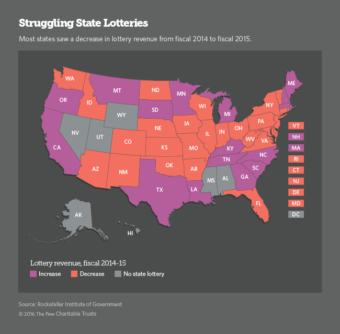
At a time when state taxes from traditional gambling like lotteries and casinos are flat or declining, a majority of states are now seeking to regulate — and possibly raise revenue from — daily fantasy sports sites.

Sites such as DraftKings and FanDuel contend they run games of “skill,” in which knowledgeable sports fans put together teams of players based on their abilities and compete against other fans. But many states have balked, calling the sites unregulated gambling. Some states have shut them down, and at least 30 states either have approved or are considering legislation to bring the games under state governance.

Entry fees for daily fantasy sports were more than $2 billion last year and could reach $14 billion by 2020, according to Adam Krejcik of the research firm Eilers & Krejcik Gaming LLC.

Only a few states are either currently tapping, or soon could be tapping, fantasy sports games for revenue — either through flat fees or income taxes. Others are likely to follow, according to the National Conference of State Legislatures, which tracks the issue.

“I don’t think we’re going to see a whole lot this year on revenue,” said Max Behlke, manager of state-federal relations for NCSL. “I think that’s a next-year issue. This year it is regulating and legality.”

Some States Seek Payday in Daily Fantasy Sports Sites

Illinois a Leader

One state taking a hard look at how to raise revenue from fantasy sports sites is Illinois, where a budget impasse has left the state scratching for revenue. A bill that would regulate and tax the fantasy sports industry is moving through the House this month.

State Rep. Michael Zalewski, a Democrat from the Chicago suburb of Summit and the main sponsor of the measure to regulate and tax the gaming sites, said he wants to “bring them into line with other forms of gaming and entertainment.”

Zalewski’s bill would tax the sites based on the amount of revenue and profit they generate. Ones that have more than $10 million in revenue would pay a $50,000 licensing fee. Those with less than $100,000 in revenue would pay $1,500. And income would be taxed on a sliding scale, with companies that make more than $15 million in revenue annually paying the highest rate of 22.5 percent.

“We’re in a position where we need all forms of revenue,” Zalewski said; he had no estimate of how much revenue the bill, if passed, would actually generate for the state.

For the most part, FanDuel and DraftKings support regulation. Without it, they worry, some states will simply ban them. That’s what Illinois, New York and Massachusetts initially did, which sent the issue to the courts. New York reached a settlement with the companies last month that suspends the games there until September, pending action on a bill in the Legislature.

In Massachusetts, Democratic Attorney General Maura Healey set rules for the sites, including a prohibition on play by anyone under 21. She required casual players to be alerted that they are competing against veteran players by labeling those who enter more than a thousand contests or win big prizes as “highly experienced,” and demanded beginner games from which experienced players are banned. Players also are prohibited from creating multiple screen names to hide their identity.

Games of Skill?

Peter Schoenke, chairman of the Fantasy Sports Trade Association, the industry lobbying group that represents FanDuel and DraftKings, among other sites, said the organization supports most state regulations that “clarify” that fantasy sports are legal and should be subject to basic consumer protection measures.

Schoenke said his organization recognizes that there are costs associated with regulation, so it doesn’t object to paying fees. He described the $50,000 flat fees approved by Virginia and Indiana as high, and praised the sliding scale that Illinois envisions as more palatable.

The Virginia law, which takes effect July 1 and also prohibits minors from playing, was praised by FanDuel and DraftKings. In addition to prohibiting minors from playing, the Indiana law bans fantasy games based on college or high school sports. Kansas last year classified fantasy games as legal with an opinion by Republican Attorney General Derek Schmidt, but did not set any regulations.

Lawmakers in Rhode Island and California also are considering legislation. The Rhode Island bill, co-sponsored by Democratic state Rep. Deborah Ruggiero, requires an initial registration fee of $50,000, and $20,000 each year thereafter, as well as a 20 percent levy on the amount wagered by Rhode Island residents playing the games, which would go to the state’s general fund.

“I’m not opposed to it [the games],” Ruggiero said. “I’m a player. I’ve actually won.”

In California, the Assembly approved a bill that would explicitly legalize and regulate the sites and collect fees for the state. The Senate has not yet voted on it. Groups that oppose all gambling are leading the fight against the legislation.

The Rev. James Butler, head of the California Coalition Against Gambling Expansion, said regardless of how the gaming is regulated, “it would be an expansion of gambling we already have. For that reason alone, we would oppose it.”

Butler said he also worries that legalizing the sites would increase their popularity and result in more people gambling or in people gambling more. He maintained that increases in crime, unemployment, homelessness and bankruptcy can be attributed to gambling.

Battle in New York

New York sprang to the fore of the fantasy imbroglio last year when Democratic Attorney General Eric Schneiderman declared the sites illegal and shut them down. A bruising court battle followed, and the companies agreed in March to stop operating in New York until state lawmakers take action.

State Sen. John Bonacic, a Republican, is sponsoring a bill that would require the companies to register with the state and subject them to regulation. The bill calls for a one-time $500,000 registration fee, which can be applied to offset taxes paid over the first three years of operation and includes a 15 percent tax on gross revenue generated from players in New York.

Seth Young, vice president and chief operating officer of Flower City Gaming LLC in Rochester, N.Y., a company that runs the smaller fantasy site Star Fantasy Leagues, said $500,000 in licensing fees is too high.

“Even $50,000 in Virginia is too high,” he said. “For the smaller operators, it doesn’t make sense for them to pay that kind of money if they are not going to make that kind of money in that state.”

Young suggested that states may not reap as much from fantasy sports as they think they can.

In a report titled “State Revenues from Gambling: Short-term relief, long-term disappointment,” the Rockefeller Institute of Government said gambling revenue has softened in recent years as more states get into the gaming business or expand it.

Lotteries account for two-thirds of state and local gambling revenue; commercial casinos account for 19 percent and racinos (which combine race tracks and casinos) account for 12 percent.

Overall lottery revenue declined by 0.7 percent in 2015, the report said, with 27 states reporting declines. That was the second consecutive year of decline. Revenue from casinos and racinos increased an anemic 1.1 percent, but the growth was attributable mostly to Maryland and Ohio, which recently legalized operations and opened more facilities.

Between 2008 and 2015, inflation-adjusted tax and fee revenue from commercial casinos grew by more than $1.3 billion in states with newly authorized casinos, the report said, but declined by $1.4 billion in states with established casinos, for a net decline of 1.5 percent nationally.

“For state legislators, it is much harder to raise taxes on income or sales or cut spending on education or other vital services, while legalizing and expanding gambling is seen as a relatively easy and painless source of revenue and job growth,” said Lucy Dadayan, the Rockefeller analyst who wrote the report.

“However,” Dadayan said, “the history and trends indicate that tax revenues from gambling are not lucrative, and counting on tax revenues from gambling is ‘gambling’ by itself.”

Read original article
Some States Seek Payday in Daily Fantasy Sports Sites

What Is a Smart City?

Kansas City, Mo., is launching its smart city efforts along its new streetcar corridor. (Photo courtesy of Pew Charitable Trusts)

KANSAS CITY, Mo. — On the new streetcars that will start running in Kansas City next week, there’s a decal that says “KC is a smart city.” As the streetcars clang through the downtown business district on trial runs, pedestrians can watch the sentence slide by.

Along the 2-mile streetcar line, Kansas City is installing video sensors to spot badly parked cars, traffic lights that are programmed to keep traffic flowing and digital kiosks that serve as city guides. All this, the city says, helps makes it smart.

But the truth is that there’s no clear definition of a smart city, a label that many cities are grabbing onto by integrating some information technology into some city services.

“The concept of a smart city is somewhat amorphous, but it’s focused on cities leading with technological innovation,” said Brooks Rainwater of the National League of Cities.

“It’s just using digital technology to improve community life,” said Jesse Berst of the Smart Cities Council.

“It’s a paradigm shift in the way we think,” said Kate Garman, the innovation analyst for Kansas City.

Some smart city advocates emphasize efforts to engage and connect with residents, others emphasize infrastructure. But the general goal — something no city has yet achieved — is to collect immediate data on everything from traffic patterns to home water use, analyze it, and use that information to make the city work better.

“We have some cities moving in that direction, but a lot more doing little one-offs, really,” said Stephen Goldsmith of the Harvard Kennedy School of Government, a former mayor of Indianapolis and former deputy mayor of New York.

Advocates say smart city technology will save cities money and energy, while better connecting cities and citizens. The White House announced $160 million in spendingto research and develop smart city technology. British government researchersestimated in 2013 that the global market for such technology would reach $408 billion by the end of the decade.

But as cities like Kansas City are finding, being smart doesn’t just mean installing new gadgets. It really means changing the way city agencies operate and learning to balance that against security and privacy concerns.

Kansas City’s Smart Corridor

Kansas City has already installed two digital kiosks, the first of 25, near the streetcar line. “They’re in beta testing, so they might not work,” Garman warned recently as she approached a 7-foot unit on the wide and empty sidewalk.

She touched the icons on the kiosk’s touch screen — it worked. They opened to offer information about local news, attractions and public transit. A related smartphone app will push restaurant deals and other promotions to users.

A few blocks away, sensors wired on top of energy-saving LED streetlights will alert the city to cars parked in the streetcar’s path and brighten lights automatically when more than six people pass by.

Modems clamped to lampposts will provide free wireless internet. Updated traffic lights will use advanced computing to keep vehicles moving to avoid congestion.

The features along the streetcar line aren’t revolutionary. The kiosks mostly serve as a high-tech visitor’s guide. In a metropolitan area that sprawls across two states, a few miles of programmable lights and Wi-Fi seem very small.

But Kansas City’s latest smart city efforts, to be launched along with the streetcars, could grow into something bigger. “What you see now is technically called phase one. What phase two is, we still don’t know,” said Garman, a part-time law student and half of the city’s two-person innovation staff.

Kansas City will truly become a smart city when it starts using all this technology to find problems and fix them, she said.

The streetcar corridor isn’t the city’s first investment. In 2010, the state-run police department bought scanners that automatically collect license plate data from passing cars. In 2011, the local electric utility finished installing over 14,000 smart meters in homes and businesses. And in 2012, Google installed internet cables with speeds up to 1 gigabit here.

Kansas City is a finalist for the U.S. Department of Transportation’s $40 million Smart City Challenge, which will fund investments in driverless cars, connected vehicles and sensors. If it wins, the city will develop a self-driving shuttle from the international airport to downtown and expand the kiosks and sensors to other parts of the city, among other initiatives.

As part of its streetcar corridor, Kansas City has also issued an open invitation to entrepreneurs who are developing technologies that could improve city services. A few cybersecurity companies and a drone company are already interested in testing their products here, according to Herb Sih of Think Big Partners, a startup accelerator.

Drones, for example, could help the city save money on searching for an elderly person with a mental disability who goes missing, Sih said. He described a California company that’s developing drones that connect to wristbands; when an alert is issued, a drone can find and hover over the missing person.

The City as a Customer

Getting city bureaucracies to think creatively, using data, is the biggest obstacle aspiring smart cities face, Goldsmith said. “Government is highly mechanistic in how it’s organized.”

To aid with the transition, the Kansas City Council last year established a chief data officer position and designated contacts in charge of data in every branch of city government.

Like most cities, Kansas City will rely on outside contractors to build its smart city infrastructure. It has had to figure out how to vet vendors — who, in some cases, are hawking technology that seems straight out of science fiction — and think carefully about security and privacy.

“We get approached by vendors constantly,” Garman said. “There’s so much out there, it’s crazy.”

Kansas City didn’t plan to add sensors, kiosks and Wi-Fi along its streetcar line until it was approached by Cisco Systems Inc., a multinational technology company looking for a city to debut its smart cities software.

Cisco and Think Big Partners researched city agencies to find areas where technology could improve services. The companies and the city agreed on the streetcar corridor as a starting point. Cisco helped identify subcontractors who had the kind of technology the city wanted.

The result is a patchwork of technologies run by corporate partners: a Wi-Fi network run by Sprint Corp., video sensors run by Sensity (a lighting technology company), kiosks run by Smart City Media (a company that makes interactive signs for cities), and — as part of a separate contract — traffic lights run by Rhythm Engineering (a traffic management company).

Cisco made sure Kansas City installed the newest and best technology, Garman said. All told, the city has only had to allocate $3.7 million toward the projected $15.7 million cost of the 10-year partnership, and will share with Smart City Media some of the money raised by advertising on the kiosks.

Not all cities are becoming partners with big corporations. Boston’s innovation office is a little more leery of buying software from them. Often, software engineers at such companies don’t know what problems cities actually face, said Nigel Jacob, co-chair for the Boston mayor’s Office of New Urban Mechanics.

Jacob’s team has worked on research projects for the city since the office was set up in 2010. In the process, it has learned that new technology doesn’t fix every problem.

For example, almost half of requests for city services now come through an app Jacob’s team built. But the app hasn’t engaged new groups of people. Homeowners, the group most likely to call in a problem, are also the most likely to use the app.

Smart City or Surveillance City?

As cities add more sensors, analyze more data, and use advanced computer programming to run traffic lights and even vehicles, they’re increasingly confronting new ethical, legal and policy questions.

Smart city technology exposes infrastructure and potentially personal data to computer malfunctions and hackings. The more data cities collect, the easier it’ll be to aggregate a detailed picture of an individual’s life.

What smart city advocates call data collection their critics call surveillance.

“From an ideal privacy perspective, much of this technology is a bad idea,” said Jeffrey Mittman, head of the American Civil Liberties Union of Missouri. But technologies such as license plate scanners and drones exist, and are being used. So the question becomes how to manage the data collected, he said.

Kansas City has tried to address privacy concerns in a few ways. In April 2015, the City Council passed a resolution that laid out a number of basic data privacy principles, including a promise to consider public well-being before collecting, using and disclosing personal information.

Kansas City contractually owns all the data collected by Cisco, Sensity and Smart City Media, such as the most popular time of day for accessing a certain kiosk in a certain location. The companies can’t sell or use the data without permission. The kiosks will be able to use the interactions between users and devices to sell advertising. That’s how they’ll raise revenue.

Sprint owns the Wi-Fi data, and will follow the usual industry practice of having users click yes on a user agreement.

The city is choosing to collect less data than it could, Garman said. Her office will receive only bulk data, although cameras in the kiosks and lights will record video footage. The city will only request that footage in an emergency, such as a terrorist attack. Because it won’t have the footage, it won’t have to release it in response to a public information request.

Garman said that some potential uses of the light sensors will require users to opt in — for example, to get a text message alert when their car is parked in the streetcar’s path.

Although Kansas City’s innovation office holds periodic events to educate the public about its projects, Mittman thinks the city should do more. “The average Kansas Citian likely doesn’t know how they’re being tracked,” he said.

Chances are, the average Kansas Citian is already being tracked by private companies. Think of how Google saves everyone’s search history, or how retailers can now use video cameras to track customers through the store or use Bluetooth beacons to send customers promotions.

“This is the future, and as a city government we need to be responsive to our citizens’ expectations,” Bennett said. “And as we move toward the 22nd century we need to be a data-driven organization, we need to be connected.”

Read original article
What Is a Smart City?

An Opioid Treatment Model Spawns Imitators

A patient gets a dose of the anti-addiction medicine buprenorphine at the Broadway Center for Addiction in Baltimore, whose treatment methods for opioid addiction are viewed as a model for other clinics. (Photo courtesy of Pew Charitable Trusts)

BALTIMORE — Dr. Kenneth Stoller held court on the sidewalk outside the Broadway Center for Addiction on a sunny afternoon last week, chatting with a troop of lingering patients. He beamed as he patted a young man on the shoulder and said he’d see him tomorrow.

“It’s important for patients to see this as a place that’s safe and accepting,” he said. “For some, it’s the first place they’ve gotten positive reinforcement in their lives.”

Operated by Johns Hopkins Hospital and located two blocks from its main campus, the Broadway Center — or “911” as it’s called because of its address at 911 N. Broadway — has provided methadone maintenance therapy for people with opioid addiction for more than two decades.

But unlike most of the roughly 1,400 methadone clinics across the country, the Broadway Center offers not only methadone, but the two other federally approved addiction medications, buprenorphine and naltrexone, and a full complement of mandatory addiction counseling and group classes. In most other places, addiction treatment is fragmented, leaving patients to shop around for the care they need or settle for whatever is offered at their local opioid treatment clinic.

“If you went to a doctor for any other disease, you’d expect to be offered all available treatment options,” said Dr. David Gastfriend, scientific adviser at the Philadelphia-based Treatment Research Institute, which studies substance abuse treatment. “Addiction treatment should be no different.”

The Broadway Center also collaborates with more than 30 office-based physicians inBaltimore who are licensed to prescribe buprenorphine. Local doctors refer their patients with addiction to the center, which in turn refers its addiction patients to local doctors for physical health care.

Doctors and researchers agree that addiction medications are the most effective weapons available to combat the country’s worsening opioid epidemic. But those medicines are reaching only a fraction of the people who need them.

The center, which operates as a hub for all services for addicts in the city, including housing, transportation and job training, was recognized last year by the U.S. Office of National Drug Control Policy as a model for improving the quality of and access to much-needed opioid addiction services.

Under a grant from the U.S. Substance Abuse and Mental Health Services Administration, Stoller is sharing the details of the program and its outcomes with states beyond Maryland.

So far, Oregon and Washington state have emulated the so-called collaborative opioid prescribing program at some of their existing methadone clinics. Rhode Island is gearing up to launch similar programs at every methadone maintenance center in the state.

Georgia and New Mexico are attempting to recreate the collaborative program, but have so far been unable to convince local physicians to sign up, Stoller said.

Key to the Broadway Center’s success is Maryland’s expansion of Medicaid to low-income adults under the Affordable Care Act and its coverage of methadone at opioid treatment programs.

According to a survey by the American Society of Addiction Medicine, Medicaid programs in 20 states — Alaska, Arkansas, Colorado, Idaho, Illinois, Indiana, Iowa, Kansas, Kentucky, Louisiana, Mississippi, Montana, Nebraska, North Dakota, Oklahoma, South Carolina, South Dakota, Tennessee, West Virginia and Wyoming — do not cover methadone. States also vary in their Medicaid coverage of the other two addiction medications, buprenorphine and Vivitrol, which is a long-acting, injectable form of naltrexone.

Two states — North Dakota and Wyoming — have no methadone clinics; a third — Mississippi — has just one.

Decades of Bias

After research in 1964 showed that the synthetic opioid methadone was highly effective at reducing drug cravings and preventing relapses among heroin addicts, methadone clinics began cropping up across the country, mainly in urban areas most affected by drug use. Their services are typically limited to giving addicts daily doses of methadone, testing urine for drugs, and, to varying degrees, counseling.

From the beginning, methadone clinics were stigmatized by the belief that maintenance treatment merely substituted one drug for another, a bias that persists today. And despite tight regulation by the federal government, critics complain that methadone is diverted to the black market.

As a result, methadone clinics have generally operated outside mainstream medicine, and with little connection to other public health and social services. The Broadway Center is an exception.

When buprenorphine, an opioid similar to methadone but safer, was approved by the U.S. Food and Drug Administration in 2002, the Broadway Center immediately began dispensing it. And when Vivitrol, which blocks opioids and reduces cravings but is not itself an opioid, was approved in 2007, it was added to the center’s roster of medication options. Over the years, the center also has created a robust set of behavioral and general health classes, as well as individual counseling.

But it wasn’t until 2009, when Stoller became director, that the center began collaborating with outside medical centers.

“It was fortuitous,” he said. “We lost our block grant so we needed new patients with insurance. I visited primary care and psychiatric sites to get referrals from physicians who wanted their patients to receive treatment for substance use disorders.”

In doing so, he said, he realized opioid treatment programs like his were missing an opportunity to provide services to the medical community at a time they were most needed.

More than 2.2 million people are suffering from addiction to prescription painkillers or heroin and fewer than half are able to get treatment, said Sylvia Burwell, the secretary of U.S. Health and Human Services, at a February news conference. That’s in part because too few primary care doctors have added addiction medication to the services they provide.

More than 900,000 U.S. physicians can write prescriptions for highly addictive opioid painkillers, yet fewer than 33,000 have signed up for a federal license that is required to prescribe buprenorphine to people who become addicted to them. The vast majority of doctors with federal permission to prescribe the addiction medication rarely, if ever, use it.

That’s despite a spiraling epidemic of addiction to opioid painkillers and heroin. The U.S. Centers for Disease Control and Prevention reported that in 2014, more than 47,000 people died of a drug overdose. Sixty percent of those deaths were a result of opioids. Opioid deaths increased 14 percent over 2013, the biggest surge in deaths yet since the current opioid epidemic began, in the early 2000s.

Many Paths

A hallmark of the Broadway Center’s program is its ability to pivot from one level of addiction treatment to another, depending on a patient’s needs.

“It’s about the right treatment for the right person at the right time, using combinations of medications and counseling,” Stoller said. “Just like any other medical condition, we use all available tools to achieve the best outcomes for our patients.”

Gene, a 45-year-old Baltimore native who didn’t want his last name used because of the stigma connected with addiction, said the center’s willingness to provide treatment tailored to his needs has “opened up a whole new world” for him.

He came to the Broadway Center for the first time in March 2015, after a nearly decadelong battle with heroin addiction that began after he received prescription painkillers for injuries sustained during his semi-pro football career.

He wound up losing his job, his family and his home, and was living in a nearby halfway house. “I looked in the mirror one day and didn’t know who I was,” he said.

That’s when Gene attempted suicide by taking 80 pills of a sedative called Ativan that is known to be deadly when combined with heroin. He ended up at Johns Hopkins Bayview Medical Center, where he received psychiatric treatment and detoxification from heroin. From there he was referred to the Broadway Center.

His first step toward recovery was in an intensive outpatient program with daily doses of buprenorphine and housing provided at the Helping Up Mission, where the Broadway Center has purchased 48 beds. He attended eight mandatory classes a week and at least one individual counseling session, usually eating lunch in the center’s dining hall. He also received a weekly urinalysis to determine whether he was using any illicit drugs.

Because of his injuries and pain, Gene also received occupational therapy and made regular visits to a primary care physician.

“Our reputation is that we’re one of the most structured programs around,” Stoller said. “Some call it strict.” For patients who want a methadone clinic where they take their meds and voluntarily go to counseling, the Broadway Center may not be what they’re looking for.

“We only schedule as many classes as we think they need,” Stoller said. “But our expectations are high and that translates to a sense of hope for patients. If we expect them to achieve high goals, they start to believe they can do it.”

If a patient starts to backslide, Stoller said, “We assign more classes or more counseling. It’s not punishment. We tell them we think they need a little more help to get to their goal.”

Gene didn’t slip up, and he graduated to standard outpatient care in six weeks. After that, he started coming to the center only two days a week and got a take-home prescription for buprenorphine from one of the center’s collaborating primary care doctors. He was continuing to work on pain management and was confident he had his addiction licked.

In September, he left Baltimore to live with his sister in rural Virginia. Removed from his support network here, he was unable to continue counseling and group sessions. None were available nearby.

“I found a group an hour away, but other than that, I was disconnected. That led me back to Baltimore with no armor on at all,” Gene said. After relapsing on March 2 of this year, Gene was re-admitted to the Broadway Center March 24.

“It’s easy to return to treatment because you know what to expect,” he said. “But there’s a certain humility you have to deal with. I didn’t come here right away. I had to man up to do it.”

For Gene, the next chapter will be another intensive outpatient program. He’s also looking forward to double hip replacement and back surgery that he hopes will allow him to get out of his wheelchair.

As for his heroin addiction, Gene said he’s confident his treatment will work. “I know it works. I’m living proof that it works. If you do what you’re supposed to do, there’s no reason you can’t make it work.”

Read original article
An Opioid Treatment Model Spawns Imitators

The Money in Recycling Has Vanished; What Do States, Cities Do Now?

A plastic recycling plant in Vernon, California. Many states and localities are trying to make recycling viable again after a decline in global commodity prices. AP
A plastic recycling plant in Vernon, California. Many states and localities are trying to make recycling viable again after a decline in global commodity prices. (AP photo)

With great fanfare and promises of a new era of recycling in Alabama’s capital, officials from Montgomery and from a Florida company called Infinitus opened a state-of-the-art mixed waste and material recovery plant in April 2014.

The plant created over a hundred jobs and allowed Montgomery residents to put their garbage and recyclable material in one curbside bin for pickup. The plant’s sophisticated assembly line of shakers, sensors, sorters, belts and hoses would separate recyclable material from garbage, and clean paper, plastics, metals and glass that could be reused.

Infinitus also collected recyclables from around the region, including the western panhandle of Florida. Its revenue largely came from selling that reusable material, which was mostly destined for China.

The money was so good initially, said Montgomery’s sanitation chief, Daniel Dickey, that “we had a profit-sharing agreement with them.”

But in October 2015, the plant was suddenly shuttered, and Montgomery began dumping its curbside pickups in a landfill. The plant was operating at a loss, a victim of rock-bottom global commodity prices and a higher-than-expected contamination rate, which meant less recovered material for the market.

The closing of a plant that many civic officials thought pointed to the future of recycling is an extreme example of the disruption that has been roiling recycling programs and industries in the past year.

But it helps illustrate how the long, drastic slide in the price fetched by recyclable commodities is hurting recycling programs and companies — and laying bare some serious structural problems in how the nation collects, processes and sells recyclable material.

“Good times make us happy, and sometimes when we’re happy we don’t think down the road. That’s human nature,” said Chaz Miller, policy director of the National Waste & Recycling Association, the trade association that represents private-sector waste and recycling companies. “But now we’re down the road, and not sure what’s ahead.”

Failure to address these problems adequately could jeopardize the recycling goals that most states have set for themselves as a major part of their environmental strategies.

An Unrealistic Business Model

For years, recycling programs seemed like magic. Municipalities, counties and state-run programs were not only improving the environment, but spending little to do so and in many cases saving money by not having to pay landfill fees or making money by selling the material to processors who wanted it.

Recycling haulers and processors offered low- or no-cost contracts to municipalities and other customers because they wanted to sell the recycled material at what were high — even record high — prices during what Joe Pickard, director of commodities at the Institute of Scrap Recycling Industries (ISRI), called “the super cycle in commodities.”

Prices during the cycle, from the late 1990s until the financial crisis that began in 2008, skyrocketed for nearly all raw materials. And many recyclables hit record peaks in 2008: ISRI’s weighted index of scrap metals and paper hit a high of $380.25 a ton in April of that year. Plastics experienced similar highs. Although prices plunged later that year, they rebounded quickly and nearly reached record highs again in early 2011.

Much of the price rise was spurred by China’s extraordinary economic growth and its seemingly boundless appetite for any kind of raw material.

But, Miller said, “People forgot about commodity risk.”

Prices began a long, gradual slide in 2011 and then dropped sharply over the course of 2015, when the ISRI index of paper and metals fell nearly $100 a ton to $156.77. Commodity prices had collapsed by nearly half from the record highs.

Plastics, which ISRI does not include in the index, were hit especially hard because they are made largely from oil — and oil prices have dropped so low that it costs the same or less to make virgin plastic than to use recycled plastic.

Michelle Leonard, president of an association that represents public and private recyclers and haulers, the Solid Waste Association of North America, said “markets are so low right now that some processors are holding on to” recyclables rather than selling — especially those far from the West Coast ports that ship to China.

As prices slumped and contracts that processors and haulers had with local governments expired (or hit certain targets that allowed for renegotiating rates), taxpayers suddenly found themselves paying much more dearly for a service that had been low-cost or even a source of revenue.

In some cases, companies had trouble paying what they had promised for the recyclables they picked up and processed. Firstar Fiber, for instance, fell behind in its payments to Omaha, Nebraska, by hundreds of thousands of dollars. “There has been real sticker shock,” said Miller of the recycling industry group.

The problem was so jolting to municipalities and counties that the two recycling associations (which together represent companies serving most curbside recycling programs in the country) drew up and issued guidelines for new contracts aimed at sharing costs and risks more evenly between localities and the haulers and processors.

State Recycling Efforts Slowed?

It’s unclear whether states, most of which have some type of recycling goal, are seeing a dip in recycling efforts as the commodity crisis drives up the costs of collecting and processing.

“Nobody has really been talking to us about any problems,” said Karen Moore, the recycling administrator at Florida’s Department of Environmental Protection.

“It’s far too early to tell,” said Mark Oldfield, the spokesman for CalRecycle, the state agency in charge of recycling in California.

But that doesn’t mean states aren’t aware of the problem or thinking about whether and how to address it.

CalRecycle ran a workshop in February, entitled Recyclable Commodity Prices: Trends and Impacts, at which local officials and recycling industry representatives gathered to size up the problems.

California, which is recycling 50 percent of its waste and wants to reach 75 percent by 2020, is also trying to find ways to create more domestic demand for recycled commodities so “we insulate ourselves from the ups and downs of the markets,” Oldfield said.

“We’re good at collecting stuff,” he said. “We need to get good at using these materials here and creating a market for them.”

He points to California’s efforts through Recycling Market Development Zones to spur the creation of infrastructure that makes it easier for manufacturers to make new or existing products using recycled materials. The zones give manufacturers and entrepreneurs access to low-cost loans, technical advice, free marketing and more.

The state points to a number of companies that benefited from the program and are using or recycling materials that otherwise would have gone to landfills. American Textile & Supply Inc., for example, uses recycled fabrics in a variety of products, such as cleaning and absorbing rags. California says the company diverts an additional 1,000 tons of textiles from landfills a year thanks to the program. And Princess Paper Inc. says it uses program loans to make towel and tissue products from 5,000 tons of recycled paper each year.

Florida, which also has a recycling goal of 75 percent by 2020 and is at 50 percent now, has a less activist approach than California and generally leaves much of the responsibility for meeting those goals to cities and counties. However, counties that don’t meet the goals get a gentle push, Moore said.

Counties that didn’t reach the interim goal of 50 percent are required to submit plans explaining how they will step up their efforts. Escambia County — one of the Florida panhandle counties left in a lurch by the sudden closing of the facility in Montgomery — is building a new recycling facility and will be able to resume recycling materials residents leave in recycling bins rather than burying them in landfills.

Debating the Direction of Recycling

It’s a maxim of the recycling industry that making it easier for people to recycle increases volume. That’s why a growing number of programs have turned to single-bin systems, in which consumers put all recyclables into one container, instead of having to sort paper, cans, glass and plastics into two or three containers to be picked up. Garbage has its own can and goes straight to a landfill.

But this so-called single streaming system requires more equipment and man power to separate and clean recyclable material than handling recyclables that are already sorted by customers.

But if convenience is the goal, what could be easier than comingling all recyclables and garbage? That was the idea behind the Montgomery plant. But that approach, as Montgomery discovered, can pose problems even for the most advanced technology. The Infinitus plant there suffered a greater loss of recyclable material than anticipated, especially in paper, which is easily contaminated.

“None of my members can buy [that paper] because a lot of what we make are food-grade materials,” Fran McPoland of the Paper Recycling Coalition told the Montgomery Advertisernewspaper in November. “The objective is to take material contaminated with garbage and then magically separate it out so you have some valuable recyclable material. However, some things can’t be separated.”

Montgomery appears to have given up on the comingled approach. The city expects to eventually take over the facility and is likely to use it only to separate different types of recyclables from one another.

Indianapolis just scrapped plans to build a similar facility, which had been ardently opposed by recycling advocates there even before the Alabama plant closed. Critics had serious doubts about the plant’s ability to recover an acceptable, uncontaminated amount of recyclables. The failure of the Montgomery facility appears to have been the last nail in the coffin.

Next Moves

Most communities that already collect recyclables from a single bin are unlikely to change any time soon. That’s because customers are used to the system and the convenience, and the infrastructure for handling it already is in place, most analysts say.

“I think that horse is out of the barn,” Miller says. He is among those who suggest that contamination issues would best be resolved by educating residents.

A nonprofit called the Recycling Partnership exists to help boost recycling rates by teaching residents what should and should not go into their bins. The foundation and Massachusettsannounced in January that they would test different approaches across the state with an eye toward creating a “field-tested, data-supported program” to help drive down contamination rates.

But others argue that communities new to recycling should avoid single-bin systems. Florida’s environmental agency has gone so far as to send a memo to counties spelling out how the single-bin approach can lead to contamination and machine breakdowns.

Given that recycling of materials such as bottles, cans and glass has taken hold in much of the country, most recycling advocates and analysts argue that the next big step toward ambitious goals will be to find ways to collect and use food and other organic waste.

California is trying to encourage efforts to divert organic waste from landfills with a $100 million grant program to help spur the collection of compostable material and plants for processing it.

To succeed, “We have to manage this material,” said California’s Oldfield. “The largest amount of stuff that goes to landfills is compostable green waste and food waste.”

As Fentanyl Deaths Spike, States and CDC Respond

Bill Collins, police chief in Marion, Ohio, holds “blue drop” heroin laced with the painkiller fentanyl. Overdose deaths caused by fentanyl are surging. AP

When Ohio tallied what many already knew was an alarming surge in overdose deaths from an opioid known as fentanyl, the state asked the U.S. Centers for Disease Control and Prevention to investigate.

The rash of fatal overdoses in Ohio — a more than fivefold increase in 2014 — was not an isolated outbreak. Fentanyl is killing more people than heroin in many parts of the country. And the death toll will likely keep growing, said CDC investigators Matt Gladden and John Halpin at the fifth annual Rx Drug Abuse and Heroin Summit here.

Fentanyl, used in its legal pharmaceutical form to treat severe pain, represents the latest evolution of an epidemic of opioid addiction that began with prescription painkillers and moved to heroin, as users demanded cheaper drugs and greater highs.

At least 28,000 people died of opioid overdoses in 2014, the highest number of deaths in U.S. history. Of those, fentanyl was involved in 5,554 fatalities, a 79 percent increase over 2013, according to a December CDC report.

Unpublished data for the first half of 2015 indicate an even steeper spike in fentanyl deaths, Gladden said.

Cheap and Lethal

Fifty times stronger than heroin and a hundred times stronger than morphine, fentanyl is relatively cheap to produce illicitly and efficient to transport. It is often mixed with heroin, so that users are unaware they are inhaling or injecting the dangerous drug.

But after watching many of their friends drop dead over the last couple of years, most drug users say they are trying to avoid fentanyl, according to Traci Green, an associate professor of epidemiology at Brown University. Green was a panelist at the summit, presenting her findings from a study of fentanyl deaths in Rhode Island.

Users can sometimes detect fentanyl by color. It can be whiter than pure heroin powder, which typically has a brownish tint.

Still, some users seek out the powerful opioid for its superior high, Gladden said. “They find out someone just overdosed from it and they want to know where they can buy it.”

Because of its potency, the fast-acting opioid is more likely to cause an overdose than heroin or prescription painkillers. And fentanyl overdoses are more likely to be fatal: Because an overdose of fentanyl can shut down the lungs within two to three minutes of injection or inhalation, victims are less likely to be rescued than those who overdose on other opioids.

For suppliers of fentanyl, losing customers to fatal overdoses has not been a deterrent. Nor has drug users’ apparent fear of inadvertently using the deadly drug. When mixed with heroin, it creates a superior product that commands a higher price. Drug dealers keep producing it because it creates more addicts who are willing to pay for it, said the CDC’s Halpin.

The CDC’s analysis of Drug Enforcement Administration data revealed a twelvefold increase in law enforcement seizures of fentanyl since June 2013, primarily in Florida, Indiana, Kentucky, Maryland, Massachusetts, New Hampshire, New Jersey, Ohio, Pennsylvania and Virginia. This indicates a surging supply of the drug, which in some states already has propelled a significantly higher number of overdose deaths.

In 2014, drug overdose deaths jumped in many of the same states: New Hampshire (74 percent; all due to fentanyl, according to Gladden); Indiana (10 percent), Maryland and Massachusetts (19 percent); Ohio (18 percent); Pennsylvania (13 percent); and Virginia (15 percent), according to the CDC.

In Ohio, the agency found, the typical fentanyl-related overdose victim was a 38-year-old white male with a high school diploma and some college education. Many Ohio overdose victims had bipolar disorder, depression or other mental illnesses. And many had recently left a prison, jail, hospital or treatment facility. The deadliest month was April 2015, when 124 Ohioans died of fentanyl involved overdoses, the study found.

How to Respond

The CDC recommends that officials in Ohio issue warnings about the deadly street drug; intensify surveillance in the eight counties with the highest death rates; make the overdose-reversal drug naloxone more widely available; and ensure first responders are equipped with multiple doses of the antidote.

Because fentanyl is so potent, victims who overdose on the drug frequently require multiple doses of naloxone to be revived. They also need immediate follow-up treatment in a medical facility, making it imperative that bystanders call 911.

In general, the CDC calls for Ohio and other states to be more vigilant about testing for fentanyl in post-mortem toxicology reports to determine where fentanyl may be putting drug users at highest risk. Once fentanyl is detected, first responders in the area should be on high alert.

Long term, public health authorities and medical professionals should try to reduce the demand for fentanyl and other opioids through addiction prevention efforts, including safer practices in prescribing painkillers and improved systems for monitoring prescriptions.

Getting more people into treatment also will reduce that demand.

In Rhode Island, Brown University’s Green said, the state is sending recovery coaches to emergency rooms when people overdose to help them get into treatment. The next step, she said, will be to start overdose victims on addiction medication before they leave the hospital.

Read original article – April 01, 2016
As Fentanyl Deaths Spike, States and CDC Respond

Why Marijuana Businesses Still Can’t Get Bank Accounts

Tim Cullen, founder of Colorado Harvest Company, has had trouble keeping a bank account for his marijuana business. Pew Charitable Trusts
Tim Cullen, founder of Colorado Harvest Company, has had trouble keeping a bank account for his marijuana business. (Pew Charitable Trusts)

DENVER — Tim Cullen’s marijuana business brought in millions of dollars last year, but he’s had a hard time finding a bank to take the money. He’s cycled through 14 checking accounts in six years. Recently, he said, a bank shut down all his personal accounts, including college savings for his 3-year-old daughter.

Federal law prohibits banks and credit unions from taking marijuana money. So here in Colorado, everyone involved with the state’s legal cannabis industry has a banking problem. Businesses can’t get loans, customers have to pay in cash, and state tax collectors are processing bags of bills.

Some community financial institutions have become more open to serving the cannabis industry since the U.S. Treasury and Justice departments said they won’t go after institutions that keep a close eye on their clients and report suspected wrongdoing, such as funding gang activity.

But the big banks refuse to touch the industry, and banking challenges are only going to grow as legal marijuana expands. Nationwide, sales hit $5.4 billion in 2015, according to The ArcView Group, an analysis and investment firm that specializes in the legal cannabis industry.

Twenty-three states allow medical use of marijuana and four also allow recreational use. Voters in Arizona, California, Massachusetts and Nevada may legalize adult use this fall, and Vermont’s Senate recently approved a bill that would do so.

States are looking to Colorado — which legalized medical marijuana in 2000, and adult use in 2012 — for answers to the banking problem, but the state has few to offer. “We don’t truly think we’ll see a solution unless there’s a federal solution,” said Andrew Freedman, Colorado’s director of marijuana coordination, who’s also known as the state’s pot czar.

An Unbanked Industry

Cullen has been an unofficial spokesman for Colorado’s cannabis industry ever since he bumped into a CNN camera crew while picking up one of the state’s first retail marijuana licenses, he said. It helps that he’s a clean-cut former high school biology teacher who designed his stores with his mom in mind.

“We wanted to look like Restoration Hardware,” he said while walking through the main Denver location of Colorado Harvest Company, the marijuana growing and retail business he founded in 2009 and co-owns. That means wood paneling, edibles laid out in glass cases like chocolates, and a scent in the air that’s more reminiscent of a day spa than a college dorm.

But even Cullen’s squeaky-clean operation makes banks uneasy. The company’s current account, with a credit union, only covers basic services such as direct deposit for the company’s 70-odd employees and sending tax payments to the state, Cullen said.

An ATM sits in the corner of each of his three stores, because his business can’t process credit or debit card payments (credit card companies, like banks, may refuse to touch marijuana money). Every day an armored car swings by to pick up the day’s revenue — all cash — and takes it away to be deposited.

About 40 percent of Colorado cannabis businesses lack bank accounts altogether, according to the office of U.S. Rep. Ed Perlmutter, a Democrat who has pushed to improve banking for the cannabis industry. State officials would not comment on that number.

Freedman said a growing number of marijuana businesses seem to be obtaining bank accounts, judging by the declining share of tax revenue that businesses are paying in cash. But the services they’re able to access are limited and costly — “which means a lot of people prefer to keep as much as they can in cash,” he said.

All the cash floating around makes cannabis businesses targets for crime, Freedman says. Since Colorado fully legalized marijuana in January 2014, the Denver Police Department haslogged over 200 burglaries at marijuana businesses, as well as shoplifting and other crimes.

The loose cash also makes it harder for the state to track businesses’ finances to make sure they are obeying the law and paying their taxes. And in order to get a bank account, some businesses will funnel their cash through a shell company, Cullen said. “It starts to look a lot like money laundering.”

As Cullen’s experience shows, accounts can also be tenuous. Sometimes, a financial institution will change its mind about taking marijuana money. Or it might learn of a client’s ties to the marijuana industry. Mark Goldfogel, a consultant, said his bank closed accounts he’d held for 14 years after he revealed who his marijuana clients were.

Not Much States Can Do

Colorado’s attempts to solve the problem have shown other states how few options they have.

In May 2014, lawmakers authorized a new class of financial institution called a cannabis credit co-operative, which wouldn’t have to acquire and maintain deposit insurance. But no such institutions have been formed so far, partly because the Federal Reserve isn’t likely to approve them.

Later that year, lawmakers authorized a credit union for the cannabis industry. But the Fed denied the credit union access to a master account, which is necessary for transferring money, and the National Credit Union Administration refused to insure its deposits.

“Even transporting or transmitting funds known to have been derived from the distribution of marijuana is illegal,” the Federal Reserve Bank of Kansas City said during a court case the credit union brought and recently lost.

Without a master account, the credit union can’t fully function, said Mike Elliott, head of the Marijuana Industry Group, a trade association in Colorado. “It can be a vault. But we don’t need a vault,” he said.

Officials in other states that allow marijuana have run up against the same barriers. Tax officials in California have floated the idea of a state-run bank, for instance, as have officials inAlaska. But such an institution would still have to use federal wiring services, said George Runner of the California State Board of Equalization.

California already has trouble collecting taxes on medical marijuana, Runner said. “We’ve had folks come in with hundreds of thousands of dollars” in cash to make a payment. Other than increasing security at tax collection offices, there’s not much his office can do about it.

The cannabis industry’s banking problems would vanish if Congress were to take marijuana off the federal government’s list of most dangerous drugs. Last November, U.S. Sen. Bernie Sanders of Vermont, who is running for the Democratic presidential nomination, became the latest lawmaker to propose the change.

But that’s a remote possibility. Perlmutter has introduced a bill — twice — that would take a smaller step, and stop federal regulators from penalizing financial institutions for serving the cannabis industry. He hasn’t been able to get a hearing, let alone move the bill out of committee.

Perlmutter and his allies in Congress are now trying to cut off funding for federal enforcement actions against banks and credit unions that serve cannabis businesses.

Finding a Way

The Fed and other regulatory agencies have made it clear that states can’t create new financial institutions for the cannabis industry. But because the Obama administration has indicated that it will look the other way when existing institutions serve cannabis clients, businesses like Cullen’s do have some options.

Vermont’s Department of Financial Regulation has researched the services available to the state’s four medical marijuana dispensaries and found some good news. The state’s largest credit union serves one dispensary and says it would serve more. Although the credit union doesn’t offer marijuana businesses much more than depository accounts, federal regulators confirmed the accounts are insured.

Vermont state Sen. Joe Benning, a Republican who co-sponsored the Senate proposal to legalize marijuana for adult use, said the state’s financial institutions should be able to handle the cannabis industry’s expansion — at least initially. “You’re not going to have to be bringing in wheelbarrows full of cash to make deposits,” he said.

In other states, new services have emerged to eliminate cash transactions. In Washington and Oregon, an intermediary company called PayQwick electronically transfers money between marijuana growers, sellers, customers and their financial institutions. PayQwick also files all the paperwork the Treasury Department requires, taking a burden off banks.

Tax collection offices are doing what they can to manage cash collections. Offices in Oregon and Colorado have invested in extra security, such as safety glass and security cameras; businesses are also hiring security guards to help them make their deposits safely.

Auditing cash-only cannabis businesses is tough, but not impossible. In Colorado, the Department of Revenue relies on the state’s system for tracking legally grown and sold marijuana plants, Freedman said.

Still, the situation is far from ideal for businesses or for states. It’s temporary, too; nobody knows how the next president will enforce federal marijuana policies.

While Colorado waits for Congress to act, state officials will keep meeting with bank and credit union boards and explaining the nuances of federal law, Freedman said. That slow, institution-by-institution campaign may be states’ best hope for getting marijuana money off the streets.

“I think it’s going to get better. It certainly couldn’t be worse,” Cullen said of the cannabis industry’s banking problem. He takes the sunny view that as more states legalize the drug, it will become something federal lawmakers will no longer be able to ignore.

Read original article – March 22, 2016
Why Marijuana Businesses Still Can’t Get Bank Accounts

Site notifications
Update notification options
Subscribe to notifications