An evacuation advisory remains in effect for Juneau’s Behrends avalanche path downtown for a fifth day, but now the City & Borough of Juneau’s evacuation alert is using more urgent language,
The cost to move Juneau’s City Hall is coming in millions of dollars higher than expected,
A 10-year-old Bethel cold case murder spotlights faults in Alaska justice system,
The United States Supreme Court has once again declined to take up challenges to a federal law that protects subsistence hunting and fishing in Alaska
The UniSea processing plant in Unalaska in Jan. 2019. (Berett Wilber/KUCB)
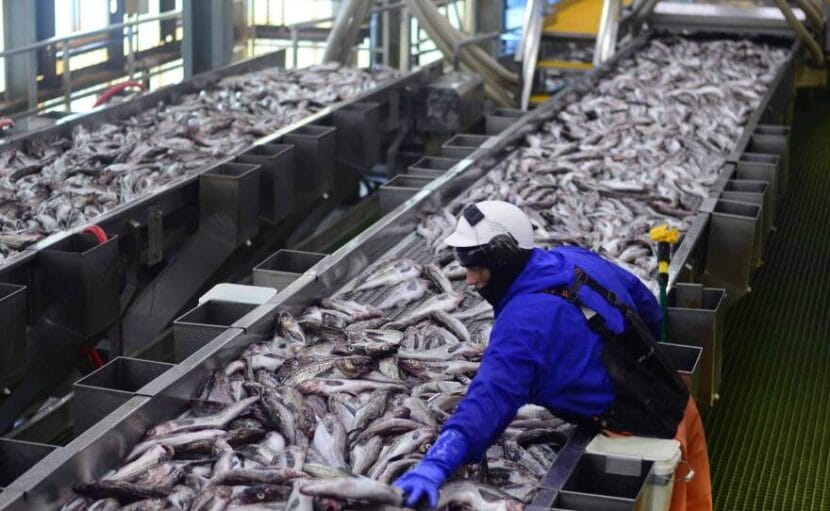
Some of Alaska’s largest pollock processors are abandoning a foreign worker visa program that once supplied up to half their workforce, citing rising costs and uncertainty under stricter immigration policies.
Tom Enlow is the president and CEO of UniSea Seafoods, Unalaska’s largest seafood processor. He said the company is moving away from the H-2B visas to save money on an inconsistent system.
“The H-2B program, I think was good for Alaska at a time when we really needed them, you know, during the pandemic, and little bit pre-pandemic, but really it’s cost prohibitive to bring workers all the way from Eastern Europe to Alaska,” Enlow said.
The H-2B visa program allows employers to bring foreign workers to the U.S. to fill temporary non-agricultural jobs during shortages. The visas can be difficult to obtain. Companies have to first show they can’t fill the jobs, then they have to apply, and then the U.S. Department of Homeland Security and the U.S. Department of Labor issue the visas through a lottery system.
Enlow said the processing plant moved back to a 100% domestic workforce this summer and will do the same for the upcoming “A” season — a major pollock season that starts later this month and brings thousands of workers to Dutch Harbor.
The main reason for that is cost. He said the Trump administration’s approach to hiring foreign workers has also made a difficult and expensive process even more complicated.
“It doesn’t make for good planning for processors, when you are bringing 200 or 300 people in from Eastern Europe and you don’t know for sure if you’re going to get supplemental visas, if [they’re] going to get approved in time, if they’re going to be in Alaska when you need them, when the season’s started,” he said.
UniSea started participating in the H-2B program in 2019, and prior to that, the company employed 100% U.S. domestic workers, according to Enlow. Some of those were green card holders or permanent residents, living in the U.S. — most from the Philippines.
When the company was actively using the special visas, as many as half of UniSea’s workers were foreign.
The company still employs a handful of Ukrainian employees who were hired through a special program designed to help those who were displaced from the Russian invasion, and will continue to work for the processor, Enlow said.
“They’re not bound by some of the rules and restrictions of the H-2B program,” he said. “They can stay extended periods of time. They can work full time, year round, they don’t have to be necessarily processors. They can work in other jobs, in other areas.”
UniSea isn’t the only regional processor filling jobs with American workers. Trident Seafoods — one of the largest seafood processors in the nation — said it employs almost an exclusively domestic workforce.
A spokesperson for the company said the processor — which has facilities across Alaska, from the Aleutians to Southeast and Bristol Bay — has been moving away from the H-2B program since 2023, in an attempt to strengthen long-term, local employment.
Westward Seafoods, another shore-based processor in Unalaska, would not provide information on employment data.
Alaska: the ‘poster child for foreign labor’
Brian Gannon is the vice president of global partnerships for LaborMex, a Texas-based company that helps connect U.S. businesses with foreign nationals for temporary or seasonal work. He said when it comes to handling and packaging Alaska’s massive seafood exports, especially for cod and pollock, the state has a very small local employment pool to work with.
“For 100 years, people have been coming from somewhere else to process fish in Alaska,” Gannon said.
Processing fish involves long hours, and often tough, repetitive and pungent work. Considering there is an entire area of plants often referred to as the “slimeline,” it can be difficult to fill those jobs.
Gannon, who started his career as a guest worker from Montana at a processing plant in Chignik in 1990, said despite the lackluster appeal of processing work, Alaska has done a good job attracting seasonal workers from afar.
“Alaska is really a poster child for foreign labor, in as much as the oil industry and forestry and mineral extraction and seafood production, etc., in Alaska for 150 years, [has] been built on a small amount of available local labor and a large amount of labor coming from somewhere else,” he said.
The Alaska Department of Labor found that in 2023 the state’s seafood industry employed nearly 22,000 workers, roughly 83% of which were nonresidents of the state. That year, the Alaska pollock industry directly employed over 8,000 workers, according to a report from Northern Economics on the contributions of the state’s pollock industry. Most were workers from the U.S., roughly 31% from Alaska, and about 12% were residents of other countries.
H-2B visa program helps fill employment gaps
Gannon said about 10 years ago, the seafood industry’s domestic workforce started to run dry. The industry’s pool of seasonal workers wasn’t replenishing. And that was especially challenging for cod and pollock processing, which unlike salmon, for example, don’t have peak seasons in the summer. He said salmon can have an advantage because it’s a summer fishery, and people sometimes have that season off. Ultimately, Gannon said companies just couldn’t match the shortfalls.
“And that’s where that H-2B visa came in quite handy,” he said.
The H-2B visas weren’t really used in Alaska’s seafood industry until about 12 years ago, according to Gannon. Congress currently doles out 66,000 for the entire fiscal year, and Gannon said they can get about 250,000 requests. Congress sometimes approves special increases for those visas.
Within the pollock processing industry, the program has been used among all sectors of processors. However, the catcher-processor fleet — that processes at sea — is required by law to employ 75% American citizens and green card holders. According to officials in the industry, they’ve never made any significant use of the H-2B program.
For a while the visas, while complicated to obtain, worked well. But Gannon said over the past several years a lot has changed in the pollock industry.
Changes in the industry spark a return to domestic labor
“So many things have upended the apple cart, and the pollock processors are not necessarily producing as much,” he said.
Gannon said things like the COVID-19 pandemic, the war in Ukraine, changes in the nation’s political dynamics and competition from China and Russia have made it hard for pollock processors to make ends meet.
Gannon said Alaska seafood companies also likely had trouble matching the prevailing wage requirements for H-2B visa holders, which he said had surpassed Alaska’s minimum wage at one point. He said the Department of Labor sets those wages, and they have to be matched or exceeded for all processors at the plant.
The seafood industry in general has also seen increases in processing costs, wages, energy prices, as well as drops in sale prices for every major species group in 2023, according to the National Oceanic and Atmospheric Administration.
Enlow said UniSea won’t be saving much, if any, money right away by switching back to an American workforce, because he’s expecting a high attrition rate.
“And so you’re going to need to hire more and bring up more people than you actually would need over time, because you’re going to lose some of those workers,” he said.
But Enlow said that should eventually be offset by avoiding uncertainties around international travel and immigration concerns.
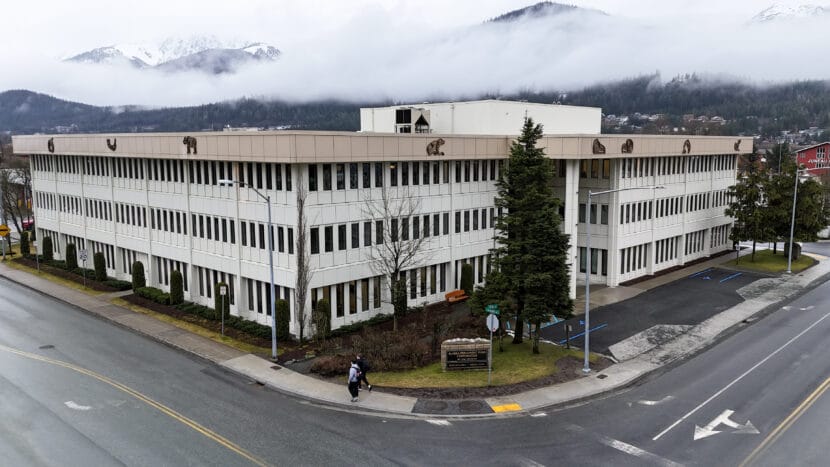
The Michael J. Burns Building, which houses the Permanent Fund offices on 10th Street, on Monday, Feb. 24, 2025. (Photo by Clarise Larson/KTOO)
The cost to move Juneau’s City Hall is coming in millions of dollars higher than expected.
According to the city administration, it’s expected to cost $20.5 million to purchase, renovate and move into two floors of the Michael J. Burns building, which houses the Alaska Permanent Fund Corporation downtown. The floors are slated to become Juneau’s new City Hall location.
Mayor Beth Weldon said the move to the Burns building is the best option for both city staff and citizens.
“We have to find a solution. We have looked under every rock to find a cheaper solution. There is no cheaper solution,” she said.
Those rocks include trying to build a new City Hall, and looking at existing buildings like the former Walmart in Lemon Creek, the Marie Drake building and the Floyd Dryden campus.
The $20.5 million price tag is millions of dollars higher than city officials anticipated it would be just a few months ago. That cost is to cover moving expenses and a partial remodel of the floors — including things such as new paint, carpet and cubicles.
And, while the Assembly has already put aside about $14.5 million for a City Hall project during recent budget cycles, they still needed to find another $6 million.
So at a meeting Monday night, Assembly members agreed to pay for the shortfall by pulling that amount from a hodgepodge of other proposed city projects, including the Capital Civic Center, the Lemon Creek Multimodal Path and a waterfront museum.
But not everyone was in favor of the plan. New Assembly member Nano Brooks voted against the transfer of funds, arguing it was too much money.
“The amount of $20 million is just, I can’t support that in good conscience,” he said. “It’s not what the taxpayers voted for, and even the funds that were initially set aside has left a lot of the community feeling very disparaged and unheard.”
The Assembly’s vote comes after multiple years of push and pull between city administration and Juneau voters. The city asked voters twice during recent municipal elections to approve bond debt. They said no both times.
Juneau’s current City Hall near Marine Park fits less than half of the city’s employees and it needs millions of dollars in maintenance and repairs. The new location would consolidate several departments that are now in separate buildings.
Assembly member Alicia Hughes-Skandijs said the plan isn’t perfect, but she’ll support it.
“There is no workable alternative that I have heard,” she said, “So we need to find the solution, and this is frequently where we find ourselves, which is just choosing the best of our least favorite choices.”
According to the city administration, the renovations and the move to the new location are expected to take at least a year to complete.
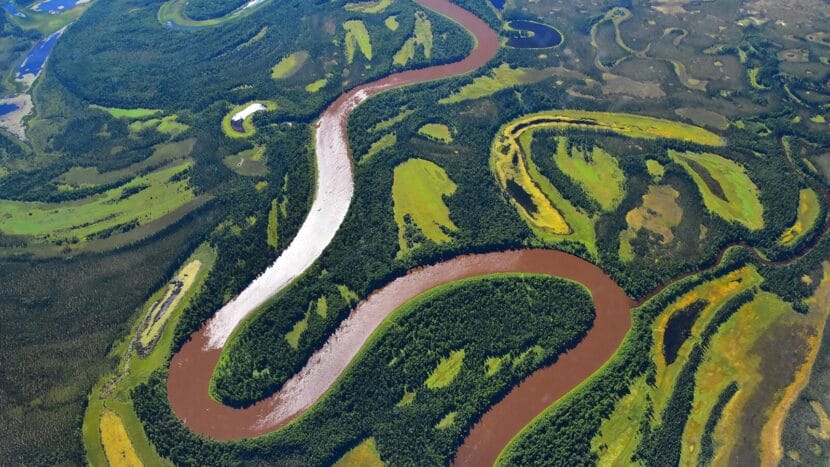
The Kuskokwim River is seen in this image captured by scientists working on NASA’s Arctic Boreal Vulnerability Experiment, or ABoVE. (Peter Griffith/NASA)
The U.S. Supreme Court has rejected the state of Alaska’s latest attempt to alter Alaska’s decades-old system of subsistence fishing management.
If the Supreme Court had taken up the case, it could have redefined Alaska’s unique system of hunting and fishing management, which allows the federal government to restrict subsistence hunting and fishing on federal land to rural Alaskans. The state is forbidden by the Alaska Constitution from offering the same preference.
Alaska Native organizations, including the Alaska Federation of Natives, praised the court’s decision, but the commissioner of the Alaska Department of Fish and Game said by email that it would continue to work with the federal government on the issue.
Monday’s Supreme Court decision ends a five-year dispute that began during a salmon shortage on the Kuskokwim River in 2021. The state of Alaska issued orders to open fishing that contradicted federal fisheries managers’ decision to keep it closed.
Salmon fishing is a critical aspect of Alaska Native culture, tradition and survival. Salmon returns have plummeted in recent years, straining managers who must balance the wants and needs of Alaskans and Yukoners pursuing the same fish.
On the Kuskokwim, the state claimed it was simply interpreting a U.S. Supreme Court ruling from 2019, but the federal government disagreed with the state’s interpretation and sued the following year.
The state appealed to the 9th Circuit, which again ruled in favor of the federal government. That prompted the state to appeal to the U.S. Supreme Court.
The Kuskokwim River Intertribal Fish Commission was one of the lead groups standing with the federal government.
“Our Fish Commission is very pleased with this historic victory in favor of the people of the Kuskokwim River. The victory not only upholds rural subsistence rights in Alaska, but upholds the participation of local people, elected by the Tribes, in the co-management of Kuskokwim salmon,” said the group’s chair, Martin Andrew, in a written statement.
Attorney Erin Dougherty Lynch worked on the case for the Native American Rights Fund, which represented the Association of Village Council Presidents.
By phone, she noted that even though this case is over, the Bureau of Land Management is considering changes to the subsistence program.
“What the state is seeking to accomplish now is basically the same thing through administrative processes. They’re definitely still going after subsistence. This won’t be the end, unfortunately, of their efforts to restrict subsistence,” she said.
Safari Club International, which petitioned BLM for regulatory changes, backed the state in the appeal that was rejected Monday.
In a written statement after Monday’s decision by the U.S. Supreme Court, the group said it believes the federal government “has increasingly superseded Alaska’s wildlife authority” and that the state and federal government should continue to work on the issue.
By email, Alaska Department of Fish and Game Commissioner Doug Vincent-Lang offered a similar comment and referred to the 1980 compromises between state and federal interests in the Alaska National Interest Lands Conservation Act.
“We will respect the decision of the U.S. Supreme Court to not address the legal issues regarding fish and game management authorities over navigable waters belonging to the State of Alaska,” he said. “This said, we will continue to work with the Secretaries of Interior and Agriculture to ensure the rights Alaska was given under its statehood compact and envisioned under ANILCA are safeguarded.”
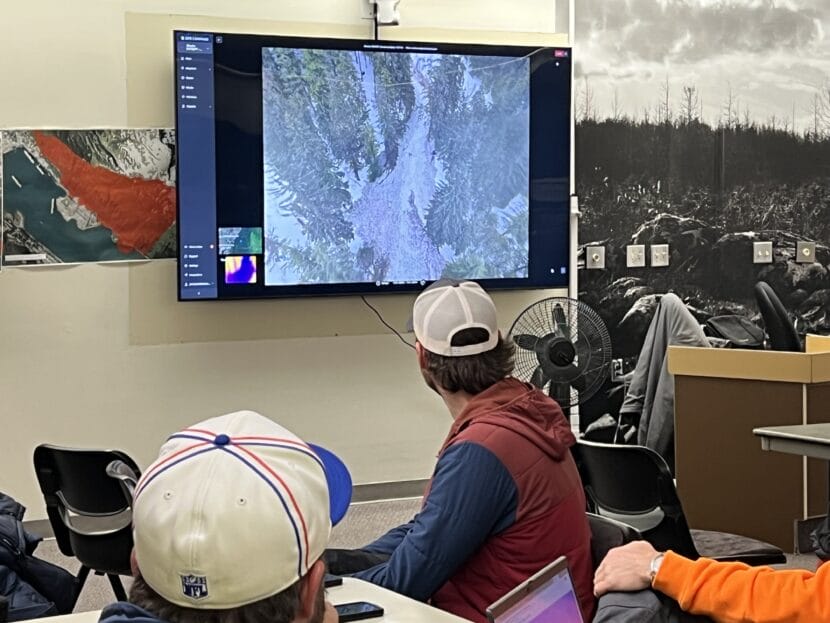
Avalanche forecasters view drone footage avalanche paths at City Hall on Jan. 12, 2025. (Photo courtesy of Catherine Melville).
An avalanche evacuation advisory remains in effect for one neighborhood that sits beneath Mount Juneau in Alaska’s capital city. And now, for the first time, the city is using a radar detection system to track avalanches that rumble down the mountain, thanks to state money freed up by the city and tribe’s disaster declaration last week.
Severin Staehly works for an avalanche technology start-up called Gravimon in Zurich, Switzerland. On Sunday, he installed the Doppler radar system at the Alaska Electric Light & Power substation on Douglas Island. It’s called an Avymonster, and it points at Mount Juneau continuously to scan for avalanches.
“We can really see where it happens and where it starts, where it ends, measure the speed and give all this information to the forecasters,” he said in an interview at City Hall.
Staehly said the Avymonster is popular in other places with high avalanche risk like Norway, Canada and the European Alps. He said he installed one in Alaska last week near Portage Lake, south of Anchorage.
A slide coming off Mount Juneau down Chop Gully above the flume in the Basin Road area on Friday, Jan. 9, 2026. (Mikko Wilson/KTOO)
John Bressette, the city’s avalanche advisor, said it works just like boat radar, so it can scan through the night and in poor weather. Now, the team won’t have to wait for clear weather to see whether avalanches occurred. The radar system notifies staff instantaneously.
“It allows us to detect avalanches when we can’t visually see them, which in Juneau is often with the darkness and with the weather,” he said.
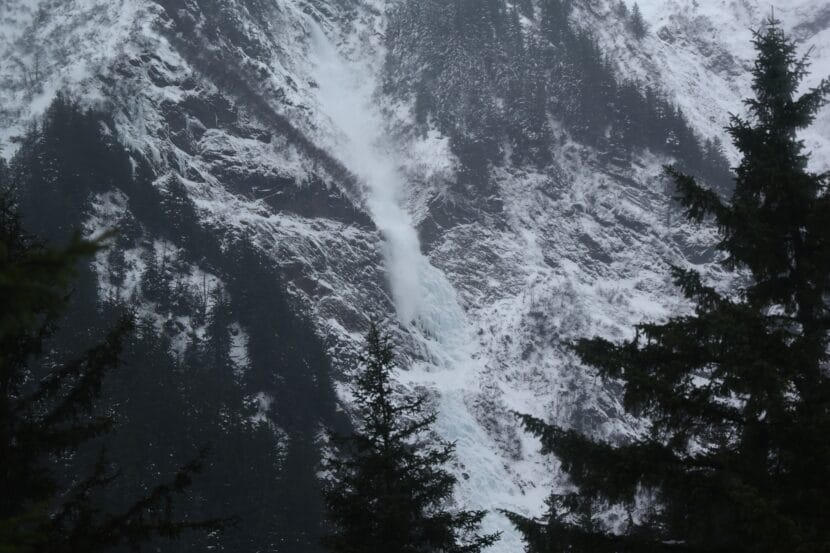
Using drone flights and binoculars when the clouds rose a bit on Sunday, Bressette said he was able to see where avalanches released some snow down the Behrends path to the end of Judy Lane. But he said the avalanche didn’t start from high up the mountain.
“There’s a lot of undisturbed snow at the top of the Behrends pass still that hasn’t been affected yet,” he said. “We feel that there’s still potential for — if that were to go — to potentially reach homes.”
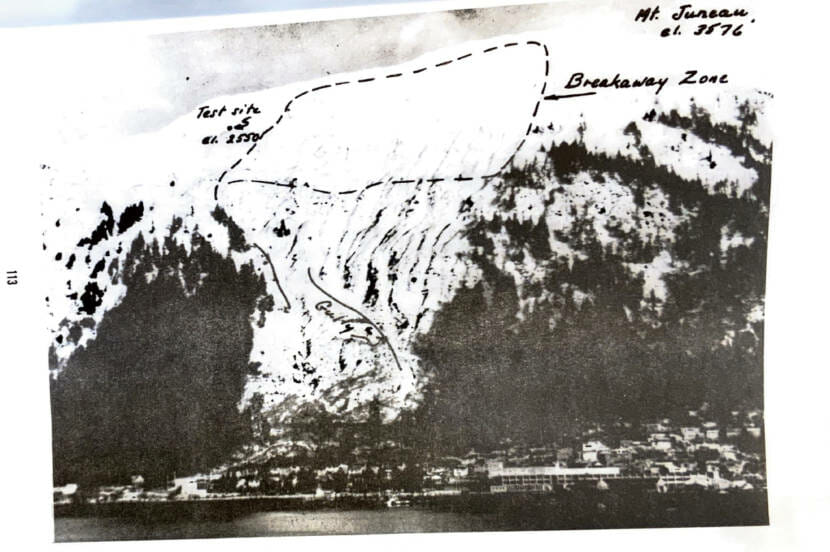
An annotated photo of the Behrends avalanche path from the 1967 report. (Keith Hart, Report of the Preliminary Evaluation of the Behrends Avenue Avalanche Path)
That’s where the city is still advising residents to keep clear. An evacuation advisory was issued Friday for residents living in avalanche hazard zones for all slide paths in downtown Juneau, and for part of Thane Road south of downtown. The advisory was lifted Sunday for everywhere but Behrends.
North of downtown, Bressette said he confirmed a loud avalanche reported on Thunder Mountain this morning around 9:00 a.m., but that it didn’t threaten homes.
Bressette said his next step is to work with the Alaska Department of Transportation and Public Facilities to fly a helicopter-mounted LIDAR sensor over the mountain to measure the snow. He also wants to dig snow pits to look at layers in the snowpack. He said that will help forecasters better estimate the risk to those who live in the Behrends path.
Ryan O’Shaughnessy, the city’s emergency programs manager, estimates the radar system and installation costs about $200,000 or less. Since Gov. Mike Dunleavy approved the city and tribe’s disaster declaration, he said the state is likely to pay for it.
“We’re very confident that this will be part of our public assistance reimbursement,” he said.
At the top of the White avalanche path on Mount Juneau, weather sensors track air temperature and snow depth. But avalanche experts say adding other sensors that measure wind, solar radiation and snowpack temperatures could also help refine avalanche risk assessments for downtown Juneau neighborhoods.
An atmospheric river struck Juneau over the weekend, after previous back-to-back storms buried the city in several feet of snow,
The Central Council of the Tlingit and Haida Indian Tribes of Alaska recently launched a new foundation,
For the first time, Juneau is using a radar detection system to track avalanches that rumble down the mountain, thanks to state money freed up by the city and tribe’s disaster declaration last week,
Democrat Mary Peltola announced this morning that she’s running for U.S. Senate, taking on Republican incumbent Dan Sullivan,
Alaska Public Media’s Eric Stone takes a look at the first wave of new bills for the coming legislative session
Close
Update notification options
Subscribe to notifications
Subscribe
Get notifications about news related to the topics you care about. You can unsubscribe anytime.