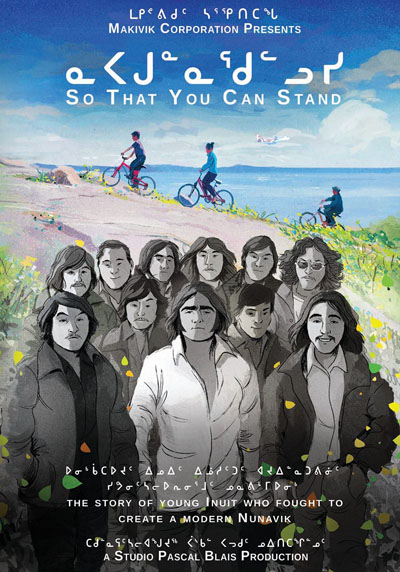
Recently deceased Juneau mayor Greg Fisk was a senior negotiator on the James Bay and Northern Quebec Agreement, an agreement analogous to the Alaska Native Claims Settlement Act. Makivik Corp. just released a documentary on the signing of the agreement, which featured interviews with Fisk. (File image courtesy of Nunatsiaq News)
Greg Fisk, an Alaskan consultant and politician, died at his home in Juneau, Alaska this week. He was 70 years old.
“I’m in shock,” said Senator Charlie Watt, who first met Fisk in the early 1970s.
“When I met Greg more than 40 years ago I saw a person who was motivated and not a submissive person,” Watt said. “He’s definitely in the history books of the Inuit of Nunavik.”
As president of Makivik’s predecessor, the Northern Quebec Inuit Association, Watt hired Fisk during a trip to Alaska to study the Alaska Native Claims Settlement Act in the early 1970s.
Fisk’s experience with the land claim as a consultant for Arctic fisheries made him a natural fit for the NQIA at the negotiating table.
Fisk’s death comes just weeks after the 40th anniversary of the signing of the JBNQA, and the release of Makivik-produced documentary on the land claim process.
Fisk actually flew to Montreal last summer to be interviewed in the film Napagunnaqullusi, which was recently premiered in Kuujjuaq and Montreal.
“Many of our youth are just learning about the trail blazers who negotiated our land claims agreement in 1975,” said Makivik president Jobie Tukkiapik in a Dec. 2 release.
“To hear one of the negotiators has died during this time is unexpected and we want his family in Alaska to know his legacy in Canada will live on.”
Fisk had only just been elected to serve as mayor of Juneau, when he was discovered dead in his home Nov. 30. His cause of death has yet to be determined.
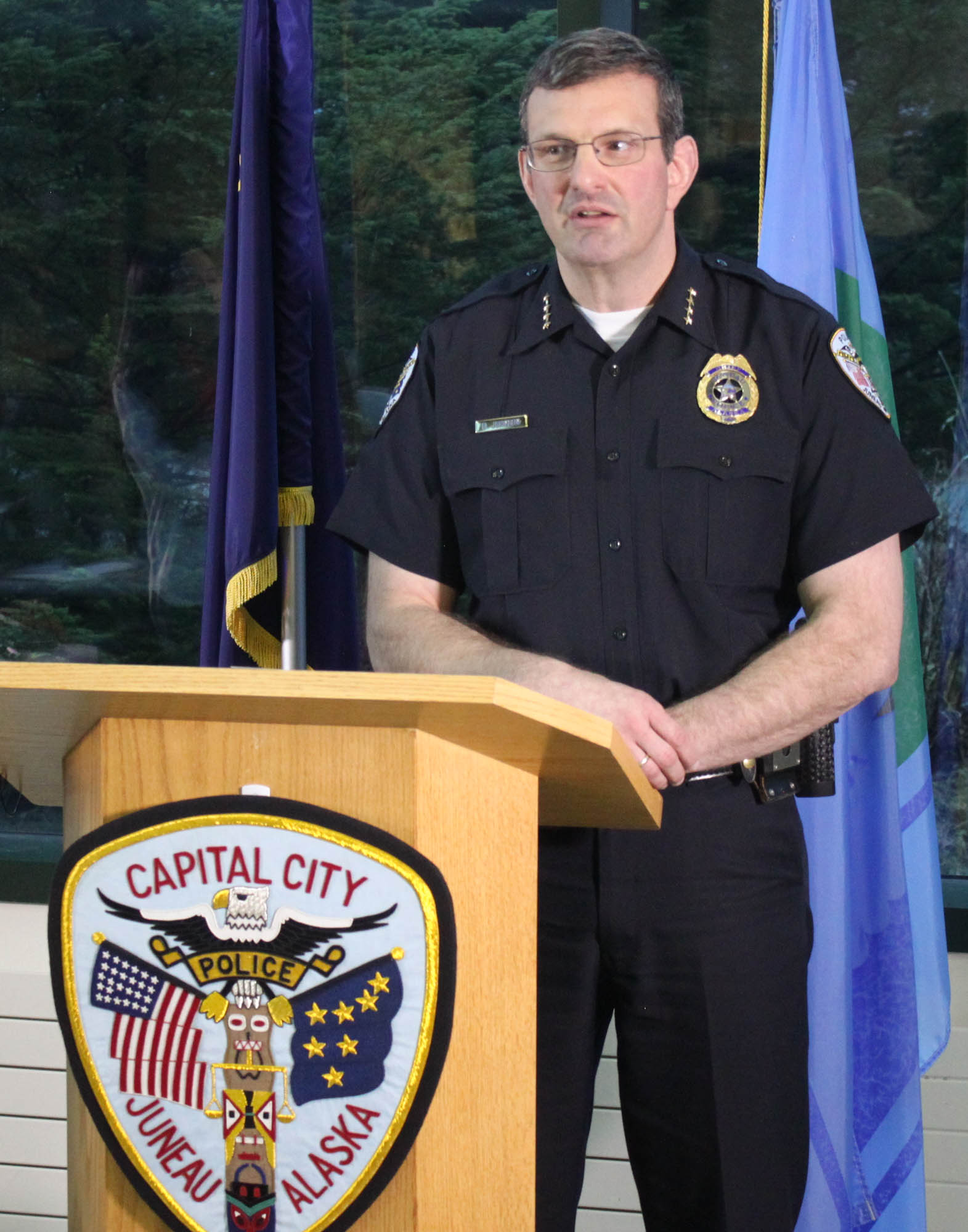
JPD Chief Bryce Johnson at a briefing announcing the preliminary autopsy results for Mayor Greg Fisk (Photo by David Purdy/KTOO)
Update | 4:50 p.m.
Preliminary autopsy results indicate Juneau’s mayor died Monday morning from natural causes, likely a heart issue. Based on that information, Juneau police do not suspect any foul play.
Greg Fisk was discovered dead inside his Kennedy Street home Monday afternoon.
At a press briefing in Juneau on Wednesday afternoon, Juneau Police Chief Bryce Johnson said the 70-year-old was found with some bruises and injuries on his face that were bleeding.
“People fall and faces get injured. It could look like there was an assault that took place and that’s why the first looks and people thought an assault took place, but it’s consistent with the fall and that’s the information we got back from the medical examiner as well,” Johnson said.
Johnson said the department has evidence that corroborates the medical examiners finding, which indicate facial injuries were not the cause of death. Johnson said it’s likely Fisk fell against a counter after experiencing a heart issue. Fisk had a history of heart problems, Johnson said.
Because the death was unattended and Fisk was found with injuries, Johnson said police had an obligation to investigate in case something potentially criminal did show up in the autopsy.
After Fisk’s body was found Monday afternoon, rumors quickly spread about the cause. His death has attracted national attention.
“There was a time period in which we just didn’t have any answers and, people being people, they run with the unknown for that couple of days. It’s Juneau, Alaska. It’s an exotic location. It’s a newly elected mayor so it was an intriguing story. It’s a tragic story for Juneau because we still lost our mayor, a tragic story for the family,” Johnson said.
Juneau police have notified Fisk’s family of the preliminary autopsy results. A final report is due in 2-8 weeks.
Update | 3:21 p.m.
The Juneau Police Department said Mayor Greg Fisk’s bruising was consistent with the location of where objects were in the scene. The injuries he sustained were not ultimately the cause of his death. Heart problems likely caused him to fall. Fisk’s body was found in the front room of his home, which is next to the kitchen.
Update | 3:02 p.m.
The state medical examiner’s office says mayor Greg Fisk died of natural causes. An autopsy was performed today and suggests that external injuries sustained by Fisk were consistent with an “injury due to falling or stumbling onto objects.” The final toxicology report is expected to be complete in 2-8 weeks.
A late night fire at a church near Engineer’s Cutoff caused more than $100,000 in damage. Capital City Fire/Rescue Assistant Chief Ed Quinto said the cause of the fire at Emmanuel Baptist Church is unknown and seems suspicious.
The fire reached into the attic, and major damage occurred in the new portion of the church.
“We were finally able to get to all the fire in the attic and we took down the majority of the ceiling sheet rock, so there’s a lot of damage there and a lot of the roof tresses got charred,” he said.
Quinto said it took about an hour to extinguish the flames. The Juneau Police Department and the fire marshal’s office are investigating. Evidence was collected at the scene last night.
Around 8 p.m. Tuesday the Juneau Police Department responded to a 911 call reporting a robbery at the Travelodge Hotel.
According to a news release from JPD, a man walked into the hotel toward a clerk with his arm and hand extended under his sleeve, as if he had a handgun. The suspect then punched a man who attempted to intervene and threatened a female witness.
He physically assaulted a clerk behind the hotel counter before fleeing on foot with cash from the till.
Officers searched the area but were unable to find the suspect. He is described as being about 6 feet tall, 250 pounds and wearing all black. The suspect was wearing a ski mask at the time of the robbery.
If you have any information, please contact the Juneau Police Department at 586-0600. An investigation is ongoing.
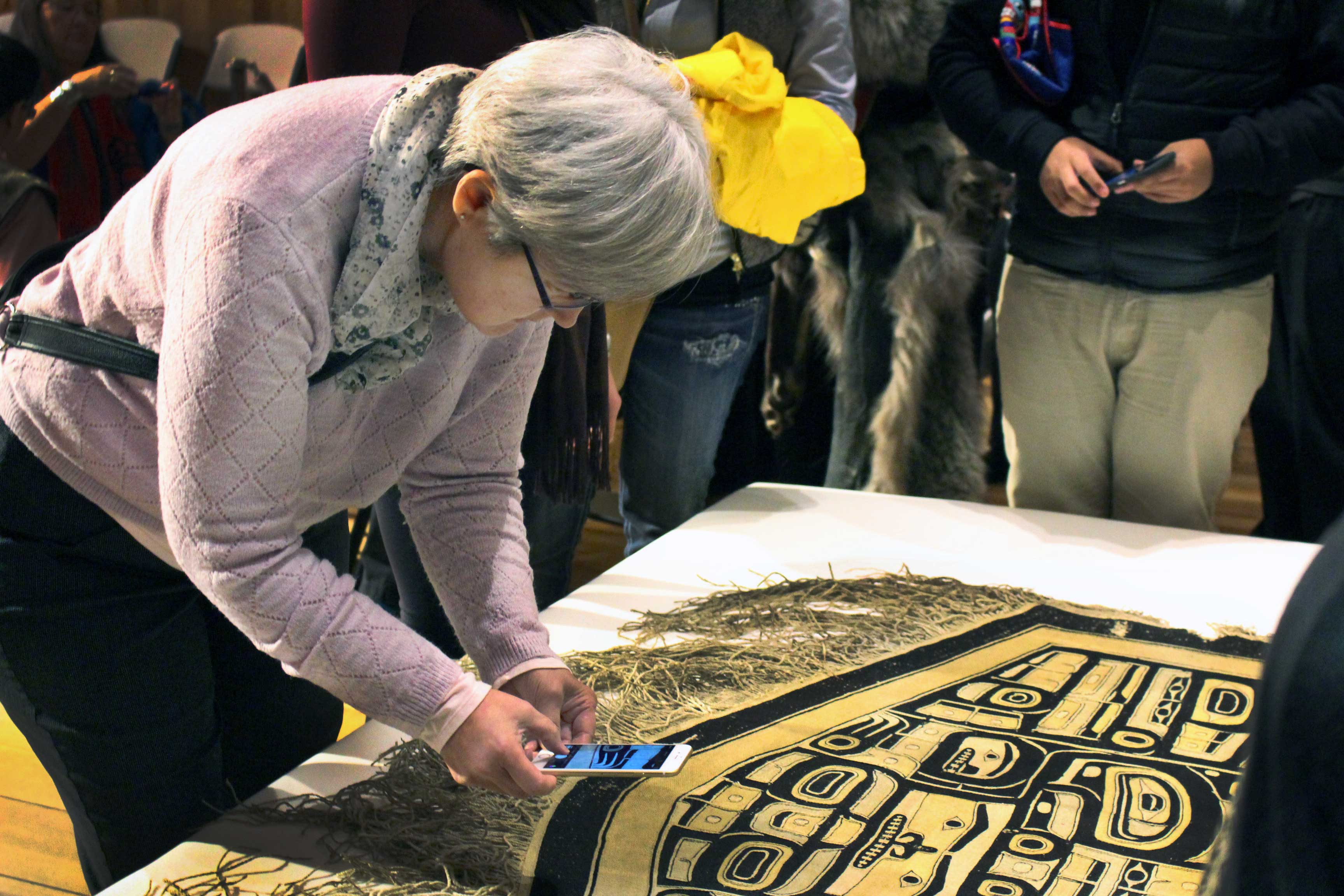
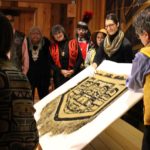
The Sealaska Heritage Institute recently acquired a Chilkat robe believed to be a funerary object. (Photo by Elizabeth Jenkins/KTOO)
A Chilkat robe that was for sale on eBay has returned to Southeast Alaska. The robe traveled all the way from Texas, where it was almost sold to the highest bidder. Instead, Sealaska Heritage Institute welcomed it home.
A crowd packed the red cedar clan house at Walter Soboleff Building downtown: Tlingit, Haida and Tsimshian gathered together. The ceremony began with two songs of mourning: one eagle, the other raven.
The robe was brought in a cardboard FedEx box and unfurled to reveal a black and yellow design.
“It’s a blanket made out of mountain goat wool and cedar bark and it takes about a year to make,” said Rosita Worl, SHI’s president.
The Sealaska Heritage Institute recently acquired a Chilkat robe believed to be a funerary object. (Photo by Elizabeth Jenkins/KTOO)
The Sealaska Heritage Institute recently acquired a Chilkat robe believed to be a funerary object. (Photo by Elizabeth Jenkins/KTOO)
The Sealaska Heritage Institute recently acquired a Chilkat robe believed to be a funerary object. (Photo by Elizabeth Jenkins/KTOO)
Worl says the clan crest could be a thunderbird or a hawk. But the organization isn’t sure. They were able to purchase the robe from the eBay seller at the base price.
Blankets like these can fetch upward of $30,000. Instead, SHI paid about $14,000.When the seller was informed about the item’s significance, Worl said he worked with SHI to make sure it was returned. She hadn’t seen the Chilkat blanket until this moment.
“I wish I had because when I first saw it I was just so overcome that I could barely make the opening remarks.”
Dorothy Gregory came to the ceremony because she wanted to see the weaving. She said she knows this is one of many blankets that have been taken out of Alaska.
“My grandmother’s blanket was one of them. We look forward to someday seeing it again, you know?” Gregory said.
George Blucker, the seller of the blanket, couldn’t be reached for comment. But in a statement, he said he purchased it at a flea market in Illinois.
SHI believes is could have been a funerary object, due to the fraying at the ends.
The ceremony closed with dancing and a joyous song. Clan leader, David Katzeek, called the robe an amazing technology. But unlike your tablet or iPhone, he said this kind isn’t isolating. It’s known as at.oow.
“That which was paid for with our lives. That’s the reason we have an intimacy,” Katzeek said. “It can be misrepresented when people say our ancestors came home. When we’re saying that, we’re talking about that technology. That generates a very intimate way of thinking about family, about each other.”
In the future, weavers and artists will be invited to study the blanket at SHI.
Recently, the U.S. Forest Service released a plan that gives loggers a timeline for the transition to second-growth harvesting. The plan is currently open for public comment. A proposal to end clearcutting of old-growth trees in the Tongass National Forest has some Southeast logging companies concerned about the future.
Susan Tyler runs Icy Straits Lumber & Milling in Hoonah with her husband Wes. It’s a family business and one of the few surviving timber companies in the region
Wes has been harvesting trees in Alaska since 1967. For the past 34 years, he’s packed his truck with power saws, axes and wedges to drive along winding roads on Chichagof Island. Once in the woods, he searches for a tree the U.S. Forest Service has marked with paint, indicating it can be removed from the old-growth forest and processed into lumber.
“Typically we are harvesting in the summertime, although we have been out in knee-deep snow harvesting too,” Wes said. “We put in a good eight-hour day out there normally, you know, working in the woods.”
Following selective logging regulations managed by the Forest Service, the company has downsized from 200 employees in the 1980s to only 10 today. New proposed restrictions that would eliminate harvest of old-growth trees are troubling for the Tylers. In a phone call from Hoonah, Wes said the company is bracing for big changes.
“The timber industry today is barely existing,” Wes said. “So you know what’s available to us here is what we’re trying to create jobs with and keep our local people working to the best of our ability.”
Wes could talk about trees for hours.
He said that the company harvests four different tree species on the island: Sitka spruce, western hemlock, alder and yellow cedar.
“Yellow cedar is a lot smaller tree than either hemlock or spruce typically,” Wes said. “It just doesn’t grow that fast. And it doesn’t grow real straight so you have sweeps and curves and kinks and there’s a lot of defect in it, so it takes a lot of work to extract all the goodies that are in it. Which we do. We take everything in that yellow cedar tree right down to a very small size.”
Lately, Susan has been spending much of her time in Juneau — a 20-minute flight east of Hoonah. She has a showroom in the capital city that is typically closed. But with the flip of a switch the room becomes aglow with woodwork. The space resembles an upscale flea market featuring only wood. Pieces range from dollhouse-sized model cabins to full kitchen counters.
She manages the showroom herself because it would be too costly to employ someone else. Susan said Icy Straits Lumber & Milling is up against big corporations like Home Depot for business. Timber sales available in the Hoonah area only allow selective logging, making profits that much harder to come by.
Bidders on timber sales are told how much wood can be harvested from each plot, but they don’t know how much of the wood is actually valuable, Susan said.
“Right now we have a lot of very expensive equipment and it’s hard to go after another timber sale because you don’t know what’s in that timber sale,” Susan said.
The new proposed restrictions could reduce the supply of trees available for harvest.
“There is a lot up in the air because … they want to stop all old-growth harvesting. Of course, that would eliminate us from harvesting any,” she said.
According to the Forest Service, the supply of second-growth forest, regrown from past clear cuts, is large enough to allow a smooth transition into the new policy.
Icy Straits Lumber & Milling is considering a switch to harvesting regrown trees, but Susan worries the Hoonah area may not have enough second-growth forest to sustain her company in the future.
“We don’t know, and you don’t want to keep investing in equipment if you don’t know what the future holds,” she said.
To supplement what standing trees they can harvest, Susan says her company also collects trees that wash up on the beach, dead standing wood, danger trees, blow downs and trees that have a dead top but are mostly usable. All of this is also managed by the Forest Service.
Some of that wood ends up in the hands of Juneau woodworker Reid Harris.The young entrepreneur started a wood furnishing business called Northern Edge Craftworks. His tables are made from vertical woodcuts that keep the natural, rough edge of the tree.
Most of the logging company’s business comes from locals like Harris. His basement and garage workshops are lined with tree slabs ranging from the length of a baseball bat to that of a kayak.
Harris exemplifies optimism for an industry with an unknown future.
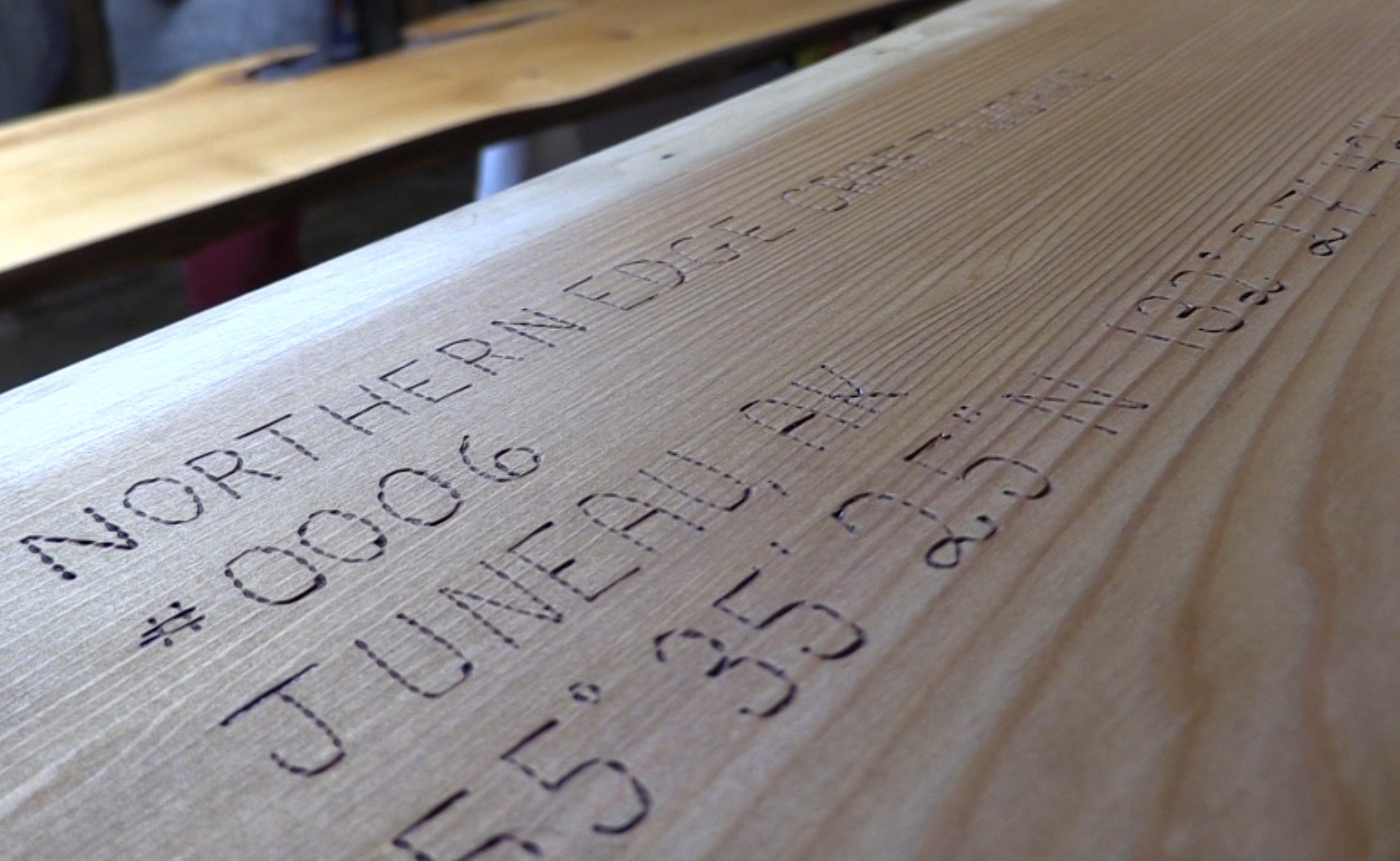
He wants to connect the people who purchase his pieces to the life of the tree, so he marks each table he makes with the coordinates of where the tree was taken.
Furniture from Northern Edge Craftworks is marked with the GPS coordinates of the tree it came from. (Photo by David Purdy/KTOO)
“We had this idea because we kind of wanted our pieces of wood to tell a story and each piece comes from a unique part of Alaska,” Harris said.
So now Wes carries a GPS into the forest with him.