Juneau

Juneau’s next charter school may the first of its kind in Alaska

Supporters for a new charter school in Juneau filled the audience at Tuesday night's school board meeting. (Photo by Lisa Phu/KTOO)
Supporters for a new charter school in Juneau filled the audience at Tuesday night’s school board meeting. (Photo by Lisa Phu/KTOO)

A group of educators and parents in Juneau are advocating for a new charter school focusing on science, technology, engineering and math. They think it would be the first elementary STEM school in the state.

More than two dozen people at Tuesday night’s school board meeting were wearing paper badges pinned to their shirts that said “Summit STEM School Supporter.” The blue and green logo on it shows an abstract design of a mountain.

“We don’t have a local indigenous or a local Native design there,” said Alberta Jones, a member of the formation committee for the Summit STEM School.

“That needs to be brought from our school members, from our people involved in the community to give us a local indigenous name. We spent a lot of time with this, trying to think, ‘OK, summit. What’s the Tlingit name for summit?’ But it’s really important that it’s a community buy-in of students and people in our community, so that we’re following proper protocols,” Jones said.

Jones is Tsimshian and Alutiiq. She’s a retired teacher from the Juneau School District and has coordinated Native education grants. She says a key component to the charter school is integrating local indigenous knowledge.

The committee proposes putting Summit STEM School within an existing Mendenhall Valley elementary school. Up to 80 students would be in multi-age classrooms – two classes of kindergarten through second graders and two classes of third through fifth graders. The hope is to later add a preschool level.

Advocates for the Summit STEM School wore these pinned to their shirts. Alberta Jones,  a member of the school's formation committee, says the logo is incomplete. (Photo by Lisa Phu/KTOO)
Advocates for the Summit STEM School wore these pinned to their shirts. Alberta Jones, a member of the school’s formation committee, says the logo is incomplete. (Photo by Lisa Phu/KTOO)

Juneau mom Stephanie Buss spoke in support of the STEM school. She says it would give parents more choice. Buss has been homeschooling her two kids since last year and says the charter school could bring her family back to the district.

“As a scientist and a business owner, I feel there is a real need for more targeted education in math and science. Each and every child in the district should be given a strong opportunity to be proficient in science and math. I love science and math and would love to see more kids excited about these fields,” Buss said.

The charter’s formation committee has been working on the proposal for two years, but Lexie Razor just heard about it a couple weeks ago. Razor is a math teacher at Juneau-Douglas High School.

“Right away it was something that struck me as something that Juneau needs. I’ve been teaching math for 15 plus years. All my years have been with minorities and low socioeconomic students. I noticed the main thing is just their confidence. And the more opportunities they have with the math, with the engineering, science, all of it, they’d be more comfortable with it,” Razor said.

Summit STEM School hopes to serve students who are economically disadvantaged – they’d make up 50-75 percent of the student population.

School Board member Barbara Thurston says the district’s existing placement process makes that goal highly unlikely.

“We’ve had issues with our placement process over the years with our other alternative programs, probably none of which have what we would consider the ideal ratios, distributions of demographics in them,” Thurston said.

The applicant pool for alternative programs tends to be made up of non-targeted students, she added. Thurston wants the board to set up a subcommittee to review the placement process.

The School Board will have a work session on the Summit STEM School on Aug. 31. If the board accepts the charter application on Sept. 15, it would go on to the State Board of Education for final approval.

The new charter school would receive an allocation of $1.1 million if it has 80 students, according to the district.

The Summit STEM School hopes to open fall of 2016.

Gardentalk – Picking for peak ripeness and flavor

Salmonberry
This overly ripe salmonberry is about ready to drop to the ground. (Photo by Matt Miller/KTOO)

Master Gardener Ed Buyarski has some tips on picking berries and apples before they get too ripe and begin losing flavor. This Gardentalk segment aired Aug. 6 on KTOO’s Morning Edition.

“Timing is real important,” says Buyarski. “Tasting as you go.”

Yellow transparent apples, for example, may be tart and a little green before they ripen and turn a pale yellow-white within about two weeks in sunny and warm weather.

“At that point, they’re overripe,” Buyarski says. “They cook great down into applesauce. But they’re very mealy, not tasty for eating.”

Buyarski also checks in on this season’s gooseberries, raspberries, and kiwis.

Warmer, wetter climate expected for Southeast Alaska this summer

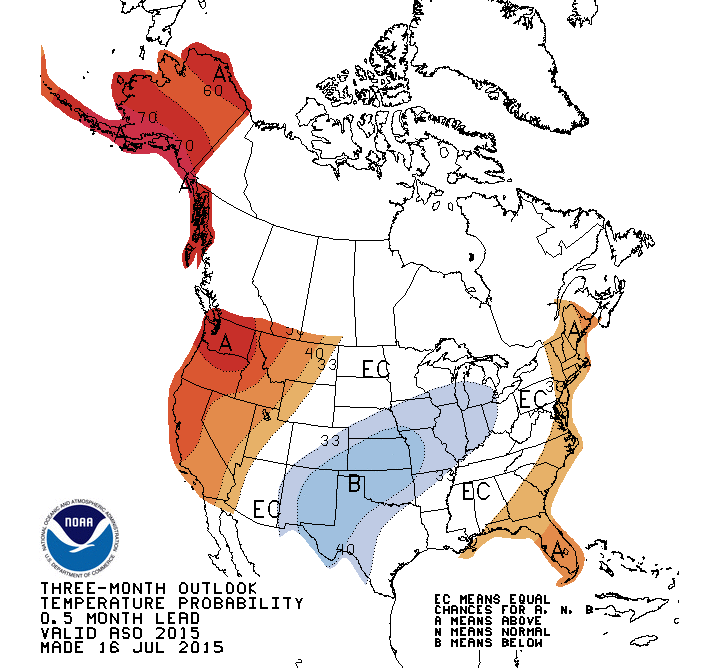
Map issued by NOAA's Climate Prediction Center shows the probability for increased temperatures over the next three months. Numbers superimposed over Alaska indicate a 60%  to 70% chance that temperatures will be higher than normal.
A map issued by NOAA’s Climate Prediction Center shows the probability for increased temperatures over the next three months. Numbers superimposed over Alaska indicate a 60 percent to 70 percent chance that temperatures will be higher than normal.

Climate experts say Southeast Alaska will likely be wetter and warmer over the next three months. The National Oceanic and Atmospheric Administration’s Climate Prediction Center just issued their three-month forecast that, for Alaska, is largely based on the continued warming of the Pacific Ocean.

The Alaska portion of the report was prepared by climatologist Rick Thoman with the NOAA in Fairbanks. Thoman believes there’s an increased chance of significantly higher precipitation for southern Alaska for the next three months. There’s also a greater chance of significantly above-average temperatures throughout most of the state.

For Juneau, the current forecast calls for a 65 percent chance that the temperatures will fall into that “significantly warmer than normal” category between now and the end of September.

“That still leaves us with about a one-third chance that they’ll fall into the ‘near normal’ category and just a very small, but non-zero chance that they’ll fall into the ‘significantly below normal,’” Thoman says. “That all, of course, assumes that the forecast is — in some statistical sense — correct.”

Thoman says they issue their climate predictions using probabilities instead of trying to predict that a particular region will get so many more inches of rain or that it will be so many degrees warmer.

“Just because the three-month average is ‘significantly above normal,’ doesn’t mean you can’t have a cold couple of weeks. As we move forward, that’s almost certain to happen. Even if precipitation winds up ‘significantly above normal,’ that doesn’t mean that you can’t have a dry spell or two in that three-month period. It’s not that every day is going to be warm. It’s just going to be on that long-term, average climate scale.”

Thoman says sea surface temperatures are important factors in their climate predictions for Alaska.

“The water, of course, holds heat much longer than the air so it’s slow to warm up, slow to cool down,” Thoman says. “That really serves as the memory for the whole climate system which is really kind of the linked ocean, atmosphere, cryosphere. So snow, ice, all of that plays into the climate forecast.”

“But the oceans, because of that big heat reserve, are a major driver in these very long term outlooks,” Thoman says.

The warmer ocean temperatures are caused by a combination of a strong El Niño event that started forming in the tropical Pacific, the cyclic ocean pattern called Pacific Decadal Oscillation and the warm water anomaly called “The Blob” that now stretches from the Gulf of Alaska down to California.

Scientists suspect that recent algae blooms off the Pacific Northwest Coast and in the North Pacific may have been caused by warmer ocean temperatures.

Juneau Assembly relaxes child care facility restrictions

Abigail Capestany said she probably wouldn't have moved to Juneau if she'd known childcare was so limited. (Photo by Jeremy Hsieh/KTOO)
Abigail Capestany said she probably wouldn’t have moved to Juneau if she’d known childcare was so limited. (Photo by Jeremy Hsieh/KTOO)

The lack of child care in Juneau has been a shock for Abigail Capestany and her 19-month-old toddler.

“My husband and I moved here about a month ago and we’ve been on a waiting list since February, with no end in sight,” Capestany said Monday. 

She moved from Louisiana where, while she was pregnant, she signed up for child care at a big, church-run center. She says the day care even had webcams so she could check-in on her son remotely.

“So then coming here, it was like, oh, there’s very limited options,” she said.

She told the Juneau Assembly that if she knew it would be this hard to get child care, she and her Coast Guard husband probably wouldn’t have come.

That could change soon. As the Assembly went through the motions to unanimously adopt an ordinance significantly relaxing land-use restrictions on child care facilitiesIsraa Kako-Gehring was beaming in the audience with a huge grin, fists clenched in quiet victory. It was an ordinance she began lobbying for months ago, after her plan to open a nursery school was stymied.

Israa Kako-Gehring beams after the Assembly adopts an ordinance relaxing land-use restrictions on childcare homes and centers, Aug. 10, 2015. (Photo by Jeremy Hsieh/KTOO)
Israa Kako-Gehring beams after the Assembly adopts an ordinance Monday relaxing land-use restrictions on childcare homes and centers. (Photo by Jeremy Hsieh/KTOO)

“Currently in the code, schools and churches are allowed to operate in any residential zone, but day cares are not,” she said. 

She and her husband had bought an old church to convert to the nursery school.

“We weren’t allowed to operate. And we wanted to change that, so I called the Assembly members,” she said. 

That was back in November. When the ordinance she lobbied for goes into effect in 30 days, the key land-use restriction that blocked her will be out of the way.

Kako-Gehring already has business cards made up that say “Gehring Nursery School.” She handed me one, which caught Abigail Capestany’s eye. She asked for one, too and then asked if she was taking applications for toddlers. 

Juneau Assembly nixes sales tax break on high-value jewelry

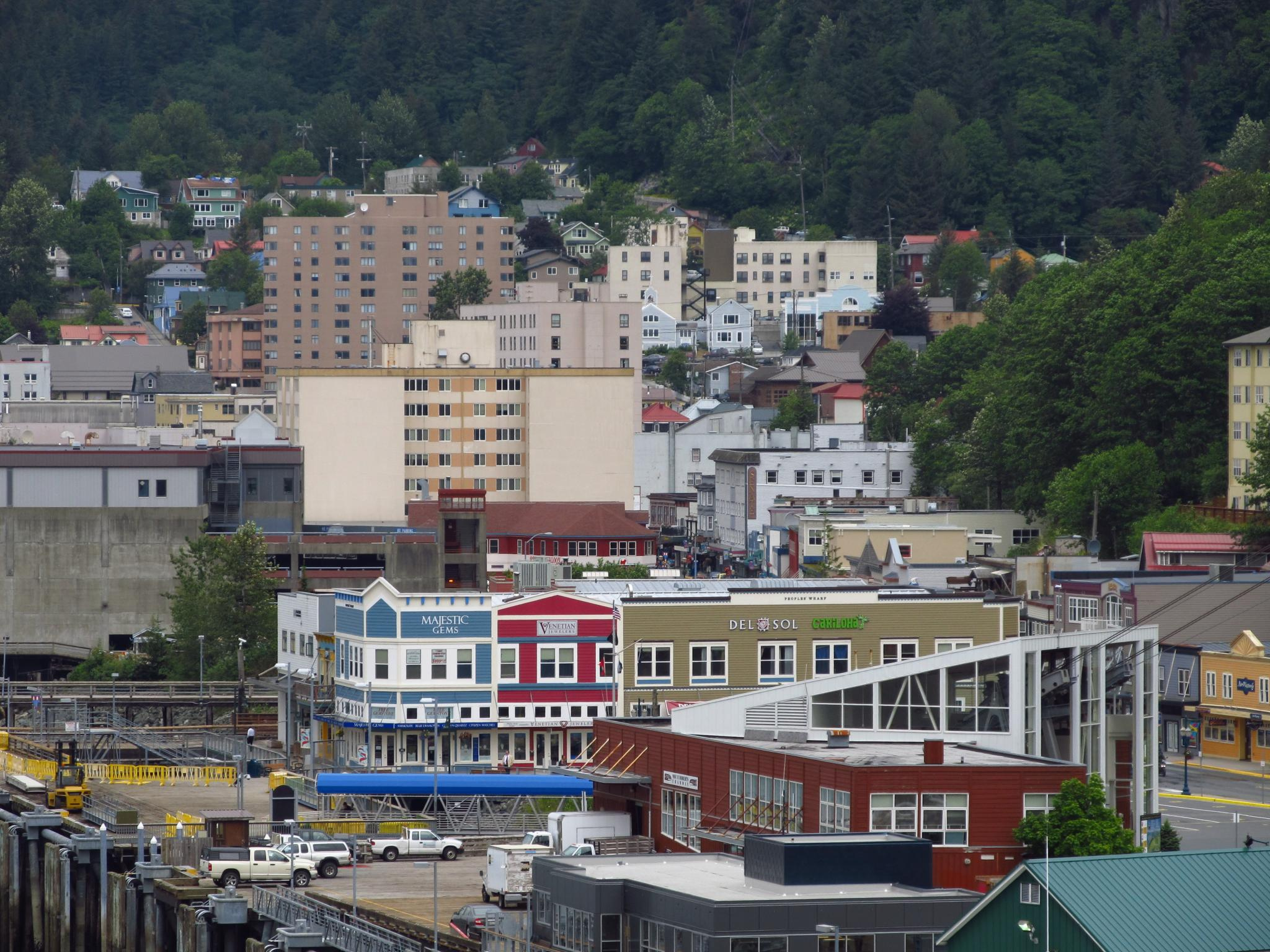
The view of South Franklin Street from aboard a cruise ship June 20, 2011. (Creative Commons photo by Jasperado)
Jewelry stores along South Franklin Street are one of the first things many Juneau cruise ship visitors see, as in this June 20, 2011, photo taken aboard the Golden Princess. (Creative Commons photo by Jasperado)

The Juneau Assembly adopted an ordinance Monday in a 6-3 vote that eliminated a sales tax break on high-value jewelry.

Beginning in 2016, individual jewelry items that sell for more than $12,000 will be taxed at the same rate as everything else.

Assemblyman Jerry Nankervis objected to the ordinance.

“I think this unfairly targets one industry for something that we don’t target anybody else on.”

Assemblywoman Debbie White and Mayor Merrill Sanford joined Nankervis’ no vote.

Assemblywoman Kate Troll responded to Nankervis.

“This is not about singling out a single business, this is about getting our policy back to its original intent. The original intent was to ensure that large, expensive ticket items purchased by locals would have an incentive to purchase them here.”

She said records indicated the original break was intended for locals buying cars and electronics, not jewelry.

The city is home to about 50 jewelry stores, according to the city Finance Department. No one testified during the public hearing on the ordinance.

Until recently, the taxable value of all big-ticket items and services was capped at $7,500. In April, the Assembly raised that cap to $12,000. The cap will adjust automatically for inflation beginning in 2018.

Which means a $15,000 piece of jewelry sold in April would have $375 in sales tax, $600 if it were sold now and $750 next year when Monday’s ordinance takes effect.

Under the old cap, the city lost about $275,000 in jewelry sales tax revenue a year.­

Rookery’s Beau Schooler wins national seafood competition

Juneau chef Beau Schooler and sous-chef Travis Hotch at the Great American Seafood Cook-Off in New Orleans. (Photo courtesy Alaska Seafood Marketing Institute)

Juneau chef Beau Schooler was crowned “Best Seafood Chef” at the Great American Seafood Cook-Off this weekend in New Orleans. He was one of 12 competing chefs from all over the country. He won with a dish that only had one main ingredient – Alaska wild salmon.

Louisiana Chef Cory Bahr tears open the first place envelope.

“From the state of Alaska, Chef Beau Schooler!” Bahr announces.

As Schooler kneels on one leg to be crowned, confetti falls from the ceiling. Schooler is chef and co-owner of The Rookery Café in Juneau.

“First time ever Alaska’s winner,” Bahr says.

Alaska is usually at the competition, which has been around for 12 years. Gov. Bill Walker nominated Schooler to compete this year and the Alaska Seafood Marketing Institute paid his way.

Schooler and sous-chef Travis Hotch brought sockeye salmon from Juneau company Taku River Reds to the competition.

Schooler describes their cooking method as a nose-to-tail approach, using every piece of the fish.

“The fillet portions, we brined and cedar roasted. All the scrap that’s usually clinging to the bone and the belly pieces, we ground that up and turned it into a salmon chorizo,” Schooler says.

They made crispy chips out of the skin and fried the salmon collars, the bony part between the head and the body.

“And then we have been working on this thing called bone salt where we’re taking salmon bones and cleaning them up and dehydrating them and then grinding them up and they kind of have this oceany, salmony flavor, so we seasoned the whole dish with this salmon bone salt,” Schooler says.

Schooler's winning dish featured salmon skin chips, salmon bone salt and salmon chorizo. (Photo courtesy Laura Hotch)
Schooler’s winning dish featured salmon skin chips, salmon bone salt and salmon chorizo. (Photo courtesy Laura Hotch)

For Schooler and Hotch, cooking the various components came easily.

“We were kind of doing stuff we do at the restaurant every day. So getting that all done in an hour and presenting it to people, it was just kind of another day at work really,” Schooler says.

You can find the chorizo at The Taqueria, another Juneau restaurant Schooler is part of. Everything else has been on the menu at The Rookery before.

Schooler and Hotch had discussed different ideas before settling on, “Let’s do all the different parts of the fish and just put it on one plate and not put anything else on there,” Schooler says.

That was a pretty novel concept at the competition. The cook-off hosts talked about it while the judges deliberated.

“How dangerous is that to just do fish on the dish?” asked Johnny Ahysen, a Baton Rouge TV reporter.

“I don’t know. I think he was really confident. It was just fish but it was a lot of different flavors there, a lot of different preparations there,” replied Louisiana Chef Randy Cheramie. “Could it be seen as a gamble? Maybe so, maybe not. We’ll see.”

“That was a bold dish from Beau Schooler,” added New Orleans TV News Anchor Charles Divins.

After the competition, Schooler and Hotch spent time exploring the food scene in New Orleans, then Seattle for, as Schooler put it, “a couple days of gluttony,” before returning home.


Site notifications
Update notification options
Subscribe to notifications