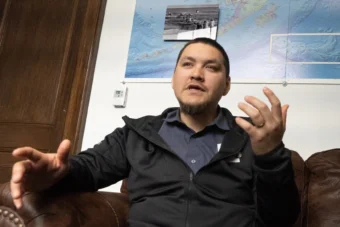
Josiah Patkotak on his last day as the representative at Alaska Legislature. Patkotak represented District 40 before becoming the North Slope Borough Mayor. (Lex Treinen/Alaska Public Media)
The North Slope Borough clerk has issued a recall petition for the borough mayor, Josiah Aullaqsruaq Patkotak. It comes after months of efforts from residents over what they say were “lavish travel expenses” by the mayor and his family.
The petition authors said the mayor should be recalled for “misconduct in office, incompetence and failure to perform prescribed duties” because he used borough funds to pay for his family’s travel.
After several recall applications and a legal complaint from the group, the clerk, Sheila Burke, issued the petition on March 21.
Forrest Deano Olemaun, a former assembly president and one of petition sponsors, said public officials need to exercise transparency and honesty in how they treat public funds. He said the money used for the mayor’s travel could have been spent to support residents instead.
“It may not be much to those that already have, but it certainly is a lot to those that don’t have anything to begin with,” Olemaun said. “When you add it all up, it makes a huge difference.”
The borough assembly voted in December to allow officials to receive compensation for bringing their family on business trips. The prior code allowed for travel with family but did not specify whether the borough would pay for family travel costs.
However, Patkotak had already received compensation for taking his wife and children on at least 15 trips across the state and country, as well as overseas, before the code changed. Those travel expenses amounted to tens of thousands of dollars and included flying first class and staying at luxury hotels.
Patkotak did not respond to calls and emails asking for comment. Angela Cox, the borough’s director of government and external affairs and the mayor’s cousin, responded to questions about petitioners’ concerns last month via email. She said that former mayors also traveled on business with their families. Besides, she said, Patkotak has small children, and bringing them on trips is crucial.
A recall petition was also issued for Assembly President Crawford Patkotak, who is the mayor’s father. Petition authors said that when Crawford Patkotak voted to approve the ordinance allowing compensation for officials’ family travel, he did not disclose his personal interest in protecting his son.
Crawford Patkotak said in a phone call Thursday that traveling with family has been a common practice for borough officials. He also said that the assembly voted to simply clarify the code.
“We have tried our best to be transparent at the assembly level, working closely with the mayor and his staff,” Crawford Patkotak said. “We disclose through the process who we are, and the fact that our people, the voters of the North Slope Borough voted to put us in these positions.”
No other borough code in the state mentions compensating officials for bringing their family on business trips. Officials in at least eight Alaska boroughs are not allowed such practice, according to borough clerks. In most boroughs, officials are asked to use the most economical fare.
Residents filed their first application for a petition in February, but the borough denied it, stating it didn’t meet grounds for recall. After the authors filed their second application on March 4, the borough clerkSheila Burke requested to adjust the petition to only keep the grounds that she deemed recallable. She said she issued the petition with those adjustments on March 21, though the group said they only received it this week.
The latest petition describes the mayor’s decision to use public funds on his family’s travel as improper and unethical. But the document omits some recall grounds the authors originally listed. Those include using the borough medevac plane for non-medical errands, approving too many nepotism waivers and misusing public funds to open an office in Anchorage.
Olemaun said the authors were disappointed the petition was edited but reluctantly accepted the changes.
Burke, the borough clerk, said residents have until mid-May to collect 371 signatures for the petition to recall the mayor, and 261 signatures to recall the assembly president. After that, the petition would be submitted to the assembly, and an election would be scheduled within 90 days.
Josiah Patkotak in May, 2023. (Lex Treinen/Alaska Public Media)
A group of North Slope residents is trying to recall the borough mayor, Josiah Aullaqsruaq Patkotak, alleging that he misused public funds.
That group’s application for a recall petition says the mayor – whose salaryis over $280,000 – should be recalled for, among other things, receiving compensation from the borough for “lavish travel expenses” for his family.
The assembly adjusted borough code in December to allow compensation for family travel, but that change came after Patkotak had already received tens of thousands of dollars for at least 15 domestic and international trips with his family.
“Everybody, even the mayor, has to follow rules and regs and procedures,” said Marietta Aiken, one of the residents involved in recall efforts. “He thinks that those standards do not apply to him.”
Angela Cox, the borough’s director of government and external affairs, told KNBA in an email on Monday that some borough mayors traveled with their families even before the borough code change.
“It has long been the practice of the borough to support the mayor and their spouse for travel as they fulfill their public duties and obligations,” Cox said in an email.
The residents submitted their first recall application in February. But the clerk’s office denied it, saying that it failed to meet grounds for recall. In Alaska, officials can be recalled for misconduct in office, incompetence or failure to perform prescribed duties.
The authors filed a new application on March 4, which the borough has not responded to yet. On Friday, one of the residents, Beverly Aqak Hugo, filed a court complaint asking the court to direct the borough to issue a recall petition.
Cox said Tuesday that the group’s petition is being reviewed by outside counsel.
Family travel on the borough’s dime
Travel records show trips costing tens of thousands of dollars where Patkotak took his family — often flying first class — to North Slope villages, Anchorage, Fairbanks, Seattle, New York and Peru.
Hugo, an Utqiaġvik elder and retired Iñupiaq language teacher, said that was one of the main motivations for the recall effort.
“The mayor’s family is not the borough’s responsibility,” Hugo said. “He and his father make enough money if they want to bring their family, they can pay for them themselves.”
Beverly Hugo at her family’s home in Anchorage during her visit for the basketball tournament on March 13, 2024. (Alena Naiden/KNBA)
At a December borough assembly meeting, the assembly voted to make it clear in borough code that assembly members and the mayor could use borough funds to pay for family members’ travel during business trips. At the meeting, Patkotak – who is also a former Alaska House representative for District 40 – acknowledged that he was already doing that and defended the practice.
He said that bringing his family along – which sometimes included his wife, his infant daughter or all three children – helped him to be more efficient. He added that in his eyes, “when you elect a mayor, you’re electing the family unit that he or she represents.”
Cox said that because Patkotak is the youngest North Slope Borough Mayor ever elected, traveling with family is more necessary for him.
“Mayor Patkotak has young children, all minors between the ages of 2 and 11,” she said.
In response to a public records request about the travel history of previous mayors, the acting borough attorney Roxanne Rohweder said those records were lost in a fire in January. She said the finance director has not provided digital versions to her.
But Cox did share several travel claims showing that the borough paid for the spouse of former mayor Harry Brower Jr. to accompany him on business trips.
No other borough code in Alaska mentions compensating officials for family members’ travel expenses. Clerks from eight Alaska boroughs said their policies explicitly prohibit the practice.
“We do not pay for any family members to accompany any elected officials or employees on business trips,” Kodiak Island Borough clerk Nova Javier said. “If they decide to bring any family members, we will only pay for the employee, not for the family member.”
Last fall, Point Hope City Council removed city mayor Tariek Oviok from office after he faced allegations for misusing public funds to take his family on personal trips. And former North Slope Borough Mayor Charlotte Brower was recalled in 2016 on grounds that included spending borough funds on family trips, such as sending her grandchildren to basketball camp.
Limousines and first class tickets
North Slope Borough code directs employees to choose the lowest refundable tourist class airfare unless the mayor has authorized an upgrade as being in the best interest of the borough. The policy says that when employees travel to locations where the borough doesn’t have contract hotels, air carriers and car rental agencies, they can choose businesses with reasonable rates.
“To fly first class on the borough is not acceptable,” Hugo said.
In at least 12 other Alaska boroughs, officials are asked to use the most economical fare when they travel.
“The borough pays for the main refundable ticket,” said Aleutians East Borough Clerk Beverly Ann Rosete. “If they decide to upgrade to first class, it will be at their own expense.”
According to travel records provided by the borough attorney, Patkotak took his wife andinfant childon an 11-day trip to Lima, Peru last September, where he attended the International Whaling Commission meeting. The trip cost nearly $16,000 and included first class and premium airfare tickets as well as eight nights in a deluxe suite with a jacuzzi and sauna.
In October, Patkotak planned a trip to Iceland for the Arctic Circle Assembly and then to New York for a syndicated bond sale. He canceled the Iceland portion of the trip, but at least $3,000 worth of hotel reservations were nonrefundable. Patkotak’s New York expenses included first class plane tickets and cost the borough at least $15,230.
In New York City, Patkotak was joined by a group of 17 others. That number included borough employees and officials, assembly members, the borough clerk and some of their spouses,according to the documents provided by the authors of the recall petition application. All 17 flew first class, and their travel expenses totaled nearly $115,000, according to travel claims.
Cox said that the bond sale trip was an opportunity for leadership to better understand how the borough funds large-scale projects such as village schools and power plant rebuilds.
“Capital projects are our largest investment and bond financing is an important tool to finance our infrastructure,” she said. “This bond research trip was fully approved and funded, and backed a key initiative of the North Slope Borough to fund major infrastructure projects.”
Cox said flying first class to New York made sense because the trip involved at least 12 hours of travel and a four hour time change.
Patkotak also expensed a meal for the group that cost $1,938 — though the travelers also received per diem payments meant to cover food. Cox said the dinner was for a large group, in an expensive city.
Patkotak also flew first class to Anchorage, Los Angeles, Seattle, Philadelphia and other locations during his solo trips. He rented a limousine during a trip to California to meet with Angeles Investments and attend a helicopter expo. And during a trip to Washington, D.C. to meet with Alaska representatives, he used a luxury chauffeur service Blacklane as his airport shuttle. His total costs for the six-day D.C. trip were over $9,000.
Other grounds for recall
The residents behind the recall effort also allege that Patkotak misused the borough medevac plane for non-medical errands, approved too many nepotism waivers and misused public funds to open an office in Anchorage.
The residents have also submitted an application to recall Crawford Patkotak, who is the president of the North Slope Borough Assembly and the mayor’s father, “for misconduct in office, incompetence and failure to perform prescribed duties.” The application stated that when Crawford Patkotak voted to allow the mayor to bring his family on business trips, he failed to disclose his personal interest in supporting his son.
“The conflict of interest of the father and son – that is not acceptable. It should never be tolerated,” Hugo said.
Crawford Patkotak did not respond to a request for comment.
If the borough administration establishes that the petition charges are recallable, the authors will need to gathersignatures equal to at least 25% of the total number of voters in the last regular election, according to borough code. The borough clerk would then submit it to the assembly, and an election would be scheduled within 90 days.
The sticker-covered wall outside the Prudhoe Bay General Store, a landmark in the community of Deadhorse, is seen on Aug. 22, 2018. Behind it is an oil equipment and oil-related facilities sited at Deadhorse, just outside of the Prudhoe Bay field. On Tuesday, temperatures reached 89 degrees at the industrial camp community, the highest ever recorded there and likely the highest ever recorded at this latitude anywhere in North America. (Photo by Yereth Rosen/Alaska Beacon)
A scorching hot day in Alaska’s Arctic set multiple records on Tuesday, according to the National Weather Service.
At Deadhorse, the industrial camp community next to the Prudhoe Bay oil field, the temperature hit 89 degrees. It was not only an all-time high for Deadhorse but appears to be the highest temperature ever recorded at any site above 70 degrees latitude in North America, said Brian Brettschneider, a National Weather Service climatologist.
The 89-degree reading beat the previous Deadhorse record of 85 degrees, set on July 13, 2016. And it beats the previous Deadhorse August record of 84 degrees, set almost exactly a year ago.
It is possible that areas at similar latitudes in Russia have had higher temperatures than 89 degrees, but Russian information is not reliable, Brettschneider said.
The heat was the product of a combination of factors, including Chinook winds from the south, winds that prevented cooler air from seeping in from the sides and a variety of upper-atmospheric conditions, Brettschneider said. “If you would have asked me two weeks ago, ‘What would it take for Deadhorse to hit 90 degrees?’, I would have described what happened,” he said.
While extreme weather can emerge on any individual day, more such events can be expected on the North Slope and elsewhere because of climate change, Brettschneider said.
An arch made of whalebones, along with the frame of a traditional umiat, are displayed on the beach at Utqiagvik, the northernmost U.S. community. The cultural items, seen on Aug. 2, 2022, are at the edge of the Arctic Ocean. Tuesday’s high temperature of 74 degrees set a record for this time of year in Utqiagvik. (Photo by Yereth Rosen/Alaska Beacon)
“In a warming world, you can now set records when the conditions aren’t so extreme, and it’s easier to achieve extreme events,” he said.
Across the North Slope, average annual temperatures rose by 5.8 degrees Fahrenheit from 1969 to 2018, according to researchers at the University of Alaska Fairbanks. While all of Alaska has warmed, the North Slope had the biggest increase in average temperature over that period, according to the UAF scientists.
Meanwhile on Tuesday, other high-temperature records were set elsewhere on the North Slope, according to the National Weather Service.
At Barter Island, which lies east of Deadhorse and is near the Canadian border, Tuesday’s temperature of 74 degrees was a new record for August, the service said. The temperature at Utqiagvik, the nation’s northernmost community, also hit 74 degrees, setting a similar record, according to the National Weather Service.
For people doing physical labor in that part of the state, especially those wearing heavy safety gear, the unusually warm conditions could be bothersome, Brettschneider noted.
ConocoPhillips, one of the main operators in the North Slope oil fields, has worker-safety procedures that include water supplies and regular water breaks that can be adjusted as needed, said Rebecca Boys, a company spokesperson. There also are medical services available and communications systems to relay information about any medical need, she said.
A Shell station in Anchorage. (Photo by Nathaniel Herz/Northern Journal)
Imagine, for a moment, that you’re the head of a publicly traded oil company.
In your corner office, a team of executives has come to pitch you on a new, possibly lucrative drilling opportunity. It’s in a relatively politically stable country; the local tax regime is reasonable, if not generous. Other companies have found huge deposits in the area, and your own geologists are telling you that there’s likely a whole lot of oil in the ground. You’ve already leased the area.
There’s one big problem, though: The project is in the Arctic, in an undeveloped region of Alaska’s North Slope — and while it’s not in deep water, it’s a slight distance offshore. Which means drilling risks provoking lawsuits and permitting challenges from conservation groups, protests from local whaling captains, maybe even disruptions from climate activists at your next shareholder meeting.
You call up the heads of other multinational oil companies that you sometimes work with to see if any of them want to buy a stake in the project and take the lead on drilling. But they all balk.
So, you take a pass, and hand back to the state what could ultimately be some highly valuable leases. You’ll take your chances drilling somewhere else — probably in a region where you expect to be able to get the oil to market sooner, before there’s too much of a risk of declining global oil demand amid adoption of renewable technologies.
Welcome to Alaska’s future. Or, really, its present.
The details are a bit fuzzy, but this story is not entirely hypothetical. Something like it just happened.
Earlier this month, Shell’s Houston-based U.S. arm said it would relinquish a set of oil leases in an area of the North Slope, West Harrison Bay, that some observers say the company’s own geologists were salivating over. The leases were Shell’s last majority-owned properties in the state, following its decision to give up a batch of federal offshore leases in 2016.
“As a former oil company guy for over 40 years, I have sympathy for those guys in Houston, because I knew it probably drove them crazy that their upper management was so against it — and so scared of the European climate cultists,” said Anchorage Republican Rep. Tom McKay, who convened a legislative hearing about the West Harrison Bay prospect earlier this year.
McKay, a petroleum engineer, said in an interview that he thinks other companies could still acquire the leases at a state auction and drill for oil themselves — including, potentially, an upstart player, Narwhal LLC, that has bought up surrounding acreage.
But Narwhal lacks Shell’s enormous financial wherewithal — a crucial asset when the cost of drilling wells in remote parts of the North Slope can top $100 million.
Other industry players say that Shell’s exit from the state is an important and unsettling symbol of the economic future for oil-dependent Alaska: As the world looks toward lower-carbon energy sources in response to global warming, some of the state’s hard-to-tap petroleum prospects are becoming less attractive.
The exit of Shell — one of the first major companies to operate in Alaska — follows the departure of other major companies from the state, including BP in 2020.
“A lot of stuff is coming together that suggests decreased investment in remote, Arctic areas for oil and gas. Alaska leadership has to understand this stuff is happening,” said Mark Myers, a former state natural resources commissioner who also once led the U.S. Geological Survey. “Worldwide events are overcoming us faster than we can manage it. Shell’s response should not be seen as a one-off.”
Mark Myers (U.S. Geological Survey photo)
The end of oil and gas is still far off in Alaska, where taxes and royalties from the industry amount to slightly more than one-third of the state government’s unrestricted revenue.
Two huge new oil projects are currently under construction on the North Slope, and could collectively boost Alaska’s overall production by some 50%.
But the new Pikka development, now owned by Australian company Santos, was delayed for years amid concerns from investors about backing a project in the Arctic. And ConocoPhillips’ new Willow project has faced a slew of lawsuits and intense, broad opposition from conservation groups and climate advocates.
The drilling ultimately cost the company $7 billion, but never produced a barrel of oil for sale.
In the wake of that failure, and amid fierce lobbying by activists against Arctic oil development, the company said a few years later that it would not pursue any new remote exploration leases in the region.
But it quietly held on to its 125 square miles in West Harrison Bay, in the state waters just offshore of the National Petroleum Reserve – Alaska.
The deposit is north of ConocoPhillips’ Willow project, and just to the west of Santos’ Pikka development. And Shell, in correspondence with the Alaska Department of Natural Resources in 2020, said it had identified several potential oil and gas accumulations and prospects.
A map of Shell’s West Harrison Bay leases that the company submitted to state land managers in 2020.
But to confirm the presence of commercially viable oil deposits, Shell would have to drill wells. In 2020, the company took an initial step in that direction, merging its 18 leases into a single unit.
But Shell, in its correspondence with the state, indicated that it did not want to drill the wells itself. Instead, it was searching for another business to buy a stake in the leases, take on some of the “risk and cost” associated with the area’s development and begin an exploration campaign.
Shell said its efforts were hindered by the coronavirus pandemic. Through September 2023, it told the state that it was still having “ongoing discussions with its global contacts,” but finally, earlier this month, the company said it had been “unable to secure a suitable co-owner” and would surrender the West Harrison Bay leases.
“The Arctic is such a tough optic for a large international oil company. You can’t have an annual meeting without someone saying, ‘Increase your profits, but by God, don’t do it in the Arctic,’” said a person familiar with the decision, who requested anonymity due to the sensitivity of the deliberations. They added: “It’s not that there’s no oil there.”
In an emailed response to questions, a Shell spokeswoman, Cynthia Babski, did not directly identify the obstacles to finding a partner, saying only that the company had been “actively seeking a co-owner and operator” for several years but ultimately was unsuccessful.
Babski declined to address McKay’s comments about the “climate cultists,” and also did not directly answer a question about why Shell did not seek to sell the leases rather than return them to the state.
“After discussions with the Alaska Department of Natural Resources and other stakeholders, Shell chose to terminate the unit and relinquish the leases,” she said.
That choice could have repercussions for Narwhal, a small, privately owned oil company whose majority stakeholder is a Texas-based family partnership, according to corporate filings with the state.
Narwhal’s leaders include a former Shell employee who worked on the company’s West Harrison Bay development plans. And Narwhal owns more than a dozen of its own leases in the bay that surround the area formerly leased by Shell — though it also hasn’t done any drilling.
A map of Alaska’s West Harrison Bay shared by oil company Narwhal with state land managers. Narwhal’s leases are in red, while Shell’s former leases are in green.
For the past two years, Narwhal has pushed Republican Gov. Mike Dunleavy’s administration to pressure Shell into advancing its drilling efforts in West Harrison Bay. It also said in 2022 that Shell had “summarily dismissed” at least a half-dozen of Narwhal’s formal proposals, since 2016, to either jointly drill for oil in the area, or to buy Shell’s leases outright.
Narwhal officials did not respond to requests for comment, and Babski declined to comment on Narwhal’s assertions. But now, if Narwhal wants to buy the leases formerly held by Shell, it will have to win them at an upcoming auction held by the natural resources department, which officials say could happen as soon as later this year.
“The department understands this area to be highly prospective,” said John Crowther, the department’s deputy commissioner.
One major problem for any oil company that ends up finding oil in West Harrison Bay is getting it out.
The land surrounding the nearshore leases relinquished by Shell is all within the National Petroleum Reserve, where the Biden administration just finalized new limits on oil and gas infrastructure and development.
Industry observers say that building a new pipeline from West Harrison Bay across the petroleum reserve and east to connect back to the trans-Alaska pipeline could be difficult, if not impossible, to secure environmental permits for. Crowther and others suggested that perhaps a pipeline could stay offshore, in state waters, until it connects back to state-owned land, where permitting is more industry-friendly.
The big question now is whether any company can secure the investment needed to take up such challenges.
Myers, the former natural resources commissioner, said he thinks that permitting and political impediments have become an increasing problem for Arctic projects, given that oil developments in other areas can often be brought online more quickly.
“You have to look at the time it takes you to permit and develop, even if you’re successful. How does that play into the timing of when we start decreasing oil demand in the world?” he said. “Before, if I sit on it for 20 years, it’s worth hanging onto because there’s always going to be a market for it in the future. Now, oil is systematically being replaced for many of its uses. You’re looking at a different opportunity in the future.”
Myers is worried enough about Alaska’s post-oil economic future that he’s currently investigating whether the state might hold economically valuable underground deposits of a carbon-free fuel: hydrogen.
Rep. Tom McKay, R-Anchorage, is seen at an April 25, 2024, hearing of the House Energy Committee. Seated next to him are Rep. Tom Baker, R-Kotzebue, and Rep. Stanley Wright, R-Anchorage. (Photo by Yereth Rosen/Alaska Beacon)
Dunleavy, the governor, is also hosting a sustainable energy conference this week. But some lawmakers remain deeply skeptical about the need to reposition the state’s economy.
McKay, the Republican state representative, noted that the Alaska Legislature just passed a bill that could help sustain the state’s oil and gas industry by allowing companies to sequester carbon pollution underground.
“It’s all emotion. You can’t spend trillions of dollars on something that’s based on emotion,” he said. “I’m just not ready to surrender our oil and gas business.”
Nathaniel Herz welcomes tips at natherz@gmail.com or (907) 793-0312. This article was originally published in Northern Journal, a newsletter from Herz. Subscribe at this link.
Hilcorp’s Alaska headquarters in Midtown Anchorage seen on Wednesday. The Alaska Oil and Gas Conservation Commision assessed penalties totaling $452,100 on the company for unauthorized injections of miscible gas into some oil pools. (Photo by Yereth Rosen/Alaska Beacon)
The agency that regulates oil and gas wells in Alaska has assessed a $452,100 fine on Hilcorp for rule violations on the North Slope.
The Alaska Oil and Gas Conservation Commission, in an enforcement order issued on Tuesday, cited Hilcorp for unauthorized injections into various parts of the Prudhoe Bay Unit, which encompasses several satellites. The company has operated Prudhoe Bay, including its satellites, since 2020, when it acquired BP’s remaining Alaska assets as the latter company exited the state.
The violations concern injections of miscible gas, a substance that blends with oil to enhance oil recovery. Violations date from mid-2021 to mid-2023, according to the enforcement order issued by the AOGCC.
The order issued Tuesday makes final a fine that was proposed in December.
In the past, the commission has criticized the company for a series of lapses and violations. A 2021 order assessing a $267,500 fine for violations at the Milne Point Unit cited Hilcorp’s “lack of good faith” and “track record of regulatory non-compliance,” and it noted that it had already issued more than 60 enforcement actions against the privately held company for violations in both the Cook Inlet basin and on the North Slope.
This time, however, the AOGCC said Hilcorp has made some changes and taken steps to improve its performance. The downward trend in violations was discussed in meetings between Hilcorp and the AOGCC in December and January, the enforcement order said.
“While it is always AOGCC’s goal to have zero violations, and consequently zero repeat violations, AOGCC does acknowledge the overall downward trend in Hilcorp’s violations as Hilcorp noted during the informal review. It is encouraging to see that Hilcorp is monitoring its compliance history and seeing improving performance in this area,” the order said.
Hilcorp did not dispute the violations, though it questioned the assessed penalty, the order said. The commission opted against lowering the penalty from what was proposed in December, but it dropped a requirement that Hilcorp submit a report on the events, the order said. Hilcorp has already conducted an internal investigation into the causes and ways to prevent future recurrences and shared the results with the commission, the order said.
Along with paying the penalty, Hilcorp must carry out the corrective actions identified in its internal investigation, the order said.
In a statement, Hilcorp spokesperson Luke Miller referred to the company’s improved performance.
“We are pleased to see a downward trend in compliance issues, as noted by AOGCC in its Order, and look forward to continuing to work closely with AOGCC to ensure compliant, safe and responsible operations,” Miller said in the statement.
Protestors at the White House in 2023 demonstrate opposition to the Willow oil drilling project on the North Slope. (Liz Ruskin/Alaska Public Media)
ConocoPhillips has already begun to develop its Willow oil leases in the western Arctic, but environmental organizations and a group of Inupiat people opposed to the project are still trying to stop it.
Attorneys for both groups of opponents argued at the 9th Circuit Court of Appeals that the federal agencies made mistakes when they approved the project.
Earthjustice attorney Erik Grafe argued that the government should have fully considered lower-impact options. Instead, Grafe said, the agency clung to the idea that it had to allow development on the whole field, and only at the end chose to trim the proposal slightly.
“The decision that they reached was constrained by the lack of alternatives they looked at,” he said.
The groups also claim the agencies didn’t adequately consider the climate impact Willow would have on the region’s polar bears and other animals listed under the Endangered Species Act.
The government’s attorney, Amy Collier, said experts at the agencies did consider that an increase in greenhouse gas emissions would cause the Arctic to lose sea ice, which the region’s polar bears depend on. But, she said, the link wasn’t direct. They didn’t have evidence that the specific emissions resulting from the Willow project would shrink sea ice in this part of the Arctic, hurting this particular population of polar bears.
Willow has become a flashpoint for climate activists and others who say President Biden’s approval of it is incompatible with his climate goals. It’s the largest new project on federal land anywhere in the country and would produce 180,000 barrels a day.
ConocoPhillips Attorney Jason Morgan said the Bureau of Land Management’s approval of Willow was the logical result after years of careful planning and study.
“So how could BLM then come back and say: ‘I know we’ve zoned it open to surface development. I know we’ve issued you leases and charged you millions of dollars for these leases. But we’re not going to allow you to develop this area, even though your proposal complies with all of the stipulations,’?” he said.
Willow has broad support from tribal and government leaders on the North Slope. The region is projected to reap billions of dollars in revenue sharing and local taxes over 30 years
Close
Update notification options
Subscribe to notifications
Subscribe
Get notifications about news related to the topics you care about. You can unsubscribe anytime.