North Slope

ConocoPhillips faces potential fine of $914,000 for Arctic gas leak

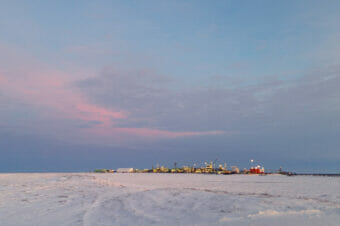
ConocoPhillips’ Alpine facility on the North Slope. (Elizabeth Harball/Alaska Energy Desk)

State regulators are proposing a $914,000 fine to punish ConocoPhillips for a gas leak last year at its Alpine drill site on the North Slope.

The oil company was drilling a well in March of 2022 when workers noticed gas emissions hundreds of feet away, including from fractures in the surface of the gravel drill pad. A concrete barrier intended to contain well pressure had cracked.

The Alaska Oil and Gas Conservation Commission later determined that Conoco had underestimated the gas production potential of one zone the well went through. And then, shortly before the underground blowout, workers had pumped in freeze-protection fluids that briefly over-pressurized the well, beyond allowable limits.

Compounding the company’s faults, the operator failed to submit regulatory paperwork.

The incident was a black eye for ConocoPhillips, and it occurred just as the Biden administration was considering whether to allow the company to develop its highly controversial Willow project, just 30 miles away.

The leak at Alpine continued for days before workers got control of it. It took more than three weeks to stop the flow at the source. The total amount emitted was roughly equivalent to the annual gas consumption of a small city subdivision.
A company spokeswoman says Conoco is reviewing the investigative findings and proposed civil fine. The company can request a review or a hearing if it chooses to contest the commission’s determinations.

Hilcorp fined again for deviating from permit at Milne Point

(Hannah Lies/Alaska Public Media)

A state regulatory agency has fined Hilcorp $267,000 for making unauthorized equipment changes at Milne Point, one of its North Slope oil fields.

The Alaska Oil and Gas Conservation Commission order says that Hilcorp’s drilling permit for a well called I-27 allowed for the use of an electrical submersible pump. An investigation later revealed the company had substituted a jet pump without notifying the agency of the change.

The order says Hilcorp has a track record of regulatory non-compliance that includes more than 60 enforcement actions. Regulators found problems at Hilcorp operations in Cook Inlet and on the North Slope. Several of them were for making changes to a permitted plan.

At Milne Point, three workers nearly died in 2015 after Hilcorp pumped nitrogen down a well without authorization instead of the seawater it said it was going to use. The nitrogen leaked into a trailer where the men were working.

Hilcorp said it launched an investigation as soon as it learned of the unauthorized pump substitution and has already begun revising procedures and training.

“An important part of Hilcorp’s culture is to get better every day, and we look forward to continuing to work closely with AOGCC to ensure compliant, safe and responsible operations,” the company said in an email.

The Alaska Oil and Gas Commission order says the steps Hilcorp has taken are too narrowly focused and are unlikely to prevent a similar reoccurrence.

ExxonMobil says it plans ‘relatively limited’ Arctic investment

Point Thomson is approximately 60 miles east of Prudhoe Bay. (Photo courtesy Exxon)

ExxonMobil told shareholders last week the company doesn’t expect to expand its activities in the Arctic.

“Our current investment plans do not include exploration activity within the (global Arctic) region, and we plan relatively limited investment to sustain our existing interests in the region,” it said in an April 13 proxy statement.

Exxon has been a major player in Alaska since the dawn of the state’s oil industry. It has a stake in some of the largest oilfields in Alaska, including Prudhoe Bay and Kuparuk, as well as Point Thomson. Exxon also owns a 21% share in the Trans-Alaska Pipeline.

Environmental groups trumpeted the news as a sign that next year’s lease sale in the Arctic National Wildlife Refuge will be a bust.

“I think it shows that oil companies are losing interest in the Arctic and recognizing that it’s a bad investment and it’s bad business,” said Tim Woody, a spokesman for The Wilderness Society in Alaska.

The Wilderness Society, the Sierra Club and other groups have been trying to make the Arctic unattractive to oil companies, in part by pressing major banks and insurance companies not to support industrial activity there.

Kara Moriarty, president of the Alaska Oil and Gas Association, said Exxon’s statement does not indicate any change in the company’s strategy for the region.

“And it does not say that they have no interest, because if they had no interest, then their assets would be up for sale,” she said.

A tax law Congress passed in 2017 requires the federal government to hold a second lease sale in the Arctic National Wildlife Refuge by the end of 2024. The first generated few bids and only a fraction of the revenue that was projected. The only bidder that has kept its leases in the refuge is a state-owned entity, the Alaska Industrial Development and Export Authority.

ConocoPhillips can start road work for Willow Arctic drilling project, judge decides

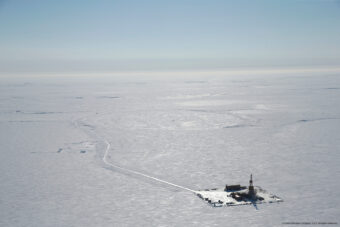
This 2019 aerial photo provided by ConocoPhillips shows an exploratory drilling camp at the proposed site of the Willow oil project on Alaska’s North Slope. (ConocoPhillips)

ConocoPhillips can begin construction immediately on the Willow project in the western Arctic, a federal judge ruled Monday.

U.S. District Court Judge Sharon Gleason denied requests for an injunction that would have stopped the company from working in the final weeks of the winter construction season, which will likely end in late April, when the tundra becomes too soft for heavy equipment to travel on.

Environmental groups and local residents who oppose the project filed two lawsuits last month, claiming the decision to allow ConocoPhillips to develop its leases in the National Petroleum Reserve was made contrary to environmental laws.

Those cases are still pending. But the judge declined to stop work on Willow in the meantime, saying the plaintiffs did not convince her that the company’s winter construction plans would cause serious and irreparable harm.

Her decision frees ConocoPhillips to embark on its plan to build ice and gravel roads, open a gravel mining site and begin hauling and dumping gravel in the National Petroleum Reserve-Alaska. Noise and vibration from blasting at the mine site won’t cause permanent harm, the judge wrote.

She acknowledged that the mayor and some residents of Nuiqsut — the closest village — have concerns about Willow, but Gleason said she gave “considerable weight” to the views of the North Slope Borough, the regional Native corporation and the village corporation for Nuiqsut, all of whom support the project and the winter construction activities.

The Wilderness Society, one of the groups that is suing, issued a statement vowing to continue to fight the project.

Judge likely to rule next week on halting Willow construction on Alaska’s North Slope

Protesters asking President Biden to rule against the Willow project outside the White House in January. (Liz Ruskin/Alaska Public Media)

A federal judge could issue a decision as early as next week to temporarily halt construction of Willow, ConocoPhillips’ controversial oil drilling project in the National Petroleum Reserve.

Two lawsuits, filed by environmental groups and an Inupiat advocacy organization, aim to overturn the Biden administration’s approval of Willow. The plaintiffs have asked for an injunction to halt construction until the case is decided.

U.S. District Court Judge Sharon Gleason said she’d try to have a decision on the injunction by April 3.

The Interior Department’s decision to allow three drill pads and 200 oil wells was a blow to climate advocates. It drew applause from ConocoPhillips, labor unions and many constituencies on the North Slope, as well as Alaska’s Legislature and congressional delegation.

The Legislature and the trio who represent Alaska in Congress have taken the unusual step of jointly filing an amicus brief, to offer their perspective to the judge.

“We are working hard to get the judge to hear our voices — literally collectively, tens of thousands, if not hundreds of thousands of Alaskans — to convince her that this project going forward, of course, abides by the law, but is strongly in the public interest,” U.S. Sen. Dan Sullivan told reporters Monday.

The public interest is a big factor the judge must weigh in deciding whether to grant an injunction, Sullivan said.

“In many ways, discerning the public interest is what elected officials do all the time,” he said. “And so we thought it was very important to have a brief from all the statewide elected officials in Alaska, that lay out what we see as the public interest, which is to deny this preliminary injunction.”

Trustees for Alaska attorney Bridget Psarianos, who filed one of the lawsuits, said the amicus — or friend of the court — brief does nothing to negate her claim that the administration failed to follow environmental laws in issuing the Willow decision.

“This is unfortunately emphasizing Sen. Sullivan’s blinders — that the state government and oil companies and our own congressional delegation from Alaska have — to the impacts that Willow would have on local communities and global climate,” she said.

Nationally, opposition to the project built rapidly in February and early March. Anti-Willow videos on social media garnered millions of views, and young voters in particular say they feel President Biden violated a campaign promise.

Biden said last week that he was inclined not to approve Willow but was advised that ConocoPhillips would sue and likely win.

The company has held the Willow leases since the 1990s.

Alaska regulators hear testimony on ConocoPhillips’ 2022 Alpine gas leak

ConocoPhillips’ Alpine facility on the North Slope. Conoco’s Scott Jepsen says a new processing facility in NPR-A would be about the same size. (Photo by Elizabeth Harball/Alaska Energy Desk)

While ConocoPhillips faces national scrutiny over a future Arctic oil drilling site known as Willow, state regulators took testimony Thursday about an uncontrolled natural gas leak last year at Alpine, a developed oilfield about 30 miles away.

The company rerouted the gas through a waste disposal well within days of the 2022 incident, but it took more than three weeks to stop the leak at the source. ConocoPhillips employees repeatedly told the Alaska Oil and Gas Conservation Commission that gas was not detected beyond the gravel drilling pad, known as CD-1, and that no harm to people or wildlife was observed from the gas that emerged through the tundra and gravel.

The company said nothing like this has ever happened before in its 50-year history of operating in the region, and that it has learned lessons to prevent it from occurring again. But for opponents of development at Willow, the gas leak at Alpine represents a cautionary tale.

The Alpine leak worried residents in nearby Nuiqsut enough for them to evacuate. Nuiqsut Mayor Rosemary Ahtuangaruak said villagers remain concerned about the health impacts of emissions, particularly on pregnant women, infants and elders.

“This event gave our community members much concern,” she testified. “We want to fully understand to prevent this from happening with the new developments that will be nearby our community.”

The mayor asked for an alarm system to warn of future emissions.

The event started in late February 2022, when workers put fluids down the well to prevent freezing. The pressure built to unsafe levels, which wasn’t fully recognized for days, even after gas was detected at the surface of the pad 450 feet away from the well on March 4.

Some sections of the well were enforced with concrete, to prevent events like this. But the source of the leak was determined to be from an area 3,000 feet down, from a relatively shallow formation not previously known to contain much gas. Commissioner Jessie Chmielowski asked why the company doesn’t use more concrete.

ConocoPhillips’ chief Alaska well engineer, Erica Livingston, said the company relies on its well design.

“Do we have an adequate well design that addresses any kind of significant hydrocarbon zones or abnormally pressured geostrata, as is mandated by the regulation? If that required pumping more cement, we would. Absolutely,” Livingston said. “Or we would figure out a way to make the well designed adequate for what we have identified.”

Livingston said ConocoPhillips is now tracking pressure more closely but has not required alarms that would signal an event of this type.

“But again, we’re able to track that pressure and watch it much more closely than we had in the past,” she said.

The commission is considering the case for possible enforcement action, which could include fines. Commission Chair Brett Huber said the panel will issue a written decision. No date has been set for that report.

Site notifications
Update notification options
Subscribe to notifications