North Slope

An Alaska oil and gas expert thinks the state could make money by not drilling in ANWR

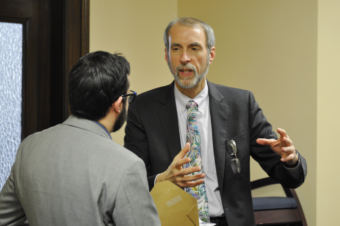
Larry Persily speaks to a reporter in the Alaska State Capitol on Feb. 4, 2014, when Persily was federal coordinator of Alaska Natural Gas Transportation Projects. (Photo by Skip Gray/Gavel Alaska)

ConocoPhillips got approval this week for developing its Willow project in the National Petroleum Reserve-Alaska. But another area the state has been hoping companies develop, the Arctic National Wildlife Refuge, has received almost no industry interest. The Alaska Industrial and Development Export Authority is currently the only leaseholder in ANWR.
The state is sending millions of dollars to the federal government to hold the leases as the Biden administration reviews the leasing program.

Alaska oil and gas expert Larry Persily has an idea. He wants the state to consider selling carbon credits for keeping oil and gas in the ground in ANWR.

After laying out his proposal in a recent op-ed in the Alaska Beacon, Persily says that it’s a serious proposal even if it’s not likely to happen.

Listen:

This interview has been edited for length and clarity.

Larry Persily: I don’t think Alaska’s political leaders are willing to admit there will be no ANWR development. And like I said, you’d have to go and get the feds to cooperate because the federal law says if you got a lease, you got to produce it or get off the lot. And I think the argument would be not producing it and selling carbon credits does not meet that requirement. But to me, it seems an elegant solution. We don’t have to… the state could hold onto leases, make some money. The federal government could share in the credit of not developing it, which wasn’t gonna happen anyhow. I think there’d be a lot of buyers out there. They would find it very high-profile, opportunistic to pay for the credits of not developing ANWR.

Wesley Early: So you touched on this a little earlier, but can you give a quick overview of how we got to this moment regarding ANWR from the Trump presidency to the Biden administration?

Larry Persily: Sure. So Alaskans certainly have been wanting to develop ANWR pretty much, I think since Earth was created in the Big Bang, probably that long. That’s been argued about for years and years. There was legislation passed by Congress that said there will be lease sales. There was one that was rushed through in the Trump administration, the very final days; essentially nobody bid but the state of Alaska. There were a couple of small non-oil and gas producers that put in very small bids and they later said, in hindsight, “We’ll give you back the leases, we don’t want them.” So the industry, I think, is looking at ANWR, looking at the high visibility of ANWR Arctic oil and gas development and they just don’t want any part of it. So the Biden administration came in said, “Hey, those were rushed leases under Trump. We’re going to put them under review. You can’t do anything. We’re going to think about it. We’re going to ponder some more. We’ll get back to you.”

Wesley Early: There’s been a lot of talk about carbon credits lately — essentially companies could purchase these credits to offset their own carbon emissions. And the governor’s also proposed allowing companies to lease depleted Cook Inlet oil and gas reservoirs to store carbon dioxide. What do you think of these plans to lower emissions while also making money for the state?

Larry Persily: Well, right now, anything that makes money for the state would be great because we refuse to tax ourselves, and oil is not exactly a growth industry, Willow aside. So I think the governor is proposing these carbon credits to divert attention from the fact his budget doesn’t balance. We do not have a diversified source of revenue. We don’t want to tax ourselves. So he’s conjured up that we could make billions of dollars by selling carbon carbon credits. There is a market for carbon credits, no doubt about it. Other places are doing it, but the purchasers of these carbon credits are getting more skeptical. They’re saying, “Wait, are you really… is this legit?” in terms of your promising not to log in the Amazon or you’re promising not to log in Alaska. There is growing skepticism in the market for carbon credits where companies want to know they’re real and it really means carbon is going to stay in the ground, not the atmosphere. And that’s why I think something like oil and gas that doesn’t get produced is much more attractive than trees that don’t get cut, which were never going to get cut anyhow.

Wesley Early: You mentioned earlier that your plan does have a hang-up in that federal law does say you have to drill in your oil and gas leases. How would the federal government have to shift things to make your plan work?

Larry Persily: Well, that would assume that I actually put legal research into it. I don’t know if it would take a regulation or a law. I think it probably would take a change in law, but it was also a column I wrote to just get people thinking, “Why are we holding onto these leases? Why are we paying $3.5 million a year for something that’s never going to return anything?”

Wesley Early: You note at the end of your op-ed, that this is a dream, albeit a “sweet dream.” From your perspective, how likely do you think your dream could become a reality?

Larry Persily: Probably not. I mean, I’ve dreamed about a lot of things in Alaska for 50 years and most don’t become reality. But I guess I also want to make the point, okay, you don’t like my dream — find another. Because right now you’re writing a check for $3.5 million a year on leases that are not going to produce because there is just no industry interest in it. So pick another dream or keep writing the checks for nothing.

Conservation groups sue to block Biden-approved Willow oil project on Alaska’s North Slope

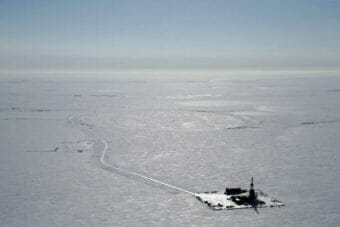
An aerial view of one of the exploration pads and wells that ConocoPhillips drilled during the 2018 exploration season at its Willow prospect. (Photo courtesy of Judy Patrick Photography/ConocoPhillips Alaska)

Six conservation groups filed a lawsuit against the federal government Tuesday, a day after the Biden administration approved the Willow project — the $8 billion ConocoPhillips oil development located in the National Petroleum Reserve-Alaska.

The lawsuit claims federal agencies violated the National Environmental Policy Act by approving Willow because of its potential impacts to sensitive Arctic environments, subsistence users and climate change.

Tim Woody, a spokesperson for one of the plaintiffs, The Wilderness Society, appeared on Alaska Public Media’s “Talk of Alaska” Tuesday. Woody said Willow runs counter to the administration’s goal to cut greenhouse gas emissions in half by 2030.

“Part of that means we don’t commit to long-term, massive oil and gas extraction projects that will drastically increase greenhouse gas emissions over such a long period of time,” he said.

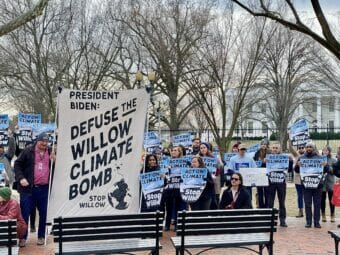
Opponents have termed Willow a “carbon bomb.” The 600 million barrels of oil it’s expected to produce over 30 years equates to adding 2 million cars to the road each year.

The other plaintiffs include Sovereign Iñupiat for a Living Arctic, the Alaska Wilderness League, Environment America, Northern Alaska Environmental Center, and the Sierra Club.

Rosemary Ahtuangaruak, the mayor of Nuiqsut — the closest village to the Willow site — has repeatedly condemned the project as bad for local residents’ health.

A map of the North Slope showing Willow's drill sites
This map from the Bureau of Land Management shows the site of the Willow development on the North Slope of Alaska. Willow’s drill sites are marked by squares. (Bureau of Land Management image)

But many other Indigenous groups, including the Arctic Slope Regional Corporation and the North Slope Borough, support Willow. Nagruk Harcharek is president of Voice of the Arctic Iñupiat, based in Utqiagvik. He said on “Talk of Alaska” he looks forward to economic benefits in the form of jobs and dividends for locals on the North Slope.

Harcharek added that he believes the project will not threaten subsistence hunting in the area.

“Subsistence Inupiaq lifestyle that we live is important, it’s the most important for us,” he said. “So if there was ever a project that we thought would negatively impact that, in ways that would be irreparable, we would not be in support of that project.”

The approved version of Willow scaled the project back from five drilling pads to three to reduce potential impacts to caribou migration and subsistence users, according to the Interior Department.

As a concession to the Indigenous and environmental groups opposed to the project, the Biden administration also announced plans Monday to protect parts of the NPR-A and Arctic Ocean from any future development.

Woody is skeptical those plans will ensure much.

“They’re positive steps, we like them,” he said. “The problem is they’re what we call non-durable protections, meaning a future administration could overturn them and throw them out.”

Kara Moriarty, president of the Alaska Oil & Gas Association, said ConocoPhillips could apply to extend the project to more than three pads in the future.

“That’s always a possibility with any project approval. But I think at this point, they’re going to focus on what was approved … getting that done right and getting it done safely,” Moriarty said.

The three drill sites are projected to produce as much as 180,000 barrels of crude oil per day.

Both Harcharek and Woody expect that ConocoPhillips will begin work to ready the new pads for drilling within the next month.

Questions about Biden’s approval of Arctic drilling of Willow? We’ve got answers

conocopipeline_Harball
Pipelines stretch toward the horizon on NPR-A land leased by ConocoPhillips. (Photo by Elizabeth Harball/Alaska’s Energy Desk)

The Biden administration announced Monday morning that it is approving a permit for Willow. That’s the $8 billion ConocoPhillips project in the National Petroleum Reserve-Alaska, the largest oil development in Alaska since the 1990s. And Sunday night, ahead of the Willow announcement, the administration said it would impose new restrictions on drilling in the NPR-A.

Alaska Public Media reporter Wesley Early spoke to Washington correspondent Liz Ruskin to learn more.

Listen:

The following transcript has been lightly edited for clarity.

Wesley Early: Liz, this is a victory for Conoco and everyone else who lobbied to get the Willow permit approved, right?

Liz Ruskin: Yes. The administration approved three drilling pads for Willow, which amounts to about 219 wells. That’s the same number as the Bureau of Land Management recommended in January. Conoco had wanted five drilling sites and 250 wells. So it’s slightly scaled back but proponents of Willow are calling this a big win. Certainly the congressional delegation is. So are groups on the North Slope that have been lobbying for Willow.

Wesley Early: What are these drilling limitations the Biden administration announced Sunday night, and what’s the deal with a Sunday night announcement?

Liz Ruskin: Yeah, it was weird. What kicked it off, I think is that Friday, Bloomberg reported – based on unnamed sources – that the administration was going to approve Willow. Then a whole bunch of other media outlets reported this, also based on unnamed sources. Then the reaction started pouring in from conservation groups and climate activists and other people who wanted to stop Willow. I think the Interior Department announced these protections when they did to try to blunt the criticism.

Wesley Early: Did it work? The criticism from environmental groups seems pretty loud today.

Liz Ruskin: Right. I’d say it didn’t really work, but it does add a smaller headline under the main one today. The main headline is “Biden allows Arctic oil development, enraging climate advocates.” The smaller one says “but he’s also imposing some limits on Arctic drilling.”

Wesley Early: What are the limitations and will they hinder future developments, beyond Willow?

Liz Ruskin: We don’t really know how much impact these measures will have and whether they’ll apply at all to land that’s already under lease, but we’ve got two categories of government action here. One is that the Interior Department says that they are working on new rules that would limit development on – or “protect,” depending on how you view this – 13 million acres of the reserve. That’s more than half of the reserve. The press release says it would seek the highest level of protection for at least some of the acreage, and that the limits would be applied to land already deemed sensitive or special. So we don’t really know the details and we likely won’t until the rules are put out for public comment, which the Interior Department says will be in a few months.

The administration also announced that President Biden will remove 2.8 million acres of the Beaufort Sea from possible consideration for oil lease sales. That strip of the Beaufort was the only remaining part of the Arctic Ocean under U.S. control that might have been considered for offshore drilling. That’s because in 2016 President Obama put almost all of the Chukchi and Beaufort Seas off-limits.

Wesley Early: The Willow project has faced criticism from some Indigenous and conservation groups for years, but it recently started to trend nationally through some coordinated social media advocacy, especially through the app TikTok. Can you talk about how that advocacy influenced the debate in the last week?

Liz Ruskin: Well, I’m not sure how much influence it had, since ultimately the decision didn’t go their way, but It certainly brought the debate to a lot more people and very quickly. It kind of put Willow on the map, nationally speaking. Especially for younger people who care a lot about stopping climate change. I think that awareness and that activism doesn’t disappear. I think we’ll see a replay when future Arctic developments are debated.

Wesley Early: Lastly, do you expect environmental groups will challenge this in court?

Liz Ruskin: Absolutely. And soon.

Biden approves Willow project, announces new limits elsewhere in NPR-A

Harball_CD5
CD5, ConocoPhillips’ first oil development within the boundaries of NPR-A. Conoco may soon get approval for a third development there. (Photo by Elizabeth Harball/Alaska’s Energy Desk)

The Biden administration announced Monday morning that it will approve the Willow development, a major ConocoPhillips project in the National Petroleum Reserve-Alaska.

ConocoPhillips wanted approval for five drilling pads. The Biden administration approved a plan for three drill pads, with more than 200 wells.

The approval comes hours after the administration said it intends to seek “maximum protection” for sensitive areas of the National Petroleum Reserve Alaska.

The unusual Sunday night announcement of new Arctic protections seems aimed at softening the blow to Willow opponents. Environmental advocates and younger voters are urging the administration to move the country away from fossil fuels to avoid a catastrophic climate crisis.

Several conservation groups responded immediately to say the protections are good but don’t outweigh the impact of granting the Willow permit.

“No matter what they’re doing with all of these protections, in terms of the special areas or the offshore drilling, it’s not enough if they’re going to permit Willow,” said Karlin Itchoak, Alaska director for The Wilderness society.

The announcement says the administration will propose a new rule seeking additional protection for 13 million acres – more than half the refuge – that are already considered to have high natural and historical value.

It’s not clear if any of the limits will apply to the 2.5 million acres that are already under lease in the NPR-A.

Willow has widespread support from Alaska’s political and business establishment. It’s been a top priority of Alaska’s congressional delegation. The Alaska Legislature passed a unanimous resolution asking the Biden administration to approve it. Support is particularly strong in the North Slope Borough. The borough and local governments in the region would gain millions of dollars a year in payments and taxes.

At peak, Willow would boost Alaska’s oil production by 40% over today’s output. It’s projected to remain in operation for 30 years.

The green section show the area President Obama put off-limits to oil and gas drilling in 2016. President Biden proposes to withdraw the area in brown from consideration as well. (Map: BOEM)

The tribe and city of Nuiqsut, the nearest community to Willow, oppose the project. They cite concerns about pollutants, industrial noise and disruption to the wildlife central to their subsistence way of life.

The administration’s announcement also says President Joe Biden will use executive authority to withdraw 2.8 million acres of the Beaufort Sea from potential offshore oil and gas leases. In 2016, President Barack Obama removed nearly the entire Beaufort and Chukchi seas from consideration for leasing. Biden’s action would remove the remaining section – a strip of ocean near the NPR-A.

This story has been updated with the addition of the Willow decision announced Monday morning.

Biden administration can’t have it both ways by shrinking Willow project, Murkowski says

An aerial view of one of the exploration pads and wells that ConocoPhillips drilled during the 2018 exploration season at its Willow prospect. (Judy Patrick Photography/ConocoPhillips Alaska)

Alaska’s U.S. senators warn that half measures won’t suffice as they campaign to get federal approval for ConocoPhillips’ Willow drilling project in the western Arctic.

Sen. Lisa Murkowski told reporters Tuesday that the Biden administration may try to reduce the plan to two drill sites to ensure that it won’t be economically viable.

“So in effect, (they will) be able to have it both ways: The project doesn’t proceed – satisfies the environmental community – but they can say, Well, we approved it,” she said. “That is not acceptable. That cannot happen.”

ConocoPhillips originally proposed five drill sites west of the community of Nuiqsut, in the National Petroleum Reserve-Alaska.

Conoco’s Willow oil and gas prospect is located in the northeastern corner of the National Petroleum Reserve-Alaska. (Image credit Bureau of Land Management)

The Bureau of Land Management has recommended an option that includes three drilling sites, or about 219 wells. But BLM’s parent agency, the Interior Department, immediately issued a statement saying it wasn’t required to approve that preferred alternative.

Sen. Dan Sullivan interprets that as a signal that Interior wants to curtail the project.

The online press conference was arranged through a public relations firm working for Voice of the Arctic Iñupiat , a pro-development advocacy group funded by the Arctic Slope Regional Corporation and the North Slope Borough. The group’s president, Nagruk Harcharek, said the 24 member organizations represent the leadership of the region.

“Our organization passed the resolution unanimously to support the Willow project, which is clear that there’s majority consensus on the North Slope,” he said.

National environmental groups oppose Willow. They say the project would threaten wildlife in the area and that the fuel produced will accelerate climate change. Other opponents include the city and tribe of Nuiqsut. They’ve written a letter opposing Willow, while Kuukpik, the village corporation of Nuiqsut, supports the drilling project that the BLM selected as its preferred alternative.

After China balloon scare, Air Force shoots down object flying over Alaska’s North Slope

A Chinese balloon flies above Billings, Montana, on Feb. 1, 2023. (Photo by Chase Doak, special to States Newsroom)

An F-22 fighter jet from Joint Base Elmendorf-Richardson shot down an unidentified object flying above Alaska’s North Slope on Friday, officials at the White House said.

The downing, at 9:45 a.m. Alaska time, took place less than a week after an Air Force fighter jet shot down a Chinese surveillance balloon off the coast of South Carolina.

Federal officials repeatedly declined to say whether the object was a balloon.

John Kirby, the National Security Council Coordinator for Strategic Communications at the White House, said in a news conference that the object on Friday was “much, much smaller” than the Chinese surveillance balloon and was “about the size of a small car.”

Kirby said it wasn’t immediately clear whether the object was from China.

President Joe Biden ordered the object be shot down, Kirby said. It was traveling at an elevation of about 40,000 feet and could have posed a threat to commercial aviation, he said.

NORAD, in charge of air defense over North America, detected the object with ground-based radar on Thursday, according to the Defense Department.

A fighter jet inspected it visually, Kirby said. The president gave his order Friday morning after consulting military officials, and a jet conducted a second visual inspection before the balloon was shot down with an air-to-air missile.

Kirby said the flybys didn’t reveal much.

“They did the best they could, but again the speed and the conditions up there as well as the size of the object made it a little bit more difficult,” he said.

Brig. Gen. Pat Ryder, a Defense Department spokesperson, said the object’s origin isn’t yet known. He declined to say how quickly the object was traveling.

“We will know more once we’re able to potentially recover some of those materials. But the primary concern again was the potential hazard to civilian flight,” he said.

The Federal Aviation Administration issued a temporary flight restriction over Prudhoe Bay, portions of the North Slope and the Arctic Ocean on Friday morning. At least one flight carrying oilfield workers was delayed, according to a scheduling announcement given to the Beacon by a worker.

State Rep. Josiah Patkotak, I-Utqiagvik, represents the North Slope and said there is limited air traffic in the area — a regular flight between Utqiagvik and Kaktovik, plus commercial flights carrying cargo and passengers into Prudhoe Bay.

After it was shot down, the object fell onto sea ice offshore.

Online flight tracking services showed a C-130 from Elmendorf Air Force Base circling south of Prudhoe Bay for much of the morning before flying offshore and circling above a spot northeast of Prudhoe Bay.

Ryder said helicopters were also involved in the effort.

In a congressional hearing this week, Sen. Lisa Murkowski, R-Alaska, said she was angered that the earlier Chinese balloon was allowed to travel across Alaska and much of the United States before being shot down.

Sen. Dan Sullivan, R-Alaska, mentioned the balloon during his annual address to state legislators this week and said after the first downing that the incident “cannot become a precedent for further Chinese Communist Party aggression.”

Patkotak said Friday’s incident indicates a need for military infrastructure development on the North Slope in order to respond to similar incidents. Any such development should be done only after consulting local communities, he said.

Reporter Ashley Murray contributed to this report from Washington, D.C.

This article is developing and will be updated. Check back for more.

The article originally appeared in the Alaska Beacon and is republished here with permission.

Site notifications
Update notification options
Subscribe to notifications