North Slope

Alaska is short on gravel and long on development projects

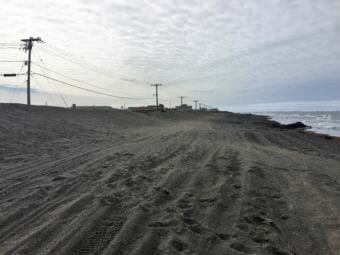
A gravel berm is one of the ways that the North Slope Borough protects infrastructure from storm damage.

Every year, millions of migratory birds flock to Arctic Alaska. Hundreds of thousands of caribou use the tundra, rich in plant life, as their calving grounds. Alaska’s North Slope is also rich in other natural resources: oil, gas, minerals. But one important thing is lacking: Rocks. “Yes, gravel is a precious commodity on the North Slope,” said Jeff Currey, an engineer with the state’s Department of Transportation and Public Facilities who works in the agency’s Northern Region Materials Section. For decades, Currey said, the state has been searching for gravel all over the North Slope, with limited success.

Gravel is essential for all kinds of long-term development: building projects, road construction, runways and other major infrastructure. “There’s a big need for gravel, and not a lot of it, is really what it comes down to,” said Trent Hubbard, a geologist with the Alaska Division of Geological and Geophysical Surveys.

“We need roads. We need housing developments,” said Pearl Brower, president and CEO of Ukpeaġvik Iñupiat Corporation (UIC), based in Utqiaġvik, during a panel discussion at last year’s Arctic Encounter Symposium, the largest annual Arctic policy symposium in the United States. Brower was among a handful of leaders from across the Arctic speaking on the region’s future.

“I definitely think it’s kind of a paramount necessity,” said Brower. UIC runs a construction company that has completed more than $1 billion in construction projects throughout the United States. The company’s website boasts that it specializes in remote locations. Brower said its projects over the last three decades have exhausted two gravel pits, and the corporation is now developing another. “You look all around (Utqiaġvik) and we’re very gravel-based,” Brower said. “You know, we don’t have pavement for the most part, and you wonder, ‘Wow, you know, where did all this gravel come from?’”

Ross Wilhelm — the project superintendent at UIC Sand and Gravel, which opened a new pit last year — said that if all the projects that currently require gravel from UIC’s pit are completed, it could be in operation for up to nine years.

A piece of the Utqiagvik coastline in a residential area near downtown. Much of this bluff collapsed during the September 2017 sotrm. Visible to the left are “supersacks,” part of the North Slope Borough’s strategy at the time for protecting the coastline from storm damage. (Ravenna Koenig/ Alaska’s Energy Desk)

According to Wilhelm, climate change is increasing demand: Gravel is needed for stabilizing existing infrastructure as the frozen ground underneath it thaws, as well as for a seawall to protect Utqiaġvik from high rates of coastal erosion. “I think it’s a big factor,” he said. A five-mile-long sea wall was priced at nearly $330 million, according to a 2019 feasibility study by the U.S. Army Corp of Engineers.

Gravel may also be a means to a richer economic future for Alaska’s North Slope. “To keep the economy growing, it’s so vital,” said Wilhelm. Many of the region’s residents dream of connecting at least some of its eight main communities by road, but doing so would require lots of gravel. The state and the North Slope Borough are partnering on a project, the Arctic Strategic Transportation and Resources, or ASTAR, that could do exactly that. It’s been under evaluation by state geologists since 2018.

The issue isn’t just locating enough gravel for projects like ASTAR; the cost can also be exorbitant. Currey said he’s heard of other North Slope projects where the bids are as high as $800 a cubic yard for gravel, enough to cover about 50 square feet. In Anchorage, a cubic yard of aggregate gravel — the kind used for building projects — goes for about $15. “The DOT has paid on the order of a couple hundred dollars a cubic yard for material being barged in, because that’s the only way to do it,” Currey said. Some of those barges come all the way from Nome, traveling more than 700 sea miles north and east through the Bering Strait and up and into the Beaufort Sea to deliver gravel.

Gravel is also a prized commodity for the oil and gas industry. Last year, the Biden administration approved ConocoPhillips’ Willow Project, a decades-long oil-drilling project in the National Petroleum Reserve. The controversial endeavor will require 4.2 million cubic yards of gravel — more than 12,800 Olympic-size swimming pools’ worth of rocks — for its three oil drilling pads, as well as enough for more than 25 miles of new road. Much of that gravel will come from a 144-acre mine ConocoPhillips will dig itself.

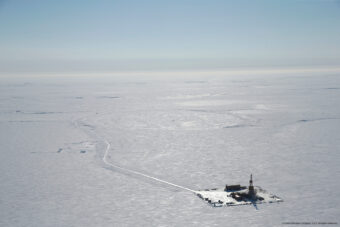
ConocoPhillips’ Willow prospect, pictured here, is still being explored. (Photo courtesy ConocoPhillips)

When it comes to gravel, the Willow Project may fare well, mainly due to its geography; it will be located just west of the village of Nuiqsut, where there’s actually plenty of gravel. Nuiqsit lies on the eastern side of Alaska’s North Slope, where the Brooks Range is closer to the coast. Streams that run northward down the mountains carry gravel with them, according to Hubbard.

But the North Slope is vast, spanning nearly 95,000 square miles, and further west, gravel resources dwindle: The mountains are farther from the coast, and gravel gets caught in the Colville River. “Much of the material north of the Colville River is largely silt and sand left over from historic sea-level rise and fall,” said Hubbard. It’s the kind of material that doesn’t work for projects like Willow or the roads and critical infrastructure that communities rely on. “Gravel,” said Hubbard, “is just a really hard resource to find.”

Emily Schwing is a reporter based in Alaska.

Email High Country News at editor@hcn.org or submit a letter to the editor. See our letters to the editor policy.

This story originally appeared in High Country News and is republished here with permission.

Federal judge rejects legal challenge to ConocoPhillips’ Willow Project

This 2019 aerial photo provided by ConocoPhillips shows an exploratory drilling camp at the proposed site of the Willow oil project on Alaska’s North Slope. (ConocoPhillips)

The massive Willow oil project on Alaska’s North Slope can move forward, a federal judge in Anchorage ruled Thursday.

U.S. District Court Judge Sharon Gleason ruled against environmental groups, who argued that the government’s decision to greenlight the ConocoPhillips project in the Arctic was flawed.

Gleason found the government’s analysis was consistent with environmental laws and with goals Congress established for the large federal area in the western Arctic, called the National Petroleum Reserve in Alaska.

“ConocoPhillips, as the lessee, has the right and the responsibility to fully develop its oil and gas leases in the NPR-A subject to reasonable restrictions and mitigation measures imposed by the federal government,” she wrote.

ConocoPhillips has called Gleason’s pending decision “make-or-break” for the major oil prospect. The project’s federal approvals have been challenged by several environmental groups. In April, Gleason gave ConocoPhillips a green light to begin constructing roads to support the project.

The initial federal approval of the project under President Joe Biden generated a political backlash, ranging from pushback among Alaska Native groups to protests in Washington, D.C. and opposition from the United Nations and outdoor-gear maker Patagonia.

Biden has tried to temper that anger by making other parts of the NPR-A off-limits to drilling and canceling oil leases in the Arctic National Wildlife Refuge, in Alaska’s eastern Arctic.

The project has been greeted with more favor in the realm of Alaska politics, with state budget projections improving as they take Willow into account and an unanimous Alaska House vote in support.

Conoco says the project would produce 600 million barrels of oil over 30 years, $7.6 billion in revenue for the U.S. Treasury and 2,500 construction jobs.

Chum salmon are spawning in North Slope rivers, University of Alaska researchers find

Peter Westley of the University of Alaska Fairbanks holds two chum salmon at the Anaktuvik River on Sept. 14. Westley, an associate professor at UAF’s College of Fisheries and Ocean Sciences, led a team that found about 100 of the spawning fish last month on the North Slope. The discovery backs up the hyphothesis that climate change is causing salmon to shift their range north. (Photo provided by Peter Westley)

Chum salmon, a species that has faltered in the Interior Alaska river systems, are now reproducing farther north in some North Slope rivers, researchers have confirmed.

A University of Alaska Fairbanks team last month found about 100 chum salmon that were spawning or had just spawned in the Anaktuvuk and Itkillik rivers. The rivers are tributaries of the Colville River, which flows into the Arctic Ocean.

The discovery of salmon that far north was not a surprise since all five species of Alaska salmon have been spotted in the Arctic, said Peter Westley, an associate professor at UAF’s College of Fisheries and Ocean Sciences and leader of the project.

But the discovery of so many spawning chum in the Colville tributaries was gratifying and supports scientists’ hypothesis that salmon are shifting their range north as climate change warms their more southern habitat, he said.

“I was just really happy to see it all come together,” said Westley, who is studing salmon population shifts. “It felt like we were kind of looking for a needle in a haystack.”

The findings confirm local reports of chum salmon swimming in North Slope rivers. And the UAF work follows a previous discovery of a single juvenile chum salmon in a Beaufort Sea lagoon, an earlier piece of evidence that the species is starting to reproduce at that high latitude.

Yet to be determined, he said, is the success of the chum spawning that his team found. The question is whether the salmon found on the North Slope are occasional strays or part of a more permanent change, he said: “Are they now a fixture in the ecology, or some years they’re there and some years they’re not?”

The team is doing follow-up work to track the results. That includes chemical and genetic analysis and readings from temperature sensors placed in the spots where the spawning chum were found, he said.

If liquid water remains there throughout the year, there is support for a more permanent chum salmon presence, he said. “If they freeze solid, it’s pretty much the end of the road,” he said. “Salmon eggs can’t survive if they freeze.”

So far, pink salmon have been the species most frequently observed in higher latitudes, Westley said. Pink salmon have short life cycles, only two years long, so that makes quicker population shifts more feasible, according to scientists.

The body of a female chum salmon found on the North Slope, seen on Sept. 22, still has some eggs inside. About 100 chum spawning chum salmon were found in two North Slope rivers by a University of Alaska Fairbanks team. (Photo provided by Peter Westley/UAF)
The body of a female chum salmon found on the North Slope, seen on Sept. 14, still has some eggs inside. About 100 chum spawning chum salmon were found in two North Slope rivers by a University of Alaska Fairbanks team. (Photo provided by Peter Westley/UAF)

Chum salmon, though they spend multiple years in the ocean, have a trait in common with pinks that might also make a northward range shift more feasible, Westley said. Like pinks but unlike sockeye, coho or Chinook salmon, chum salmon spend very little time in freshwater. “They really only use the rivers for spawning,” he said.

The catalyst for the spawning-salmon project was an Arctic salmon workshop held by the Alaska Sea Grant program in Anchorage last December.

One North Slope resident who participated in the workshop, Robert Thompson of Kaktovik, confirmed the growing presence of salmon on the North Slope.

“When I first came here, if someone got a salmon, it was the talk of the town,” said Thompson, who began living part-time in Kaktovik in the 1970s and moved there permanently in 1988. Now, he said, salmon are caught regularly, albeit in low numbers.

“I’ve caught a fish of each species — king, silvers, reds, chum and pink,” he said, using alternate names for Chinook, coho and sockeye.

The emergence of salmon on the North Slope is similar to another change in the waters where local people harvest whitefish, Thompson said. “We’ve got a species that’s moving in, the saffron cod,” he said.

Research led by the U.S. Geological Survey found that saffron cod, a more southern fish species than Arctic cod, have increased up to 19-fold in the past three decades in Beaufort Sea lagoons near Kaktovik.

There is some concern that saffron cod might crowd out other fish species on which local people depend, Thompson said.

“They could, when you have only so much food for them,” he said.

For salmon, there are also varying opinions as to whether the northward shift is good or bad.

In Nome and the rest of Western Alaska’s Norton Sound region, commercial fishers are taking advantage of the increasing pink salmon numbers. Last year in Norton Sound, more pinks were harvested commercially than any other salmon species, according to the Alaska Department of Fish and Game.  That followed an unexpectedly large pink salmon harvest in 2021.

But in Norway, pink salmon are considered an invasive species. There, pink salmon compete for food with the more prized Atlantic salmon, and rotting post-spawning pink carcasses are seen as sources of pollution.

On the North Slope, the presence of salmon might be beneficial, Thompson said. He is planning to use a large-mesh net next year to try to catch more of them, he said.

“It would be nice if they would get established up here because they’re going away in other places,” he said.

Thompson referred to salmon collapses farther south, in the Yukon and Kuskokwim river systems and elsewhere, and he blamed the warming climate.

“I don’t think people are taking climate change seriously enough,” he said. “When you’ve got the whole Yukon River shut down and they’ve been fishing there for thousands of years, that’s really serious.”

Correction: The photos were incorrectly dated in the original version of this article. They were taken on Sept. 14.

Haaland cancels leases in Alaska’s Arctic Refuge: ‘Climate change is the crisis of our lifetime’

A polar bear walks along the edge of Kaktovik, the only village within the Arctic National Wildlife Refuge’s coastal plain. (June 2018 file photo: Jeff Chen/Alaska Public Media)

Interior Secretary Deb Haaland has canceled all oil and gas leases in the Arctic National Wildlife Refuge, in a move designed to protect the region and reduce fossil fuel production.

“With today’s action, no one will have rights to drill in one of the most sensitive landscapes on Earth,” Haaland said in an online news conference Wednesday. “Climate change is the crisis of our lifetime. And we cannot ignore the disproportionate impacts being felt in the Arctic. We must do everything within our control to meet the highest standards of care to protect this fragile ecosystem.”

No company was close to drilling in the refuge, in northeastern Alaska. Two companies that bought leases during the Trump administration later gave them up. A state agency, the Alaska Industrial Development and Export Authority, still holds seven leases. But Haaland’s cancellation forecloses the possibility it might sell them to a company to develop them. Her announcement also seems aimed at dissuading any company from even thinking about drilling in the refuge, even as the department is planning its second legally required lease sale there.

Kara Moriarty, president of the Alaska Oil and Gas Association, said cancelling the ANWR leases sends a chilling message to the industry nationwide.

“It does not send a signal of stability or consistency, or that this administration believes in the future of oil and gas development in our country,” Moriarty said. “If you’re an investor in any federal area in America, you have to wonder, ‘What the heck?’”

She called it ironic that this announcement comes just as news emerges that more oil tankers are sailing through the Bering Sea, taking oil from Russia’s Arctic to China.

“The world demand for oil is not going away,” Moriarty said. “So if the Biden administration was really concerned about the climate, I don’t think they would want to make more regulatory changes in the state that does it better than anywhere else.”

The future of the ANWR leases has been in doubt since the start of President Joe Biden’s term, when he ordered the Interior Department to review them for “alleged legal deficiencies.”

“What we have found in our analysis is that the lease sale itself was seriously flawed, and based on a number of fundamental legal deficiencies,” Haaland said Wednesday.

Her department says the Trump administration failed to properly consider alternatives to drilling in the refuge and to completely quantify the greenhouse gas emissions that would result from producing oil, refining it and burning it as fuel.

In addition to canceling existing leases, the Interior Department also released a new draft Environmental Impact Statement intended to govern the next lease sale in the refuge, which Congress ordered must be conducted by the end of next year.

Haaland also announced a proposed rule to make protections on federal land to the west, in the National Petroleum Reserve Alaska, more durable. It closely follows the contours of previously announced protections on 13 million acres that were set aside as “special areas,” including Teshekpuk Lake. The NPRA rule doesn’t directly impinge on ConocoPhillips’ work on its Willow leases, acquired in the 1990s.

“The proposed rule would not impact valid existing rights,” said Laura Daniel-Davis, principal deputy assistant Interior secretary for Land and Minerals Management.

ConocoPhillips says it has already spent more than $900 million on preliminary work at Willow and plans to spend that much again on construction this winter, if it wins a legal challenge pending in U.S. District Court.

The Arctic policy announcements drew a barrage of praise from environmental groups while Alaska’s congressional delegation panned it.

“I am deeply frustrated by the reversal of these leases in ANWR,” said Congresswoman Mary Peltola, D-Alaska. “This administration showed that it is capable of listening to Alaskans with the approval of the Willow Project, and it is some of those same Inupiat North Slope communities who are most impacted by this decision.”

The proposed rule for the National Petroleum Reserve Alaska and the draft environmental statement for the Arctic Refuge are subject to public comment periods that begin soon. The lease cancelations are not. The Interior department says Haaland has the authority to cancel or suspend any oil and gas leases that were issued contrary to law or regulation. Her power to toss out the seven Arctic Refuge leases will likely be tested in court.

ConocoPhillips says court case is likely do-or-die for Willow Arctic oil project

An exploration site at ConocoPhillips’ Willow prospect is seen from the air in the 2019 winter season. (Photo by Judy Patrick/provided by ConocoPhillips Alaska Inc.)

In documents filed Tuesday in Anchorage, international oil company ConocoPhillips said an ongoing federal court case is likely to make or break Alaska’s largest planned oil development in decades.

If Alaska District Court Judge Sharon Gleason cancels required federal approvals, “the Willow project is highly unlikely to proceed at all,” said Connor Dunn, vice president of Willow for ConocoPhillips.

Dunn’s statement came as ConocoPhillips filed a legal reply to several environmental groups who sued the federal government earlier this year and asked Gleason to overturn existing federal approvals as inadequate.

The plaintiffs include the Alaska Wilderness League, Sierra Club and Sovereign Iñupiat for a Living Arctic. After a similar lawsuit, filed in 2020, overturned a previous federal approval and forced regulators to restart their process, and new approval was granted this spring.

The federal government is opposing the environmental groups’ lawsuit and is backed by ConocoPhillips, the state of Alaska, the North Slope Borough, and a variety of companies and industry groups who hope to see the project developed.

ConocoPhillips said in this week’s filings that through July, it has already spent $925 million on Willow, and if allowed to proceed, it expects to spend another $903 million by the end of the winter 2023-2024 construction season.

As many as 1,200 people would be involved in direct construction, the company said, with another 600 offering support.

Willow is expected to hold as much as 600 million barrels of recoverable oil and would generate billions for the state of Alaska in the long term but would cost the state money during its initial years.

The environmental groups are scheduled to reply to ConocoPhillips and other defendants by mid-September, allowing Gleason to decide the case before the start of the winter construction season.

If the case isn’t resolved by then and ConocoPhillips can’t work this winter, there is a risk that the company could fail to meet the requirements of its land lease with the federal government.

Willow would be the first large project constructed in the National Petroleum Reserve-Alaska, and ConocoPhillips’ 30-year lease was signed in 1999.

Under the terms of the agreement, the first oil must flow by September 2029. Writing to Gleason, Dunn said that “timely first oil requires a highly integrated series of construction milestones from 2023 through 2029, and there are no opportunities to further compress the construction schedule that would not create major execution risk.”

It’s possible that the federal government allows a lease extension, he said, but that’s not guaranteed.

If Gleason overturns the existing approval altogether through what’s known as a “vacatur” order, it would likely cost ConocoPhillips at least two winter construction seasons, Dunn said, because of the time needed for federal regulators to redo the approval process.

“It could take years, depending on market conditions, to reassemble the right team to execute the project safely and efficiently,” Dunn said. “This is a real, practical consequence of a vacatur order, and it would weigh heavily against ConocoPhillips moving forward with a project that faces a risk of lease expiration.”

This story originally appeared in the Alaska Beacon and is republished here with permission.

State appeals federal court ruling that allows ConocoPhillips to keep Willow drilling data secret

An exploration site at ConocoPhillips’ Willow prospect is seen from the air in the 2019 winter season. (Photo by Judy Patrick/provided by ConocoPhillips Alaska Inc.)

The Alaska Oil and Gas Conservation Commission is appealing the decision of a federal judge who ruled in March that ConocoPhillips, a major North Slope oil producer, may keep some drilling data secret.

According to a filing dated Wednesday, the commission is appealing the decision by U.S. District Judge Sharon Gleason to the 9th U.S. Circuit Court of Appeals.

In March, Gleason determined that a federal law preempts a state law that requires North Slope companies to make data publicly available.

The state’s goal was to encourage drilling on the North Slope, but Gleason determined that the state law should be overridden by federal rules because the relevant data comes from five oil wells in the federally owned National Petroleum Reserve.

ConocoPhillips Alaska is developing part of the reserve under its Willow Project, which is also the subject of separate litigation.

Gleason determined that the Willow data should be released only after ConocoPhillips’ leases with the federal government expire.

ConocoPhillips filed a lawsuit against the commission last year after unsuccessfully asking the state to extend the privacy period.

As of Thursday morning, the state’s appeal had not been processed by the 9th Circuit, and no additional documents had been posted online.

Site notifications
Update notification options
Subscribe to notifications