North Slope

Gov. Dunleavy says Alaska doesn’t flare its natural gas. It does.

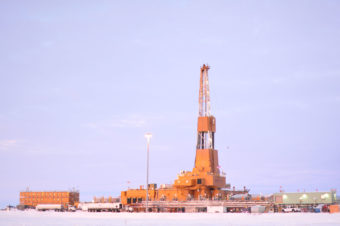
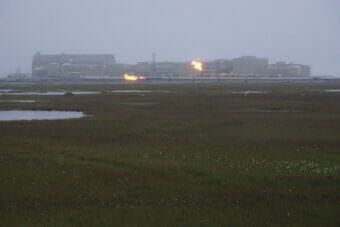
Flames from burning gas stream into air on Aug. 23, 2018 at a facility within the Greater Prudhoe Bay Unit on Alaska’s North Slope. (Photo by Yereth Rosen/Alaska Beacon)

During last week’s State of the State address, Gov. Mike Dunleavy incorrectly said that Alaska’s oil and gas producers are banned from releasing gas into the atmosphere and burning it, a process known as flaring.

“We don’t flare our gas, and never have, and we don’t have to be told not to by the federal government,” he said.

It’s not true.

While the state has strictly limited gas flaring since the 1970s, the state allows producers to flare gas for safety reasons, during maintenance periods, and in order to test new oil and gas wells.

In November, for example, the Alaska Oil and Gas Conservation Commission, which is charged (among other duties) with overseeing and limiting flaring, approved a special permit that allows a producer to flare gas for at least three months — and possibly as many as nine — from a new well near the Dalton Highway.

For oil producers testing new wells, flaring makes economic sense: They don’t have to worry about where to put the gas that’s produced as a side effect of oil drilling. During ordinary production on the North Slope producers compress it and reinject it below ground, using costly equipment to do so.

But the state doesn’t generally require reinjection during test drilling. And while the state taxes gas production, there’s no tax on gas burned in flares that stay below limits imposed by the AOGCC, according to the Alaska Department of Revenue. That amounts to a state subsidy for test wells and the flaring that results.

In 2021, Alaska producers flared 6 billion cubic feet of natural gas. By comparison, Chugach Electric used about 13.4 billion cubic feet in 2022, based on an average of 36.8 million cubic feet per day.

That was a particularly good year for flaring by historic standards. In 2012, the state flared almost twice that amount, and in 1993, the state flared between three and four times as much.

State regulations require producers to “take action in accordance with good oil field engineering practices and conservation purposes to minimize the volume of gas released, burned, or permitted to escape into the air.”

That regulation isn’t for environmental reasons. It’s because Alaska’s subsurface oil and gas are owned by the state and managed collectively on behalf of all Alaskans, and state law requires efforts to avoid waste.

Only about 0.17% of the state’s gas production was flared in 2021. Texas, which like Alaska is a major oil and gas producer, flared almost 1% of its gas, or 102 billion cubic feet. California flared almost 1.1%, Wyoming about 4.75% and North Dakota a whopping 7% of all gas produced.

In 2022, Alaska flared about 0.27% of all gas produced here, according to reports submitted to the AOGCC; figures for other states haven’t been published yet.

State seeks investment

The governor’s wrong statement in the State of the State may have been a simple misstatement, but the governor’s office didn’t answer a question seeking clarification about what it was based on.

One of the key points of Dunleavy’s speech was a request for $5 million to market Alaska as a “leader in responsible resource development.”

The stakes are high for that advertising campaign.

Banks and other firms are instituting policies that prohibit investment in Arctic oil and gas, emphasizing non-economic considerations under environmental and social governance rules (also known as ESG), the Dunleavy administration has been trying to market Alaska oil and gas as an environmentally cleaner alternative to the same stuff from the developing world or Russia.

“We know we’ve been doing ESG since before ESG was the latest fashionable thing on Wall Street or in Washington,” Dunleavy said last week.

The administration has flown officials, including former Senate President Peter Micciche, R-Soldotna, to New York City to speak directly to investment officials, but problems for the oil and gas industry have persisted.

In a presentation to the Senate Resources Committee on Monday, Department of Natural Resources Commissioner-designee John Boyle said an impending natural gas shortage in Cook Inlet may be partially attributable to drillers being unable to find financing because of the new restrictions.

“We’re going to tell this story, our story, the real story, and it’s not the story the extremists want everyone to believe,” Dunleavy said in last week’s speech. “Through multiple media channels and targeted industry outreach, we’ll promote our unmatched opportunities for investment and development.”

Burnishing the state’s record on flaring, a major source of greenhouse gas pollution globally, would help the state make its case.

Economics, not state rules, have limited flaring

That has risks. Alaska’s limits on flaring are based on what defines waste, and what defines waste is determined by economics, not environmentalism. If the economics of flaring change, the state’s sterling reputation could as well.

Flaring right now is at a low ebb, but history shows that pattern can change quickly. In 1993, flaring spiked to 0.8% of all gas produced in the state, according to figures from the Energy Information Administration. That was lower than other states but far more than the state flared before and after.

And while the state is eager to advertise itself as a leader in responsible development, it’s been slow to back that advertising with regulatory action.

Dunleavy has said he doesn’t believe greenhouse gas emissions contribute to climate change, the Legislature has declined to pass climate legislation and the state courts have been unwilling to define existing laws to encompass climate change.

The state’s newly proposed carbon sequestration program remains hypothetical and wouldn’t directly change the environmental effects of oil and gas drilling.

That leaves the state to market existing efforts that aren’t intended to benefit the environment as being environmentally friendly.

“The world is going to want oil and gas for decades and decades to come,” Dunleavy said on Talk of Alaska on Tuesday, “And it’s my position that Alaska does it better, as opposed to sending it overseas to places like Russia, or Africa or South America. So the premise should be that we want to produce as much oil and gas here. It helps Alaskans across the board.”

Oil-spill regulations imposed after the Exxon Valdez oil spill have left Alaska with some of the toughest spill reporting requirements in the country. During a news conference last year, Dunleavy compared those requirements to pictures of crude oil flowing through canals and channels in Russia.

Using gas flaring as a similar example could be misleading. Oil companies here are extremely careful about spilling oil in part because they’re required to. Flaring isn’t done more widely here because it doesn’t usually make economic sense, not because the state forbids it.

Commission allows gas flaring for oil field testing

In August, Great Bear Pantheon, an Anchorage-based subsidiary of a London firm, requested permission to flare gas from a prospective oil well for nine months in order to test the production of a possible oil field.

Flaring for new test wells is typically limited on the North Slope because they’re normally only accessible by cold-weather-dependent ice roads, but Great Bear’s site is near the Dalton Highway, which makes year-round access — and testing — possible.

Pat Galvin, husband of Rep. Alyse Galvin, I-Anchorage, and an official at Great Bear, said the planned gas release is limited and helps the company determine the extent of its oil find. If proved and developed, that find could generate millions in revenue for the state. If testing turns into production, future gas would be captured, he said.

The AOGCC noted that the length of the flare was unusual, but it ultimately approved the request, noting that it was “necessary to determine if Great Bear has made an economic discovery and to be able to design production facilities for a full field development.”

Environmental groups have focused on the flaring of natural gas in oil work because of its effect on the atmosphere. They’re also concerned about venting, the release of gas to the open air without burning.

One of the main components of natural gas is methane, and over a 20-year period, methane released into the atmosphere will create 80 times as much global warming as a comparable amount of carbon dioxide.

The Biden administration is also interested in limiting the practices; the Bureau of Land Management has proposed new restrictions on flaring and venting from oil and gas production on federal land.

The rules on state land here in Alaska, as in Great Bear’s case, are different. Economics, not environmentalism, is the guiding principle.

Trustees for Alaska, an environmental organization, petitioned AOGCC to reject Great Bear’s flaring request, citing the impact on the atmosphere, but the commission didn’t address that issue in its final determination.

The commission has traditionally ignored environmental issues as outside its purview. In 2018, Juneau resident Kate Troll and 46 other people petitioned the AOGCC to ban all non-emergency flaring and venting to limit global warming and climate change.

The commission rejected that petition the following year after a public hearing, concluding that petitioners “acknowledged, and the AOGCC reiterated at the hearing, that while the AOGCC regulates to prevent waste, it has no authority to act regarding that subject matter.”

Similarly, the commission declined in 2022 to fine oil and gas producer Hilcorp for a leaky gas pipeline in Cook Inlet, largely because the state had already been paid for the gas that leaked.

Millions of cubic feet of gas escaped into the atmosphere during the four-month leak, but the AOGCC concluded that the problem — and the resulting impact on the atmosphere — was beyond its jurisdiction because it was no longer the state’s gas.

“The primary purpose behind the prohibition against ‘waste’ is to maximize ultimate resource recovery,” commissioners concluded.

For now, economics and environmental concerns are aligned. Alaska doesn’t ban flaring entirely, but the drive to eliminate waste means Alaska has one of the lowest rates of flaring in the nation.

In other parts of the United States, environmental concerns are driving states to catch and pass Alaska in the race to reduce emissions. In 2019, Colorado approved a law directing its oil and gas commission to pass environmentally centered regulations that ban flaring in most cases and restrict emissions when it does take place.

As a result, Colorado in 2021 flared less than one-tenth of 1% of its produced gas, by far the lowest rate in the nation according to federal statistics, and the state is marketing itself as the capital of “responsibly sourced” oil and gas, the same target Alaska has set.

This story originally appeared in the Alaska Beacon and is republished here with permission.

Rep. Peltola joins Alaska senators to champion Willow project

Mary Peltola speaking into a microphone
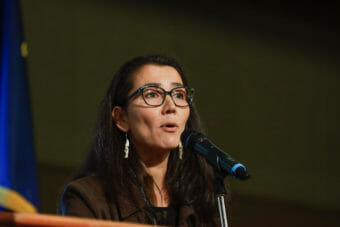
Mary Peltola speaking at the Alaska Oil & Gas Association candidate forum on Aug. 31, 2022. (Photo by Matt Faubion/Alaska Public Media)

Alaska’s congressional delegation, including Democrat Rep. Mary Peltola, sent a letter to Interior Secretary Deb Haaland Tuesday asking her to approve the Willow project, a proposed oil development in the National Petroleum Reserve-Alaska.

The letter itself is not unusual. It recounts the lengthy permitting process, lists benefits to Alaska’s economy and urges Interior Secretary Deb Haaland to approve the project in time for the winter construction season.

Republican Sens. Lisa Murkowski and Dan Sullivan have sent at least two earlier versions of the letter, but Rep. Peltola’s signature could carry extra weight with Haaland. She, like Peltola, is one of only a handful of Indigenous women to ever serve in Congress.

Haaland gave an emotional speech at a reception last week celebrating Peltola’s swearing-in. She’s contributed to her political campaign. And they’re both Democrats.

The Willow oil and gas prospect is located in the northeastern corner of the National Petroleum Reserve-Alaska. (Image credit Bureau of Land Management)

Whatever the letter’s power to expedite the Willow project over the objections of environmental groups, it helps Peltola’s profile as she campaigns in a Republican-leaning state. With her next election just weeks away, actions like this help her show that she can work in tandem with Alaska’s Republican senators.

They also demonstrate that she’s in favor of some development projects, making it harder for her Republican opponents Sarah Palin and Nick Begich to define her as a captive of the Democratic left and their allies in the environmental lobby.

Last remaining private bidder from 2021 ANWR lease sale pulls out

The Canning River forms the northwestern border of Arctic National Wildlife Refuge. (Lisa Hupp/USFWS)

The last remaining private company that bid in last year’s controversial Arctic National Wildlife Refuge lease sale has pulled out of its lease.

It’s another blow for drilling advocates hoping to develop the northernmost slice of the refuge, called the coastal plain, in northeast Alaska. Environmental groups celebrated the news Monday.

Knik Arm Services was one of just two small companies that each picked up a single tract in the last-minute lease sale the Trump administration arranged in January 2021, days before leaving office. The other company, Regenerate Alaska, a subsidiary of Australia-based 88 Energy, canceled its lease a few months ago.

The only other bidder was the state-owned Alaska Industrial Development and Export Authority, or AIDEA, which picked up seven tracts.

The development process was halted almost immediately when President Biden took office. Biden placed a temporary moratorium on development in the refuge the day he was inaugurated, and a few months later, suspended the leases while the Interior Department conducts an environmental review. AIDEA sued the Biden administration over the decision last November.

Knik Arm Services owner Mark Graber said it no longer felt worth it to hold onto the lease amid the legal battles.

“It’s become apparent with this stop work order that it could extend into years, especially assuming AIDEA’s lawsuit drags on indefinitely,” he said. “It was time to move on to better opportunities.”

Graber said Knik Arm Services paid about $2.1 million for the tract. He said the Bureau of Land Management has accepted a request to terminate the lease and will issue a full refund.

BLM has not yet replied to a request for comment.

The refuge has been the subject of significant controversy for decades. The coastal plain potentially sits atop billions of barrels of oil, and some Alaska politicians have fought to open it to drilling for decades. But Indigenous groups, including Gwich’in communities, have long fought against oil drilling in the coastal plain because it is a calving ground for caribou, a subsistence animal. Environmental activists argue that expanding fossil fuel development will worsen the impacts of climate change.

Harry Potter Lake, once too big to see across, vanished in a day

A helicopter sitting by a mostly dry lakebed
Harry Potter Lake, at the top of this drone photo, after most of its water drained into a nearby creek on Alaska’s North Slope in early July 2022. (Photo by Allen Bondurant)

“Lakes seem, on the scale of years or of human life spans, permanent features of landscapes, but they are geologically transitory, usually born of catastrophes, to mature and die quietly.” — George Evelyn Hutchinson, “A Treatise on Limnology,” 1957.

Harry Potter Lake did not die quietly. Water in the basin on Alaska’s North Slope cut through a 30-foot strip of tundra in early July 2022. The lake then roared into a creek. The creek swelled like a python for a day, robbing Harry Potter Lake of the majority of its water.

Scientists know this because they were watching the lake with game cameras and satellite images.

Chris Arp of the University of Alaska Fairbanks Water and Environmental Research Center named Harry Potter Lake because his daughter was enjoying the book series when he first encountered the lake. It also somewhat resembled a wizard’s hat when seen from above.

Arp and other scientists were monitoring the lake because it’s in an area oil companies are considering for development. The lake was large enough that while standing on one side of the water-filled oval in that flat, buggy landscape, you could not see the far shore.

A creeks meander cutting very close to the shore of a lake
Harry Potter Lake, at the top of this photo, as it looked four years ago, perched 10 feet above and 30 feet away from the creek that in 2022 received most of its water. (Photo by Chris Arp)

During field work four years ago, Arp noticed that the lake basin was perched 10 feet above the creek level. If gravity had its way, lake water would some day make it into the creek.

Arp noticed a trickle of water between the lake and the river in summer 2021. When he returned this summer, the water was doing its thing.

“By late June that water had begun to cut a major niche, which increased the flow and caused it to erode even faster,” Arp said from Deadhorse after returning from the lake basin in mid-August. “We realized then it was going to go soon.”

Judy Kayaak Creek — the nearby stream that received all that water — flows into larger drainages that empty into the Arctic Ocean northwest of the village of Nuiqsut.

On July 7, 2022, the erosive power of the water cut a new channel, sending a torrent of lake water flooding into the creek.

Judy Kayaak Creek pirated almost the entire volume of Harry Potter Lake in about 24 hours. The creek raged with 100 times its normal volume during the peak flow.

“It was probably strong north winds in early July that ultimately pushed enough water over that outlet to trigger the failure,” Arp said.

Alaska’s treeless North Slope is peppered with lakes that have formed because of surface water that thaws frozen ground. Those lakes have emptied themselves for at least 10,000 years or so, leaving behind scars on the landscape and fertile places for new plants.

Drained lake basins make up more than half of the Arctic coastal plain, the part of the Alaska map that most resembles Swiss cheese.

The disappearance of Harry Potter Lake is “kind of a tree falling in the forest type of thing,” according to Arp. Rarely do people get to see it.

And no one saw the breach this time — except for the cameras standing on posts near the new outlet of the lake and satellites orbiting 500 miles overhead.

Meteorologists at the National Weather Service warned the residents of the village of Nuiqsut, who might have fish camps along the creek, to be watchful for the sudden pulse of water (which did no reported damage).

Other living things have noticed the absence of Harry Potter Lake. Arp flew over the basin one last time on Aug. 15. He noticed it was full of ducks, shorebirds and other waterbirds attracted for some reason to the ponded, muddy lake bed.

“It was kind of amazing how fast they moved in,” he said.

Fairbanks man’s rafting trip turns into wilderness COVID ordeal

A large helicopter on a sandbar by a river
A North Slope Borough Search and Rescue helicopter landed along the Canning River to pick up David Hamilton. (Photo courtesy of David Hamilton)

A Fairbanks man is recovering from COVID-19 after getting seriously ill during a 12-day wilderness rafting trip on the North Slope.

Seventy-seven-year-old David Hamilton is an experienced backcountry traveler and was part of a group floating the Canning River earlier in July. Hamilton says another member of the party had COVID-19 but didn’t know it until they were out on the remote river.

“He was pretty miserable there for a few days, and we did everything as far as following protocol, masking and distancing and so on,” he said. “But I got COVID out there.”

Hamilton says he’s fully vaccinated and boosted, but he also has asthma, and he quickly became very sick.

“Pretty tired, wiped out, achy, had a bad headache, a really bad cough, couldn’t stop coughing,” he said. “And my blood pressure went off the top too, so I knew as was in — I had to get out of there.”

An aerial view of ANWR's coastal plane and the Canning River
The Canning River, seen here in 2018, flows from the Brooks Range into the Beaufort Sea along the western edge of the Arctic National Wildlife Refuge. (Photo by Lisa Hupp/U.S. Fish and Wildlife Service)

Hamilton used a satellite phone to call 911 and began communicating with an operator.

“She asked what’s the nearest town, and I said Kaktovik, and she says how do you spell that,” he said. “Then she said is there any roads, or can an ambulance get to you, and I said ‘No, Kaktovik is about 150 miles away and there’s no roads at all out here. I’m in the middle of nowhere Alaska, on the North Slope on a gravel bar on the Canning River.’”

Hamilton says the operator gave him the number for North Slope Borough Search and Rescue, which sent a helicopter out of Utqiaġvik that picked him up and flew him to Deadhorse.

He said that a medevac plane landed about 10 minutes after he got to Deadhorse, and within an hour and a half he was at the hospital in Fairbanks.

“It was just slick,” Hamilton said. “It was just really highly professionally done.”

He emphasized the value of his $125 per year medevac insurance.

“If you ever had to pay for one of those, it would just bankrupt you I’m sure,” he said.

Hamilton says he’s testing negative now and has largely recovered. He says he’s been doing wilderness trips his entire life and plans to continue.

After lawsuit, a major Alaska North Slope oil project is again moving forward

A map of the North Slope showing Willow's drill sites
This map from the Bureau of Land Management shows the site of the Willow development on the North Slope of Alaska. Willow’s drill sites are marked by squares. (Bureau of Land Management image)

On Friday, the federal Bureau of Land Management released a draft environmental impact statement for the Willow project, a major oil development planned for federal land on Alaska’s North Slope.

Willow, which at peak production is expected to deliver as much as 180,000 barrels of oil per day to the trans-Alaska Pipeline System, is opposed by environmental groups who successfully sued to overturn a prior impact statement that would have allowed the project to advance.

The release of the new impact statement is necessary to advance the project toward construction.

Members of the public have until 10 p.m. Aug. 29 to state their support for one of five options for the project’s future. The alternatives include “Option A,” which would not build it, and “Option B,” which is preferred by ConocoPhillips Alaska, the company backing the project.

On Friday, the BLM’s initial draft stated that it supports “Option E,” which reduces the amount of surface infrastructure to something less than preferred by ConocoPhillips. Early Saturday morning, the BLM said that language had been a mistake and it does not have a preferred option.

The state of Alaska and Alaska’s Congressional delegation have supported the project.

At current oil prices, the Willow project could be eligible for hundreds of millions of dollars in state tax credits, according to information provided to the Alaska Legislature in 2019.

In the long term, the project is expected to generate several billion dollars in additional state revenue, and generate work for construction firms and oilfield services companies.

Site notifications
Update notification options
Subscribe to notifications