North Slope

Barrow experiences earliest snowmelt on record

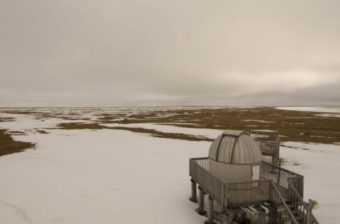
NOAA’s Barrow Observatory recorded the earliest snowmelt on record this year. (Public Domain photo by NOAA)

Snow in the northernmost town in the nation is melting earlier than ever before on record.

The National Oceanic and Atmospheric Administration’s Observatory in Barrow reported a snowmelt starting May 13. That’s 10 days earlier than the previous record set in 2002. NOAA has been recording snowmelt from its Barrow Observatory for over 70 years.

The record melt follows a winter of record-setting temperatures. Alaska was more than 11 degrees warmer than usual this winter.

This winter didn’t just see an early melt on land. According to the National Snow and Ice Data Center, 2016 also saw the lowest winter sea ice extent in satellite history.

David Douglas, a research biologist with the U.S. Geological Survey, said in a NOAA press release that conditions in the Arctic are looking more like they would in late June or early July right now.

The early thaw is already taking a toll on wildlife in the far north.

“Polar bears are having to make their decisions about how to move and where to go on thinner ice pack that’s mostly first-year ice,” Douglas said. Douglas also expects walrus to struggle this summer with the thinner sea ice and warmer temperatures.

State oil and gas regulators propose record high safety, environmental fines

oil barrels
(Creative Commons photo by Carsten ten Brink)

Alaska’s oil and gas companies set a record in 2015 for fines.

State regulators proposed some $1.7 million in penalties against five companies — and the University of Alaska Fairbanks — for violating safety and environmental regulations.

One reason for the increase? More smaller operators entering a state long dominated by a handful of major players.

The largest violator in recent years has been the company Hilcorp, which has revitalized gas production in Cook Inlet and expanded onto the North Slope while racking up more than $1 million in proposed fines.

On Sept. 25, 2015, three contractors nearly died while working on a well at Hilcorp’s Milne Point Unit on the North Slope. The three men were knocked unconscious when nitrogen filled the trailer where they were working.

All three recovered. But an investigation by the Alaska Oil and Gas Conservation Commission, which regulates the state’s wells, found that the incident “would have been fatal” if one of the workers hadn’t been lucky enough to collapse in the fresh air outside the trailer.

That conclusion was first reported this winter by the Alaska Dispatch News.

The commission found that Hilcorp violated state regulations at the site — and it wasn’t the first time.

In a letter, the commission wrote, “the disregard for regulatory compliance is endemic to Hilcorp’s approach … and virtually assured the occurrence of the incident” that injured the three workers.

Regulators proposed a $720,000 fine, adding, “Hilcorp’s conduct is inexcusable.”

This spring, the commission posted a list of all the penalties it’s imposed since 1976, about 30 in all. More than a third of those were logged last year.

AOGCC penalties 1976-2015That’s in part because of more enforcement, said Cathy Foerster, one of the agency’s two commissioners.  Foerster is one of the agency’s two commissioners. (A third seat for a commissioner has been open for more than a year.) But it’s also been driven by a shift in Alaska’s oil fields, as newer companies have entered the state.

“As we get in smaller operators and new operators that aren’t familiar with Alaska regulations, we’ve had some operators who’ve used the ‘learn as you go’ approach to regulatory compliance, which I frown upon,” Foerster said.

Foerster was quick to add that not all smaller operators have trouble following the rules.

And the largest penalty ever recorded wasn’t for a small company at all – it was a $1.27 million fine against BP, which operates the state’s largest oil field, Prudhoe Bay, for an explosion and fire that injured a worker in 2002.

But of the 11 fines proposed last year, 10 were for smaller companies.

Larry Persily is an oil and gas adviser to the Kenai Peninsula Borough. He said it may be too early to call it a trend, but if it continues, it’s not unique to Alaska.

“Looking around the country, smaller operators, which is what we’re seeing more of in Alaska, … smaller operators tend to get cited on compliance issues more than the major oil and gas producers,” Persily said.

Persily said smaller companies may not have the resources, the expertise, the staff or the emphasis on following the rules.

Most fines aren’t for incidents that cause environmental damage or injure workers. Reading through the list of penalties can feel like going through a stack of parking tickets. There are citations for failing to provide reports, or failing to test or install the right equipment.

But that’s exactly what the commission should be focused on, Persily said.

“Even if a violation doesn’t seem like a big deal, it’s a big deal because the risk of not complying, the risks are so big: pollution, environmental damage, worker safety,” Persily said. “It’s good governance on the part of the state and the industry to have zero tolerance for any errors, any violations, because (if) things go bad, they really go bad.”

That appears to be the commission’s concern about Hilcorp, which accounted for six of the 11 penalties proposed last year.

Since entering Alaska in 2011, Hilcorp has taken over fields from bigger players in Cook Inlet and the North Slope, becoming a significant oil producer and the inlet’s largest natural gas producer. It’s currently applying for permits for its Liberty project, which would take place in shallow water in the Beaufort Sea.

In the process, it has been hit with $1.2 million in proposed penalties.

Foerster wouldn’t comment on specific incidents, because most of those fines are still being appealed. But she said she stands by the commission’s written statements.

“In their early time, we didn’t send out any notices of violation or notices of enforcement,” Foerster said. “Instead we chose to educate them. But you can only be the new kid on the block for so long before you start having to be responsible for your behavior.”

Representatives from Hilcorp declined to be interviewed.

In an emailed statement, David Wilkins, Hilcorp Alaska’s Senior Vice President, wrote, “… We take regulatory compliance issues seriously. We are working to improve communications and understanding with all of our regulators including the AOGCC.”

Foerster said her team believes Hilcorp is serious about changing how it operates going forward.

And, she said, the solutions are pretty simple.

“Regulatory compliance isn’t that difficult,” Foerster said. “You have to prioritize it, you have to incentivize it and you have to equip for it.”

Above all, she said, companies must make it clear to their employees that following the rules is non-negotiable.

Do Arctic villages need oil? Point Lay leaders say no

BOEM director Abigail Ross Hopper and Wainwright Mayor John Hopson prepare to testify before the Senate Energy Committee. (Photo by Liz Ruskin/APRN)

If oil companies are ever going to return to drill for oil in federal waters of the Arctic, they will need leases. Sen. Lisa Murkowski complained at a hearing in Washington Thursday that the leasing plan the feds are considering is too limited.

Murkowski bolstered her position by calling on an Arctic Slope mayor, who testified that he and his neighbors need the industry. Other Arctic residents passionately opposed to offshore drilling listened from the back of the hearing room.

In Washington, both sides of any Arctic drilling dispute want to show they have locals on their side. John Hopson, Jr., a whaling captain and the mayor of Wainwright, on the Chukchi Sea, came out to make the case for federal leasing in the Arctic. Hopson is also a member of the North Slope Borough, which taxes the industry to provide services to the region.

“Every one of our eight communities is surviving on oil and gas money,” he said.

A snow machine can cost $12,000, he said. A boat and motor might cost $20,000. Last year, Hopson said, he had to pay over $7 a gallon to operate his truck, his boat and his 4-wheeler.

“We need infrastructure to be able to tax so that we can employ people, so they have an opportunity to hunt,” he said. “The world is banking on saving animals without thinking of my life, my children’s life. Where are we going to live?”

The Bureau of Ocean Energy Management has proposed three lease sales in Alaska over the next five years, one each in the Chukchi Sea, the Beaufort Sea and Cook Inlet. But Abigail Ross Hopper, director of the agency, could not assure Murkowski that those sales would remain in the final plan.

“I think, chairman, it would be premature to make any statement about the fate of those

Alaska sales in the final program,” Hopper said.

Murkowski says Alaska’s governor, the congressional delegation and the vast majority of Alaskans support offshore drilling. She zeroed in on a tweet Hopper’s agency issued the day before.

The tweet shows the BOEM boss meeting with tribal council members from Point Lay. Although it’s just down the coast from Wainwright, this group of village leaders is ardently against offshore drilling. They came to Washington to participate in a “Keep it in the ground” rally.

Murkowski said she didn’t have a problem with the picture the agency tweeted, just the message.

“You tweet in it that they … are opposed to drilling in the Arctic,” Murkowski said. “I looked at it and I said, ‘How do we not conclude that the die is already cast and that your agency has already decided what it is you’re going to be doing?’”

Hopper said she didn’t write the tweet, but she’d seen it.

“I’m sorry if you took that impression from it,” she said.

The Point Lay delegation had an appointment to meet with Murkowski after the hearing. Some said they were surprised their visit, hosted by an environmental group, seemed to tick people off.

Tribal council member Cilia Attungowruk and Jane Tukrook are both raising children in Point Lay to respect traditional ways. They say offshore drilling is a threat to the environment and they dispute that they need the oil industry to support their subsistence lifestyle.

“We don’t have to have money to go out there. We can go out there on foot and with our own bare hands and still get what we need to eat,” said Attungowruk.

“Because that’s exactly how our ancestors did it in the past,” Tukrook said. “It worked for them. So what’s to say that it won’t work for us?”

Tukrook has a job. She’s Point Lay’s tribal administrator. She says a switch to renewable energy technology might produce more paychecks in Point Lay.

Arctic broadband brings concerns about changing culture

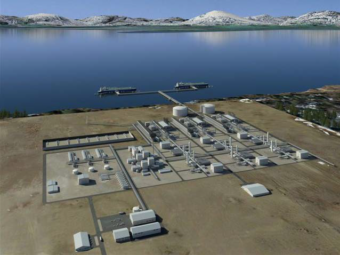
A Quintillion spokesperson says the company should be able to offer broadband to five coastal Alaska communities by early next year. (Image courtesy of Quintillion)

The biggest local internet-service provider in northern Alaska expects high demand for the broadband connections. It’ll be offering the service early next year.

“Everybody is enthusiastic about this project that is a heavy user of broadband – the schools, libraries, clinics,” said Jens Laipeneks who directs operations for Arctic Slope Telephone Association Cooperative. “All of those are anchor institutions.”

Laipeneks said ASTAC has been upgrading its system over the past year or so to transition from the satellite-based system it now uses to provide internet and wireless service to one that uses a subsea fiber-optic cable that Anchorage-based Quintillion Networks will be laying off the coast of northern Alaska this year.

“The capacity that we’re going to have access to is much, much greater than everything that was done over the satellite,” he said.

Laipeneks said that’s good news to residential customers who’ve had to deal with the slow, bulky and expensive internet connections for such bandwidth-hogging uses as streaming video.

“Netflix, gaming – things that require very quick response times.”

He said the fiber optic cable is more dependable and less expensive to maintain, enabling ASTAC to offer its 1,000 or so customers twice as much bandwidth for about the same price they’re paying today.

It’ll also no doubt be good news to ASTAC’s newest customers in five coastal communities that have never had real broadband before, including Nome, Kotzebue, Point Hope, Wainwright and Barrow.

But it’s also troubling news for Steve Oomittuk, a lifelong resident of Point Hope.

Steve Oomittuk, who was born and raised in Point Hope, hopes broadband won't aggravate the problem of Western culture overwhelming Native culture – especially among youth. (Image courtesy of Jiri Rezak/Greenpeace)
Steve Oomittuk, who was born and raised in Point Hope, hopes broadband won’t aggravate the problem of Western culture overwhelming Native culture – especially among youth. (Photo by Jiri Rezak/Courtesy Greenpeace)

“I just feel that high technology is good, but there’s a time and place that it should be used,” he said.

Oomittuk, an Inupiat whale hunter-turned schoolteacher, said he’s concerned that all that expanded internet access will distract young people in the villages, and further erode their cultural identity that’s already being overwhelmed by Western culture.

“I try to let the younger generation understand that they have an identity that should never be forgotten,” he said. “And (they) have a rich history, a rich culture, and should never forget their identity as a people.”

Oomittuk said pretty much all the young people in the village, like their counterparts in just about anywhere else in the world, already are constantly glued to their cellphones. He’s concerned those mobile devices combined with broadband will widen the gap between Native and Western culture.

Exxon hopes Point Thomson is down payment on a gas line

Construction on Exxon Mobil’s Point Thomson field in December 2015. (Photo courtesy of Exxon Mobil/MSI Communications)

Nearly 40 years after it was first discovered, Exxon Mobil Corp. has started production this spring on the Point Thomson field.

The field sits on the coast about 60 miles east of Prudhoe Bay, near the edge of the Arctic National Wildlife Refuge. When it’s fully online, it’ll send about 10,000 barrels a day of diesel-like oil down the trans-Alaska pipeline.

But Exxon sees the field as a down payment on a much bigger prize: a North Slope gas line.

Cory Quarles is new to Alaska — he only moved to Anchorage about a year ago, to become Exxon Mobil’s production manager in the state.

But the project he’s leading? That has history — as Quarles acknowledged when he spoke to the Resource Development Council in early May.

“Some of you may be wondering, OK, so ExxonMobil, what took you so long?” Quarles said, to laughter.

Point Thomson has been a long time coming. The field was first discovered in 1977. In 2006, Gov. Frank Murkowski’s administration, frustrated by the lack of development, tried to revoke the leases at the field, launching a seven-year legal battle. Three governors later, Gov. Sean Parnell approved the Point Thomson settlement in 2012, laying out a roadmap for development at the site.

This spring, after some four years and $4 billion, Exxon Mobil announced the first production.

“This is an extremely big deal for us,” Quarles said, sitting in his office on C Street in Anchorage, in what was his fifth media interview to tout the milestone. The field’s 10,000- barrels-a-day contribution to the trans-Alaska pipeline is certainly worth something, especially in this era of low throughput. But Quarles was clear: that is not the final goal.

“10,000 barrels per day is not the end game,” he said. “That’s not the end game. Point Thomson is a pre-investment for what’s to come.”

In the future, Exxon Mobil hopes an 800-mile pipeline, which would carry natural gas from the field (and from Prudhoe Bay to the west) to Cook Inlet, for export to Asia and the rest of the world. That’s the Alaska liquefied natural gas project.

Because while Point Thomson is producing liquids right now, it’s actually a gas field. And it’s not just any gas field. It is a huge gas field.

With up to 8 trillion cubic feet of natural gas, it holds about one-fourth of the known gas reserves on the North Slope.

“So this is massive,” Quarles said. “This would be considered a world class type of field. So that’s the prize. That’s how big it is.”

But right now, Point Thomson a gas field without a gas line. Negotiations on the Alaska LNG project are stalled, held up by low oil prices and disagreements among the partners: Exxon Mobil, BP, ConocoPhillips, and, of course, the state of Alaska.

Under the current plan, the four partners would make a final decision on whether to go ahead with the project by about 2019 — but that now seems optimistic.

That might not matter to Exxon Mobil.

Charles Ebinger is with the Brookings Institution in Washington, D.C. He said, even if the gas line is delayed by a decade or more, it’s probably still worth it for the company.

“These companies really do think in 20 to 30-year time horizons, in terms of ‘What’s our energy portfolio going to look like?’” Ebinger said. “So it’s not that far out in Exxon’s time horizon.”

The bottom line, he says, is Exxon Mobil clearly believes there will be a natural gas line from the North Slope at some point.

In the meantime, the company is cycling the gas at Point Thomson: it pumps the gas out of the ground, strips out liquids to send down the trans-Alaska pipeline, and then re-injects the gas into the reservoir.

It’s a basic process used at fields the world over, but with one crucial twist: Point Thomson is one of the highest pressure reservoirs Exxon has ever developed — one of the highest pressure fields in the world, Quarles said. He compared the force inside the reservoir to having the entire weight of an elephant balanced on your thumb.

That makes for a major engineering challenge.

“While it’s not a new technology, it is a new application of existing technology,” Quarles said. “What you’re talking about is, piping that’s thicker than you’ve ever seen before. You know, the piping is 3 inches thick of steel – steel!”

The company is required to study the gas cycling for at least the next five years, as it seeks to prove to the Alaska Oil and Gas Conservation Commission that the field really is best used to produce gas — and not the liquids that are found with the gas in the reservoir. The commission, which is charged with ensuring that Alaska’s oil and gas resources aren’t wasted, currently classifies the field as an oil field. That would require any oil in the reservoir to be produced first — unless Exxon can prove that it isn’t technically or economically feasible. One major goal of the gas cycling is just to learn how a field like this works.

And Exxon is out to prove something else, too. The field opens up a new region of the North Slope, and Quarles says the company wants it to be a role model for future development.

“There are no other fields producing this far east,” he said. “It demonstrates oil and gas production can occur safely and responsibly even in a very remote area…to where you could potentially unlock even other fields that far east.”

What’s east of Point Thomson, of course, is the prize many oil and gas explorers — and Alaska officials — have eyed for ages: the Arctic National Wildlife Refuge.

Industry executives, senators give oil and gas tax overhaul a cool reception

Oil and gas industry advocates and Senate Finance Committee members gave a cool reception to a bill overhauling industry tax credits.

The House rewrote the bill Friday with a wide-ranging amendment that would end large companies’ ability to deduct losses from future tax bills. The amended House Bill 247 also would limit the amount of time new oil projects benefit from special tax treatment to seven years. And it would raise the minimum production tax that companies must pay from 4 percent to 5 percent when oil prices reach $70 per barrel.

But oil industry advocates say the bill would devastate the state’s economy by discouraging investment. Most industry representatives who testified during a hearing on Sunday said they want to keep the current tax system.

Armstrong Oil and Gas owner Bill Armstrong said North Slope exploration depends on the tax system. He said the bill would harm the state’s future.

“This latest version of (HB) 247 is absolutely a joke,” Armstrong said. “It’s illogical. It’s reckless. It’s irresponsible. It’ll be devastating to the state.”

Sen. Pete Kelly, R-Fairbanks, at a Senate Majority press availability, Feb. 22, 2016. (Photo by Skip Gray/360 North)
Sen. Pete Kelly, R-Fairbanks, in January. (Photo by Skip Gray/360 North)

House Finance Committee Co-Chairman Pete Kelly, R-Fairbanks, spoke against the bill on Saturday, saying it would discourage production. He added that the state has changed its oil and gas tax “as much as we change our underwear,” and the bill would be counterproductive.

“The changes we’re talking about making are going to make it so we have even less money,” Kelly said.

Some residents who testified during a hearing on Sunday supported the bill.

Kasilof resident George Pearce said that oil and gas taxes changed several times due to industry lobbying.

“Raise taxes on oil companies in Cook Inlet and the North Slope,” Pearce said. “Let these credits expire.”

Senate Finance Co-chairwoman Anna MacKinnon, R-Eagle River, raised concerns about the bill. But she also told oil and gas executives that the state is trying to respond to a revenue shortfall, just like the industry is.

Amendment sponsor Rep. Paul Seaton, R-Homer, said the bill would bring the state more revenue sooner, reduce long-term liabilities, and support current projects.


Site notifications
Update notification options
Subscribe to notifications