North Slope

BLM to review new ConocoPhillips project in National Petroleum Reserve

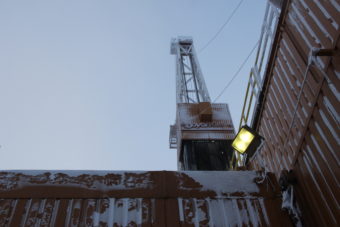
A Doyon drill rig putting in new wells at the ConocoPhillips CD5 drill site on the North Slope. Photo: Rachel Waldholz/APRN

The National Petroleum Reserve Alaska — or NPR-A – was first set aside for oil production nearly a century ago. But it wasn’t until last year that the Reserve produced its first barrels: that’s when ConocoPhillips brought its CD5 unit online.

Now the company is hoping to expand production from the reserve, with a string of new drill sites pushing ever deeper into the NPR-A.

One of those projects — Greater Mooses Tooth 1 — will start construction this winter. And the Bureau of Land Management is launching an environmental review of ConocoPhillips’ most recent proposal — called Greater Mooses Tooth 2.

Listen now

ConocoPhillips first proposed these drill sites over a decade ago, but the development of CD5 ran into a series of obstacles, including negotiations with the village of Nuiqsut over a road through local subsistence grounds. It took ten years to permit and build, starting production last fall.

Now, ConocoPhillips is hoping it’s full steam ahead.

The projects are like stepping stones, each reaching a little further into the National Petroleum Reserve. CD5 sits on Native corporation land right at the edge of the NPR-A. From there, the company plans to build a road to Greater Mooses Tooth 1 — or GMT-1 — which is scheduled to start construction next year.

“And GMT-2 is the next step-out in development,” said Jim Brodie, ConocoPhillips’ project manager for the NPR-A.

Like GMT-1, the GMT-2 site will be a gravel pad with a maximum of about 30 wells, sending oil by new pipelines back to ConocoPhillips’ Alpine facility – and from there, to the trans-Alaska pipeline.

Brodie said the sites are some of the company’s main priorities these days.

“In terms of new development in Alaska, the NPR-A tend to be the most attractive,” he said.

That doesn’t mean they’re cheap. ConocoPhillips officials joke that a billion dollars doesn’t go as far as it used to. The entire Alpine field was a billion dollar development in 2000. Now each new drill site costs about a billion dollars.

That’s largely because of sheer logistics – the further into the Reserve you move, the further from any existing infrastructure, and the more expensive it is.

But ConocoPhillips has also been frustrated by the pace of the permitting process. In July, Alaska’s congressional delegation sent a letter to the Secretary of the Interior, saying, essentially, get a move on.

On July 25, the Bureau of Land Management announced it would start its environmental review, the next step toward approving the project. The Bureau is currently asking the public for input on what it should study.

Stephanie Rice, the project manager for the BLM, said two areas of focus will be impacts on climate change and ensuring the project doesn’t interrupt Nuiqsut’s access to subsistence resources.

“The main subsistence resource is going to be caribou, and making sure roads and pipelines and air traffic do not interfere with caribou migration,” Rice said.

Meanwhile, some conservationists aren’t thrilled with the project. Marissa Knodel is a climate campaigner with Friends of the Earth, in Washington DC. She said the development doesn’t line up with the Obama administration’s commitments on climate change.

“The bottom line is that any new development for oil and gas, like what is being proposed in the National Petroleum Reserve, moves us completely in the opposite direction of where we need to be going in terms of a safe climate future,” Knodel said.

The state of Alaska takes the opposite view: that new oil and gas development is imperative for economic growth and state revenue. And right now, ConocoPhillips’ developments in the NPR-A are among the few potential sources of new oil for the trans-Alaska pipeline.

The public can submit comments on the proposed project here.

Democratic leaders seek bipartisan coalition in backing challengers

State Democratic Party officials are backing challengers to two Democrats who caucus with the Republican-led House majority. The challengers and party officials say this will increase the chances for a bipartisan coalition.

There’s a long history of rural legislators joining majority caucuses, regardless of the party. In the House, four Democrats from northern and Western Alaska have joined the Republican caucus since 2009.

This year, Benjamin Nageak of Barrow and Bob Herron of Bethel are facing challengers backed by other Democratic House members and state party officials.

Casey Steinau
Democratic Party Chairwoman Casey Steinau (Photo courtesy Alaska Democratic Party)

Party Chairwoman Casey Steinau said electing Dean Westlake of Kotzebue, who’s challenging Nageak, and Herron’s challenger Zach Fansler of Bethel would increase the chance of a bipartisan coalition in the House.

“That’s how things get done and how we work together,” Steinau said. “Being who you are, but still, reaching across the aisle and doing it as a group, as the coalitions do in Juneau. I think that the bipartisan coalition that was there for years was very effective in getting legislation passed, and I’d like to see that happen again.”

While both legislative majorities have members from both parties, they generally don’t describe themselves as bipartisan coalitions, and only include rural Democrats.

The Senate was led by a bipartisan coalition that included substantial numbers of both Democrats and Republicans from 2007 to 2012.

Gov. Bill Walker has been unable to get most of his fiscal plan through the Legislature, despite support from some minority-caucus Democrats and moderate Republicans. Now Democratic leaders want to grow this grouping into a majority. A fundraiser for Westlake and Fansler on Monday in Anchorage will be co-hosted by former U.S. Sen. Mark Begich, as well as nine House members, among others.

Westlake said the public sees the Legislature acting in an increasingly partisan way, and this hasn’t benefited rural voters.

At one time, the Bush Caucus was strongest, and probably the best thing for Alaska. The caucus wasn’t split on party lines, instead Alaskans took the party mantle off, and working together for the betterment of state as a whole.

But Nageak sees the work he’s done as co-chairman of the House Resources Committee as being in the tradition of powerful rural legislators of the past, such as Al Adams.

“I think what they’re trying to do is minimize what we  – the Bush Caucus – are doing with the majority,” Nageak said.

Nageak said an oil and gas tax bill, House Bill 247, that he supported was scrutinized more than any other bill in recent years. And he said it will benefit the residents he represents. This is the second straight election in which Westlake is challenging Nageak. Nageak won in 2014 by 131 votes of more than 2,000 cast.

Herron said Democratic leaders have focused on the times when he voted with the majority, rather than the issues where he opposed the Republican leadership. He cited his bucking the majority on the last major overhaul of oil and gas taxes in 2013, and his opposition to ending the last special session after a week.

But Herron said rural legislators have served their constituents well by staying in the majority. He said this year is the first time he’s aware of that any party is backing primary opponents to incumbents who followed this tradition.

“Urban Democrats want this guy (Fansler) to win so that they can take care of their constituents – and he’s helping them,” Fansler said. “That’s where I have an issue with this whole thing.”

But Democratic Chairwoman Steinau said the official party organization plan since at least 2014 has said the party won’t support legislators who don’t caucus with the party.

And Fansler said Herron has continued to support the majority caucus at a time when rural Alaska isn’t benefiting from the policies it’s pursuing.

“If you look at the incumbent’s voting record, it’s pretty much lockstep with what the majority kind of votes and, you know, I personally think the agenda that they’re pushing is not an agenda that’s helpful to my district,” Fansler said.

The possibility of a new bipartisan coalition in the House may become clearer on the primary day, Aug. 16.


Why a Bahamas tanker is carrying North Slope crude

U.S. District Court Judge Carl Barbier ruled nearly two weeks ago that BP acted recklessly in the 2010 Deepwater Horizon rig accident and oil spill. Alastair Grant/AP
Photo by Alastair Grant/AP

A foreign-owned tanker is expected to transport North Slope crude to Asia in the coming weeks. BP has shipped its oil overseas before, but it’s been decades since it was on a tanker built and managed outside the U.S.

State petroleum economist Joyce Lofgren said news about the oil tanker — named Tianlong Spirit — has caused some confusion. She’s received emails from people wondering what all of the fuss is about. They thought Alaska was already able to export crude.

“I don’t think it was the idea of exporting that was the big issue. It was the issue of the foreign flag,” Lofgren said.

Alaska was already exempt from laws that kept other American oil producers from selling overseas. But last year, Congress dropped those restrictions. Now, those companies can sell to foreign refineries, and Alaska producers can transport crude on foreign tankers.

That’s what BP is doing. Tianlong Spirit will haul North Slope crude to Asia and a Bahamas flag is flying from the tanker.

Lofgren said before, if BP wanted to transport crude overseas, it had to use an American-made vessel, staffed with U.S. labor.

“So it’s more expensive, say, than a foreign flagged tanker from the Bahamas,” she said.

BP confirmed its crude is being transported on Tianlong Spirit, headed for an Asian refinery. The company said its own tanker is in dry dock, which is the “primary motivation” for using the foreign flagged vessel.

Lofgren said typically, North Slope crude heads to the West Coast.

“There were some special things happening about that time, and one of them was the maintenance on the North Slope,” Lofgren said. “So there were maintenance issues and some refining issues that made a little more crude available.”

In the past five years, Lofgren said North Slope producers have been selling off their West Coast oil refineries, but she doesn’t think more Alaska crude will make its way overseas.

“You know, I don’t imagine we’re going to see, just my personal feeling, a lot of this because, first of all, Alaska production is so significantly less than it used to be,” Lofgren said.

Governor appoints Hollis French to oil and gas commission

Sen. Hollis French addresses a joint session of the Alaska Legislature during debate about confirmations of the governor's appointees, April 17, 2014. (Photo by Skip Gray/Gavel Alaska)
Sen. Hollis French addresses a joint session of the Alaska Legislature, April 17, 2014. (Photo by Skip Gray/Gavel Alaska)

Gov. Bill Walker has appointed Hollis French to the Alaska Oil and Gas Conservation Commission, or AOGCC. French, a Democrat from Anchorage, served in the Alaska Senate for 12 years. Now he’ll oversee regulation of the state’s oil and gas industry.

The third seat on the AOGCC is designated to a member of the public who is familiar with oil and gas. French says some of his legislative colleagues may be unaware of his background.

“I started my oil and gas career washing pots and pans on an oil rig in Cook Inlet, and the company that ran that platform, Shell, decided to train me to be an operator,” French said.

That’s the person who runs the turbines, pumps and compressors after the oil comes out of the ground. French also worked on the North Slope. In all, he says he spent 18 years working in the industry.

Previously, Gov. Walker appointed Michael Gallagher to the commission. But Gallagher wasn’t confirmed by the legislature. And come January, French will also need enough legislative support to keep his seat.

But French says he’s not worried about his appointment seeming political.

“Really, I have gratitude towards the industry,” French said. “I used my oil industry days off to get an undergraduate degree. I used my oil industry earnings to go away to law school, and so I think that they’ll see we have a lot in common.”

French starts his new job as an AOGCC commissioner on Monday.

North Slope records fall with ‘unprecedented warmth’

(Graphic courtesy Brian Brettschneider)

Climate change is a daily reality in Alaska. Those changes are happening across forests, tundra, in the Arctic ocean and in your backyard.

Brian Brettschneider is a climatologist in Anchorage who closely tracks climate data and trends in the state. Alaska’s Energy Desk is going to be checking in with him regularly.

Two all time temperature records were set on the North Slope on July 13 and 14. Deadhorse hit a record high of 85 degrees on July 13, exceeding the previous record by 2 degrees. The next day, Kuparuk recorded a temperature of 86 degrees.

“That is the highest temperature ever recorded in Alaska within about 50 miles of the Arctic ocean,” Brettschneider said. “So really unprecedented warmth for Alaska.”

The normal for Alaska’s northern coast is the mid to upper 50s. Brettschneider calls the last few years in Alaska “relentlessly warm.”

“In 2016, only one day in the entire year has been below normal and that was only a very small amount,” Brettschneider said. “So the temperatures have been warm from basically last Christmas onward and it’s really been peaking in the last few weeks.”

(Graphic courtesy Brian Brettschneider)

Brettschneider says the seasonal outlooks show it’s going to remain above normal in the state for the foreseeable future.

Lawmakers press on North Slope marketing request

North Slop Drill Rigs at night
North Slope drill rigs, Dec. 5, 2012. (Creative Commons photo by Kevan Dee)

At a Senate Resource Committee meeting on Tuesday, lawmakers pressed state officials about why the administration is trying to obtain gas marketing information from North Slope oil and gas producers. Gov. Bill Walker has yet to sign off on the oil companies’ 2016 development plan for Prudhoe Bay.

Corri Feige, the director of Alaska’s Division of Oil and Gas, acknowledged it was a new policy. But says it’s within their rights to request the information.

“We are asking for information concerning marketing plans and activities that will result in the commencement of a major gas sale,” Feige said. “And to have those just be adequately explained with anything that is specific and measurable. Are there any timelines that they could share with us at this point in time?”

Feige says the division has a responsibility to make sure there’s “diligence” in the development of the gas. But for some Republican lawmakers, the discussion raised more questions than it answered.

Rep. Craig Johnson, a Republican from Anchorage, thinks the request is a conflict of interest, as the state looks at developing natural gas.

“Until we make a decision how we’re going to take our gas. Are we going to let them market it for us? All we’re doing is asking for a marketing plan from our competitors,” Johnson said. “If I were Wal-Mart and I walked into Kmart and said, ‘Hey, I need to know your marketing plan for the next six years,’ they would throw you out the door.”

BP, ConocoPhillips and ExxonMobil lease the land on the North Slope from the state. The producers have until November to turn in the marketing information. No industry representatives testified at the hearing.

Site notifications
Update notification options
Subscribe to notifications