North Slope

EPA fines BP, Hilcorp for spills on the North Slope

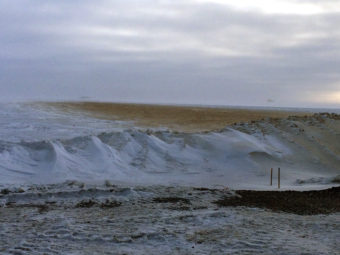
Contaminated snow-covered tundra on April 29, 2014 from a BP Exploration Alaska spill in Prudoe Bay, Alaska. (Photo/ADEC)
Contaminated snow-covered tundra on April 29, 2014, from a BP Exploration Alaska spill in Prudoe Bay. The EPA fined the company $30,000 for the spill, the state of Alaska fined it an additional $100,000. (Photo courtesy ADEC)

BP Exploration Alaska and Hilcorp Alaska have agreed to pay fines after spilling oil and waste on the North Slope.

The Environmental Protection Agency announced the companies will pay $130,000 in federal penalties.

According to the EPA, the Clean Water Act violations by both companies affected Arctic wetlands that support wildlife like caribou, ptarmigan and geese.
EPA spokesman Mark MacIntyre said the North Slope is one of the harshest environments where companies operate in Alaska. It’s also one of the most ecologically sensitive.

“We know that the tundra is kind of like a big sponge and is completely overlaying water that drains off and runs to various tributaries to rivers and then rivers to the sea,” he said.

Hilcorp had a breach in a production line in its Milne Point field. The leaky pipeline caused nearly 10,000 gallons of crude oil and water to spill onto about an acre of land. The company will pay $100,000 to the EPA.

Piping showing oil from the BP spill in Prudhoe Bay on May 2, 2014 in Alaska. (Photo/John Ebel-ADEC)
Piping showing oil from the BP Exploration Alaska spill on May 2, 2014, in Prudhoe Bay. (Photo by John Ebel/ADEC)

BP will pay $30,000 in federal penalties for spilling 700 gallons of waste onto 33 acres of tundra and gravel pad. That spill was caused by a frozen rupture in one of the company’s lines in Prudhoe Bay.

MacIntyre said spill cleanup on the North Slope can be complicated by winter weather. Hilcorp response crews had to struggle through blizzard conditions while BP workers had to remove acres of contaminated snow.

“A lot of times, frankly these spills happen at the worst time of the year, when it’s the coldest, when it’s the darkest, when (it) really puts people at risk in terms of responding and trying to fix things when they spill,” MacIntyre said. “So it’s really in nobody’s interest to have anything spill.”

Neither company agreed to interviews about the incidents. Both sent prepared statements.

Hilcorp spokeswoman Lori Nelson said it is proud of its response to the spill and inspected other similar pipeline sections as a result of the incident. While BP spokeswoman Dawn Patience said the company has worked to strengthen safety and risk management.

EPA relies on the companies to report spills. After the agency notifies a company it is considering a fine, MacIntyre says the companies can weigh-in.

“They come in and negotiate with us and we end up with a final penalty,” he said.

Each case is resolved differently. Sometimes the money goes to the state, sometimes to the federal government. In BP’s case, the company will pay $30,000 in penalties directly to a federal fund that is used to pay for cleanup when spills occur and the responsible party is either unknown, or refuses to pay.

BP also settled its case with the Alaska Department of Environmental Conservation after its spill. It will pay the state $100,000.

Hilcorp could still face further fines from its Milne Point spill. A spokeswoman from DEC said the state is investigating the incident and its case is still open.

Both companies have reported dozens of spills in Alaska since 2014, but most of the discharges are minute amounts of fuel or oilfield chemicals.

Clear and present danger: Rapidly warming Arctic threatens Cold War radar sites

Col. Frank Flores
Col. Frank Flores is commands the PACAF Regional Support Center based at JBER. As part of his work, he visits the Air Force’s remote radar sites, and has been to 17 of the 21 so far, including a recent visit to Cape Romanzof. (Photo by Zachariah Hughes/Alaska Public Media)

A group of strategic Air Force radar facilities along the North Slope are at an accelerated risk of degradation. Erosion driven by climate change is happening decades sooner than the military predicted, and the plan now is to spend tens of millions of dollars to fortify in place.

The 15 sites within the Long Range Radar program are designed to spot foreign aircraft heading into U.S. airspace or civilian planes that have gone off course.

It is an expensive state of preparedness to maintain, with billions of taxpayer dollars sunk into the equipment and infrastructure.

“That $7.1 billion is the overall portfolio, so those are just government-owned assets,” said Col. Frank Flores, who oversees the Long Range Radar sites in Alaska, along with several other similar sites in the Pacific that all feed signals back to Joint Base Elmendorf-Richardson.

The $7.1 billion figure doesn’t include the contract with a private company to staff and take care of the facilities, worth $345 million over the next 10 years.

“That’s primarily the cost to operate the sites,” Flores explained in his office at JBER. “What it doesn’t include are the additional costs to maintain, to support infrastructure, additional projects that might come up because of the wear and tear of the Arctic environment.”

Those costs are rising for sites in the North Slope, because coastal erosion is encroaching on the airstrips, roads and residential structures that support the actual radar equipment.

“For example, at the Oliktok Long Range Radar Site we anticipated that erosion was going to be at a certain point in 2040, but we’re already, as of about a year and a half ago, at that point today,” Flores said. “So it’s happening at a quicker rate than we anticipated.”

At Oliktok, midway between Prudhoe Bay and Nuiqsut, the erosion mitigation work has to happen within the next three years, according to Flores.

Along the Chukchi coast, spending to fortify the radar site north of Point Hope is already underway.

“At the Cape Lisburne Long range Radar Site we’ve seen a significant amount of erosion because the sea ice isn’t coming in as soon as it used to, and it’s not staying as long as it used to,” Flores said.

The site’s runway is around 25 meters from the coast.

“It’s the only place we can put a runway out of the site, and we’re having to execute a $47 million project to protect that runway and keep that radar site viable,” Flores said.

Construction projects are extremely expensive at the remote Arctic locations, but Flores sees the infrastructure improvements today as an investment that could save billions in the future to protect the radar sites.

Though there’s no immediate threat to sites near Kaktovik and Barrow, the Air Force has observed land erosion there, as well.

Less than a decade ago, the Pentagon closed three early warning radar sites on the North Slope due in part to erosion problems.

Though Flores said radar sites further below Alaska’s Arctic don’t have any imminent threats, it remains to be seen whether they’ll soon be dealing with the same hazards to basic infrastructure faced by many of the communities in western Alaska, caused by diminishing permafrost and less predictable weather systems.

It’s not just the Alaska sites seeing new problems related to climate. South of Anchorage 3,500 miles, the Air Force site at Wake Island in the Pacific under Flores’s command is seeing irregular wave activity flood parts of the island, prompting the military to study what would happen if a major tidal event happens.

The Pentagon is aware that climate change is putting many of its strategic assets under threat. A 2014 report by the Government Accountability Office looked at where the Department of Defense faced the greatest hazards adapting to changing environmental conditions, repeatedly mentioning Alaska’s radar sites. The report concluded that more coordination was necessary among DOD and its partners.

There are no plans to close sites down. Flores said they’re a vital asset the Pentagon plans on maintaining in perpetuity.

“The long range radar sites in Alaska allow us to maintain national sovereignty for the air,” he said.

The radars allow military officials to see when military or civilian craft are transiting airspace, and find out why.

But with environmental changes rapidly outpacing predictions, it’s unclear how and if spending and strategic planning will be able to keep up.

Federal agency predicts lean oil decades for Alaska

EIA Annual Energy Outlook 2016.

The Energy Information Administration released its Annual Energy Outlook Tuesday. It shows oil production from Alaska dwindling to less than half its current level after 2030.

“Unless more oil is found in Alaska or along the pipeline right of way, it’s very possible that the Alaska pipeline itself … would end up shutting down,” says EIA Administrator Adam Sieminski. The EIA is a federal agency that was established to be a source of unbiased data, independent of policymakers.

While the EIA baseline case shows Alaska contributing almost nothing to U.S. oil production in a few decades, that’s not the only scenario. If the EIA assumes advances in technology and more discoveries, the forecast for Alaska production would bump along at about the current level and then rise a bit by 2040, the end of the forecast period.

The rosier scenario assumes oil production from federal waters off Alaska, starting in 2035.

As for prices, Sieminski wasn’t very specific, even over the short-term.

“If you use the current options prices, over the next year or so, what that says is oil prices could be anywhere between about $25 a barrel and $80 a barrel,” he said, summarizing data from the oil options market.

In the EIA’s baseline forecast, oil would fetch $100 a barrel by the late 2020s. But don’t bank on it: Sieminski warns that volatility is too high to forecast with much certainty what the price in a given year.

State considers increasing ownership stake in Alaska LNG pipeline project

This illustration shows what a liquefaction plant could look like. (Image courtesy of Alaska LNG)
This illustration shows what a liquefaction plant could look like. (Image courtesy Alaska LNG)

Gov. Bill Walker’s administration is considering major changes to the Alaska LNG project, the effort to build a massive natural gas pipeline from the North Slope.

State officials said Tuesday the administration is considering increasing Alaska’s stake in the project — or even taking over ownership completely.

That would be a radical shift from the structure as it’s currently envisioned — and blessed by the legislature. Right now, Alaska holds a 25 percent stake, sharing ownership with the big three North Slope producers: ExxonMobil, BP and ConocoPhillips.

Keith Meyer started work as president of the state-owned Alaska Gasline Development Corp. last week. In an interview Tuesday, he said if the state increases its ownership, it would look for outside investors to fund the project.

“So this is significantly different from the way it was done (to date),” Meyer said. “However, it’s very similar to the way that most of the pipelines in the U.S. have been built, and also the way most of the LNG facilities now have been built.”

Both Meyer and Marty Rutherford, the acting commissioner of the Department of Natural Resources, said Tuesday that the state is discussing the change because the three oil companies have indicated they may not be ready to move the project forward next year as planned, as low oil prices have cut into their bottom lines. The final project is expected to cost $45 to $65 billion.

But both stressed that nothing has been decided, and the state is still in discussions with its three partners.

The administration is set to deliver its quarterly update on the project to the legislature on June 29.

Two women died rafting on Kongakut River

Alaska Alpine Adventures says the two women who died in a rafting accident on the Kongakut River had been paddling rapids when their raft flipped Wednesday.

The North Slope Borough identified the women as 69-year-old Cheryl Minnehan of Elk Grove, California, and 67-year-old Karen Todd of Sparks, Nevada.

“Words cannot adequately convey the grief and sense of loss that we feel today for the families and loved ones of Karen and Cheryl,” Dan Oberlatz, CEO of Alaska Alpine Adventures, said in a statement.

Officials say there were five rafts on the trip and the victims were in a raft carrying at least 10 people.

The borough’s Department of Search and Rescue received a report Wednesday of two people missing after a boat capsized on the Kongakut River, about 75 miles south of Kaktovik.

Kaktovik is a small community on the Beaufort Sea, off Alaska’s northern coast, about 625 miles north of Anchorage.

The borough and the Alaska Air National Guard safely recovered eight other people and took them to the community of Deadhorse. The guard found the bodies of the missing rafters Thursday.

The North Slope Police Department is investigating the deaths.

Legislature passes oil and gas tax credit bill, but funds’ fate remains uncertain

Oil and gas companies would continue to receive tax credits under a bill that both bodies of the legislature passed Monday, but they may not be able to count on receiving much this year.  That’s because the next round of credits depends on funding that one key lawmaker is already calling on Governor Bill Walker to veto.

House voted 21-19 and the Senate voted 13-6 to pass an amended version of the Senate’s bill. It’s the twelfth version of House Bill 247 that the legislature discussed this year.

The bill provides much less in savings to the state government than the version the House passed.

Sen. Cathy Giessel, R-Anchorage, addresses the Alaska Senate in favor of passing House Bill 11, an act that would make certain criminal records unavailable on the internet, Jan. 27, 2016. (Photo by Skip Gray/360 North)
Sen. Cathy Giessel, R-Anchorage, speaks in January. (Photo by Skip Gray/360 North)

Sen. Cathy Giessel, R-Anchorage, said the bill protects the state’s fiscal outlook and sends a message to the state’s partners in developing a natural gas pipeline.

“It protects our today as well, in terms of reducing the tax credit outlay, but also keeping in place a stable tax structure which will do what we can to ensure a major gas project in the future.”

To provide tax credits this year, the bill depends on drawing on $430 million that would otherwise go into state savings.

Rep. Paul Seaton, R-Homer, opposed the bill. He said Walker should veto the $430 million. That would leave tax credits at a minimum of $32 million, with most of this year’s credits pushed off into the future.

“With that bill, it makes it so without any production tax credits coming in, I don’t think we can possibly reach a sustainable fiscal plan, because we’re limiting one of the only sources of revenue the state has significantly.”

Four Republican House members who previously voted for deeper cuts to tax credits supported the bill.

Rep. Jim Colver, R-Palmer, said the bill isn’t perfect, but would be an improvement over current law.

“Are we reducing the cash burn to the state treasury? And, yes we are,” Colver said. “Is it as fast as some of us would like? No. But it’s going to make a substantial impact to the bottom line of our budget.”

While both the House and Senate bills reduced tax credits for oil production in Cook Inlet, the House version would have also eliminated the ability of North Slope oil producers to use operating losses to reduce future tax liability.

The bill disappointed members of the Democratic-led House Minority caucus. Caucus members originally hoped that cuts in oil and gas tax credits would be part of a budget compromise. But they voted for the budget last week to avoid layoff notices to state workers.

Rep. Geran Tarr, D-Anchorage, unsuccessfully sought to amend the bill to make it more similar to the House version. As the only minority member of the bill conference committee, she was outvoted 5-1.

“I don’t think we could say that this is going to provide stability, because we have not dealt with a couple of the problem areas that if the prices dip low again, we’ll have to come back and address,” she said.

Site notifications
Update notification options
Subscribe to notifications