North Slope

Low-turnout primary could lead to five House incumbents losing

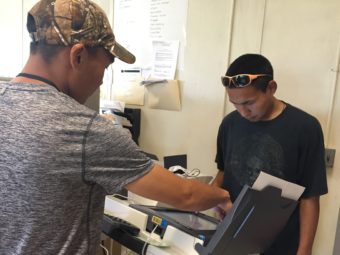
A poll watcher helps Newtok resident Bosco John, 27, vote during Tuesday's election. It was the village's first time using a digital machine. (Photo by Mareesa Nicosia, The 74)
A poll watcher helps Newtok resident Bosco John, 27, vote during Tuesday’s election. It was the village’s first time using a digital machine. (Photo by Mareesa Nicosia, The 74)

Alaskans ejected as many as five incumbents from the House in the primary Tuesday. And they also rejected two House members who tried to move up to the Senate.

But not many people showed up to vote: It was the lowest turnout for a primary in state history.

Three Republican incumbents and two Democrats who caucused with the Republicans trailed their opponents in a primary that drew only 15 percent of voters, not counting outstanding absentee ballots.

House Majority Leader Charisse Millett attributed both incumbents’ headwind and the lowest-ever turnout to the same factor – low oil prices that have hurt Alaska’s economy and the state budget.

“When you are in a deficit, I think … it’s depressing,” Millett said. “People want  to get and vote for, you know, candidates that are upbeat, and it’s hard to be upbeat in this environment.”

A lack of highly competitive statewide races also contributed to the low turnout.

Millett, who was unopposed, said it was a tough year to run for re-election.

“People are looking for someone to blame for the falling oil prices and … a sitting legislator is an easy target,” Millett said.

It’s not yet clear how the primary will affect the balance of power in the Legislature.

If the current totals hold up and Republicans continue to hold the majority, then they will have to do so with two fewer Democrats joining them — Bob Herron of Bethel was defeated by Zach Fansler, and Benjamin Nageak of Barrow trails Dean Westlake of Kotzebue (by five votes).

Casey Reynolds, who edits the political blog The Midnight Sun, said this year’s special sessions kept incumbents in Juneau and away from their districts. With the apparent losses of Herron and Nageak, he sees the chances of a bipartisan coalition increasing.

“A bipartisan organization is more likely today than it was before the election,” Reynolds said. “And the general election is going to be very important. It’s really going to be the deciding factor on this one.”

One Republican who showed a willingness to cross party lines lost.

George Rauscher defeated Republican Rep. Jim Colver in a district that sprawls from Valdez through parts of Palmer to Big Delta.

Business groups targeted Colver after he voted to reduce oil and gas tax credits.

Other incumbents who lost include Wes Keller of Wasilla, defeated by David Eastman, and Bob Lynn of Anchorage, defeated by Chris Birch.

Rauscher had said Colver was likely to join a bipartisan coalition with Democrats, though similar comments aimed at other candidates didn’t succeed.

In Palmer, Richard Best lost after making a similar charge against DeLena Johnson. And Homer incumbent Paul Seaton won, despite, he said, being subjected to disturbing and unfounded charges..

“It was the most negative campaign I’ve ever seen on the lower peninsula,” Seaton said.

State Republican Party spokeswoman Suzanne Downing said the party has room for improvement in turning out voters in the November general election.

“Every single district could improve their voter turnout, and I think as a party we’re going to work a lot harder on that for the general,” Seaton said.

Rep. Lora Reinbold won the Republican nomination for her seat. (Photo by Anne Hillman/Alaska Public Media)

The only legislator who isn’t a member of either caucus – Eagle River Rep. Lora Reinbold – was re-elected. The Republican caucus expelled her in 2015 after she refused to support a caucus-backed budget. She says she wants to rejoin the caucus and work with them to set their principles for the next term.

“And alls I’m asking is that we stick with those principles,” Reinbold said. “And that’s why it’s really important, the team that we send down there. And we’re just hoping that we’re lock-in-step and stay under the umbrella of our principles.”

While most competitive races were in the House, the state’s most expensive race was in an Anchorage Senate district, where Natasha Von Imhof defeated Rep. Craig Johnson and Jeff Landfield.

Another representative, Lynn Gattis of Wasilla, was defeated by David Wilson in her attempt to move up to the Senate. Rep. Shelley Hughes succeeded in winning the Republican nomination to succeed Sen. Bill Stoltze.

Tom Begich defeated Ed Wesley to be the Democratic nominee to succeed Sen. Johnny Ellis in his Anchorage district. Forrest McDonald defated Roselynn Cacy for the Democratic nomination to face Von Imhof.

In the House, Jennifer Johnston defeated Ross Bieling, who ran the best-funded House primary campaign, to be the Republican nominee to succeed Rep. Mike Hawker in Anchorage. Gary Knopp defeated three opponents to be the Republican nominee to succeed Rep. Kurt Olson in the Kenai Peninsula. And Don Hadley deated Lisa Vaught to be the Republican nominee to face Democratic Rep. Ivy Spohnholz in Anchorage. Colleen Sullivan-Leonard will be the Republican nominee to succeed Gattis in Wasilla. And incumbent Republican Representatives Dan Saddler, Liz Vazquez, Lance Pruitt, David Talerico and Mark Neuman defeated challengers.

The state Division of Elections still has to count absentee and questioned votes, and the results will remain unofficial until they’re certified in early September.

Anne Hillman of Alaska Public Media and Shahla Farzan of KBBI contributed to this report.

After challenge from their own party, two rural Democrats could lose state House seats

Dean Westlake is challenging Barrow Rep. Bennie Nageak in the Democratic primary; in 2014, Westlake lost the race by 131 votes. Photo: Rachel Waldholz/Alaska's Energy Desk
Dean Westlake is challenging Barrow Rep. Bennie Nageak in the Democratic primary; in 2014, Westlake lost the race by 131 votes. Westlake is winning by five votes, but that state election officials say they still have absentee and questioned ballots to count. (Photo by Rachel Waldholz/Alaska’s Energy Desk)

As votes continue to trickle in, a hotly contested race in the North Slope and Northwest Arctic Borough has two bush Democrats within five votes of each other. 

Rep. Benjamin Nageak raises his fist in solidarity with the effort to reduce domestic violence in Alaska at the Choose Respect rally on the Capitol steps, March 27, 2014. (Photo by Skip Gray/KTOO)

Incumbent Rep. Ben Nageak is slightly behind in his race against newcomer Dean Westlake. All precincts in that district have been counted, but the state Division of Elections still has absentee and questioned ballots to count.

Westlake ran against Nageak two years ago and lost by 131 votes. 

Nageak declined to comment and Westlake is out of reach at his fish camp.

Nageak is one of two rural Democrats targeted by members of their own party for caucusing with the Republican-led majority in the state House.

House Democrats are hoping to build a bipartisan coalition next year.

A challenger to Democrat Rep. Bob Herron is winning the race for House District 38. Zach Fansler has clinched his lead over Herron with nearly 57 percent of the vote. There is one district left to report in that race. It covers Bethel, the lower Kuskokwim River and several coastal villages. 

Herron did not respond to multiple requests for comment, Fansler also has not responded. His campaign manager Mitchel Forbes said they won’t talk about results until every vote has been counted. 

Zach Fansler and Bob Herron
Zach Fansler and Bob Herron meet outside of KYUK for an August 2, 2016 campaign debate in Bethel. (Photo by Geraldine Brink/KYUK)

That district had the largest voter turnout in the state with 21 percent of the registered voters casting a ballot.

With no Republicans in either race, neither candidate will have a general election challenger.

At DNR, new leader tackles ‘maze’ of oil and gas development on federal land

Andy Mack is the state's newest Department of Natural Commissioner. (Photo courtesy State of Alaska)
Andy Mack is the state’s newest Department of Natural Resources Commissioner.
(Photo courtesy State of Alaska)

From Soldotna to the North Slope to Anchorage, the state’s newest natural resources commissioner has spent his career weighing in on energy issues all over the state. Now, Andy Mack has been tapped by Gov. Bill Walker to help guide the state through the maze of federal regulations required to develop oil and gas resources.

He’s has worked as both a civil and criminal defense attorney. He was a legislative aide for a decade and, most recently, managed a private investment firm. But, he’s probably best known for his time spent working on the North Slope.

And the state’s newest DNR commissioner said that when it comes to the state’s future, people should be looking north.

“Without Arctic development the State of Alaska will probably struggle,” Mack said. “I think that we have a lot of tools that are not Arctic related, but I think that if we really want to thrive as a state, all eyes should be on the Arctic.”

But nothing in the Arctic is easy. And, the technical challenge for oil companies mirrors the tricky process of navigating tribal, state and federal land ownership.

Mack has plenty of experience wading through the complex regulatory process of opening up federal land for public and private use. He spent five years working as an adviser to the North Slope Borough during a renaissance/ in exploration and development in the Arctic Ocean.

Mack said he spent a lot of his time at the borough weighing-in on development on federal land like the National Petroleum Reserve-Alaska and the Outer Continental Shelf.

“I think the challenge for Alaska is how to approach areas where we historically have not had access or the access is controlled by the federal government and I think part of my experience lends itself very well to ensuring that we can generate access,” he said.

Key to that access, Mack said, is whether local communities – like Barrow- support going into areas that are managed by the federal government. He said the communities have to balance development and subsistence.

Mack’s experience gaining access to federal lands and building contacts across the state is one of the main reasons Walker hired him.

“It’s a maze that we need to get through that he has worked in his capacity as an attorney and as a consultant for a number of organizations in Alaska that have been in permitting processes with the federal government on oil and gas development and beyond,” Walker said.

Mack joined Walker’s oil and gas team at a contentious time.

The state is battling with BP, ConocoPhillips and ExxonMobil over the details of how the companies will sell natural gas from Prudhoe Bay.

When the producers declined to turn over specific marketing information, Walker refused to sign the annual development plan for the field.

It’s unclear what will come of the state threatening the companies’ leases if they refuse to give in.

But Prudhoe Bay was responsible for nearly half of the state’s oil production last year.

The decision to pursue marketing information pre-dates Mack’s time at DNR. He said he supports the process, but wasn’t ready to weigh-in on whether the state would revoke the leases at Prudhoe Bay.

“We’re in a process, so I’m not going to answer,” he said.

Mack also said he supports another of Walker’s controversial decisions. This year, Walker vetoed about $430 million in tax credit payments owed to oil companies.

Looking ahead, Mack says he’s focused on protecting the state’s interests and encouraging investment in the state’s resources at a time when budget challenges make it seem risky.

“It’s very important that as Alaskans we appreciate what the world markets think of Alaska, that we’re able to attract investment capital and that we’re able to recycle some of the money that we have available here to us in Alaska,” he said.

Mack will also be spending a lot of time working on the state’s response to the Department of the Interior’s five-year plans for offshore oil and gas leases. Right now, those plans include three potential lease sales in Alaska – two in the Arctic and one in Cook Inlet.

Crystal Serenity to arrive in Nome Sunday

The city of Nome is busy preparing for the arrival of the Crystal Serenity cruise ship on Sunday, August 21, with the first boat of passengers docking at 8 a.m.

The Crystal Serenity carries about 1,000 passengers, and it is the first vessel of that size to travel to Nome.

Robin Johnson, a partner at local travel agency Nome Discovery Tours, said preparations for the Crystal Serenity began more than a year ago.

“They came to us and said, ‘What can you develop for us?’” she said, “and we worked on that. And they told us what they liked, and what sounded good. We’ve been talking a lot all year. There’s been a ton of communication.”

Nome Discovery Tours has prepared an extensive list of activities for Crystal Serenity passengers.

Passengers can choose from a variety of hikes and flying tours, as well as a trip to Shishmaref and even a flight to Russia.

Meanwhile, the Nome Berry Festival will give passengers a chance to experience the art, food, and entertainment that Nome has to offer.

“So that will be a full day of music and crafts and food and dancing and door prizes and berry buckets,” Johnson said. “And I think there’s going to be a polar bear swim that evening as well. If everything falls into place like it’s supposed to, it’ll be a good day.”

However, things might not fall into place if the weather is bad. Because the Crystal Serenity is too large for Nome’s port, the ship will anchor out at sea and passengers will be ferried to Nome’s shore.

Choppy seas could make it impossible for passengers to deboard, but Johnson isn’t concerned.

“Well, if the weather is really bad, getting them off the ship could be an issue,” she said. “But I don’t think that’s going to be a problem.”

Democrats target their own in state House primary, backing Nageak challenger

Dean Westlake is challenging Barrow Rep. Bennie Nageak in the Democratic primary; in 2014, Westlake lost the race by 131 votes. Photo: Rachel Waldholz/Alaska's Energy Desk
Dean Westlake is challenging Barrow Rep. Bennie Nageak in the Democratic primary; in 2014, Westlake lost the race by 131 votes. Photo: Rachel Waldholz/Alaska’s Energy Desk

Democrats are hoping to take control of the state House this year. To achieve that, they’re gunning for two lawmakers who run as Democrats but largely vote with the Republicans.

One is Rep. Bennie Nageak, D-Barrow, who represents House District 40, which stretches from Kotzebue to Kaktovik.

Listen now

Piles of shoes at the entrance to a Democratic fundraiser for Dean Westlake and Zach Fansler, at the home of oil and gas attorney Robin Brena. The fundraiser was co-hosted by nine House Democrats and former U.S. Senator Mark Begich, among other. Photo: Rachel Waldholz/Alaska's Energy Desk
Piles of shoes at the entrance to a Democratic fundraiser for Dean Westlake and Zach Fansler, at the home of oil and gas attorney Robin Brena. The fundraiser was co-hosted by nine House Democrats and former U.S. Senator Mark Begich, among other. Photo: Rachel Waldholz/Alaska’s Energy Desk

In early August, a who’s who of Alaska Democrats gathered at the home of oil and gas attorney Robin Brena for a fundraiser. Shoes were piled by the door as guests mingled in their socks with former U.S. Senator Mark Begich, among others, eating hors d’oeuvres and taking in the view.

That show of Democratic solidarity and support? It was aimed at unseating two of their own: incumbent state lawmakers Bob Herron of Bethel and Benjamin Nageak of Barrow.

Both lawmakers caucus with the Republican majority in the state legislature, and their colleagues, it’s clear, are fed up.

“I mean, we had Rep. Pruitt say that one of the best Republican members that they have is Ben Nageak,” said House minority leader Chris Tuck, D-Anchorage, citing Anchorage Republican Lance Pruitt. Tuck was one of nine House Democrats who co-hosted the fundraiser. “I just want to have more Democrats, more true Democrats, in the state House.”

Nageak’s challenger, Dean Westlake of Kotzebue, is director of village economic development for NANA, the regional Native corporation for Northwest Alaska. He said he’s running to make sure rural Alaska has a voice in the capital.

“There are a lot of us dissatisfied because the values that we have are not the ones that we see down in Juneau,” he said in an interview.

Westlake ran against Nageak two years ago, losing by just 131 votes.  This time, running with the explicit – and financial – backing of the state Democratic Party, he has high hopes.

Democrats turned out to support Dean Westlake and Zach Fansler, who are challenging incumbent Reps. Bob Herron of Bethel and Bennie Nageak of Barrow. Photo: Rachel Waldholz/Alaska's Energy Desk
Democrats turned out to support Dean Westlake and Zach Fansler, who are challenging incumbent Reps. Bob Herron of Bethel and Bennie Nageak of Barrow. Photo: Rachel Waldholz/Alaska’s Energy Desk

Westlake’s campaign said the fundraiser brought in $6235. (Zach Fansler, who is challenging Herron in House District 38, also raised $5900 at the event.) As of Aug. 9, Westlake’s campaign had brought in a total of $34,864.48, compared with $11,190.11 for Nageak.

If elected, Westlake said, he’d prioritize rural education and community revenue sharing; and he proposed working harder to bring federal money into Alaska villages at a time when state funding for things like water and sewer projects is disappearing.

“One of our values is you always take care of the least of us, and as a representative, that’s what I’d have to do,” Westlake said. “Whoever takes this job, you absolutely have to work with whoever is out there, regardless of party affiliation.”

But the man he’s challenging says the Arctic already has a strong voice in Juneau – his.

“As you probably know, I am a voice that won’t be stopped,” Nageak said in an interview. “And they’re trying to stop me from doing the work I’ve done for the past forty years.”

Nageak, a former North Slope Borough mayor and assembly member, is running for his third term in the state House. He’s co-chair of the House Resources Committee, and he’s known in Juneau for passionate floor speeches, often in defense of resource development and its importance to North Slope communities. In the fight over oil taxes this year, his committee rolled back Governor Bill Walker’s proposal to severely limit tax credits for oil companies.

Rep. Benjamin Nageak, D-Bethel, during debate on the creation of Indigenous Peoples Day, April 1, 2016. (Photo by Skip Gray/360 North)

Nageak is unapologetic about his support for the industry.

“99 percent of the…tax revenues that we get, not only here in the North Slope Borough, but in the state, comes from oil and gas taxes – period.” he said. “So if anything happens to the industry, where are we going to get the money to run the whole state?”

It’s a slight exaggeration: in the years before oil prices fell, up to 90 percent of state general fund spending came from oil revenue

Nageak said he’s disappointed the legislature couldn’t come up with a long-term budget solution this session — and he blamed the gridlock, at least in part, on minority Democrats. But, he said, he’d happily join a Democratic-led majority, if one materializes.

“Who wouldn’t?” he said with a laugh.

The point, he said, is to be in the majority. He pointed to a provision he passed in 2014 which lifted the cap on how much oil revenue the North Slope Borough could devote to government operations — a longtime goal for the region, which he said he couldn’t have achieved in the minority.

One of Nageak’s allies in that fight? Then-Borough Mayor Charlotte Brower, who has since been recalled over the misuse of public money. Nageak defended her during the recall effort this spring, an issue that might come up with Barrow voters.

With no Republican running in House District 40, the race will be decided in the primary on Aug. 16

Federal Health Official Praises Kenaitze Programs

A “Łuq’a Nagh Ghilghuzht” sculpture by Joel Isaak depicts traditional Dena’ina life at fish camp outside the Kenaitze Indian Tribe’s new Dena’ina Wellness Center in Old Town Kenai.
A “Łuq’a Nagh Ghilghuzht” sculpture by Joel Isaak depicts traditional Dena’ina life at fish camp outside the Kenaitze Indian Tribe’s new Dena’ina Wellness Center in Old Town Kenai. (Photo by Patrice Kohl/Redoubt Reporter)

Alaska got a glowing report in a checkup from a top federal health care official. Though there are issues that need further treatment and support, communities showed a healthy dose of innovation in delivery and integration of care.

Mary Wakefield, acting deputy secretary for the U.S. Department of Health and Human Services, toured Alaska from Aug. 1 to 4, visiting Barrow, Fairbanks, Circle, Anchorage and Kenai. But she wasn’t bringing a prescription from Washington. Instead, she got ideas for the treatment of health care in rural communities that can be brought to other areas of the country.

“I’ve seen some phenomenal examples of Alaska Native and American Indian communities that are really focused on comprehensive services that are delivered effectively and very efficiently on behalf of their communities. So there’s some wonderful examples to draw from this state and from these communities and try to think about how we might apply some of these examples in other parts of the United States,” Wakefield said.

HHS provides funding for a wide range of community services. A big part of the department’s presence in Alaska is through Indian Health Services, which funds facilities and programs administered through Native tribes throughout the state.

During her visit to Kenai on Aug. 4, Dr. Wakefield toured the Kenaitze Indian Tribe’s Head Start program, elder center, tribal court and Dena’ina Wellness Center, which offers medical and dental care, behavioral health services and a wide variety of general health and wellness programs. The center provides care to Alaska Native and American Indian people. Behavioral health services are available to anyone in the community.

Jaylene Peterson, executive director of the Kenaitze Tribe, says it was an honor to meet with Dr. Wakefield.

“This is an unprecedented visit. It was an amazing time that we were able to share with the deputy secretary, and we were able to show her what we’ve been able to accomplish with funds that have not always met the true need. So we’ve been blessed by this trip. I believe that she has learned much about the Alaskan community and why things are so different and more challenging here in an Alaskan setting,” Peterson said.

Peterson hopes the visit will help remove some stumbling blocks that come with HHS funding. She says that some of the reporting and training requirements can be onerous.

“I don’t disagree that we should be accountable for the funds that we receive, but sometimes it can be a lot more than should be required. So, there are ways that I believe that we can be smarter with our money,” Peterson said.

Primarily, though, the tribe wanted to show its holistic approach to health care.

“It’s just phenomenal. The leadership, the commitment, the approach that is innovative in terms of the integration of a wide range of services on behalf of the people who are served here is absolutely exceptional,” Wakefield said.

Before her trip to Kenai, Wakefield participated in a summit in Wasilla on opioid abuse.

“It is an absolute epidemic in every state the across the country, including right here in Alaska. And there are some pretty serious problems in communities within the state that are really adversely impacting families and putting special burdens on law enforcement, (and) special burdens on health care providers,” Wakefield said.

She says the Obama Administration is focusing efforts on making sure health care providers have the clinical skills necessary when prescribing opioids, closing the gap between people who want treatment and access to that care, and making sure people who have overdosed have immediate access to life-saving medications.

Among its many social services, the Kenaitze Tribe offers a chemical dependency recovery program.

Site notifications
Update notification options
Subscribe to notifications