North Slope

Cruise-ship evacuation exercise begins as luxury liner prepares for Arctic trek

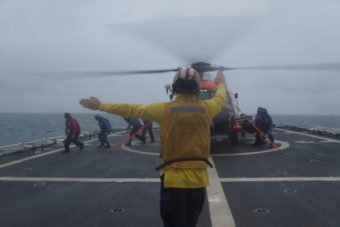
A member of the Stratton’s crew signals to the pilot of a Coast Guard helicopter during a training exercise held earlier this month off Alaska’s northern coast. The agency has stationed two MH-60 helicopters in Kotzebue to help it respond more quickly to emergencies around the remote Arctic expanse. (Photo by Gina Caylor, U.S. Coast Guard)
A member of the Stratton’s crew signals to the pilot of a Coast Guard helicopter during a training exercise held earlier this month off Alaska’s northern coast. The agency has stationed two MH-60 helicopters in Kotzebue to help it respond more quickly to emergencies around the remote Arctic expanse. (Photo by Gina Caylor, U.S. Coast Guard)

The U.S. Northern Command and Coast Guard have launched a major field-training exercise off Alaska’s northwest coast.

Arctic Chinook is intended to demonstrate how local, state and federal agencies would respond to a simulated cruise ship accident.

Coincidentally, a big luxury cruise ship will sail through the area while the exercise is under way.

And to further complicate things, bad weather has just set in.
Arctic Chinook planners have had to incorporate some extra precautions into the exercise because of rough weather that set in over the weekend over the Bering and Chukchi seas, said Coast Guard Commander Mark Wilcox.

“We are having to adapt our exercise just slightly to accommodate what is going to be gale-force winds,” he said.

The National Weather Service had issued a gale warning effective through Tuesday evening for waters off the Seward Peninsula, where the exercise will be held.

It’s also where the luxury liner Crystal Serenity and its 1,600 passengers and crew will soon be traveling through en route to the Northwest Passage and on around to New York.

The weather service predicted the storm would whip up 35- to 45-knot winds off Alaska’s coast, and it issued a winter storm warning and forecast up to 8 inches of snow on the western end of the North Slope.

The Coast Guard and the U.S. Northern Command, or NorthCom, scheduled Arctic Chinook for now because usually it’s the best time of year to conduct such an exercise, Wilcox said.

“We place a lot of these sort of key events – we time them for August, because we expect to get the best weather and least sea ice,” Wilcox said. “Mother Nature doesn’t always let us move forward as planned.”

Wilcox said the exercise is intended to test the ability of local, state and federal emergency responders to rescue 200 passengers from a cruise ship that’s run into trouble in those waters, The scenario calls for bringing passengers to shore around Tin City, near the westernmost tip of the Seward Peninsula – where rescuers would face their next logistical challenge. (This morning, organizers announced they’d moved the evacuation portion of the exercise to the Kotzebue Long Range Radar Site, due to rough weather.)

“So, how do we keep people alive on the beach while the secondary round of rescue assets that will bring them to an Arctic hub or village – how do we keep alive in that time span?”

The exercise scenario called for responders on the beach to triage the evacuees, sending uninjured passengers to Nome, then on to Anchorage. Fifty people will play the role of injured passengers, who’ll be taken initially to Kotzebue, said Army Col. Michael Forsyth. He’s chief of staff for Alaskan Command, the NorthCom subordinate agency based at Joint Base Elmendorf-Richardson that’s helping the Coast Guard manage the training exercise.

“There’s about 50 folks who will actually get in lifeboats. They are going to … casualties that the municipal community will have to react to.”

Forsyth said Arctic Chinook will involve up to thousand people from several agencies, along with three ships, about a dozen aircraft and many other types of equipment. He said agencies involved include U.S. Army Alaska; Air National Guard; federal Homeland Security Department and its state counterpart and the Arctic Domain Awareness Center, Homeland Security’s University of Alaska-affiliated research arm.

“Canada is also contributing to the exercise a helo, a fixed-wing aircraft and also dozens of personnel.”

Forsyth said other Arctic nations are sending observers. He said management of the complex exercise will be done out of the Alaskan Command’s facilities at JBER, where many of the agencies already have offices.

On the Serenity, keeping alert for an icy voyage ahead

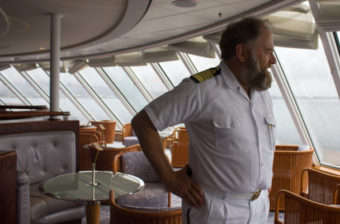
Birger Vorland is the captain of the Crystal Serenity, and he doesn’t shake hands, he touches elbows.

“Make sure everybody stays healthy,” said Vorland. “It’s a Crystal handshake.”

The Crystal Serenity is carrying 980 passengers on a 32-day journey from Anchorage to New York City.

The cruise ship is the largest ever to navigate the Northwest Passage, a voyage of many other firsts for Crystal Cruises, according to Captain Vorland.

“I mean, this is the longest single cruise we’ve ever made,” he said. “And it is the most expensive cruise we’ve ever made. And it’s the one that sold out the fastest — 48 hours, it was basically gone.”

A trip like that comes with a lot of pressure.

“The captain never sleeps heavy,” Vorland said. “He always sleeps a little light.”

Vorland’s biggest concern is the ice that the ship might encounter further north.

The ship is equipped with searchlights, an ice radar, thermal-imaging technology and a Canadian navigation program called IceNav, all to detect that ice.

The icebreaker vessel Ernest Shackleton joins the cruise in Ulukhaktok.

Vorland thinks that ice isn’t all bad.

“This goes two ways,” he said. “We don’t want ice, but we do want ice because if we don’t have ice, we don’t have polar bears.”

This is one paradox of the Crystal Serenity’s current voyage.

The ice is the greatest threat to the ship, but it’s also why the ship is traveling through the Northwest Passage in the first place.

Crystal Cruises Land Programs vice president John Stoll thinks the passengers are on this cruise for the Arctic wildlife sightings, first and foremost.

“So if we have to, we’re going to convince the captain to go where we need to go to spot the wildlife,” Stoll said.

In the Crystal Serenity’s open, airy Palm Court lounge, Stoll showed off the ship’s Cineflex system.

Giant television screens line the dance floor.

During wildlife sightings, the onboard cameraman will zoom in on the animals and broadcast those images to the screens, as well as to the TVs in all the state rooms.

The system has already been put to use. On their way to Nome, they spotted a pod of whales.

On this voyage of new experiences, one thing isn’t new: the passengers.

Keith Steiner is a passenger who has sailed 81 cruises with Crystal. He said he’s seeing a lot of familiar faces onboard.

“Many of them are seasoned cruisers,” Steiner said. “I think all but six people have sailed Crystal at least one time or more beforehand. So that’s very unique. You have people who cruise every year, they cruise for many days.”

There are even three passengers who currently live full-time aboard the Crystal Serenity.

Although many passengers participated in a variety of tours while in Nome, approximately 200 passengers never deboarded the ship.

To some, the Northwest Passage is a chance for a new adventure, and to others, it’s cruising as usual.

Back in the Palm Court lounge, Captain Vorland looked out the window at the rain.

He sees himself as part of tradition as well.

Not a tradition of cruising, but a tradition that hearkens back to Roald Amundsen, who became the first explorer to travel the Northwest Passage by ship in 1906.

Amundsen was Norwegian, just like Vorland. And like the seafarers of old, Vorland isn’t above a little superstition.

“I told my wife when I went on the world cruise in January, I said, ‘Honey, when I come back from the world cruise, I’m going to stop shaving,” he said. “I am going to keep it that way until all the ice is behind me, and then I’m going to shave again.’ Once we leave Greenland, and all the ice is behind us, the beard is going off.”

On this voyage, Captain Vorland isn’t taking any chances. Not even with his facial hair.

More stories about the Crystal Serenity

Nome City Council saves Anchor from abatement, considers small-bottle liquor ban

The Nome City Council held a public hearing work session Monday night, allowing citizens to argue for their properties to be taken off the abatement list.

For the five properties on the list, only one person showed up to verbally defend his property’s removal from the list.

Mark Sackett, the owner of the property 245 A,B Front St., also formerly known as The Anchor, said that he’s been correcting some construction problems from a year and a half ago on the property.

This year will be the year it gets finished, he said, even though Mayor Richard Beneville questioned his construction plans.

“I’m almost done with what’s going on with Soap ‘n’ Suds,” Sackett said. “We’ve got just a few more days, then I can dig it (245 A,B Front St.) right back out, like we did before, and put in the 8-by-8 stanchions … I’m going to fix that.”

Earl Merchant III also spoke during the work session, but only to condemn his Cherry Way property and allow it to remain on the abatement list.

During the regularly scheduled meeting, the council unanimously passed an amended resolution that removed Sackett’s property from the abatement list and deemed the remaining four properties as fire hazards, health hazards or public nuisances that can be demolished if needed.

In other city council business last night, the regularly scheduled meeting focused on marijuana and hard liquor.

One resolution on the agenda authorized City Clerk Bryant Hammond to submit a formal protest regarding commercial marijuana license applications to the State of Alaska alcohol and marijuana control office.

City Manager Tom Moran explained the director of the State alcohol and marijuana control board, Cynthia Franklin, asked the city to follow up on an anonymous complaint that a commercial marijuana property is too close to the Checkpoint Youth Center.

“We’re not trying to stifle industry, and I told her specifically when we reported the anonymous complaint that this was not a formal complaint on behalf of the city, and she said, ‘I would appreciate it if you as the local advisory board committee would file a formal one,’ ” Moran said.

According to the city manager, there are two applications for growing marijuana currently pending with the city.

A resolution that was not on the docket centered on prohibiting the sale of hard liquor in amounts of 750 milliliters (approximately 2.5 fluid ounces) or less.

Several people spoke about this issue during the citizens’ comments portion of the meeting, including Tim Brown of the Alaska Commercial Company store in Nome, who spoke for himself as a community member.

Brown said he’s on the front lines, and he feels prohibiting any of the small containers won’t address the real problem. “I don’t really feel that small bottles is the issue, it’s drinking, period,” he said.

Mayor Beneville asked Brown about the AC store’s alcohol sales in Nome.

“I sell more fifths and liters than I do pints,” Brown replied.

Based on the Council’s general agreement on this issue, a resolution could be drafted for a first reading by the next city council meeting, which would be held at City Hall on September 12 since city offices will be closed for Labor Day on September 5.

Nome greets massive Serenity with drums, dance, festivity

Despite rainy weather, the luxury cruise liner Crystal Serenity arrived in Nome on schedule, Sunday morning.

About a thousand people poured out of the floating hotel and emptied into the town of Nome for a full day of scheduled activities and events, including the formal commemoration held at the Nome Mini Convention Center.

Commemoration speaker and Nome Mayor Richard Beneville said it’s days like these that make him feel excited to be mayor of Nome.

“And I got to be honest with you, as mayor of this town, I am so proud,” Beneville said. “I am so proud of our city employees that have come out to help this happen; I’m so proud of our volunteers that have worked on it; I’m so proud of Kawerak, who brought people in from the villages to sell goods. So it’s such a win-win-win, and it’s beautiful, and there’s a buzz in the air, and it’s energy, and it feels great.”

Many of the passengers getting off the boat were stepping onto Alaskan soil for the first time, Beneville learned from people onboard.

Passenger Marc Sola described the activities he was able to participate in as he ventured into Nome.

“We went to the church, we went to the visitors’ center, and then, there’s a little gift gallery we went to, and now we’re over here at the blueberry festival,” Sola said. “We just came out of that, all kinds of things going on in there, singing, gifts, all that kind of stuff.”

Carl Topkok and Linda Kimoktoak, a drummer and dancer for the King Island Dance Group, were thrilled to share some of their culture with these newcomers inside the Mini Convention Center.

“It really means a lot to us, it has to come from the heart, and you have to want to love it to do these songs,” Topkok said.

“Oh, it’s amazing to pass down our culture to people who haven’t experienced it before,” Kimoktoak said. “You kind of get goosebumps, and you get a really good, tingly feeling.”

Crystal Serenity captain Birger Vorland will have to traverse the icy Arctic waterway in order to successfully land in New York City within 30 days. An icebreaker vessel is accompanying the cruise liner throughout the journey.

The Norwegian ship captain was presented with a key to the City of Nome yesterday in the Mini Convention Center, and he took the opportunity to sink all rumors of his cruise liner being the next Titanic.

“We are the largest ship ever to attempt to go through the Northwest Passage, and when I say ‘attempt,’ that’s just for show, you know. We are going to make it, guaranteed,” Vorland said.

Captain Vorland and the Crystal Serenity’s next stop will be Ulukhaktok in the Northwest Territories of Canada.

Crystal Cruises is already booking passengers for another trip through the Northwest Passage next year.

Uptick in oil prices helps Alaska’s bottom line, but not much

The Trans Alaska Pipeline System, or TAPS, carries oil from Alaska's North Slope to the rest of the state, shown here running along the Dalton Highway. Oil prices have rebounded slightly in the last few weeks, analysts say that won't mean much for Alaska's bottom line. (Photo by Lindsay Ohlert/Creative Commons)
The Trans Alaska Pipeline System, or TAPS, carries oil from Alaska’s North Slope to the rest of the state, shown here running along the Dalton Highway. Oil prices have rebounded slightly in the last few weeks, analysts say that won’t mean much for Alaska’s bottom line.
(Photo by Lindsay Ohlert/Creative Commons)

Oil prices were up for the third straight week last week.

In Alaska, North Slope crude rose to nearly $50 a barrel by the end of the week.

That’s much higher than the $40-a-barrel price the state based this year’s budget on. But, the price isn’t nearly high enough to fill the state’s massive $3.2 billion budget deficit.

Ken Alper, director of the state’s tax division, said each dollar increase in the price of oil works out to about $25-$30 million in revenue for the state. And while that’s helpful, it’s not going to balance the budget.

“I don’t think we’re expecting it to move very much and once again we’re anticipating over a $3 billion dollar deficit so a few hundred extra million is certainly helpful but it still means a large shortfall for the current year,” Alper said.

Alper said the rebound in prices is good for oil companies.

“The big difference that happens around $46 a barrel is, that is, per our estimates, around the break even point for the major producers on the North Slope,” he said.

That break even point is a big deal for the state. If oil stays at that price, the state is guaranteed a four percent tax on production. Any lower and the companies can claim credits that reduce the state’s tax revenue.

But the price of oil is still half of the $102-per-barrel needed to balance the state’s budget this year.

Alper said that it is technically possible oil prices could get back up to that level, but very unlikely.

“It’s a small likelihood. There’s certainly a possibility. We can’t discount it. But if I had to put a number out there, I’d put it in the less than 5% category,” he said.

There are several factors affecting the price of oil. A big one is that global inventories of crude oil are high and the market is oversupplied. Analysts say that isn’t likely to change soon.

Members of the Organization of Petroleum Exporting Countries, or OPEC, are set to meet with other producers in September to discuss freezing production. That fueled speculation that drove prices up last week.

Esa Ramasamy, is an analyst for S&P Global Platts.  He said OPEC signalling that it would discuss capping production could drive prices up in the short term, but other factors have longer lasting impacts on the market, like the forecast.

“This year, they believe the winter is going to be much cooler than what it was last year,” he said.

Hurricane season can also drive oil prices up as storms hit the Gulf of Mexico and halt production at rigs there. But, Ramasay said there are other factors that could pull prices down. Of those, one of the most critical is investment.

As oil prices cratered, companies stopped investing. Ramasamy says there hasn’t been any measurable investment in the last two years.

In Alaska, low prices have caused the state to dip into its $8 billion constitutional budget reserve to close the deficit this year.

And, while more revenue from the bump in oil prices will cause the state to draw less on its savings, the problem is far from resolved.

By Monday, prices had fallen by 3 percent, making it seem even less likely that they’ll rebound to budget-balancing highs anytime soon.


Voters in one village were allowed to cast ballots in both primaries

Rep. Benjamin Nageak, D-Bethel, during debate on the creation of Indigenous Peoples Day, April 1, 2016. (Photo by Skip Gray/360 North)

The result of Tuesday’s Democratic primary for House District 40 remains in doubt.

There also are concerns over how voters in the Northwest Arctic village of Shungnak were able to cast ballots in both the Republican primary and in the primary for Democrats and others.

According to the Alaska Dispatch News, Shungnak precinct chairwoman Evelyn Woods says she mistakenly allowed 52 voters to cast ballots in both primaries.

Dean Westlake is challenging Barrow Rep. Bennie Nageak in the Democratic primary; in 2014, Westlake lost the race by 131 votes. Photo: Rachel Waldholz/Alaska's Energy Desk
Dean Westlake is challenging Barrow Rep. Bennie Nageak in the Democratic primary; in 2014, Westlake lost the race by 131 votes. (Photo by Rachel Waldholz/Alaska’s Energy Desk)

Dean Westlake is ahead of Benjamin Nageak by five votes in the district, which covers the North Slope and Northwest Arctic boroughs, as well as three precincts in the Unorganized Borough.

Election officials continue to count absentee ballots and will review questioned ballots.

State Division of Elections director Josie Bahnke said a state review will examine the statewide results – particularly those in Shungnak.

“We’re still getting to the bottom of it,” Bahnke said. “We’re considering this to be a huge training issue for us going into the general, and one we will address meaningfully and promptly.”

Shungnak was one of six precincts in northern and western Alaska that didn’t report their results until well into Wednesday – many hours after they were supposed to be reported under state election procedures.

Bahnke noted that no voter in Shungnak was allowed to vote twice in the Democratic primary. The number of Democratic voters was similar to previous primaries, but there were more than four times as many Republican voters in the village.

Forty-eight Shungnak residents voted for Westlake, while only two voted for Nageak.

It could be at least several weeks before the winner in District 40 is clear.

The deadline for absentee ballots mailed before the election to arrive by mail is Aug. 26. And the Division of Elections anticipates it will take another week to certify the results.

There’s a good chance there will be a recount, since the trailing candidate or a group of voters in an election this close can request a recount paid for by the state.

The recount request deadline is five days after the state review of the results.

Site notifications
Update notification options
Subscribe to notifications