Richard Rinehart Jr. was appointed at the regional Native corporation’s board meeting last week in Juneau.
Rinehart was Sealaska’s chief financial officer and corporate controller from 2003 to 2009. He is from Wrangell and is managing partner at Raven Potlatch Real Estate in Bellevue, Washington.
He’s run for the board several times, starting in 1995.
New Sealaska board member Richard Rinehart. Photo courtesy Sealaska.
“It’s just something I’ve wanted to do for a long time and I feel very honored and quite humbled by it all,” he says. “I understand there were many qualified candidates and I know Sealaska has a number of qualified shareholders. So I was just glad they chose me.”
Rinehart says he hopes to apply his familiarity with the corporation and his business expertise while on the board. That includes Sealaska’s efforts to develop new ventures within Southeast.
He fills the seat left open when Clarence Jackson Sr. of Kake died earlier this year. Jackson was on the board since the corporation’s beginning.
“He’ll be greatly missed. And I’m honored to fill that position for this remaining few months of his term. But I think I’m there as a Sealaska person, not as somebody to replace Clarence,” he says.
Rinehart is one of 13 Sealaska board members. He’ll run in this spring’s shareholder elections.
His business, Raven Potlatch Real Estate, works with tribal and other investors. It’s worked on housing projects in petroleum-producing regions.
“I’ve seen a huge opportunity with all the explosive growth in western North Dakota, from the oil exploration that’s happening out there. Coupling that with the extreme lack of housing, it’s kind of the fastest growing area of the country as far as housing development and growth,” he says.
Rinehart is Tlingit and Haida, Kiks.ádi, Raven/Frog and is originally from Wrangell. He also spent about 20 years in Oregon.
Sealaska has about 21,000 shareholders, and many of those not living in Alaska are in Washington State.
Sealaska Plaza in Juneau, headquarters of the Southeast regional Native corporation.
Sealaska’s approximately 21,000 shareholders will get their spring dividends around April 12th. Sealaska’s Board of Directors approved the more than $12 million distribution at a meeting today at its Juneau headquarters.
Here are details of how the distribution is divided up. Totals assume ownership of 100 shares, the most common number.
Urban and At-Large Shareholders: $698
Elder Urban and At-Large Shareholders: $852
Non-Elder Village and Leftout Shareholders: $154
Elder Village and Leftout Shareholders: $308
Descendant Shareholders: $154
Here‘s how the shareholder categories are defined:
Urban: Also a shareholder in an urban Native corporation, such as Juneau’s Goldbelt or Sitka’s Shee Atiká.
At-Large: Not a shareholder in any urban or village Native corporation.
Village: Also a shareholder in a village Native corporation, such as Huna Totem, Kake Tribal, Klukwan and Cape Fox corporations.
Elder: Original Sealaska shareholder who has reached the age of 65.
Descendent: Direct descendents of original shareholders who are at least one-quarter Alaska Native.
Here’s where the money comes from, per 100 shares:
$544 from ANCSA Section 7(i) (regional corporation resources earnings) revenue sharing. A $5.44 per share payment will be made.
$100 from corporate earnings. 35 percent of the corporate consolidated net earnings averaged over five years, minus earnings associated with the Permanent Fund. The distribution includes an operations dividend of $1.00 per share.
$54 from dividends from the Marjorie V. Young Permanent Fund, which are based on a percent of market value (POMV) of the fund balance. Based on the POMV calculation, the 2013 April dividend will be $0.54 per share.
Some members of the Juneau-based regional Native corporation have more or fewer than 100 shares due to inheritance or gifting.
Much of the dividend – close to $550 – comes from a pool of regional Native corporation resource earnings. Most of that money comes from Northwest Alaska’s NANA, an owner of the Red Dog Mine.
Sealaska’s urban shareholders receive that part of their dividend directly. The corporation pays village members’ share to their local corporations, which decide whether to pass it on.
Last spring’s distribution was about 20 percent more for urban shareholders and about the same amount less for village members.
Sealaska’s shareholders are mostly of Tlingit, Haida or Tsimshian descent. Close to half live in Southeast.
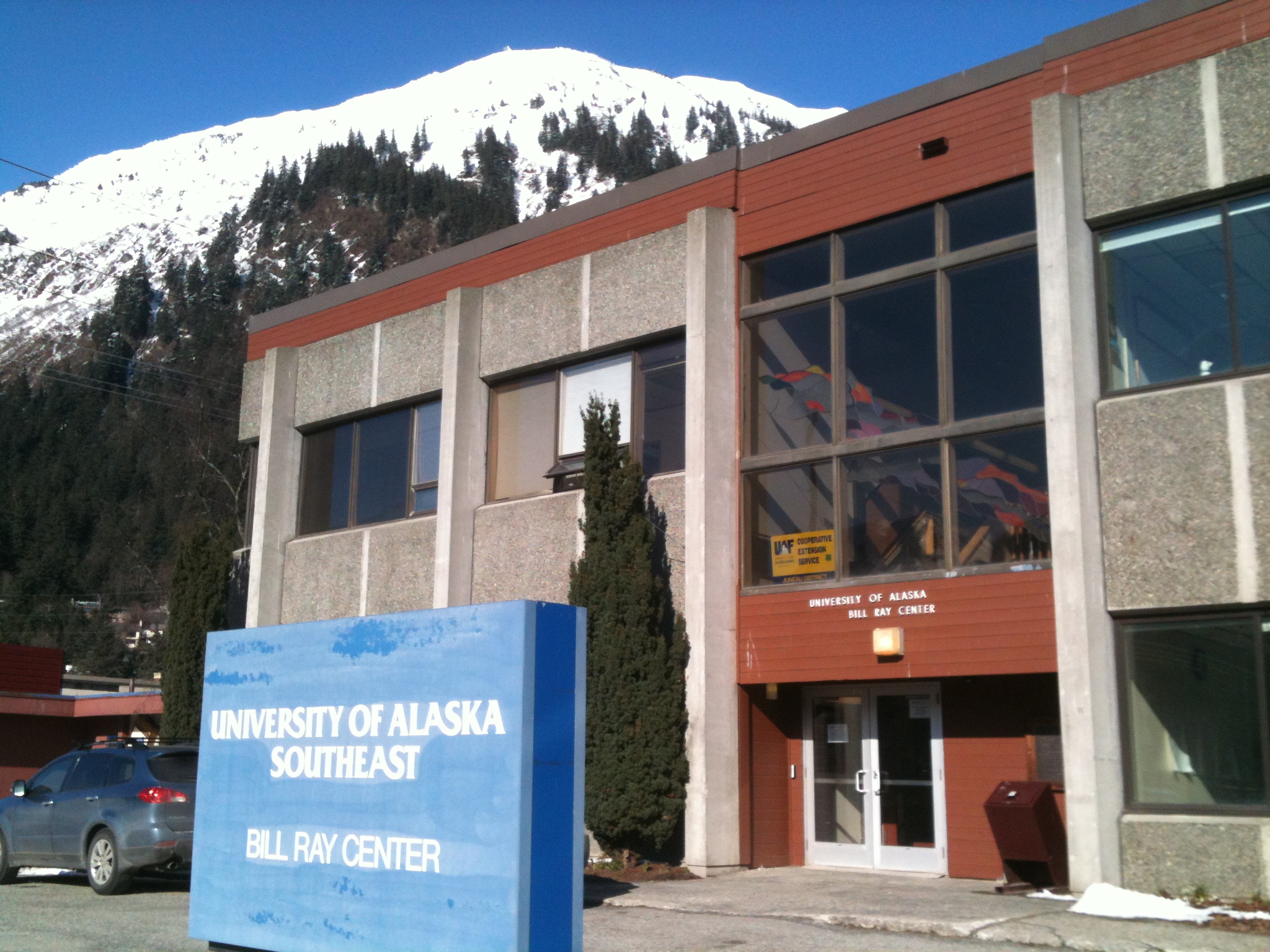
The University of Alaska says the low level of usage of the Bill Ray Center does not justify holding onto the property.
The University announced earlier this week that they’re accepting purchase offers on the downtown F Street building and nearby parking lot until April 22nd.
Kate Wattum, spokesman for the University of Alaska system, says disposal of the underutilized Bill Ray Center is part of the University of Alaska Southeast’s master plan.
And within that campus plan, it came up from students, faculty, and staff that the location of the Bill Ray Center and utilization of the building wasn’t as cohesive with the campus as it could be.”
Wattum says they won’t be losing any of the facility functions or classes with the possible sale of the building. Any existing classes will simply be moved to the main UAS campus at Auke Lake or Auke Bay.
The building built in 1976 is 22,000 square feet while the parking lot across the street is 38,000 square feet. The University says they intend to sell the property as-is, and “at or above fair market value”.
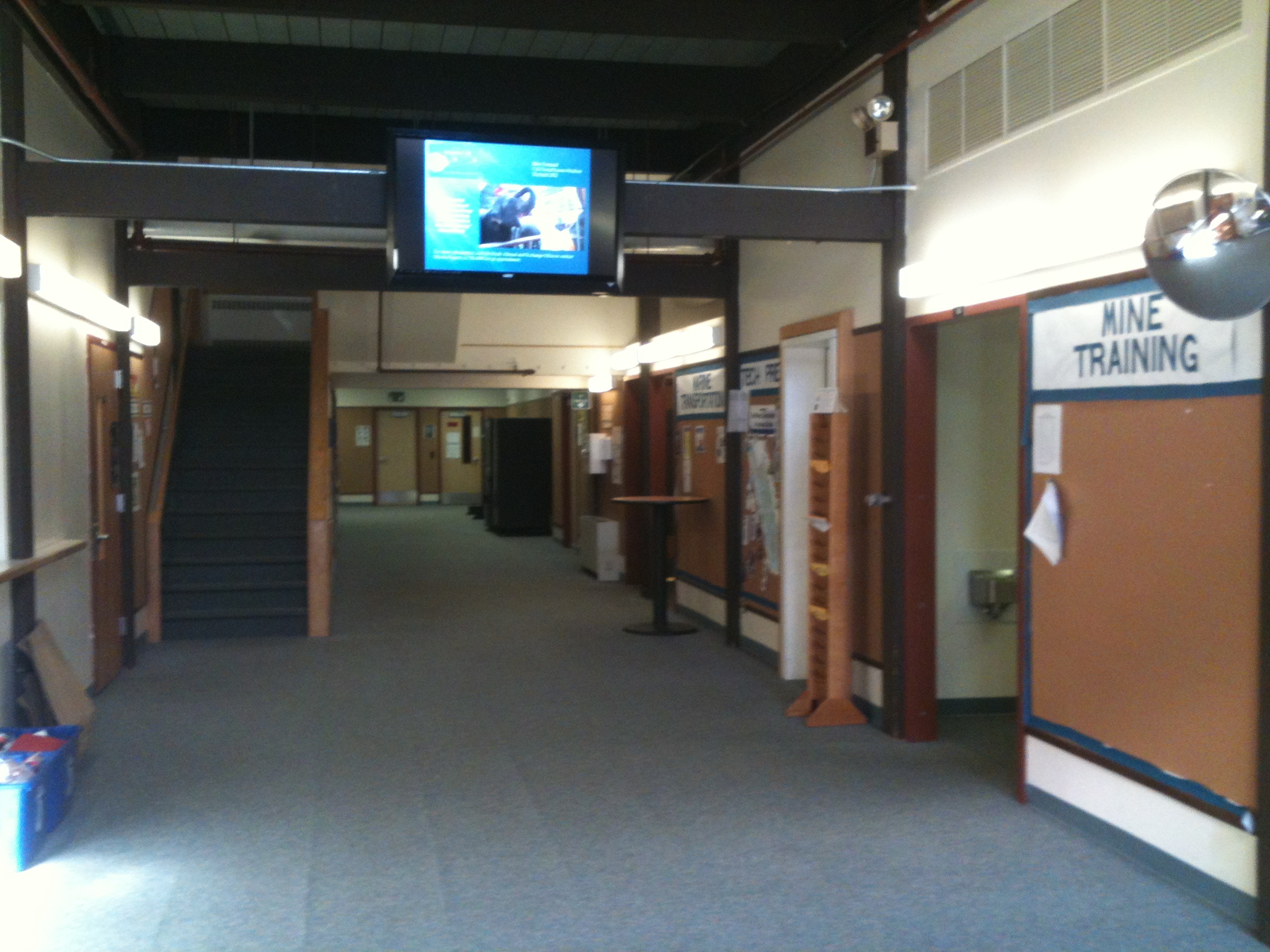
Keith Gerken, director of facilities services for the University of Alaska Southeast, recalls that the building was built in two phases and it was originally designed to include primarily classrooms with offices added over the years. But at least three classrooms, a specialty use room, and a nursing lab are only partly or sporadically occupied now. Most administration personnel who had offices in the Bill Ray Center have since relocated back to the Auke Bay area at the old Horton Hardware building.
About five- or six-years ago, at least half of the building was office space that basically got pushed out of the campus to make room for other things like a larger cafeteria. Administrative services people used to be in the Mourant Building, and they put them downtown because it was a space that was available and it made the cafeteria bigger. It was kind of a surge space for campus, and now we’ve sort of surged back the other way and moved those functions back out to campus.”
The University’s career education and the nursing program currently use the Bill Ray Center. Staff and faculty with offices currently in the building would likely be relocated to the Auke Lake campus or the Tech Center on the downtown waterfront across from Juneau-Douglas High School.
Gerken says the Bill Ray Center is in above-average condition with no major flaws, and it features a recently-upgraded dual-fuel interruptible boiler system.
He estimates that the operation and maintenance of the building, including fuel, costs about $40,000 a month. That would not automatically translate into equivalent savings upon sale of the building since a potential increased use of Auke Lake classrooms could incur additional expense. Relocation of the nursing program may also require additional renovation to an existing classroom space.
We tend to have more general purpose classrooms, in total, than we actually need. For the last decade, most of the growth in student hours has been in distance student hours as opposed to face-to-face student hours. Our growth has not generated the need for more general purpose classrooms and we don’t see it changing in the future. Some of those classrooms we can do without entirely and we’d be fine. Those classes (at the Bill Ray Center) can easily fit in the classroom space that we have at the Auke Bay and Auke Lake campus.”
Part of the second floor of the Bill Ray Center is also used by the University of Alaska Fairbanks’ Cooperative Extension Service which could be forced to look for a new location under a new owner.
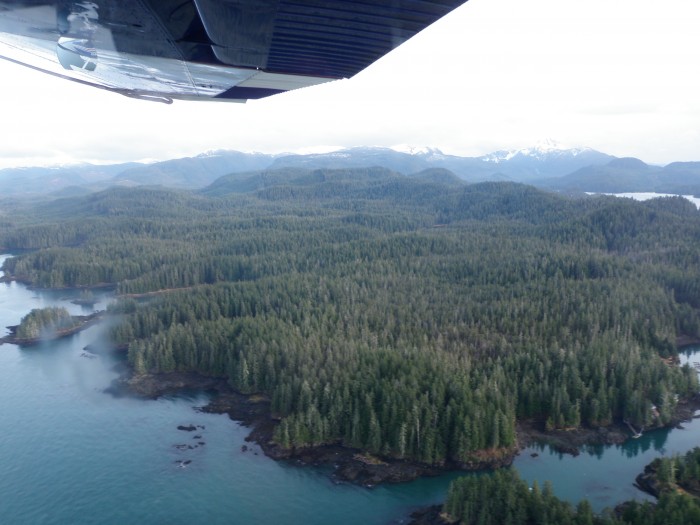
Point Baker, left, and Port Protection, right, are on the northwest coast of Prince of Wales Island. Residents oppose Sen. Lisa Murkowski’s Sealaska lands-selection bill. Photo by Joe Viechnicki/KFSK
A major Southeast Alaska environmental organization has endorsed the latest Sealaska land-selection legislation. But a group of communities on or near Prince of Wales Island continues to strongly oppose the measure.
The Southeast Alaska Conservation Council opposed the Sealaska bill from the start.
It negotiated with the regional Native corporation, but actively lobbied against the measure in Southeast and Washington, D.C., as well as online.
Now, it’s endorsed revised legislation proposed by Alaska Senator Lisa Murkowski.
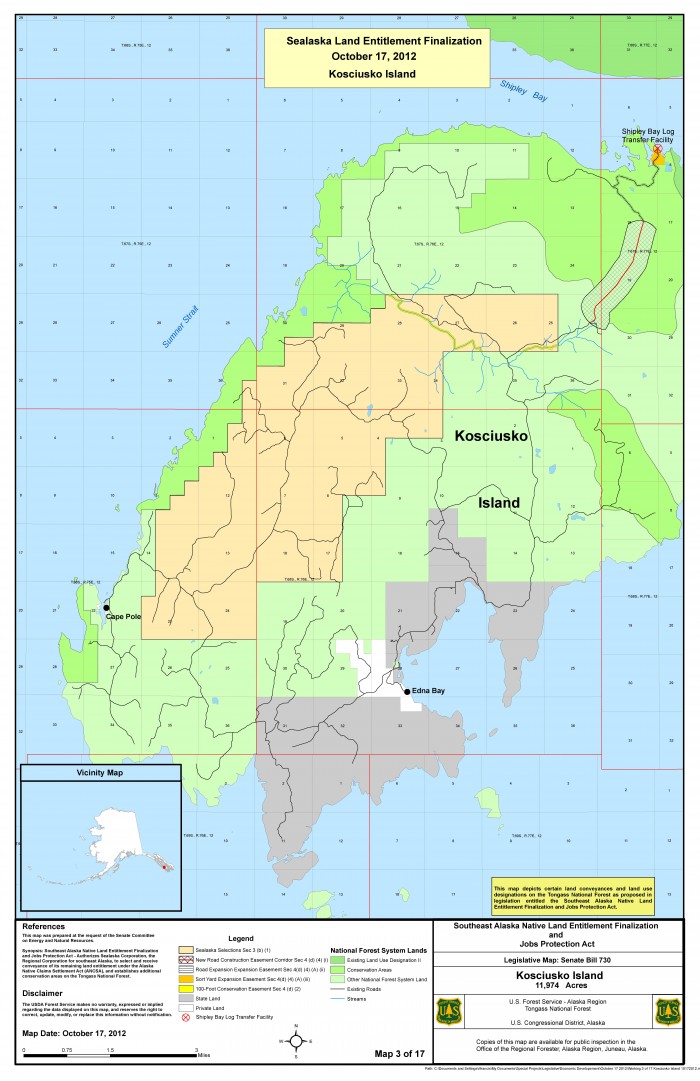
A map showing selections on Kosciusko Island. Courtesy U.S. Forest Service via www.murkowski.senate.gov.
“This wasn’t an easy decision,” says Buck Lindekugel, a SEACC attorney who’s been active in timber issues.
“We tried to be realistic about our chances of stopping the bill or the opportunities available to continue to try to influence decision-makers as the bill moves forward,” he says.
Murkowski’s bill would transfer about 70,000 acres of the Tongass National Forest to Sealaska ownership.
The Alaska Native Claims Settlement Act required the corporation to choose property from within boxes surrounding communities with large numbers of shareholders.
Murkowski’s bill allows selections from other parts of the Tongass.
“We’ve also got to remember that Sealaska has received 290,000 acres already around the villages. And those lands have been heavily hammered,” he says.
SEACC wants further changes to the bill, such as dropping added acreage at Calder, on northwest Prince of Wales Island.
But Lindekugel says the new measure removes some very sensitive watersheds.
“It drops nearly 30,000 acres of incredibly productive lands on north Prince of Wales from selection. And it dropped another 4,000 acres of high-value karst lands on Kosciusko Island,” he says.
“Greetings from your neighbors on north Prince of Wales Island. We, the residents of Point Baker and Port Protection, are asking you to join our voices in opposition to the latest Sealaska lands bill,” says one of the residents of the towns’ residents on a radio commentary. (Hear or read the full commentary.)
That’s the beginning of a radio commentary voiced by 20-plus residents.
Point Baker’s Andrea Hernandez says the people in the recording speak as a group and didn’t want to put names to specific statements. She did provide a list of those who spoke.
The commentary points to Sealaska’s agreement to a Native claims settlement act amendment limiting selections to areas around Native villages. And they say they’ve built their lives and communities around the guarantee that they’ll be able to hunt, fish and log on nearby Tongass lands.
“Now the corporation wants to exchange the land from their designated areas to areas around our towns. How fair is this?”
They particularly oppose a provision transferring additional land from part of the northwest coast.
“Calder Creek is a highly productive salmon stream. And some of the highest volume of old-growth left on the north end of Prince of Wales Island is on Calder Bay. Sealaska will most assuredly clear-cut every last bit of it, leaving the entire watershed bare, with inadequate protection to the streams,” another voice on the commentary says.
Thorne Bay, Hollis, Naukati, Whale Pass, Kupreanof, Edna Bay and Cape Pole are the other communities in the group of nine.
“We can prove that we’ve listened to people and that we’ve been able to go in and make changes that try to remove the rough edges off this bill,” says Vice President Rick Harris.
He says the latest version reflects most critics’ concerns: “Nobody’s going to be happy with every aspect of it. But if you go compare what we could select inside the boxes versus this selection we think we end up with a much better result.” (Link to Sealaska’s statement on the new bill.)
“We see it as a bill that would just make a lot of rich people within Sealaska richer,” says Dominic Salvato, a shareholder living in Anchorage. He runs Sealaska Shareholders Underground, a Facebook page with 800 “likes” that’s critical of the corporation.
He says past practice shows the corporation is not environmentally responsible.
“It’s a man-made tsunami that went through Kake and went through Hoonah, and it’s just promising to be more of the same. It’s got to stop somewhere. The Tongass has given enough,” he says.
Salvato says shareholders will not get much of a benefit from land selections or timber operations.
“They’re looking at the land like, ‘How can we convert it to cash?’ They don’t look at it for its beauty and scenery. They’re looking at it for how they can convert it to long-term … bonuses for executives,” he says.
Other Native activists support the bill.
Richard Peterson is president of the tribal government of Kasaan, a Haida village on Prince of Wales Island.
“Sealaska has so far been good stewards and they’ve been coming and meeting with our community and working with us and engaging us in that process. So it’s a deal that needs to be closed,” Peterson says.
Murkowski’s land selection bill has not yet been heard by the Senate Energy and Natural Resources Committee, where she’s the ranking Republican member.
Spokesman Robert Dillon says this is about as good as it’s going to get.
“We believe that we’ve addressed the majority of their legitimate concerns and we would hope that would take a hard look at that. Because the land selections have got to be finalized one way or another. And as SEACC pointed out, this bill is better than letting them select out of their original boxes,” he says.
The Alaska Forest Association, an industry group, supports the bill, though it says the measure has undergone too many changes.
The U.S. Forest Service has not taken a formal position. The agency was critical of earlier bills.
A similar measure with fewer compromises was introduced in the House by Representative Don Young. While his measure passed the House last year, most involved say the Senate bill is the most likely to get attention.
It will be an all-Juneau final in the Region V 4A basketball tournament Friday night.
The Thunder Mountain Lady Falcons defeated Ketchikan 64-55 in third-round action Thursday morning at Sitka’s Mt. Edgecumbe High School.
Sophomore Ashley Young and senior Jonelle Staveland both put up double-digits for the Lady Falcons, with 19 and 18 points respectively. But Ketchikan junior Jayley Taylor — despite her team’s losing effort — now holds the single-game tournament record of 34 points, with 12 coming in the fourth period, including a pair of three-pointers.
The second loss takes Kayhi out of the tournament. Thunder Mountain advances to the final against the Juneau-Douglas Lady Crimson Bears. If Thunder Mountain defeats the as-yet undefeated Lady Crimson Bears, it will force a playoff game between the same two teams on Saturday afternoon. The winner of that game will represent Region V in the state 4A tournament in Anchorage.
Photo courtesy of Robert Woolsey, KCAW
It’s the same matchup on the boys side, except it is Juneau-Douglas which is coming into Friday’s final through the losers’ bracket.
The Crimson Bears defeated Kayhi Thursday morning, 60-58, in the closest contest yet in the boys’ tournament.
Juneau senior Keith Ainsworth led all scorers with 18 points, including a pair of three pointers. Fellow senior Phillip Fenumiai put up 13 points.
Ketchikan once again had a balanced scoring attack, with three players in double-digits. Seniors Kable Lervick and Brien Auger scored 12 and 10 respectively. Junior Isaiah Navales also had 10.
The second loss knocks Kayhi out of the tournament. Juneau will meet Thunder Mountain in the 4A final Friday afternoon. As with the girls, a win by Juneau will force a Saturday playoff for the regional title.
The top-seeded Juneau-Douglas Lady Crimson Bears were rested and rock-solid, as they took down the Ketchikan Lady Kings, 49-33, in the second round of the regional tournament in Sitka this week.
The first-round bye for Juneau might have made the difference in Wednesday’s game. The Lady Kings traded baskets in the first quarter, which ended with Juneau ahead 13-12. But Ketchikan had trouble finding the basket in the next two periods.
Juneau senior Gabi Fenumiai led all scorers with 18 points before fouling out in the fourth quarter. Juneau had consistent scoring from its bench as well. Nine of the twelve players on the squad put up points for the Lady Crimson Bears.
Kayhi also had balanced scoring from seven players, but no one reached double-digits. After struggling through the second and third periods, the Lady Kings woke up in the fourth quarter, outscoring Juneau behind seven points by Junior Brooke Simmons, and three clutch free-throws from sophomore Alexis Biggerstaff. But the effort was not enough to break Juneau’s momentum.
The Lady Crimson Bears will play in the 4A final Friday at 3 p.m.. The Kayhi girls drop to the losers bracket, and wil meet Thunder Mountain Thursday morning at 8 a.m.
Region V Tournament photos courtesy of Robert Woolsey, KCAW
The top-seeded Thunder Mountain boys also used their first-round bye to advantage, beating the Ketchikan Kings 55 – 33 in the second round.
Like the Lady Kings, the Ketchikan boys also waited until the fourth period to make things interesting. Junior Isaiah Navales sprang to life and scored two field goals and a free throw. Sophomore Alex Pihl also scored four of his six total points in the fourth period.
In all, nine of the twelve players on the Ketchikan team scored, but no one was red-hot.
That was not the case with Thunder Mountain, which had two players in double digits. Junior Matt Seymour led all scorers with 19 points. Senior Sam Jahn put 10, dropping 6 of 10 free throws.
Thunder Mountain now advances to the final at 4:45 p.m. Friday. Ketchikan drops to the losers bracket and will play Juneau-Douglas at 9:45 a.m. on Thursday.
Close
Update notification options
Subscribe to notifications
Subscribe
Get notifications about news related to the topics you care about. You can unsubscribe anytime.