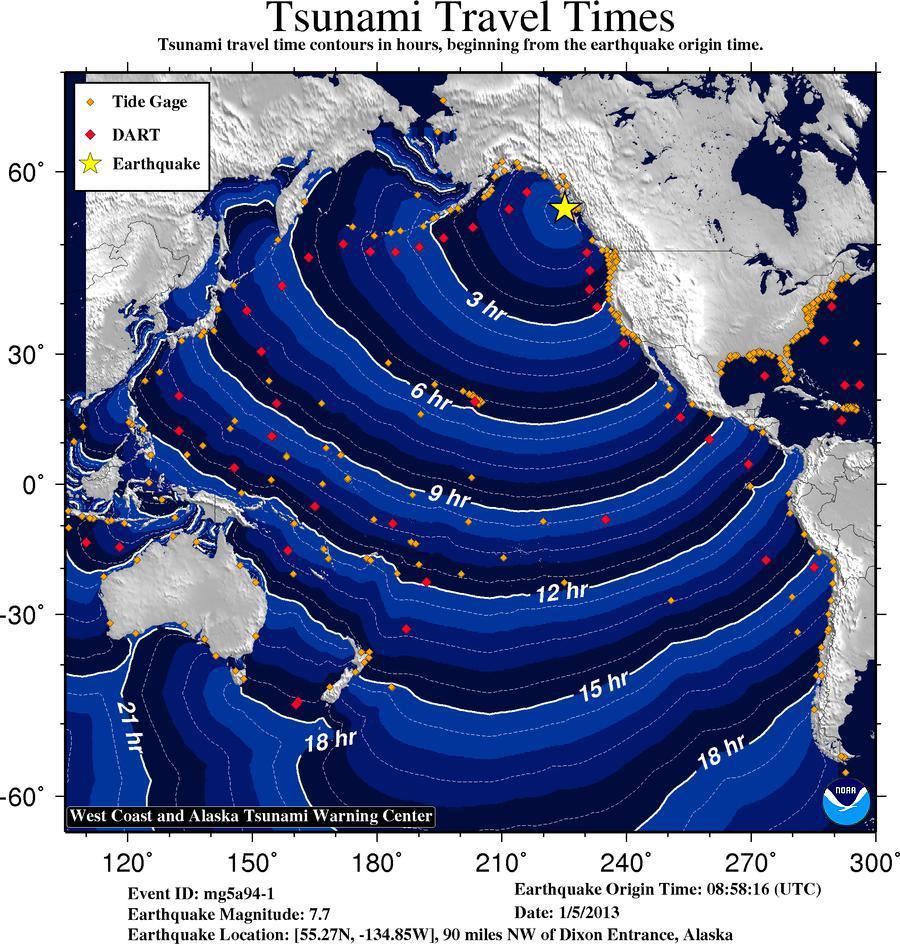
A major earthquake Friday night shook Southeast Alaska residents awake and prompted some in coastal areas to move to higher ground after warnings of a possible tsunami.
The epicenter was located 75 miles northwest of Dixon Entrance, or about 63 miles west of Craig or 208 miles south of Juneau. The quake occurred at a depth of 3.1 miles.
There were no reports of any significant damage or injuries.
GCI released a statement saying the earthquake damaged fiber optic lines serving Wrangell. The company said a crew had arrived in the community Saturday to repair the damage.
A tsunami warning was initially issued for the coast of Alaska and British Columbia ranging from Cape Suckling down to the northern tip of Vancouver Island. Full evacuation of those areas was suggested.
A tsunami advisory was issued for the coast of Alaska ranging from Cape Suckling to Kennedy Entrance and for the Pacific Northwest Coast from the northern tip of Vancouver Island to the British Columbia-Washington border. Residents were advised to stay away from shore.
Officials in Sitka and on Prince of Wales called for an evacuation of low lying areas. Bleary-eyed Petersburg residents drove or walked up the hill to the local ballfields, the post office, and airport.
Chris Cook was working the night shift at downtown Petersburg’s Scandia House Hotel when the earthquake hit.
“I haven’t felt an earthquake before so I actually thought it was a wind gust,” Cook said. “But then I realized that wind would have been louder and doesn’t shake things quite on the inside.”
A wave of a half-foot was reported in Port Alexander at 1:07 a.m. Alaska time and a wave of a few inches was later reported in Sitka.
At 1:17 a.m., the tsunami advisory was canceled for the coastal areas of British Columbia from the Washington-British Columbia border to the north tip of Vancouver Island, British Columbia.
The City of Craig reported at about 1:45 that they were closing the tsunami evacuation points. A minor tidal surge was experienced, but no tsunami damage was reported.
At 1:58 a.m., tsunami warnings and advisories for all of Alaska, British Columbia, and Washington coastal areas were cancelled by the West Coast and Alaska Tsunami Warning Center.
In an analysis published online by the U.S. Geological Survey shortly after the quake, geologists said Friday night’s shaker was related to last October’s 7.8 magnitude Haida Qwai earthquake. The more-recent earthquake was the result of shallow strike-slip faulting near the plate boundary between the Pacific and North America plates, and it broke a fault approximately 50 kilometers in length and slipped about seven meters.
The Pacific plate is moving northwestward with respect to the North America plate at a velocity of 51 millimeters per year. U.S.G.S scientists say that area of the plate boundary has hosted eight earthquakes of magnitude 6 or greater over the past 40 years.
As of 12:30 p.m. on January 5, at least thirteen afterschocks ranging in magnitude from 3.5 to 5.1 have been recorded in the same area.
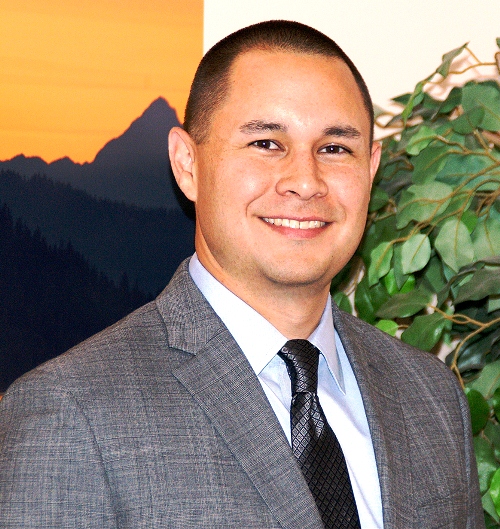
Michael E. Douglas, SEARHC general counsel. Photo courtesy South East Alaska Regional Health Consortium.
SEARHC interim general counsel Michael E. Douglas has been hired permanently for the job.
Douglas has been the attorney for the SouthEast Alaska Regional Health Consortium since June and will continue to be based in Juneau. The non-profit health consortium serves Native communities in Southeast Alaska, including the Ethel Lund Clinic in Juneau and Mt. Edgecumbe Hosptial in Sitka.
Douglas is Haida Indian, with a law degree from the University of Washington. He was formerly president of the Northwest Indian Bar Association and a volunteer mentor for the Alaska Court System Color of Justice Program. He coordinates a scholarship program for Alaska Native and American Indian law students through the bar association.
Before moving to Juneau, Douglas worked for Sonosky, Chambers, Sachse, Miller & Munson, LLP, an American Indian law firm in Anchorage.
Jonathon Kreiss-Tomkins has won the House District 34 race by just 32 votes.
The Alaska Division of Elections Wednesday morning completed the tally of absentee ballots, giving the 23-year-old Sitka Democrat 4,123 to 4,091 for Haines Republican Rep. Bill Thomas.
The margin of difference is just .38 percent and is eligible for a recount, according to Elections Division Director Gail Fenumiai.
She says the recount cannot be requested until the district vote has been certified then the request must be received within 5 days. It would be held for another five days before the count takes place. Fenumiai anticipates certification of the district on Friday.
House District 34 encompasses a large area of Southeast Alaska from Haines to Sitka, including Metlakatla, Craig, Hoonah, Angoon, Kake, Klukwan, Port Alexander, Pelican, Elfin Cove, Klawock, Kasaan and Hydaburg.
In Anchorage Senate District J, Sen. Hollis French won the race by 54 votes over Republican challenger Bob Bell.
Fenumiai says the ballot count is complete. Themargin is .36 percent, also eligible for a recount.
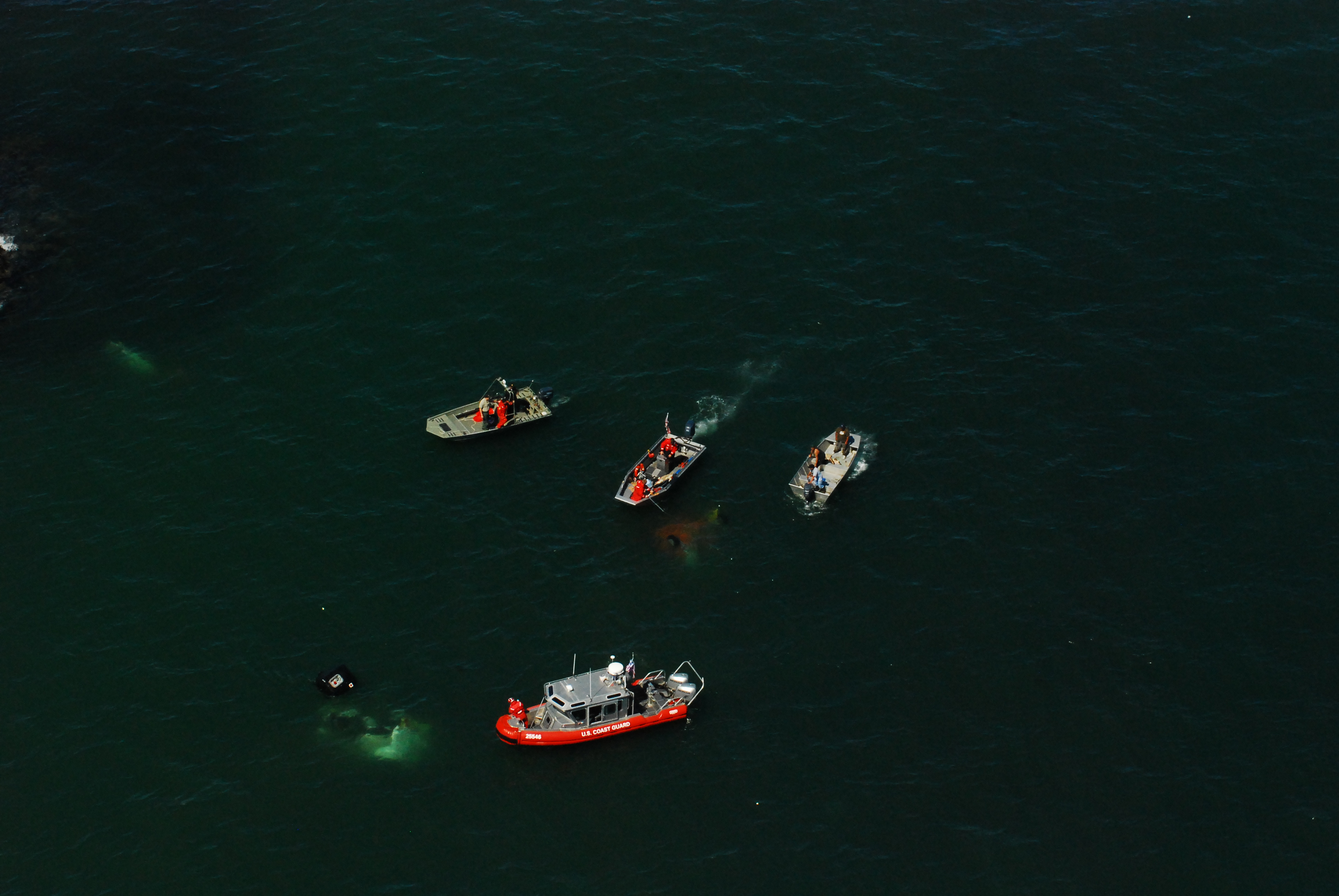
A Coast Guard crew from Station Quillayute River, Wash., along with local emergency response personnel, search the water near James Island, Wash., for crew members and wreckage from a Coast Guard Jayhawk helicopter, which crashed July 7, 2010. (Coast Guard photo by Petty Officer Nathan Litteljohn.)
Lt. Lance Leone was the only survivor of a fatal helicopter crash in 2010, in which three people from Coast Guard Air Station Sitka died. Leone was the co-pilot aboard Coast Guard Helicopter 6017 as it flew back to Sitka from Astoria, Oregon.
Leone recently talked about the mission and the events leading up to the flight, as well as his experience in the cockpit with Lieutenant Sean Krueger, the pilot in command and a longtime friend. On their way north, they saw a small Coast Guard boat leaving a station in Washington. Krueger decided to fly low over the boat.
“And he started a righthand turn down in a decreasing altitude along the coastline. At this point in the flight recorder it gets very interesting. I say “Well, that’s Quillayute.” And I say it wrong. … But I said it, and on the third time of saying it, moments later, we hit something we never saw.”
Electrical wires, stretching nearly 2,000 feet between the mainland and nearby James Island. The impact caught the chopper’s right main landing gear. Its four main rotor blades broke off, and the fuselage was torn into five pieces, coming to rest in shallow water about 150 yards northeast of the island.
Leone talked more about the crash with KCAW’s Ed Ronco in an interview that was recorded last week.
LEONE: I was in the left seat. My shoulders and my knees and my head were all banging around in the cabin for I don’t know how long. It felt very slow motion, but then there was a rapid stop, and that rapid stop quickly became a rapid liquid stop. And I was underwater, upside-down, in a helicopter.
RONCO: It happened that fast.
LEONE: It was that fast. We were flying, everything was fine, and then it blew apart. When I was underwater I didn’t know anything. It felt like the world was shaking apart.
RONCO: What did it sound like?
LEONE: Screeching? Screeching and cracking. I had double hearing protection, but it was kind of like a pounding and a screeching. I got to listen to it on the voice recorder and it is literally screeching and crashing. I don’t know how to link it to … what anyone else would hear. I guess, like a car accident?
RONCO: Was that difficult, listening to those recordings?
LEONE: I had the opportunity to read the recordings months in advance. Actually this time last year was the first time I had the ability to read through the recording and to go through and see what I had done right. I’d read the investigation and seen everything I’d done wrong, and that the crew had done wrong, because that’s what they’d focused on. But to see what I’d done right and everything I did to the best of my ability, but then to listen to it and hear the sounds, it was … I would say “troubling,” but I was ready for it, based upon my desire. I didn’t have to. My lawyers could’ve just listened to it with me outside the room, but I wanted to make sure the nonverbal made it into there.
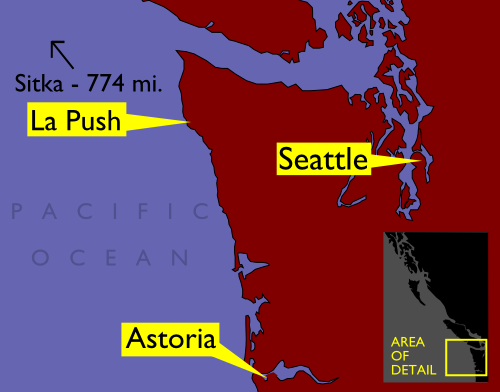
CG 6017 left Astoria, Ore., at 8:48 a.m. PDT on July 7, 2010. At 9:41 a.m., it crashed near La Push, Wash. (KCAW map)
Leone is referring to nonverbal communications going on in the cockpit. He wanted to make sure they were part of the investigation record, which would later be summed up in what’s called a FAM, or Final Action Memo.
RONCO: The FAM says there were six minutes between impact and the time you fired off a flare. What was going on in those six minutes?
LEONE: So, after the abusive vibrations and then it stopping underwater, I did what every aviator would do out there. We train on it all the time. Yearly, we’re flipped over in a chair and go through the procedures. I did the procedures the Coast Guard taught me. I retracted my collective, found my exit, pushed the exit out of the way. Undid my cords, released my harness and pulled through the hole to get out. This is where it changed a little from what I’d done before. I was kicking to get out and I wasn’t getting to the surface. I hadn’t put my regulator in to breath underwater yet. I just assumed I’d be able to get out quicker than be able to have to put that in. Normally when we do it, it’s a slow flip in a chair. This was an unbelievably fast hitting the water. I can’t quote on how many Gs but I know there was a lot of impact having been flying through the air at 125 knots, and hitting the wires at approximately 115 feet. At that point, we were a projectile.
Leone used an emergency air supply helicopter crews carry. It’s called a HEEDS bottle, which stands for Helicopter Emergency Egress Device. It carries about 1.5 cubic feet of compressed air. How long that lasts depends on how you breathe. In training, Leone could usually get between 7 and 13 good breaths out of it. But after the crash, as he tried to find his way out of the underwater wreckage, he only managed six.
LEONE: Coming to the surface, my eyes were burning because when the 6017 crashed, we were pretty much max-fueled with JP8 jet fuel, which is very similar to kerosene. So when I came up on the surface, I was covered in kerosene. I still had my helmet on, and I started looking for anything to float on, because I couldn’t kick hard enough to keep my head and my body out of the water enough to be comfortable.
Leone broke his collarbone in the accident, and as he tried to inflate his life vest, he discovered his arms weren’t working.
LEONE: It was the first time I’d ever asked my body to do something and my body said “No.” But my wrist worked, and so I cranked my wrist against the base of the regulator, which was sitting right to my left, and for some reason, it worked, with just that little bit of wrist motion.
The vest inflated, but there were still problems. Leone’s dry suit was torn and filling with water, and although he says he wasn’t in pain, he certainly was injured.
LEONE: I had a piece of helicopter that had lodged itself in my left forearm. My right hand was fairly mutilated because of pounding against something in the helicopter. My right shin was open to the bone. The bone looked like a corncob that had been eaten – like the white, remaining husk of corn. My ankle was badly swollen. But the only real injury was a broken collarbone and a dislocated shoulder, which are both seatbelt injuries from the seatbelt that saved my life.
Now floating in the water between James Island and La Push, Washington, Leone began to look for his crewmates.
LEONE: I’d assumed based on every survival class I’d taken that everybody else would be there. I’d not taken classes where you’re the only one left to survive. You’re always part of a team. And I couldn’t find Sean, Brett and Adam. I didn’t know where they were. It was very disheartening, but I knew I had to stay afloat if I could ever figure out where they were.
Leone looked for his emergency beacon, but with his arms disabled, he couldn’t get to it. Next, he reached for a signaling mirror to try and reflect sunlight and catch someone’s attention. As he opened that pocket, out popped a pencil-sized flare. He managed to assemble it using only his fingertips. By the time he fired it into the air, a skiff from the La Push harbormaster’s office was already heading in his direction.
LEONE: As they approached me, they said “We’re going to grab you, we’ve got other people looking for the other three.” I, at that moment, had the wherewithal to tell them “I don’t want you to pull on my arms,” because I didn’t feel like they were attached. In my head, I kind of envisioned them being disconnected from my body, although my fingers worked. Because I couldn’t use the rest of them, I just pictured they were either just flopping around with nerves just connected, but with bones not… so they, with all the training that they’ve had, pulling fishing nets aboard that boat, they scooped me out of the water by dropping the gunnels of the vessel below my back and sliding me into the back of that johnboat – I call it a johnboat, but it’s just an aluminum craft. But those were the heroes of the day for me.”
Leone was taken to a nearby hospital and then medevacked to Seattle for further recovery. His parents from Maine and Florida, and his family in Sitka met him there within 12 hours.
LEONE: Ellen, my unbelievably great wife, loaded up the children, got an Alaska Airlines flight the Coast Guard booked for her, and she landed in Seattle. The pilots came on the intercom and had everyone sit down so she and the children could get off. The Coast Guard brought her directly to the hospital to see me.
Less than a week after the crash, hundreds of Sitkans, as well as high ranking Coast Guard officers and elected officials gathered at Air Station Sitka for a memorial service in honor of Krueger, Banks and Hoke. Leone was there, too.
LEONE: I had wanted to attend a memorial service in La Push, but my doctors wouldn’t let me go, because they were afraid of blood clotting.
RONCO: Were you medically ready to leave the hospital when the memorial service happened, or was that a little faster than – it just seems fast to me, I guess.
LEONE: I didn’t like being in a hospital. I don’t like being a patient. I like helping people, I don’t like being helped. I don’t know what it is about my personality. The day after the accident I asked when I could stand up and they said “Just wait one more day.” So on Day 3, I stood up, walked around, did the stairs, and on that day I started the long process of physical therapy. It was quick. Similar injuries to a car accident. Obviously physical wounds were very quick to heal. Now, the mental stuff took a lot longer.
The Capital City had the lowest unemployment rate in Alaska last month.
At 4.3 percent, Juneau’s October rate was unchanged from September and almost a full percentage point below October 2011.
The statewide jobless rate last month was 7.1 percent, well below the national rate of 7.9 percent.
Alaska’s employment picture is affected more by seasonal work than any other state. The numbers of those seeking unemployment benefits go up every fall and down in the spring.
But state labor economist Caroline Schultz says Juneau typically has a lower unemployment rate compared to the rest of the state.
“We have a less seasonal economy than Southeast Alaska, certainly because of the stability of government jobs and other private sector jobs,” Schultz says, “the perks of having a bigger economy in Juneau than we have in the rest of Southeast, where those communities are subject to much more seasonal changes.”
Skagway is the poster child for seasonal employment. In September, 2.4 percent of the workforce filed for unemployment benefits. It grew to more than 17 percent last month.
Sitka was another bright spot in the state’s economy last month, with unemployment slightly above Juneau’s, at 4-point-6 percent.
Over the year, the Southeast Alaska economy has grown by 2 percent, according to Schultz, with growth across all industries, and bigger gains in the private sector.
Sealaska shareholders will soon get their largest end-of-year dividend in three years.
Sealaska Plaza is the corporation’s Juneau headquarters. Officials have announced the December distribution, the largest in three years.
But it’s mostly due to the success of another regional Native corporation.
The Southeast regional Native corporation will issue dividends to about 21,000 shareholders on or around December 6th.
Payments range from $96 to $868, depending on the class of shareholders.
Almost 90 percent of the larger dividends are funded by a pool of all regional Native corporations’ resource earnings. It’s known as 7(i) money.
Sealaska spokesman Todd Antioquia says it’s mainly from the Red Dog mine, owned by the Kotzebue area’s corporation.
“NANA continues to be the bulk of the distribution. Historically, Sealaska was the major contributor to 7(i) revenue sharing throughout the state through our own [timber] resource development,” he says.
Shareholders who are also members of urban Native corporations, such as Juneau’s Goldbelt, will receive $772. That’s assuming they have 100 shares of stock, the most common number. (Scroll down for all classes’ numbers.)
Members of village corporations, such as Angoon’s Kootznoowoo, will only get $96 directly. That’s the part of the dividend funded by corporate earnings. But Sealaska will pay the rest to their local corporation, which can pass part or all of the money on to shareholders.
Qualified descents of original shareholders will get only $96. And enrolled elders will be paid an extra $100 or so.
A little more than 5 percent of the larger dividends are paid out of corporate earnings, including investments. A slightly larger percentage comes from Sealaska’s permanent fund.
Its payments are based on a five-year earnings average. Antioquia says that’s been held down by low returns from the Wall Street crash.
“We have continued to feel the effects of 2008 through the last few years. Now that 2008 is rolling off of these averages into the future, as long as the markets remain stable or if they continue to improve, then we’re optimistic that we’ll see improvement there,” he says.
This December’s distribution is about 10 percent more than 2011’s, and about 35 percent more than 2010’s. But the previous two years were 37 and 26 percent more, respectively. (Scroll down for a five-year perspective.)
December’s payout totals about $13 million. Last April’s came to $14 million. That means shareholders are getting a total of around $27 million this year.
A little less than half live in Southeast. That means dividends are contributing about $13 million to the region’s economy this year.
Brian Holst of the Juneau Economic Development Council says it’s significant, especially to villagers.
“We know the Alaska Permanent Fund in some rural communities can be a very significant part of income. And in that sense, a Sealaska dividend can be similar to the permanent fund dividend in that it helps maintain a lifestyle in these small communities, which is very important for the sustainability to these places,” Holst says.
Holst ran the numbers and came up with several ways to explain the dividends’ economic impacts.
He says the total equates to the annual income of nearly 300 average Southeast Alaskans. Or a quarter of the region’s mining wages. Or around half of the value of seafood landed in Juneau.
Holst says it’s also about 7 percent of what tourists contribute.
“We know our cruise-ship passengers spend about $200 per person when they visit Juneau. And so, if we were going to think of that infusion of the Sealaska dividend as though it were cruise-ship passengers spent the same way, that would be the equivalent of about 68,000 cruise ship passengers additional in our communities,” he says.
Sealaska pays dividends twice a year.
Its businesses include timber, gravel, investment, plastics, government-contracting and environmental-cleanup operations.
December 2012 Distribution & Stock type: Per Share Per 100 Shares
Non-Elder Urban and At-Large Shareholders $7.72 $772
Elder Urban and At-Large Shareholders $8.68 $868
Non-Elder Village and Leftout Shareholders $0.96 $96
Elder Village and Elder Leftout Shareholders $1.92 $192
Descendant Shareholders $0.96 $96
December dividend only per 100 shares for urban shareholders
2012: $772
2011: $714
2010: $577
2009: $1,227
2008: $1,046
Yearly total per 100 shares for urban shareholders
2012: $1,617
2011: $1,430
2010: $989
2009: $2,208
2008: $1,605
The Sealaska dividends distribution chart, courtesy Sealaska.
Close
Update notification options
Subscribe to notifications
Subscribe
Get notifications about news related to the topics you care about. You can unsubscribe anytime.