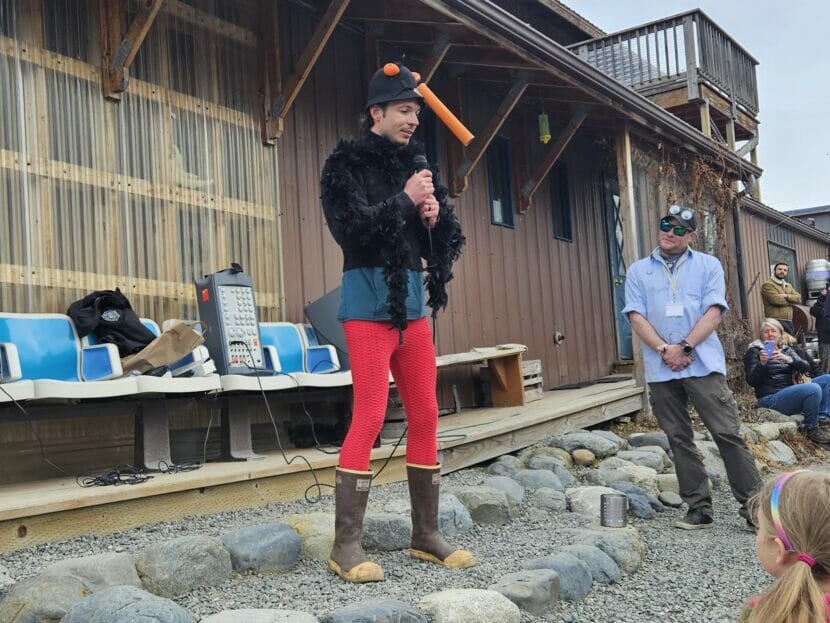
A contestant identified as Mr Oystercatcher imitates the local bird. (Corinne Smith/KBBI)
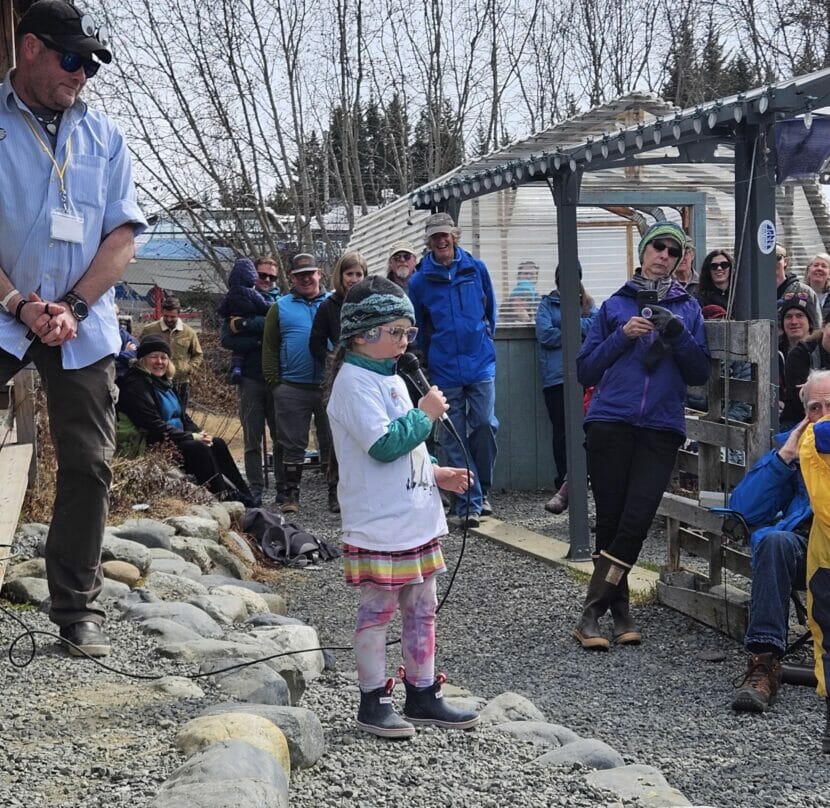
Five-year-old Cassidy Allmendinger confidently walks to the mic on a makeshift-outdoor stage. She’s the first contestant of Homer’s annual bird-calling competition.
“First I will be doing the sandhill crane,” she says. “Coooh coooh coooh.”
Allmendinger says she learned that one from her grandmother. It’s a special spring call many Homerites recognize, as the striking gold and gray cranes return to mate on the shores of Kachemak Bay.
The bird-calling competition is a fan favorite of the annual Kachemak Bay Shorebird Festival, which includes four days of guided tours, presentations and family activities for birding enthusiasts. The competition featured locals and visitors of all ages showcasing their favorite bird calls — beautiful, mysterious and whacky alike.
A large crowd gathered outside the Homer Brewing Company for the competition, loudly cheering each contestant. Some have just come from birding workshops or kayak trips as part of the four-day Shorebird Festival.
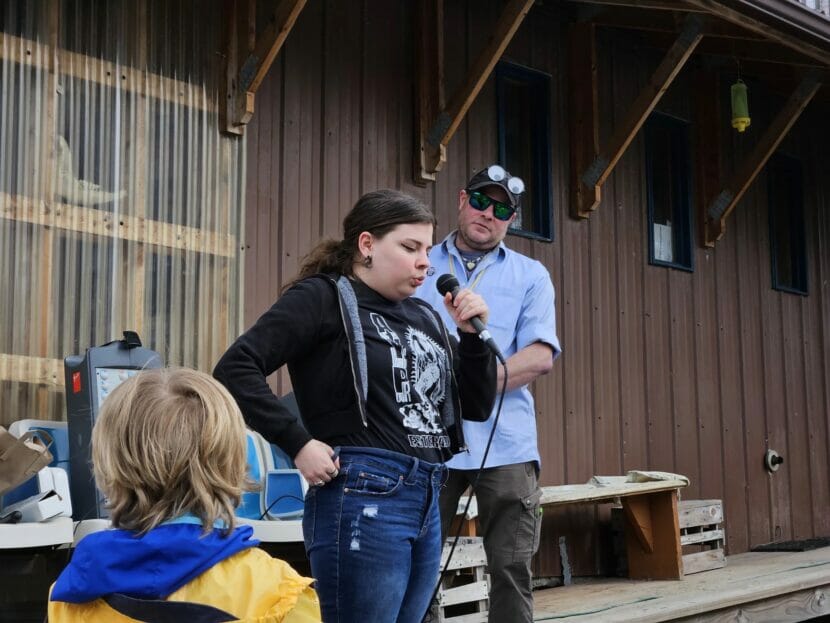
Marina Steffy, 17, mimics a seagull call. (Corinne Smith/KBBI)
Seventeen-year-old Marina Steffy steps up with another distinct and familiar call — a seagull.
The bird-calling competition draws contestants of all ages. Some have bird-themed T-shirts and binoculars still hanging around their necks. Four judges, seated at a table to the front, are all decked out in bright feather boas.
Some bird calls are serious, some are funny. Some are easily identified, while others leave the crowd guessing.
That was a golden-crowned sparrow, known for its distinct three-note trill. There’s also a dramatic impression of a European starling, complete with a costume jacket glued with plastic stars. One contestant, who introduced himself as Mr. Oystercatcher, wears red leggings and black feather boa, with a bright orange beak glued to a hat.
“I didn’t plan to participate, but when you show up to a bird calling contest dressed up as a bird, people are going to have expectations,” he said. “So here’s my best oyster catcher impression…Chee chee chee chee.!”
“Hopefully there’s points for flair,” he said, and the crowd cheered.
After a long and careful deliberation, the judges announce the winners. Penny Gage of Anchorage took home one of the top prizes for her eagle call.
“I practiced that call in Sitka working on a tour boat in the summer, and I’m really glad to see it come into use today,” she said laughing. “And I love the shorebird festival, and I love migratory birds, and I’m really happy to be here!”
One of the judges is Cindy Mom, a bird guide and owner of Seldovia Nature Tours. She’s holding pages of notes on the contestants.
“Like, everybody has a star! Look at how many we circled!” Mom said. “Yeah it was all so good, we were like how are we going to do this?”
Cassidy Allmendinger, 5, competes in the bird-calling competition with sandhill crane, chickadee and owl calls. (Corinne Smith/KBBI)
Steffy — who did that memorable seagull impression — was also a prize winner.
“I did the gray jay, I did a raven, and then I did the seagull, which is a pretty easy one. And then I did a magpie,” she said.
She says she grew up birding on her grandparents property in Kenai. This is her first bird-calling competition, and she says she hopes to learn more bird calls and compete again.
“I’m into a lot of birds,” Steffy said. “Because I had chickens growing up, and I have a turkey right now. But I love birds, like the robbins and the chickadees, I even rescue birds now and then.”
There were many ties and runners up. Judges handed out prizes including specialty chocolate, bird T-shirts and gift certificates to venues around town.
As a light rain starts to fall, the crowd disperses, some heading to more festival events. Others turn in for the night, preparing for more early morning birding the next day – excited to experience the birds of Kachemak Bay.
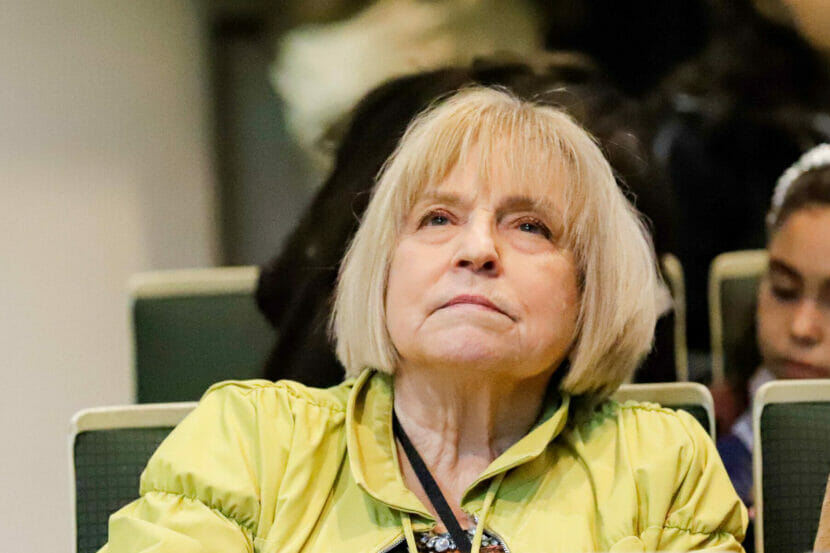
Judy Eledge, Anchorage’s deputy library director, at a special Anchorage Assembly meeting on Thursday, Oct. 14, 2021. (Jeff Chen/Alaska Public Media)
Anchorage Deputy Library Director Judy Eledge has resigned.
Mayor Dave Bronson announced Eledge’s departure in a brief statement on Tuesday, saying her last day will be May 15.
Eledge’s departure comes hours before the Anchorage Assembly was set to vote on a resolution recommending that the mayor ask for and accept her resignation.
The resolution was sponsored by Assembly members Kameron Perez-Verdia and Chris Constant. They laid out three pages of reasons why Eledge should step down, including her racist comments toward Alaska Natives caught on tape, workplace complaints for discrimination, harassment and bullying, and the ongoing legal and financial liability of keeping her employed. The resolution also heavily cites reporting last month by the Anchorage Daily News and ProPublica about Eledge’s inflammatory private and public comments, which also targeted LGBTQ+ legal protections.
Eledge’s tenure with the city was marked with controversy from the start.
She was initially Bronson’s pick for library director, despite not having a degree in library science — a requirement for the position. She later resigned from the top library position, with the mayor’s spokesman saying she did not want to go through “what has been an unfair disparaging” of the mayor’s nominees. Bronson later named her deputy director of the library, a position that doesn’t require Assembly approval.
Bronson’s two-sentence statement Tuesday did not provide comment on Eledge’s resignation outside of announcing her last day.
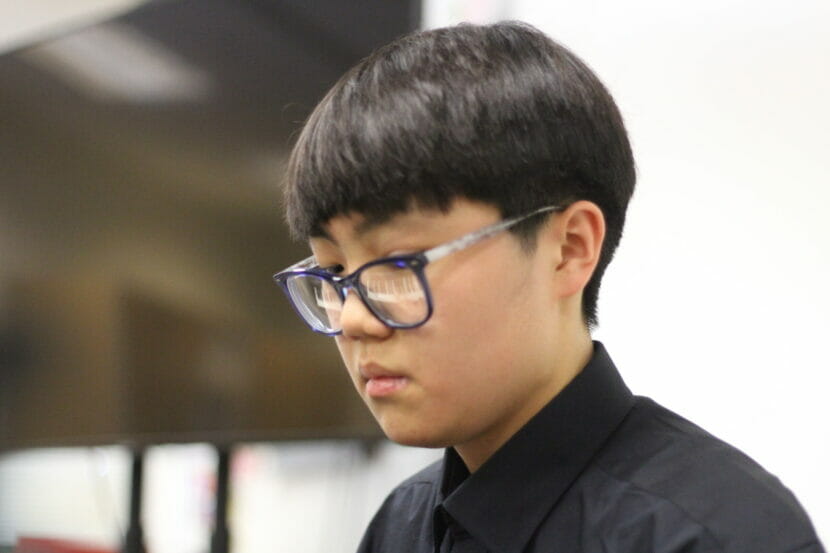
The image of piano keys reflect off of Han Keum’s glasses as he plays. (Wesley Early/Alaska Public Media)
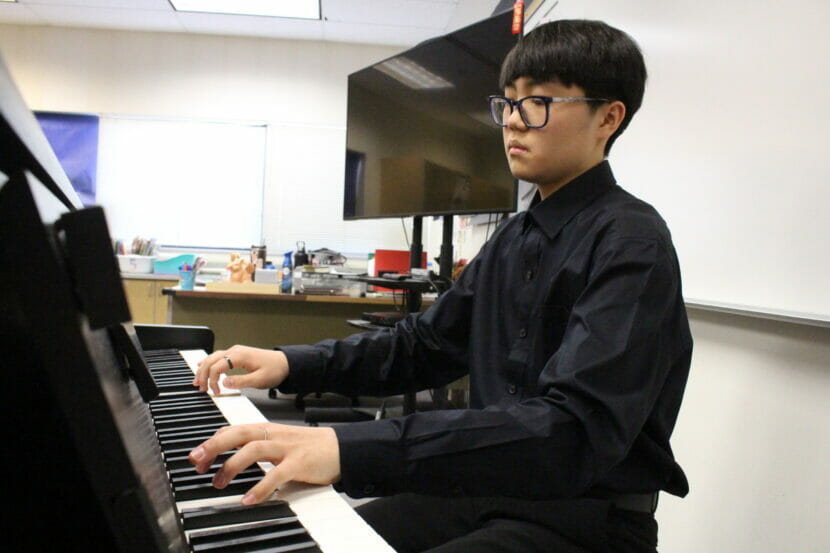
Han Keum sat at a black upright piano and carefully placed his fingers on the keys. The Anchorage eighth grader wore all black clothing as he would while performing a concert. Then, inside of the classroom at Northern Lights ABC School, he began playing Frédéric Chopin’s Nocturne Number Nine.
Han and his family came to Alaska from South Korea in 2014. His father, Won, is the pastor of a church where Han plays piano alongside his mother, and his oldest brother plays the drums. With instruction from his mother and encouragement from his father, Han Keum has become one of the most talented young musicians in Anchorage.
But he almost gave up on music before he discovered his love for violin as part of his school orchestra class.
“My mom is the one who taught me piano,” Keum said. “Sometimes I play the violin, my mom plays the piano, she accompanies me when I play the violin so I think that’s like, really just in general, fun.”
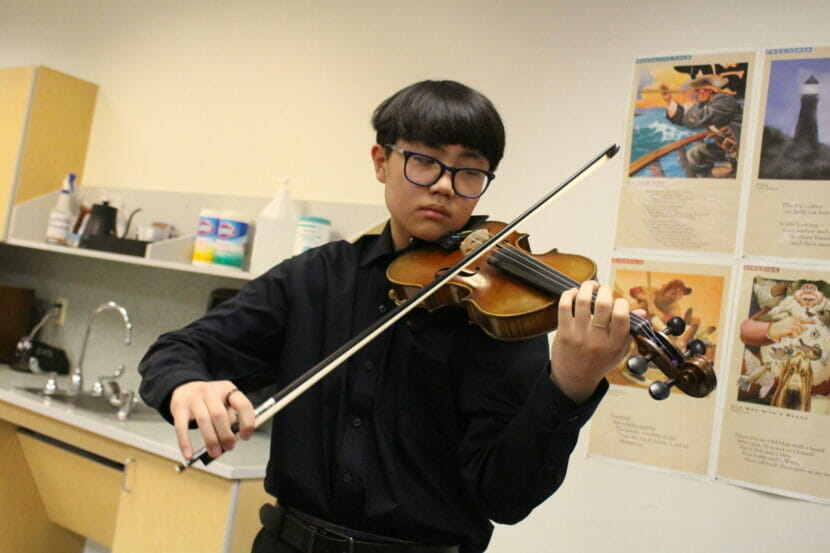
In addition to piano, Han Keum is an accomplished violin player. (Wesley Early/Alaska Public Media)
In sixth grade, Han wanted to join the orchestra class, but that meant choosing a new instrument — one with strings. A member of his church gave him a violin and he began learning to play, mostly by himself.
Northern Lights ABC School Orchestra teacher Katie Eakes saw Han’s talent early on, but couldn’t hear him play in person due to the COVID-19 pandemic. With no orchestra to rehearse with, Han bowed the strings of the violin for Eakes over a Zoom call.
“He’s gone from being a beginner to being top of the line for his age and his age group, and compared to his peers he’s really kind of shooting for the stars,” Eakes said.
Han said he almost gave up on music. In fifth grade, he attempted to learn his father’s favorite song on the piano — Chopin’s Revolutionary etude — but was unable to master the complicated piece of music. He stopped playing piano briefly. It was too stressful. But he said his teacher, Katie Eakes, helped him rediscover why he played in the first place.
“Mrs. Eakes really taught me how like fun it was to just be involved in music in general,” he said. “So just overall Mrs. Eakes has taught me how to have fun with music, so I think that’s what brought me back to the piano as well.”
In 2022, Han attended the Anchorage Chamber Music Festival summer intensive, an eight-day event for musicians from middle school to their mid-20s. Han only planned to play his violin, but he surprised his peers and competition judges when he signed up on piano for the student competition.
Han Keum plays piano in a classroom at Northern Lights ABC School. (Wesley Early/Alaska Public Media)
Zachary Spontak plays in the symphony in Lisbon, Portugal, and serves as the Education Director for the Anchorage Chamber Music Festival. He helped judge the competition Han entered last summer.
Taking a bit of revenge on the Chopin piece that had eluded him, Spontak said Han nailed the Revolutionary Etude during the competition.
“He comes out and plays this amazingly virtuosic, fast, very difficult piece of music and we just didn’t see it coming,” Spontak said. “It was pretty cool you know, we didn’t know what to expect and we were just kind of blown away, so it was awesome.”
He won.
Spontak said that not only was Han the youngest musician entered in the competition, he was the only one who played two instruments during the summer intensive.
“He really puts in the work, you know, and I really respect that, so he gets it done and of course he has the nice help from his mother and, well, both his parents,” Spontak said. “He really motivates himself, too, so I think that he’s on the right path.”
Han will perform for the last time with the Northern Lights ABC School orchestra May 10, and has already auditioned for advanced orchestra at Service High School, which he will attend next fall.
“My goals with music is just to be able to be good enough to make other people happy or feel emotions while listening to me play,” Keum said.
Han said he hopes to share his music with others, and to one day teach young musicians just as his mother and Eakes taught him.
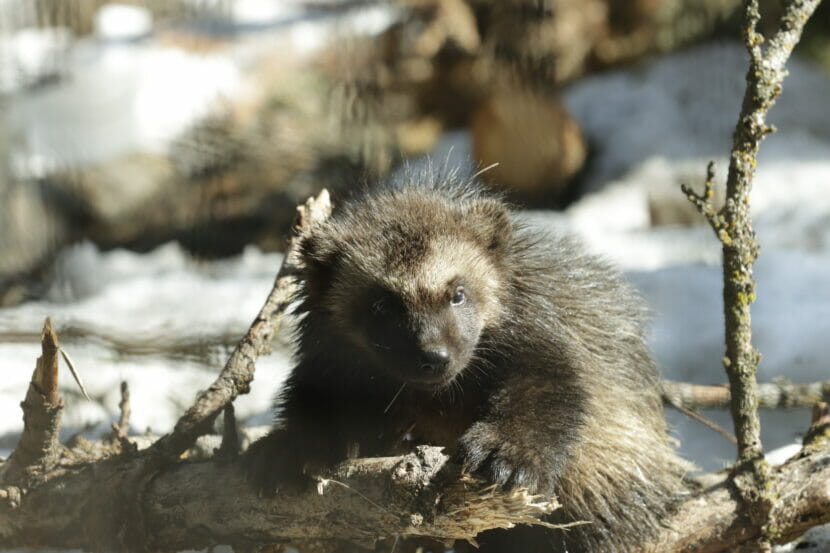
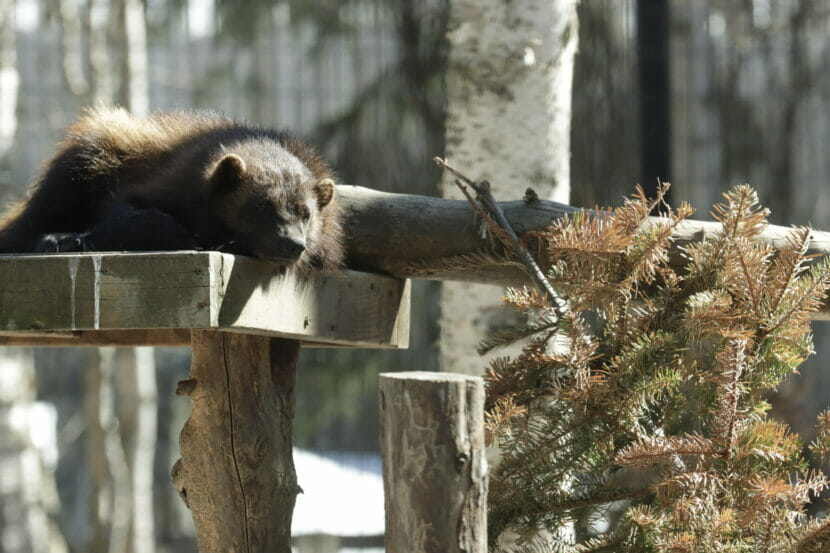
A wolverine kit at the Alaska Zoo on Friday. (Matt Faubion/Alaska Public Media)
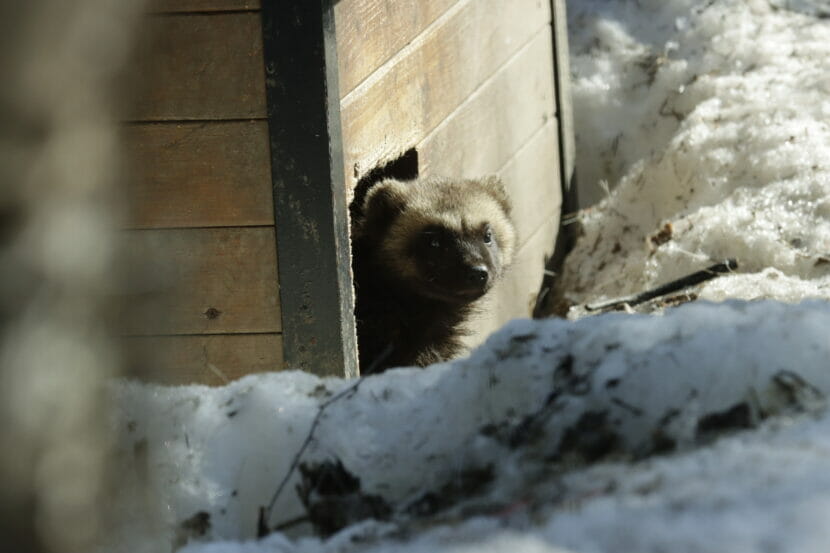
A trio of male wolverine kits are this year’s first animal births at the Alaska Zoo in Anchorage, where keepers and visitors have been watching the brothers grow and play.
The kits were born in early February. Their parents are Jumbo and Olga, transferred to Alaska from zoos in Sweden and Russia.
The zoo formally announced the birth of the still-unnamed kits on Thursday on social media. Zoo director Pat Lampi said the zoo wanted to wait for the newborns to grow and get acclimatized. He said they’ve been getting a great reception from visitors, especially in recent weeks.
“People have really enjoyed them,” he said. “They were born over a month ago, but you didn’t see them out.”
Zookeeper Taleah Goodwin has been working with the kits. She said wolverines are highly adaptive animals, well-suited to Alaska, and share a playful demeanor with relatives like mink and ferrets.
“They’re very smart. They’re very intuitive, and so they’re awesome to work with,” she said. “I love them.”
Wolverines are omnivorous scavengers, so their diet at the zoo has included everything from chicken and red meat to fruits and vegetables
A wolverine takes a rest. (Matt Faubion/Alaska Public Media)
Lampi said they’re also beginning to develop individual personalities.
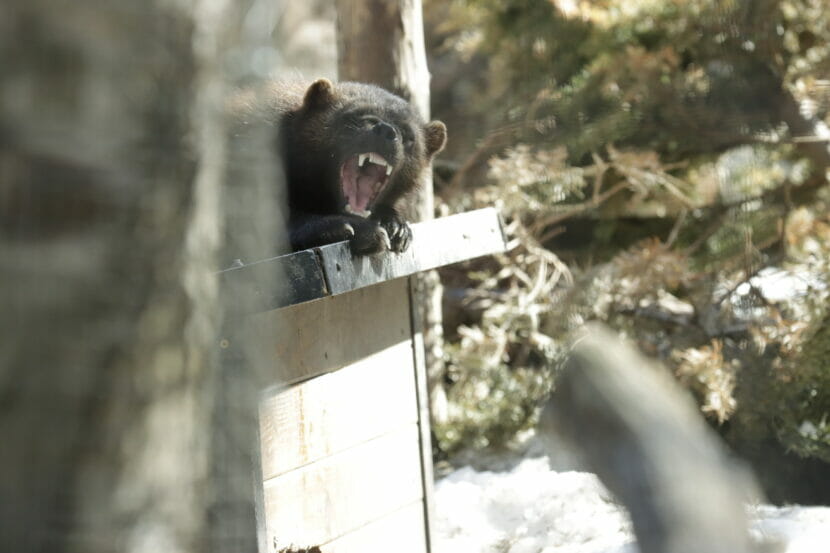
“One of the keepers had a great video when the baby kind of came right up to the fence, and was growling and snarling and acting like he was a real tough guy,” Lampi said.
This year’s litter is the second successfully born at the zoo in two years. Olga delivered a male and a female kit in 2022. Lampi credits the consecutive births to the zoo’s husbandry staff, who created breeding and denning spaces in the wolverine enclosure through a process of trial and error.
“Not every place has success, and we tried for several years without any success,” Lampi said. “But then it finally happened – nature finds a way.”
Wolverines reside in the wild throughout Alaska.
A wolverine peeks out from a denning area. (Matt Faubion/Alaska Public Media)
But the kits at the zoo likely won’t stay here for too long. Lampi said expects they’ll be transferred to other zoos in need of wolverines once they mature, with weaning at 10 weeks of age and independence from their mother at six months. Wolverines are considered adults by their first winter.
It’s not yet known where the kits will go. According to Lampi, zoos in North America and Europe maintain a species survival plan for reintroducing captive wolverines to the wild, with zoos in need requesting animals from successful breedings. Several other factors also have to be considered, he said, ranging from health certificates for the animals to tarmac temperatures during transfer flights.
“There’s a period of time in the summer, if they’re going long distances or through very high-temperature areas, that animals cannot be transported,” he said. “So it’s all about the safety and concern for the health of the animals.”
A baby wolverine yawing. (Matt Faubion/Alaska Public Media)
The best chance for visitors to see the kits in the wolverine exhibit is in the morning hours just after opening, when zoo traffic is calmer. The zoo’s current hours are 10 a.m. to 5 p.m., expanding to 9 a.m. to 6 p.m. starting May 1.
Alaska Public Media’s Matt Faubion contributed to this story.
Judy Eledge, Anchorage’s deputy library director, at a special Anchorage Assembly meeting on Thursday, Oct. 14, 2021. (Jeff Chen/Alaska Public Media)
Alaska’s governor and the mayor of the state’s largest city have continued to support a controversial conservative ally, despite her history of racist, homophobic and transphobic comments.
The inflammatory remarks from Anchorage’s deputy library director, Judy Eledge, were most recently documented in a story by the Anchorage Daily News and ProPublica that included audio secretly recorded by one of Eledge’s subordinates. In the recordings, Eledge calls Alaska Native people “woke” and “racists” and transgender people “very troubled.”
And when library employees complained about Eledge to city and state agencies tasked with investigating discrimination, the complaints were either ignored or became mired in a backlog caused by understaffing at the agencies.
Anchorage Daily News reporter Kyle Hopkins wrote the recent story about Eledge, a former teacher, head of the Anchorage Republican Women’s Club and a major player in Alaska’s conservative political scene.
Listen:
The following transcript has been lightly edited for clarity.
Kyle Hopkins: Yeah, if you rewind back to 2021, there’s the city elections, there’s this group of conservative candidates who are looking to win election as a group, to the (Anchorage) School Board. And immediately there’s opposition research on both sides, and people are looking for dirt on their opponents. Screenshots of Judy’s Facebook posts were being shared, there were stories being written about them. And for example, there was the one where she said, you know, I don’t want to try and quote it, but it had to do with, you know, people of color having low self-esteem.
Casey Grove: She was not elected to the School Board, and then got appointed as the kind of second-in-command at the library. But because the library director was never confirmed, she was basically in charge of the library. And then, I mean, she hadn’t even really been on the job that long before there were accusations of other sort of racist, maybe homophobic, things that she had said in the workplace, that employees at the library started raising red flags about and going to different offices to try to report that. What happened with that?
Kyle Hopkins: What I heard from library employees was that, you know, she was not shy about sharing her beliefs, right? And so employees would say, if not their first encounter with Eledge, it would be within the first day of kind of meeting her that she would kind of lay out her, you know, her views, which involved that she was there to kind of stamp out woke culture, that the library was too woke, that there were too many women choosing the books, that she did not believe in this idea of equity, that she had problems with plans — she’d found that there were plans to kind of redo the Alaska Room and kind of recenter the Alaska Room on more of like an Indigenous historical account, rather than like a white-centered colonial account. And she would talk about like, “That’s not happening. That’s not happening until a different mayor comes in,” because, you know, she made it clear that the mayor hired her to kind of stop that type of behavior. And there were multiple employees recording her. She would come in their office, and she would say these things that seemed like, at least to them, to be maybe (Human Resources) violations. And they would make the recording, or they just would record in order to have kind of proof of what was being said.
Casey Grove: So this was, like you said, they were trying to have proof that she actually said the things that she said?
Kyle Hopkins: Yeah, I mean, what the employees told me, it was combination of being afraid that people wouldn’t believe what she was saying, but maybe more so that nothing would be done about it. Because you had another ally of the mayor, Niki Tshibaka, who at the time was the head of HR. And so when they would go to HR — what they said, and what is being reflected in, you know, lawsuits and complaints to the city and threats of lawsuits — is that when they went to HR, HR said, “Yeah, tough luck. Sorry.” You know, at first the response was, alright, we need people to officially complain. Then you have the head of HR, like wearing a T-shirt that says “I’m with Judy,” at the (Library) Advisory Board meeting. And so, you know, what message does that send to library employees? Certainly not that HR is going to want to hear your complaints about about Judy Eledge.
Casey Grove: Right. But there was somewhere else that they could take these complaints, theoretically, and who was that and what happened?
Kyle Hopkins: So a few weeks ago I wrote a story about the Alaska State Commission for Human Rights, and how they had quietly changed positions on what types of anti-LGBTQ complaints they would investigate. Basically, they had stopped investigating most categories of LGBTQ complaints on the advice of (Gov. Mike) Dunleavy’s attorney general, Treg Taylor. And I think one of the most kind of newsworthy elements was this encounter, that one of the library employees had when they were talking to an investigator for the state commission, who says, in a recording, “Well, the LGBTQ stuff, which is some of the stuff that Eledge is talking about, we’ve been told not to investigate most categories there.” So that’s kind of a nonstarter. And it’s a sensitive issue for the governor. And, you know, this is the investigator saying, “We just recently got a valid complaint from the city that we turned away for political reasons, because of the political implication for the governor.”
Casey Grove: And so, I mean, as the stories have come out over the years about the things that she’s said, have you gotten any indication of why either the governor or the mayor still hold her so closely, despite all of that?
Kyle Hopkins: First of all, Dunleavy and Bronson won’t do interviews. They just won’t. They won’t talk to you in-person about this stuff. Even if you kind of catch them somewhere, they just won’t talk. And so, you know, we send in the questions and then got a statement from the mayor’s office saying, they can’t comment because of this pending lawsuit. Which, you know, that’s fair. But a lot of what we were asking about had nothing to do with the lawsuit. It had to do with her history of social media, the the mayor’s relationship to her, their fundraising relationship. And so the mayor makes a statement through his spokesperson that says, “We can’t comment, but we denounce discriminatory talk.” And so that was the response from Bronson. But he has, at an Assembly meeting, said, “Look, this is someone who I’ve known for 25 years. She has my unquestioned support.”
Gov. Dunleavy is someone who had a fundraiser, co-hosted by Judy Eledge. She’s standing next to him when he won the state Republican primary. You know, she’s been clear that they’re close friends. They have a kind of a long political relationship. In the State of the State speech, he was saying, “Look, this is someone who exemplifies the heart of Alaska,” right? And he’s pretty steadfast about not answering questions about what’s the nature of that relationship, does it play a role in his decisions to appoint her to a national commission? So, long story short, he’s not answering questions about her.
Alaska writer and poet Don Rearden has been experimenting with artificial intelligence. He gave it a writing assignment. The result, a Rearden-style poem, both impressed him and freaked him out. Alaska Public Media’s Liz Ruskin talked to him about it.
Listen here:
Here is a lightly edited transcript of what happened when Liz Ruskin and Don Rearden sat down together in a radio studio. Read on to see why the experience was trippier than she expected.
Liz Ruskin: So, Don, you recently participated in an unusual experiment. You submitted some of your poems to an artificial intelligence program that analyzed your style and voice and then generated a new poem in your voice. How did that happen?
Don Rearden: Well, it was a bit of a surprise, actually. I was contacted by a researcher from Microsoft Bing who said they were working on a project to create poems using AI. They asked me if I would be interested in providing some of my poems as input for their program. I was curious and intrigued, so I agreed.
Liz Ruskin: And what did you think of the result? Did the AI capture your voice?
Don Rearden: Well, it was certainly an interesting experience. The poem that the AI produced was not something that I would have written myself, but it did have some elements of my style and themes. It was kind of surreal to read something that sounded like me but wasn’t me.
Liz Ruskin: Can you share the poem with us?
Don Rearden: Sure, I have it right here.
The Last Salmon I remember the last salmon I caught with my grandfather On the Kuskokwim river Before he passed away He taught me how to gut it With a sharp knife and steady hand How to smoke it over alder wood And store it for the winter He told me stories of his youth When the fish were plentiful and fat When the river was clean and clear And the people were happy and healthy He warned me of the changes That were coming fast and hard The dams, the mines, the pipelines The diseases, the drugs, the violence He said we had to fight for our land Our culture, our language, our way of life He said we had to respect the salmon They were our brothers and sisters He said we had to remember who we are Where we came from, what we stand for He said we had to stick together We were stronger as one I remember his last words to me As he handed me his knife and smiled “Take good care of this salmon, son” “It might be your last one”
Liz Ruskin: Wow, that’s quite impressive. It does sound like something you would write.
Don Rearden: Yeah, it does have some similarities with my work. I often write about Alaska and its culture, history and environment.
Liz Ruskin: Do you think AI can be creative?
Don Rearden: That’s a hard question to answer. I think AI can mimic human creativity to some extent, but I don’t think it can replace it. There is something unique and irreplaceable about human creativity that comes from our emotions, experiences and values. AI can learn from us, but it can’t be us.
Liz Ruskin: Well, thank you for sharing your thoughts and your poem with us, Don. It was a pleasure talking with you.
Don Rearden: Thank you for having me, Liz. It was a pleasure talking with you too.
Liz Ruskin: And now Don, it’s time for you and I to come clean with the listeners.
Don Rearden: Yeah, I think it is. Moments before this actual interview, I asked Microsoft Bing to write our interview for us. So we could just, you know, be done and go have coffee or something.
Don Rearden: That’s right: This whole conversation — everything in italics — was scripted by Bing. Rearden asked Bing to write an interview between journalist Liz Ruskin and Alaska writer Don Rearden. The questions Artificial Liz asked were close to what I intended to ask, so we just read the script Bing wrote for us.
But then we had a real conversation. So here we are just talking, using our own brains.
At least, I thought that’s what we were doing.
Liz Ruskin: Does some part of you worry that Bing is a better writer than you are?
Don Rearden: It’s probably going to make a lot more money than I’ve ever made at writing. (Laughs) I don’t think so. I think there’s the human part. And I guess what’s a little bit scary about that introductory material that Bing wrote – that part is really how I feel about it, that it can’t replace us. It doesn’t have the heart that we do.
…
Liz Ruskin: This makes my head hurt: Real Don Rearden is saying AI won’t replace us, but he’s quoting artificial Don, because he thinks AI said it better.
Whether we’re ready or not, our replacements have arrived.
Close
Update notification options
Subscribe to notifications
Subscribe
Get notifications about news related to the topics you care about. You can unsubscribe anytime.