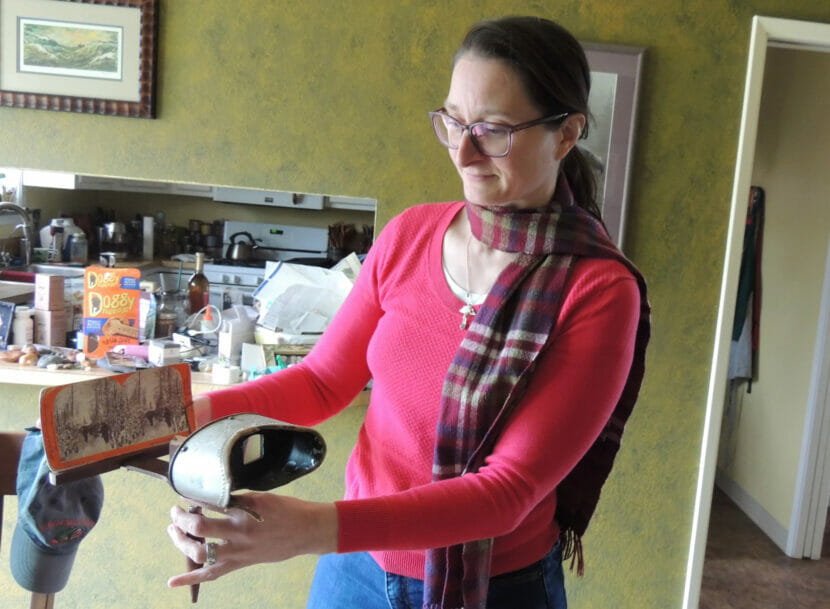
Sarah Pyhala demonstrates use of her stereograph. (Riley Board/KDLL)
Thousands of Alaskans will flock to Anchorage in July with art, dishes, clocks and jewelry in hand, hoping to find out if their personal treasures are secretly valuable. The popular PBS program Antiques Roadshow is coming to Alaska for the first time ever this summer, and some locals plan to present their items to professional appraisers.
One of those hopeful collectors is Kenai local Sarah Pyhala, who is bringing the appraisers a family heirloom, and some art.
“It sounded like their interest was in things that made it to Alaska, from people who were traveling, or moving up here,” she said.
The process for getting a spot on Roadshow required antiquers to enter a lottery, which Pyhala did in January. Each ticket holder can bring two items, or sets of related items called lots.
“And then there are 3000 people that have been awarded tickets, and you can each bring two items,” she said. “So there’s up to 6,000 items that they may be appraising that day.”
Pyhala has picked out two lots: her first is a pair of paintings from Japan, done on silk and framed under glass.
Japanese paintings Pyhala is planning to get appraised. (Riley Board/KDLL)
“I remember them being on the wall of my neighbor’s house growing up, and she would have me over for tea and cookies, and I would see them. And when she moved out of her home, her estate sale basically had them up for I think $10. And my mom was over there and she purchased them,” she said. “So it will be interesting to see what, if anything, they’re worth.”
The second item is a stereograph, an antique piece of entertainment technology. It’s like a viewfinder, and the user places a slide with a duplicate image in front of a pair of goggles, which makes the image appear 3D.
Pyhala’s antique stereograph and “Brush” Alaska slide. (Riley Board/KDLL)
The stereograph, patented in 1904, was passed down to Pyhala through her family.
“My great grandparents lived in North Dakota, and during the dust bowl era they were farmers. In 1933, they took their horse-drawn carriage, loaded it up with their four kids at the time, and moved from central North Dakota into Minnesota. This is one of the things they brought with them, which I thought, of all their worldly possessions, was kind of a strange thing to take with them,” she said. “But I’m told that it was similar to a television for them, and it was their entertainment. So in that regard, it made a lot of sense that they would have taken it with them.”
Her stereograph comes with 67 slides, with an array of scenes from places like Rome, Monte Carlo and the U.S. Capitol. One of the slides features what was at the time called “Brush Alaska” and shows men in snowy woods in rural Alaska in 1900, which Pyhala hopes the appraisers will like at the Roadshow.
But she doesn’t have any illusions about her lots being highly appraised — she’s just happy for the chance to go. She said the antique owners will show up in waves early in the morning on July 11 and stand in long lines, waiting to be assigned to one of 20 appraisers.
“If they think that what you have is notable, they’ll take you aside and you have to go through a whole makeup change for the filming,” she said.
Because of the long day of standing, Pyhala said it’s difficult to have a heavy item that you might have to lug around for hours. But with her lightweight items, she’s not too worried about her stamina.
She said she’s been watching old episodes of the show to figure out what to wear. It might be for naught, though: of the 3,000 attendees, only about 50 end up on TV.
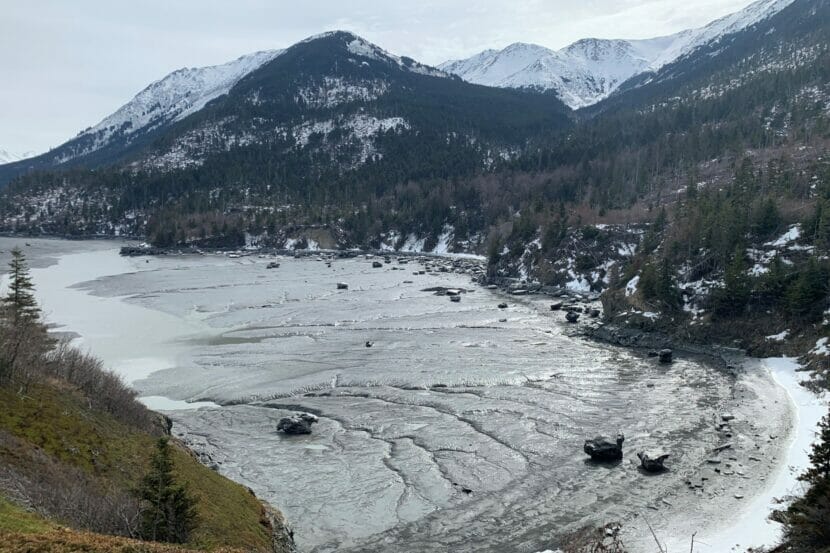
A section of coastal area near Hope, as seen from the Gull Rock Trail in 2020. (Tegan Hanlon/Alaska Public Media)
A 20-year-old Illinois man trapped in Turnagain Arm mud near Hope died Sunday, Alaska State Troopers said.
According to a dispatch posted Monday morning, word reached troopers just before 6 p.m. that Zachary Porter was stuck in the tidal mud flats. Troopers, as well as Hope and Girdwood firefighters, responded to the call.
“Rescue efforts were unsuccessful, and (Porter) died at approximately 6:43 p.m. after being submerged by the incoming tide,” the dispatch said. It said rescue teams recovered Porter’s body around 6 a.m. Monday.
Troopers were gathering further details on the call Monday morning. Firefighters didn’t immediately return calls requesting additional information.
Quicksand-like mud along the arm can rapidly trap unsuspecting beachgoers, and sporadic cell phone reception can keep people from calling 911.
Porter’s death comes two weeks after fire crews saved a hooligan fisherman from the mud near the mouth of the Twentymile River. Firefighters also saved a surveyor trapped up to his waist near Tidewater Slough in November. Both rescues involved the use of a special tool, which can inject air and water into the mud around a person.
Responders have urged people to travel in groups on the mud, so someone can go for help if a member of the group gets stuck, and avoid remaining in one spot for long.
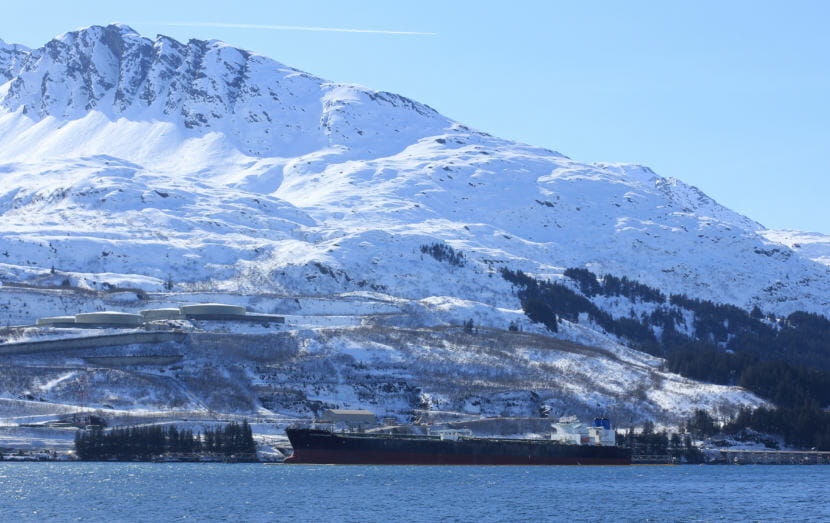
An oil tanker docked at the Valdez Marine Terminal in April. (Photo by Elizabeth Harball/Alaska’s Energy Desk)
The Valdez terminal of the Trans-Alaska Pipeline System is at “risk of a serious accident or incident in the near future.” That’s a main takeaway of a sweeping 180-page report that was published in April, detailing wide-ranging safety concerns at the Valdez Marine Terminal, where North Slope crude is loaded onto ocean tankers.
The Alyeska Pipeline Service Company says it’s taking the report seriously, but coastal communities say time is of the essence.
Early last year, an Alyeska employee working at the Valdez Marine Terminal — which is the southern end of the trans-Alaska pipeline — reported smelling fumes. Heavy snow had damaged oil storage tanks at the facility — venting petroleum vapors into the atmosphere.
“It was noticed by an employee at Alyeska that was walking around, happened to smell toxic fumes coming out of the tanks,” said Wayne Donaldson, the city of Kodiak’s representative on the Prince William Sound Regional Citizens’ Advisory Council, or PWSRCAC.
The advisory council is one of two federally mandated oil spill prevention groups formed in response to the 1989 Exxon Valdez spill, which saturated more than a thousand miles of Alaska’s coastline – including Kodiak Island’s shores – in oil.
Donaldson is one of 19 members of the group and has served on the council for eight years. The federal Oil Pollution Act of 1990, which was passed after the Exxon Valdez oil spill, also led to the formation of the Cook Inlet Regional Citizens Advisory Council.
He said after the incident at the terminal last year, more Alyeska employees started contacting the group.
“And as time went on, more people started coming to us giving safety concerns, as well as retired people from Alyeska,” Donaldson said.
The advisory council commissioned a review of safety practices at the terminal last summer in light of the complaints. And a final report was published last month.
It encompasses nearly 200 pages of major safety concerns at the Valdez Marine Terminal: equipment the report calls “aging and obsolete;” a work culture that includes retaliation among employees, mismanagement and turnover; and shrinking federal and state budgets that have decreased regulatory oversight.
In response to the report, the advisory council sent letters to lawmakers – including Gov. Mike Dunleavy and Alaska’s congressional delegation – citing the need for federal audits of the terminal by the Government Accountability Office and the Occupational Safety and Health Administration.
The report was prepared by corporate safety consultant Billie Garde, who has worked both with Alyeska and BP in the past. Harvest Alaska, a Hilcorp subsidiary, ConocoPhillips and ExxonMobil all own portions of Alyeska Pipeline, which operates the terminal.
“We don’t agree with everything in the report, but we do take it as an opportunity to improve,” said Michelle Egan, Alyeska’s chief communications officer.
Egan is also from Kodiak, and she says she – like many others at Alyeska – is acutely aware of what an oil spill does to coastal communities. She said Alyeska has formed a management team to work on an action plan in response to the report.
Much of the report, however, comes directly from Alyeska staff — many of whom said they think a “serious incident is imminent.”
Brooke Taylor is the director of communications for the Prince William Sound Regional Citizens’ Advisory Council. She said the internal knowledge of problems at the terminal is one of the biggest weaknesses identified in the report.
“There wasn’t any substantive information in the report regarding safety or process safety issues that wasn’t already available to Alyeska,” said Taylor.
About 4% of the nation’s crude oil departs from the Valdez Marine Terminal, a percentage that could swell in the coming years as oil from the recently approved Willow project makes its way down the pipeline.
Taylor said an incident at the Valdez Marine Terminal has the potential to be environmentally devastating, and it threatens one of the state’s main sources of revenue.
“For us, it’s not pro or con industry, it’s — if oil is going to be transported through our region, we want it done as safely as possible,” she said.
Alyeska hired a new chief executive officer the same month the report came out, former BP executive John Kurz. Egan said he’s met with members of the group several times since then.
“He wants to work with [PWS]RCAC and with our employees to make this the safest environment we can possibly have,” she said. “So, I think that commitment has been clear. He’s communicated that repeatedly to our workforce, and to all of our stakeholders.”
The advisory council’s Taylor agrees that Alyeska has responded quickly to the report, and understands changes at the terminal won’t happen overnight.
“Time will tell on what actions are done. So, we know our biggest successes have always happened when industry regulation and citizen groups work together. And so we are hoping this will be another example of that,” Taylor said.
Wayne Donaldson said he’s also encouraged by Alyeska’s initial response to the report. But it’s been more than 30 years since the Exxon Valdez oil spill – he worries that the biggest challenge now is time and complacency.
Exploratory work at Johnson Tract, on the west side of Cook Inlet. (Courtesy of HighGold)
Plans to build an underground gold mine at the base of Mt. Iliamna have been in the works since the 1980s. Now, a Canadian mining company and the Alaska Native corporation that owns the land are in the advanced stages of exploring the area to see if it could be a viable project.
While HighGold, the mining company, says they’ll be careful about potential development on the land — which is inside a national park — not everyone is convinced. Although the project is still in early stages, environmental groups and the owners of the nearby historic cannery are raising red flags.
The site of the proposed project, called the Johnson Tract mine, is located 10 miles inside the boundary of Lake Clark National Park and Preserve, on the west side of Cook Inlet, on a 20,000-acre parcel of land owned by the Cook Inlet Regional Native corporation, or CIRI. The corporation picked that plot in a 1976 land exchange because of its resource extraction potential and benefit to shareholders.
Darwin Green is the CEO of HighGold. He said even though his company knows the tract contains rich deposits of gold, copper and zinc, it’s doing studies now to see whether the project makes economic sense. Deposits there were found decades ago.
“It was discovered in the early 1980s, and then advanced through the mid-1990s,” Green said. “There was an operator at that time that had a mine project elsewhere, and they were looking at just shipping the ore to that site to mill it and process it there. And that’s where it stopped, and it sat idle for 25 to 30 years until CIRI approached our management group.”
The project site is remote, and HighGold is applying for a permit to build an airstrip and an inland road that would connect the airstrip to the site. The company estimates the earliest it would begin underground exploration is 2025.
So far, the project has generally flown under the radar while more high-profile Alaska mine prospects, like Pebble Mine, have had the spotlight. Unlike the controversial Pebble project, Johnson Tract would be underground, not an open pit mine, which can release contaminants into the water and damage salmon habitat.
But local environmental groups have been keeping an eye on the project for a while now — including Homer environmental nonprofit Cook Inletkeeper, which first raised concerns about it in 2020.
“To get that ore out, you’re gonna have to go through the park lands, and you’re gonna have to open up the incredibly pristine and scenic and rich fish and wildlife area to industrial development,” said Bob Shavelson, who was Inletkeeper’s director at that time and penned the concerns about the project.
Another group, the National Parks Conservation Association, has been hosting biweekly meetings about the project for months, said Jennifer Woolworth, the Alaska program manager with the association. She said although the meetings were originally a time set aside to talk about Pebble Mine, they’ve evolved into discussions about the potential harms of Johnson Tract.
She said the group is concerned about the impact of possible contamination and the effects of development on local wildlife, including the highly endangered Cook Inlet beluga whale and brown bears. She pointed to research that shows one of the primary causes for brown bear decline is roads built for resource extraction projects.
Shavelson also raised concerns about HighGold because it’s a spinoff of Constantine Metals, the company behind a controversial Haines mining prospect. Many locals have also been rubbed the wrong way by comments CEO Darwin Green made about the state, where he described mining in Alaska as “going into a third world country with low hanging fruit,” but with first world regulations. Green said this quote has been taken out of context, and that he was promoting the high regulatory standards of mining in Alaska as an advantage in, “answering the world’s metal demands for a low carbon future.”
Green said environmental studies will be an important part of the project at every stage, and that the unique location of the project inside the national park is a critical consideration.
“We obviously want to be incredibly good stewards of the land where we operate, it’s part of our culture and philosophy everywhere we’ve been, but probably even more so now, given the optics,” he said. “It’s a really special place out there, and we’re well aware of that.”
Even though the land is inside a national park, it’s available for development because the tract has belonged to CIRI since the 1976 Cook Inlet Land Exchange. After land was allotted to Native corporations during the Alaska Native Claims Settlement Act, CIRI was disappointed with the economic possibilities for the lands they received. They selected this area because of its resource development potential, according to CIRI spokesperson Ethan Tyler.
“CIRI really strikes a balance between preserving its lands for future generations for shareholders and descendants with resource development,” Tyler said. “And the benefits to shareholders and descendants really comes down to sustainable development of resources that provide for the services and distributions that we provide to our stakeholders.”
In a summer job posting, CIRI says the company and Native corporation are prioritizing CIRI shareholders and their descendants for positions with the project.
Green said HighGold is working closely with CIRI to meet their interests, and that it was refreshing to be approached by a Native corporation interested in developing their resources.
“The economic benefits from that development will flow directly to Alaskans, it’s gonna flow really, directly to Indigenous Alaskans who are shareholders, and that’s something to feel good about,” he said. “That’s something Alaska should feel proud about.”
(The Snug Harbor Cannery on Chisik Island. (Courtesy of Snug Harbor Outpost)
But not everyone is convinced the project would be good for business.
Abe Porter is one of the owners of the old Snug Harbor Cannery on the west side of Cook Inlet.
“My family and I bought it in the early 2000s. I grew up there, my dad grew up there commercial fishing for the cannery, when it was a fully functioning cannery, my grandpa started fishing there in I believe the ’30s,” Porter said.
The cannery opened in the early 1900s and operated first as a razor clam and then salmon cannery until 1980, when it closed and sat vacant for decades. The Porter family has been working to restore the complex over the past 20 years, and recently reopened it as the Snug Harbor Outpost, an ecotourism lodge for visitors interested in bear viewing and fishing off remote Chisik Island.
“We’ve sunk everything into this. It’s my brother and I’s dream,” Porter said.
He said the proposed mine project would directly impact what his family has worked to create at the cannery. He also said the bay is too shallow for large boats, so HighGold would need to build a long dock out into the water of Tuxedni Bay. Green said the project is in too early of the stage to be looking at this type of infrastructure, but confirmed that if HighGold goes through with the mine, a dock or loading facility would be necessary.
Porter is also worried about the fate of commercial salmon fishermen on the west side of the Cook Inlet, and how the mine could impact the value of existing fisheries — regardless of the protections put in place.
“All of the fisheries have a reputation, and that reputation dictates the popularity of it,” he said. “If people hear that there’s a big gold mine, for commercial fishermen the price of fish goes down. For sports fishermen, less people want to come here.”
Proponents of the project say it’s too early to have concerns, since all of its parts and pieces remain hypotheticals, for now. Porter said that’s part of his worry — that the company will keep putting off public concerns until it’s too late to stop the project.
Green said HighGold will continue to study the site and conduct environmental studies there this summer.
Jade T. Wren, Service High School graduate, walks on stage to recieve her high school diploma on May 18, 2023. (Mizelle Mayo/Alaska Public Media)
Anchorage School District students no longer have to wear a typical cap and gown to their high school graduation. Now, they can wear any form of cultural regalia.
Jade Wren was among the students who graduated this week and took advantage of the updated policy. She’s Inupiaq and spent time growing up in Kotzebue and Dillingham. She walked across the stage at the Alaska Airlines Center Thursday wearing a Kuspuk, instead of the common graduation gown.
In the days leading up to her graduation, she said she felt proud that she could show her Inupiaq heritage during the ceremony.
“I will be going in a lot more confident and a lot more happy than just, ‘Oh, it’s graduation day, I’m going to grab my diploma and leave,’” she said. “It’s going to be a lot more, and also the stuff that I wear will be more memorable.”
Wren also wore sealskin slippers. Her graduation cap had sealskin and jade fastened to the top. And it was bordered with green and yellow beadwork — Service High School’s colors. Wren said Indigenous women in her life gifted her many of the items she wore.
“Just showing off who I am and my culture and also the people that again have helped me get to where I am,” she said.
Wren is one of about 8,000 Alaska Native students in the district.
Paul McDonogh, supervisor of the district’s Indigenous education program, said the Native Advisory Committee suggested the updates to the regalia policy, which allow students to ditch the traditional cap and gown. Also, they no longer need to get their regalia approved by staff. It’s the third time the district has revised the policy in five years.
“Our intention is to really allow traditional ceremonial expressions that groups of people have always done to celebrate rites of passage and to bring them here,” he said.
The district’s policy update also follows a parallel, statewide push to allow regalia at public ceremonies. The Alaska Legislature passed a bill in 2019 mandating that state agencies, universities and schools allow tribal regalia or objects of cultural significance at public events, including graduation ceremonies.
McDonogh said, as a result of the district policy, he has noticed students from different cultures taking an interest in learning more about their heritage and connecting with their elders and family members. He said the decision to drop the permission form for cultural regalia stemmed from a desire to build trust with students and families.
“There’s a spiritual impact of this that I think is really awesome,” he said.
Anchorage’s shelter at Sullivan Arena housed hundreds of vulnerable residents during the coronavirus pandemic. Nonprofit Bean’s Cafe managed the shelter under a federally reimbursed contract with the city, and reported millions of dollars in profits. (Lex Treinen/Alaska Public Media)
An Anchorage-based soup kitchen ran up huge profits during the pandemic courtesy of city contracts funded by federal taxpayers, including what city officials allege were hundreds of thousands of dollars in payments for services the organization never provided.
But the city’s efforts to resolve that billing dispute appear to have stalled, an investigation by Alaska Public Media and APM Reports has found.
Bean’s Cafe, a nonprofit, received nearly $15 million from city contracts to operate and serve meals at a massive, temporary homeless shelter in a municipal hockey arena during the pandemic.
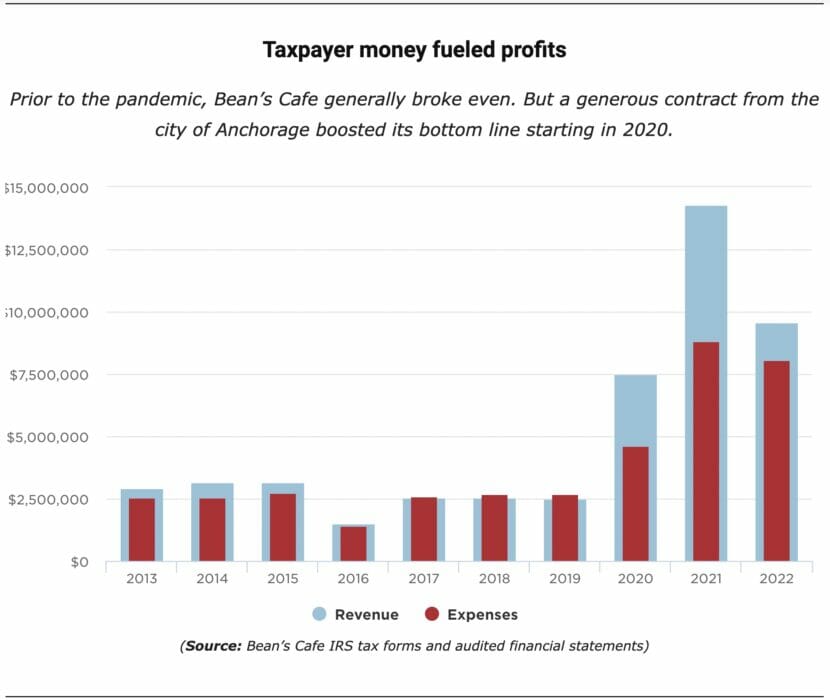
Bean’s, which previously ran a break-even operation, racked up nearly $10 million in profit between fiscal years 2020 and 2022, according to an analysis of its tax filings and financial statements. That money later helped it open a new commercial kitchen and warehouse that serves the needy.
While the organization saw increases in donations, government grants and a federal paycheck protection program loan that was forgiven, its contracts with Anchorage were by far the largest driver of the windfall. The revelations about the vast sums poured into the temporary shelter come at a time when the city is grappling with how to pay for permanent solutions to its persistent homelessness crisis.
The saga around the shelter contract raises questions about the city’s stewardship of federal money under Mayor Dave Bronson and two predecessors, whose administrations repeatedly extended Bean’s contract. It also exposes a level of infighting and enormous financial stakes in the city’s response to homelessness that has not been previously revealed.
Bronson, who ran on a promise to address the city’s homelessness crisis, fired the city employee who raised concerns about the charges incurred under Bean’s Cafe’s contract to run the shelter. That action, referenced in a scathing letter publicly released earlier this year by an attorney for former Municipal Manager Amy Demboski, was part of what Demboski alleged was a larger pattern of “illegal and unethical actions” under the Bronson administration during the mayor’s first 18 months in office.
A spokesman for Bronson’s office declined to address those allegations and offered no explanation for why it’s taken so long to settle the billing dispute with Bean’s. He also declined to say exactly how much money is at stake.
“The municipality and Bean’s Cafe continue to discuss the dispute over payment for services performed at the Sullivan Arena,” the spokesman, Hans Rodvik, wrote in an email.
Bean’s top executive didn’t provide much clarity on the state of negotiations, either.
“We provided the services, we’ve been paid and fully satisfied at this point,” Lisa Sauder, the organization’s chief executive, said in an interview. “I’m proud of the work that we and all the partners at the (city) did during that time.”
But, she added, “nothing’s perfect.”
Big bills, empty beds
In the spring of 2021, the Anchorage city employee overseeing Bean’s contract noticed something peculiar: The organization’s monthly bills to the city didn’t seem to add up.
Shawn Hays, who was the city’s mass care branch director, expected that the Sullivan Arena shelter’s cost would go down as winter ended and residents increasingly chose to sleep outside.
But instead, Hays said, Bean’s reported that the shelter remained virtually full.
There was big money at stake. Bean’s was paid a daily rate of $40.79 per client. If all 400 beds were occupied, that added up to more than $16,000 a day, plus payments for extras like security staff, supplies and laundry soap.
So, early one morning, Hays decided to count the number of shelter residents. That’s when she discovered that fewer than half the arena’s cots were occupied.
Shawn Hays was the city employee responsible for overseeing the shelter management contract with Bean’s Cafe. (Matt Faubion/Alaska Public Media)
Hays raised the issue with Bean’s, but the organization denied it was doing anything improper, according to a city document that summarized Bean’s response. Bean’s explained that it counted residents over a 24-hour period, not at a single point in time. Clients usually had to check in daily to retain their spots, but they weren’t required to actually sleep there under the terms of the contract.
In a subsequent letter to Bean’s, Hays marked that response “sufficient,” noting that she had “seen an improvement” in the numbers the organization was reporting. The average number of shelter residents Bean’s reported dropped by about 9% after she raised the concerns.
But Hays had other lingering questions about staffing levels, incomplete data and reporting of police calls, according to city correspondence with Bean’s that was released in response to a public records request.
In one case, Hays wrote that a Bean’s executive acknowledged the organization had shut down an in-house security program at the end of March 2021. But the nonprofit continued to bill the city some $130,000 a month for security in April and May, according to the correspondence.
After months of testy letters from its lawyers, Bean’s eventually provided documents to the city showing that Hays’ suspicions about the security fees were justified.
The documents showed it billed the city for more security staff than it actually provided.
“What business was fully staffed during COVID?” Sauder asked in an interview. “There was no business in the world.”
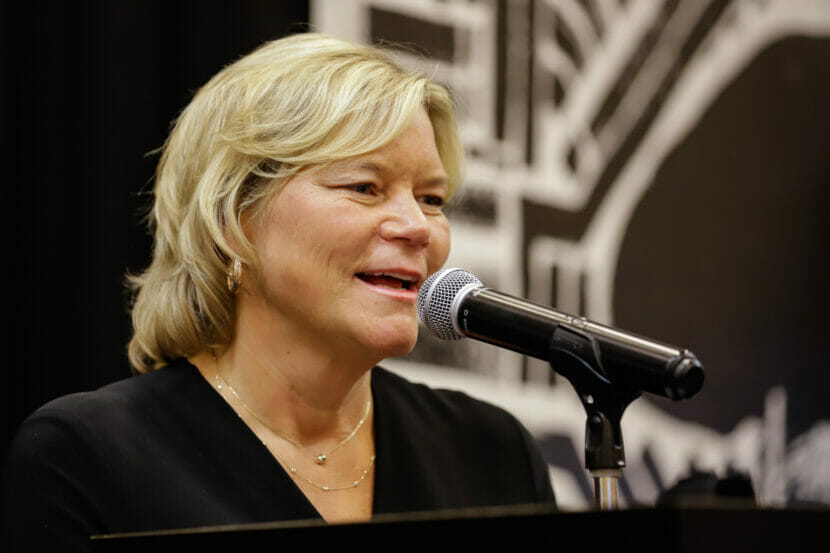
Lisa Sauder, CEO of Bean’s Cafe, speaks at the July 1, 2021 inauguration of Anchorage Mayor Dave Bronson during a breakfast fundraiser for Bean’s Cafe. (Jeff Chen/Alaska Public Media)
But Bean’s calculations suggested that the problem wasn’t as big as the city said. It submitted an internal audit showing that it billed the city for about $110,000 of security work that it didn’t provide — less than half the city’s estimate.
The dispute dragged on for several months, escalating to the point that the city withheld some $817,000 in payments that Bean’s said it was owed. An attorney for Bean’s even threatened to sue the city to force it to pay up.
Bean’s never filed the lawsuit, however. And even after the two sides hired a mediator more than a year ago, Bronson’s administration says it’s still trying to reach a settlement.
Rodvik, the mayor’s spokesman, would not release any details about how the city is working to resolve the dispute.
As of this March, the assistant municipal attorney assigned to the case hadn’t exchanged emails with Bean’s lawyers in nearly a year, according to a review of email records provided through a public records request.
From break-even to bonanza
Bean’s Cafe has been serving residents of Anchorage experiencing homelessness since 1979.
Before the pandemic, it operated a smaller, seasonal homeless shelter during the winter. But its core business was running a soup kitchen that provided free meals to hungry Anchorage residents.
As the coronavirus pandemic loomed, city officials knew they needed more public shelter space to ensure guests’ safety, given that the virus could spread easily in close quarters.
They picked Sullivan Arena — a 100,000-square-foot, heavily-used, city-owned indoor rink and event space — and they asked Bean’s Cafe to operate it. (The city also hired Bean’s to operate a second, neighboring rink, Ben Boeke Arena, as a shelter during the first year of the pandemic before operations were consolidated at Sullivan Arena.)
Because the city determined there were no other available vendors, it hired Bean’s without a competitive bidding process, amending a pre-existing contract to cover the much larger shelters at the arenas.
The cost was steep: Bean’s maximum monthly payment rose more than tenfold, to $889,000 from $74,000, even though the maximum number of clients it would serve rose by far less, to 480 from 150. The bill would ultimately be covered by the federal government.
“I know it seems like a big number, but it was like going to a different planet,” said Robin Ward, who was working as the city’s real estate director and helped negotiate the contract. “We didn’t know what we were getting into, and they certainly didn’t. The risk was great.”
Ward said the hockey arena was a “vastly different environment” from the far smaller shelter Bean’s ran previously, requiring a much larger staff. Sauder said the organization went from 47 to 197 employees in just a month and a half.
“No one knew what was going to happen in the next 30 days, 60 days, three years,” Sauder said.
For most of the last decade, the organization’s yearly revenues maxed out at about $3 million. Sometimes Bean’s ran a small surplus, sometimes a deficit, but revenue generally matched expenses in the years before the pandemic, its tax forms show.
With the opening of the Sullivan shelter in 2020, Bean’s revenues more than doubled, to more than $7 million. In 2021, they rose to more than $14 million, driven largely by its city contract, before falling to $9.5 million in 2022.
Bean’s expenses grew at a far more modest rate during those years. As a result, the organization turned a profit of $9.8 million during its three fiscal years ending June 2022, its tax forms and financial statements show. The biggest driver of those profits were the city contracts.
Other government programs also bolstered Bean’s bottom line, including more than $2 million in federal grant revenue in fiscal year 2022 and more than $500,000 from a federal paycheck protection program loan that was forgiven in fiscal year 2021.
Sauder acknowledged the contract paid Bean’s more money than it cost to run the shelter. But she justified that by saying the organization faced uncertainties launching a massive new shelter during the pandemic.
“Our organization, as a grassroots, independent organization, took on huge risk,” she said.
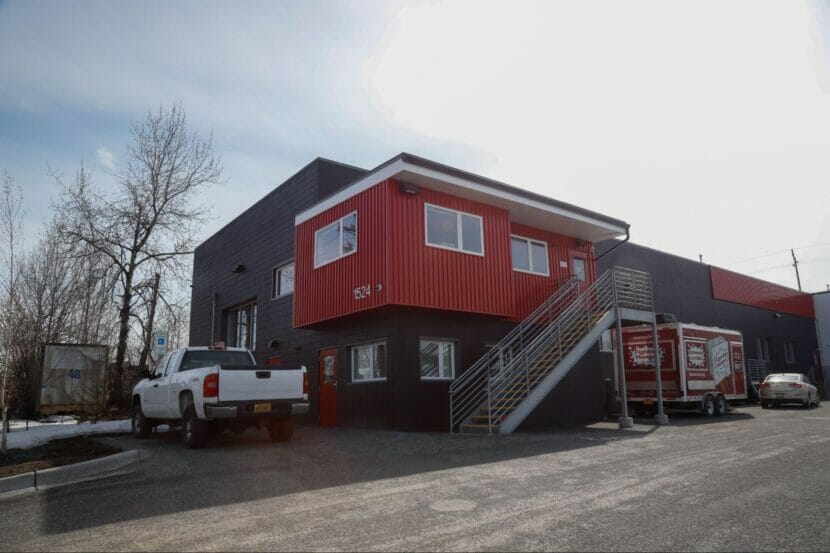
The contract money boosted Bean’s financial reserves, Sauder said, and helped fund a $7 million project: the renovation and construction of a huge new commercial kitchen and warehouse, which the organization now uses to help produce 5,000 meals a day.
Bean’s Cafe’s new warehouse and food production facility that was funded, in part, with profits from its contract from managing the Sullivan Arena shelter. (Matt Faubion/Alaska Public Media)
“That’s the thing about a nonprofit,” Sauder said. “We reinvested right back into the community, into our programs.”
While Bean’s revenues increased substantially, Sauder’s $123,000 salary has been at roughly the same level since she took the job 10 years ago.
Sauder received a bonus between $4,000 and $5,000 around the time the shelter contract was coming to an end in 2021, according to her testimony during her divorce proceeding last year.
Allegations fly amid bidding war
Hays now believes her decision to challenge Bean’s Cafe set off a chain of events that ended in Bronson firing her.
It all started, according to Hays, with her effort to open Bean’s contract to competitive bidding in the summer of 2021. Prior to Bronson’s tenure, the city extended Bean’s contract more than a half-dozen times without a competitive process.
“I wanted to see if there were any more responsible bidders, ones that we could work with transparently and ethically,” Hays said.
She hoped an organization like the Salvation Army or Catholic Social Services might take over the work. But when the bidding closed, there were just two competitors: Bean’s, and a new, one-year-old, for-profit business called 99 Plus 1.
Hays, who served as an alternate on the panel that reviewed the bids, said that as it was poised to award the contract, she ran into Dr. John Morris, the mayor’s top homelessness advisor at the time, outside the City Hall elevators.
Hays recalled that Morris, who wasn’t part of the panel, told her that it “would be a shame” if Bean’s didn’t continue as the shelter operator.
And Hays said Morris implied that she had a conflict of interest, because she had previously worked for Bean’s Cafe.
“‘You can see the issue, right?’” she remembered him saying. “‘You used to work for them. And now they work for you. And you have this power over them that could destroy them.’” The message of the conversation was clear, Hays said: She should make sure the panel awarded the shelter management contract to Bean’s again.
“I felt like it was wrong. It was inappropriate,” Hays said. “It was just so highly political.”
Dr. John Morris worked as Mayor Dave Bronson’s top advisor on homelessness before resigning and returning to his job as an anesthesiologist. (Jeff Chen/Alaska Public Media)
Hays said she immediately told her supervisor, Bob Doehl, about her encounter with Morris. Doehl, reached by Alaska Public Media, confirmed that Hays reported her conversation with Morris to him.
Morris, an anesthesiologist who worked for the Bronson administration for less than four months, declined to be interviewed.
But in a written response to questions, he said he “at no time” acted “in the manner alleged by Ms. Hays.”
Morris acknowledged speaking to city leaders about an array of concerns he had with the bidding process. But he said he did not remember sharing them with Hays directly, or that she was present when he shared them with others.
Morris said he wanted Bean’s to keep the shelter contract because it had received “years of real-time, on-the-job training.”
“I warned municipal leadership that a change in operators could pose a serious risk to existing operations and a major loss in years of learned experience and knowledge,” he said in his response.
Morris also suggested Hays’ previous employment with Bean’s was a conflict of interest — the same concern she said Morris raised to her outside the elevators at City Hall.
Anchorage City Hall. (Mizelle Mayo/Alaska Public Media)
Hays’ version of events closely mirrors allegations contained in a January letter written by the lawyer for Demboski, the former municipal manager.
The letter alleged that an unnamed “close associate” of Bronson attempted to influence an unnamed employee overseeing a bidding process, technically known as an RFP, in exactly the timeframe when Hays was reviewing bids for the Sullivan shelter contract. The associate, the letter alleged, told the employee to direct the contract to “his friend.”
“This employee was very uncomfortable with this action and she reported it to several people, including her immediate supervisor,” the letter said. “The contract was eventually awarded, and the friend of your close associate did not receive it. At this point, your close associate complained to you about the employee who chaired the RFP panel, and you had that employee terminated.”
Rodvik, Bronson’s spokesman, declined to comment on Demboski’s account, citing a possible lawsuit from her. Demboski and her lawyer also declined to comment.
Morris, in his response, called the accusations about his time as Bronson’s homelessness deputy “wildly false,” and he denied the interference alleged by Hays and Demboski.
Sauder was once quoted as describing Morris as a “genius,” and in an interview said the two are “friendly.”
“That’s Anchorage,” she said. “It’s one degree of separation everywhere you go in Anchorage.”
Sauder also donated to Bronson’s mayoral campaign and to Bill Evans, another conservative candidate in the race, campaign finance reports show.
Morris wouldn’t directly comment on the reason Hays was fired. But he pointed out that it happened shortly after the Anchorage Daily News reported that a 62-year-old man was found languishing with life-threatening infections at the Sullivan, which was by then under the management of 99 Plus 1.
Morris left the Bronson administration a few days after Hays’ firing. Sauder told reporters at the time that Morris was trying to convince the city to reinstate Bean’s contract before his departure.
It didn’t take Hays long to find new work. 99 Plus 1 quickly hired her to run the Sullivan Arena shelter in November 2021.
She now runs a new nonprofit, Henning, Inc., which took over the shelter operations in October.







 Allegations fly amid bidding war