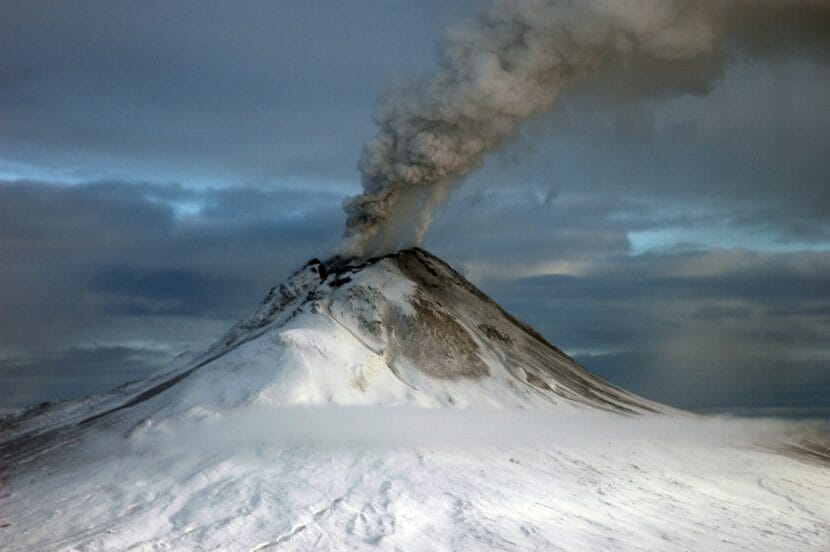
Smoke rises from Augustine volcano during its last eruption in 2006. Experts have been studying the volcano to better understand the hazards it poses to Alaskans. (Photo courtesy of U.S. Geological Survey)
Researchers are looking to the past of Alaska’s Augustine volcano to find answers about its future. An ongoing research collaboration between the Alaska Volcano Observatory and scientists at Western Washington University seeks to broaden existing knowledge about the volcano to understand the true threat that it poses to Alaskans living in the Cook Inlet region.
The research is spearheaded by Kristina Walowski, an assistant geology professor at Western Washington University. In 2020, she and her colleagues received a grant from the National Science Foundation to study Augustine, located at the southwest end of the Cook Inlet, 170 miles from Anchorage and visible from nearby Homer. They conducted much of their research last summer and are in the process of compiling it.
“Augustine is one of our highest-threat volcanoes in Alaska,” said Matt Loewen, a research geologist at the Alaska Volcano Observatory, who is also involved in the research collaboration.
The volcano is of special interest to researchers like Walowski because of its proximity to Alaska’s largest city and its history of explosions. Augustine is a unique volcano because it has erupted six times in the past 200 years, Walowski said. The most recent eruption occurred in 2006 and greatly impacted air travel in the area.
But the recent eruption is not what is most interesting to Walowski and her team. They are focused on two eruptions in particular: one 400 years ago and one about 800 years ago. Those two eruptions were more explosive than recent ones, and Walowski and her team are attempting to understand why that was the case and what that might mean for the future.
“Why has [Augustine] changed its personality? And is there a potential for it to revert back to its old ways?” Walowski said.
Her team is studying rock material from the volcano to backtrack its life to see if Augustine might have another major eruption, similar to its past big eruptions, in its future. Looking at the components of rocks is essential because scientists can get an inside view into the pressure or temperature that formed that rock, Walowski said. And in turn, that information offers up clues about how the volcano behaved in the past and how it might act in the future.
But Walowski was quick to say that she does not work in predictions. Rather, she offers a window into the past of the volcano and what might happen in the future. With this information, she said that the Alaska Volcano Observatory could be better equipped to inform people about what may happen next with Augustine. One of the biggest threats of the volcano is the tsunamis that it might create caused by a large displacement of land matter in the event of an explosion. This happened once in 1883 and could happen again, according to the U.S. Geological Survey.
“We have a mission to, you know, both understand volcanoes and provide alerts and warnings about eruptions,” he said. “Well, the academic world tends to be more about developing fundamental research, and I think this is a great case where we’re putting those together. So they’re kind of mutually beneficial.”
Walowski hopes to see the research published in the next year or so. She is excited about its potential to create a broader picture of Augustine’s threat to Alaskans, so that more people may be better prepared in the event of an emergency.
“It’s important for the public to know that there are scientists working on understanding volcanoes at many different levels and all of those little puzzle pieces can be sort of stuck together to make people and communities as safe as possible,” she said.
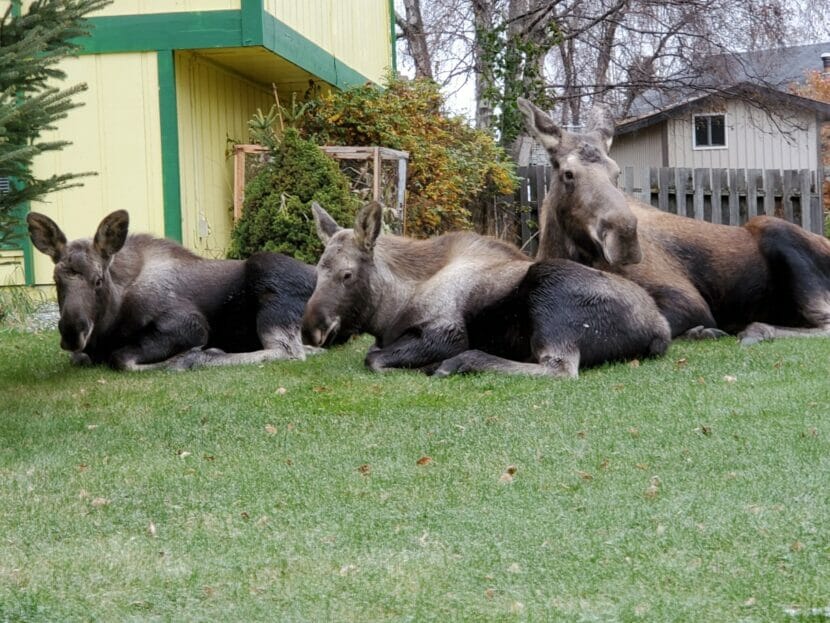
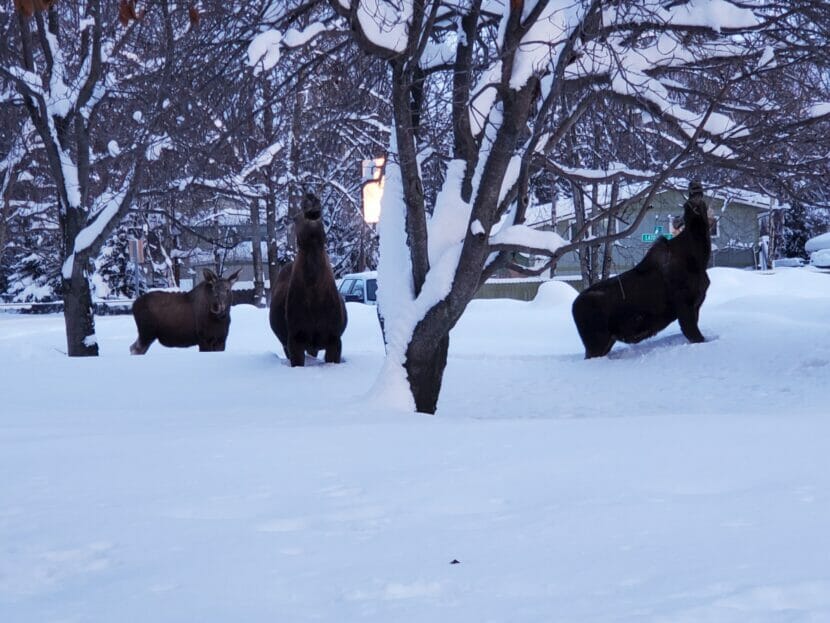
Three moose rest on a lawn in a Midtown Anchorage neighborhood on Oct. 14, 2022. More than 1,000 moose live in or travel through Anchorage, and many of them are leaving antibiotic-resistant microbes in the scat that they drop around town, University of Alaska Anchorage research shows. (Photo by Yereth Rosen/Alaska Beacon)
The moose that amble through Alaska’s largest city are leaving more in their wake than piles of nugget-shaped feces.
Within that scat, researchers from the University of Alaska Anchorage have discovered, is something troubling: microbes that are resistant to several varieties of antibiotics.
Antibiotic-resistant Escherichia coli, a pathogen commonly abbreviated as E. coli, and other antibiotic-resistant microbes have been found in moose scat collected from locations throughout Anchorage and in some areas beyond – by waterways, in parks, in backyard in residential neighborhoods, in parking lots near medical facilities and elsewhere. Possibly most concerning is the discovery of antibiotic resistance in moose scat collected from wooded areas used for camping by homeless people, said Grace Leu-Burke, the assistant UAA College of Health professor leading the research project. That is what has struck her students, Leu-Burke said. “They’re really worried about the homeless people. Because the first thing is they don’t have access to clean water. And it’s right there,” she said.
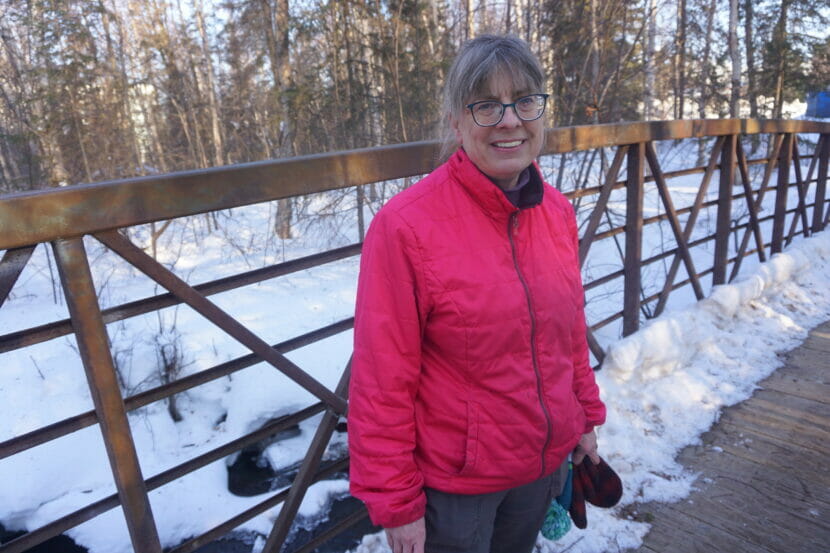
Grace Leu-Burke, UAA assistant professor, stands on March 13, 2023 at a trail site near her office where she and her students collect moose scat for testing. (Photo by Yereth Rosen/Alaska Beacon)
Among the hot spots for moose scat collection is a wooded pathway just south of the UAA Health Sciences Building, where her office and lab are located. There, by a bridge that crosses a small creek on a sunny March morning, was a small pile of food containers and other trash left, evidence of a makeshift campsite.
“When I see this, I just worry,” Leu-Burke said, indicating the debris. She and her students have even found drug-injecting needles in some scat-collection sites, she said.
More than 1,000 moose live in or walk through Anchorage, it is estimated. There is no sign that the presence of antibiotic-resistant microbes is causing any health problems for them, Leu-Burke said.
But the pathogens could make their way to people, and the most likely transmitters would be dogs, she said.
Three moose stand in deep snow on Feb. 13 and graze on trees in a Midtown Anchorage neighborhood. (Photo by Yereth Rosen/Alaska Beacon)
Pharmaceutical antibiotics have been in use for about a century. In 1928, penicillin derived from mold was found to kill many bacteria that historically led to illness and death. Over time, their use expanded beyond human health to agricultural purposes, including mass-scale dosing of livestock. While antibiotics are valuable for human and animal health, their widespread use has an unfortunate side effect: evolution of resistant bacteria that do not respond to various types of antibiotics. That has led medical and agricultural policymakers around the world to develop more careful protocols for antibiotic use. There are now national and international programs working on ways to combat the spread of antibiotic resistance.
Antibiotic resistance has caused health problems for people in Anchorage, as has been the case elsewhere. Six Alaska hospital patients have been identified since the start of 2022 with serious infections of antibiotic-resistant pathogens, according to a recent bulletin from the state Division of Public Health’s epidemiology section. A decade ago, antibiotic-resistant infections were linked to deaths of some Alaska hospital patients.
Leu-Burke, who is program director of medical laboratory science at UAA’s School of Allied Health, started her UAA moose surveillance work in 2018. For consistency, samples are collected at the same time of the year, in the spring, when snow is softening. Samples are frozen for a year before being cultured. As of this spring semester, there will have been over 300 scat samples cultured, she said.
Results from samples collected from 2018 to 2020, which Leu-Burke presented on February 28 at a One Health conference hosted by the University of Alaska Fairbanks, show about 40% of the collected scat had E. coli that survived the year of freeze. Among those, there was resistance to all types of antibiotics tested.
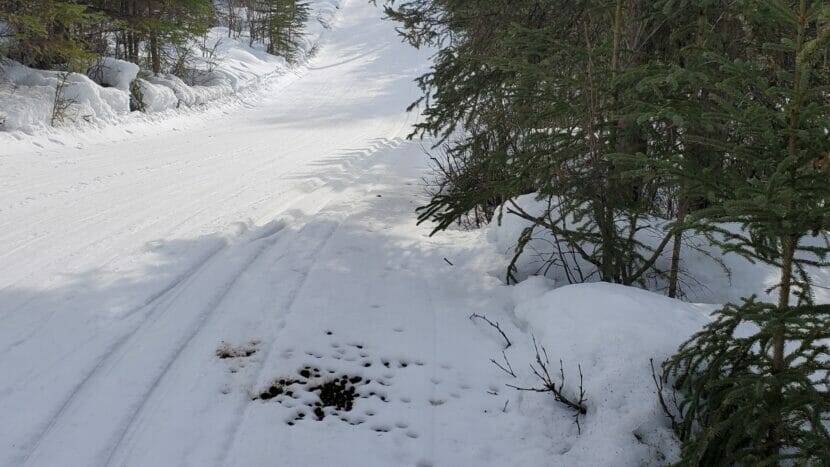
Moose scat is seen on April 15 on the groomed Besh Loop ski trail in South Anchorage. Ongoing research at the University of Alaska Anchorage is tracking the prevalence of antibiotic-resistant microbes in the moose scat distributed around town. (Photo by Yereth Rosen/Alaska Beacon)
Those findings may be disheartening, but they are not surprising, said Christina Ahlstrom, a geneticist with the U.S. Geological Survey’s Alaska Science Center who has been studying antibiotic resistance in Alaska birds.
“It’s not good. But I think this is just the world that we are living in at the moment,” said Ahlstrom, who has been working with USGS colleagues to track gulls at various Alaska locations.
What they have found in their studies of gulls is consistent with other studies: Where there is more human presence, such as in cities with big, open, bird-attracting landfills, there is more likelihood that that gulls will carry antibiotic-resistant microbes. Gulls can also carry those microbes over long distances as they migrate, the USGS scientists have found.
Even Arctic terns, which fly between the Arctic and Antarctic and are the world’s longest-distance migratory birds, can carry antibiotic-resistant microbes, other research has found.
While Ahlstrom said she does not know of any studies of antibiotic resistance in Alaska mammals other than Leu-Burke’s work, there have been studies of mammals in somewhat similar environments.
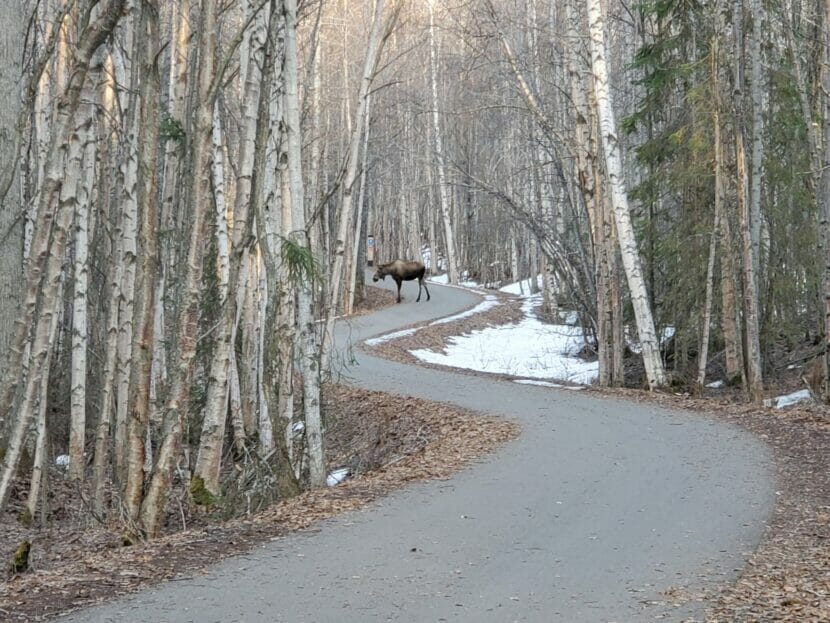
A moose crosses the Tony Knowles Coastal Trail near Earthquake Park on April 28, 2022. Moose are commonly encountered on local trails. (Photo by Yereth Rosen/Alaska Beacon)
A 2021 study detailed “widespread” presence of antibiotic-resistant microbes in harbor seals and harbor porpoises in Washington state’s Salish Sea, for example. A 2021 Swedish study of wild bears that analyzed both modern animals and museum specimens dating back as far as 180 years found a pattern reflecting human use of antibiotics. There was some good news in the study: It found that antibiotic resistance levels in bears decreased in recent years, suggesting that recent controls on antibiotic use and management have had a positive effect.
Ahlstrom pointed out that there is some natural antibiotic resistance in the environment, but it is usually associated with bacteria that does not carry diseases that infect people or animals. When the resistance shows up in bacteria like E. coli, it has probably been introduced by humans in some way, she said.
“It really shouldn’t be there, and we really don’t know what the consequences are for the ecosystem,” she said.
Tracking the precise pathways of human-introduced antibiotic resistance is difficult.
For Anchorage moose, likely deliverers are birds like those being monitored by the USGS scientists, Leu-Burke said. “That’s the most common, and that’s really a strong indicator,” she said.
That is logical, she said: Birds fly around source sites like local wastewater streams and, if they have migrated from the south, big agricultural operations, and they share space in Anchorage with moose. Evidence of the link is in the discoveries made by her team of overlap in the type of antibiotic-resistant microbes carried by moose and birds, especially along waterways.
A moose grazes on April 16 near the FedEx terminal at the Ted Stevens Anchorage International Airport. Moose are found throughout Anchorage. (Photo by Yereth Rosen/Alaska Beacon)
But her group has also found some differences in the bacterial types, indicating non-bird sources. Leu-Burke said it makes her wonder if there are possible effects to bark-eating moose from pesticides being sprayed on trees to protect them from beetle infestations.
On the positive side, the work has become effective hands-on education for enthusiastic student researchers, who are able to do lab work that goes beyond an academic exercise and has real-life significance, Leu-Burke said. Her students carry fecal-collection kits in their backpacks, even during spring break, a prime collection period, and she is also busy during that time of the year. “That’s why I’m never off on spring break,” she said.
Though moose in highly traveled Anchorage remains the main focus, some students have branched out to other locations and to other mammals.
Caribou scat samples collected by one student from the Tok and Chicken areas, for example, produced results that were inconclusive but raised enough questions to warrant further investigation. Bear scat collected by another student by Eklutna Lake tested positive for some antibiotic resistance microbes.
As the surveillance work continues, important lessons are emerging, she said. One is to consider environmental factors as well as risks of prescription-medicine overuse.
“What I try to impress upon the medical community is that we have to stop thinking that all our antimicrobial resistance is coming from misuse of antibiotics,” she said.
Grace Leu-Burke, a University of Alaska assistant professor leading the project that is monitoring antibiotic resistance in moose scat, holds one of the cultured petri dishes in her lab. The bacteria on the dish, seen March 13, is Klebsiella ozaenae, a gram-negative bacilli in the Enterobacteriaceae family. This isolate is resistant to multiple antibiotics: penicillin, cephalosporins and macrolides. (Photo by Yereth Rosen/Alaska Beacon)
Another lesson is that Anchorage-area residents should handle moose scat in the same way they handle any potential infectious agent, she said. That means the Alaska tradition of using moose nuggets as garden fertilizer might no longer be a good idea, she said.
“I don’t think it’s a safe use for compost at this time, at least in the Anchorage Bowl area,” she said. “I’m all one for doing natural stuff, but it’s got more things in it than I suspected.”
That goes for another once-accepted use of moose nuggets — the crafting of them into gift items like necklaces and cocktail swizzle sticks.
“There is no zero-risk anymore, is what I’m saying. We can no longer make jewelry out of moose scat,” she said.
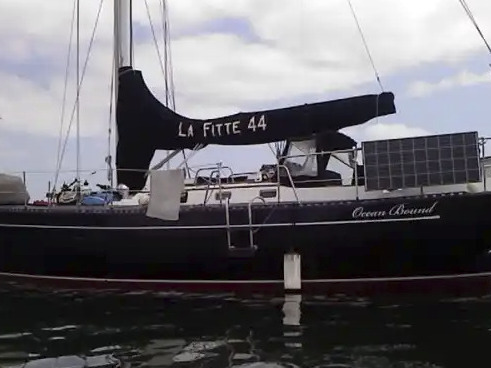
The Mexican Navy searched for three Americans who went missing along with their sailboat off Mexico’s northern Pacific coast. Kerry and Frank O’Brien of Girdwood, Alaska, were aboard the boat with their friend William Gross. They have not been heard from since April 4, according to the U.S. Coast Guard. AP
In a news release Wednesday, the agency said the search was suspended pending “further developments” after SEMAR — the Mexican navy — and the Coast Guard spent roughly 280 hours searching Mexico’s northern Pacific coast.
After searching nearly 200,000 square miles with no sign of the missing passengers and the missing sailing vessel, officials suspended the search.
“SEMAR and U.S. Coast Guard assets worked hand-in-hand for all aspects of the case. Unfortunately, we found no evidence of the three Americans’ whereabouts or what might have happened,” Coast Guard Cmdr. Gregory Higgins said.
The three sailors — identified as Kerry and Frank O’Brien of Girdwood and their friend William Gross — reportedly left Mazatlán, a city on Mexico’s west coast, aboard a 44-foot boat named Ocean Bound on April 4 and were headed to San Diego.
They planned to stop in Cabo San Lucas — roughly 224 miles from Mazatlán — on April 6 to report in before they continued their trip, the Coast Guard said. However, there was no record of the three mariners arriving in Cabo San Lucas nor a check-in of their location.
In an interview with San Diego TV station NBC 7, the family of William Gross told the station they have not lost hope and that he and his sailing companions will be found.
“Our hope is for our Dad, and Kerry and Frank to be sailing into port soon, tired and sore, but safe,” the Gross family said in a statement to the station. “And our hearts certainly go out to the other two families who are being equally impacted during this extremely difficult time.”
Copyright 2023 NPR. To see more, visit https://www.npr.org.
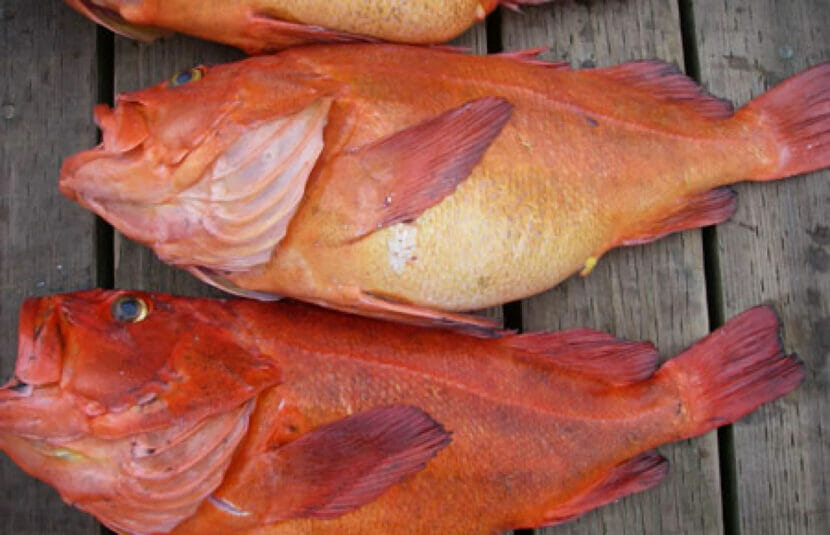
Yelloweye rockfish. Fish and Game is placing stricter limits on rockfish this season, which is says is to make sure the species doesn’t dip to unsustainable levels. (From ADFG)
Tourists are lured to the Kenai Peninsula every summer by the promise of big catches from the decks of saltwater fishing boats. That promise looms large in local lore: a sign proclaiming Homer the “Halibut Fishing Capital of the World” is the first thing anyone sees when they enter the city. And each spring, hundreds of boats each spring venture into Kachemak Bay for the annual Winter King Salmon Tournament.
But as regulations on halibut and king salmon fishing have ramped up in the last decade, charter guides have branched out into another species: rockfish. This year, the Alaska Department of Fish and Game is limiting rockfish harvest by emergency order to make sure the population doesn’t plummet to a point of no return.
“Things are OK. We’re just on an increasing harvest trend that is likely to lead to unsustainable levels,” said Mike Booz, area management biologist for the department’s division of sportfish.
Booz traced that trend back, in part, to 2014, when the council that manages fishing in Alaska’s federal waters passed a catch-sharing plan to allocate halibut harvest between commercial and sport fisheries in the Gulf of Alaska and Southeast. Charters had to limit how much halibut they were allowed to catch. Booz said right away, charters started going more for rockfish.
Meanwhile, the department has tightened regulations on king salmon fishing, too, including closures and decreased bag limits. That’s as king salmon across Alaska continue to suffer.
Ray DeBardelaben owns Long Live the Kings lodge in Soldotna and is president of the Kenai River Professional Guide Association. He also takes clients out on his saltwater boat, the O’Dea, out of Homer.
He’s been fishing since the 1980s, when he said it was possible to get a 200-pound halibut. He said he no longer targets the clientele that expects that sort of fishing.
“That clientele’s gone for me,” he said. “So I’ve really just spent money on marketing and got new clients. They pull up a halibut that’s 25, 30 pounds. And the first thing they say is – ‘wow.’”
He said there are still days when he’ll take clients out to fish for halibut, alone or for halibut and king salmon, together. But he said he started focusing more on trips for halibut and rockfish over the last seven years.
Rockfish are found further offshore — as far as the Chugach Islands in Cook Inlet, on the other side of Kachemak Bay State Park. They’re also found in Resurrection Bay, in the Chiswell Islands area, Booz said.
“That is a long way for a charter vessel to travel,” said Brian Ritchie, a charter operator out of Homer and vice president of the Homer Charter Association. “And it does increase fuel costs. But it’s something that businesses here have shown they’re willing to take on, and it’s something that we certainly adapted to.”
He said Homer-area fishermen have been eyeing rockfish abundance for a few years. Recently, the total rockfish harvest in Cook Inlet salt water skyrocketed to over 50,000 fish a year — a 300% increase from the historical average between 2006 and 2013, according to Fish and Game. Most of the increased harvest of the species has been black rockfish, the department said.
Booz said rockfish, as a species, are susceptible to overharvest. They don’t migrate much, but instead stick to the spots they like, which makes them easier to catch.
“Because we know right where they’re going to be, every day,” Booz said.
Rockfish are also slow to mature, and live a long time. Black rockfish can live to be 50 years old.
Booz said that makes it hard for them to bounce back, too — which has happened to rockfish fisheries in the Lower 48. He said that’s another reason to be conservative with restrictions.
The new bag limits are three a day in Cook Inlet, down from five, and three in the Gulf Coast area, down from four. In both areas, just one of those fish can be non-pelagic.
Booz said this week’s announcement is an emergency order, for this season. Any longer-term regulation changes would have to pass the Alaska Board of Fisheries later this year, at its Lower Cook Inlet finfish meeting in Homer in November. Proposals to the board were due earlier this week.
Ritchie said fishermen in Cook Inlet are getting more used to diversifying, as regulations continue to shift. This year, for example, charters can’t fish for halibut on Wednesdays and some Tuesdays throughout the season.
“That kind of uncertainty, when it’s your business and it’s your job, can be stressful. And I think it’s been stressful the last two years, especially, for Homer-area businesses and operators,” he said.
Another challenge for charters has been increased gas prices, said DeBardelaben, who will start taking clients out for the season later this month. He’s also had to diversify in freshwater — with king runs suffering on the Kenai River, he instead takes clients out to fish for sockeye.
He thinks there’s been a mentality shift.
“I’ve had to change my attitude on how much fish do I need, how much fish do I want,” he said. “And I try to pass that onto my customers — the attitude of, ‘We’re going to go out and we’re going to have fun, and we’re going to catch some fish and we’re going to eat it.’”
He said clients want the experience of going out and catching fish, no matter the species.
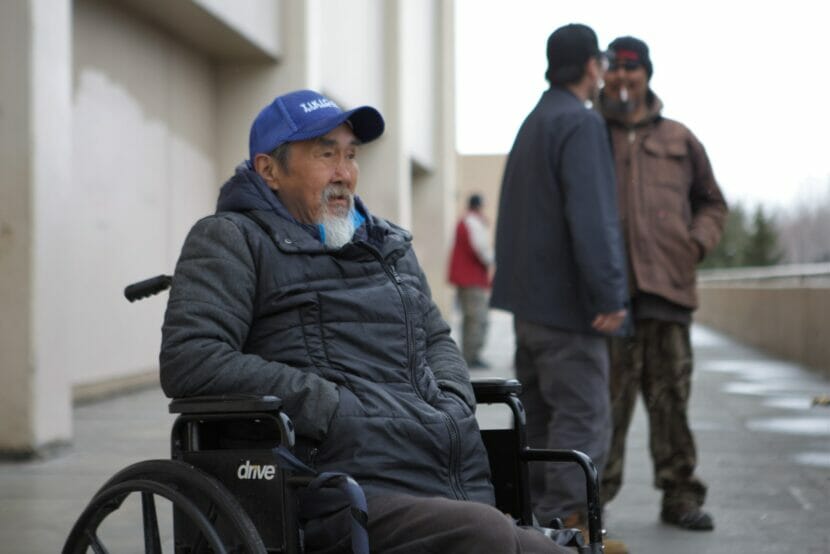
From his wheelchair, Alfred Koonaloak looks out across the parking lot of the Sullivan Arena in Anchorage on Thursday. (Jeremy Hsieh/Alaska Public Media)
When it does, Tikiun thinks it’ll be more dangerous for everyone.
“It’s stressful,” he said. “We’re growing gray hairs left and right, all of us. And we don’t even know what we’re gonna do. We don’t even have a plan.”
He said it can be chaotic at the Sullivan. It’s a low-barrier shelter, meaning being intoxicated or having a criminal record aren’t disqualifying. But he prefers it to sleeping outside on his own.
“That’s our only option right now,” Tikiun said.
He’s one of about 460 people staying in the Sullivan Arena, the biggest of Anchorage’s three winter shelters. Another 140 people are staying in hotel rooms contracted for winter shelter use. They’re all set to close in two weeks.
Most people will have to start camping outside, as Anchorage Assembly members and service agencies plot what’s next. Homelessness experts expect the number of people sleeping outdoors to swell from about 300 now to as many as 800.
“We may have a couple weeks of chaos,” said Assembly member Daniel Volland.
The Sullivan Arena in November. (Elyssa Loughlin/Alaska Public Media)
Volland represents North Anchorage, where the Sullivan and many other resources are located for people without homes. He has repeatedly pressed to close the Sullivan. Its neighbors attribute graffiti, littering, pedestrians in the road, trespassing, open drug use, assaults and even outdoor deaths to people drawn to the shelter.
Volland thinks the shelter has to shut down for the rest of Anchorage to take part in managing homelessness.
“I think Anchorage as a whole is going to be better here, as we engage in this conversation and get some solutions online and are willing to think outside the box,” he said.
Instead of a mass shelter, he said multiple, smaller sites around the city would be better for the clients and for neighborhoods.
“For so long we’ve been fixated on the Sullivan,” he said during a discussion on shutting down winter shelters at Tuesday’s Assembly meeting. “One more month – just one more month. Just three more months. Just six more months. Just another year. How long is this going to draw out? So now’s the time. Now’s the time for a reset. And it’s going to be hard.”
Assembly members said they don’t want another version of last summer’s haphazard, mass relocation of Sullivan shelter residents to a dangerous campground.
Their attention is split, but one quick change will be to increase summer outreach, and they’ll vote on that soon. More outreach means meeting people where they are, including if it’s in a tent in the woods, with food, medical care, hygiene services, case workers and help with transportation.
They say there may be some last-minute opportunities to lease some rooms for the most vulnerable, there’s a new push to pilot a 30-unit tiny home village at some point this summer, and the former Golden Lion Hotel and Barratt Inn are both in the process of being converted into low-income housing.
The Assembly also wants to stand up a new, low-barrier shelter by next winter, so that the Sullivan Arena doesn’t reopen as a mass shelter for a fourth year.
All that work may be too late for the immediate reality of shelters closing.
Everyone’s situation is different. For some people, the conditions at the Sullivan were already more discouraging than the cold, and they chose to sleep outside.
Alfred Koonaloak has done both, but spent this winter at the Sullivan. Even though he uses a wheelchair – he lost a leg in a train accident years ago – he’s surprisingly at ease about what’s next. He hopes he can get housing for people with disabilities.
“If I don’t get housing, that’s OK,” he said. “At least I’m still alive and making it throughout the winter. … I’ve been sleeping outside for years. You know, I’ve just had to be in here because it was a very harsh, very, very difficult winter last year, and it got way below zero.”
Koonaloak said he’s grateful that he was able to stay in the Sullivan.
The lawsuit said Pierce would touch and kiss his assistant against her will and that he made sexual remarks, using his authority to intimidate her behind closed doors in his Soldotna office. (Elyssa Loughlin/Alaska Public Media)
The Kenai Peninsula Borough will pay more than $200,000 to settle a harassment suit filed last fall against former borough mayor Charlie Pierce, according to a statement released Tuesday night on behalf of the borough assembly and administration.
The announcement comes eight months after Pierce resigned and six months after his former assistant, Pamela Wastell, sued him for repeated sexual harassment, and sued the borough for failing to protect her.
The borough has been tight-lipped about many of the details of the suit. The assembly voted not to disclose the details of an internal investigation last fall, and met in executive session again last month to talk about it.
But at its meeting this week, the assembly agreed to make public that it had settled with Wastell for $237,500. The borough will pay $206,250 and Pierce owes $31,250, the statement said.
In a statement sent by her lawyer Tuesday night, Wastell said she was pleased by the settlement, but that “there’s not enough money in the world to go through what I have.”
Pierce’s lawyer, Richard Moses, said Pierce isn’t paying his sum, personally. Rather, he told the borough that his part of the settlement would be covered by the borough’s Alaska Municipal League Joint Insurance Association policy, according to Sean Kelley, attorney for the borough. That policy includes the borough’s property coverage, work compensation and other liability.
Kelley said the borough was not informed of this until Tuesday night.
“If AMLJIA (Alaska Municipal League Joint Insurance Association) or anyone else is paying Mr. Pierce’s fees or settlement sum that would be a unilateral decision by them that was not done in agreement or consultation with the Borough,” Kelly said in a follow-up email Wednesday.
A spokesperson from the insurance association did not respond to a request for more information, before airtime. Kelley said the borough is not covering Pierce’s attorney fees.
Mayor Peter Micciche — who voters picked to fill Pierce’s spot in a special election in February — said the borough’s portion of the settlement will come from its Insurance and Litigation fund, which he said contains an “adequate balance” to cover the cost. There was over $2.7 million in that fund in the 2023 fiscal year.
Neither the borough nor Pierce is admitting wrongdoing, according to the respective parties.
The lawsuit, filed on behalf of Wastell in Kenai Superior Court last October, said Pierce would touch and kiss Wastell against her will and that he made sexual remarks, using his authority to intimidate her behind closed doors in his Soldotna office. It also said he had intimidated other female employees, and that the borough didn’t have the reporting mechanisms in place to protect any of them.
In a prepared statement sent Tuesday night, Wastell’s attorney, Caitlin Shortell said the alleged harassment was devastating and ruined her plans to retire.
Wastell, in the same statement, said she did not feel safe reporting the harassment at the time since the acting human resources director at the time was Pierce’s chief of staff, Aaron Rhoades.
In its own statement, the borough said the assembly and current mayor decided to settle the suit without further litigation to avoid spending “more public funds” and “bring finality to a difficult time.”
“Neither the Assembly nor Mayor Micciche are happy with all aspects of this settlement, but we also recognize that years of litigation on this matter is not in the best interest of the Borough, or the taxpayers,” the statement said.
Moses, Pierce’s lawyer, says Pierce is happy to put the suit behind him.
Pierce was elected as borough mayor in 2017. He resigned last August, citing his then-bid for Alaska governor. The borough later said Pierce was asked to consider submitting a voluntary resignation as part of a potential resolution, to help the borough avoid a lawsuit.
The borough previously settled with two former human resources directors over bullying and discrimination complaints involving Pierce, in 2019 and 2021, totaling $267,000 in costs to the borough. With this settlement, the borough will be paying nearly half a million dollars settling lawsuits involving Pierce.
Separately, an ongoing suit against the borough, filed in January, alleged harassment and retaliation from another borough employee with the Kachemak Emergency Services Fire Area.
At Tuesday’s meeting, Micciche said the borough was adopting a new sexual harassment and discrimination policyso borough employees will know how to report incidences of assault, and what the consequences are.
Micciche said the new policy went “live” Monday morning and that it applies to anyone who may be in the borough building and working on the borough’s behalf. The policy, emailed to borough employees yesterday, elaborates on several ways to report harassment, including through the borough’s new online reporting tool, or directly to a supervisor, the mayor, the human resources director or the borough attorney. Micciche also said he’ll establish a three-person, mixed-gender reporting panel of borough directors that will field complaints.
Shortell, the lawyer for Wastell, said change for other employees was very important to her client.
“And she’s very happy to see that the borough is adopting new policies,” she said. “I would just add a caution that a policy on paper is only as good as the people who implement the policy.”
She said it will be up to the borough to make sure the policy is not just words on a page.
This story was updated Thursday with more information from all parties’ lawyers.
Close
Update notification options
Subscribe to notifications
Subscribe
Get notifications about news related to the topics you care about. You can unsubscribe anytime.



9(MDEwMjQ0ODM1MDEzNDk4MTEzNjU3NTRhYg004))