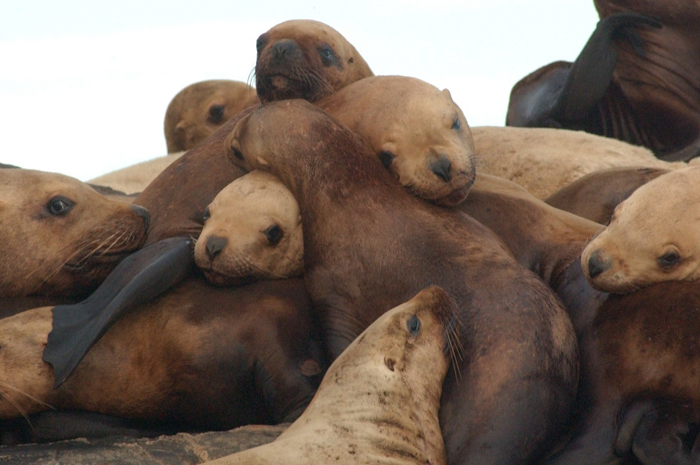
Group of eastern Steller sea lions, taken during research conducted by Alaska Department of Fish and Game in 2007. (Photo by Jamie King/ADFG)
Seven Steller sea lions were shot near Cordova last month, and investigators are offering a reward for information that could lead to the shooter.
A statement from NOAA fisheries said the sea lions were discovered in the Copper River Delta near Cordova on May 16, by members of the agency’s protected resources division. The Copper River commercial fishery opened just a day earlier. NOAA says the sea lions appear to have been shot with no evidence of an attempt to harvest or salvage them.
Steller sea lions are federally protected under the Endangered Species Act, and killing marine mammals like sea lions is also a violation of the Marine Mammal Protection Act.
NOAA is offering a $5,000 reward for any information leading to a “civil penalty or criminal conviction” in the shootings. You can call the investigating agent at (907) 250-5188, or NOAA’s Enforcement Hotline at (800) 853-1964.
A NOAA law enforcement spokesperson declined to comment further on the ongoing investigation.
Cargolux Airlines International S.A., a Luxembourg cargo carrier, deplanes at Ted Stevens International Airport on May 16, 2023. (Mizelle Mayo/Alaska Public Media)
To explain why Anchorage International Airport gets so much cargo traffic, Airport Director Craig Campbell picked up a decorative globe he keeps on his desk.
He pointed to the major exporters in Asia, then dragged his finger across the Pacific Ocean to the big U.S. hub cities where the imported goods are distributed. The virtual halfway point of each of those trips, he said, is Anchorage.
Every plane has a weight limit, so in order to maximize the portion of that weight allotted to valuable merchandise, the carriers only fill half the amount of gas they’ll need. They then make a pit stop in Anchorage to gas up for the second leg of their trip.
“If you put a lot of gas in to fly from Asia all the way to Chicago, that’s heavier weight in gas, less cargo,” Campbell said. “So by stopping here – less gas, more cargo.”
Global cargo demand softened after the pandemic boom, but Campbell said thanks to its geographic advantage, Anchorage traffic is down far less than other airports. That has allowed operations — and employment opportunities — to continue expanding.
The airport now accounts for one out of seven jobs in Anchorage, according to a study by the Anchorage Economic Development Corporation. And Campbell said proposed new developments could push that number even higher.
For example, Campbell said an agreement hasn’t been finalized, but FedEx wants to build a regional hub at the airport to focus solely on shipping packages throughout Alaska.
“That’s going to be new and developing over the next couple of years, which shows that we are increasing,” Campbell said. “The airport’s increasing, the activity is increasing, the air freight, especially for Alaska, in rural Alaska is still very, very important. And it’s recognized by the industry.”
Craig Campbell, airport director of Ted Stevens Anchorage International Airport, talks about the designated cargo spaces. (Mizelle Mayo/Alaska Public Media)
But how much air cargo potential is there in a small city in the far north? Darren Prokop is a logistics professor at the University of Alaska, Anchorage and said the potential growth of Alaska air cargo is limited by the kinds of goods the state exports.
“We have a lot of cargo that is either transiting through, some of it is coming off, but we don’t have much cargo originating in Alaska,” Prokop said.
That’s because air cargo tends to consist of fragile, high value goods like pharmaceuticals and computer chips, he said. Alaska mostly exports bulk natural resources like oil and minerals that are shipped out on barges.
“When we think of Alaska shipping things, we think of bulk: we think of mining, we think of bulk seafood, we think of lumber. We don’t think of things that typically go on air cargo planes,” Prokop said.
One airport proposal could start to shift that dynamic, though. Alaska Cargo & Cold Storage plans to build a warehouse next to the runway with refrigerated storage facilities — the first of its kind at Ted Stevens’ International. That means more fresh salmon could be shipped to restaurants in the lower 48. It might also heighten demand for Alaska peonies – the state is the only place in the world where the popular flower is available during summer months.
But Prokop said beyond that, Alaska would need to start manufacturing one of those high value products in order to realize its air cargo potential.
“Should we do part of value-added manufacturing of semiconductors, of computers, for example?” Prokop wondered. “So it’s a real puzzle. What is that right product that makes sense that we could do in Alaska, and it’s conducive to get on air cargo?”
Expanding cargo facilities could entice new businesses to set up shop here, but only if they understand Anchorage’s global orientation. Prokop explained that the shortest distance between Asia and the U.S. is actually up and through Alaska, because the Earth is round. He said that it’s hard to visualize that without looking at a round, 3-D globe.
“People are used to looking at wall maps, not globes,” Prokop said. “Ted Stevens Airport needs to explain to manufacturers: the Earth is round, a lot of your products are coming through Alaska, maybe you want to be here.”
Since Anchorage is less than ten hours from the majority of the industrial world, Prokop argued that Alaska is really more of a central locale than a remote one.
A male opossum captured near Homer City Hall on Thursday. Biologists say it’s a descendant of Grubby, a female opossum captured the month before by Homer police. (Jason Herreman/ADFG)
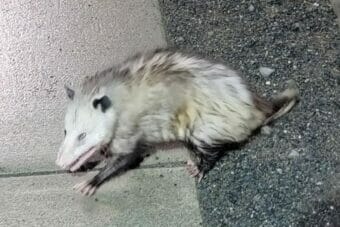
It turns out that Grubby the opossum — who hitched a ride to Alaska in a shipping container in March — had babies.
State biologists say they captured a male opossum Thursday near Homer City Hall. The opossum, one of Grubby’s offspring, appears to be two to three months old. They’re now looking for more young opossums in the Kenai Peninsula town.
“Opossums typically have litter sizes of, say, eight to nine — they’ve been known to have as many as 13,” said Jason Herreman with the Alaska Department of Fish and Game. “So there’s probably a few individuals out there that we’re trying to track down.”
Grubby originally landed in Homer in the back of a shipping container that came from Washington state. She was on the run for about two months. Biologists wanted Grubby caught because opossums don’t live in Alaska, making her an invasive species. Police eventually captured her at the end of May and she was taken to the Alaska Zoo in Anchorage.
Herreman said Grubby was most likely pregnant when she arrived in Alaska. But that wasn’t known until the young opossums started appearing. He said there have been multiple sightings of opossums around Homer this week, including one near Grubstake Avenue, Grubby’s namesake street where she was first seen.
Grubby is currently in quarantine. (Sam Lavin/The Alaska Zoo)
Herreman said it’s not surprising that the younger opossums are out on their own.
“These guys are to the size and age where they should be able to make it on their own just fine, particularly with the conditions we have in Homer and where they’re at in town,” he said.
As an invasive species, Herreman said the young opossums pose the same concerns that Grubby herself did, ranging from spreading infectious diseases to eating indigenous animals.
“There’s plenty of food sources for them, the weather’s warm,” Herreman said. “So unfortunately, that gives them a good chance of getting a foothold, and establishing a population if we don’t manage to check all these guys down pretty quick.”
Homer police said on Facebook that placements are available for Grubby’s offspring, so people shouldn’t be afraid to report them.
Grubby has attracted quite a fanbase during her time in Alaska, spurring memes, the hashtag #FreeGrubby and donations to The Alaska Zoo.
A small group of Anchorage Assembly members and the news media gather for a press conference outside Anchorage City Hall on April 19, 2023. (Jeremy Hsieh/Alaska Public Media)
Federal investigators are looking into the business dealings of an Anchorage woman whose charity the city gave $1.6 million during the coronavirus pandemic to help people experiencing homelessness or addiction.
That’s according to reporting by the Anchorage Daily News and ProPublica, who found the city gave one of its biggest pandemic relief grants to Rosalina Magaeva’s nonprofit House of Transformations, despite the state having investigated Magaeva for alleged fraud and permanently banning her from serving as a Medicaid provider years earlier.
Anchorage Daily News reporter Kyle Hopkins wrote about all of this recently and joined Alaska News Nightly host Casey Grove to talk about it.
Listen:
The following transcript has been lightly edited for clarity.
Kyle Hopkins: House of Transformations is a charity that is a place where you can go and stay, you know, after you get out of jail or are awaiting trial. It’s basically a halfway house, but also, more than that, a place where you can theoretically get substance abuse treatment, you can go into rehab, you can get hooked up with job training opportunities.
You know, imagine it’s 2020, there’s this new nonprofit that starts up, and pretty soon there’s just a wave of money, of federal relief money, that comes along to help businesses and nonprofits grapple with trying to survive the pandemic. And in 2021, the city had the first round of like $50 million to hand out. And so House of Transformations, along with many other local charities and nonprofits, they asked for some of that money, and they received $1.6 million from the city as part of what’s called ARPA, you know, the American Rescue (Plan) Act.
Casey Grove: So Rosalina Magaeva founded House of Transformations. She’s obviously a central figure here. Who is she, though? And what’s the story with those earlier Medicaid fraud allegations?
Kyle Hopkins: Well, this was not someone who I was familiar with at all, really. I had been doing some reporting back in March on the Anchorage Equal Rights Commission, because there were lots of complaints being made by city employees. we’ve talked about this before, but, you know, city employees were alleging all kinds of things happening within City Hall. And one of the agencies that’s supposed to investigate discrimination within the city was the Anchorage Equal Rights Commission. And then I was trying to get familiar with their new commissioners, and Rosalina was one of the new commissioners appointed by Mayor (Dave) Bronson.
At the time, if you had Googled her, one of the first things that comes up is this permanent ban by the state of Alaska, because she had another company called A Loving Care, and that provided home personal assistance. So that business and then Magaeva herself were banned by the state from serving as Medicaid providers, which is, you know, a pretty drastic punishment from the state. And she actually was formally criminally charged, but they ended up going the administrative route and banning her and her corporation from serving as Medicaid providers. And I didn’t mention it in stories at the time, because it felt tangential and not super-important to discussing why the investigators weren’t closing cases, and it didn’t come up again until more recently, when I learned that she’s now under federal investigation once again.
Casey Grove: Yeah, and so how do you know that they’re under investigation? Because, I mean, we haven’t seen an indictment or some charges come out. But I understand folks are talking about that.
Kyle Hopkins: Yeah, and to be fair, I mean, we often hear people are under investigation and are unable to land stories about it. The feds, they investigate, they investigate lots of things, and they often don’t lead to indictments. But in this case, we knew that, for example, I’d spoken to a business owner who had been approached by a Treasury Department investigator, and maybe someone from the Small Business Administration. And remember, the Small Business Administration gave out the PPP loans. And they were asking questions about Bitcoin investments, and about these kind of nesting — what I’ve referred to as nesting dolls of nonprofits — because you have Magaeva, who owns House of Transformations, but then House of Transformations, either the nonprofit version or a for-profit version, might own a bunch of other corporations, right? So the investigators were, frankly, they’ve talked to a lot of people as part of this investigation, so I think it was probably hard to keep it secret.
?What if the city and state vetted the people who get patronage jobs and public money by at least looking at the first page of Google results?
Meantime, here's how many businesses Anchorage housing development commissioner Rosalina Mavaega has created in recent years. … pic.twitter.com/VUsky0fNSa
You know, two things allowed me, in my opinion, to report the story. One was I went to Transformations, and they just basically said, “Yeah, we’re being investigated.” I mean, they kind of admitted to the investigation. And the other element was eventually the city just said, “OK, here’s what we’ve been asked about,” you know, “We have heard from the feds, they are asking questions, and here are the corporations and entities they’re asking about.”
Casey Grove: Do we know what they’re under investigation for?
Kyle Hopkins: I think it would be risky to kind of guess what they’re under investigation for exactly. I mean, we know that the feds are asking about the federal money that they received. The federal investigators are asking for things like the applications that they submitted, saying, “Here’s what we’re gonna do with those grants.” So I imagine they’d be looking at, well, you know, what was that money used for? Right?
Casey Grove: Obviously, a big part of the story is whether the city — and I guess in this case, we’re talking the Anchorage Assembly — properly vetted this nonprofit and its founder. So what does either the mayor’s office or the Anchorage Assembly have to say about that?
Kyle Hopkins: Yeah, I mean, what struck me was just, it just seemed like it would come up. It just seemed like it would come up. You know, if you’re gonna give a million dollars-plus to somebody that you would, like — the thing I was telling my editor was like, you would imagine that the state or the city would vet someone, you know, to the degree (of) somebody who’s like vetting their first Tinder date. Well, you know, that they would probably Google the name, maybe look at CourtView. We call it the “Tinder Threshold.” Like, did they do like that amount of vetting? And it does not seem like it. Or if they did, they sure didn’t ask about it, right? Which maybe even kind of raises even more questions.
Let’s see, Rivera was the (Assembly) chair at the time, I think. And he said, “Well, the Assembly doesn’t have the budget for an investigator.”
Casey Grove: And that’s Felix Rivera, the Assembly chair.
Kyle Hopkins: Yeah. But I don’t know. I mean, they seem perfectly capable of Googling things. So, you know, it does seem like the kind of thing that maybe should be addressed in policy, like some type of formal policy.
Casey Grove: So there was a lot of federal money flowing into the state, as you noted in the story, during the pandemic, and for pandemic relief. Is your sense that this is, you know, one of maybe other groups that we’re going to find out in the future either wasn’t vetted properly or came under investigation?
Kyle Hopkins: Absolutely. I think the ARPA funding was a beacon for fraud, nationwide. I think that’s been shown. And now we’re seeing examples of questions being raised about how that money was allocated, who was given to and what they did with it in Alaska. And, frankly, with this type of reporting, I feel like I’m just kind of getting started looking at, OK, where’s the federal money going? Because anytime you scratch in one direction or another, it just doesn’t take long to kind of come across something that just really raises a lot of questions. So I think I think there’s a lot more to be known in that arena.
Grubby is currently in quarantine. (Sam Lavin/The Alaska Zoo)
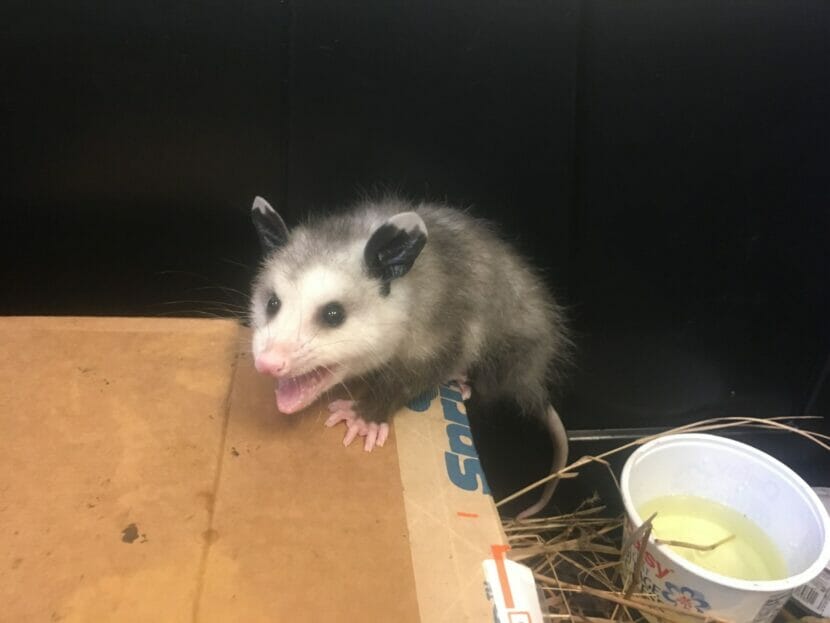
Grubby, Alaska’s most wanted opossum, was settling into her new home Friday at the Alaska Zoo in Anchorage.
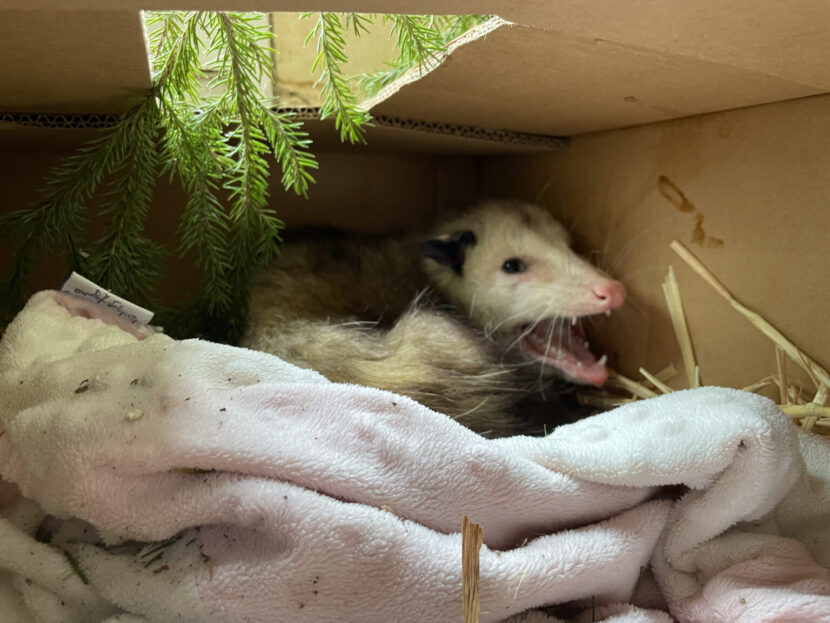
She arrived Wednesday night from Homer, and is the first opossum to reside at the zoo. Curator Sam Lavin said Grubby has been adhering to her nocturnal instincts by sleeping during the day and tearing up cardboard when she’s awake. Lavin said she’s working to win Grubby over.
“Mainly we’re doing trust building right now, getting her to associate us with food,” said Lavin. “Seeing people is less stressful when she associates them with food.”
It’s been two months since Grubby’s unexpected arrival in Alaska. She was a stowaway in a shipping container from Washington state that was bound for Homer in March. Once she got to the Kenai Peninsula town, she immediately caused a stir as she wandered around and evaded traps. Some people wanted her captured and killed because opossums are invasive to Alaska. But other rallied around her, launching the hashtag #FreeGrubby.
Right now, Grubby is technically in quarantine at the zoo. She’s living in an infirmary, and visitors can see her through a window. Her neighbors include a ground squirrel who’s also new to the zoo.
The zoo plans to keep Grubby after she is done quarantining, but staff still need to decide how to design her exhibit.
“Since they don’t live in Alaska, we’re going to have to keep in mind how she’ll do in the wintertime,” said Lavin. “We’re surprised that she survived out in Homer as well as she did considering the winter we had this year.”
Zoo staff estimate Grubby is about 2 years old. They say the zoo has received various donations in the past 24 hours from Grubby’s supporters and her fanbase over social media has continued.
Grubby arrived in the Kenai Peninsula community in March after hitching a ride on a shipping container from Washington state. The visitor quickly divided the community. Some wanted it captured and killed because it’s an invasive species. But others took a liking to it, launching the hashtag #FreeGrubby.
Grubby the opossum’s last moments of freedom, on May 24, 2023. (From Homer Police Department)
Grubby was on the lam for weeks until Wednesday.
Alaska Department of Fish and Game biologist Jason Herreman said Officer Taylor Crowder was able to capture the female opossum.
In a whimsical Facebook post, Homer police confirmed the capture of the “wanted fugitive and somewhat local celebrity” near Lakeside Drive and Smokey Bay at about 5:30 a.m. Wednesday.
“Officer Crowder attempted to contact the suspect alone, who then fled the area, ultimately coming to a dead end, cornered in front of a local business,” police wrote. “Officer Crowder, without any fear or hesitation, attempted to apprehend the suspect, who then let out a little hiss and growl and bit our officer in the hand.”
Homer police officer Taylor Crowder is sworn in on May 14, 2021. Grubby bit him on the hand. (From City of Homer)
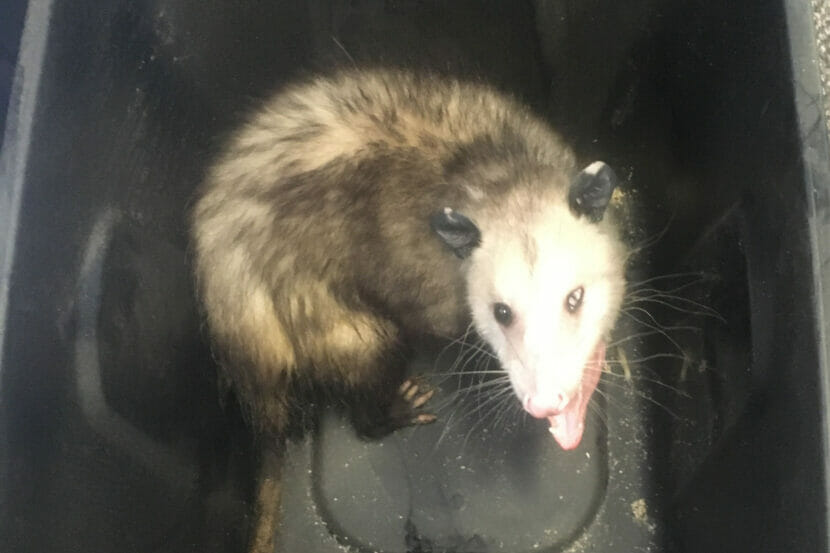
Crowder and others were able to place the opossum in a garbage can.
Herreman said biologists had originally planned to euthanize the opossum because of the dangers — ranging from predation to disease transmission — invasive species can pose to indigenous animals.
“We don’t want invasive species in the state, because of the problems that come with them, and the disruption to the ecosystem that could cause so we do our best as an agency to limit them,” he said.
According to Herreman, the fate of Grubby – named because she was discovered near Homer’s Grubstake Avenue – had become a hot topic among locals.
“There was folks who were interested in making sure this animal wasn’t necessarily destroyed, but had a chance to be re-homed or sent back to where it came from,” he said. “And then we have other folks who understand the invasive-species issues and don’t have any issues with the animal possibly being put down for the good of the ecosystem.”
After checking with regional animal facilities, Herreman said the Alaska Zoo in Anchorage volunteered to take the animal in.
Zoo director Pat Lampi said Thursday that Grubby arrived Wednesday night and will undergo an examination by zoo veterinarians.
“It’s another rescue, not something native to Alaska, but they do get as far north as into Canada,” Lampi said. “And so we decided we would go ahead and try to make a home for it.”
Because opossums are common in the Lower 48, Lampi said Grubby is likely to remain in Alaska — possibly as part of an exhibit on invasive species in the state, rather than being transferred to another zoo.
“I think it’s the first opossum that’s ever been turned in here to my knowledge,” Lampi said.
Close
Update notification options
Subscribe to notifications
Subscribe
Get notifications about news related to the topics you care about. You can unsubscribe anytime.