Southcentral

2 Anchorage Assembly members want to encourage more affordable housing with a dramatic zoning rewrite

Homes are being built in a neighborhood near Sand Lake in Anchorage, pictured here on July 5. (Matt Faubion/Alaska Public Media)

There’s a truism that comes up a lot when Alaska experts talk about ending homelessness.

“Housing is the pure solution to homelessness, hard stop,” said Alaska Coalition on Housing and Homelessness Executive Director Brian Wilson on Talk of Alaska in December.

“We know that the answer to ending homelessness is housing,” Anchorage Health Department homelessness coordinator Alexis Johnson said on Alaska Insight in May.

“You will hear me say it every time I get the chance to speak: The solution to homelessness is housing,” said Anchorage Assembly member and Anchorage Coalition to End Homelessness Executive Director Meg Zaletel at a press conference in April 2022.

In recent years, Anchorage taxpayers, charities and businesses have invested millions of dollars converting hotels into low-income housing. These units have helped hundreds of people sleeping in cars and tents and emergency shelters get into permanent housing.

Anchorage has also been spending a lot of time, money and effort helping the city’s homeless people with their most basic needs: food, shelter and health care.

“There’s that tension between the emergency safety net and the longer term investment,” Zaletel said on Talk of Alaska in December. “The solution to homelessness is housing. So if we’re intending to solve homelessness, we have to make investments in housing, and we need to maintain a safety net to keep people alive and well in the mean time.”

The pockets for directly investing in housing are only so deep, and there are only so many properties that can be converted. In an ideal free market, this wouldn’t even be a public sector problem – private developers would build the supply to meet the demand.

Instead, when experts look at the big picture, they see a lopsided housing market, where limited supply drives up rent and home prices — and the housing insecurity that contributes to homelessness.

Housing construction in Anchorage has been in a long decline. Census Bureau data show that most of Anchorage’s housing was built in the 1970s when the Trans-Alaska Pipeline System was being built, and the 1980s after the oil started flowing. Today, Anchorage has more homes that were built in the 1950s than in the 2010s.

So home prices and rents have climbed, and so has homelessness.

“Most of our real estate is over 40 years old in Anchorage – means we’re not even building enough to replace the older homes that are getting dilapidated,” said Anchorage Assembly member Kevin Cross.

Cross and Zaletel are proposing a dramatic simplification of the residential zoning rules that govern home building in the Anchorage bowl, Eagle River, Chugiak and Girdwood. Right now, zoning rules block building anything but single family homes and duplexes in huge swaths of the municipality.

Cross, who is a commercial real estate broker, said the current rules drive up building costs excessively, and also create perverse incentives for developers to build extra large, single-family homes and duplexes on a given piece of land, while market trends and demand are for more modest homes.

Cross said zoning is an initial hurdle that may block a developer from building multiple small homes with the same overall footprint and number of bedrooms as the hypothetical megahome.

“We just need to get out of our own way,” Cross said. “Let’s simplify zoning, let’s get private development back at the table.”

Cross and Zaletel are working together on a residential zoning reform ordinance. In the Anchorage bowl, it would take the 15 existing residential zoning types and collapse them into two. Similarly, in Chugiak and Eagle River it would go from 13 to two, and in Girdwood from six to two. Utility infrastructure like sewer and water would be the key distinction between the two new zones.

The specifics of the new, simplified zoning types aren’t in the proposal. Instead, it sets a goal to write them after the ordinance passes, and have the new rules go into effect in 2025. But the intent is clear: simpler building rules and more homes per acre.

Cross said that will lead to more affordable housing.

There are critics of Cross and Zaletel’s proposal. Two former Anchorage Assembly members who worked on the current zoning rules told the Anchorage Daily News it would “decimate single-family home neighborhoods” and that it would be like “throwing a bomb” at those neighborhoods.

Cross said if homeowners’ immediate reaction to zoning reform is fear, he asks them, “If you had to buy your house today, could you afford it? And the answer is alarmingly, ‘No.’”

He said that plays a big role in today’s labor shortages, outmigration and declining school enrollment.

“Affordable housing solves all our problems,” Cross said. “It gets us the workforce we need, it attracts skill and attracts competent labor. It provides that and it quits the rapid inflation of housing prices that drive people out of their homes. That’s why I’m so passionate about this zoning reform.”

The ordinance is scheduled for public hearing at the Assembly’s July 25 meeting. Cross said he expects that hearing will be delayed to allow for more Assembly deliberation in work sessions.

Anchorage’s elected officials have rolled back other regulations to encourage more housing in recent months. In January, they relaxed rules to allow for more accessory dwelling units to be built at existing properties, and in November eliminated onerous requirements for off-street parking spaces at new developments.
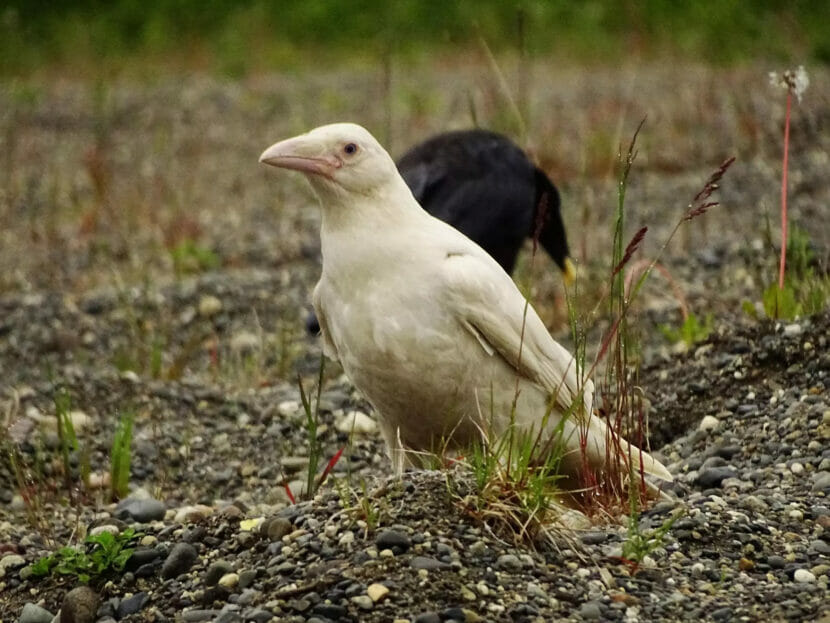
A white raven has appeared on the Kenai Peninsula

One of Gregory Messimer’s photographs of a leucistic raven in Kenai. (Courtesy of Gregory Messimer)

A white raven has been turning heads around Kenai for the last month. Gregory Messimer, a local photographer, has been documenting the bird, and he says the white raven is both visually striking and culturally symbolic.

Messimer is an amateur photographer in Kenai, who has been photographing and keeping tabs on the bird for weeks.

He first saw it on June 16 in North Kenai, among a family of mostly black ravens.

“The parents in this group had seven chicks that made it, and one of its siblings has some white feathers on its chest, and one had reddish feathers on its neck and face,” Messimer said.

According to the Kenai National Wildlife Refuge, the raven probably isn’t albino, a condition involving an absence of certain enzymes that create melanin, and results in a complete lack of that pigment. Instead, it’s what’s called leucistic, which means there’s a lack of pigment in some feathers due to an absence of cells that produce melanin.

Messimer said he took note, not just because of the bird’s aesthetic differences, but because the white raven has symbolic relevance in many religious traditions and mythologies.

“It’s an omen, or it’s a curse, or it’s a blessing, but mainly it’s ‘some sort of change is about in the world,’” he said. “Whether it’s good or bad depends on the tradition.”

In Greek mythology, the white raven is associated with the god Apollo. In Haida tradition in northwest Canada, a white raven helped bring the sun, moon and stars to earth, but turned black when it brought fire to humans.

Messimer said “white raven” is also an idiom.

“In Europe, it turns out, a ‘white raven’ is a saying for something that has a very low chance or an impossibility,” he said.

The Kenai National Wildlife Refuge posted about the bird on Facebook as sightings trickled in, and called it, “truly a once in a lifetime occurrence.” The refuge confirmed that the bird is leucistic, not albino. It has blue eyes instead of red, which would indicate albinism.

Messimer is worried about the prospects for the bird. He said the white coat makes the raven vulnerable because melanin provides structure to the feathers and skin. They’re also more susceptible to bacterial infections and to sunburns and cancers. He suspects the bird is unlikely to survive the winter.

“The white feathers don’t allow it to hold in heat, or absorb heat, so they’re reflective in the winter,” he said.

His hope, he said, is that the bird may be taken in by the Alaska Wildlife Conservation Center near Girdwood, or the Alaska Raptor Center in Sitka. In the meantime, he’s keeping an eye out for the raven to snap more photos, and hoping this one is a good omen.

Rain and mud make Mount Marathon trail ‘an absolute nightmare’

Runners take off at the starting line of the Mount Marathon men’s race in Seward on July 4, 2023. (Dev Hardikar/Alaska Public Media)

More than 800 runners tackled rain and treacherous trail on Tuesday in Seward’s grueling Mount Marathon race. David Norris, originally from Fairbanks, took first place in the men’s race with a time of 44 minutes and 51 seconds. He said it was one of the toughest races he’s ever run.

“It’s probably the gnarliest I’ve ever seen,” said Norris. “Just like, super muddy down in the woods, and then even up top where it’s usually just dry rock, that had a little mud mixed in.”

Brenna Flannery and fellow racers trudge up Mount Marathon. (Matt Faubion/Alaska Public Media)

This year marked the 95th running of the race that sends runners up and back down the towering Mount Marathon on the Fourth of July. Norris now lives in Colorado, and has run the Mount Marathon race four times. He’s also won all four times. He set the record of 41 minutes and 26 seconds in 2016.

In the women’s race, Christy Marvin of Palmer came out on top with a time of 52 minutes and 52 seconds.

“This is my 10th year, and it was my goal to make it in the top three all 10 years in a row,” she said. “And I did it today with a third win! So I’m super stoked.”

Competitors make the grueling climb to the top of the course. (Matt Faubion/Alaska Public Media)

She pulled off a close first place just 15 seconds ahead of runner-up Meg Inokuma of Palmer.

Marvin said the rain made the race especially tough this year. It slowed down all the runners, who had to be careful not to slip. The course was so muddy that competitors had to hose themselves off at the finish line.

“The conditions were an absolute nightmare and a huge mess and I was really nervous both for my boys this morning and then for myself this afternoon,” said Marvin.

Competitors make their way up the ridgeline. (Dev Hardikar/Alaska Public Media)

Marvin wasn’t the only one in her family with a first-place win on Tuesday. Her 16-year-old son Coby won the Mount Maraton boy’s race.

Tania Boonstra of Kenai, age 15, won the girl’s race.

Julianne Dickerson (left) rejoices with other racers at the Mount Marathon finish line. (Matt Faubion/Alaska Public Media)

Alaska weightlifter Bobby Hill brings home gold from Special Olympics World Summer Games

Eagle River Special Olympian Bobby Hill (right) and his father Bobby Sr. Hill won four medals at this year’s Special Olympic World Summer Games in Berlin. (Matt Faubion/Alaska Public Media)

Several Alaska athletes competed in the Special Olympic World Summer Games in Berlin, Germany this month. Eagle River resident Bobby Hill took home a gold medal and three silvers in various weightlifting events.

Hill has been doing Special Olympics for more than 30 years. He says training for multiple events means keeping up his strength. While he likes earning medals, he says he appreciates meeting other athletes more.

“It’s great, and really awesome,” Hill said. “But I like being with my friends.”

Hill earned a gold medal in bench press, lifting 70 kilograms – or 154 pounds. He took silver in squat, deadlift and combination lifting as well.

Hill’s father, Bobby Sr, says his son has always loved sports and started competing in the Special Olympics when he was 8. In addition to the accolades, Bobby Sr. says competing in powerlifting has helped his son live a healthier life.

This isn’t Hill’s first time at the World Summer Games. He competed in Dublin, Ireland in 2003 and Shanghai, China in 2007.

Hill wasn’t the only Alaskan to shine at this Summer Games. Palmer resident Gretchen Winter got 4th place in the 1500-meter run.

“Bobby and Gretchen have represented Alaska and the United States with pride,” said Special Olympics Alaska Interim CEO, Sarah Arts. “Watching Gretchen fight through an injury, never giving up, was incredibly inspiring. And Bobby rose to the occasion, lifting more than his bodyweight in all three of his lifts.”

Alaska Supreme Court considers whether Hilcorp’s financial information should stay secret

State Sen. Bill Wielechowski, D-Anchorage, speaks at a rally on Tuesday outside of the Boney Courthouse in Anchorage. Critics of Hilcorp staged the rally just before the state Supreme Court heard arguments in the city of Valdez’s lawsuit seeking to open the privately held corporation’s financial records. (Photo by Yereth Rosen/Alaska Beacon)

Three years after Hilcorp Energy Co. took over as operator of the Prudhoe Bay oil field and the near-half owner of the trans-Alaska pipeline, the Alaska Supreme Court is considering whether the public should have access to that privately held company’s financial information.

The Supreme Court on Tuesday heard arguments in a case pressed by the city of Valdez, which claims that state regulators violated citizens’ fundamental rights when they allowed Hilcorp to keep its financial information secret after acquiring all of BP Plc.’s Alaska assets.

The $5.6 billion sale by BP to Hilcorp was completed in 2020, with the blessing granted by the Regulatory Commission of Alaska. Along with that decision approving transfer of BP’s portion of the trans-Alaska pipline was the commission’s approval of Hilcorp’s request to keep its financial information confidential — a contrast to the situations with BP and other major oil companies operating in Alaska, which are publicly traded.

Robin Brena, the attorney representing Valdez, said the public has a right to know the evidence behind the RCA’s decision that Hilcorp is willing, able and qualified to manage the Trans-Alaska Pipeline System, including the Valdez marine terminal that is located in that Prince William Sound city.

“There is not on the record one shred of evidence that that’s true,” Brena told the justices in the hearing.

Valdez is not seeking to undo the transaction, Brena emphasized. But it wants public access to financial information so that city residents and other Alaskans can know whether Hilcorp, as it continues to operate the pipeline and other facilities, has the wherewithal to operate safely, to address any disasters such as oil spills, and to clean up facilities when they are no longer used, with the cost of the latter project estimated at over $5 billion.

“As it stands today, we Alaskans, nor the city of Valdez, nor this court has any way to determine whether or not the largest owner of the most important publicly regulated facilities in Alaska has $1,000 in the bank, much less the financial capacity to safely operate these publicly regulated facilities in the public interest,” Brena said.

Valdez made a similar argument but lost when a state Superior Court judge dismissed the case in 2021. The city is now asking the Supreme Court to reverse that decision and send the case back to Superior Court so that its full merits can be considered.

Attorneys representing the RCA, Hilcorp and BP spoke in succession at the hearing, and reiterated their clients’ arguments that Valdez lacked legal standing to challenge the commission’s decision and that the question of disclosing Hilcorp’s financial information is now moot.

Valdez could have filed an official complaint seeking to block the RCA action but did not do so, they said.

“This appeal is not about the merits,” nor is it about the commission’s actions, said David Wilkinson, the assistant Alaska attorney general representing the RCA. “It’s about what Valdez failed to do to bring the issues to the point of being capable of resolution and to preserve those issues for judicial review.”

Former Alaska legislator Kay Brown, attending a rally on Tuesday outside of the Boney Courthouse in Anchorage, wears a jacket with a slogan urging public access to Hilcorp Energy Co.’s financial information. Critics of Hilcorp staged the rally just before the state Supreme Court heard arguments in the city of Valdez’s lawsuit seeking to open the privately held corporation’s financial records. (Photo by Yereth Rosen/Alaska Beacon)

Michael McLaughlin asserted a similar argument. He was the attorney representing BP, which fully exited Alaska after half a century of operations in the state when it sold its last assets to Hilcorp.

“Valdez sat on its rights here and allowed its appeal to become moot,” McLaughlin said.

Justices appeared skeptical of some of those technical arguments, especially the claim that Valdez lacked standing in the dispute.

Justice Joel Bolger said such technicalities were hard to accept “when I think about the Valdez marine terminal, the location of Port Valdez – all these things that the commission and many other people just know.” He cited the city’s official comments, which concluded that any disruption of the Trans-Alaska Pipeline System would be of huge consequence to Valdez residents.

“How could you say that these interests are not sufficient to confer standing for Valdez to make this appeal on behalf of its citizens?” Bolger, who is retired but was on the panel hearing the case, asked Anne Marie Tavella, the attorney representing Hilcorp Harvest Midstream, its pipeline subsidiary. “I understand your procedural objections, but when you get right down to the substance, I can’t think of anybody that’s more concerned about this transaction.”

Tavella responded that Valdez, though it has substantial interest in the matter, was not harmed by the RCA’s approval of the BP-Hilcorp transaction. To have standing, she said, a party must be harmed or potentially harmed by an action.

A substantial crowd sat in the court’s chambers for the proceedings, which lasted for more than two hours. Among the onlookers was Vic Fischer, 99, the last surviving author of the Alaska constitution, and some former state lawmakers.

That was noticed by the justices. “We as a court appreciate the public interest in this case,” Chief Justice Peter Maassen said at the close of the hearing.

Maassen said the court will issue a written ruling sometime in the future, though he did not give an estimate of how long that will take.

There are mixed feelings in Alaska about Hilcorp’s emergence as one of the main oil industry operators.

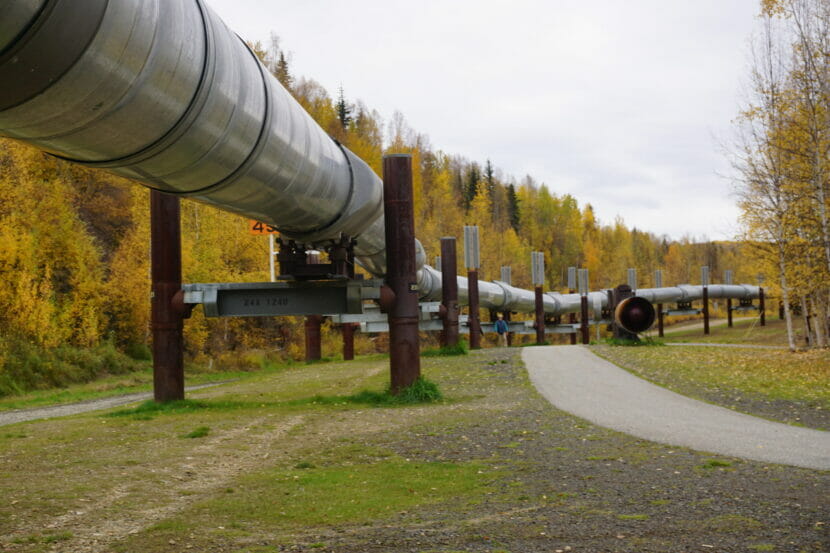
The trans-Alaska pipeline is seen on Sept. 19 in Fairbanks. This portion of the pipeline is 450 miles south of Prudhoe Bay. Hilcorp Energy Co., through its subsidiary Harvest Midstream, now own the approximately 49% share previously owned by BP. The Regulatory Commisison of Alaska gave final approval to the acquisition in December of 2020. (Photo by Yereth Rosen/Alaska Beacon)

Supporters of the company point to its successes at stemming production declines at aging Prudhoe Bay and its enhancements at other North Slope fields acquired from BP. Hilcorp has a history of rejuvenating aged oil and gas fields previously operated by major companies. It began its Alaska operations in 2012 in Cook Inlet, where it acquired assets from Chevron and Marathon Oil.

Hilcorp’s detractors say the company cuts corners and has a history of safety and environmental violations. They point to dozens of enforcement actions, the most recent one taken by the Alaska Oil and Gas Conservation Commission for drilling violations at the Milne Point field and the most serious possibly being a 2015 event at that oil field that nearly killed three workers.

Critics of the company, including members of the Alaska Public Interest Research Group and the Fairbanks Climate Action Coalition, rallied in front of the courthouse just before Tuesday’s Supreme Court hearing. They chanted slogans like “No more secrets, no more spills,” and “We are watching,” with the latter directed at the court’s justices.

Among the Hilcorp skeptics at the rally was state Sen. Bill Wielechowski, D-Anchorage. He said he fears that BP unloaded its assets to Hilcorp to avoid the huge cleanup costs involved in future dismantling of facilities, and that Hilcorp lacks the ability to cover those costs.

“Why did BP sell for such a low price?” he asked after speaking at the courthouse rally.

Wielechowski is sponsoring a bill that would force the privately held company to pay corporate income taxes to the state, just as BP did during the decades it operated in Alaska. The measure, Senate Bill 114, would apply to privately held companies in the oil and gas business that make over $4 million in profits. That change, Wielechowski said, would yield an extra $120 million a year to the state.

The oil industry and its supporters have fiercely opposed Wielechowski’s bill. In a memo that urged members to testify at a May 4 legislative hearing, the Resource Development Council for Alaska said the bill “threatens the future of oil and gas development in Alaska and would be a disaster for the economy, jobs, and Alaskans’ quality of life.”

This story originally appeared in the Alaska Beacon and is republished here with permission.

New estimate for Cook Inlet belugas shows hope for endangered population

A gray beluga whale calf and three adults swim together in Cook Inlet. A newly released population estimate shows signs of recovery, or at least stablization, among the endangered whales. The unprecedented marine heatwave known as The Blob is believed to have taken a toll, but the population has increased since that heatwave dissipated. (Photo by Paul Wade/NOAA Alaska Fisheries Science Center)

The number of endangered beluga whales swimming in Alaska’s Cook Inlet increased slightly in the past four years, providing “a glimmer of hope” for a population that crashed in the 1990s and remained at a low number long after that, according to a new estimate released on Thursday by federal biologists.

The latest population estimate for endangered Cook Inlet belugas is between 290 and 386, with a median estimate of 311, the National Oceanic and Atmospheric Administration said. That compares to NOAA’s’ Alaska Fisheries Science Center 2018 median estimate of 279 and a range of 250 to 317 animals.

The new population estimate is based on aerial surveys conducted in the summers of 2021 and 2022.

In a NOAA Fisheries statement, one of the biologists who compiled the new estimate expressed tempered optimism.

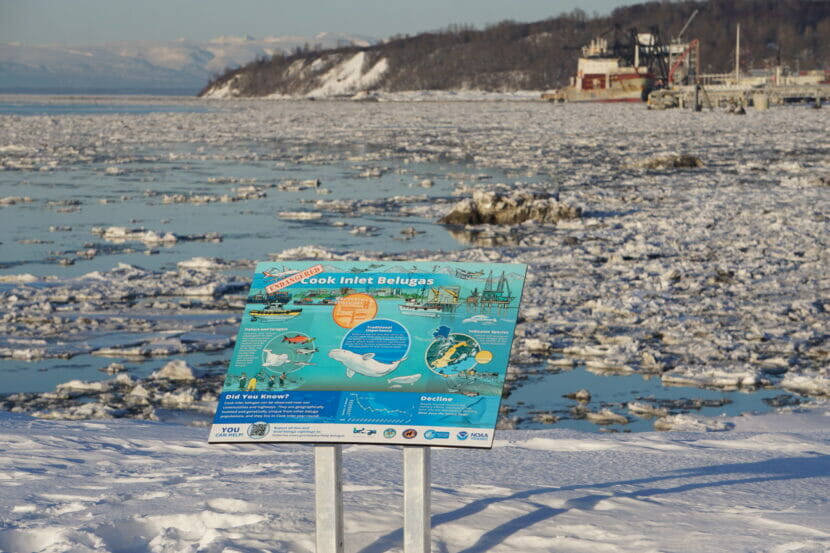
An educational sign about endangered Cook Inlet belugas is seen on March 7 at the small boat launch Anchorage’s Port of Alaska. The sign was designed and erected to raise public awareness, part of a wide-ranging strategy to help the endangered whales recover. Cook Inlet belugas’ habitat overlaps with a lot of human uses, including those at the port. (Photo by Yereth Rosen/Alaska Beacon)

“While this is certainly encouraging news, it is important to recognize that abundance estimates can vary from year to year due to a number of factors,” Kim Goetz, an Alaska Fisheries Science Center marine mammal biologist listed as the lead author of Thursday’s report, said in the statement.

Cook Inlet belugas numbered about 1,300 in 1979, according to NOAA. The steep decline that started in the 1990s was blamed on overhunting, but even after Indigenous subsistence hunting ceased, the population continued to decline. In 2008, Cook Inlet belugas were listed as endangered.

Now, a slight upturn of less than 1% a year appears to have been happening for at least a few years, according to the new population estimate.

Recent analysis of the past two decades shows that there was likely a steady increase in Cook Inlet beluga numbers from 2004 to 2010, but the population dropped over the next eight years before increasing again.

While the reasons for the 2010-2018 decline are yet unknown, the report said, a likely suspect has emerged: the sustained and unprecedented northeast Pacific marine heatwave that disrupted fish stocks and triggered die-offs in various wild populations.

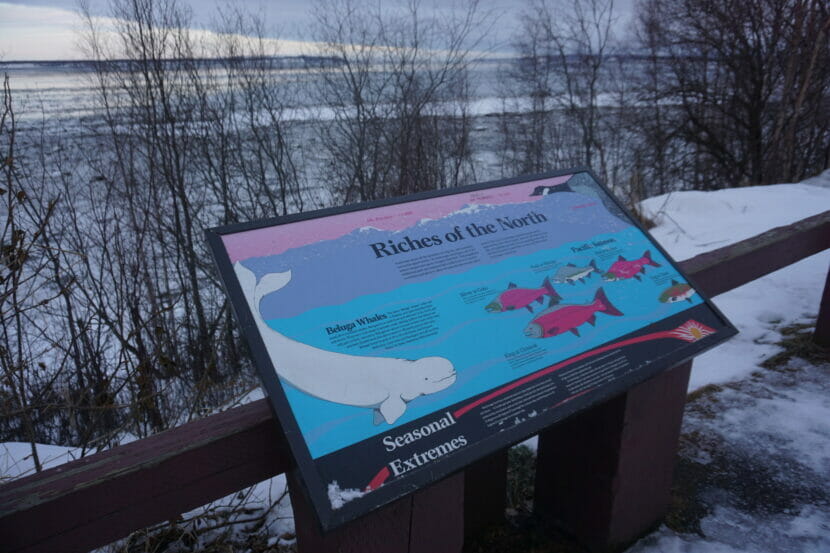
Informational sign at Anchorage’s Earthquake Park, seen on Jan. 27, describes the belugas and salmon found in Cook Inlet. Salmon make up much of the belugas’ diet, so the endangered whales suffer when runs are poor. (Photo by Yereth Rosen/Alaska Beacon)

Among the cascading effects of that heatwave, which became known as The Blob, were a near-total loss in the northern Gulf of Alaska of capelin, an important and oil-rich forage fish; mass die-offs of birds, including Alaska’s biggest die-off of common murres on record; a die-off of large whales; and a sharp decline in Pacific cod, which triggered some Gulf of Alaska commercial harvest closures. Cod are also important to Cook Inlet belugas, the report noted.

There may have also been overlapping human-caused problems for the belugas during the period of decline, said the report. Nonetheless, the increase in abundance since 2018 shows signs that the population is slowly growing or at least stable, the report said.

Cook Inlet belugas live in Alaska’s most populous and developed region. Scientists say they face a myriad of threats and potential disturbances from forces like climate change, habitat degradation, pollution, industrial noise and ship traffic in Alaska.

At the same time, they have also been the subject of numerous conservation and protection efforts. A task force with representatives from multiple government agencies, businesses, academia and other organizations has been guiding recovery work.

This story originally appeared in the Alaska Beacon and is republished here with permission.

Site notifications
Update notification options
Subscribe to notifications