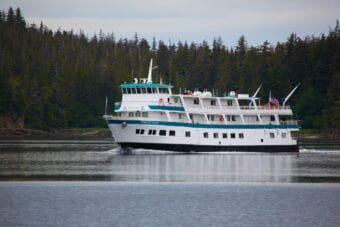
The Norwegian Joy docks in downtown Juneau on Saturday, April 26, 2025. (Photo by Clarise Larson/KTOO)
Over 3 million people visited Alaska during the tourism season that ended in April 2025 marking a new record for the state, according to data released at the Alaska Travel Industry Association’s annual convention in Anchorage Tuesday.
The Alaska Visitor Volume report includes data over the 12-month period starting in May 2024. It shows 33,000 more visitors came to Alaska compared to the previous travel season, an increase of 1.1%.
The association’s president and CEO, Jillian Simpson, said the increase was driven by the cruise sector, and that a few smaller communities saw big increases in visitation.
“There are some ports of call outside of Seward and Whittier that actually saw really big jumps in cruise visitation, and that is Kodiak, Alaska. But they were outdone by, can you guess who? Unalaska,” Simpson said.
Data in the report was gathered by McKinley Research Group. It found 88% of travelers that came to Alaska did so in the summer. Over half of visitors arrived on a cruise ship, followed by airline travel.
Juneau’s port had the highest number of passengers at 1.7 million – almost 4% higher than the previous year, according to the report. The majority of people who flew to the state came into Anchorage.
Winter travel to Alaska has been increasing over the long-term, but it dipped 5.5% last year, according to the report. Simpson said it’s the first decline since the association started tracking winter visitors in 2006. Fewer than 400,000 people came to the state during the winter months – a decline of 21,700 winter travelers from the previous season.
It’ll be months before tourism data for summer 2025 is available, but Simpson said early indicators show a slight decrease in cruise visitors and airline travel.
“On the cruise sector side, we did see essentially flat this year, which is what we were predicting with capacity,” she said. “It was ever so slightly down.”
The tourism sector supported 48,000 jobs in Alaska last year, according to the presentation.
Correction: This story previously has an incorrect byline.
Haines residents carry signs showing support for Canada during a rally and march through downtown in April. (Avery Ellfeldt/KHNS)
Escalating tensions between the U.S. and Canada last winter fueled fears that Canadians would respond by canceling cross-border visits to Alaska this summer, potentially hitting local economies.
New data shows fewer people did cross the Canadian border near Haines and Skagway this year compared to last year. Still, a full-scale boycott never seemed to materialize – at least in the upper Lynn Canal.
Skagway tourism director Jaime Bricker said she was concerned that Skagway would see fewer Yukoners specifically this season. In some cases, she did hear about people canceling trips to southeast Alaska’s northernmost town. But overall, her worries didn’t come to fruition.
“The majority of people that I’ve talked to have made a special exception to visit Skagway,” she said. “The south Klondike Highway feels like family — it doesn’t feel like one country versus another.”
That comes in sharp contrast to what happened across the country amid intensifying frustration in Canada over President Donald Trump’s trade war and his claims that the country should become the 51st state.
Nationwide border crossings from Canada into the U.S. between May and August of this year dropped by about 24% when compared to last year, according to U.S. Customs and Border Control data published last month by the federal Department of Transportation.
But in Skagway, not much changed at all, the data shows. The nearby port of entry sits just north of town. Between May and August this year, more than 68,000 passengers entered the U.S. there in personal vehicles. That marks about a 4% decrease from the same time period last year.
Bricker noted that she receives border data directly from customs agents stationed in Skagway. According to those figures, border crossings are actually up this year compared to last, not slightly down, as the data published by DOT showed. The reason behind the discrepancy is unclear.
Haines
The situation played out differently in Haines. The Dalton Cache Port of entry is about 40 miles outside town. And CBP data suggests 3,700 fewer people entered the U.S. there between May and August of this year. That represents a nearly 16% decrease.
Haines Borough Tourism Director Reba Hylton said she observed the dip, including at the local visitor center.
“We were definitely negatively impacted,” she said. “And we saw a lot less, not only Canadian travelers, but international travelers in general.”
The local economic impact is less clear. Alaska Sport Shop employee Gabe Long, for instance, said the fishing and outdoor gear store saw plenty of Canadians who have been coming to Haines for years – if not generations. But typically, they also serve a lot of younger Canadians visiting for the first time. That demographic, he said, didn’t seem to arrive in full force.
“We had about eight Saturdays where we had significantly less people than I’ve had last year,” Long said.
But it’s hard to say if that hurt sales, Long added. That’s due in part to the fact that two of the shop’s main competitors were closed this summer.
Haines Brewing owner Paul Wheeler, meanwhile, did notice a drop in business. One month over the summer, he said, sales were down about 20%. He said he observed fewer Canadians than normal, but also fewer Germans. He thinks that’s because German airline Condor canceled their direct flights to Whitehorse.
Other business owners said they really didn’t notice a shift at all. Ramie Carlson Clayton owns Ampersand, a local art gallery and said the season was business as usual. Rhonda Hinson, owner of local store Alaska Rods, echoed that point.
“The Canadian traffic this summer, I’d say, was pretty steady,” Hinson said. “I had folks in pretty much every weekend, and a lot of times throughout the week.”
The log storage facility would be located in Haines’ Lutak Inlet, pictured above in August 2025. (Avery Ellfeldt/KHNS)
A company under contract for a major timber sale in Haines is trying again to secure a permit to store harvested logs in Lutak Inlet, a key piece of its proposed operation.
As part of that process, the company conducted a required survey this spring that says the storage site is appropriate and would not affect sensitive marine habitat.
But some community members remain unconvinced. The area Fish and Game Advisory Committee submitted a comment letter on Friday that says the intertidal area of the inlet is a “sensitive habitat” for species including salmon, eulachon, or hooligan, and crab.
The committee argues the permit should not be granted absent more information about potential repercussions.
“These species provide an essential source of food security as well as cultural continuity for local residents who rely on the Inlet for subsistence harvests,” the committee wrote. “Any degradation of these habitats would directly impact the community’s ability to access traditional and sustainable food resources.”
Oregon-based Northwest Forest Products Inc. won a contract years ago to carry out the Chilkat Valley’s largest timber sale in decades, known as Baby Brown.
The timber harvest hasn’t begun. But last spring, the company’s local operator, NSEA Inc., applied for a five-year permit for log storage with the Alaska Department of Natural Resources.
Then, the agency pulled the application after realizing it skipped a crucial step: requiring a survey of the sea floor.
“We don’t have a ton of log transfer facilities anymore. So I believe that kind of just slipped through the cracks,” said natural resource manager Tony Keith. “And that was our bad, so that’s why we did pull it.”
NSEA conducted the survey in April. That entailed using a device with underwater GPS, video and mapping software to examine current ocean floor conditions.
The survey report, which was submitted with the new permit application, concludes that the site is “suitable” for the facility. And it says no sensitive or critical habitat was documented.
Then NSEA re-applied for the permit in late September. The application proposes a log transfer facility and storage area on a 12-acre site about four miles out of town, off Lutak Road. The facility would be used to transfer logs into the inlet, near the shore, where they would be stored until they’re loaded onto ships.
The survey report explains that those ships will head overseas to the export log market “because there are no in-state purchasers for logs in the northern part of southeast Alaska.”
The company has indicated it plans to begin logging the timber sale in the spring of 2026 and wrap it up before the end of 2028.
Area management biologist Nicole Zeiser said the proposed facility would directly interfere with local fishing.
“Especially with the mooring buoys that may be installed. I’m not sure how many or exact location, but that would significantly reduce access for both subsistence and commercial gillnet fishermen, but crab fishermen as well,” she said.
State Forester Greg Palmieri previously told KHNS the storage site would be about 1,700 feet long. The new permit application says it would take up about 2,500 feet parallel to the shore. In an email on Friday, he said log rafts have been used in the Lutak Inlet historically – and that facility use can easily be managed to avoid fishing impacts.
NSEA President Polly Johannsen did not respond to a request for comment.
The public has until Oct. 13 to comment on the permit application. Comments can be submitted to muriel.walatka@alaska.go.
About 50 people packed into the Haines Public Library in early October for an open house-style meeting about the Chilkat Connector Feasibility Study. (Avery Ellfeldt/KHNS)
On a dreary evening late last week, dozens of people packed into the back of the Haines Public Library. Before long, two attendees broke into a chant.
“No road! No road! No road!” they shouted.
Their words captured the tenor of the gathering, which centered around a controversial effort by the state of Alaska to study what it would take to build a road that would – at least in theory – better connect Juneau, Haines and Skagway.
The Department of Transportation and Public Facilities announced the study last spring, indicating that the plan was to assess options for the route along the west side of the Lynn Canal.
The agency organized last week’s open house-style event to provide information to the community and get feedback.
“We’re trying to show people what this project looks like, what potential benefits there are. We also want to understand everybody’s concerns,” said Greg Lockwood, DOT’s Southcoast region project manager.
Some locals have expressed support for the idea, noting that the state ferry system is unreliable and that a road could open up access for recreation and other purposes. But others are opposed, for a long list of reasons.
Attendee Shannon Donahue, who initiated the “no road” chant, is among them. In an interview, she said that as she sees it, it’s clear the state’s central goal is to “create roads to resources.”
“It’s unlikely that this whole thing is going to come to fruition,” Donahue said. “Pieces may come to fruition. Roads to logging, roads to mines, and you know, that can do a lot of damage.”
Others at the open house raised the same concern, particularly given that state officials recently unveiled plans to remove longstanding logging restrictions in the Haines State Forest and open up the entire area to logging. The potential west-side road would run through that forest and could provide better access for timber sales.
In a phone interview following the open house, DOT’s Lockwood said finding ways to partner with and benefit industry is an important part of the process. He added that the potential project “is just not purely a ferry terminal, and road to a ferry terminal.”
“If we can find added value, a freight dock, if we can find a way for mining trucks coming from the Yukon to use [a west side road] and stay out of town, or if there’s timber to be harvested, that would all be value added that would help support this roadway,” Lockwood said.
Critics of the idea have also raised concerns including the rugged terrain along the canal, which would complicate building a road and maintaining it, particularly during winter.
Other worries include implications for people traveling by ferry without a vehicle – and potential environmental impacts of the road itself.
“The Marine Highway is an excellent alternative,” said Sky Skiles, another attendee. “I think putting money into that to keep it in good shape is a better alternative than to cause so much damage to our environment.”
A new ferry terminal, route options
The idea of building a road between Juneau and Haines has been around for decades. But it’s never come to fruition, despite a smattering of earlier feasibility studies. This time around, the study will cost at least $1 million and is being carried out by DOWL LLC, a Washington-based consulting firm.
Gov. Mike Dunleavy’s administration says a road would create more cost-effective and efficient transportation for the region. That idea is that the road in Haines would reduce the length of ferry service between the two locations.
The contractor is studying two main route possibilities, which were illustrated in detail on maps set up during the event last week. Both rely on a yet-to-be-built ferry terminal at Cascade Point, about 30 miles north of Juneau.
The state signed an initial contract for that project this summer, a move that sparked criticism in the upper Lynn Canal but was welcomed by a mining company planning an ore shipping facility in the same location.
Under the first route option, travelers starting in Juneau would need first to travel from town to Cascade Point. From there, they would take a ferry across the canal to William Henry Bay, at which point they would drive north until they hit a bridge back into Haines.
In the second option, travelers would still need to get to Cascade Point and board a ferry. But the ferry would take them further north to Pyramid Harbor, near Haines. From there, they’d drive a much shorter distance to a bridge and then cross back into Haines.
Notably, neither option, as illustrated on maps, indicates how people would get to Skagway.
Lockwood, of DOT, emphasized that it’s still early days, and the agency is still purely gathering information.
“People need to understand this, this isn’t a done deal.” he said. “We haven’t made any decisions.”
The agency plans to have a draft report in December and a final version in January, which will be used to inform next steps. The public can ask for more information and provide feedback by emailing ChilkatConnector@dowl.com.
A man stands in front of acid mine drainage from British Columbia’s Tulsequah Chief Mine, which has been leaching acid mine drainage into the transboundary Taku River since it was abandoned in 1957. (Photo by Chris Miller)
Listen to this story:
Canagold representatives faced resistance from residents about their proposed New Polaris underground gold mine at an open house in Juneau last month.
The mine site is a remote area where the Tulsequah River joins the Taku River in British Columbia, around 40 miles northeast of Juneau. As the mine goes through its environmental assessment across the border, some Alaskans feel they don’t have a meaningful say in the process.
The Taku River runs through the traditional homelands of the T’aaḵu Kwáan. Butch Laiti is president of the Douglas Indian Association, which represents the T’aaḵu Kwáan. He said the tribe isn’t willing to gamble with the health of the river.
“We’re not gonna back down or give way, because there’s too much at stake here,” Laiti said. “If we lose the Taku, and then that’s it, it won’t come back. And that’s the bottom line, right there.”
The mine is projected to produce around 800,000 ounces of gold over about a decade. The project is part of a controversial wave of mining expansion in British Columbia upstream of the Taku, Stikine, and Unuk Rivers in Southeast Alaska.
Laiti said past mining projects in Canada set a precedent of damaging and neglecting the rivers that flow into Southeast.
“I know you understand our nervousness, but a lot of that’s from the history of all the mining that comes out of BC,” Laiti said.
The Tulsequah Chief mine, located just across the river from the New Polaris site, was abandoned in 1957 and has been leaching unsafe levels of toxins, including aluminum, cadmium, chromium, copper, lead, mercury and zinc into the Taku River since.
Canagold CEO Catalin Kilofliski said that the province is cleaning up the site, but it could take a decade. And he said it’s given mining a bad rap.
“I think the issues you mentioned, unfortunately, that’s the legacy of mining,” Kilofliski said. This is the legacy we are faced with — miners too.”
That legacy has continued.
For instance, the Premier gold and silver mine in British Columbia was found responsible for releasing toxic materials into the Portland Canal Watershed for years near Hyder, Alaska, and was fined in March. Also this spring, the Red Chris copper mine in British Columbia was found to have leached heavy metals into the Stikine River Watershed. In September, the province fined that mine for failing to monitor the water. Last year, a failure at the Eagle gold mine in Yukon spilled cyanide into the Yukon River Basin.
The state of Alaska signed a non-binding memorandum of understanding with British Columbia a decade ago meant to keep Alaskans informed about water quality beneath existing mines and to engage them in the public process for developing new mines. But some Alaskans say it’s not enough to make sure they’re heard or to protect the waters they depend on.
So far, almost all of the public comments submitted on New Polaris were written with concern for the lower reaches of the Taku River in Alaska.
Heather Hardcastle has been fishing at the mouth of the Taku River since she was a kid, and said the mine could harm this essential salmon run. She’s a campaign advisor at SalmonState, a nonprofit that advocates for salmon habitat across borders, and said the provincial government isn’t required to take Alaskans’ concerns into consideration.
“We still don’t have any kind of binding forum through which those of us downstream have any meaningful say in whether or not and how a mining project is developed,” Hardcastle said.
The U.S. has atreaty with Canada called the Boundary Waters Treaty of 1909. It states that “waters flowing across the boundary shall not be polluted on either side to the injury of health or property on the other.”
Despite pressure from Southeast cities and Alaska’s congressional delegation, the federal government has yet to raise the issue with the International Joint Commission, which is a framework for resolving issues under the treaty.
Canadian officials are mandated to consult with Indigenous peoples on projects that could affect their territories. There’s an ongoing dispute about whether that mandate extends consultation to tribes across the border.
Canagold signed an agreement with the Taku River Tlingit First Nation, whose territory is on the Canada-side of the border, that it won’t build the mine without their consent. It’s unclear when the First Nation will decide. The Taku River Tlingit First Nation did not respond to requests for comment.
New Polaris is now going through Canada’s environmental assessment process. A representative from Canagold said mine construction could start in 2027 at the earliest.
Olerud’s Market in Haines, pictured above in 2022. (Corinne Smith/KHNS)
Haines might soon join communities across Southeast Alaska that have tweaked their tax policies to shift the local tax burden off year-round residents and onto tourists.
Voters this week will consider a ballot measure that would increase sales tax during the summer, when visitors flock to town, and reduce the rate in winter. Sweetening the deal is a provision that would exempt groceries from sales tax entirely during the winter months.
“Over the course of a year the visitors and seasonal residents will pay more and year-round residents (depending on who they are and what they buy when) should pay less or the same as they do now,” Haines Borough Finance Director Jila Stuart said in an email on Thursday.
Local sales tax in Haines is currently set at 5.5%. If the measure passes, it would boost the rate to 7% between April and the end of September. The rate would fall to 4.5% for the rest of the year – excluding groceries, which would not be subject to sales tax at all in winter.
The goal is to raise funds for two key purposes: school funding and road improvements.
“I think it’s an agreeable enough deal, in so much as folks will get 5.5% off groceries all winter long, and they’ll get 1% off everything else,” Haines Mayor Tom Morphet said in an interview this week.
Morphet has been a major proponent of the provision, which is modeled after versions adopted in communities across Southeast. Among them are Craig, Pelican, Seldovia, Ketchikan, Sitka and Skagway – Haines’ closest neighbor.
Each seasonal sales tax looks slightly different. But the goal generally speaking is to take advantage of the busy summer season to generate local tax revenue.
Consumers in Skagway for instance, currently pay a 5% sales tax in the summer and 3% in the winter. But that could soon change. On the Skagway ballot this year is a measure that would boost summer sales tax by another 2%. In exchange, the borough would waive local utility fees.
Morphet has done a handful of public presentations about the tax. He said he has heard some concerns, including extra administrative costs for businesses, and that the tax could discourage people from shopping in Haines.
All told, the tax is expected to generate about $280 thousand dollars – which amounts to a 6% boost to local sales tax revenue, according to the borough.
Morphet acknowledged that 6% is an “incremental” figure. But he emphasized it’s still a crucial sum given that the borough is grappling with a $1 million budget deficit that he says has to be made up somewhere.
The deficit is due in part to federal funding cuts and a senior tax exemption passed by voters last year. But it also resulted from the borough needing to kick in more than half a million dollars more for the school this year compared to last, to make up for insufficient state funding.
That’s a challenge facing communities across Alaska.
“Communities are responding by adopting a seasonal sales tax,” Morphet said. “In Craig, the seasonal sales tax goes entirely to the school. And you know, until we have a new governor, our hands are going to be tied.”
If passed, the Haines borough expects that year-round residents would spend roughly the same amount in sales tax that they currently do.
Someone who spends $30,000 per year on taxable goods and services – $7,000 of which is groceries – would spend about $80 less on tax under the new structure, according to a borough fact sheet.
That could look different depending on the person. The math might not pencil out as well for someone who spends a lot on gasoline in the summer, for instance, as opposed to groceries.
Close
Update notification options
Subscribe to notifications
Subscribe
Get notifications about news related to the topics you care about. You can unsubscribe anytime.