The Chilkoot Indian Association will ship donations to Anchorage, including these jars of saak eix̲í, or hooligan oil. (Avery Ellfeldt/KHNS)
Haines and Skagway have joined communities across Alaska that are doing what they can to support the more than one thousand people displaced by ex-Typhoon Halong last month.
Skagway’s donation drive is focused on clothing and gear, as opposed to food. Residents have until the end of the day on Wednesday to drop items from a long list at the Dahl Memorial Clinic, the local health care facility. Donations will be handled by nonprofits in Anchorage.
“The items that they’re looking for are clothes of any sort, preferably new, sleeping bags and pillows and hygiene items like toothbrushes and things of that nature,” said Albert Wall, the clinic’s executive director.
Wall emphasized that people should bring items that are either new or gently used – and clean. Other acceptable donations include air mattresses, duffle bags, cell phone chargers and crafting supplies.
“We’ve had a pretty good response so far,” Wall said.
In Haines, meanwhile, the Chilkoot Indian Association initially asked the community to drop off traditional, harvested foods. But council President James Hart says they will accept any food donations, as long as they’re shelf stable and not expired.
“The preference would be something that you harvested,” he said. “But we shouldn’t be pushing anything away.”
On Monday, at the tribe’s downtown office, there were several boxes of canned goods, including sockeye salmon, homemade applesauce, highbush cranberry juice and hooligan oil.
Soon, there will also be three cases of canned seal meat. Hart, along with locals Zack James and Nels Lynch, harvested the seal in late October to contribute to the effort.
Hart said he knows first-hand how important it is to help when communities are struck by disaster, referring to the 2020 atmospheric river event in Haines that triggered widespread destruction and a fatal landslide.
“I know how much we pulled together as a community, and how much outside help we received, so having the opportunity to give back in that way is special,” he said.
“My heart goes out to all those folks and the challenges they’re going to be going through,” Hart added. “They just went through a whole harvest season, and I’d assume all of that has been lost. That’s so hard to hear and think about and even fathom.”
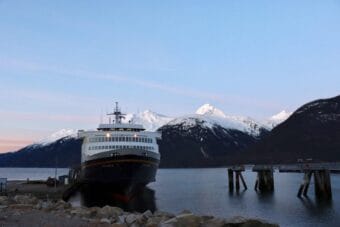
The Alaska Marine Highway System ferry Hubbard approaches the dock in Skagway on July 28, 2024. (Eric Stone/Alaska Public Media)
A state plan to build a new ferry terminal north of Juneau is hard to justify on its financial merits but could pose long-term benefits, including more flexible regional travel and a boost to the mining industry.
That’s the conclusion of an economic analysis released by the Alaska Department of Transportation in mid-October. It weighs the agency’s plan to shorten the ferry route between Juneau, Haines and Skagway by routing passengers through a new terminal located 40 miles outside the capital city.
For months, local officials and members of a key advisory board have called on the state to provide an economic analysis or feasibility study of how the project might help – or hurt – travelers. At least so far, they’re unimpressed with the resulting document.
“It’s not convincing me,” said Haines Mayor Tom Morphet. “And it’s certainly not, even in their own words, a slam dunk.”
Bob Horchover of the Alaska Marine Highway Oversight Board echoed that point during a meeting last week. He said the analysis, which was first reported by the Juneau Independent, read “like a timeshare brochure.”
“I don’t think it was realistic, and I’m not sure where they got some of their numbers,” he said.
At issue is the so-called Cascade Point ferry terminal project. The state says it’s been working on the idea for several years. But DOT recently kickstarted the effort by signing a $28 million contract for the first phase of the project.
The site is located on land owned by Goldbelt, Inc., a Juneau-based Alaska Native Corporation. News of the initial contract was welcomed by Canadian mining company Grande Portage, which plans to develop an ore terminal at the site – in partnership with Goldbelt.
DOT, for its part, argues the project would reduce operating costs and ease passenger travel by moving the ferry terminal significantly closer to Haines and Skagway, shortening the ferry route.
The new economic analysis assesses those claims plus concerns raised by critics. It was written by a contractor, Ed King, who formerly served as chief economist and economic advisor for the state of Alaska.
On the whole, the report acknowledges that the project’s “extensive capital costs” are “difficult to justify based on savings alone.” Still, it paints a picture of the so-called Cascade Point ferry terminal as a project with more pros than cons – especially in the long term.
“In conclusion, although the Cascade Point Ferry Terminal presents challenges as an independent initiative,” the report reads, “it may prove valuable as a strategic investment that facilitates resource development and improves access to the Capital.”
A skeptical ferry board
That framing drew sharp criticism from members of the Alaska Marine Highway Oversight Board during a meeting last week.
Board Chair Wanetta Ayers said it seems like the analysis aims to “build a case for Cascade Point,” as opposed to evaluating it against alternative options.
“I don’t believe it makes a strong case, certainly from a customer service standpoint, and very marginally from an economic standpoint, that the project is justifiable,” Ayers added in a follow-up interview.
That’s concerning, she said, given that dollars are already being allocated to it — and that there’s a long list of other ferry-related projects in desperate need of funding. The nearly 45-page report explores potential impacts from the terminal, which would shorten the ferry ride between Juneau, Haines and Skagway.
The analysis acknowledges that the terminal would create new infrastructure and maintenance responsibilities for the state. It also finds that “construction costs are unlikely to be recovered in a meaningful timeline without additional changes.”
Another con is that passengers would have to make up for the shorter ferry route by traveling 28 more miles outside Juneau. That would make regional travel more expensive, given extra gas, vehicle wear and tear, and ferry fares that would stay the same.
Goldbelt has committed to running a bus service to transport passengers between Cascade Point and Juneau. But uncertainty remains about the reliability and cost of that shuttle for those traveling without a vehicle – and about what the longer drive would mean for those who do bring a car.
“My guess – and obviously, I’m not an economist – is that for the average user, it’s not a clear cut win, to put it most lightly,” said Morphet, the Haines mayor. “And certainly, to a lot of people, I think would be a loss” of access.
DOT spokesperson Danielle Tessen did not directly address those concerns during an interview Wednesday morning. She said shortening the ferry route ultimately comes down to saving money for the chronically underfunded ferry system.
“That is what we’re focused on, is creating these shortened ferry distances, because that’s how we’re able to continue reducing the cost of operations,” Tessen said.
Cascade Point “not an on-its-own project,” DOT says
The analysis concludes that the new terminal would reduce planet-warming emissions and operating costs. Shorter ferry runs would result in “modest reliability gains” and an estimated 5% bump in ridership, it says.
But the real value comes from other long-term factors.
“Cascade Point, and this terminal, it’s not an on-its-own project,” said Tessen, of DOT. “And what I mean by that is, there is a bigger plan.”
That bigger plan has two main prongs. The first is another DOT effort, known as the Chilkat Connector Feasibility Study, which has also faced fierce opposition in the Upper Lynn Canal.
The agency is assessing what it would take to build a road aimed at easing travel between Skagway, Haines and Juneau. Cascade Point, the analysis notes, would be a “foundational” component of that effort.
The second prong is regional economic development by way of mining. The analysis says the new terminal would serve as a major boon for Grande Portage Resources’ proposed New Amalga Gold Project, which would likely use Cascade Point as its logistical base.
Morphet took issue with that logic.
“It’s kind of based on this trickle-down view of the economy, that if there’s commercial or industrial development at Cascade Point, there’s a greater benefit to the public,” he said.
“But is there a greater benefit to the traveling public?” he added. “That’s what this question is about: transportation.”
Horchover, the operations board member, echoed that point.
“I don’t know exactly what the motivation is, but it sure isn’t for the good of the Alaska Marine Highway service,” he said. “That’s my two cents.”
The board has previously raised concerns that the Cascade Point planning process deviated from the ferry system’s long-range planning process. During last week’s meeting, the board voted to write a so-called “corrective action” letter to the agency and state legislature saying as much.
The state announced on Wednesday that it is soliciting public comment on phase one of the project through Nov. 28.
Jerod Cook opens the door of Bravo’s kennel on Petersburg’s Sandy Beach, releasing the seal back into familiar waters on Oct. 23, 2025. (Olivia Rose/KFSK)
Back in May, National Marine Fisheries Enforcement Officer Jerod Cook responded to a call from Petersburg’s police department about a stranded baby seal at the Libby Straits, south of town.
“He was just hanging on to the beach there,” Cook said. “We never did see a mother for it.”
He moved the seal to a safer location, then came back to check on it the next day.
“It was obvious that something, a decision, needed to be made,” Cook said.
After several weeks of treatment at the Alaska SeaLife Center in Seward, that seal returned home on Oct. 23. Over a hundred people gathered at Sandy Beach to see the nearly five-month-old Bravo get released back into the wild.
Among the excited crowd was coach Matt Pawuk’s middle school basketball team. He admitted that they should have been at practice.
“I like to say it’s because they’re gonna get extra credit in their science class,” Pawuk said. “But mostly I’m doing it out of selfish reasons, because I really want to see this.”
Over 100 people gathered on Sandy Beach in Petersburg to see off the rescued seal on Oct. 23, 2025. (Olivia Rose/KFSK)
Nearby, members of Petersburg’s outdoor child care program gathered along the water.
“We love watching the seals when they’re here,” Kinder Skog co-founder Katie Holmlund said. “So it’s really exciting to get to see one released back into the wild.”
In May, after rescuing the baby seal, Cook sent it on that morning’s jet to Seward.
“His mother hadn’t come to him, and so I checked with the sea life center. They said they’d take him,” Cook said.
Jane Belovarac is the wildlife response curator with the Alaska SeaLife Center. She said they estimated Bravo was about three days old when he was found.
She said there are a number of reasons why a baby could get separated from its mom, but they don’t know what happened with Bravo.
The Alaska SeaLife Center is the only licensed marine mammal rehabilitation center in the state, and they got straight to work getting Bravo ready to go home.
“When this guy first came to us, he was about 16 pounds,” Belovarac said. “He now weighs over 50 pounds, so he is at a really good weight to go back out into the wild and start hunting on his own.”
In addition to helping Bravo pack on the pounds, the center also had to prove that he could hunt on his own and that he would have more than a 50% chance of surviving in the wild.
“We definitely feel very confident that this guy is going to do well,” Belovarac said.
Among the gathering at Sandy Beach, Jonas Banta was waiting for the seal’s arrival. Banta had already gotten a sneak peek of Bravo because he flew in on the same jet. Banta came to Petersburg to go deer hunting, but when he heard about the seal’s release, he came to check it out.
He said flying on the same plane as a seal was “actually very exciting,” and that the smell of the seal was also pretty prominent.
“It was smelly,” he said. “It smelled just like herring.”
Bravo enters the waves at Petersburg’s Sandy Beach on Oct. 23, 2025. (Olivia Rose/KFSK)
Bravo arrived in a kennel in the back of a pickup truck and was promptly swarmed by children, eager to see him. He was soon carried past the excited crowd and brought to the water.
The crowd quieted down as Belovarac told Bravo’s story from the shoreline.
“He hasn’t seen the ocean in a very long time, and he’s never seen this many people. So we don’t want to scare him,” she said, asking the gathering to give the seal space.
Cook opened the door to the kennel, and Bravo hopped out into the waves.He came back to the beach once before heading off into the water, where other bobbing seal heads were waiting.
Belovarac says if you see a marine mammal that you think needs help, you can call the 24-hour NOAA statewide hotline at (877) 925-7773, or the Alaska SeaLife Center 24-hour hotline at (888) 774-7325.
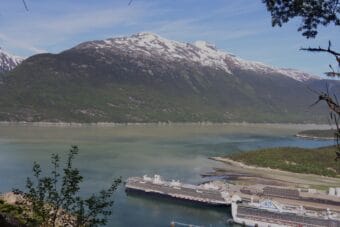
The Norwegian Jewel berths below the Railroad Dock in Skagway on Friday, Sept. 6, 2024. (Photo by Clarise Larson/KTOO)
A major rockslide has been threatening Skagway’s busiest cruise ship dock in recent years. Numerous industry experts were in town recently to present options for long-term mitigation. None of the choices were easy or cheap.
A rockslide above Railroad Dock in 2022 prompted a study by the geological firm Shannon & Wilson. That report stated the firm’s opinion that “the slide mass will eventually fail and the consequences of such failure will be catastrophic in nature with significant risks to life and property.”
Since then, the municipality has been doing routine scaling work, which is basically removing loose rock. Crews installed additional fencing and netting and instruments to measure ground movement. During tourist season, they send someone up the mountain each morning to take photographs. But, these are all admittedly short-term solutions.
“Nobody wants the big failure to happen and then not be ready for it,” said Kyle Brennan, project manager for Shannon & Wilson.
Brennan said the mountain needs long-term mitigation.
“We’re able to keep track of what’s happening up there. And right now, we have safe operation of the facility at the bottom,” he said. “But it’s time to move forward and take care of this larger hazard with these unstable rock masses at the top of the slope. Because predicting when that failure will eventually happen … is very difficult. And so right now, we have time. To be proactive about these things and take care of them is in the best interest of the community and everybody else.”
Shannon & Wilson presented four options. Option one concedes that the rock is too difficult to move and will therefore remain in place. The dock and everything below would be moved to a safer distance. Option two is excavating the unstable rock and sending it down the slope, where it is collected and hauled off-site. Option three leaves the rock mass in place and attempts to stabilize it. Brennan says this would be a “case study.” Option four would excavate the rock mass and move it up the slope, leaving it on the mountain.
The team wholeheartedly prefers option two.
“We’re looking at modifications to the dock,” Brennan said. “But for the most part, it’s just simply excavation and removal and letting gravity move the rock for part of it, and then picking it up and putting it somewhere else. This seems to be like our lowest risk option right now.”
The municipality was awarded a nearly $20 million grant for the project from the Federal Emergency Management Agency. But a majority of that money dissipated with President Donald Trump’s administration, leaving only the funds for the design portion of the project.
However, the municipality chooses to move forward, and however they manage to pay for the multi-million-dollar project, Brennan said it’s not going to be easy.
“It’s a tender site,” he said. “It’s going to take a lot of TLC to get that rock down. And so we want to make sure we’re doing it in a purposeful manner that’s safe, that’ll achieve the goal without catastrophe. The last thing I want to do is stand up here in front of you guys in a couple years and try to explain why everything went sideways…”
Skagway resident Lynne Davison was one of many intently listening to the presentation.
“And so I hear you talking about these alternatives and when the decision is made,” she said. “But how and who? How is that decision going to be made?”
“The decision, the ultimate decision is not one that Shannon & Wilson and our design team will make independently of anybody else,” Brennan answered. “The city will be involved with that decision. And ultimately will likely be the ones to make that decision based on our input and based on all of your input.”
Brennan said there will be at least two more public meetings before the construction phase. If funding is procured, that could start in 2026 and would take place between tourist seasons.
Snow geese take off at the Beach Meadows in Gustavus on May 13, 2022. (Photo Courtesy of James Mackovjak)
A private beach in Gustavus known as the Beach Meadows is now protected by a conservation easement the owners signed with the Southeast Alaska Land Trust, or SEALT.
Bailey Williams is an outreach and development specialist at SEALT. She said the temporary easement will protect the land for up to five years.
“We are using that time to secure funding for the permanent conservation easement,” Williams said.
She says it will cost around $800,000.
The easement covers 187 acres of coastal meadow that rose out of the ocean in the last century or so as melting glaciers shed weight from the land. Williams said it’s important habitat for migratory birds, moose, wolves, bears and other animals, and a great place to forage for berries and seaweed.
The land is owned by the DeBoer family, which started a homestead there in the 1950s. The family did not respond to a request for comment.
Mike Taylor is a Gustavus city council member and chair of the Conservation Lands Advisory Committee. He said the current owner has continued his family’s legacy of providing public access.
“He has kept it open, though, and encouraged people to enjoy hiking and picnicking, skiing, birding, berry picking and so forth on it, as his father and grandfather had,” Taylor said.
Taylor said he wanted to formalize that arrangement.
“With their spectacular views of Icy Strait and the Fairweather Range behind, the property could, in the future, be a prime target for development,” he said.
He said this is the first step toward ensuring that doesn’t happen and the land remains accessible to everyone in the community.
Correction: A previous version of this story included an incorrect estimate provided by SEALT of the permanent easement cost.
Skagway resident Katie Auer said she hasn’t grocery shopped at the local store in more than a year due to concerns over store quality and prices. (Avery Ellfeldt/KHNS)
This is the second story in a four-part series from the Alaska Desk called Shelf Life, which looks at food security in Alaska.
In the very back corner of Skagway’s only grocery store, a laminated sign boasts: “LOCAL GROWN.” Above it sits a container with bundles of radishes. Next to them, a few boxes of greens.
But that’s all there is. Everything else in the store is shipped in from very far away – and it shows. While walking the aisles of the AC Fairway Market earlier this month, resident Katie Auer picked up a bag of partially wilted and bruised mini peppers.
“You’re telling me I’m going to pay 9 dollars and 29 cents for a bag of peppers, that I’d have to throw away over half of them?” she said, shrugging.
Grocery chain Alaska Commercial Company bought the store in 2021 from long-time local owners. And Auer is among those who contend that the store is expensive, the shelves aren’t well stocked and the produce rots quickly.
Greens and radishes fill the small section of Skagway’s store that carries locally grown produce, pictured above in early October. (Avery Ellfeldt/KHNS)
Locals say that’s particularly true during summer – and that things are better in Haines, Skagway’s closest neighbor.
“Why is our produce so much more expensive?” Auer asked. “Why is our food in general so much more expensive than Haines, when it’s 13 extra nautical miles to get here? Why is it so much more rotten?”
A few factors drive those challenges, including shipping costs and the drastic seasonal population swings that come with hosting cruise ships in the summer.
Both make it harder to keep the store well stocked and profitable.
In response, some residents seem to be doing what they can to avoid the store entirely – including getting same-day grocery deliveries by small planes.
A catch-22
Skagway’s supermarket woes are not unique in Alaska, where communities across the state struggle to access affordable, fresh food.
But Skagway has some advantages other remote communities don’t. For starters, it’s connected to an international highway. And like much of Southeast, it’s on the barge route, which is perhaps the most efficient way to transport food.
“Certainly, within the data I see, as Southeast compares to the rest of the state and off-road Alaska, it’s a significantly lower quantity of food that actually spoils in transit to a store,” said Mike Jones, a food systems economist at the University of Alaska Anchorage.
But different communities face different challenges. In Skagway, they largely revolve around one main issue. The town’s wintertime population hovers around 900 people. Then, in the warmer months, it booms amid an influx of tourism workers and, on some days, more than 10,000 cruise ship passengers.
Lee McKinney has managed the local store since 2021, when it was purchased by Alaska Commercial Company. (Avery Ellfeldt/KHNS)
That sets the store up for a complicated guessing game: ordering, storing and stocking enough food to last through the week without shipping in so much that products rot in storage or on the shelves.
“In the summer, I don’t have enough space to maintain all the produce I could sell,” Lee McKinney, the Fairway manager, said. “But the other side of the coin is, if I do, a larger portion of that produce is going to go bad and have to be thrown out before I do sell it. It’s a catch-22.”
During the off-season, meanwhile, people complain that store shelves appear empty and that there are plenty of products the store doesn’t offer at all. Auer noted she prefers to drink skim milk, but that the store doesn’t carry it.
Brooke Jasky-Zuber, another local, said the store has limited organic products and few meat substitutes for her partner, who is vegetarian.
McKinney said he does what he can to meet folks’ needs, including ordering entire cases of certain products if a customer says they’ll buy all of it. But he added that he has to order specialty and more popular products based on what will actually sell.
“If I bring in that full shelf load, 90% of it’s going to date out before it sells and means I’ve got to write it off and throw it away,” he said.
“We got to make sure to make money with that space,” he added.
Skagway resident Brooke Jasky-Zuber shows off tomatoes grown at the local farm run by the Skagway Traditional Council. (Avery Ellfeldt/KHNS)
Quality and cost concerns
It’s less clear why the quality of food in Skagway would be worse than in Haines or Juneau. Jones, the food systems economist, said there could be a few factors at play.
He said stores could use different quality distributors. But they don’t. The Fairway in Skagway and the two Haines stores all use Rhode Island-based United Natural Foods Inc. for general grocery items. For produce, both the Fairway in Skagway and Olerud’s Market Center in Haines use a Seattle-based distributor called Charlie’s Produce.
Another factor could be the length of time food sits on the barge. But it doesn’t take that much longer for food to get to Skagway than it does to Haines or Juneau.
Product turnover could also help explain the problem. Consider a minimum shipment of lemons. It would likely take longer to sell those lemons in Skagway than in larger communities like Juneau or Haines.
“The big challenge is maintaining your product and not seeing everything date out on you because you don’t turn it fast enough,” McKinney said.
A container of hummus at Skagway’s AC Fairway Market rang in at $7.29 early this month. (Avery Ellfeldt/KHNS)
Then there’s the issue of prices, which fluctuate frequently and are determined by factors including freight costs, corporate pricing structures and more.
KHNS compared eight products at one store in Skagway to the same products at Howsers IGA Supermarket in Haines, including milk, various greens, and shelf-stable groceries. Everything was cheaper in Haines except spinach.
Jones, the economist, said that checks out.
“Skagway is on the high end within Southeast in terms of the prices that I can see for a couple products that happen to be right in front of me,” he said. “That’s not necessarily unreasonable, because they are farther up the barge away from Seattle.”
Grocery shopping by small plane
The challenges in Skagway underscore that even in communities with better access and infrastructure, struggles abound. And for some, the situation has reached a tipping point.
Auer, the Skagway local, said she hasn’t shopped at the Fairway in more than a year. Instead, she hits stores in Canada, Juneau and Haines when she can.
And she ships a lot of her food from out of town, including via Instacart — from Juneau.
Instacart is a service that allows people to order their groceries online and have someone pick them up at the store and deliver them to their doorstep.
In rural Alaska, it looks a little different. Customers can place their weekly orders from Skagway. Then, a driver in Juneau heads to Costco or Fred Meyer, shops, and delivers the food to the airport. From there, it’s loaded onto a flight and flown in – typically the same day.
“You can get two dozen free range organic eggs for $8 from Costco,” Auer said. “And they are $10.50 including shipping, including paying Instacart, tipping my driver and $1 per pound shipped here from Juneau.”
That day at the Fairway, there were two options for eggs: one cost $12 a dozen, the other about $9.
Brooke Jasky-Zuber walks through the Skagway Traditional Council’s farm in early October. (Avery Ellfeldt/KHNS)
Flying food around southeast Alaska is far from new. But reliance on Instacart seems to be. Data provided by the company indicates that annual Instacart deliveries to the Juneau airport have more than doubled since 2019.
Jasky-Zuber is among those who said that relying on the local store to fill her fridge and pantry just doesn’t make sense any more. For the last four years, she’s managed the local tribe’s farm, which is where the locally grown radishes and greens in the store came from.
Jasky-Zuber said she sources most of her produce from the farm in the summertime. But otherwise, she stocks up on bulk items in Whitehorse, Canada – and ships plenty in from Juneau.
“Not because I don’t want to support our grocery store. I do,” Jasky-Zuber said. But ultimately, she added, “I find mostly other ways to get the bulk of what I need.”
Close
Update notification options
Subscribe to notifications
Subscribe
Get notifications about news related to the topics you care about. You can unsubscribe anytime.