Southeast

Global backcountry ski and snowboard event set to return to Haines next year

Haines is considered 'the dream stop' among skiers and snowboarders around the world.
Haines is considered “the dream stop” among skiers and snowboarders around the world. (Avery Ellfeldt/KHNS)

The backcountry ski and snowboard community has long dubbed Haines “the Dream Stop” for the rugged terrain and pristine conditions it offers athletes.

Less than a year from now, the area will have the chance to live up to that moniker again during the Freeride World Tour, a competition of the world’s top riders.

The event will mark the first time the tour has visited Alaska since 2017. Tour CEO Nicolas Hale-Woods said that’s a major win for the tour and the athletes it draws — many of whom have dreamt about competing in the region their whole lives.

“Alaska, and Haines in particular, is the ultimate free ride destination,” Hale-Woods said in an interview. “And we’re very, very happy to put that stop on the calendar once again.”

The tour announced the Haines stop earlier this week. It will be the fifth in a series of six competitions where skiers and snowboarders fly down ungroomed slopes, chasing a world champion title.

The athletes have to start and end at a certain point on the mountain. But otherwise, they’re free to choose their route. Using binoculars, judges score and rank participants out of 100 points.

“They’re not allowed to ride and ski the mountain before their competition run, which makes it very difficult,” Hale-Woods said. “They have to basically memorize their line and show control, fluidity and jumps.”

After a three-year run in Haines between 2015 and 2017, the event shifted to other locations because it cost too much money to get competitors and support crews to Southeast Alaska — and into the mountains via helicopter, Hale-Woods said.

This year, the event has funding help from outside sponsors, including outdoor goods company Yeti and apparel brand Peak Performance. But the Haines borough also plans to kick in at least $75,000 to make it happen and is looking for ways to potentially contribute another $25,000, said Haines tourism director Rebecca Hylton.

The funding was allocated during last year’s budget cycle and then reapproved this year. Hylton said the money will come from a funding bucket meant for tourism and economic development.

In a funding pitch to the borough, she estimated the event could generate more than $400,000 in local spending, providing a boost to the town’s economy in the off-season, when it needs it most.

All told, Hylton said the competition is expected to bring more than 100 people to town for about a week, depending on the weather.

“They’ll be staying here in town, and a few people up the highway as well,” Hylton said. “And there should be a really positive economic impact to our community, to different sectors of our community.”

Ketchikan woman officially sets Guinness World Record for largest mouth

Ketchikan resident Marie Pearl Zellmer Robinson measures her mouth with a pair of digital calipers.
Ketchikan resident Marie Pearl Zellmer Robinson measures her mouth with a pair of digital calipers. (Marie Pearl Zellmer Robinson)

It’s official: A Ketchikan woman now holds the Guinness World Record for “largest female mouth gape.” That’s how wide you can open your mouth vertically.

Guinness World Records announced Marie Pearl Zellmer Robinson as the new record holder on April 9. In an accompanying video, Robinson narrates as she fits a cheeseburger stacked 10 patties high between her teeth.

A Ketchikan dentist measured her open jaw at over three inches wide. The measurements varied but Guinness reported an average of 7.28 centimeters. Robinson said she was able to get up to 7.62 centimeters and may still be widening.

“I’m pretty sure I can beat my own record in the future as well,” Robinson said in her Guinness World Records video.

She shattered the 6.52-centimeter record previously held by Samantha Ramsdell, a Connecticut woman.

“Holding a record for something is like making a fact that the whole world can learn from. And people can look at that and think “that’s something that really exists,” she said.

Robinson and her husband co-founded a local delivery service called Ketch-A-Courier. She told KRBD in an interview prior to setting the record that she was inspired to reach for fame by an earlier Ketchikan record – when nearly 2,000 Ketchikan residents donned rainboots a little over a decade ago and broke the world record for “largest rainboot race.”

“Every time I see somebody do something amazing, I’m like, ‘Well, I can’t do that,'” she said. “But this one was one that I could do, and I surprised myself even.”

Robinson said if anyone thinks they can beat her world-class jaw, she welcomes the challenge.

Tlingit and Haida tribal assembly votes to limit number of delegates from outside Southeast Alaska

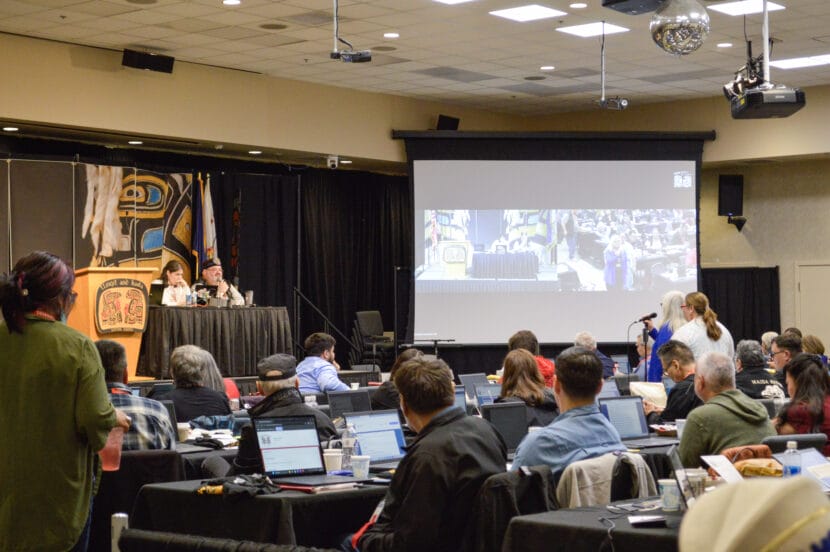
The Central Council of the Tlingit and Haida Indian Tribes of Alaska’s 90th tribal assembly meets in Juneau on April 18, 2025. (Photo by Yvonne Krumrey/KTOO)

Southeast Alaska’s largest tribal government approved a rule change Friday that greatly reduces the number of representatives from communities outside the region.

Delegates from places like Seattle and Anchorage say the amendment limits the voices from some of the largest communities of tribal members, but delegates from Southeast say this gives rural tribal members more of a voice. 

Friday was the last day of the Central Council of the Tlingit and Haida Indian Tribes of Alaska’s 90th tribal assembly in Juneau. The majority of delegates approved an amendment that reduces the maximum number of delegates from urban communities like Anchorage, Seattle and San Francisco to four delegates each. 

One of Sitka’s delegates, Gerald Hope, said a larger proportion of representation from tribal villages would show support to those communities. 

“The village communities are hurting really badly. How can we stand with them?” Hope said. “One of the things in this kind of form of government is to give them a modest increase in voice.”

The five-hour debate brought up questions of representation and belonging, and what leads people to leave their home communities. 

“Those of us who live in urban areas are there for things that are out of our control,” said Anchorage Delegate Tasha Hotch, who said she left Southeast because of domestic violence. 

“I’ve tried to move back to Juneau, I’ve tried to move back to Klukwan,” she said.

Other delegates who live in Anchorage and Seattle said that lack of opportunity and financial stability led them to leave their villages as well, but this shouldn’t limit their voice as tribal members. 

According to representatives from Tlingit and Haida, the amendment is part of a broader plan to review the structure of government to better reflect the tribe’s citizenry. 

It would also reduce Juneau’s delegation — and any within Southeast Alaska — to 20 people. Even with the reduction, Juneau will be allotted the most delegates in the assembly. 

Before the amendment passed, Seattle was tied with Juneau with 25 delegates that represent the community’s interests to the broader tribal government. Communities elected one delegate per 200 tribal citizens. But this resolution raises that threshold to 275 citizens. 

Seattle has the most enrolled tribal members of any community, with more than 9,000. Juneau has more than 7,000.

The resolution doesn’t propose any changes to tribal services in communities like Anchorage and Seattle, where Tlingit and Haida has offices, but the delegates that came from those communities said representation itself matters too.

Karen Elliott-Lauth, from Seattle, asked for more time to compromise on the resolution. 

“So I’m just asking you guys to table this,” she said. “Let’s get together and make solutions instead of being so divided, that’s all I ask.”

Wrangell Delegate Mike Hoyt grew up in Seattle, so he empathized with what tribal members from urban areas are feeling about the loss of their delegates. But he says it’s vital that voices in the villages are heard too. 

“I think what people are feeling, and the concerns that you guys have in terms of silencing of voices or having maybe a lack of that balance, is what the villages currently are feeling,” Hoyt said. 

Despite the emotional testimony, speakers expressed respect for the other delegates present.

The amendment passed 63 to 52, and it takes effect immediately.

Southeast landslide conference canceled amid federal uncertainty

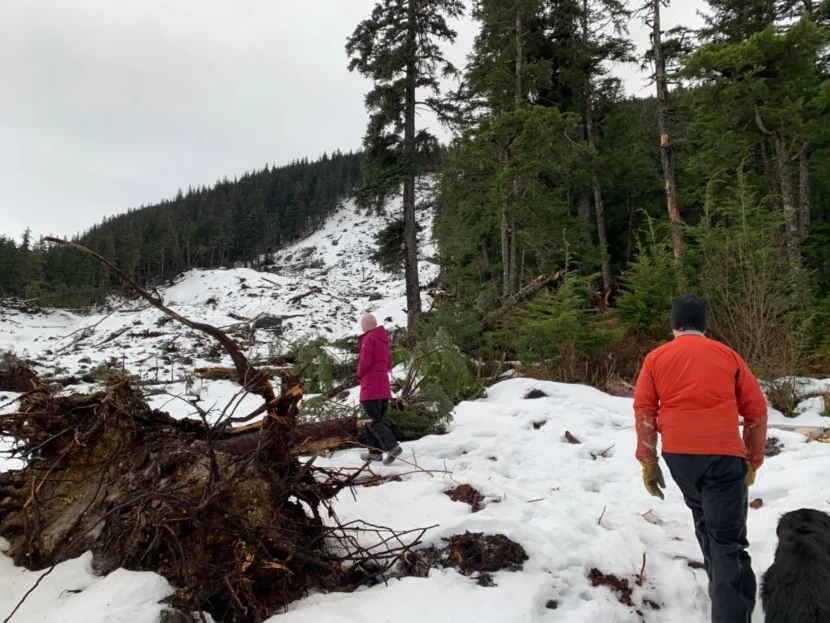
Amber Winkel (left) and Todd Winkel (right) make their way across the Beach Road landslide in order to check on their home in January 2021. (Henry Leasia/KHNS)

Dozens of fire chiefs, city planners, tribal natural resource managers and other officials from across Southeast Alaska were set to gather last month for a second annual landslide conference.

But that didn’t happen.

The event’s organizers cancelled the gathering amid uncertainty over federal agencies’ ability to interact with regional landslide efforts moving forward. Another factor: President Donald Trump signed an executive order in February limiting travel by federal employees.

“Our state partners were pretty insistent that the federal representatives really needed to be there,” said Ron Heintz, a senior researcher with the Sitka Sound Science Center, which helped organize the conference.

“It would be very difficult to make plans and do things in the future without any sort of certainty of what the government landscape was going to look like in the next 12 months or so,” he added.

The two-day conference, which was scheduled to take place in Sitka starting March 11, was meant to pool landslide-related knowledge and strategies for managing the risk. Attendees should have included representatives from federal agencies like the National Weather Service and U.S. Geological Survey.

The gathering was born out of a broader, regionwide effort dubbed the Southeast Alaska Landslide Information and Preparedness Partnership. It’s made up of representatives from Southeast communities all seeking to better understand and prepare for landslide risk, which is increasing with climate change.

The region has seen four fatal landslides over the last decade, including one that killed two people in Haines in 2020.

Lisa Busch, who runs the partnership as a contractor for the Central Council of the Tlingit and Haida Indian Tribes of Alaska, said in-person gatherings like the conference are crucial.

“This is where the exchange of knowledge happens, so the communities can tell agencies and scientists what they’re concerned about, what they’re anxious about, what their needs are,” Busch said. “And the agencies and the scientists can talk to community members about what they know.”

Heintz echoed that point, noting that communities across the region are wrestling with a slew of similar challenges. Among them: modeling when and where landslides might happen, determining how to respond when they do occur, and making zoning and land-use decisions that could put fewer people at risk.

“These are all really difficult and complex questions, and that’s what we discuss in these, with this group of people that meet,” Heintz said. “And it’s really important that you do that face-to-face.”

Derek Poinsette has participated in the regional partnership as a member of the Haines borough planning commission. He said these types of events ensure landslide-related research and planning efforts aren’t siloed in different communities.

He added that Haines has seen benefits from the effort, including a state-funded landslide risk analysis published earlier this year. The borough had that opportunity due to connections made through the regionwide partnership.

“Not every community has one of those, so we’re kind of special in that regard,” Poinsette said.

Beyond the conference, Busch said federal agencies have played a key role in helping gauge landslide risk in Southeast, including by installing monitoring equipment. That work will likely be affected, she added, if federal employees can’t get back to the region.

“It’s kind of like you’re hooked up to an IV or a blood pressure machine, and a nurse can’t check on you,” Busch said. “What’s the point in gathering the information?”

In the meantime, she said, the risk isn’t going away.

“Landslides don’t care who runs the government,” Busch said. “We’re still going to have to deal with landslides here.”

Tlingit and Haida president calls for unity amid federal uncertainty at tribal assembly in Juneau

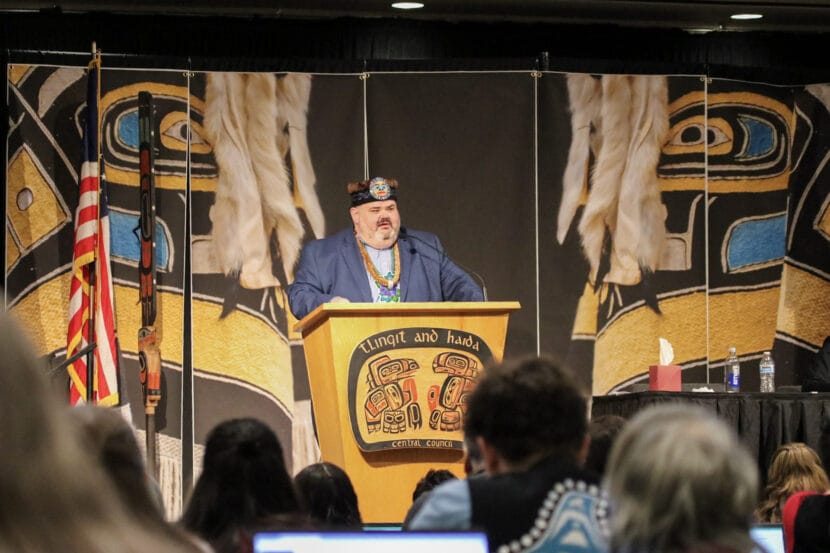
Chalyee Éesh Richard Peterson, president of Central Council of the Tlingit and Haida Indian Tribes of Alaska, speaks at the 90th annual Tribal Assembly in Juneau on Wednesday, April 18, 2025. (Photo by Clarise Larson/KTOO)

The president of Southeast Alaska’s largest tribal organization called for unity as proposed federal funding cuts could drastically impact the future of the tribe. 

On Wednesday, more than 120 delegates of the Central Council of the Tlingit and Haida Indian Tribes of Alaska met for the first day of its 90th annual tribal assembly in Juneau. 

Its president, Chalyee Éesh Richard Peterson, told delegates during his State of the Tribe address to remember the values and strengths of their ancestors and fight for the tribe’s future.

“Today, we face new challenges, political division, environmental threats and the continued impacts of colonial systems,” he said. “But our power is in our connections to each other, to our land, to our ancestors and to the generations still coming.”

Peterson expressed concern to tribal leaders during an executive council meeting earlier this week about proposed federal cuts that he said have the potential to slash a third of the tribe’s funding from the government. 

During his speech to delegates, he specifically referenced a traditional food distribution program that was ended by the Trump administration. He said the cut is a setback in a much longer fight.

“Federal policies took our lands, restricted our harvest and undermined our food sovereignty,” he said. “This program was helping us rebuild that connection to our food, to our health and to who we are.”

The tribe also works closely with federal agencies like the U.S. Forest Service and the Bureau of Indian Affairs, which were both hit by the Trump administration’s sweeping federal workforce and spending cuts

The theme of the three-day assembly is “Honor the Past, Empowering the Future.” This year’s assembly is also a constitutional convention, meaning the tribe will consider proposed changes to its constitution. 

Delegates traveled to Juneau from different villages in Southeast Alaska, Washington and California. The tribal assembly will consider amendments to its constitution Friday morning before adjournment that evening. 

Conservationists say Canadian mine is contaminating Wrangell-area watershed

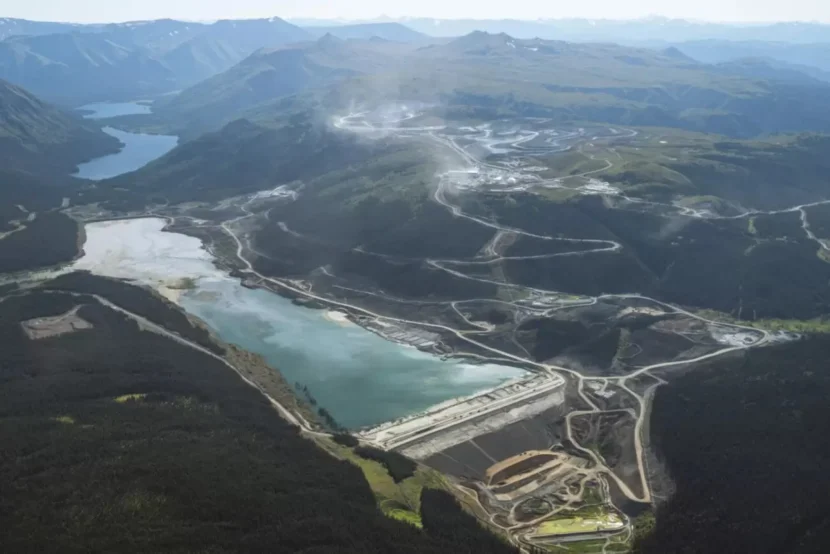
Red Chris Mine’s tailings waste facility and open pit in the headwaters of the Iskut River, a major tributary of the salmon-bearing Stikine River. (Photo courtesy of Colin Arisman)

This article is part one of a two-part series about the Red Chris Mine and its potential threat to the Stikine River.

The Red Chris Mine is already huge — at 89 square miles, it’s bigger than Wrangell Island. And the mine — which is just 25 miles from the British Columbia border on the Canadian side — could get bigger. British Columbia officials are expediting expansion plans due to the Trump Administration’s recent tariffs.

But a conservation group is raising alarms that the gold and copper mine is already leaching heavy metals into the Stikine River watershed. In a report released March 17, the SkeenaWild Conservation Trust says the mine is “releasing significantly more contaminated seepage” to the watershed than predicted.

Tribal groups downstream from the mine say the report speaks to their concerns about whether it could harm subsistence resources they rely on.

“We have long had concerns for the Red Chris Mine,” said Jill Weitz, who serves as a government affairs liaison with the Central Council of Tlingit and Haida Indian Tribes of Alaska. “Even before we knew that there was potential seepage coming from their tailing storage facility.”

Contamination found in lakes and creeks

The open pit mine extracts 11 million tons of ore per year. If it’s expanded to include an underground mine, that could increase to 15 million tons per year. Three tailings dams surround the mine to store the rock waste, which will exist in perpetuity.

Adrienne Berchtold, an ecologist who studies mining impacts for SkeenaWild, is the study’s primary author. Her team used data collected by the mine from the first seven years of the Red Chris Mine’s operation, from 2015 to 2022, to analyze environmental impacts from the dam.

Berchtold said they did not find evidence that the mine is contaminating the Stikine River or its two major tributaries, the Iskut and the Klappan. But she said toxins are contaminating lakes and creeks that are closer to the mine.

Tests at surrounding water bodies found that contaminants have seeped into the groundwater from tailings deposits since the mine began operating. The report also says contaminants have been seeping from the dam’s waste rock storage area since at least 2017.

The report says contamination levels have increased in Ealue and Kluea Lakes as well as Trail and Quarry Creeks, which flow into major tributaries of the Stikine River. Selenium and copper were the main contaminants found in the creeks and lakes, and the report says their levels were high enough to affect aquatic life.

Impacts to fish could affect human health

Berchtold’s team found that the potential impacts to fish in the area could also affect human health.

“There are rainbow trout in the lakes immediately surrounding the mine and people do fish in those lakes,” she said. “They rely on those rainbow trout for sustenance.”

Berchtold said that the area is naturally a highly mineralized environment, and selenium concentrations in fish tissues would already be elevated without the mine there.

“When you have a situation where those elements are already elevated for natural reasons, that’s even more cause to be even more cautious about how much more of those contaminants you’re putting into the system,” she said.

Berchtold said she doesn’t see risks to the transboundary right now, apart from the rare chance of a catastrophic dam failure.

“Our shared resources”

Berchtold said SkeenaWild is concerned about the province’s plan to fast-track the mine’s expansion.

“We’ve seen so much evidence of issues being overlooked,” she said. “I feel that deregulating and kind of pushing through these approvals just risks those types of issues falling by the wayside even more.”

And while SkeenaWild estimates that the mine will cease ore extraction in 13 years, tribal groups are concerned that it could last much longer.

“That mine is never going to close down,” said Guy Archibald, the Southeast Indigenous Transboundary Commission’s executive director. “It’s just going to keep going, and they’re going to keep asking for more permits and more extensions as long as they can.”

The Red Chris Mine is in the First Nations Tahltan Territory. The Tahltan Central Government has not responded to KSTK’s requests for comment.

But Weitz, of Tlingit and Haida, said she hopes SkeenaWild’s report will help raise awareness of environmental threats posed by Canadian mines in transboundary watersheds.

“With the relationship between Canada and the United States, we want to ensure that our shared resources are protected,” Weitz said. “This isn’t an ‘us versus them’. This is ‘us and the communities.’”

She said the communities near the Stikine depend on each other, as well as sharing the resources the river offers.

“The majority of these projects in Northwest British Columbia and even Southeast Alaska to date are gold interest,” she said. “What are we willing to risk for the expense of our clean water and our salmon watersheds?”

Site notifications
Update notification options
Subscribe to notifications