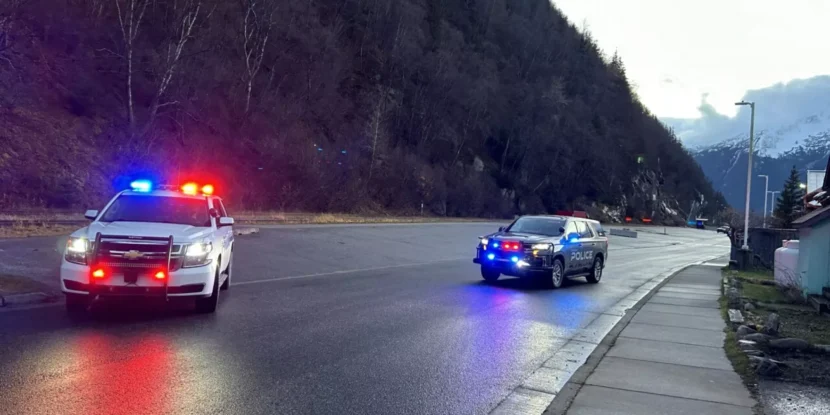
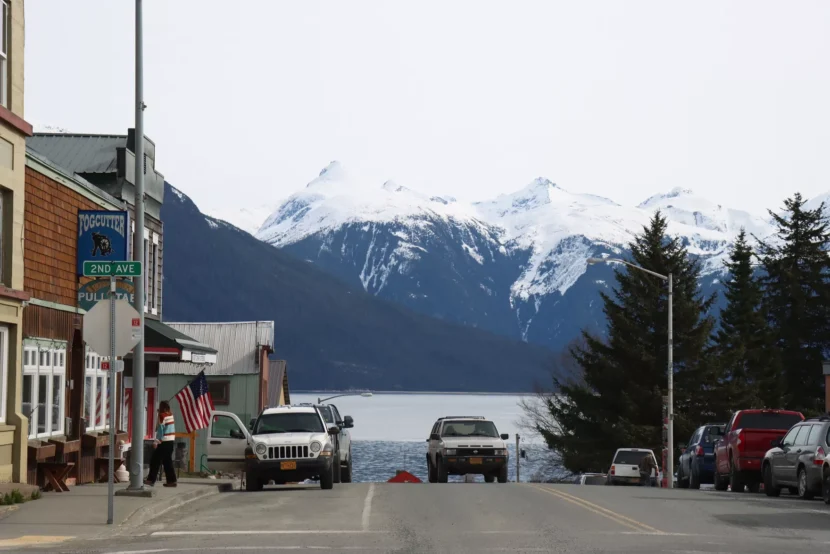
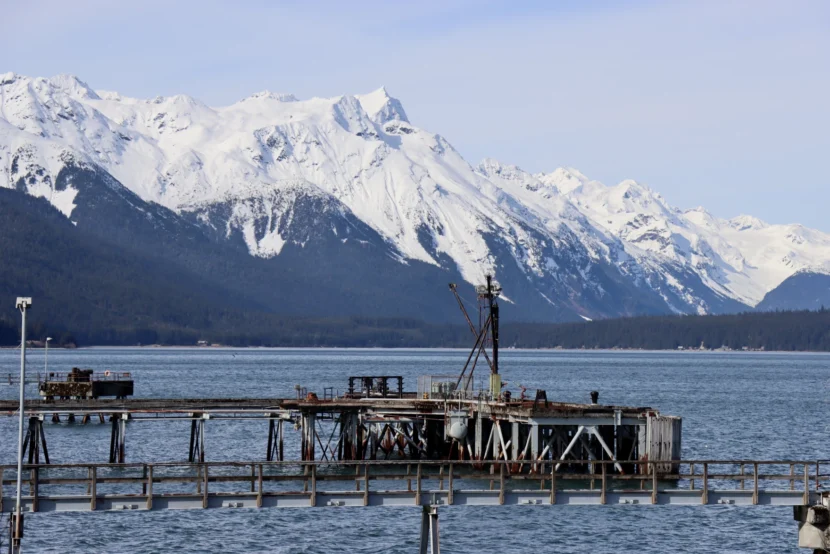
A recent rockslide in November 2024 briefly closed down Skagway’s Railroad Dock. (Melinda Munson/KHNS)
Skagway was slated to be Alaska’s first recipient of grant funding under a Federal Emergency Management Agency program. But recent changes at the agency have put nearly $20 million in funding in question.
It’s a lot of money to lose for a community that hoped to use the funding to fix its unstable mountainside.
The title of the press release wasn’t encouraging: FEMA Ends Wasteful, Politicized Grant Program. That press release is how Skagway found out it likely won’t receive federal Building Resilient Infrastructure and Communities funding to mitigate rockslides above its busiest cruise ship dock.
FEMA is cancelling all BRIC grants awarded from 2020 to 2023. Skagway was recently approved for phase one of its grant in 2022. Borough Manager Emily Deach said she was just about to send a project bid to the Assembly. Phase one, which is $1.3 million from the federal government, is for project planning. Phase two is the actual construction.
“It looks like we may still get phase one funding, because it’s already been awarded and obligated,” Deach said. “But it seems as though phase two for construction is not going to be funded. And we’re sort of, we’re sort of waiting on this to get more information.”
In 2023, Skagway spent a little over $3 million installing safety mechanisms on its mountainside. Last year, it cost just over $1 million to mitigate the site. Deach estimates that this year, the municipality will spend $2 million.
The BRIC grant was meant to help the borough find a long-term solution.
What happens if phase two funding doesn’t come through?
“I don’t think there’s a need to panic at this point,” Deach said. “I think the project will be done. I think, if anything, maybe it will delay it a little bit because we’ll have to accumulate funding, or look at other options.”
Deach said that Skagway collects $13 per passenger on its two municipal docks and $8 per passenger on the privately owned Railroad Dock. That money goes into the vessel impact fee fund.
“We could potentially spend maybe a few years accumulating funding that would go towards this project,” Deach said.
But she acknowledged that losing the federal funding isn’t best case scenario, with all of the other capital improvement projects Skagway currently faces.
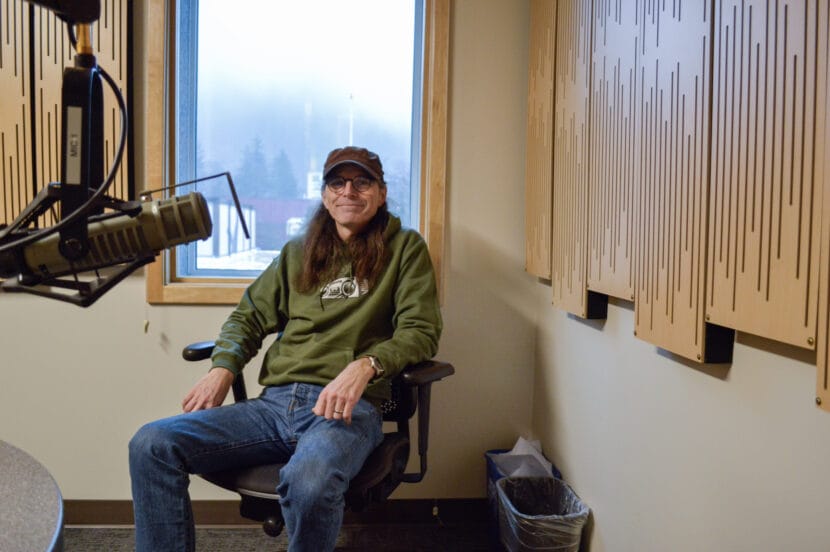
Justin Smith is an independent music producer in Gustavus who has produced albums for Alaska artists like Annie Bartholomew, Blackwater Railroad Company and Josh Fortenbery. Pictured in the KTOO studio on Jan. 24, 2025. (Photo by Yvonne Krumrey/KTOO)
This is Tongass Voices, a series from KTOO sharing weekly perspectives from the homelands of the Áak’w Kwáan and beyond.
Justin Smith of Gustavus has produced albums for Alaska artists like Annie Bartholomew, Blackwater Railroad Company and Josh Fortenbery.
He’s performed at festivals with blues legends like B.B. King, James Brown, Son Seals and Taj Mahal, but Smith says he loves playing and producing for Alaskans more than anything.
The following transcript has been lightly edited for clarity.
Justin Smith: There’s this whole sort of instrumental bridge section in a tune called “Happy Tune” on the Blackwater Railroad record where it’s just musically so exciting. And I was just sitting there hearing them play it, you know, and looking over at the computer and seeing, like, “Yes, it’s recording. We’re getting this, yeah!” You know?
Dec. 1 of 93, I spent my last dollar at Heritage Coffee. Got off the ferry. We were like, pulling change out from under the seat, you know, of the car, trying to get enough money together for our ferry tickets.
And I had $1 left when I got to Juneau. Walked around, it was First Friday in December. We walked out of the galleries eating all the cookies because we didn’t have any food. That was my start in Juneau. And I got here, and everybody told me I needed to go to the Alaskan (Hotel) on Thursday night for the open mic. So I did that on my first Thursday.
And I was always the guy in the high school bands and stuff that would set up the PA and figured those things out, and I would mess around with a four-track recorder, things like that. So I had kind of an inclination towards the gear side of things, but eventually I wanted to record myself.
I got a little bit of gear, and then I just kind of branched out from there, because I heard somebody singing once at open mic and invited them over to record their stuff. And I just, I just love it, you know? I just love it.
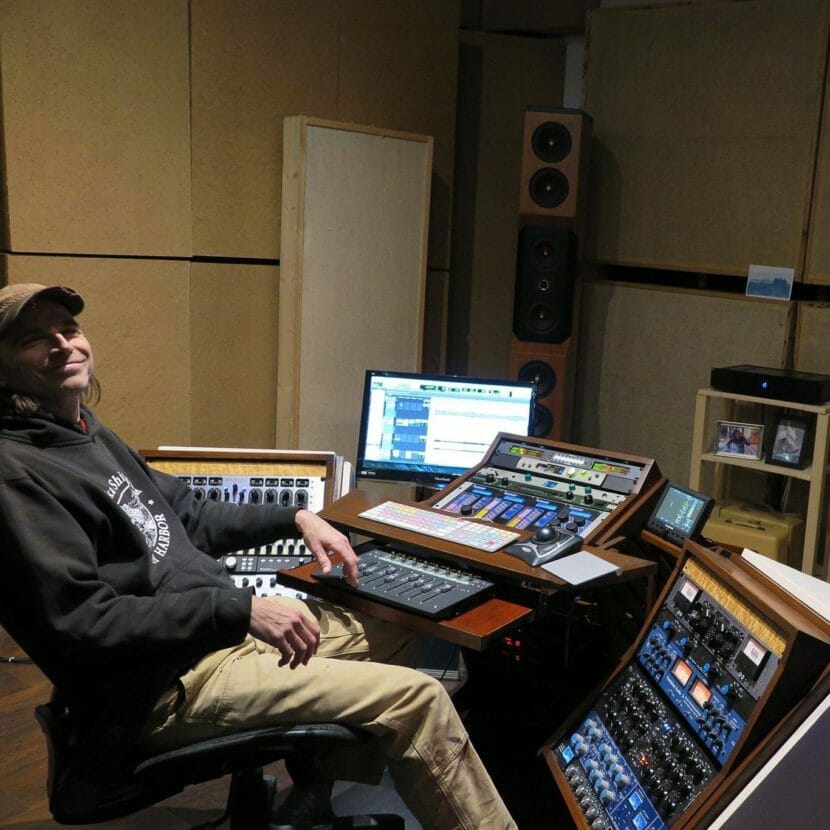
Justin Smith’s studio, Rusty Recordings, in Gustavus. (Photo courtesy of Justin Smith)
And I tried to acquire nice gear and learn the best methods, because I didn’t want anything to sound amateur, and I didn’t want to put a lot of blood, sweat and tears into getting a performance, and then feel like if I ever wanted to put it out on a record, I’d have to re record it in a real studio, you know, because it’s just so hard to get that performance and get that thing that you want, and to think that you’re only doing it temporarily, until you can do it for real in a real music studio. So I tried to start with nice equipment and doing it the right way.
When we did Annie’s record, when we did Sisters of White Chapel, we did that in a cabin at the Methodist camp. One of my favorite things on that was, at the end of “Last Confession,” there’s this long piano outro, and we recorded the band with Kat (Moore) playing bass, and then we came up with this arrangement idea to like, give it to the piano to reprise the melody at the end of it.
Kat sat at the piano and was trying to pick out the melody, and she played a few wrong notes while she was trying to figure out the melody. She’s okay, “I think I got it. Let’s do this.” And we recorded it once, and I was like, “Could you play it the way that you did, like a few minutes ago, and you’re still trying to figure out the melody, and it wasn’t quite exactly right?” And she sort of got back to that space, and that’s what’s on there. And it’s just so beautiful.
Because the concept of it is like, there aren’t — of the record, you know — there weren’t concert musicians in the Yukon, you know, in the 1860s right? And so it was meant to seem a little ragged and a little sort of amateur. And it’s just such a beautiful moment when we all put that together and listen back to it, we were all so floored. It was so great.
What I love about music, and what I love about Alaska, it’s all the same. It’s beauty, you know. And there’s so much beauty in these things. And I want it around me. I want music around me all the time, and I want Alaska around me, and wildlife and just the beauty of the environment here and the beautiful, amazing people. I want all of that around me all the time in my life. So that’s why I want to be here, you know?
And there’s so much support for music here and all of the arts. And Alaskan artists, I found with these productions that I’ve done, are passionate about doing their work in Alaska. They often see it as like a little bit of a cop-out to go down to Seattle or LA or something and buy some studio time to record their music that they’ve come up with up here. They want to do it in Alaska with Alaskans and that’s so cool, because we have it all here.
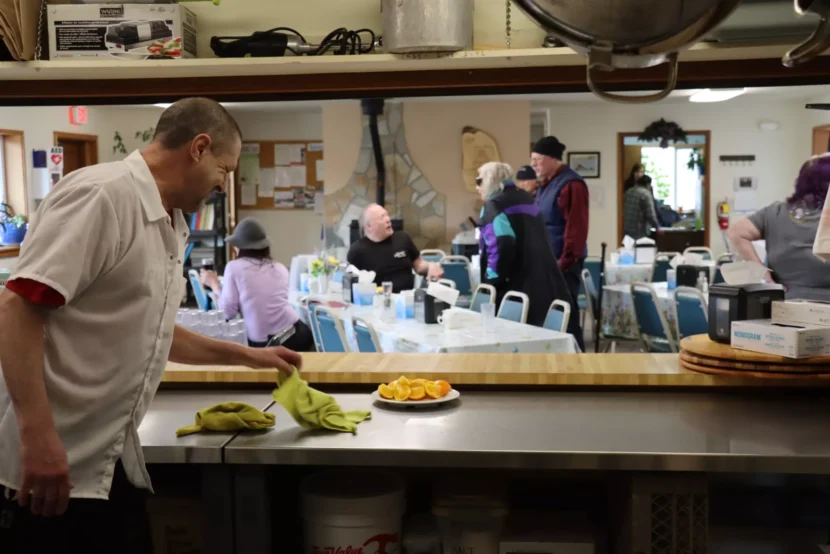
Seniors can access lunch for just $5 three days a week at the Haines/Klukwan Senior Center. (Avery Ellfeldt/KHNS)
There was a steady hum of chatter at the Haines/Klukwan Senior Center during a recent Wednesday lunch. On the menu: lasagna, apricot salad, bread and steamed veggies – all for just $5, for those who could afford to pay.
Lunch may be what brings seniors to the building three days a week around noon. But it’s far from the only draw. Haines resident David Kohlstaedt, who was sitting at a long table chatting with friends, said the space is a crucial social outlet.
“Three meals a week, I don’t have to cook,” he said. “I come almost an hour early every day, and we come around and shoot the breeze.”
Christal Verhamme, who manages the center for the Juneau nonprofit Catholic Community Service, says Kohlstaedt isn’t alone.
“A lot of them say this is the only thing that they do, their only outlet. Their only way to get rides,” she said. “And for some, it’s their only way to get a cooked meal.”
The Trump administration’s ongoing effort to downsize the U.S. government is fueling concerns over the future of this center – as well as other programs that serve people across Alaska.
At issue is the Administration for Community Living, a federal office that funds programs for older people and people with disabilities – including Catholic Community Service – from within the Department of Health and Human Services.
The move is among several Trump policies fueling uncertainty for nonprofits and the people who rely on the services they provide, said Erin Walker-Tolles, executive director of Catholic Community Service, which operates 10 senior centers in Southeast Alaska.
“We’re just concerned that about additional cuts and lack of resources from the administration, because community need is only growing as the senior population continues to grow in Southeast,” she said.
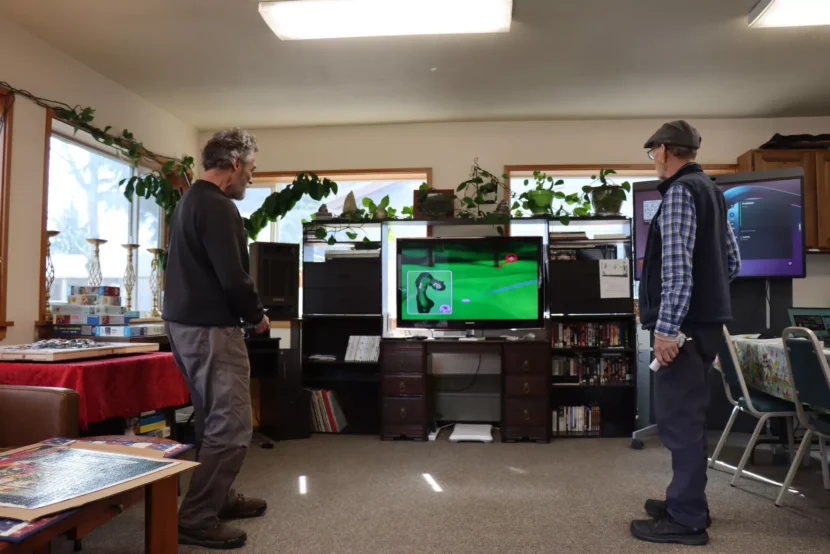
Two Haines residents play Wii disc golf at the Haines/Klukwan Senior Center. (Avery Ellfeldt/KHNS)
So, what is the Administration for Community Living?
The Administration for Community Living was created back in 2012 to streamline federal efforts to support seniors and people with disabilities.
The office doles out grants to programs that run senior centers, provide rides and distribute millions of meals — including through Meals on Wheels. Catholic Community Service, for instance, received roughly $3 million from the office last year, much of which comes through tribal partners. That’s nearly 40% of the organization’s budget.
Walker-Tolles said that it remains unclear what the reshuffling will actually mean for programs, but that she assumes funding will be administered some other way. She added that she understands the importance of reducing costs and streamlining resources – but that the lack of clarity around these moves has consequences.
“As these changes come through, there is no plan that we are aware of to ensure that things are simpler. Instead, it is more work,” Walker-Tolles said. “It is chaos.”
That’s especially concerning in Southeast, where the population is older than most of the state. Haines specifically has long held the title of being Alaska’s oldest borough. The median age here is just under 50 years old, compared to about 37 statewide.
‘It’s very scary’
The Trump administration’s firings and program cuts at the Administration for Community Living – and to the broader department – won’t just affect seniors.
Southeast Alaska Independent Living, for instance, provides a bevy of services, including in Haines. Among them: loaning out walkers, crutches and wheelchairs, and supporting students with disabilities as they transition into adulthood. A report from last year says 20% of the organization is federally funded – at least some of which comes from the Administration for Community Living.
There’s also REACH Inc., a Juneau-based non-profit that supports people with disabilities. The group doesn’t get funding from the Administration for Community Living, said Naomi Studevan, the organization’s executive director. But it does get funding from another federal agency that focuses on medicaid and medicare, which reportedly lost 300 employeesto layoffs in recent weeks.
“There’s already a waitlist that is there when it comes to people accessing services in the first place. So to think that there’s going to be fewer people there to review applications, fewer people there to have oversight,” Studevan said. “It’s very scary.”
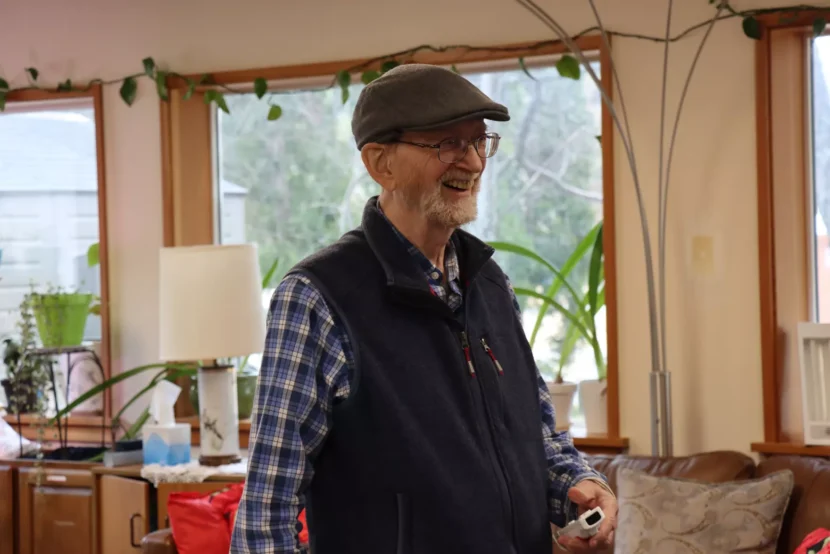
Donald Poling, above, said he and his wife Dottie rely heavily on the senior center. (Avery Ellfeldt/KHNS)
Back at lunch in the senior center, all seems normal. People eat, visit, participate in a book club and play disc golf on a Wii gaming system. But all it takes is one question about the administration’s recent moves to reveal lingering anxiety about the future of the senior center.
“We’re worried about it,” said Haines resident Todd Wagner, who comes to the center most days that lunch is served. “We don’t want it to get messed up where they don’t have it anymore. That could happen, we know that.”
Then there’s Donald Poling, who is 82 and has lived in Haines with his wife Dottie since the 1990’s. He said they heavily rely on the facility’s services, including for rides to the ferry and airport when they leave town to seek medical care.
Asked what he makes of the recent announcement, Poling took a swipe at Elon Musk, who has been spearheading White House efforts to downsize the government.
“It looks like President Musk is kinda taking the government apart,” Polling said. “And that means public services, services to poor people, services to seniors, even Social Security, Medicare and Medicaid.”
Haines, pictured above on April 3, is Alaska’s oldest borough with a median age around 50. The next oldest borough in the state is Wrangell. (Avery Ellfeldt/KHNS)
Alaska has returned to a period of slow-but-steady population growth as births outpace deaths – making up for migration out of the state.
That’s according to this month’s economic trends report from the state Department of Labor and Workforce Development. The report found that the statewide population has been trending higher since 2020, and that the increase appears to have accelerated in 2024.
“Our net migration losses haven’t been that big, and we’ve been able to make up for net migration losses with what we refer to as natural increase, which is just births outnumbering deaths,” said David Howell, the state demographer.
The state’s population surpassed 740,000 people for the first time this decade in 2024. That’s nearly 8,000 more people than lived in Alaska in 2020, according to the report. Between 2023 and 2024 alone, the state saw a 0.3% population increase. That’s up slightly from the average increase per year since 2020: 0.25%.
Howell attributed the bulk of that growth to one area.
“All the growth since 2020 has pretty much been on that Rail Belt running from Kenai up through Fairbanks, with the Mat-Su kind of being our one standout area that’s grown consistently for decades now,” he said.
That comes in sharp contrast to other regions. The population of every borough in Southeast, for instance, has declined since 2020. Skagway specifically has seen its population drop by an average of over 2% per year – the largest decrease regionwide.
“There’s not as many people at high fertility ages, and you have more people at these ages where mortality is higher,” Howell said, noting that in Skagway deaths now outnumber births.
Meanwhile in Haines, which is Alaska’s oldest borough with a median age of 50, the population has dropped between 1% and 2% per year on average, according to the report. Local officials say it’s becoming harder and harder to attract younger families to the area due to insufficient housing and childcare.
Haines Mayor Tom Morphet raised the issue during a recent meeting of the Haines Planning Commission. The commission has been working on an ordinance that would aim to create more housing in town by making it easier for homeowners to build auxiliary dwelling units on their properties.
“The housing crisis in this town is extreme,” Morphet said during the meeting. “We cannot keep teachers, we cannot attract new employees.”
It’s a different story entirely in Western Alaska, which has also seen its population decline over the same time period – but for a different reason.
“Out there, the population is very young. But what you see is a lot of people moving for work or something like that. So they’re moving more to population hubs or out of the state,” Howell said. “So, very different reasoning than Southeast.”
The log transfer facility and storage site would be a little over four miles outside of town, in Haines’ Lutak Inlet, pictured above on March 27, 2025. (Avery Ellfeldt/KHNS)
Four years ago, an Oregon-based timber company won a contract to harvest some 23 million board feet of spruce and hemlock outside Haines. Now, the company’s plan to get that timber out of Alaska – and into buyers’ hands – is sparking pushback.
That’s because the company’s local operator is seeking permits to build a log transfer facility and storage site in Haines’ Lutak Inlet, a popular spot for commercial and subsistence fishing.
“We all fish right there,” said Erik Lembke, a commercial fisherman in Haines.
The concern pushed the State Department of Natural Resources to make an about-face late Wednesday afternoon by temporarily closing the permit application’s public comment period. The period was originally set to end on Friday.
Tony Keith, a natural resource manager with the department, said the feedback the agency had received so far made it clear the public needs more information. In response, the agency will require the company to provide the public with more details, including a dive survey of the ocean floor.
“Then, once you’re finishing the log transfer facility, or if you’re trying to bring it back under review or anything, you’re able to do another dive survey and go out there and check bark accumulation and stuff like that,” Keith said.
The Chilkat Valley’s first major timber sale in decades
The so-called Baby Brown timber sale lies in the Haines State Forest, just over 35 miles northwest of town between Porcupine and Jarvis Creeks. The state first awarded the sale to a contractor in 2016 but later canceled it after conservation groups appealed the land use plan. Later, in 2021, the sale was awarded again, this time to an Oregon-based company named NWFP Inc.
State Forester Greg Palmieri said the company has been developing what he called a “responsible plan” for the project over the last several years. As he sees it, Baby Brown presents a “huge opportunity” for Southeast and the Chilkat Valley specifically, which used to be home to a booming timber industry – but hasn’t seen a major sale in decades.
Palmieri said 8 million board feet of timber were harvested in the area in 1995, and there were a few other, smaller sales until about 2000. But he added that the last time there was a sale around the size of Baby Brown, “it was probably around the mid-70’s.”
“If there’s no industry working in the area, there’s no potential for growth. So this sale was designed to encourage the development of the industry,” Palmieri said. “Conceptually, does it crack that egg? We’ll have to see. It has the potential to do that.”
The contractor’s local operator – NSEA Timber Inc. – submitted the permit application on March 11, according to Keith of the Department of Natural Resources. The company also needs permits from the borough and U.S. Army Corps of Engineers.
The application proposes a log transfer facility and storage area on a 12-acre site about four miles out of town, off Lutak Road. The property is in a borough-designated waterfront industrial zone near the Alaska Marine Lines dock.
The facility would include a slide to transfer log bundles into the water. A boat would then place each bundle into a floating log raft and tow the raft to a storage site close to shore. Later, they would be loaded onto ships, which would transport them to buyers.
“This is a fundamental step in that process to get the product to market,” said Palmieri.
This type of facility has been around for decades, said Charles Nash, who used to be employed by the contractor but is no longer associated with the sale. Nash has worked in Alaska’s timber industry for years.
“There used to be log transfer facilities all over Southeast, and they come in many types. Some are slides, some are cranes,” he said. “But that’s how, generally, how logs got in the water.”
Palmieri, the forester, said the facility is a conservative option that aims to reduce traffic and limit impacts on the inlet – and the fisherman who use it. He estimated the storage site would be about 1,700-feet long, roughly one-third of a mile.
Fishing concerns
But some worry about the log rafts affecting water quality and access to the inlet.
“The way that you fish Lutak Inlet, you know, you fish out from the shoreline,” said Rafe McGuire, a commercial fisherman in Haines.
He added that a log area close to shore would mean fishermen would lose access to that area and more because they would need to make sure their nets wouldn’t get swept closer by the tide.
“You can’t fish very close to it. So you’d lose most of that distance,” McGuire said.
Lembke, the other fisherman, said there could be up to 20 boats fishing the area during the sockeye run.
“I think if there was a lot of logs and a big ship, it would pretty much make it impossible to do that,” he said
Polly Johannsen – who signed the permit application for the local operating company, NSEA Timber Inc. – did not respond to multiple requests for comment. Nicole Zeiser, area management biologist with the state Department of Fish and Game, did not respond to an emailed request for comment.
Earlier this month, a separate lumber company confirmed it was temporarily shutting down a work site near Kodiak. The company attributed the decision to China’s pause on imports of U.S. logs in response to ongoing trade disputes.
Palmieri says he’s received no indication that the trade war has affected the sale. The permit application, for its part, says logging could begin as soon as this spring and run through 2028. The agency did not say when the dive survey will take place or what the permitting delay will mean for logging operations.
A still from “Work It Out Wombats!” with characters Zeke, Zadie, Chanáa and Malik. (photo from GBH.)
Sydney Isaacs-Hulstine is a Craig-based Lingít and Haida artist. Raised in Klawock, Isaacs-Hulstine is an associate producer for children’s TV show “Molly of Denali.”
She recently wrote an episode for another children’s show, “Work It Out Wombats!” It features an Alaska Native character that draws on Lingít and Haida culture.
Isaacs-Hulstine sat down with Jamie Diep to talk about the episode and the importance of representation in children’s media.
Listen here:
The following transcript has been lightly edited for clarity.
Jamie Diep: I want to talk about this episode of “Work It Out Wombats!” that you wrote. Could you give a quick rundown of what you pitched? The process of producing this episode and watching it come together
Sydney Isaacs-Hulstine: With “Work It Out Wombats!” the team really wanted me to pitch an idea that felt like Alaska, that felt like my culture. They wanted me to really embrace it, whatever it may be. And so I was thinking and thinking, ‘What could I do? And I kept thinking of this Raven character, because he plays such a significant role in all of our cultures, for Lingít, Haida, Tsimshian, and a lot more folks hold Raven in high regard.
So I kind of pitched this character in a way, this elder character named Chanáa, which is Haida for grandfather. And they really liked it. They were over the moon for this crazy, kooky, elder, with some mischief and jokes, and [he] kind of reminds me of Tigger a little bit from “Winnie the Pooh.”
And so from there, we were like, ‘Okay, we have this character. What is he going to do?’ And again, thinking of my culture, that Raven is this trickster, the mischief. He’s smart and quick, and there’s tons of wit everywhere. And so I thought riddles, and that kind of spurred on this whole thing.
So it was like a really neat kind of balance of how tricky of a riddle is too tricky, and how is it too easy? And where’s the balance there? We spent a lot of time together trying to figure out that balance, and then from there, once the story was solid, it was design time.
A portrait of Sydney Isaacs-Hulstine. (photo from Sydney Isaacs-Hulstine)
And I had asked at the very beginning, like even before I started writing, if it would be okay if I were to see Chanáa’s design, because I feel very strongly to make sure that we’re represented authentically and accurately. The wombats has a very unique style. So it was like, how much of my culture and balance it with their world, so that it doesn’t pop out in a weird way, but it feels natural.
And so his hat, his necklace, shirt, his vest, all of that is very much based on the culture, with references and working hand in hand. And then same with some of the props in there too, near the end of the episode that was all worked out together – and the dance movements and the drum beats – they worked with me on it to make sure it was accurate.
Jamie Diep: What’s something that stood out to you or something that surprised you about working in children’s media?
Sydney Isaacs-Hulstine: GBH Kids and the children’s media department was really thoughtful, and I was astonished by how much they cared and how much they crafted all of our series, all of our episodes. And every single show was just very carefully done to make sure that kids were not only entertained, but they’re also getting some education. And I don’t think that exists everywhere.
Jamie Diep: What’s particularly important about having a broad spectrum of representation in children’s media and the projects that you’ve worked on, whether that’s Alaskan Native representation, Lingít and Haida representation, or just other forms of representation. Why is this important in children’s media?
Sydney Isaacs-Hulstine: The early exposure that kids can get to different cultures and diversity and underrepresented voices, the better off that they’re going to be. They’re going to grow up knowing this and just be more well rounded individuals for it, with a broader experience and lens. And it’s really important to have that, because it’s just a part of growth and life, and it’s for everybody. The more voices that you have and different perspectives that come to play their part in how these shows are made. It just gives you a deeper and richer experience and a really great quality show.
And I think it’s really good for kids to absorb that, because they can feel that through the screen and take in that information that they’re hearing and that representation and grow up knowing, ‘oh, oh, the I know exactly who these folks are. I’ve learned about this. I’ve seen it on TV.’ And then it just continues. It just spreads. It’s very infectious.
Close
Update notification options
Subscribe to notifications
Subscribe
Get notifications about news related to the topics you care about. You can unsubscribe anytime.