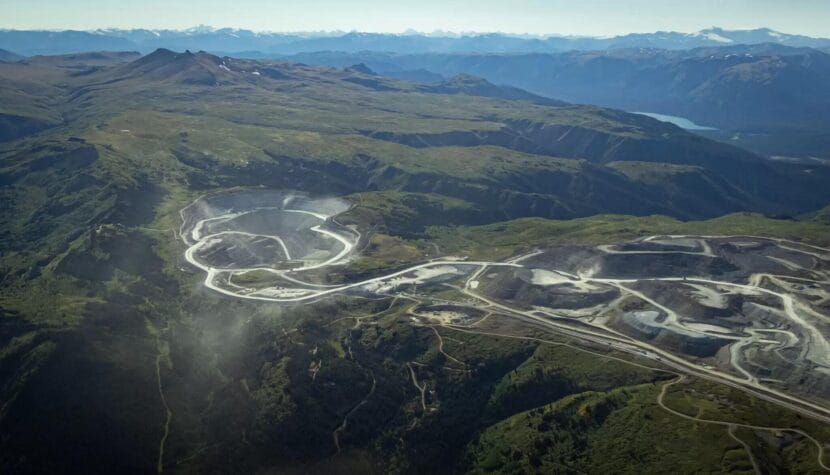
The open pits and waste rock pile at Red Chris Mine in the headwaters of the Iskut River, a major tributary of the salmon-bearing Stikine River. (Colin Arisman)
Editor’s note: This is the second part of a two-part series about the Red Chris Mine in Canada, which could contaminate Southeast Alaska waters. Read Part 1 here.
Red Chris Mine sits 25 miles from Alaska’s border in the Stikine River Watershed. It has operated for a decade, but its ownership changed two years ago.
Before the new company, Newmont, bought the mine, conservation scientists conducted research over a seven-year span. Newmont has made some environmental adjustments since it acquired the mine in 2023.
But Newmont is also hoping to expand the copper and gold mine, which is already bigger than Wrangell Island. That’s even after an environmental report was published in March.
It shows heavy metals have leached into a transboundary Alaska and British Columbia watershed. Communities downstream of the Stikine River are concerned about this, including Wrangell’s tribal government, the Wrangell Cooperative Association.
“It’s very difficult when you have colonial constructs imposed on you,” said WCA Tribal Administrator Esther Aaltséen Reese. She’s the president of Southeast Indigenous Transboundary Commission, which represents 15 tribal groups in Alaska and Canada. “We view the border as a colonial construct.”
She said downstream tribes are the ones that will get the ill effects of mining and they should have a say in how safe the mines upriver are.
A March report by SkeenaWild Conservation Trust researched the mine’s impacts over the first seven years of operation. It said that numerous contaminants from the mine, mainly selenium and copper, are elevated in the surrounding creeks and lakes. These levels are high enough to impact aquatic life, according to the report. Reese said she’s worried about the Stikine River salmon that so many rely on.
“Any kind of failure would just have a huge risk to downstream human populations – us here in Wrangell,” she said. “This is a very critical issue.”
Reese said they have requested to meet with Canada’s Tahltan Central Government since the mine is in its territory and the government co-manages it with Newmont. KSTK reached out to the Tahltan Central Government and hasn’t received a response.
Researcher hopes report will influence similar B.C. mining projects
Adrienne Berchtold is the primary author of the environmental report. She’s an ecologist and mining impacts researcher with SkeenaWild Conservation Trust.
She said her team made the report as a model for other similar proposed mining projects in British Columbia. Currently, there are eight active copper mines operating in the province.
The report states that the leaching contaminants have affected rainbow trout in the mine’s surrounding lakes, which are part of the Stikine River Watershed. Berchtold hopes the findings will encourage B.C. to improve policies and regulations.
“Our concern is that the provincial government has not required mine owners to address that and to really look into what impact those trends might be having on fish in the receiving lakes,” she said.
Newmont spokesperson Kievan Hirji said since the company acquired the mine in 2023, it has established a relationship with the Tahltan First Nation, co-managing the mine under an Impact Benefit Agreement.
“We’re very proud to be going through that process,” he said. “(We) have been working very, very closely with the Tahltan Nation since acquiring Red Chris in 2023 to build a really positive and strong relationship that’s really predicated on that consent as well as transparency and trust and a shared vision for the future.”
According to Hirji, about 15 percent of Newmont workers are members of the Tahltan Nation.
“We also pay royalty payments to the Tahltan Nation,” he said. “That mine is reaching its end of life within the next couple of years, and if that economic success is going to continue, the mine requires an extension to the life of mine.”
That extension, he said, would be an underground mine, or block cave mine. It would sit within the footprint of the existing open pit mine and is expected to last 13 years.
‘We will leave it to the province of British Columbia to continue with that engagement’
First, Hirji said, British Columbia and the Tahltan Nation must assess Newmont’s proposal. The tribal consortium testified this spring against the project.
As for the tailings dams, which hold the mine’s waste, there have been links drawn between the Mount Polley dam and Red Chris’s. Mount Polley’s tailings dam broke in 2014, contaminating nearby waterways. But Hirji said Red Chris’s is constructed differently, even if some of the materials are the same.
“We’ve looked very carefully at the structural integrity of the dam at the Red Chris Mine with Tahltan Central Government, and there is no concern with respect to structural integrity,” he said. “That dam is structurally sound, safe.”
An ongoing concern of downriver tribes is that they haven’t had much say in the mine’s operation. Hirji said that’s not the company’s fault – it’s up to the British Columbia government.
“We will leave it to the province of British Columbia to continue with that engagement,” he said. “We’re really focused on the relationship that we have with Tahltan Nation through the Impact, Benefit and Co-management Agreement, and really building a shared vision with Tahltan Nation.”
Shawn Larabee is the communications manager of BC’s Ministry of Mining and Critical Minerals. He said British Columbia takes environmental protections seriously. He wrote in an email that QUOTE “the scope of consultation the Province undertakes with U.S. Tribes may be different from its consultation with First Nations in B.C.”
Last year’s annual reports of Red Chris Mine are expected to be made available by the B.C. government in the coming weeks.
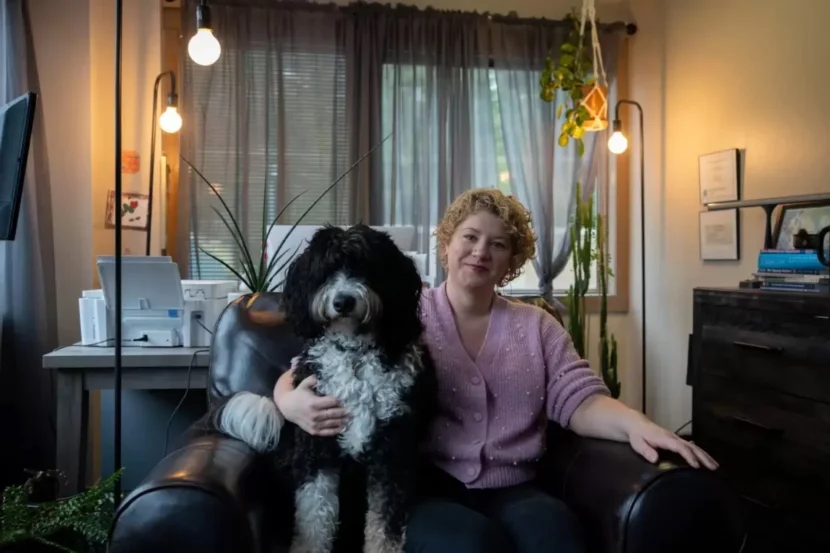
Caitlin Andrews and Guinness the therapy dog in her office at Oilean Wellbeing in Ketchikan. May 1, 2025. (Jack Darrell/KRBD)
Living in America right now can feel like you and your dad are trying to fix a car, but you can’t even agree on where the engine is. And neither one of you can fathom how the other could’ve been so wrong this whole time and still drive a car. So you’re glaring at each other, white-knuckling a wrench — and the car’s still broken.
It’s not just you. The Pew Research Center says the political and ideological divide in the U.S. is wider now than it’s been in decades. And in a small town in Alaska — especially one you can’t drive away from — it can feel like there’s no escaping the conflict.
Ketchikan has seen a lot of demonstrations lately. There have been protests and rallies against and for the federal government, the mass firings, abortion, and just Donald Trump in general.
When I talked to people at the protests and rallies, though, one thing stood out. Lots of people talked about resenting people they love because of their politics. They talked about how much it sucks, and how exhausted they feel.
Believe it or not, reporters feel that tension too. So I fired off some emails to family therapists in town. “I need your expertise on navigating pressure points,” I wrote.
I told them I wasn’t comfortable with how reactive and angry I felt, and I didn’t think I was alone. I said I wanted to know if there was a way to not feel that way.
One therapist responded immediately.
“I believe there are a few of us who would appreciate talking about this topic,” she wrote. “It’s certainly at the forefront of my life currently, both with clients and personally.”
_______
Caitlin Andrews has tea and a noise machine in her waiting room. Her enormous therapy dog, Guinness, snoozed in a big armchair next to me while we talked.
Andrews’ practice is called Oilean Wellbeing – that’s Irish for “Island.” She says that in a small island town like Ketchikan, the cavernous political divide “just feels really heavy.” And she says alienation from others in the community is something her clients have been experiencing more and more.
“This is huge. I mean, the week of the elections, that was all my clients talked about. It was affecting everyone in one way or another – whether arguments with their family, not seeing eye to eye, or feeling like their household was going to be affected,” she said. “Those are all really, real things that I think therapists across the country are faced with right now.”
Andrews is a family therapist and works with people across the political spectrum. Many of her clients are teenagers and their families. She says when it comes to religion and politics, everyone needs supportive people to talk to.
“Find the people that you can have constructive, healthy discussions with,” she said. “It’s sad that it can’t be, like, the people you’ve always had in your life — but that’s just life.”
Andrews says it’s normal to feel anger towards the people closest to you, but we should ask ourselves what’s under the surface.
“Anger is not ever by itself. It’s a secondary emotion. There’s always something causing anger,” she said.
None of this is simple. Andrews says it’s important to stand up for what you believe in, but if you care about the other person, it matters how you do it.
“The important part is being able to circle back and talk about that,” she said. “If they’re emotionally mature enough and saying ‘Hey, I want to talk about what happened with our conversation.”
Still, it’s easy for both people in a political argument to take it as a personal attack.
“Especially with family, sometimes people have a hard time separating what they’re supporting versus it being about them,” Andrews said. “Sometimes, when we are upset with another person, it’s projecting something like rejection.”
And Andrews says that sometimes, protecting yourself can mean drawing a line and taking painful topics off the table.
“Go in prepared to say, ‘This is getting ugly, and I love you too much. We’re gonna have to stop talking about this topic,’” she said. “That’s a boundary.”
Some degree of pain is often built into the foundations of family relationships, but Andrews doesn’t advocate for her clients to tear it all down.
“It’s not all or nothing,” she said “I don’t think you have to cut someone off, but you have to really protect yourself.”
She says her clients often feel powerless, like no one is listening. But she told me that I’d already done step one: acknowledging I have a problem.
“That can sometimes be the hardest part,” she said. “A lot of people don’t take that responsibility. People come to me because they want to get better.”
And Andrews believes there’s one thing everyone can control: their reactions to the headlines and the people in their lives who may read them differently. And she says that’s a good place to start.
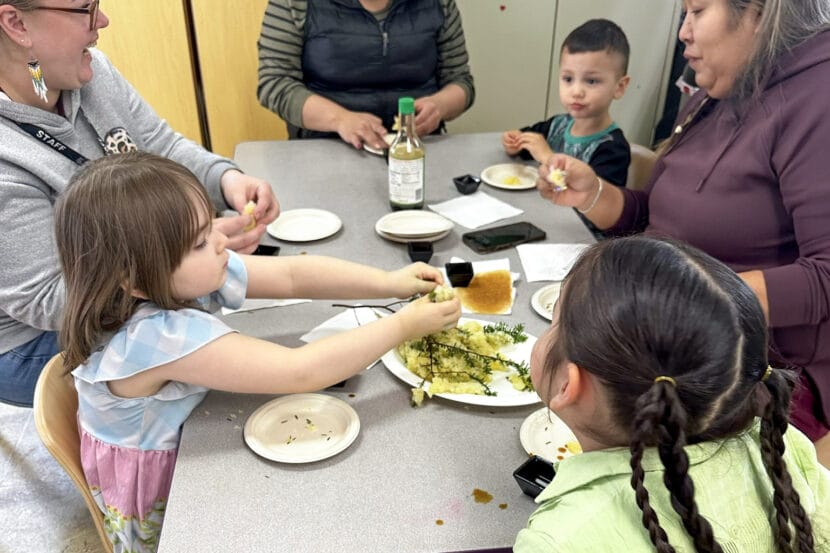
Hoonah Head Start students try herring eggs. (Courtesy of the Central Council of the Tlingit and Haida Indian Tribes of Alaska)
Springtime is herring egg season in Southeast Alaska. Usually that means that the region’s largest tribal government would be setting up to deliver tens of thousands of pounds of the traditional food to tribal citizens across the region and beyond.
But this year, those distributions won’t happen.
The Central Council of the Tlingit and Haida Indian Tribes of Alaska announced this week that its annual traditional food distributions were canceled this year. In March, the federal government canceled a funding agreement with the tribe.
For the last three years, the tribe distributed herring eggs, salmon and black cod to tribal citizens in each of its recognized communities — from villages in Southeast to cities like Anchorage and Seattle.
But the U.S. Department of Agriculture canceled funding that provided the tribe’s food assistance program. A USDA notice to Tlingit and Haida said that the tribe’s community food distributions “no longer effectuates agency priorities and that termination of the award is appropriate.”
Aaron Angerman is Tlingit and Haida’s food security program manager. He said the community distribution program started in 2022 to promote self-sufficiency, and to reduce reliance on food shipped from the Lower 48.
“Our answer to that, and then our heavy reliance on barge systems and things like that, was to turn back the clock a bit about food sovereignty, which is something that our people have relied on since time immemorial,” he said.
The tribe planned to use more than $500,000 from the USDA for the distribution. The money was allocated to the tribe in January, but USDA sent Tlingit and Haida a notice in March that said the agreement had been canceled.
The money was part of a program called the Local Food Purchase Assistance Agreement which was intended to encourage local governments to buy from farmers and food producers.
And that aligned with the tribe’s goal to keep more traditional foods that are harvested in Southeast Alaska in the fridges and freezers of tribal members.
“For us to be able to take a food that was purchased from commercial vendors, to contract those vendors who are tribal citizens, to keep not only that funding within the tribe and the region,” Angerman said. “But also take a food source that was harvested in our area and typically sent overseas to bring that food back to our people and to be shared.”
The herring egg distribution is special for this reason: because of overfishing and exporting of herring and herring roe, the fish now only spawn in very limited areas.
Angerman said his team is working to get more secure funding. But there’s a lot of other work they are doing to further the understanding and use of traditional foods in the meantime.
“We need to work with elders and those with traditional ecological knowledge to see why and where and how we harvested previously,” he said. “Then to not only do that, but to teach people how to harvest themselves, how to process that food, how to put up or prepare that food.”
Because, he said, if a salmon ends up on someone’s doorstep, and they don’t know how to process it, that isn’t food sovereignty.
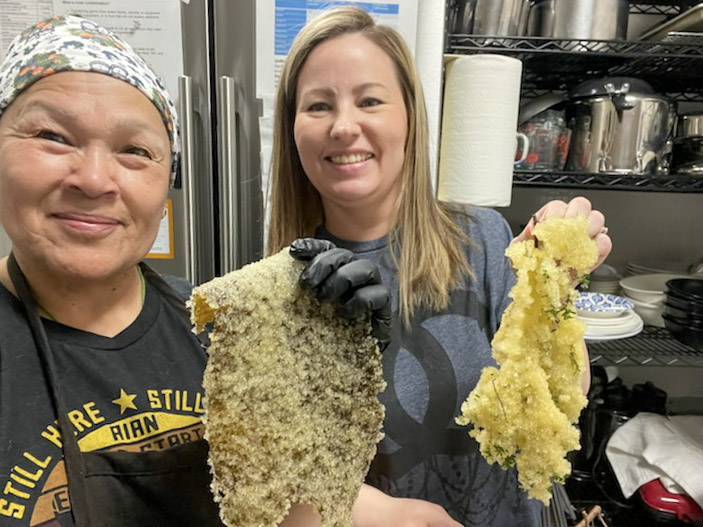
Sitka Head Start Teacher Aide Carolyn Moses and parent Evelyn Edenshaw hold up herring eggs they prepared for Head Start preschool students. (Courtesy of the Central Council of the Tlingit and Haida Indian Tribes of Alaska)
Angerman said Tlingit and Haida was able to purchase enough herring eggs to bring to some of their tribally-run and federally-funded Head Start preschool classrooms this year, so the youngest tribal citizens can still learn about the importance of traditional food and land stewardship.
And some distributions in Washington and Oregon will still happen, according to the tribe’s release. The local tribal council in Seattle used different funding sources to set aside money for distributions to reach elders outside of Alaska.
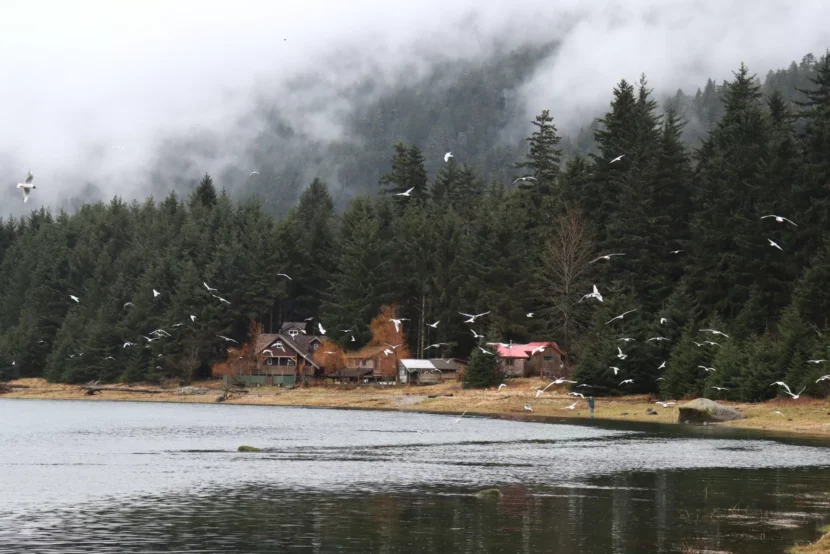
Gulls feeding on hooligan in April, 2025. (Avery Ellfedlt/KHNS)
By high tide on Monday, the sky was overcast and spitting rain. Birds circled cacophonously above the Chilkoot River, and sea lions bellowed downstream. Haines resident Sonny Williams was there, too – posted up on the bridge that straddles the river nine miles outside of town.
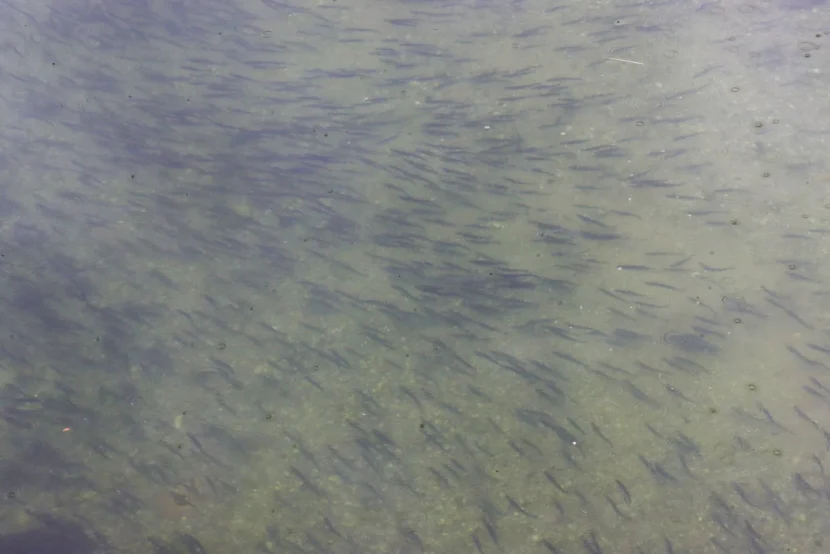
They were all there for the same reason: hordes of small black fish wriggling through the current below, a telltale sign of spring. Williams pointed as a school made its way upstream. In one swift motion, it spiraled back and merged with another school that was headed back toward the ocean.
“They’re going up and down, up and down,” he said. “Their bodies are acclimating to the freshwater.”
Williams is 73. He has lived in the Chilkat Valley and harvested hooligan here all his life. The fish — also known as eulachon, or saak in Tlingit — return to the area to spawn each spring. For millennia, the Chilkoot and Chilkat Tlingit people have harvested them and extracted their oil, both to trade and to keep.
Some years, the run is thick. Others, it’s lighter or never comes at all, depending on the river. Why exactly that happens remains uncertain, as does a long list of other questions about the fish, which experts say is understudied and little regulated.
That’s why, about two decades ago, Williams started keeping his own records — and advocating for a more robust data collection effort.
“Nobody was recording when they were coming. What days they were coming on the Chilkat side, and coming over here,” he said. “And I was doing that.”
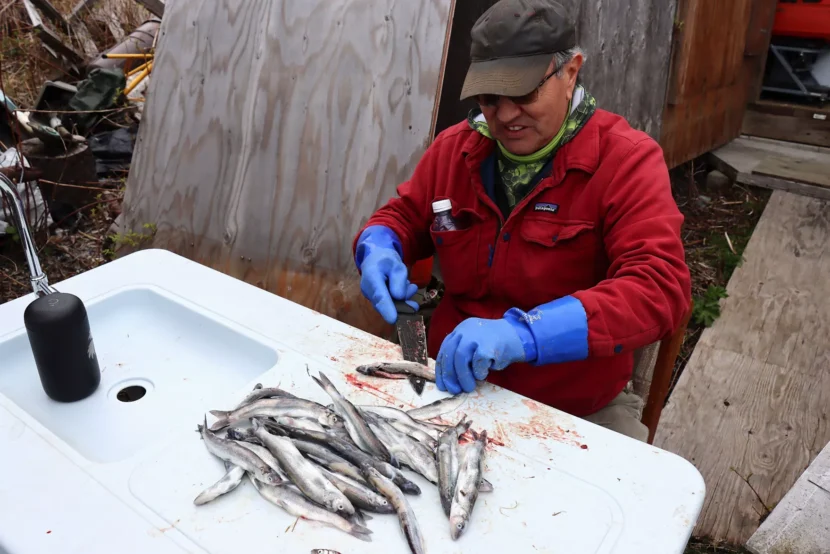
Sonny Williams processes hooligan outside is home in late April. (Avery Ellfeldt/KHNS)
Williams is still taking notes. He said the information is crucial for protecting the fish for future generations.
But now, so are a handful of researchers across the region. In 2010, the Chilkoot Indian Association launched a study to start tracking the run, prompted by tribal members who wanted more concrete data about how the populations were faring from year to year.
“Runs further south were dramatically declining,” said Meredith Pochart, a fisheries biologist for the tribe. “It’s not really a coincidence that also in 2010, the year we started this study, was the same year that the populations in Washington, Oregon and California were listed as threatened under the Endangered Species Act.”
The study first focused on the Chilkoot River. But Pochart said it became clear that to really gauge population trends, the study needed to branch out. So in 2017, the tribe expanded the project to include the Chilkat, Taiya and Katzehin, among other rivers.
So every day at this time of year, Pochart heads to the Chilkoot to take samples. On a windy, cold morning earlier this week, she knelt down to fill some bottles. Later, the samples would be sent to an out-of-state lab to analyze the DNA that hooligan have shed in the water.
That data helps track the size of the run, when it arrives and how long it lasts. But even 20 years in, it’s not a huge sample size – especially when compared to generations of observations by Tlingit people.
A school of hooligan swim through the Chilkoot River in Haines. (Avery Ellfeldt/KHNS)
“This is a drop in the bucket compared to the thousands of years of traditional knowledge of monitoring these species,” Pochart said.
But there are still plenty of questions about the fish. Pochart said those include how old they are and if they spawn more than once. Another gray area is why they spawn where they do each year – though she and other local experts say factors including human activity and environmental changes can play a key role.
“Obviously the fish have an idea of what’s going on, probably way more than we do,” Pochart said. “We don’t know.”
Williams echoed that point, and added to the list of unknowns.
“One of the things they don’t know is where they go, and how come they’re a species of fish that come and spawn and go back out to the sea,” he said. “Herring come and spawn and they go back. But salmon don’t do this. Salmon come to spawn and they die.”
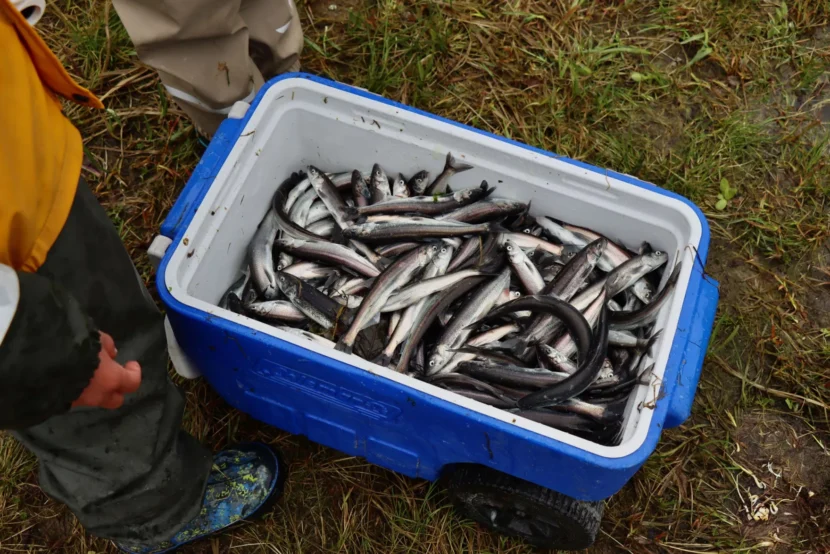
A cooler full of hooligan on the banks of the Chilkoot River in Haines. (Avery Ellfeldt/KHNS)
While Pochart finished taking samples, a flock of gulls took off from a nearby bank. Steller sea lions huffed in the distance. It was an impressive show of the hooligan run’s immense ecological value to the area.
“This is like, the buffet is open,” Pochart said. “Eulachon are a forage fish. They’re the basis of a food web. And so it’s what supports all of this other life.”
The sea lions forage on eulachon just before the females give birth. If they can’t find the nutrient-dense fish at this time of year, it can thwart their ability to nurse their young.
Which is why it’s also important to monitor other species’ activity. Stacie Evans is the science director of the Takshanuk Watershed Council, a local nonprofit that partners with the tribe to track the run on the Chilkat River. Every day when she heads out to get water samples, she also does a wildlife survey.
One day last week, the Chilkat appeared calm when Evans arrived to do her survey. But then she set up a high-powered scope and scoured the opposite bank, where she said the water is deeper and draws more hooligan. Evans estimated that more than 50,000 gulls were there to feast before migrating further north.
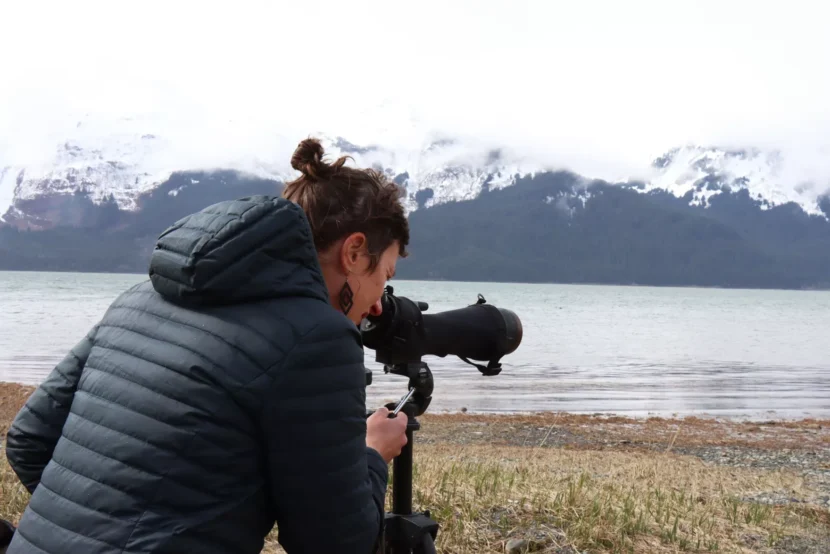
Stacie Evans gauges bird activity on the Chilkat during the 2025 hooligan run. (Avery Ellfeldt/KHNS)
“They are going bonkers, all over the estuary here,” Evans said.
“It’s just like life coming back to the valley, in such a big way,” she added. “I’ve really never seen anything quite like it anywhere else, and I’ve worked in a lot of cool places.”
Back on the bridge over the Chilkoot, the fish were coming in thick. Williams grabbed his bucket, made his way down to the riverbank and swung his throw net.
It was heavy with fish when he pulled it back out – enough to fill his small, blue cooler in one go. Over the next few days, he said, he would fillet and smoke just the males. He doesn’t like dealing with the females, which ooze eggs during processing.
Then he’ll eat one hooligan a day, or maybe more if the mood strikes, until he runs out – hopefully, around the same time next year.
Brian Bezenek pulls up data at the National Weather Service office in Juneau on April 30, 2025. (Alix Soliman/KTOO)
Last month wasunusually rainy across Southeast Alaska and was Juneau’s fourth wettest April on record.
The capital city saw 6.12 inches of rain across 26 days last month, meaning residents experienced just four dry days.
Rainfall was more than 2.5 inches above average in Juneau, Sitka and Ketchikan. Yakutat more than doubled its usual precipitation for the month, making this its second rainiest April recorded.
Brian Bezenek, the lead meteorologist at the National Weather Service in Juneau, said it’s not typical for it to be so soggy this time of year.
“April tends to be one of our driest months of the year,” he said.
But areas of low pressure lingered over the Gulf of Alaska throughout the month.
“That tended to force moisture into the Panhandle from either the southwest or from the south, which generally just brings more rain and more fronts,” Bezenek said. With the mountains pressed against the sea, “we have no way to clear it out,” he said.
It looks like there won’t be much sunshine to start May off, either. Bezenek said to expect showers through much of next week.
On the bright side,he reminds us that April showers will bring May flowers.
“It’s always that way — and the sun is always there, we just can’t see it because of the clouds,” Bezenek said.
The National Weather Service will issue an official April climate report for Southeast next week.
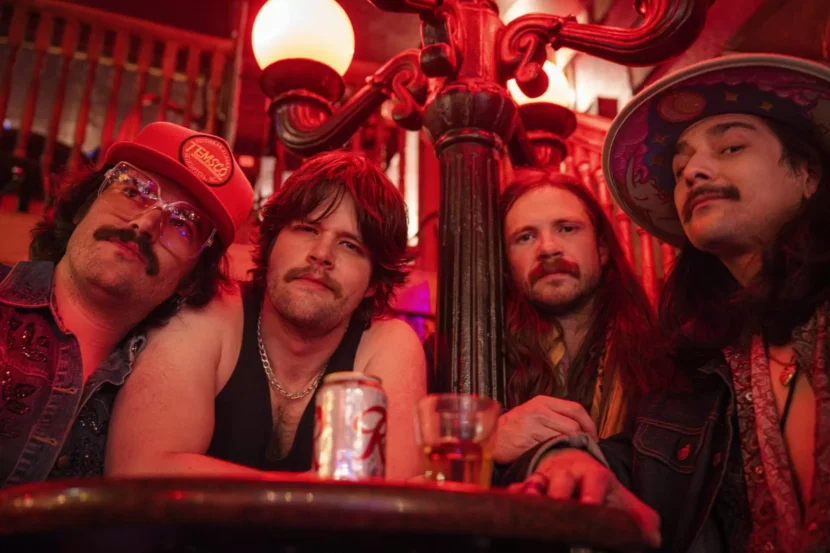
From L to R: Dude Mtn frontman Cullen McCormick, bassist Chazz Gist, Joel Forlines, and drummer Kalijah LeCornu at the Alaskan Hotel & Bar in Juneau. 2025. (Photo courtesy if Patrick Troll)
The Alaska Folk Festival wrapped up earlier this month in Juneau. The festival was celebrating its 50th anniversary. Pickers and folk fanatics flocked from all over the state and country and packed into Centennial Hall and other bars and stages around the Capital City.
Andrew Heist, the president of the festival’s board of directors, told the crowd on closing night that they’d had a record-breaking week selling Alaska Folk Festival merchandise. And they weren’t the only ones that broke records during the festival.
Ketchikan band Dude Mtn headlined shows at the Crystal Saloon and the Alaskan Bar. The shows, which also featured Juneau pop-punk band the Rain Dogs, broke both bars’ all-time records for alcohol sales.
Its been a big year so far for the psychedelic rock trio. They have a live album in the works, recorded during a show at the Mean Queen pub in Sitka, and a headlining gig lined up at Southeast Alaska State Fair in Haines this summer.
Front man Cullen McCormick, bassist Chazz Gist, and drummer Kalijah LeCornu sat down with KRBD’s Jack Darrell to talk about their run in Juneau and the ups and downs of trying to tour in Southeast Alaska.
Note: This interview has been edited for length and clarity.
Jack Darrell: So you guys are fresh off of Folk Fest. How was it?
Cullen McCormick: Well, it was the 50th Folk Fest, and it was legendary. A lot of cool people. We got to hang out with all of our music homies from around Southeast Alaska and the Interior and all converge on one city. Everybody got to do their thing, and we got to watch people do their thing, and they got to watch us do our thing. It was super cool.
Jack Darrell, KRBD: So you guys broke a couple records with beer sales. What does that look like? Was it just tearing down the house?
Cullen McCormick: One would think it’s maybe “tearing down the house,” but I think a lot of it has to do with just the vibe that’s going on in the room. Normally, the vibe that’s going on in the room when we’re playing is like –
Kalijah LeCornu: ‘Let’s drink some beer.’
Cullen McCormick: Sure, people drink beers, you know, or people drink whatever. But at the same time, we don’t put up with any weirdness. We make sure that we cultivate a specific vibe in our shows where everybody feels comfortable.
Jack Darrell, KRBD: This isn’t your first Folk Fest. Obviously, you guys have played a lot of shows, and at this point, have gotten it down to a bit of a science. Have you noticed the Alaska Folk Festival scene change over recent years?
Chazz Gist: Obviously, there’s gonna be a lot of folk music in Juneau for Folk Fest. So, us coming up there and having just a vastly different kind of sound has always been part of the draw. It was just a couple years ago when we first – we’ve been breaking records pretty consistently at The Alaskan at the very least. This is the first year that we broke both our own sales record at the Alaskan and also broke the record at the Crystal Saloon, which is usually held by another band also at Folk Fest.
We’ve just been doing very good in Juneau for a long time. And this was a bigger Folk Fest – the 50th annual. And so I think numbers are just bigger all around for everybody.
Jack Darrell, KRBD: Do you guys feel like the broader music scene in Southeast Alaska is different than when you started?
Kalijah LeCornu: People are paying more attention to it now. Everyone has been so artsy in Southeast Alaska. I feel like forever it’s been such a rich environment for people to create and everyone consumes in in Southeast Alaska. I think we just are more of a part of it now, which is a blessing. But no, I think the scene has been growing regardless of if we’re all along for the ride or not.
Chazz Gist: But interconnecting a lot more than it has in previous years.
Cullen McCormick: Oh, yeah. I think that has a lot to do with COVID. Like, back during COVID, everybody was kind of like, ‘Oh, dude, as soon as this is over, we’re gonna get out and we’re gonna do this, and we’re gonna do that.’ Then COVID ended, and everybody was like, ‘All right, yeah, we are getting out and doing this.’
That’s when this band started. During COVID, we would just lock ourselves in a garage and and literally jam for hours.
I think there’s been a big bloom of artists who have just been waiting. I know it’s 2025, now, but there’s been this bloom. You’re seeing it. The artists who are really starting to do the thing in Alaska have bloomed out of COVID and into this thing that they wanted to be. It’s phenomenal.
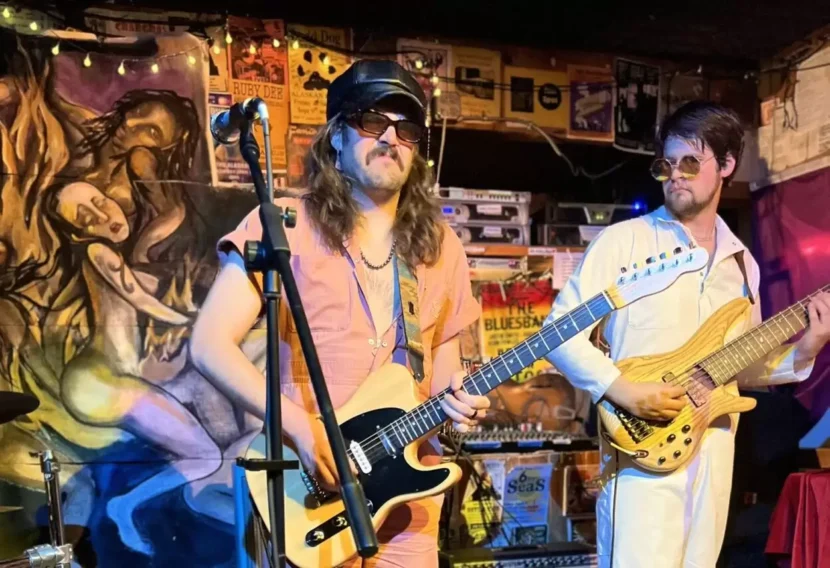
Dude Mtn’s Cullen McCormick (L) and Chazz Gist (R) on stage at the Alaskan Hotel & Bar during Alaska Folk Festival in 2023. (Photo courtesy of Brittany Rickard)
Jack Darrell, KRBD: So, you guys have said in the past that when you guys first started, the band was called the Dude Mountain Boys, right? And you changed that to kind of get away from the “O Brother, Where Art Thou?“-esque vibe.
Cullen McCormick: Yeah, it was a little novelty.
Jack Darrell, KRBD: Was part of that distancing at all from folk and Americana because it was outside of your sound? Obviously Alaska Folk Festival is kind of stepping back into that. Did you kind of change at all for Folk Fest?
Cullen McCormick: I think we dropped the “boys” because we wanted to take ourselves more seriously. At first, it was kind of a pet project. We’d wear overalls all the time and and then it was like, ‘Oh, let’s take it more seriously.’
And in regards to the folk thing – we don’t play folk, but we are a few folks that play music. That’s what we always say in Juneau.
Kalijah LeCornu: The first time we had to say something like that, because we really didn’t know what to expect. Its called “Folk Fest.” Well,
and we got in on a fluke too.
It was because there was that volcano that happened too, that really just kind of helped our little fan base in Juneau, mainly because there was no other bands that could make it. And it’s something I could have never imagined coming from a little COVID band, but man, it does warm my heart.
Jack Darrell, KRBD: How did your beer come about? Denali Brewing’s “Dude Mountain Hazy IPA”?
Kalijah LeCornu: It was Cullen’s fault.
Cullen McCormick: I was tweeting at Alaskan Brewing Company during our first Folk Fest because I was like, ‘Dude, name a band that has a beer. That would be sick.’ And Alaskan was like, ‘Haha.’ And they retweeted it, and they were toying with the idea but they were just fooling about.
And then the Denali rep, Tommy Vrabec, was at the show and heard about it, and was on Twitter and he hit us up, and asked if they can make us a beer and we said absolutely. It’s been this cool partnership.
Chazz Gist: Up north, we’re still pretty unknown. Southeast Alaska is like a totally different country to people up north.
Jack Darrell, KRBD: Touring in Southeast Alaska must be an incredibly, uniquely difficult thing to do. How do you schedule a show when you can barely schedule a flight half the time?
Cullen McCormick: So, that’s the pain of it all. First of all, you gotta get that figured out on time. Then, you have gear, right? You want to travel with your gear. You know how it sounds and how it operates. A lot of times, if you borrow somebody else’s gear, it sounds wonky, you know, it’s like driving somebody else’s car for a week. You get used to it, but it’s still not your car. So, we’re traveling around with gear, and it can be a pain because a lot of it is overweight, and we have a lot of gear and a lot of road cases. And so Alaska Airlines is charging $100 for each overweight item, and it’s like, ‘Oh my god, we have all these bags.’
So that can be a hard part, especially for other bands who are just starting out, if they want to travel and play.
Chazz Gist: I was born and raised here. I’ve never known any other way. But if you’re on the road system, it’s just nothing to pack up your gear in the van. So, it’s about trying to factor in those costs into our pricing.
Cullen McCormick: As a collective, we are not good at planning at all, and but we’re all figuring it out. My wife Stasha is helping us out, even our good friend, Austin Otos. If you’re gonna travel as a band, I would highly recommend bringing friends along, because it just makes everything so much easier with extra hands around and extra vibes.
Kalijah LeCornu: That is the key right there. Bring your friends on tour. Bring your homies on tour. That’s my advice. [Alaska Folk Festival] is the best thing in Alaska that they put on every year. I will stand by that.
Jack Darrell, KRBD: And are you guys writing music at all?
Cullen McCormick: Always trying. We actually did write a song about the milk run while we were at Folk Fest, because everybody hates the milk run. Hoping to record an album in the fall and put it out by next spring.
Chazz Gist: We got a live album in the works from our Dec. 7 show in Sitka, which is Cullen’s birthday.
Jack Darrell, KRBD: Do you guys have any favorite stages or audiences that you have played or play consistently?
Kalijah LeCornu: Personally, I think it’s the Alaskan. That one has my heart. The sound is – I can’t hear a thing up there, but it sounds like everyone else can. So it’s all right with me.
Cullen McCormick: Yeah, I think the Alaskan is probably my favorite too. But, you know what? Aside from travel gigs, throw me into the Arctic Bar in the corner with the boys and let us rip for three or four hours.
Chazz Gist: I really like the Crystal Saloon up there. I like the tight ship. I like being able to hear everything. They just keep adding more lights. Now, they had lasers on top. So, between the fog and lasers, you have these sheets of light going above. And they just get tighter with the sound and tighter with the lights every show.
The Alaskan is can be very chaotic, and though there’s a lot to enjoy there, I have to give up on being able to hear everything. I have to give up on being able to control certain aspects of it. But the Crystal? I just like the tight ship.
Like we said, we broke sales records when we were the headliner. But in each of those shows, we had a few bands before us. Every time we go Juneau, we have our friends, the Rain Dogs.
Jack Darrell, KRBD: You guys brought the Rain Dogs to Ketchikan for the first time this summer, right?
Cullen McCormick: Yeah, I loved it. That was so much fun.
Jack Darrell, KRBD: That was a great time. It shut the electricity off.
Kalijah LeCornu: Rocking too hard!
Jack Darrell, KRBD: Any parting advice for a young band coming up in Southeast Alaska?
Cullen McCormick: Practice hard. Love your homies.
Kalijah LeCornu: Kiss your homies. They need it. They’ll definitely be kissing you back later, and it’s nice.
Cullen McCormick: Can we start that one over?
Chazz Gist: Meet other bands. Whenever bands are coming through, try and hang out a little bit. See their show and talk about what you’re doing. Just make those connections.
Kalijah LeCornu: And pack light.
Cullen McCormick: Says the drummer.
Jack Darrell, KRBD: Okay, last question. Where do you feel like Dude Mtn is going to go from here?
Kalijah LeCornu: Hopefully stay together.
Cullen McCormick: I see Dude Mtn taking over the state of Alaska, and after that, taking over the rest of the U.S., and after that, travel all around. But my end goal for the band, and I think these boys too, is to literally just be able to travel and play music comfortably. If I can make music with my friends and make some money while doing it, that is a dream I could have never imagined.
Close
Update notification options
Subscribe to notifications
Subscribe
Get notifications about news related to the topics you care about. You can unsubscribe anytime.