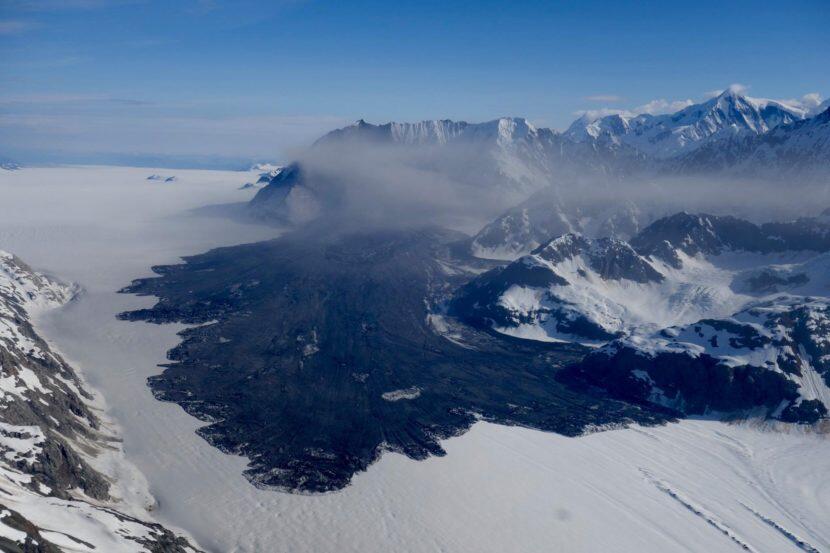
Haines pilot Paul Swanstrom spotted this massive landslide on the Lamplugh Glacier near Glacier Bay on June 28, 2016. (Photo courtesy Paul Swanstrom)
Sen. Lisa Murkowski introduced a bill last week that would reauthorize funds for landslide monitoring work across Southeast Alaska, including in Haines.
At issue is the National Landslide Preparedness Act. The legislation was originally passed in 2020 and has provided millions of dollars each year to agencies including the U.S. Geological Survey for landslide-related work.
But the funding was only approved through 2024. So Murkowski is working to reauthorize it, but this time through 2035.
“We must do everything we can to safeguard our communities and protect Alaskans from fatal natural disasters, and that is why I will continue to advocate for the reauthorization of this bill,” Murkowski said in a statement.
State officials say the original funding has played a major role in fueling Alaska’s efforts to respond to landslide risk, which is intensifying with climate change. Southeast has seen four fatal landslides over the last decade, including one that killed two people in Haines in 2020.
With the exception of some dollars from FEMA, “pretty much the entire” state landslide program is funded by the USGS, said Jillian Nicolazzo, the acting manager of that program, which is within the state Department of Geological and Geophysical Surveys.
“Without the USGS funding, we don’t have another pot of money to use,” Nicolazzo said.
The state has taken on a range of projects as a result of the national funding. Perhaps most important is a statewide inventory on where landslides have happened. Nicolazzo said that project is nearly complete, and will feed into a broader, national database.
Nicolazzo said it’s an important first step toward better understanding where landslides have already happened – and where they’re more likely to take place in the future.
“If we can see that a certain soil type, or a certain slope angle with a certain soil type have had more landslides, then maybe we can say the susceptibility is higher in those conditions,” she said.
The federal funding has also fueled work focused on Southeast weather stations.
Most towns already have weather stations at their airports. Those are critical for aviation purposes but insufficient for monitoring landslide risk across a broader area. Take Wrangell, where a landslide killed six people in 2023.
“People who lived by the Wrangell landslide said there was a lot more rain than what had been recorded at the airport,” Nicolazzo said. “And they suggested that the weather patterns had also been different than what had been recorded at the airport.”
The program helps maintain existing weather stations, including several in Haines. The station on Beach Road, for instance, needs maintenance. Nicolazzo said it looks like some animals have nibbled on wires, and that a bear may have disrupted some solar panels.
But the program also funds the construction of new stations. Nicolazzo said that could happen in Ketchikan and Petersburg this summer.
The reauthorization bill has been introduced in both the U.S. Senate and House of Representatives. The House Natural Resources Subcommittee on Energy and Mineral Resources is set to hold a hearing on the legislation this coming Tuesday.
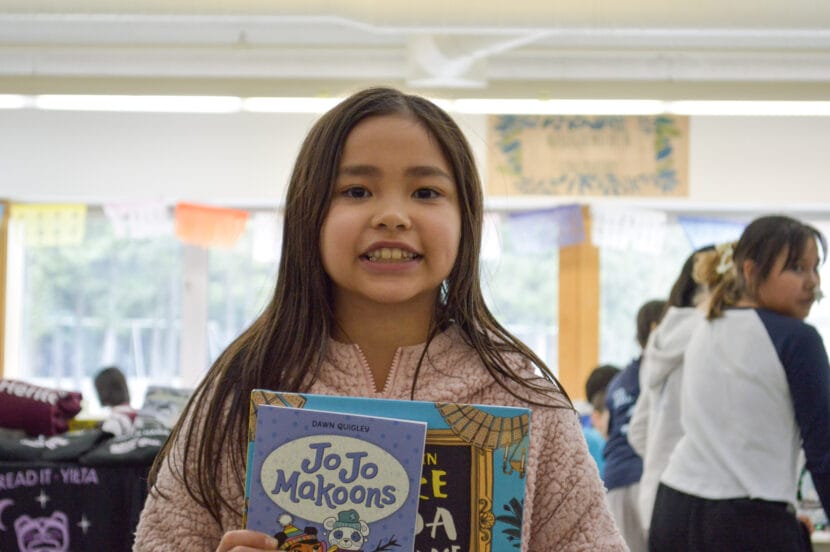
Audri Ia holds up the books she received at a book drop on May 15, 2025. (Photo by Yvonne Krumrey/KTOO)
Thousands of new books, many by Indigenous writers, are landing in the hands of kids across Southeast Alaska this month. A series of book drops are the result of a partnership between the region’s largest tribal government and a Native-led nonprofit with roots in the Navajo and Hopi nations.
During Thursday’s book distributions at Kax̱dig̱oowu Héen Elementary in Juneau, kids swarmed around tables piled with books.
Audri Ia, a third grader who says she loves reading, picked up a book about Ada Lovelace, a mathematician.
“I liked this one because I read the back of it and I got really interested in it, and I like science books,” she said, adding that she wants to be a scientist.
“I like to, like, blow stuff up at my house, but my mom always says no,” she added.
Ia wasn’t the only one who had a stack of books in her arms. Throughout the common area, dozens of kids scurried around with their own finds. Some books are for kids as young as five or six years old, and some targeted older readers. The ones for elementary-aged kids were going fast.
The Central Council of the Tlingit and Haida Indian Tribes of Alaska hosted the book drop. Special Projects Manager Tristan Douville helped orchestrate the event, and he surveyed the pandemonium with visible emotion.
“Oh my gosh. It’s so incredible. It’s like amazing. Mind blowing. Couldn’t be more exciting,” he said. “I’m like, ‘this is crazy.’”
Months ago, he reached out to NDN Girls Book Club — a nonprofit that brings books to Indigenous communities — to float the idea of book drops in Southeast Alaska. He said he knows firsthand that not all Alaska students have ready access to fun reading material.
“I grew up in a rural community. I grew up on Prince of Wales Island, in Craig and Klawock, and there were times when it wasn’t super accessible to even get to the library,” Douville said.
That kind of access is the point for Kinsale Drake, the founder of NDN Girls Book Club. She said she wishes there were book drops like this when she was growing up.
Drake is a poet, and said she thinks she may have found her passion earlier if she had more exposure to Native writers. She said she was motivated to start the book club as a way for her to work against a publishing ecosystem that can exclude certain readers or communities.
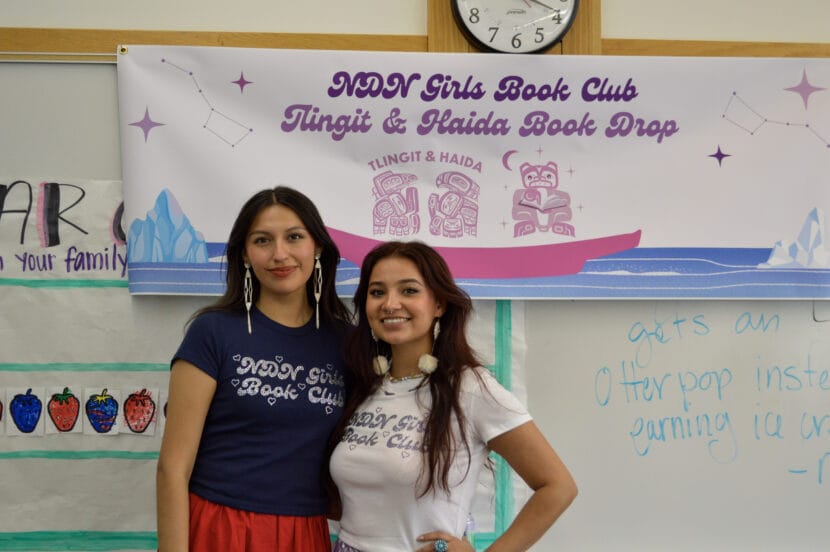
Lily Painter and Kinsale Drake lead NDN Girls Book Club on May 15, 2025. (Photo by Yvonne Krumrey/KTOO)
“Publishers care about money. They don’t care about representation unless it’s making them money,” Drake said. “And so I think, you know, the anger and the sadness, I think, of dealing with that as somebody who wants every Native kid to be able to have books with characters that look like them, that make them feel confident, that make them feel happy and seen and loved.”
Her organization started delivering books throughout the Navajo and Hopi Nations in a pink van in 2023. Since then, NDN Girls Book Club has traveled across the United States with books in tow.
Drake says events like these show publishers that there is a market for stories about and for Indigenous youth.
“When we come out here and we have a room full of kids who are, like, so excited to have books like this, it’s like, you know, we’re showing them in their face. This is representation. This is why it’s important. And you’re not going to tell us that it’s not important,” she said.
The book tour will make it to villages in Southeast, too. Next, books will land in Yakutat, Klukwan and Hydaburg.
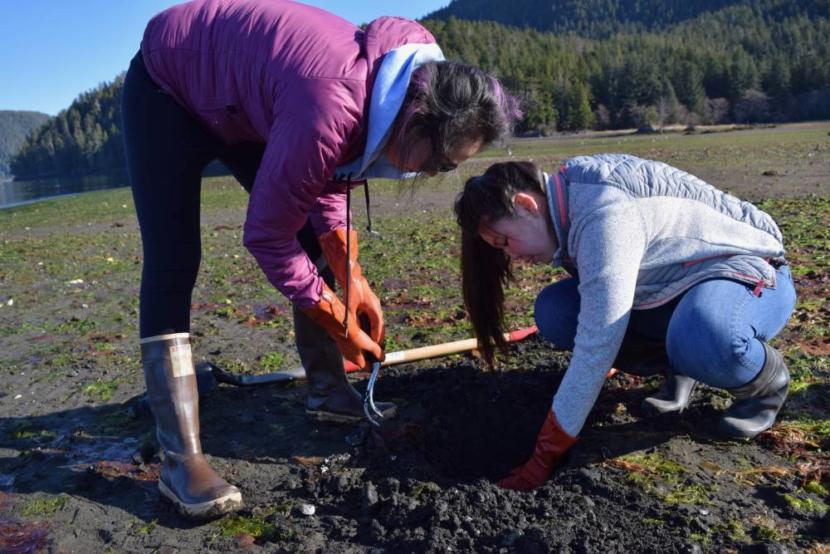
Mt. Edgecumbe High School students dig for butter clams and blue mussels in Starrigavan Estuary. (Photo courtesy of Helen Dangel)
Listen to this story:
The Southeast Alaska Tribal Ocean Research network posted a paralytic shellfish toxin advisory for recreational and subsistence harvesting in communities across Southeast this week.
The advisory warns of high toxin levels in all shellfish species in Sitka, Skagway and Ketchikan and in butter clams in Juneau, Kake, Craig, Hydaburg and Kasaan.
John Harley, a shellfish expert at the University of Alaska Southeast, said that Sitka had a harmful algal bloom that led to high shellfish toxins in early April — the earliest since scientists started keeping a record in 2016.
“I think that the window in which we have to think about harmful algal blooms occurring is increasing,” he said.
An old adage was that months ending with the letter ‘r’ were safe for harvesting. Harley said researchers in this region don’t know whether that was ever a useful rule of thumb, since data only goes back about a decade in this region. But he said that as the ocean warms, blooms will likely become less predictable.
Jeff Feldpausch, the resource protection director for the Sitka Tribe of Alaska, said to never assume is safe.
“I wouldn’t recommend people eat shellfish unless it’s tested,” he said. “Other than that, you’re just going to be taking that risk.”
Feldpausch recommends tribal members and the general public send samples of their shellfish harvest to the Sitka Tribe of Alaska’s environmental research lab to test for toxins and wait to get results back before eating them.
Alaska has one of the highest rates of paralytic shellfish poisoning in the world. The state reported 132 cases between 1993 and 2021, including five deaths. That’s in part because Alaska is the only coastal state in the U.S. without a state-run toxin testing system for recreational and subsistence shellfish harvesting. Feldpausch said testing would be a heavy lift for the state.
“The state of Alaska has countless miles of shoreline and potential areas that they would need to sample,” he said.
In fact, Alaska has more miles of shoreline than all Lower 48 states combined. The state’s high rate of shellfish poisoning could also be due in part to a tradition of shellfish harvesting across remote communities where testing is less common.
Carol Brady, Alaska’s shellfish program coordinator, said the state does routinely test commercial operations, so store-bought shellfish is considered safe. The state ramps up testing in the spring and summer.
“Between May 1 to October 31 it requires testing of the first lot harvested each week, of each species,” she said.
An alga called Alexandrium catenellais responsible for paralytic shellfish poisoning. The alga produces a neurotoxin that builds up in clams, mussels and other shellfish that feed on it. There is more toxic algae for them to feast on when conditions are ripe for a bloom, meaning there’s plenty of sunlight, nutrients, calm seas and the water is warm enough. Once the toxin concentration in shellfish is above the federal regulatory limit, it’s dangerous for people to eat. Just one milligram can kill a person.
Symptoms of poisoning include tingling or numbing in the arms, legs and lips as well as nausea and difficulty breathing. People with these symptoms should seek medical care immediately.
To prevent foodborne illness, state officials recommend checking advisories before going out to forage, avoiding shellfish that are sitting in the sun, harvesting as soon as the tide goes out, putting the harvest on ice immediately and cooking everything thoroughly. While freezing and cooking won’t kill Alexandrium catenella, it can kill harmful bacteria like vibrio andnorovirus.
To report paralytic shellfish poisoning cases, contact the Alaska Department of Health and Social Services at (907) 269-8000, or (800) 478-0084 after hours.
Jeff Jackson, Tlingit of the Kaach.ádi Clan from Kake, and Chris Pata, adopted into the Shangukeidí Clan of Juneau, prepare to set a tree into the waters of the Kasiana Islands in Sitka Sound in March 2024. The traditional process, used during herring spawning season, involves anchoring the tree with a rock and marking it with a buoy. Knowledge of local tides, spawning patterns, and the ocean floor is key to a successful set. (Photo courtesy of Gooshdeihéen)
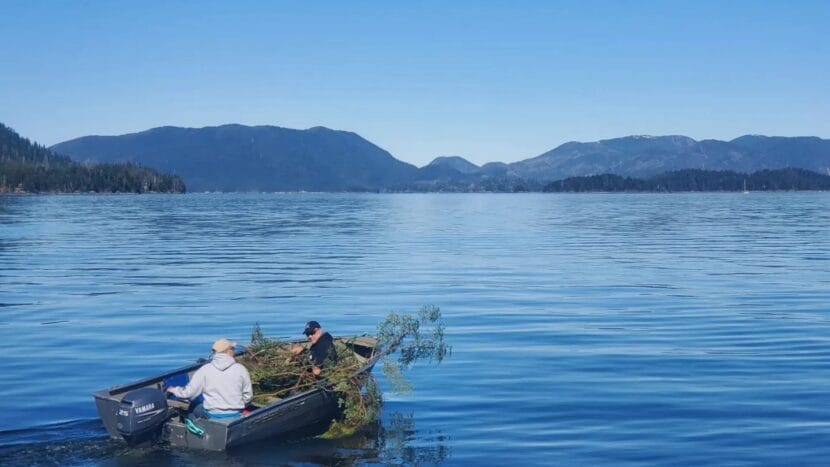
The sunlight bounces off the glassy surface of Sitka Sound as community herring fish egg harvesters navigate the waters with boats loaded with hemlock branches for the fish to lay eggs on. Surrounded by the whales, and the sounds of lively seals, sea otters, sea lions and countless seabirds, this annual harvest is a cherished sign of spring for people living in Southeast Alaska. After months of gray skies and cold weather, both people and wildlife eagerly embrace this moment.
Steve Johnson, recognized by his Łingít name Ixt’Ik’Eesh, is a prominent community leader from Sitka.
“It’s like the first real taste of spring that we get here,” Ixt’Ik’Eesh said excitedly
Of the Kiks.adi Clan of Sitka, Ixt’Ik’Eesh has been harvesting herring fish eggs for most of his life. His earliest recollection of the harvest dates back to his childhood, a memory he cherishes deeply. Ixt’Ik’Eesh recalls being on the skiff with his father and uncle, surrounded by the vast ocean.
“I remember putting my hand in the water, and I could feel the herring as they ran around it, and just the sight and the smell of it and the beauty of the world around us,” recalled Ixt’Ik’Eesh. “It’s an amazing time of the year.”
He now plays a vital role in educating community members on the techniques of harvesting herring eggs. He has successfully trained around 100 participants in the community harvest program he leads. This volunteer-driven program involves coordinating volunteers to collect and distribute the eggs through a Facebook group. Active for two decades, the program has successfully distributed about 17,000 pounds of eggs, benefiting roughly 20,000 people. This initiative not only feeds the community but has also empowered individuals by providing them with the necessary experience and knowledge to launch their own fishing operations.
Volunteers at the production line packing up herring eggs. Left to right: Lucas Goddard, Tlingit of Kik.sadi Clan;, Ixt’Ik’Eesh, Tlingit of Kiks.adi Clan;, Oliver Koutchak, Inupiaq; and CJ Johnson-Yellow Hawk, Dakota band of Ihanktownna. (Photo courtesy of Mary Goddard)
“There was a period of time not too long ago where there was just a little over a dozen harvesters left, and that was really scary to me on a number of ways,” explains Ixt’Ik’Eesh.
For Ixt’Ik’Eesh, it is crucial to preserve and pass on the traditional knowledge of herring egg harvesting to ensure it remains a vital part of Łingít culture rather than fading into history.
“This is one of the few practices that we have that have been unbroken by colonization.” says Ixt’Ik’Eesh.
He not only brings valuable experience and oversees a community harvest program, but also holds formal leadership roles for both Sitka and the state of Alaska, serving on various boards and commissions, in addition to being a Council member of the Sitka Tribe of Alaska. Last year, he represented the Sitka Tribe of Alaska at the Alaska Board of Fisheries meeting as a traditional harvester, where he advocated for the protection of Promisla Bay from commercial fishing. He proposed designating the bay as part of the subsistence conservation zone, highlighting its significance as a major producer of herring eggs and a vital harvesting area for locals.
The proposal didn’t pass but that hasn’t stopped Ixt’Ik’Eesh, and his work doesn’t go unnoticed. In a nomination form for the Joint Board of Fisheries/Commercial Fisheries Entry Commission Herring Revitalization Committee, which is a combined board of the Alaska Commercial Fisheries Entry Commission and the Alaska Board of Fisheries to herring across the state. Ixt’Ik’Eesh has been recognized as the number one producer of subsistence herring egg harvesting.
The nomination highlighted his work providing herring eggs to over 10,000 households through the implementation and 20 years of distribution of tribal food security initiatives. Additionally, it recognized his extensive experience, exceeding 25 years, in both subsistence and commercial fishing.
Ixt’Ik’Eesh shared that he is guided by the Kiks.adi Clan principle of sharing. It serves as a powerful reminder of generosity.
“We measure people, and particularly leaders, not by what they have or what they show but by what they give away,” says Ixt’Ik’Eesh. “And so for me, that’s a big part of my upbringing, of my core values, and that whenever we have an abundance of something, we share it.”
This philosophy is reflected in the numbers. According to the Alaska Department of Fish and Game, in 2023, “93% of the harvest was shared with other households within Sitka or in other communities in the state and beyond.” This level of sharing underscores ancestral traditions that prioritize community health and connection.
Despite the unsuccessful Promisla Bay proposal and complexities of colonial management systems, Ixt’Ik’Eesh will always be found on his traditional homelands and ocean. This bond is rooted in a deep cultural understanding of his place and calling. Engaging in the labor of harvesting for community members and individuals who are unable to access the eggs is a task that is both physically and mentally demanding. However, Ixt’Ik’Eesh finds joy in this work, as it allows him to contribute to the well-being of his people while honoring traditional practices. The Facebook group plays a crucial role in this dynamic, serving not only as a means of communication and organizing but also as a place to share memories.
Left to right: Lucas Goddard, Tlingit of Kik.sadi Clan, and Ixt’Ik’Eesh, Tlingit of the Kiks.adi Clan, box up herring eggs to send to Juneau for tribal citizens to enjoy. (Photo courtesy of Mary Goddard)
“I really like it when people send pictures and when they post pictures of their family meals and their gatherings and people enjoying them and knowing that myself and my friends and volunteers all had a very strong hand in producing that food that’s on their table that they’re enjoying.” says Ixt’Ik’Eesh.
Capturing Community
One of the volunteers aboard Ixt’Ik’Eesh’s boat this season was Mary Goddard, a Łingít filmmaker and artist. She experienced the herring egg harvest in Yakutat as a young girl and remembers her and her mother running to the beach to witness the herring spawn. They’d return the next day to check if the eggs were ready to eat. She recalls pulling seaweed from the ocean, each strand covered in herring eggs. Originally from Yakutat, a Southeast Alaska community about 230 miles from Sitka, Goddard hadn’t experienced the large harvest that Sitka is known for but still felt the same excitement.
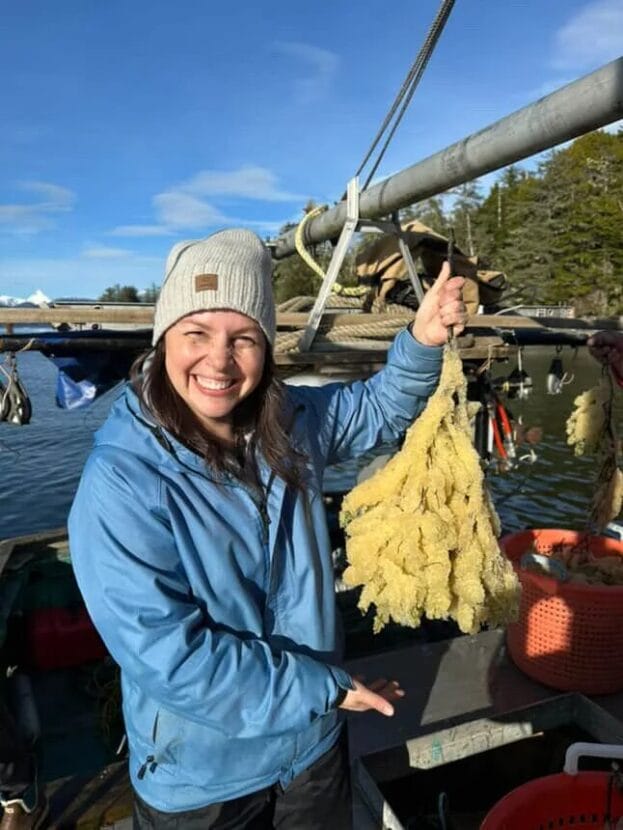
Mary Goddard, Tlingit of the Kaagwaantaan clan, proudly holds up a hemlock branch thick with herring eggs. (Photo courtesy of Dave Fedorski)
“It was fun to be able to just walk down from our house to the beach and grab those herring eggs and eat them for dinner that night,” says Goddard. Her first career path was in acting, which took Goddard across the country to New York City, where she attended the American Musical and Dramatic Academy. But along the way, she fell in love with filmmaking. After spending 15 years in the industry, she returned to Alaska.
That leap of faith led her to found her own production company, MidnightRun LLC. After moving to Sitka, she came to see the harvest as a community celebration to welcome spring. Due to her curiosity as a filmmaker, Goddard herself began harvesting.
Aboard a boat in the ocean loaded with about 30 hemlock trees, Goddard was nervous yet excited because of her role in the harvesting process.
“My role this year was really fun, because I gotta do it from start to finish,” says Goddard.
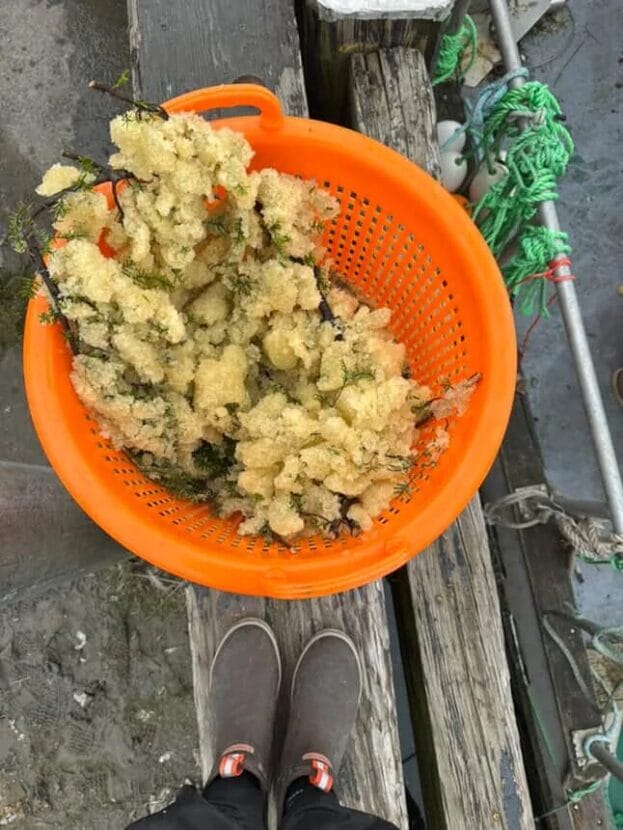
The process begins by determining the spawning locations and timing for herring, which, according to Goddard, happen during the spring season when dollar-sized snowflakes are falling from the sky. Following this, the volunteer crew prepares by searching for medium-sized hemlock trees that have fresh needles, as these provide a desirable flavor for the herring eggs. Once enough branches are collected, they are placed in the water, secured with weights and buoys. The next step involves checking the branches one or two days later, with the hope that the herring will have laid their eggs on the gathered branches.
“Then a couple of days later, you’ll come back and pull up those trees and if it’s a good harvest, they’re rich and thick, full of herring eggs,” says Goddard.
Harvesting has evolved into more than just a filming opportunity; it has become a chance for Goddard to share this tradition with her son. This season, she took her 9-year-old out on a Saturday to scout for trees in preparation for the harvest. By bringing her community on screen, Goddard also returned home to connect younger generations with their elders, utilizing filmmaking as a tool to generate enthusiasm for traditional practices.
“Being able to teach the youth in a way that maybe they’re already engaged with is one way to ensure that the youth will continue to practice our harvesting ways,” says Goddard.
Ultimately, Goddard wants her son to appreciate the effort involved in harvesting from the land and recognize the value of natural resources like herring eggs. She emphasizes that it is far easier to waste food purchased from a grocery store than to invest the time and energy required to gather and prepare food sourced directly from the earth or sea. Additionally, she highlights the deep connection that Indigenous peoples have with the animals they rely on, underscoring the importance of respect and stewardship in their relationship with nature.
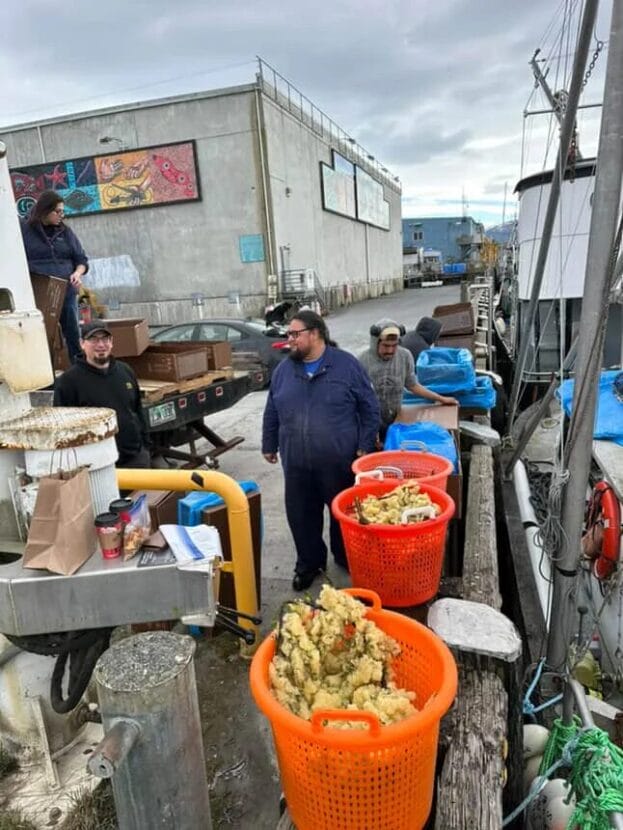
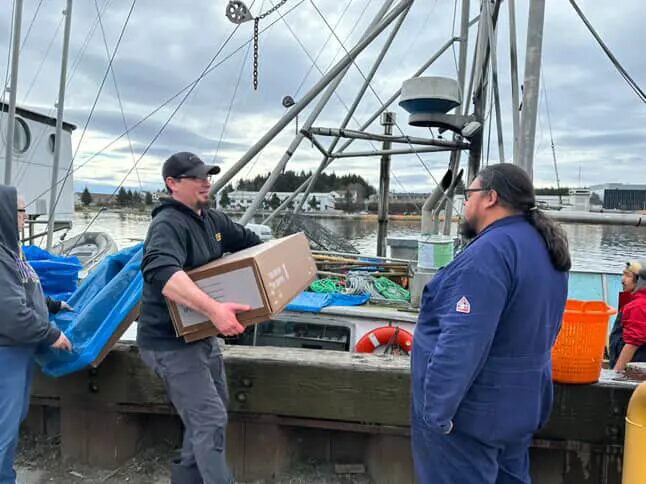
Baskets of herring eggs are transferred from coolers to fish boxes in preparation to ship out around Alaska and Washington to share with tribal citizens. (Photo courtesy of Mary Goddard)
“I want him to be able to respectfully harvest, respectfully take care of his body through healthy food that he knows where it came from,” Goddard said.
“I want him to really care for himself by eating really healthy food, and being connected to community and gratitude, and all these amazing things that subsistence living teaches you,” Goddard continued.
Family tradition
Like Goddard, for Ricardo Worl, known by his Łingít name Gooshdeihéen, this is a family tradition, something he has looked forward to since childhood. Although he was too young to be on the ocean, he was able to contribute to the harvesting process in other meaningful ways. Gooshdeihéen remembers packaging the eggs collected by his uncles in Sitka, often handling boxes that weighed as much as 50 pounds. Surrounded by family, he participated in the enduring tradition of utilizing and processing the resources provided by the land.
“I just remember me and my cousins receiving that box excitedly, and vacuum sealing it, sharing it out,” reflects Gooshdeihéen.
As a community harvester, he can now be found alongside his uncles in the ocean each spring. As a nephew, he is expected to learn from their experience. His responsibilities extend beyond merely acquiring knowledge; he is also tasked with engaging in physically demanding work.
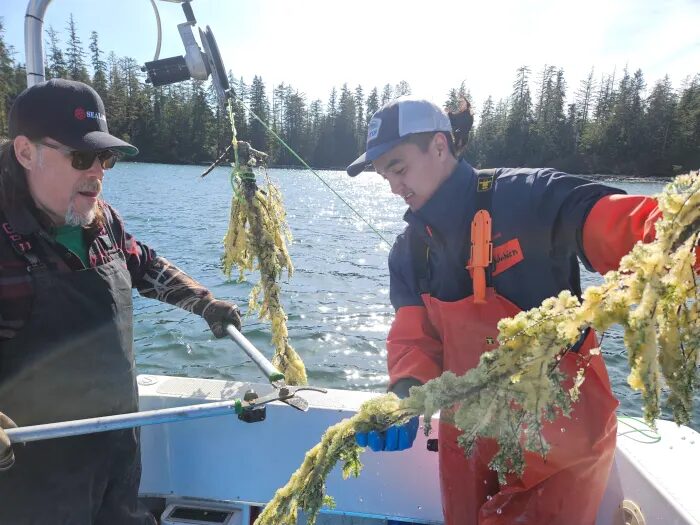
“My role was to cut down all the trees, bring them from out of the woods, down to the boat so they could put the trees and branches into the water,” Gooshdeihéen said. “And after the herring had spawned on the trees, my job was to pull the trees up to the boat so we could clip the branches off and pull them in.”
Gooshdeihéen didn’t formally participate in the harvest until after completing his undergraduate education at Whitworth University in Spokane, Washington, in 2021. After Gooshdeihéen returned home to Juneau he enrolled in the Haa Yoo X’atángi Deiyí: Our Language Pathway Project to learn his Łingít language. In the program, Gooshdeihéen expressed that he was interested in reconnecting his language with subsistence practices.
Left to right: Jonathan Ross, Dena’ina and Gooshdeihéen, Tlingit of the Kaagwaantaan Clan, harvest herring eggs from submerged trees. After the herring finish spawning, the trees are pulled up and tied off to the boat. Large branches are clipped for easier handling, while the rest are returned to the ocean to support the herring’s life cycle. (Photo courtesy of Anna Michelle Schumacher)
“I found that becoming a language scholar has made me a better fisherman and being a better fisherman has made me a better language learner,” says Gooshdeihéen.
He believes that both elements of the language and ways of living are inherently intertwined, and says he now has a greater appreciation when learning about his heritage.
Although Haa Yoo X’atángi Deiyí ended in 2023, Gooshdeihéen continues his linguistic journey to translate the Łingít language, aiming to contribute to the development of educational curricula. He shares that he is not only grateful for past language speakers but that his community is “lucky that our aunties, uncles, and grandparents documented a lot of our language, so there’s a lot to be translated. ”
Gooshdeihéen is one of the 22,601 individuals of Łingít descent, according to the latest Census data. The Łingít people are the largest group of Alaska Natives with a rich cultural heritage and historical presence in Alaska. According to the Alaska Native Language Center there are about 500 speakers of the Łingít language.
“I’d love to do translation and curriculum development to create some curriculum and language learning resources for future generations,” says Gooshdeihéen.
Gooshdeihéen’s goal and data figures highlight the ongoing efforts to preserve and revitalize the language, which is an integral part of the Łingít identity.
In the meantime, he is enrolled in language classes at the University of Alaska Southeast and coaches the Yadaa.at Kalé ski team, and the cross-country, and track teams at Juneau-Douglas High School. When he isn’t focused on language studies, skiing, or retrieving heavy tree branches from the ocean, Gooshdeihéen enjoys preparing herring eggs by blanching them on the branches, then picking them off and dipping them in seal grease. He has also been experimenting with new methods to enjoy this traditional delicacy.
“But recently, I have been trying new recipes with the row on kelp, where I sort of marinate it like you would kimchi,” says Gooshdeihéen.
Beyond trying new recipes and learning traditional ways of living, Gooshdeihéen is part of a larger network of Indigenous people who are living the traditional ways of their ancestors. Belonging to the Kaagwaantaan clan, Gooshdeihéen shares that having the opportunity to harvest herring eggs with his uncles not only reinforces his connection to the land but also the connection to his clans and community. He explained that when he is out on the ocean, he is amazed that he can “connect with the lands that my ancestors stewarded and do the things that they’ve been doing since time immemorial.”
“I’m doing the same thing in 2025 that my ancestors were similarly doing 10, 15,000 years ago,” Gooshdeihéen continued.
A 2019 study by the University of Alaska Southeast confirms this.
“In northwestern North America, the archaeological record of faunal remains shows that herring were fished for more than 10,000 years and were routinely taken by at least 4,000 BP (Before Present),” the university announcement of the study said.
He is dedicated to continuing his ancestral traditions in other ways as well.
“I made sure I shared a box with my grandparent’s people, the T’akhdeintaan out of Hoonah, and it’s really rewarding, and it feels good to reinforce these clan connections that have been also maintained since time immemorial,” says Gooshdeihéen.
The lessons he learned in childhood remain meaningful as he continues to pack eggs into boxes for his community.
Historical Athabascan and Tlingit trade routes
One of the special boxes was sent to Val Adams, a Gwich’in and Koyukon Athabascan from Beaver, who lives in Fairbanks, Alaska. Her friend, Sara Beaber-Fujioka, whom she knows through church, sent the box from Sitka. Beaber-Fujioka’s late husband was a fisherman who also harvested herring eggs and through his knowledge and relationship with Alaska Native traditions, also packaged and sent similar boxes.
“Harvesting and sharing food was central to his life, and so we had been harvesting and sharing herring eggs as this amazing abundance that we have in Sitka,” says Beaber-Fujioka.
After her late husband’s passing, Beaber-Fujioka and her daughters decided to carry on the legacy. She says that being able to share this abundance with people she knows will carry forward the joy of giving, especially among elders, is Beaber-Fujioka’s way of giving back to the community.
Adams chose to share the mail by distributing the eggs among the elders in the Denakkanaaga program, a nonprofit organization that provides cultural programming for elders living in the Interior.
“It’s our traditional way,” says Adams. “It’s our custom to share, especially delicacies such as this.”
Val Adams, Gwich’in and Koyukon Athabascan of Beaver, Title VI Director at Denakkanaaga, cuts up the herring eggs to distribute to elders in Fairbanks, Alaska, on April 1, 2025. (Photo courtesy of Denakkanaaga)
Sharon McConnell, the executive director of Denakkanaaga, emphasizes that this generosity illustrates the historical trade relationships that existed before Western contact. As noted by Sealaska Heritage, Łingít people have always historically traded amongst themselves and neighboring communities for goods that couldn’t be found in the region. Łingít’s offered, “greenstone for tools, clams, mussels, red and yellow cedar, dried halibut and salmon, seal oil, herring eggs, seal meat, hooligan oil, and berries.”
“Through the decades we’ve traded with other tribes throughout the state of Alaska, and the bonds have been made between Native people in different regions of Alaska, and one is between Southeast Alaska and Interior Alaska,” says McConnell.
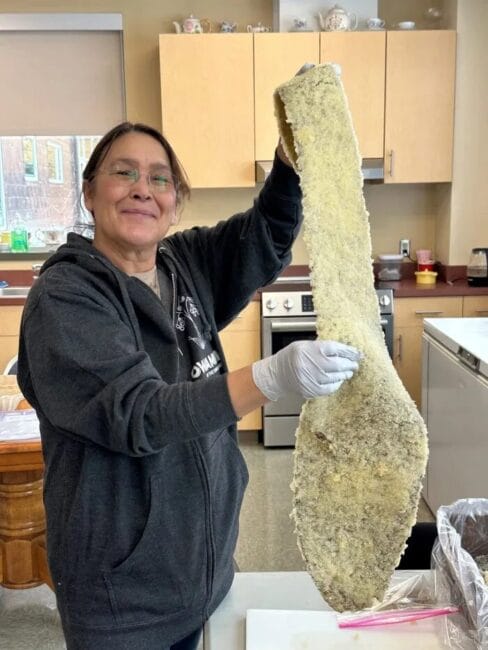
While the box of herring eggs didn’t cross the vast landscape through the rivers, mountains, and lakes on a trade route, the eggs were still enjoyed by the elders. McConnell shared that everyone loved it as the elders enjoyed the eggs to their liking, such as eating them raw or blanching the eggs before eating.
“For those in Southeast to share it with us, it’s very meaningful and very appreciated,” reflects McConnell.
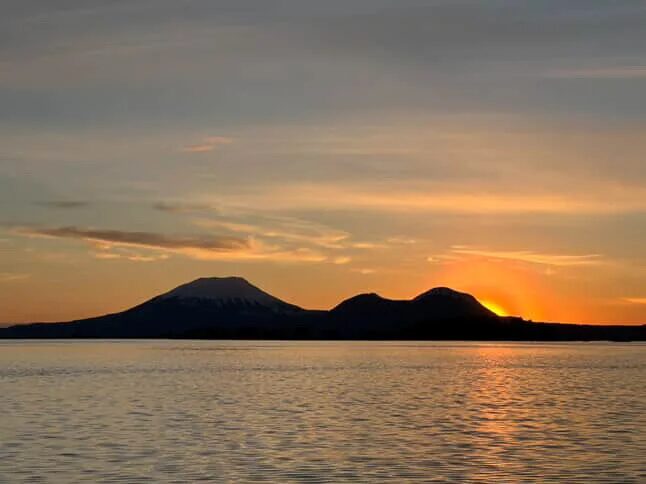
Harvesters return home from harvesting herring eggs while the Sitka sun sets marking the beginning of spring. (Photo courtesy of Mary Goddard)
The 2025 herring egg harvest in April serves as a reminder of how traditional values continue to foster unity among diverse communities of Alaska. This annual harvest, deeply rooted in Indigenous practices, reflects a respect for nature and a commitment to sharing resources. As the herring spawned, various clans, each with their own histories, came together to participate.
Goddard shares that the act of gathering isn’t only a means of food security but also reinforces the community aspect of this practice.
“I don’t think we were meant to do it on our own, or especially in our cultures, we weren’t meant to do it on our own,” Goddard said. “We’re meant to rely on each other, and I think that is something like the herring egg harvest really represents.”
ICT originally published this article. ICT is an independent, nonprofit, multimedia news enterprise. ICT covers Indigenous peoples.
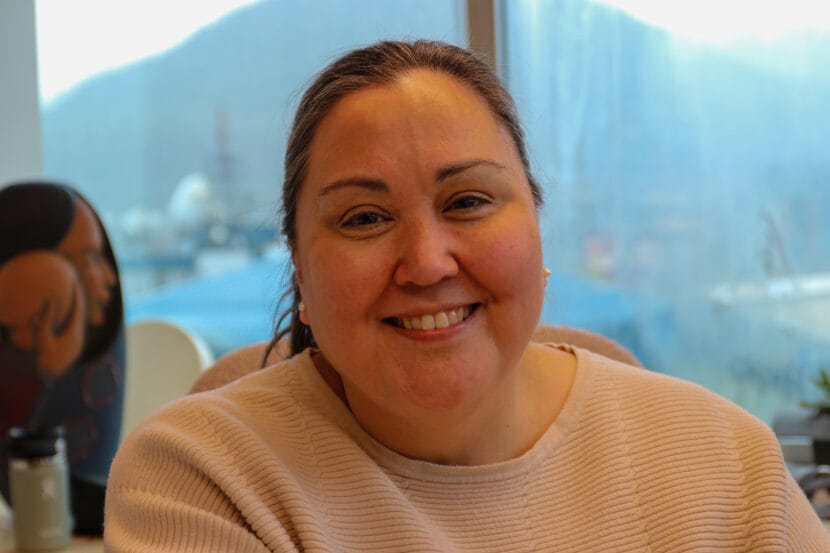
Mary Johnson sits for a portrait in her office in Juneau on May 6, 2025. (Photo by Jamie Diep/KTOO)
The Central Council of the Tlingit and Haida Indian Tribes of Alaska can now receive reimbursements for providing child welfare services directly from the federal government. Both governments finalized the agreement last month.
That means the tribe’s reimbursements no longer need to go through the State of Alaska. Tribal officials say the agreement gives them more flexibility in handling cases where child abuse and neglect may be happening.
Mary Johnson is the senior director for family services at Tlingit and Haida. She said the tribe will continue working with the state on child welfare services, but it can now look into ways to expand its services.
“What do we need to get into place to license our own foster homes? What do we need to get into place if we do want to initiate a child welfare case within our own tribal court? And how do we go about putting that into action?” Johnson said. “Now we have the resources to make that happen with a lot of work.”
Alaska’s Office of Children’s Services has agreements with tribes across the state to serve Alaska Native children placed in the system. Tribes assist in Indian Child Welfare Act cases. The law sets standards for children’s services agencies to place Alaska Native and Native American children with family members or to keep them in their home communities if they are removed from their family.
That means Tlingit and Haida works with the state to find a suitable place for children to live after they’ve been removed. In the past, federal reimbursements were distributed to tribes from the state. With the new agreement, Johnson said the tribe can now receive reimbursements directly from the federal government.
Johnson said the tribe’s family services generally have a better understanding of a referred family’s cultural background.
“If you are working with a caseworker at Tlingit and Haida, the chances of them being Alaska Native or even a tribal citizen are pretty high,” she said. “So you’re going to be connecting with someone that just tends to know your way of living a bit more than someone who doesn’t. So that makes a huge difference when working with our families.”
Data from OCS shows that more than two thirds of the children removed from their home last year in the state were Alaska Native.
Tlingit and Haida worked on more than 233 cases in 15 states last year. The tribe serves all of its tribal citizens, including those that live outside of Alaska.
Johnson said the tribe hopes to expand its abuse and neglect prevention services through the agreement as well.
“We have communities that are really strong in one area, and that could be a great area to build off of to do a prevention activity so it can be individualized to a community based on their strengths and their needs,” she said.
The tribe will now go into an implementation phase, where officials will continue developing its child welfare and monitoring program to be approved for reimbursements. Johnson said in an email she anticipates the tribe will need six to 12 months to go through the approval process.
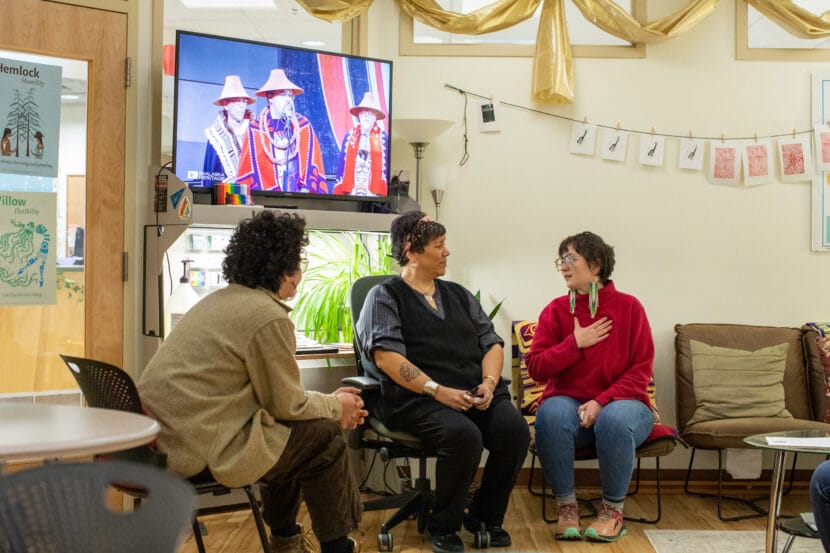
From left to right, Ḵaa Yahaayí Shkalneegi Muriel Reid, DaxKilatch Kolene James and Selah Judge converse at the Native and Rural Student Center at the University of Alaska Southeast on Thursday, April 15, 2025. (Photo Courtesy/Brian Adams, Robert Wood Johnson Foundation)
Juneau was one of nine communities selected for an annual grant by the Robert Wood Johnson Foundation. The health philanthropy group announced on Tuesday that the community was selected as a Culture of Health Prize winner for its commitment to uplifting Alaska Native culture and healing.
For more than a decade, the foundation has highlighted and awarded grants to dozens of communities across the country that work to promote health equity and inclusion.
The Haa Tóoch Lichéesh Coalition applied for the $250,000 grant on behalf of the community. It’s a nonprofit that offers Indigenous-based healing practices and reconciliation with the history of colonization in Juneau.
Ḵaa Yahaayí Shkalneegi Muriel Reid, a storyteller for the Haa Tóoch Lichéesh Coalition, said the award honors decades of healing work done by the community.
“We just want to show so much gratitude to the community,” he said. “There are so many people that have put their hands into this work for generations and generations.”
The award highlights different local organizations and residents who have contributed to reviving Indigenous culture and healing generational trauma.
The nonprofit pointed to community efforts like Orange Shirt Day, which remembers the harmful legacy of Indigenous Boarding Schools, and the revitalization of local Indigenous languages happening in Juneau schools. Reid said there’s still much work to do, but it’s important to celebrate the growth already taking place.
“There are so many places in Juneau where the only reason these wonderful moments of healing are happening is because of cross-sector work and collaboration and community, all working together towards a common goal of healing,” he said.
Reid said the Haa Tóoch Lichéesh Coalition will use the funding to continue to support ongoing work already happening in Juneau.
Disclaimer: KTOO pays Haa Tóoch Lichéesh Coalition to provide language lessons to staff.
Close
Update notification options
Subscribe to notifications
Subscribe
Get notifications about news related to the topics you care about. You can unsubscribe anytime.