Western

Facing harsh conditions Iditasport racers scratch, competition ends early

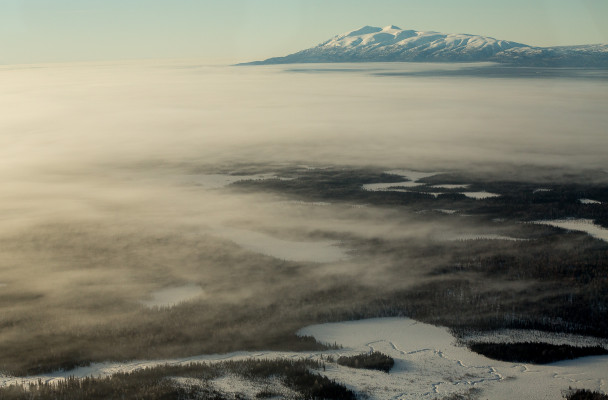
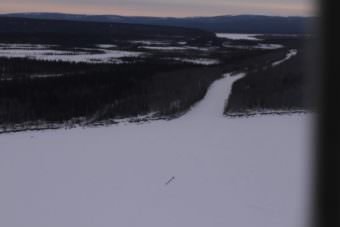
An aerial view near the Alaska Range.
An aerial view near the Alaska Range. (Photo by David Dodman/KNOM)

While mushers along the Iditarod are enjoying good trail conditions, the same isn’t true for the Iditasport. The event bills itself as a “human powered ultramarathon,” where participants bicycle and walk the traditional Iditarod route. It ended prematurely when all the competitors scratched.

The first Iditasport was in 1997, but it went defunct in the 2000s. This year, to commemorate the 20th anniversary, it was relaunched. Though poor snow conditions along one section of the trail re-routed the Iditarod sled-dog race, the three Iditasport participants set out from Big Lake and toward the Alaska Range on the heels of the Iron Dog in mid-February. But getting just halfway to Nome was nearly impossible.

Jan Kriska looks severely beaten up.

“I’ve been frostbitten now, 4-5 days ago, they were my fingers. They were a minor frostbite, but they became a major frostbite.

Kriska is a doctor, originally from Slovakia, but now living on a farm in North Carolina. His nose is discolored, fat bandages swaddle fingers that look a disturbing shade of purple, and he can barely walk.

“Friction and the pressure and no circulation plus cold caused big chunks of foot ya know, side of the foot to be missing.”

We’re talking in Ruby, which Kriska was only just barely able to reach as he ran, walked, and post-holed through hundreds of miles of remote country. He’s one of three people who entered the Iditasport hoping to reach Nome following the traditional Iditarod route. But this year, because the sled-dog race was re-routed to Fairbanks, there was less traffic along the trail heading up and over the Alaska Range toward the Yukon. And recent snows, along with deep cold, make things even more challenging.

“The accumulation of the snow later on, the section between McGrath and Ruby was essentially, there was no trail because Iron Dog had gone through a long time ago, then, accumulation of the new snow abolished the existing trail.”

Though the Iditasport requires entrants to have completed an “Alaskan winter event,” it only has to total 370 miles. Survival training is mandatory, but the program is just eight hours long. Kriska has done other cold weather races, but he wasn’t prepared when things started going wrong.

“It was… I thought I wasn’t gonna make it. I lost my snowshoes. Then, I didn’t have matches, so I couldn’t make water. It was (negative) 40°. Then, the stove stopped working. So I decided I’m not gonna bivy out anymore, so I pushed the last 30 miles through the night and came here (at) 3 o’clock in the morning.”

He was in touch with race organizers through a two-way communicator, so they had an idea of where he was and what was going on. But even Kriska says he didn’t know how bad things were until he visited the clinic in Ruby and saw the extent of the damage to his feet. Iditasport doesn’t have staff beyond McGrath, where a number of participants ended a similar, shorter outdoor race. Now, Kriska is preparing to catch a plane back to Anchorage.

He isn’t alone. Another runner trying to reach Nome is Jorge Latre who reached Ruby a few hours after Kriska flew out.

“You’re going at less than a mile an hour, and you’re in a thousand-mile race, so you think you’re gonna spend the rest of your life doing that. The last three nights were very cold, all below negative 30°, so it took a lot of skill not to lose your fingers or toes or nose. As you had to go about your normal routine, like, just putting on and off your gators, that time is enough to freeze your fingers off. So, every single activity becomes harrowing and difficult.”

Latre is in much better shape than his trail mate. Though he’s got a bandage over his nose, he looks otherwise unscathed as he shovels down a plate of fresh fruit, pancakes, and breakfast meats. But he’s not going any further. He thinks it was just a rough year in terms of conditions and doesn’t see the need to push his luck. Latre believes the safety precautions for the race are adequate, so long as you know how to identify trouble.

“People know where you are, and you send for an SOS, you can call for help, you can call with questions, so you have a line and people know where you are. If things get totally out of hand, you can get rescued or pull through self-rescue. But absent that: you’re on your own.”

Neither Latre or Kriska knew if they’d try the race again.
Musher suffers dog loss at Galena checkpoint

The trail between Ruby and Galena.
The trail between Ruby and Galena (Photo by Ben Matheson/KNOM)

A dog has died in this year’s Iditarod. It happened shortly before midnight at the Galena checkpoint.

The dog was part of race veteran Seth Barnes’s team. Upon arriving at the checkpoint vets tried resuscitating the animal but to no avail.

There is no official cause of death yet or official statement from the Iditarod Trail Committee. Typically a necropsy is performed on dogs that pass away during the race.

Barnes first ran the race in 2015.

Government and nonprofits shakeup village of Oscarville with clean water and cheaper power

Oscarville students dance in the village school in February 2016.
Oscarville students dance in the village school in February 2016. (Photo by Dean Swope/KYUK)

A group of representatives from a variety of government and nonprofit agencies are headed to Oscarville on Friday. The group is going there to observe the changes that have been made to the village since it became a pilot project for what is being called a holistic approach to community development.

Jack Hebert of the Cold Climate Housing Research Center was one the people who came up with the idea of working with a community so small that it did not have the capacity to do its own planning. The group included people from the Department of Energy, the Department of Agriculture, the Alaska Native Tribal Health Consortium, and the Bureau of Indian Affairs, among others. They approached the Association of Village Council Presidents to see which community would be a good pilot project for their holistic approach.

“AVCP recommended Oscarville because the community of Oscarville is very tight knit,” said Brent Latham, a program administrator with AVCP. “They work well together. They spearhead projects, and that is really needed to get things done.”

Though it was connected to Bethel’s electric utility by a six-mile-long cable, Oscarville was seeing many of the challenges facing much of bush Alaska. The village of about 60 people has no roads in or out. During fall freeze-up and spring breakup, residents are stuck in the village, unable to get to Bethel for groceries or health care.

The pilot project started with a meeting in Bethel two years ago and included a site visit to Oscarville, and the community met with agency people. At first, the residents thought what they wanted was a recreational facility for the kids and community, but after discussing the difference between what they wanted and what they needed, it became obvious that what they needed was much more basic: water.

Hebert and others at the initial meeting did not know that the village well had failed some time ago and that families were making do with rainwater, melting snow, and river water. Unfortunately, Oscarville is downstream from Bethel’s wastewater discharge.

“So there were some real health concerns,” said Hebert. “And this is the part that the Alaska Native Tribal Health Consortium was addressing. And that’s being done now. They have a new well that’s been drilled. It has to be developed and brought into their water treatment plant with upgrades there, but now they’re going to have water.”

That left another big need: cheaper electricity. Though Oscarville is part of the Bethel grid, in that it has a line coming into the community, there was only one official buyer: the village corporation, which was not eligible for the state’s Power Cost Equalization subsidy. The community then had its own grid, and each household paid for its share of the village’s bill.

“That means they were paying four times more for power than people in Bethel,” said Hebert. “This is a small community with very little economic resources paying their bills, but basically held to that standard: one meter for a whole town, plus the line-loss.”

The Alaska Village Electric Cooperative helped Oscarville bring its grid up to current standards and helped install meters that allow villagers to qualify for Power Cost Equalization. Oscarville’s electricity now costs almost the same as what’s paid by homeowners in Bethel.

There are other projects in the pipeline, like more energy efficient buildings, but according to Hebert the biggest change is that the community feels it now has control over its future and doesn’t have to just get by with whatever is provided.

“I think the greatest success of Oscarville has been that sense of empowerment of the people themselves,” said Hebert. “Of taking control of where that community is going to go.”

Members of the group representing agencies and nonprofits are visiting Oscarville Friday, and are hoping to come away with ideas that they can apply in other small communities.

“It was an advantage for us on the scalability of this first pilot project on the holistic approach for Oscarville to be that size, because we could get our hands around it,” said Hebert.

“But what we want to do, and what we are working on at the housing research center, is a template for the holistic approach for other communities, communities that are larger. We are taking that same approach with our multi-agency partners and the community of Newtok to develop a whole new community at Mertarvik because of climate change and issues they are having to deal with.”

Among the future plans for Oscarville are a new boat ramp for the village, a board-road extension to Bethel, and that multipurpose building the community wanted when the planning process began.

Senate majority unveils spending limit, Permanent Fund draw

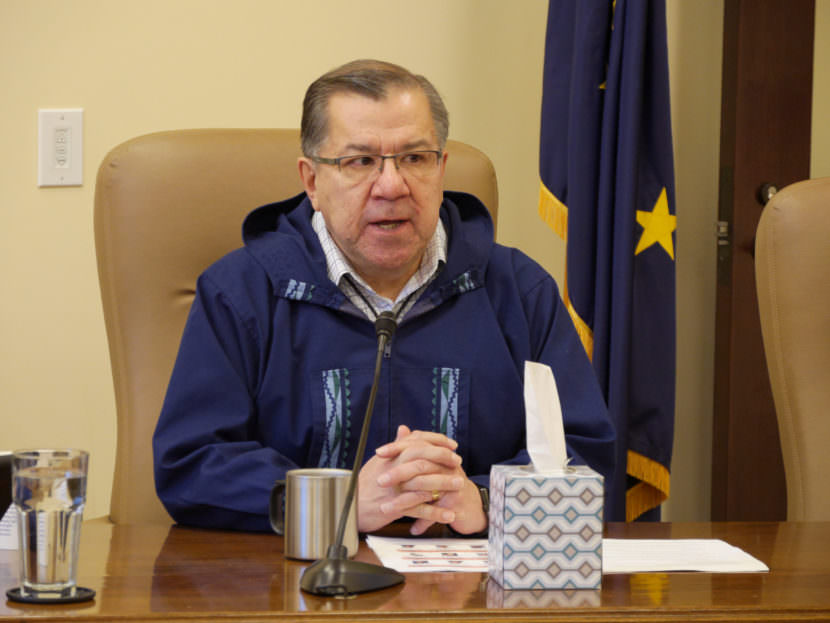
Sen. Lyman Hoffman, D-Bethel, at a Senate Majority press availability, February 24, 2017. (Photo by Skip Gray/360 North)
Sen. Lyman Hoffman, D-Bethel, at a Senate Majority press availability on Feb. 24, 2017. (Photo by Skip Gray/360 North)

The Senate majority unveiled its plan to limit state spending and draw money from Permanent Fund earnings to pay for the state budget Friday.

Senate President Pete Kelly, R-Fairbanks, said the plan in Senate Bill 70 will prevent spending from getting out of control.

“We’re going to initiate a spending limit, so that once we get the budget down, then it doesn’t just take off again the next time we have a little bit of money,” Kelly said.

The Senate majority’s plan would draw 5.25 percent of the fund’s value from Permanent Fund earnings for the next three years, then scale back to a 5 percent draw.

Permanent Fund dividends would be $1,000 for the first three years. Then PFDs would be a quarter of the overall draw, projected to be somewhat more than $1,000.

There are two big differences with the plan introduced by the House Finance Committee. One is that the Senate plan doesn’t include the income tax included in the House.

The Senate version would also limit state spending to $4.1 billion. That’s about $200 million less than Gov. Bill Walker’s proposed budget.

Senate Finance Co-Chairman Lyman Hoffman, a Bethel Democrat, said the cuts are much smaller than what would have to occur if the state doesn’t draw from the Permanent Fund.

“Many people throughout Alaska say we’ve cut enough, but until we have a long-term plan, we have to continue to look at budget reductions,” Hoffman said.

The other big difference is that the spending limit would only allow the state budget to grow at the inflation rate.

Hoffman said the Permanent Fund restructuring in the bill would protect dividends in the future.

The Senate Finance Committee plans to hold hearings on the bill Monday and Friday.

Joint rescue effort recovers stranded snowmachiners near Shishmaref

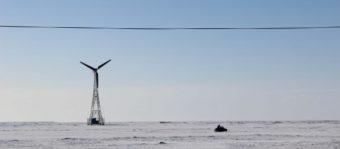
A snowmachine racing past one of Kwigillingok’s wind turbines. (Photo by Rachel Waldholz/APRN)

A crew of four, with the assistance of Alaska Army National Guard assets, rescued two snowmachiners southeast of Shishmaref over the weekend.

Late Friday night, Alaska State Troopers received a call from the Alaska Rescue Coordination Center about multiple distress beacon requests coming from the area near Quartz Creek airstrip.

According to a press release from the Department of Military and Veteran Affairs, Troopers requested that the Army National Guard provide assistance in the search for two snowmachiners, who activated the beacons.

A UH-60 Black Hawk helicopter from the 207th regiment left Nome with three crewmembers and a paramedic from the Nome Volunteer Fire Department. The crew located a male and female pair who had attempted to snowmachine to Serpentine Hot Springs but had gotten stuck in deep snow.

After a medical evaluation, it was reported that the couple had no serious injuries. Their snowmachine was removed from the snow, and the couple were escorted safely to a nearby heated shelter for the night before continuing their travel.

Currently, the identities of the two snowmachiners have not been released by Troopers or the Department of Military and Veteran Affairs.

When traveling into the wilderness, the Alaska Rescue Coordination Center recommends travelers take a personal locator with them.

Emperor goose hunt proposed for the first time in decades

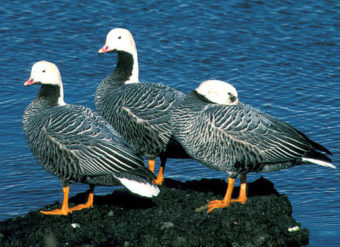
Emperor geese at Adak Island.
Emperor geese at Adak Island. (Public Domain photo courtesy U.S. Fish and Wildlife Service)

A subsistence harvest for Emperor Geese has been proposed this spring for the first time in 30 years. The population declined in the early 1980s. The last subsistence hunt took place in 1987. Jason Schamber, who is a wildlife biologist with Alaska Department of Fish and Game, says that the decades of conservation have paid off.

“Over the last 30 years the population has grown slowly at about three percent per year,” says Schamber. “In 2015, it finally reached the level where managers felt that the population could sustain a harvest.”

The Alaska Migratory Birds Co-Management Council developed a management plan for the spring, summer subsistence hunt, and agreed to adopt it for an initial three-year trial period beginning this year. The approved plan is a customary and traditional hunt, meaning that there will be no bag limit.

Still, the population remains susceptible to overhunting. Gayla Hoseth represents Bristol Bay on the AMBCC. She says that education will be key, along with monitoring and potential restrictions, if this trial run is to lead to a sustainable annual hunt.

“In Bristol Bay, we have our Yaquillrit Keutisti Council, and it’s also known as Keeper of the Birds, meeting. We’re going to be having a meeting here before April to talk about these kind of things, education outreach,” Hoseth says. “We don’t want to overharvest.”

Education outreach will include presentations on conservation in some villages that hunt emperor geese and informational mailers.

In addition to the subsistence hunt, there will also be a fall and winter sport hunt. There will be an unrestricted number of permits, but there will be a limit of 1000 birds taken statewide. The specific limit for the Bristol Bay region is 150. The subsistence harvest is scheduled to open April 2 and run through August 31. The fall hunt is set to begin in September.

Proposed changes are open for public comment until March 13.

Site notifications
Update notification options
Subscribe to notifications