Western

Organizations race to haul junk from villages before EPA funding cuts

The Green Star Program plans to begin removing junk like these old vehicles in the Dillingham landfill that's accumulating in villages and other small communities around Alaska. Unlike Dillingham, the logistics of removing junk from remote villages are much more difficult, requiring transport first by barge and, often, transfer to trucks, which then take loads to recycling brokers in Fairbanks or Anchorage.
The Green Star Program plans to begin removing junk like these old vehicles in the Dillingham landfill that’s accumulating in villages and other small communities around Alaska. Unlike Dillingham, the logistics of removing junk from remote villages are much more difficult, requiring transport first by barge and, often, transfer to trucks, which then take loads to recycling brokers in Fairbanks or Anchorage.
(Photo courtesy KDLG Public Radio)

Pretty much every community in Alaska struggles to get rid of junk like worn-out cars, appliances and electronics, most of which contain hazardous substances that can harm human health. But the problem is especially acute in remote communities located far off the road system, where the stuff accumulates because it’s prohibitively expensive to remove.

“That’s where the struggle is, because from there we really need to take out the material – stuff that’s legacy waste from years ago,” says Doug Huntman who directs the ‎Green Star Program, an effort supported by Anchorage-based Alaska Forum. “But the transportation costs are just so expensive. It’s very difficult to do that.”

A network of partnerships between nonprofit organizations, government agencies and private-sector recycling companies is planning to step up efforts to clean up junk and electronic waste that’s been accumulating for decades in remote communities around Alaska. The partnerships are racing to clean up as much of the stuff as possible by 2020 when federal funding for the projects is scheduled to run out.

Huntman said during a break in the Alaska forum’s environmental conference last week that members of his organization and its partners plan to find out exactly how expensive and difficult that is when they visit those communities this summer to plan cleanups next year.

Stacks of barrels and piles of building materials, like these in Tooksook Bay, are a common site in rural and remote Alaskan communities.
Stacks of barrels and piles of building materials, like these in Tooksook Bay, are a common site in rural and remote Alaskan communities. (Photo Courtesy Alaska Department of Environmental Conservation)

“We’re going out to the communities on the middle Kuskokwim – which is a tough area in the state – to try and remove that stuff,” he said.

Those communities include Upper and Lower Kalskag, Aniak, Chuathbaluk, Napaimute, Sleetmute, Stony River, Crooked Creek, and possibly Red Devil, said Dave Cannon, the solid-waste coordinator with Aniak-based Kuskokwim River Watershed Council. The council has organized smaller cleanups along the river in recent years and is now working with Huntman to figure out how to remove junk that’s accumulated in those villages.

Cannon says that includes old junk cars, “and in some villages, we have white waste – things like refrigerators, freezers. But batteries, boat and automotive batteries, probably are the biggest concern that we have.”

Cannon says the so-called legacy waste must be loaded onto a barge and taken to Anchorage. But first, it must be drained of hazardous wastes and other such substances. It’s a logistically challenging and costly endeavor. Even more so, because Cannon says it’s not known how much of the stuff is out there. And in some landfills and junkyards, it’s mixed in with other unknown substances.

“There’s a myriad of drums with who knows what materials in them,” he said. “There’s even things like household hazardous waste.”

"Legacy waste" dumped years ago in pits near remote villages can be exposed when rivers meander and erode their way into the primitive landfills.
“Legacy waste” dumped years ago in pits near remote villages can be exposed when rivers meander and erode their way into the primitive landfills. (Photo courtesy Alaska Department of Environmental Conservation)

Cannon says hazardous substances won’t be removed during this initial cleanup. But he says organizers will list them on an inventory they’re putting together. And, where possible, they’ll store them in safe places for pickup later. But another cleanup effort that’s been underway for a couple of years now is mainly focused on removing hazardous materials from remote and rural communities, mainly along the Yukon River. It’s being done by the Solid Waste Alaska Task Force, or SWAT, a consortium of experts from three Alaska nonprofits, the state Department of Environmental Conservation and the federal Environmental Protection Agency.

“Their goal and mission is to create a sustainable way to manage waste in rural communities,” said Becca Brado, executive director of Green Star of Interior Alaska.

Brado says the Fairbanks-based recycling center, not related to the Anchorage-based program, is working with SWAT to help smaller communities backhaul electronic waste, such as old computers and televisions, to recycling companies in Anchorage or even Seattle.

“So Green Star is hoping to serve as a regional hub for Interior villages and communities that don’t have direct access,” she said.

Brado says Green Star is looking for funding to launch an outreach program to promote recycling in more than 60 communities in the Yukon River watershed. She says the program is critically needed because the region lacks adequate landfills or storage facilities. So, much of the e-waste generated in those communities is smashed or dumped outdoors. And that causes hazardous substances in the electronics to seep into the soil and groundwater. Studies show many of those substances, such as heavy metals, make their way up the food chain to the people in the region who depend on wildlife for subsistence.

“With exposure to heavy metals like mercury and lead and other toxic chemicals that children, especially in children, their IQ is actually lowered,” Brado said.

Burning trash and waste in "burn boxes" is common in rural and remote communities around Alaska. But some materials release hazardous contaminants when burned.
Burning trash and waste in “burn boxes” is common in rural and remote communities around Alaska. But some materials release hazardous contaminants when burned.
(Public Domain photo courtesy U.S. Department of Agriculture)

Another expert, Lynn Zender, says the chances of exposure to contaminants are even higher when materials are burned, a common practice in communities without landfills.

“Those contaminants can be inhaled, and that’s quite dangers – serious,” said Zender, a member of the SWAT executive committee and head of an Anchorage environmental-consulting firm. And she says there’s growing awareness on the need for better solid- and hazardous-waste disposal in villages. Brado says there’s growing urgency too because funding for an EPA program to promote recycling in remote villages will run out in 2020.

“It’s a race against the clock, really, to try to help these communities get their e-waste and other backhaul materials out by then,” she said.

Brado says she hopes the effort will lead to a sustainable statewide backhauling program that would help clean up villages and keep hazardous e-waste substances out of the ecosystem.

Skeleton of orca that died in the Nushagak River printed in 3-D

3-D printer at the UAF Bristol Bay campus.
3-D printer at the UAF Bristol Bay campus. (Photo courtesy KDLG)

A machine the size of a mini-fridge sits on the counter of a college science lab. Three half-constructed plastic models of fetal orca bones are visible through the glass front. The 3-D printer’s extruder moves across the models, adding plastic layer by layer. It whirs, hums, and beeps like a “Star Wars” droid.

In September of 2011, three killer whales puzzled biologists by traveling about 70 miles up the Nushagak River. Orca’s natural habitat is saltwater. Sometimes they swim up the freshwater river for salmon, but not that far. By October all three whales had died. That raised the question of what to do with the bodies, which led to an unusual science project. Bristol Bay area scientists, students, and educators have been working to make a plastic model of the fetal orca’s skeleton.

One orca was pulled ashore, and NOAA scientists performed a necropsy. When they discovered the whale was pregnant, they saved both her skeleton and the skeleton of the fetus. But preserving the fetus was complicated because its bones hadn’t ossified and fused together yet.

Kent Winship teaches construction and runs the fabrication laboratory at the University of Alaska Fairbanks Bristol Bay Campus. He has helped oversee work on the solution to that problem.

“It was basically a bag of bones with skin on it, just like a big trash bag full of partially formed cartilage, and not all the way meshed together bones,” says Winship. “This is all cartilage, so it’s going to decay. What they decided to do was 3-D scan them.”

So the Nushagak Orca Articulation Project was born. The Dillingham City School District, Bristol Bay Campus and Nunamta Aulukestai have worked in partnership to clean, categorize, scan, and print the fetal skeleton’s hundreds of bones.

Cheyenne Roehl holds both a fetal orca bone and a plastic model. She has worked at the UAF Bristol Bay Campus for two years, scanning and printing the majority of the orca's skeleton.
Cheyenne Roehl holds both a fetal orca bone and a plastic model. She has worked at the UAF Bristol Bay Campus for two years, scanning and printing the majority of the orca’s skeleton. (Photo by Avery Lill/KDLG)

The project brought high school student Cheyenne Roehl onboard two years ago to scan bones. She works in the campus lab three hours every weekday. A few other people have been involved in scanning over the years, but Winship says that Roehl has done the bulk of the work.

Her job is to create 3-D digital models of the bones in a computer aided drafting program.

“I get one of the bones, and I put it on the scanner,” she says, explaining her process. “We have to get multiple scans, and then align them together. And then we make sure that it looks like the bone, and then we get a finalized watertight model…I’m making it sound a lot more simple than it actually is.

It’s time-consuming work. If a bone has a lot of holes, protrusions, or facets, it can take numerous scans to capture all the angles. Each scan takes about 20 minutes.

Roehl pulls a piece of the orca’s skull from one of tall cabinets where bones are stored in jars and paper bags.

She holds it, turning it over and running her fingers along its different angles.

“I see a lot of holes and places that scanned very well to have a lot more detail for the scan because we use a laser, and if it’s slanted a little bit, the scanner won’t be able to pick up that data.”

When she has the scans, Roehl joins the images to form one 3-D model. Then she prints it and organizes it with the other printed bones.

The project reached an important milestone this week. Roehl finished scanning, and she’s about to finish printing the last of the roughly 300 whalebones.

Then it will be time for the jigsaw phase of this project. Project leaders with the university, school district, and Nunamta Aulukestai are developing plans to begin constructing the skeleton out of the model bones. They aim to involve students in this stage of the work as well. Fully assembled the killer whale fetus will be about 6-feet long.

Roehl reflects on the hundreds of hours she and other students have put in over the years. She says that it’s the idea of seeing this orca skeleton completed is what keeps up the momentum.

“It’s really exciting because you know that they’re going to be turned into a 3-D model skeleton, and that will be beautiful.”

Chief justice urges lawmakers to collaborate and compromise

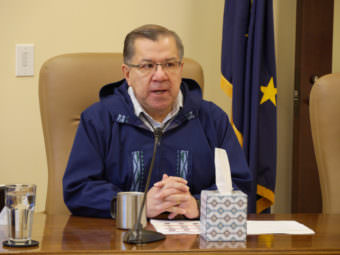
State Supreme Court Chief Justice Craig Stowers said Alaska’s courts are leading the way in cutting costs in a way that doesn’t threaten vital services.

In the annual State of the Judiciary address Stowers gave Wednesday, he told lawmakers this Legislature has a chance to be remembered by history for addressing the state’s fiscal crisis. He said much is similar to the options they faced last year.

“But things are different today in the sense that you have – Alaska has – less time to find the way forward to an effective and fair solution to the financial challenges we face,” he said.

Stowers said it’s not his place to advise legislators on how to address the state’s budget. But he urged them to collaborate and compromise.

“The stark reality is that Alaska is quickly depleting its savings; new revenue is going to be very difficult to generate; relying solely on cutting state government will not solve the problem; postponing hard decisions will needlessly squander what time remains; and there is great controversy about all of the options that you face,” he said.

The court has proposed cutting its $105 million budget by $3.6 million dollars. Combined with cuts this year and last, it would have reduced costs by $11 million over three years.

“It is doable and will not inflict long-term damage or disruption to the court’s core functions,” Stowers said. “Our strategy is to make careful, incremental reductions over time; these kinds of reductions are more manageable; and they allow for greater predictability and continuity of core court operations.”

Sen. Mia Costello prepares to escort Chief Justice Craig Stowers with Rep. Zach Fansler into the House Chambers on Feb. 8, 2017, for the annual State of the Judiciary Address. (Photo by Skip Gray/360 North)
Sen. Mia Costello prepares to escort Chief Justice Craig Stowers with
Rep. Zach Fansler into the House Chambers on Feb. 8, 2017, for the annual State of the Judiciary Address. (Photo by Skip Gray/360 North)

Stowers said the courts plan to leave 10 of 690 positions unfilled this year. And the courts aren’t filling vacant magistrate judge positions in rural courts. Stowers noted these rural courts are the face of state government in some communities. But he says the judges have “very small” case loads compared with other courts.

The cases would be heard either by a judge who will periodically travel to rural areas, or at a different court, with parties appearing by phone or video-link if they can’t attend in person.

Court workers took a 4-percent pay cut last year, when the courts began closing on Friday afternoons.

Stowers said he’s concerned about the effect of those cuts.

“This salary reduction, when added to the upcoming significant increase in employee contributions to health care coverage, is a true hardship that those earning more may not appreciate,” Stowers said. “Many of our employees are clerical employees at or near the bottom of the state government pay scale; some have to work several jobs to make ends meet for their families.”

The chief justice noted some areas where the courts have expanded services, including training workers and lawyers on the overhaul of the state’s criminal justice system.

ACA repeal could complicate Medicaid reforms

Valerie Davidson, commissioner designee of Alaska’s Department of Health and Social Services listens to the State of the State Address, Jan. 21, 2015. (Photo by Skip Gray/360 North)
Valerie Davidson, commissioner of Alaska’s Department of Health and Social Services in 2015. She’s concerned about the effect of an Affordable Care Act repeal. (Photo by Skip Gray/360 North)

State health leaders say a federal repeal of the Affordable Care Act could make it difficult to implement reforms to Medicaid. That could cost the state the tens of millions of dollars that lawmakers are counting on.

Many of the reforms the Legislature included in the Medicaid law it passed last year depend on parts of the Affordable Care Act.

State Health Commissioner Valerie “Nurr’araaluk” Davidson says medical providers have told her they hope to receive federal funding that was included in the law.

“If Medicaid expansion went away, if that authority went away, that would really impact their ability to participate in some of those reform opportunities, because it provides them with a little bit of cushion for them to be able to do things creatively,” she said.

A state plan to increase the amount of services that people with disabilities receive in their homes and communities depends on a part of the federal law. And a Division of Insurance reinsurance program that’s gained national attention also depends on the ACA.

Some members of Congress have discussed replacing the current system that guarantees federal payments for Medicaid to one where states receive a set amount of money each year, known as “block grants.”

Davidson said these proposals favor states with lower medical costs and low transportation costs.

“We really see the block grants as really a mechanism to be able to shift that federal responsibility to states,” Davidson said. “The proposals that we have seen so far to do Medicaid block grants do things that do not favor Alaska.”

More than 27,000 Alaskans receive Medicaid due to an expansion that Gov. Bill Walker supported. Another 18,000 residents receive health insurance through the ACA’s individual and family marketplace.

Senate Health and Social Services Committee Chairman David Wilson asked Davidson if she’s preparing for a repeal of the Medicaid expansion.

“Has the administration or the department come up with contingency plans for those type of scenarios, those worst-case scenarios?” asked Wilson, a Wasilla Republican.

Davidson said the department is trying to plan, but the proposals could affect the state in hundreds of ways. She’s asked members of the state’s congressional delegation to ask for long-term estimates of state expenses for proposals to repeal the federal health law.

Gov. Walker said on Talk of Alaska on Tuesday that if the federal government stops funding the Medicaid expansion, it still would have benefited Alaskans.

“If we can’t afford to fund the federal portion – which I think would be very, very difficult given our fiscal situation – we’ll just have to be pleased with those whose lives were improved, those lives that were saved as a result of taking that step to expand Medicaid,” Walker said.

Republican U.S. Sen. Lisa Murkowski has said Congress should replace the Affordable Care Act at the same time it repeals the law.

Chukchi Sea polar bears are thriving but only in the short term

A polar bear keeps close to her young along the Beaufort Sea coast in Arctic National Wildlife Refuge.
A polar bear keeps close to her young along the Beaufort Sea coast in Arctic National Wildlife Refuge. (Public Domain photo by Susanne Miller/USFWS)

If there’s a poster child for Arctic animals affected by climate change, it’s the polar bear. But the data behind those famous furry faces tells a more complicated story.

Dr. Eric Regehr is a biologist with the U.S. Fish and Wildlife Service in Anchorage. He’s the lead author of a new study on the global conservation status of polar bears. Assessments of the conservation status of polar bears have been done before, but this is the first one that takes a databased, quantitative approach.

The study establishes a relationship between sea ice reduction and polar bear population numbers. The researchers then used that trend to predict how the world’s 26,000 polar bears will fare in the future.

“Putting together all available data, and making some informed projections on the basis of those data, do suggest that there is a high probability that the global population of polar bears could face reductions of up to one-third or greater in the next 35 to 40 years,” said Regehr.

However, not all polar bear numbers are suffering, at least in the short term. There are nineteen individual subpopulations of polar bears across the Arctic. Some of these subpopulations are stable, and a few are even growing.

One group that’s thriving is the Chukchi Sea subpopulation, which includes Western Alaska and the Russian coast across the water.

“The waters are shallow, they’re nutrient rich; there are a lot of seals, ringed seals and bearded seals, out there for the polar bears to eat,” said Regehr. “And so, other studies suggest that, despite the fact that the Chukchi Sea region has exhibited a loss of Arctic sea ice the bears in that region appear to be faring quite well, currently.”

But their neighbors to the East, the South Beaufort subpopulation, are declining in number.

“The continental shelf is much narrower, the region is less biologically productive,” said Regehr. “And scientific studies there suggest that the polar bears have been negatively affected by sea ice loss. So there is a lot of variation in their status across the Arctic.”

Despite this variation, Regehr says the decline in population numbers expected in the next few decades is likely to affect bears in all regions of the Arctic.

“Fundamentally, at the end of the day, polar bears require sea ice to do what basically makes them bears, which is killing and eating seals,” he said.

That means even healthy subpopulations, like the Chukchi Sea, bears face long-term threats.

“Just logically, there’s some point at which a polar bear in the Chukchi Sea may not have enough days of the year on sea ice catching seals to get the nutrition they need and be healthy,” he said.

Regehr doesn’t know when that time will come, but he’s already seeing the bears spend an extra month on land each year. And there’s evidence that the sea ice loss is affecting not just the polar bears in the Chukchi Sea, but those that hunt them. Regehr says polar bear harvest numbers in the region have been declining for the past few decades.

He hopes that as polar bears in the Arctic continue to be monitored, his team’s study will set a precedent for more quantitative assessments.

EPA grant funding available again after temporary hold sparks concern

A crew works on a sewer system in a rural Alaska village. Photo courtesy USDA Rural Development.

Alakanuk, and other villages seeking federal sewer and water money received good news Friday afternoon.

The Environmental Protection Agency announced that its funding for grant projects is once again available. This means that tribes receiving money for infrastructure projects can proceed as normal.

Over the last week, many have questioned the need to review the EPA’s operations and speculated that there might be possible cuts to vital programs. However, the EPA explains in their statement that no aspect of the process has changed and that the grant amounts have also remained the same.

This will come as a relief to tribes and rural communities seeking funding for essential projects like water/sewer. The village of Alakanuk recently expressed concerns about the future of the program in the face of a massive overhaul of their sewer system.

The EPA says that it is still evaluating contracts that were put on pause by the Trump Administration, but as of Friday afternoon, that review was nearly complete as well.

Site notifications
Update notification options
Subscribe to notifications