Western

Rural lawmakers wield power without recent precedent

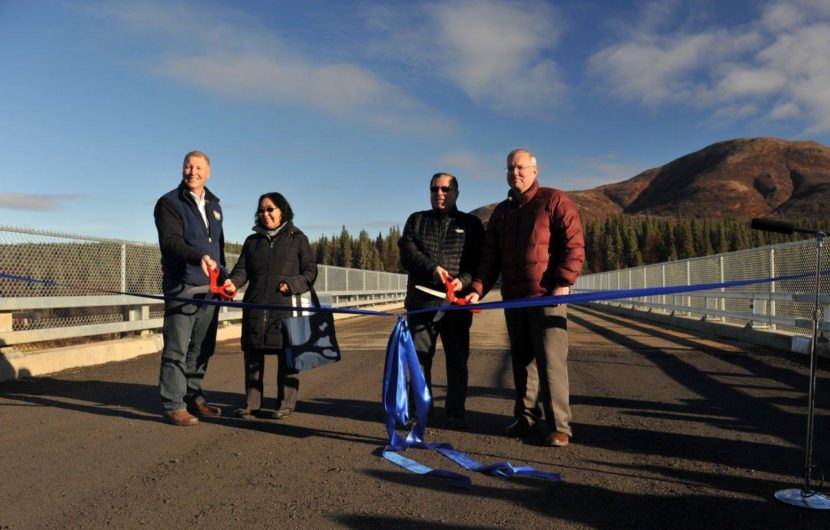
Wood River Bridge ribbon cutting
DOT Commissioner Marc Luiken, Aleknagik Mayor Jane Gottschalk, Sen. Lyman Hoffman and Rep. Bryce Edgmon cut the ribbon on the Aleknagik Wood River Bridge in October 2015. In 2017, Hoffman will be the Senate Finance Committee co-chairman and Edgmon will be House speaker. (Photo by Misty Nielson)

Dillingham Democrat Bryce Edgmon will be the first speaker of the Alaska House of Representatives from off the road system or outside of Southeast Alaska since Nome’s Howard Lyng in the Territorial Legislature of 1941.

And other rural lawmakers will hold more important leadership posts in the next legislature than they have had in decades.

Edgmon and two key committee chairmen are from northern or western Alaska.

Nome Democrat Neal Foster will be co-chairman of the House Finance Committee. Bethel Democrat Lyman Hoffman will be co-chairman of the Senate Finance Committee. It will be the first time both budget-writing committees will have chairs from Bush Alaska since 1990. Hoffman also was a finance chair then, when he served in the house.

Edgmon said the rural leaders are part of a broader regional balance that will be good for the entire state.

“I think it will be good for rural Alaska, and from my standpoint, it’s always good to have regional diversity on the finance committees,” as well as other committees, Edgmon said.

Rural lawmakers have a tradition dating back decades of joining majority caucuses. But this session they’re playing a particularly central role in control of the House. Edgmon and Foster joined with three Republicans to switch from the current Republican-led majority to the primarily Democratic incoming majority.

What this means for rural residents is uncertain. Rural lawmakers have traditionally argued for maintaining or increasing government services. Service increases will be difficult due to the state’s budget crisis. But the incoming House majority is interested in striking a balance that includes both spending cuts and new revenue, like a broad-based income or sales tax, to maintain services. Edgmon expects Foster and his finance committee co-chair Paul Seaton will keep this in mind.

“Both individuals – Rep. Seaton from Homer, Rep. Foster from Nome – are very committed to taking a balanced approach to figuring out the fiscal challenges that lie ahead,” Edgmon said.

Former University of Alaska Southeast political scientist Clive Thomas noted the state government funds a large share of jobs in rural Alaska. And Thomas expects the rural lawmakers to be at the forefront in defending school funding.

“It’s a major income generator in most villages – probably the major income generator – so I think that’s one of the things that they will be concerned about and want to protect,” Thomas said.

Edgmon said there’s another historic element of the new leadership.

“I’m very proud to be the first speaker of Alaska Native heritage,” Edgmon said. “And that’s something that I hope can serve as a role model for future speakers with Alaska Native blood.”

Edgmon said he’s a little less than a quarter Aleut, and he also grew up learning Yupik words and phrases in Dillingham, where the two cultures overlap.

“I grew up in a small town, so I bring small-town values to whatever I do,” Edgmon said. “And I think by nature I’m somebody who listens first and I’m not always the biggest talker in the room. And maybe that hearkens back to my Alaska Native upbringing.”

The budget’s effect on rural areas and the rest of the state will be clearer in mid-December, when Gov. Bill Walker is scheduled to unveil his budget proposal.

Utility officials: LNG could reduce cost of generating electricity in Tok

19_lngbyrailharball
A cryogenic tank container used to carry liquefied natural gas by rail (photo by Elizabeth Harball).

The utility that provides power to Tok is looking into using liquefied natural gas as a way to reduce the cost of generating electricity for the Alaska Highway community.

Alaska Power and Telephone President Bob Grimm says he’s optimistic that using LNG to help generate electricity in the Tok area could save money for the company and ratepayers. That’s based on preliminary results of testing AP&T conducted in late September and early October.

“It’s proven itself, that it probably is a potential fuel opportunity in the future,” Grimm said. “And our next step is to look at it a lot closer, and see if we can dissect every one of those issues that we ran into, and make it better.”

The testing involved setting up and operating equipment to store and use LNG, including systems to enable the company’s diesel-fueled generators to burn an LNG and diesel blend. Grimm says a mix of 65 percent LNG, 35 percent diesel worked well during the tests. He says savings would come from using less diesel that would be displaced by LNG during internal combustion.

Grimm concedes today’s low diesel prices make that unlikely – “Diesel is probably a better buy right now,” he said – but he expects prices to begin rising in the near future, which should make the economics of bi-fueled electricity more attractive.

“If it was cheaper than diesel at some point in the future, when we started to run it on a routine basis, any of those fuel savings would be passed down to our customers in Tok,” he said.

That would be welcome news to AP&T’s Tok-area residents, who pay about twice as much as ratepayers in Fairbanks. Dave Callos says he thinks it’s a great idea to use LNG to help generate power, but is unlikely to happen until diesel prices go back up and the economies of scale make the cost of transporting LNG go down.

“Liquefied natural gas is a great thing,” Callos said. “We have so much of it in this state. But until the price of trucking it down here goes down, we’re not going to be able to afford it.”

Grimm says that’s true, but the company wanted to test the technology and have it ready for when and if the company decides to use it when the price of diesel rises. Crowley LNG Alaska would provide the gas through a contract with AP&T, although the LNG used during testing came from Fairbanks Natural Gas.

Crowley officials said in a news release they’ve been working with AP&T for more than a year now on the project, providing engineering and other assistance.

But Tok resident Ashley Sawyer says she didn’t know anything about the test until she and many of her neighbors read about it on Facebook a couple of weeks ago – after testing had concluded.

“The general public didn’t know,” Sawyer said. “Nobody I know here knew. It was like, when it concluded, everybody knew – we all found out.”

Grimm says using LNG to help AP&T avoid exceeding emissions limits set by its state air-quality permit because LNG burns more cleanly than diesel. And he says it would enable AP&T to expand and provide service to more customers at less cost.

“If we were to get any sizeable load growth, we would have to start operating cleaner machines, more expensive machines, (and) different things to make sure that we remain below the limit,” he said.

Grimm says AP&T will likely conduct more tests on the bi-fueled generator project. But he says it’ll have to wait until spring when Fairbanks Natural Gas won’t be so busy serving its winter fuel customers – and will have equipment and personnel available for the 200-mile trip to Tok.

National Guard seeks Alaska Natives with subsistence skills

The Army National Guard has announced the start of a three-year pilot program that gives waivers to Alaska Natives who might try to join the guard, but face barriers to qualification. Some of these potential recruits have the very skills the military is looking for.

Not only is the National Guard making it easier for Alaska Natives to join up, it’s seeking them out. And that’s because of soldiers like Spc. David Smart.

David Smart Alaska Army Natioanal Guard
David Smart is a third generation serviceman from Hooper Bay. (Photo courtesy David Smart)

“My grandfather would take me out to the Bay, and we would go set a net for whitefish,” Smart said.

Smart, 28, who grew up in Hooper Bay, is a third generation serviceman. His grandfather inspired him to join the military.

“Going through the house, came across his discharge papers and his medals,” he said.

Smart said that he’s lucky to have this job.

“Pretty hard to get a job in the village, because there’s only so many places to work,” said Smart.

Smart is one of a relatively small number of Alaska Natives to get into the guard recently, but that might change. The new program, among other things, relaxes requirements for the Armed Services Vocational Aptitude Battery, a general knowledge test that the guard admits favors people for whom English is their first language.

The guard is going to make it easier to join, and what it wants in return is something many Alaska Natives already possess.

“Somebody that grows up in rural Alaska lives the weather, they don’t watch it on the weather channel,” said Bob Doehl from the state’s Department of Military and Veterans Affairs.

Doehl said that not only do Alaska Natives make better soldiers in the Arctic, practicing subsistence makes them better soldiers in general.

“Studies found that those from rural locations, who are active outdoors, are better able to spot patterns and changes in patterns,” said Doehl.

Doehl said this increased awareness can make the difference between life or death. He asks why the military would spend years training people when it’s already taken care of, which is something that Spc. David Smart agrees with.

“Give somebody fish, you feed them a day. Teach em’ how to fish, you feed em’ for life,” Smart said.

Lt. Gov. Byron Mallott, traveling with Doehl to Bethel to spread the news about the recruitment thrust, said that in the face of a troubling fiscal situation, he still supports increased enlistment.

“It comes at a difficult time because the state does not have financial resources to significantly support such an effort,” Mallott said.

Mallott said he remembers when the military was a major leadership avenue for Western Alaska, and he wants to get back to that place.

“As a young man, having grown up in Southeast Alaska and traveled the state, the National Guard was once a major presence in rural Alaska, and it was a point of inspiration,” Mallott said.

Mallott echoes a thought frequently heard in many of the state’s rural locations, and throughout much of Indian Country in the Lower 48.  Now the effort is underway to rebuild that force.

Anti-incumbent mood could threaten Republican-led House majority

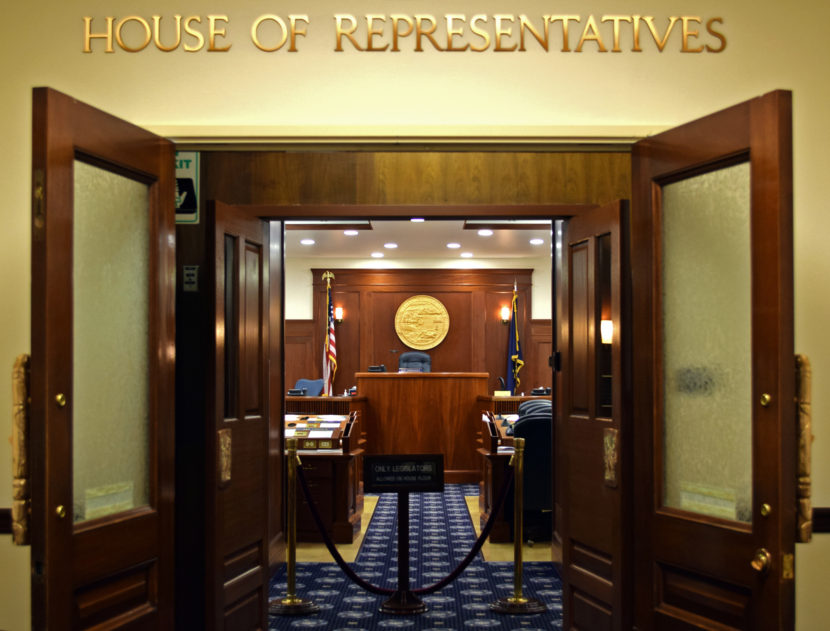
The Alaska House of Representatives entrance in the Capitol in Juneau, Feb. 6, 2015. (Photo by Skip Gray/360 North)

When voters head to the polls on Nov. 8, they’ll decide who’s going to represent them in the state House and Senate. That will trigger the backroom talks that determine who will form the majority caucuses – and the legislature’s future direction.

After the election, one thing is for certain. The legislature that voters send to Juneau in January will be very different than the one that left in July. Four senators didn’t run for re-election. And at least a quarter of the House will be replaced.

The question is how far the anti-incumbent mood will extend in the general election. More losses in the current House majority could  increase the chance of a new bipartisan coalition in that chamber.

Homer Republican Rep. Paul Seaton said he’d like to see a majority in which party labels don’t matter – only a willingness to work on a fiscal plan that includes both cuts in government  spending and new sources of state revenue.

“Hopefully, what we’ll get is a grouping of people that all want to solve the problem, that agree that moving forward with a sustainable fiscal plan is the most important thing that we have to do,” Seaton said.

Republicans have led the majority for more than 20 years, with Mike Chenault of Nikiski serving as speaker for the last eight years. The current House majority includes 22 Republicans and four Democrats, while 12 Democrats and an independent are in the minority. Republican Lora Reinbold isn’t in a caucus.

A new bipartisan caucus and who should lead it came up in a recent debate for the House race in Juneau.

Republican Rep. Cathy Muñoz said she’s open to serving in a Republican-led majority, or in a new bipartisan coalition.

“I’m going to join the majority caucus that best represents Juneau, whether it’s a coalition government, whether it’s Republican led,” she said.

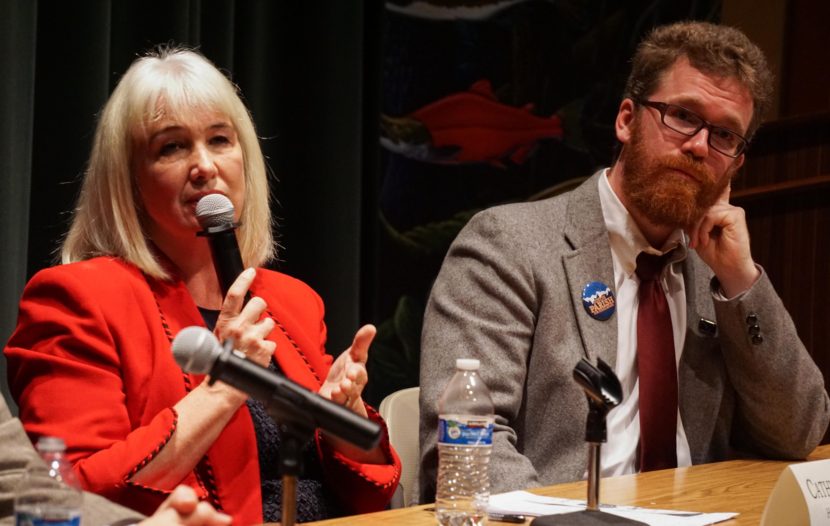
Cathy Munoz and Justin Parish at Juneau Votes Statehouse Candidates Debate 2016 10 13
Republican Rep. Cathy Muñoz answers a question at the Juneau Votes Statehouse Candidates Debate as her Democratic challenger Justin Parish listens at the Egan Lecture Hall at the University of Alaska Southeast, Oct. 13, 2016. They have different ideas about who should be House speaker. (Photo by Jeremy Hsieh/KTOO)

Muñoz also revealed her thoughts on potential candidates to lead the House as speaker, saying that either Republican Steve Thompson of Fairbanks or Democrat Bryce Edgmon of Dilligham would be a good speaker.

Both Thompson and Edgmon, have challengers – Democrat Truno Holdaway faces Thompson, while Republican William Weatherby faces Edgmon.

Edgmon agreed that the new majority should be focused on a sustainable fiscal plan – even if it has to take some positions that are unpopular. He said it’s important to sustain government services that serve his rural constituents.

“Quite frankly, I’m flattered that my name would be in consideration for speaker of the House,” Edgmon said. “I’ve had a number of people bring that to my attention. I’ve not been out seeking it.”

Muñoz’s opponent, Democrat Justin Parish, said a new bipartisan coalition would serve Juneau well. He’d like current Democratic leader Chris Tuck or Paul Seaton to be speaker.

“I’m really happy to work with whoever manages to stand on the writhing pile of bodies,” Parish said.

Tuck said it’s premature to say who would be the speaker, but he’s hopeful that he and other Democrats will be a part of the majority caucus next year. He noted that the successful primary challenges of two rural Democrats who defeated incumbents in the current majority have strengthened the Democrats.

“I wouldn’t be surprised if you still have a Democrat at the top,” he said. “Because right now, with the two elections that happened in rural Alaska with Dean Westlake and Zach Fansler winning, that makes 16 Democrats and one independent there. And all we would need is four more Republicans. So would we give up that leadership to get a coalition going? Possibly.”

There’s much less of a chance of a new bipartisan majority in the Senate. That’s because the current majority that includes 16 of the 20 senators is more insulated from losses in a year with only a few highly competitive Senate races.

In St. Paul, this Alaskan vows ‘Never Trump’

Bill Briggs is a Hillary Clinton supporter in St. Paul. (Photo by Zoë Sobel/KUCB)

As Election Day approaches, we’re checking in with voters around the state, asking what issues matter to them most — and who they’re supporting for president.

Yesterday we heard from Julie Tisdale, a Trump supporter in Anchorage.

Tonight we hear from Bill Briggs of St. Paul. Briggs is 60. He’s lived in St. Paul for 10 years, and manages the island’s seafood processing plant. And he is definitely not on the Trump train.

He spoke with Zoë Sobel of Alaska’s Energy Desk.

AVCP selects first woman CEO

Vivian Korthius, AVCP's newest CEO.
Vivian Korthius, AVCP’s newest CEO. (Photo by Dean Swope/KYUK

The Association of Village Council Presidents has selected its first female CEO: Vivian Johnson Korthuis. The decision comes on the third day of the regional nonprofit corporation’s annual convention, after a year fraught with challenges. Some see this convention, and the change it has brought, as the light at the end of the tunnel.

Vivian Korthuis, AVCP’s first female CEO, said at the end of Thursday’s meeting that she was overwhelmed but confident.

“I think the opportunity exists now to really take AVCP to the next step,”  Korthuis said.

When asked how she would grow AVCP, she pointed to changes in the bylaws that led to her appointment.

“Well I think the board of directors has created a path for the company, and my job is to help them do that,”  Korthuis  said.

Korthuis grew up in the Village of Emmonak and eventually attended Dartmouth College in New Hampshire. She is the first female CEO of a major tribal organization, and also the first to be hired – not elected.

This came about when the executive board asked delegates for control over the process and, in a three-quarters vote, it was granted. Marcy Sherer, vice president of the Native Village of Napaimute approves of the change.

“CEO really should be a hired position so that the executive board has oversight control and can manage the company through the CEO. In that aspect, it’s a very positive move,” Sherer said.

Sherer agrees with her new CEO that this could be a new start for AVCP.

“I think that this is a turn in history, a turn of the page in history,” Sherer said.

But not everyone agrees.

“It’s kind of a strange feeling,” said Mike Williams Sr., who is the alternate delegate for the village of Akiak. He didn’t like the way the vote went down, though he does think Korthuis has strong credentials.

“What we lost is having that direct voice and involvement cut off from the rest of the member tribes,” Williams said.

In the months leading up to the meeting, AVCP’s legal counsel Liz Pederson circulated a letter to the tribes informing them of the proposed changes. Williams and others responded with their own letter, calling the actions illegal under the bylaws. The final voting on the issue, done in a closed meeting on Wednesday, supported AVCP’s recommendations.

The same group raised questions earlier this year about the state of AVCP’s financial health, a topic that took up most of the first day’s meeting. Questions about whether grant funds were spent in compliance with federal regulations went without explanation for some time, and during that period former AVCP president Myron Naneng abruptly resigned.

Regardless of the dissent at this point, the AVCP Executive Board appears to have received the nod from its members to proceed with the recovery plan it laid out during the first day of the meeting.


Site notifications
Update notification options
Subscribe to notifications