Gov. Mike Dunleavy speaks at a Sept. 18, 2022 press conference on the Western Alaska storm. (Photo by Wesley Early/Alaska Public Media)
At a press conference in Bethel Monday night, Gov. Mike Dunleavy said he will request a federal disaster declaration for last weekend’s Western Alaska storm. The declaration would make federal funding and support available for recovery efforts.
Alaska National Guard Maj. Gen. Torrence Saxe, commissioner of the Alaska Department of Military and Veterans Affairs, says that before the governor can submit a request, state officials must determine how much funding to ask for.
Saxe said the state will ask the federal government for both public and private assistance.
“So that would be money for infrastructure and also for individual homes,” Saxe said. “And to get that, we need to get boots on the ground from FEMA, which they’re doing right now, to assess exactly what has happened and the dollar amount.”
Dunleavy, who has already declared the storm a state disaster, said if the federal disaster declaration is approved, FEMA would cover at least 75% of eligible disaster costs.
“We think a lot of the damage is going to be as a result of erosion on roads, some structures, maybe some power poles, etc., so certainly we believe that’s fitting for the federal government to help with that,” Dunleavy said.
On Monday, state officials visited Hooper Bay and Scammon Bay and flew over Chevak. Dunleavy said there was less damage than some officials had anticipated, and things were starting to go back to normal.
On Tuesday, officials plan to visit Newtok. They’ll go to Bering Strait communities, including Golovin and Nome, later this week.
Bryan Fisher, director of the state Division of Homeland Security and Emergency Management, said 63 Western Alaska homes have reported damage so far.
The Bering Sea Bar and Grill in Nome was demolished after catching fire in a storm on Sept. 17, 2022. (Photo courtesy of Danielle Slingsby)
The Bering Sea Bar and Grill is gone after a fire started in the building on the evening of Sept. 17 as Nome was being buffeted by a powerful fall storm.
“Definitely was an active fire. We had three go to the hospital, get treated and released. There were no deaths involved,” Nome Volunteer Fire Department Chief Jim West Jr. said.
The Nome Volunteer Fire Department fights a fire at the Bering Sea Bar and Grill on Sept. 17, 2022. (Photo courtesy of Garrick Fuller)
TJ Wright, a local Nome resident who witnessed the fire, told KNOM he heard an explosion after some propane tanks burst and the Bering Sea Bar and Grill was, “engulfed in flames, sending embers flying all over town.”
Firefighters demolished the building Saturday evening to keep the fire from spreading to other buildings.
“The bar itself, the restaurant was a total loss. We were able to save the hotel, which is three feet next to it,” West said.
Part of the backside of the adjoining Nome Nugget Inn suffered some damage, but the hotel structure is intact.
West said Sunday morning that there were still some hotspots at the building site, and the department was monitoring them.
Dunleavy on Monday said the Red Cross has designated the storm a “level four disaster” allowing it to fundraise directly for the recovery effort. Alaskans can text REDCROSS to 90999 or donate online and select “your local chapter” to make sure the donation stays in Alaska. About 50 Red Cross members are deploying to Alaska, according to the governor.
The Alaska Community Foundation has also set up a Western Alaska Disaster Recovery Fund at alaskacf.org. The nonprofit says the donations will support ongoing efforts to rebuild in the many communities impacted by the storm. It also says, thanks to the Rasmuson Foundation, 100% of donations will go directly to the relief efforts.
The World Central Kitchen is responding to the storm, too, and is taking contributions. The organization has already sent a planeload of supplies to the region.
.@WCKitchen teams getting a chartered plane loaded and ready to move west to communities affected by the remnants of typhoon Merbok….we will help every community in need….!#ChefsForAlaskapic.twitter.com/cx7dCMVBJ0
Bryan Fisher, director of the state Division of Homeland Security and Emergency Management, said this weekend that money donations are better than donating items at this point.
“At this time, we don’t need stuff and things. We will work on that, and when we have specific requests, we will share that with the public to make sure we’re all helping our neighbors,” he said. “But at this point, the most important thing to do would be to support those organizations because they’re out there right now.”
If you know of another charitable organization working to help Alaskans after last weekend’s storm, email reporter Chris Klint at cklint@alaskapublic.org and we’ll add it to this list.
High water washes over Nome’s Seppela Street on Saturday, Sept. 17, 2022. (From Alaska DOT&PF)
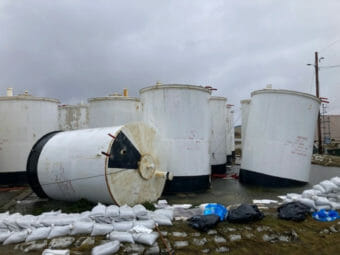
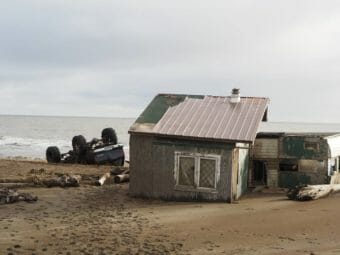
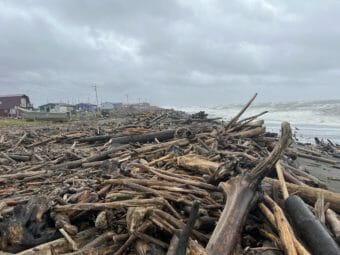
As water levels receded Sunday, residents in the Bering Strait region began taking stock of the damage done by the strongest fall storm to hit Western Alaska in 50 years. The storm destroyed sea berms, knocked homes off their foundations and left some communities with contaminated drinking water.
In Teller, the forecast from the National Weather Service had predicted that all 230-plus residents would have their homes completely flooded during the storm. But Mayor Blanche Okbaok-Garnie says the community was prepared and a little bit lucky.
“We lost parts of our seawall. We lost quite a bit of the rocks and gradians that hold up the seawall and then we lost some of the planks, treated planks,” Okbaok-Garnie said. “But for the most part…the homes were dry. Some of the water went up and around some of the homes and boats.”
Across Norton Sound, in Unalakleet, residents were evacuated Saturday afternoon to the local school until the notice was lifted Sunday morning. Despite having high water and debris on the airport ramp, the local airport was operational Sunday.
The city office also reported a complete water pressure loss during the storm, along with power outages, which has led to a boil water notice and conserving of water until the city can reach their pump house.
There could be some temporary relief coming to Unalakleet and several other communities in the Norton Sound that are without potable water.
Nome Mayor John Handeland said during Sunday’s city emergency operations meeting that Northern Air Cargo, other freight carriers and the Alaska National Guard would be delivering bottled water and supplies to communities without drinking water.
“NAC does have a couple freighters that are scheduled to come our way,” Handeland said. “Their first load, sounds like it’s going to be bottled water that needs to get out into communities around our area. The biggest concern that I mentioned to the governor and (Alaska National Guard Adjutant) General (Torrence) Saxe is probably the food supply and getting the bypass mail and cargo going.”
In spite of rising water levels threatening the Nome airstrip over the weekend, there was no standing water on the runway or significant damage, so flights resumed Sunday.
Throughout the Nome area, water levels rose to about nine feet above the normal high-tide line during the storm. That’s according to Rick Thoman, a climatologist with the University of Alaska Fairbanks’ Alaska Center for Climate Assessment and Policy.
“We can say for sure, this was the highest storm surge for Nome since the great November 1974 storm,” Thoman said. “This was about eight inches higher than the Bering Sea superstorm in 2011.”
A house rests against Nome’s Snake River bridge on Saturday, Sept. 17, 2022. (From Alaska DOT&PF)
On Saturday, a house from Belmont Point was swept into the Snake River and trapped under the bridge. City officials enlisted help from gold miner Sean Pomrenke to remove the house in sections and haul away the debris Sunday.
The city is also assisting the seven local residents who are staying at the Nome Recreation Center, which was set up as the emergency shelter during the storm. That shelter is likely to be operational for the next few days.
Locally the cleanup process has already begun, with the State Department of Transportation coordinating to make Nome’s roads passable again. Calvin Schaeffer, DOT’s regional superintendent for the Western District, says the agency will be assessing the damage to Nome-Council Road which was significantly eroded in certain sections on the east end of town.
“We’re trying to get a grader out toward the Cape [Nome] and then beyond that, assess damages and maybe take an engineer with him,” Schaeffer said. “Then we’re going to go from there and basically see what we can do to open it back up, and do what we can before winter.”
The Nome City Council is scheduled to meet at noon Monday to make a formal disaster proclamation for the storm.
Major flooding in Hooper Bay on Saturday, Sept. 17, 2022. (Photo courtesy of Lola Cernek)
The Alaska National Guard is activating all guard members in the western region of the state and is deploying more to the area.
Maj. Gen. Torrence Saxe said at a Sept. 18 press conference that troops would help with debris removal and damage assessment, with additional guard members going to Hooper Bay, Nome and Bethel.
“It is critical to have boots on the ground,” Saxe said.
Saxe said that having troops in hub communities will allow them to deploy to smaller villages more quickly.
The American Red Cross is also sending out volunteers. The state has identified five communities that have been impacted the most by the storm: Hooper Bay, Scammon Bay, Golovin, Newtok and Nome.
As of Sept. 18, three communities had a boil water advisory in effect: Elim, Unalakleet and Hooper Bay. Multiple communities, including Hooper Bay, had lost power at their airports.
Gov. Mike Dunleavy said at the press conference that he hopes the recovery response moves quickly and efforts wrap up before freeze-up begins in about three weeks.
“Wherever there is help that is needed, we’ll be getting that out there as soon as possible,” Dunleavy said.
Dunleavy issued a disaster declaration on Sept. 17 to free up state resources.
The damage from the storm ranges across a thousand miles of Western Alaska, from Kuskokwim Bay all the way up through the Bering Strait. University of Alaska Fairbanks climate expert Rick Thoman said that the widespread, severe damage due to this storm is part of what made it unusual. So is the timing. It’s the strongest September storm since records began over 70 years ago.
“We had the absolute perfect set up for a big Bering Sea storm,” Thoman said.
Thoman said that Typhoon Merbok, the source of Alaska’s storm, formed in a part of the North Pacific where typhoons don’t usually form because the water usually isn’t warm enough. But the water there was the warmest it had been in the last century.
“And after it developed and started moving north, then it moved over water that was as much as 7 degrees warmer than the long term normal,” he said. “That is a dramatic difference from normal. For the open ocean, that is really amazing.”
Thoman said that as climate change continues to cause sea water temperatures to warm, storms like this one could become more common in Alaska.
In Hooper Bay, a resident named Ben called in to KYUK on Sept. 17 to describe the scene in the village. Hundreds of people were sheltering at the school due to severe damage and power outages.
“Now, this is a wake up call. We don’t know what our future, but we can’t be ignorant or ignore it also. So we need to face the facts and reality. These storms are getting worse and worse,” he said.
Also taking stock of the damage as the storm blows over is Rep. Mary Peltola, who is from the Yukon-Kuskokwim Delta, home to some of the hardest-hit communities.
Peltola, who was briefed by Federal Emergency Management Agency officials on Saturday, has been in touch with Dunleavy and a number of mayors in affected communities. She’s worried about damage to subsistence harvests amid the flooding and power outages, as well as damage to infrastructure and equipment.
“Those are the kind of assessments that I’m going to be waiting patiently to — or not so patiently, actually — to start hearing back on,” Peltola said.
Peltola said that she and Alaska Sens. Lisa Murkowski and Dan Sullivan will be working on securing federal disaster funding.
The storm destroyed Shaktoolik’s berm, all that stands between the village and the waves. (Photo courtesy of Gloria Andrew)
Shaktoolik has lost its berm to the storm that’s hammered Western Alaska over the weekend, according to Mayor Lars Sookiayak. The berm was all that protected the small village from the sea.
“It’s a major loss,” Sookiayak said. “We’re pretty heartbroken.”
Shaktoolik, a village of roughly 220 people, sits on a gravel-and-sand spit between the Tagoomenik River and Norton Sound.
Resident Gloria Andrew also underscored the importance of the berm, made of gravel, sand and driftwood. She estimated the berm was destroyed between about 8 a.m. and 9:30 a.m. Saturday.
“It really saved us from the first hit that came in this morning,” she said.
On Saturday, he and Sookiayak both said they were worried about what might happen overnight.
“The state has been in contact with us and they say the worst is yet to come,” said Sookiayak. “So we don’t know what to expect, and we’re just going to have to go on their word.”
Sookiayak called on the community to evacuate to the local school early Saturday morning. People set up cots and air mattresses in the building, Andrew said. She spoke from her home, where she was checking on her family’s dogs and cat.
The storm destroyed Shaktoolik’s berm, all that stands between the village and the waves. (Photo courtesy of Gloria Andrew)
By late Saturday afternoon, Sookiayak said he had not heard of any storm-related injuries, and he said everyone was accounted for. Aside from the berm, he was also concerned about storm-fueled erosion that occurred a few miles from town, tearing into the coastline.
“We’re almost becoming an island,” he said.
He asked people to keep Shaktoolik in their prayers.
Andrew said, “We need all the good thoughts and prayers for the villages.”