Western

September storm leaves behind treasured beach finds

Norma Tunutmoak of Chevak shows off a message in a bottle she discovered after flood waters from an historic storm in September. (Emily Schwing for KYUK)

The remnants of Typhoon Merbok battered Alaska’s west coast in September, bringing hurricane-force winds, high seas, and severe damage to some Western Alaska communities. Homes were flooded and personal belongings were destroyed. But in its wake, the storm also left behind a few treasures.

After the storm tossed boats in Chevak like bath toys and scattered debris across the community, Norma Tunutmoak went out to survey the damage. Flooding carried loads of driftwood 17 miles inland from the Bering Sea coast. Tuntumoak, an avid beachcomber, said that she spotted something tangled among a pile of logs.

“I was like, ‘Holy cow, look at this!’” Tunutmoak said. “It was a message in a bottle.”

Her eyes lit up as she showed off a brown glass bottle with a roll of paper at her home.

When she opened the cork stopper and pulled the message out, it said that the bottle had been floating around in the Pacific Ocean and the Bering Sea for more than 20 years. According to the message, the bottle was dropped from a boat off the coast of Vancouver in 2000 as part of a long-term study on ocean currents. Tunutmoak contacted the scientist listed on the message. He’s since retired, she said.

Tunutmoak said that she had hoped the find might be more personal.

“But it’s OK,” she said proudly. “It’s still an amazing find.”

She said that she plans to display the bottle, and its message, on a shelf in her kitchen.

Up and down Alaska’s west coast, people have reported finding treasures from glass fishing floats to shoes and other flotsam. A giant prehistoric tusk discovered outside Newtok didn’t float in on a tide; it washed out of the tundra near Newtok.

“Half of it was showing from the tip and all the way to the end of it,” said Bruno Chakuchin, who discovered the tusk while scouring the coastline for debris.

Chakuchin said that the tusk was huge.

“Probably like 8 feet and 10 inches and probably a diameter of 1 foot, 6 inches,” he said.

It also weighed 128 pounds — too heavy for him to lift alone.

Tusks like this are popular among collectors and artists. Days after he discovered it, Chakuchin said that he wrapped it up and shipped it to a buyer in Anchorage.

“Depending on condition, they’ll go for about $150 a pound if it’s in really good condition,” he said.

That kind of cash can go a long way in a small community like Newtok. Chakuchin said that he’s likely to use it for bills, to pay for food and maybe invest in a four-wheeler.

“No I’m not gonna use it for fun,” he said.

Beachcombing offers a nice break for residents who are still cleaning up after their communities were ravaged by flooding, high winds and an historic storm surge.

Newtok residents are desperate to relocate after September storm

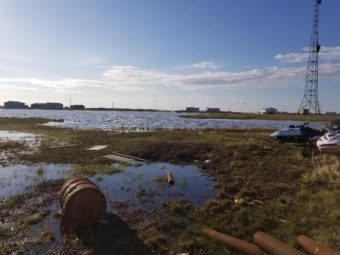
calm seas along a muddy coastline strewn with debris
The remnants of Typhoon Merbok left Newtok’s coastline littered with storm debris in September. (Photo by Emily Schwing for KYUK)

Nick Tom points across the waterlogged tundra where Newtok stands.

“The flood was all over this whole area,” he said.

Tom, who manages the village’s corporation store, said flood waters from the remnants of Typhoon Merbok shifted the boardwalks in the village and partially submerged the community’s two giant fuel tanks.

“Everything is so outdated, and there’s so much fuel. It’s just unsafe,” he said.

Smaller fuel barrels were tossed around, and at least one leaked. The Alaska National Guard was in Newtok a few days after the storm. While in the village, they removed nearly 900 pounds of debris, but there’s still garbage scattered everywhere.

Newtok is among more than 40 communities in Western Alaska affected by the storm. The Alaska Native village has garnered years of national media attention as severe erosion and melting permafrost cause a wide range of serious public health problems. The storm in mid-September has heightened the race to relocate the roughly 200 people still in the village to higher ground.

Melting permafrost and severe erosion have plagued the community for decades. The most recent storm brought waves so fierce, the water claimed roughly half of the 80 or so remaining feet of land that stands between the back end of the school and the edge of the Ningliq River.

A wooden walkway across tundra strewn with debris
Newtok residents have been dealing with severe coastal erosion for decades. A massive storm in September swallowed half of the remaining land – about 40 feet in total – that lies between the edge of the Ningliq River and the community’s local school. (Photo by Emily Schwing for KYUK)

Twenty years ago, Newtok residents decided to move to a new location on higher ground. It’s on Nelson Island, nine miles south across the river. To date, only about 70 people have relocated to Mertarvik. The other two-thirds of the population remains back in Newtok. The relocation effort is slow going, complicated by local politics, funding gaps and geography.

But Tom said the storm highlights how serious this situation is.

“It’s about safety,” he said. “It’s about our future. [Nelson] island is the only safe place for our next generation to survive.”

Not too far from the damaged fuel tanks, Janette Stuart hangs bright red and purple bed sheets on a clothesline outside her house. She has a 2-year-old son and a 1-year-old daughter. Her house is about the size of a shipping container, with plywood walls that are gray with age. The house sits above the ground on pilings, but floodwaters from the storm still rose high enough to leak inside. She worries about her kids.

“It’s so moldy, and I want them to live in a bigger house where they could run around,” Stuart said.

Five children standing on and around a dock in a pond
Kids in Newtok like to spend their after school hours wading in the local pond, on the hunt for small fish and beetles in the mud. (Photo by Emily Schwing for KYUK)

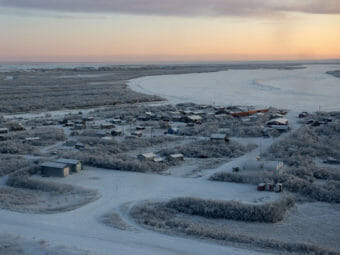
The new townsite at Mertarvik is visible from the Ningliq’s banks in Newtok. To get there, Newtok residents have to take a half-hour boat ride across the river, where the new community is slowly growing. It sits high on a tundra-covered, treeless hillside. There’s a huge gravel boat landing and two rows of colorful houses line the brand new road.

Bernice John’s house is covered in red metal siding.

“I love my house,” she said. “ It’s way better than the old one I had back home.“

John’s grandson Thom ran wild around a spacious living room as she talked about last month’s storm.

“It was sure very windy, it was the strongest winds we had,” she recalled. “It shook my house here and there a little bit and crashed my plants.”

In the summer she grows marigolds from seed outside. She said they fared OK in the storm.

No one grows flowers outside in Newtok. And the difference in how the two communities weathered the storm is stark. Mertarvik stayed dry. There was no structural damage, no boats or snow machines destroyed, and there is no storm debris littering the ground.

A photo taken from one skiff showing a second skiff traveling on a wide river
Mertarvik, the new village site for residents relocating from Newtok, is nine miles south across the Ningliq River on Nelson Island. Only a third of residents have moved to Mertarvik, which is accessible by boat. Available housing is limited, so nearly 200 people remain in Newtok. (Photo by Emily Schwing for KYUK)

New housing is under construction in Mertarvik, but there are still not enough homes available for the close to 200 people who still live in Newtok. According to the general contractor in Mertarvik, 18 houses are currently under construction there.

Nick Tom said it could be at least five years before most people fully relocate. Newtok is running out of time, he said.

“If we keep having this weather, we have more erosion,” Tom said.

The fall storm season is only beginning in Western Alaska, and Tom said that’s why it’s so urgent to get all of Newtok’s residents to higher ground.

Typhoon Merbok spotlights Alaska’s need for science and climate-resilient infrastructure

Two buildings at a fish camp, one badly damaged and the other knocked over
A fish camp in the Nome area, seen on Sept. 24, shows damages wreaked by the remnants of Typhoon Merbok. The day before, President Biden declared a major disaster for a vast stretch of western Alaska that had been slammed with high winds and floods caused by the remnants of that typhoon. Federal Emergency Management Agency Administrator Deanne Criswell, Rep. Mary Peltola and Sen. Lisa Murkwoski were among the officials who surveyed the damages in and around Nome. (Photo by Jeremy Edwards/FEMA)

When the remnants of Typhoon Merbok were barreling toward western Alaska to unleash what turned out to be the region’s strongest storm in more than half a century, meteorologists knew what was coming. What they could not predict was the exact level and location of flooding – devastation that prompted a federal disaster declaration on Friday by President Joe Biden and a whirlwind Alaska tour over the weekend by Federal Emergency Management Agency Administrator Deanne Criswell.

“The large-scale weather models nailed this storm, days in advance. The storm surge models were crap — not complete crap, but a lot of crap,” said Rick Thoman, a climate scientist with the Alaska Center for Climate Assessment and Policy at the University of Alaska Fairbanks.

Chalk that up to huge gaps in the knowledge about nearshore areas along the 1,000-mile stretch of coastline holding communities that were inundated by floodwaters.

It’s among several long-term lessons that policy experts are already considering in the storm’s immediate aftermath, including infrastructure needs.

There are only four year-round water-level stations maintained in western and Arctic Alaska by the National Oceanic and Atmospheric Administration, according to the NOAA-affiliated Alaska Ocean Observing System, which aims to use ocean data to improve safety. Only two of those stations, located at Nome and Unalakleet, are found in the wide swath of western Alaska hit by the storm.

It is a glaring deficiency that has been highlighted by the Merbok disaster, Thoman said.

“Certainly, in my opinion, we need to improve our near shore, the community-scale monitoring in real time. And we have to have that tied into a national database. We need to know what those numbers mean,” he said.

AOOS, which is part of NOAA’s Integrated Ocean Observing System, says neglect plays a role in those knowledge gaps. “Unfortunately, Alaska coasts have historically received less attention than the rest of the continental U.S. in terms of real-world observations, and as a result suffer from a higher degree of uncertainty in terms of understanding coastal water level, current and wind-wave simulation capacity,” AOOS says on its website.

NOAA has funded a project, led by the University of Notre Dame,aimed at filling in some of those gaps. NOAA is also playing catchup with its studies of the Alaska seafloor, a science known as bathymetry. Alaska bathymetry knowledge is notoriously sparse. As of early 2021, more than 70% of Alaska’s waters remained unmapped, according to NOAA’s Office of Coast Survey. Shape and features of the ocean floor affect the way that water moves onto land, Thoman said.

Deanne Criswell, administrator of the Federal Emergency Management Agency, speaks at a Sept. 23 news conference in Gov. Mike Dunleavy’s Anchorage office. Behind her are Dunleavy and U.S. Rep. Mary Pelotla. Criswell traveled from hurricane-stricken Puerto Rico to Alaska to survey the damage inflicted by Typhoon Merbok on the Bering Sea coast. (Photo by Yereth Rosen/Alaska Beacon)

The Alaska Division of Geological and Geophysical Surveys is another agency trying to piece together information to make local-scale flood forecasts. Much baseline information needs to be gathered for the first time, a difficult task because Alaska’s coastline is so extensive, is changing so rapidly and is affected by “some of the highest rates of erosion in the world,” according to the division’s website.

Repairs and rebuilding efforts spotlight another long-term need: Infrastructure improvements that will be resilient to repeat occurrences of strong storms like Typhoon Merbok.

The flooding and winds ripped houses off foundations, destroyed sections of road, scattered boats and vehicles, wrecked subsistence fish camps and, in some places, exposed sections of permafrost that will now thaw and likely erode quickly.

In the Inupiat village of Golovin, home to about 180 people and one of the hardest-hit communities, the storm has added urgency to existing plans to relocate infrastructure and homes to higher ground, said Mayor Charlie Brown.

The power plant, bulk fuel tank farm, school and water and sewer system are all in vulnerable locations, including the end of a spit, Brown said.

“Another two to three storms with this magnitude, everything will be washed out there,” he said. Water and sewer is particularly worrisome. The community has a 1.2-million-gallon water tank directly in harm’s way, he said.

Aside from relocating structures and facilities uphill, there is a possibility of protecting structures “that are still livable” by elevating them, and by also erecting a rockwall to protect the coast, Brown said.

Even before the storm, relocation of houses and community infrastructure to higher ground was seen as a pressing need in Golovin and other communities. It and five other Alaska communities were awarded grants in March by the U.S. Department of Agriculture’s Natural Resources Conservation Service to help pay for that relocation work.

A fish camp in the Nome area, seen on Sept. 24, shows damages wreaked by the remnants of Typhoon Merbok. The day before, President Biden declared a major disaster for a vast stretch of western Alaska that had been slammed with high winds and floods caused by the remnants of that typhoon. FEMA Director Deanne Criswell, Rep. Mary Peltola and Sen. Lisa Murkwoski were among the officials who surveyed the damages in and around Nome. (Photo by Jeremy Edwards/FEMA}

Rep. Mary Peltola, in a Sept. 19 media briefing, said there are plenty of signs that current infrastructure is too weak to withstand the powerful storms that are likely to become more common as the climate warms. She noted that the storm tossed around huge rocks that were arrayed to protect shorelines. “I’m not sure that we have been building things for storm surges that see 90-mile-an-hour winds,” she said.

That appears to have been the case in the Inupiat village of Shaktoolik. In that community of 210, where residents years ago opted against a relocation plan, estimated to cost $290 million, in favor of a beach-protection berm constructed with gravel and driftwood at an estimated cost of under $1 million. Typhoon Merbok obliterated that berm.

The Alaska disaster is tied directly to climate change, Thoman said. It formed over a region in the Pacific that lies well east of the usual birthplace of typhoons, he said. Those waters there have heated dramatically, he said. “We had this water that historically would not have supported tropical storm formation. Now it does,” he said. From this new origin site, Typhoon Merbok was able to travel a shorter distance and hold more of its power when it reached Alaska than previous storms, he said.

Sen. Lisa Murkowski, speaking Saturday in an interview with Nome radio station KNOM, acknowledged the role of climate change and said there is a need to prepare for that:

“Is this kind of our new normal here? And if that’s the case, we’ve got to be thinking about the longer-term view of how we provide for the resilience of these communities,” she said, mentioning more seawalls and emergency evacuation routes as possibilities.

The bipartisan Infrastructure Investment and Jobs Act signed into law last November – and authored in part by Murkowski — includes money that is specifically for Alaska village relocation and protection against flooding and erosion linked to climate change.

In the immediate term, FEMA and other agencies are racing to beat the arrival of the winter freeze expected in a few weeks and trying to figure out how to assist the people in the region who depend on harvests of wild foods.

Many residents of the storm-hit and largely Indigenous communities have lost boats, all-terrain vehicles, smokehouses and other items needed to conduct those traditional harvests. Some lost entire stockpiles of fish and other wild foods gathered over the summer and intended to last through the coming winter.

A member of the Alaska Organized Militia clears storm debris in Golovin, Alaska as part of Operation Merbok Response Sept. 26, 2022. More than members of the Alaska Organized Militia, which includes members of the Alaska National Guard, Alaska State Defense Force and Alaska Naval Militia, were activated following a disaster declaration issued Sept. 17 after the remnants of Typhoon Merbok caused dramatic flooding across more than 1,000 miles of Alaskan coastline. (Alaska National Guard photo)

It’s not the normal category of losses that FEMA tallies in natural disasters occurring in places like hurricane-stricken Florida or the tornado-prone Midwest. For now, the Department of the Interior is releasing $2.6 million through the Bureau of Indian Affairs for immediate assistance to pay for replacements.

“As we continue to work with our Tribal partners to identify and address long-term needs, these initial funds will help purchase critical food, supplies and water for those impacted by the storms,” Bryan Newland, assistant Interior secretary for Indian affairs, said in a statement.

Peltola, at a news conference Friday in Gov. Dunleavy’s Anchorage office, said she wants FEMA officials to understand who that property is needed to conduct subsistence harvests.

“I know ‘cabin’ has a recreational sound to it, I think, if you’re not from Alaska. But Alaskans recognize that ‘cabin’ means place where you’re gathering food for your family and your extended family and your community,” she said.

The same goes for the snowmachines, all-terrain vehicles and boats that were damaged, destroyed or lost, she said. “These are not recreational vehicles. These are critical for being able to provide food security for your family,” she said.

This article originally appeared in the Alaska Beacon and is republished here with permission.

As recovery begins, people in Hooper Bay worry about their village’s future

The frame of a boardwalk, with most of its planks gone, extending out into flooded tundra
The boardwalk to high ground in Hooper Bay was wiped away by floodwaters. (Photo by Will McCarthy/KYUK)

At the boat ramp by one of the sloughs running through Hooper Bay, John Rivers is checking on the damage to his boat. It’s one of the many vessels that were ripped from their anchors by a storm unlike anything Western Alaska had seen in years. But Rivers wasn’t surprised. His grandfather told him many years ago that this storm would come.

“The Elders told us long ago, this will happen, the storm, if you’re alive to see it,” Rivers said. “I lived to see it, Grandpa, I’ve seen it. After seeing that storm, it’s like, what’s next?”

In Hooper Bay, one of the villages hit hardest by the storm, school is back in session and cleanup has begun. The immediate aftermath of the flood has begun to pass. But residents of the 1,300-person village are just beginning to reckon with the emotional aftermath of the storm and what it means for their future.

“I’ve lived through storms before, but this was the worst,” said Loretta Smith, who lost her home in the storm. “The water came up so fast, and it was so high that the waves looked violent.”

Two people on an ATV driving through floodwaters
Major flooding in Hooper Bay on Sept. 17, 2022. (Photo courtesy of Lola Cernek)

Water rose faster and higher than anyone thought possible. Power outages threatened subsistence foods stored for the winter. There were panicked evacuations in waist-high water. Many of the most immediate crises, such as access to electricity and shelter, have been addressed. But residents of the village are still coming to terms with the raw feelings of what they experienced.

“I was afraid for my son and my grandma too,” Smith said. “How will we rescue them if the water comes up and it’s really cold? How will we save them?”

Although debris can be cleared and homes rebuilt, for many, a sense of security has been shattered.

The village was split in two by the rising waters, which turned parts of the town into literal islands in the storm. Families fled buildings while carrying their loved ones on their backs. If they couldn’t help each other, who would come in time to help the people of Hooper Bay?

Emma Smith, who works for the tribal council, has spent most of her life in the village. Because of the storm, she’s now considering leaving.

“I don’t know how to swim. I don’t have a boat. I’m a single grandma taking care of kids,” Smith said. “People were not there when my roof flew away — we had to run away ourselves. Will they be there now if it happens again?”

Mary Hoelscher, another lifelong resident of the village, thinks that it’s time that the town starts to consider relocating. One of her main concerns is that the boardwalk, which could bring people to higher ground in the event of an even stronger flood, was washed out by the storm. Even if it’s rebuilt, Hoelscher said that there’s no guarantee it won’t wash out next time. With the boardwalk gone, there would be no way to reach higher ground.

“On both sides of Hooper Bay there’s two sloughs, so we’re literally surrounded by water,” Hoelscher said. “Eighty, 90, or 100 mile per hour winds and no planes can come to evacuate people.”

Hoelscher also fears future floods will only become worse, in part because many of the rows of dunes that protected the village from storm surges were completely washed away by the storm. The next time a storm comes, there’s one less barrier to stop the water. Meanwhile, climate experts say that these types of storms are becoming increasingly common.

Taken together, lifelong residents like Hoelscher and Smith feel that the storm calls Hooper Bay’s entire existence into question.

“I know worry wouldn’t solve any problems, but it’s hard not to worry after seeing and experiencing what we went through with that storm,” Smith said.

Rivers, by his boat at the slough, said that he is also fearful for the future. He lived to see his grandfather’s prediction come true, but he doesn’t know what will come next.

“He tried to make us understand the world is about to end,” Rivers said. “But the worst is yet to come.”

Biden approves federal disaster declaration for Western Alaska storm

A small, square building, some skiffs, and fishing gear jumbled together onshore
Nearly 90 of the 100 boats people use for hunting and fishing out of Chevak were damaged or destroyed after a powerful storm hit Alaska’s west coast in September 2022. Nearly all of the sheds that store the tools for subsistence harvest in the community were also destroyed. (Emily Schwing for Alaska Public Media & KYUK)

President Joe Biden has approved Gov. Mike Dunleavy’s request for a federal disaster declaration in response to the historic storm that devastated many Western Alaska coastal communities last weekend.

That makes federal funding available to Alaskans impacted by the storm, as well as money available to state, tribal, and eligible local governments, plus some nonprofits.

While there have been no reports of storm-related injury or death, the wreckage spans about 1,000 miles of Alaska coastline. It ranges from road damage in Nome to the loss of Shaktoolik’s berm against the sea. In Chevak, a power outage and the loss of many local boats has destroyed both frozen subsistence foods and the means to replace them.

Alaska’s congressional delegation applauded Biden’s response in a statement Friday evening, which came two days after Dunleavy made a formal request to the federal government.

“So many communities throughout Western Alaska have been devastated and are in dire need of federal support,” said U.S. Sen. Lisa Murkowski. “I appreciate the President for listening to us and recognizing the urgency of this situation. With winter weather looming, this federal assistance can’t come soon enough.”

“I appreciate the quick response from the Biden Administration approving Governor Dunleavy’s request for a major disaster declaration to support Alaska’s recovery from the impacts of Typhoon Merbok on Alaska families, homes, businesses, schools, and infrastructure,” said U.S. Sen. Dan Sullivan.

“I am grateful that President Biden understood how urgent the need for federal assistance was to the people of Western Alaska and thank him for swiftly approving the governor’s request for a disaster declaration,” said Congresswoman Mary Peltola.

Biden’s approval of a disaster declaration arrived along with Federal Emergency Management Agency Administrator Deanne Criswell, who is visiting Alaska this weekend to see damage from the storm firsthand. Dunleavy, who has already declared the storm a state disaster, has emphasized the need for relief efforts to move quickly in the next month before winter freeze-up.

“With winter coming in a matter of weeks and bringing a new set of hazards with it, we have hard work ahead of us to protect and prepare communities for the freeze-up, especially those that were already vulnerable before the storm hit,” Criswell said.

The U.S. government says federal funding is available to residents and business owners who suffered losses in the storm in the Regional Educational Attendance Areas of Bering Strait, Kashunamiut, Lower Kuskokwim and Lower Yukon. People can begin applying for assistance at DisasterAssistance.gov, by calling 800-621-FEMA (3362) or by using the FEMA App.

Chevak stunned by food losses after Western Alaska storm: ‘We’re gonna have to start over’

A man holds the lid up and looks into a large freezer
Chevak resident Ryan Bukowski says three freezers at his home filled with subsistence and store-bought foods completely thawed out during a three-day power outage after Western Alaska’s September 2022 storm. (Emily Schwing for Alaska Public Media & KYUK)

The historic storm that slammed into Alaska’s west coast last weekend was a dramatic blow to food security in Chevak, where people are reeling after the storm destroyed boats, gear and many of the tools they use to hunt and fish for their main sources of food.

“I was hoping to go moose hunting, but unfortunately this storm hit us here, so I can’t use my boat and motor,” said Derek Knight. He was at the Chevak community building this week to report his losses to the local tribe, which plans to seek disaster relief funds from the state and federal government.

The storm hit at the tail end of the fishing season and just as the berry-picking season was ending. It’s also the middle of the moose-hunting season.

“It’s just devastating,” said an emotional Knight. “It’s hard, but we have to deal with it. But there’s a lot of heartbreak.”

Losing this summer’s fish is already painful, but with their boats lost locals are unable to replace that with moose or seals they would hunt in the fall. Knight and others say nearly 90 percent of the 100 or so boats people use to gather food were damaged or completely destroyed by the storm.

It’s not just boats and motors that are now gone. Video on social media during the storm shows small, square plywood shacks floating away. Those sheds held all kinds of equipment: life jackets, gas cans, fishing nets, camping gear — all the tools required for subsistence. The community stands on a tall bluff along the Chevak River, 17 miles from the Bering Sea coast. The storm surge brought so much water inland that for a few hours, it was as if Chevak were right at the coast.

A small, square building, some skiffs, and fishing gear jumbled together onshore
Nearly 90 of the 100 boats people use for hunting and fishing out of Chevak were damaged or destroyed after a powerful storm hit Alaska’s west coast in September 2022. Nearly all of the sheds that store the tools for subsistence harvest in the community were also destroyed. (Emily Schwing for Alaska Public Media & KYUK)

Many of the damaged boats lying along the riverbank now look like dented soda cans. They’re tangled up in fishing nets. There are pieces of lumber and broken sheets of plywood all over the place. There are bottles, soda cans, round orange fishing floats and overturned gas cans everywhere, and there’s a strong smell of gasoline and oil.

On Wednesday, Leemon Joe had the cowling off his boat motor. As a light evening rain fall, he wiped mud and debris from inside the boat motor motor with an old towel.

“Yeah, I’m trying to clean everything, trying to see if everything is good,” Joe said.

Joe said the motor was completely submerged in the river for three days.

“My friend’s coming down to help me out, see if I can get it running again,” he added.

The boat was still parked at the riverbank on Friday.

The storm surge also knocked out power to part of the village as well. Ryan Bukowski lives on the west side of town and has three giant freezers at his home, which was without power for three days.

“Yeah, everything thawed out and refroze here,” Bukowski said.

Bukowski’s freezers are filled with fish, moose and seal meat, all of the berries his family gathered this summer and a lot of store-bought supplementary food — much of it now spoiled. He’s responsible for feeding at least nine family members, but now he’s not sure if any of this food is safe to eat.

Just under 1,000 people live in Chevak, roughly 136 miles west of Bethel. The food security threat is both short and long-term. People have lost not only the food they’ve already gathered, but also their means to replace it.

Bukowksi said losing the contents of a freezer is like finally showing up at a store, only to find the shelves are empty.

“We’re gonna have to start over,” Bukowski said. “I don’t know how we’re gonna do it, but we’re gonna have to figure out something fast.”

Site notifications
Update notification options
Subscribe to notifications