Western

As the storm raged, a mad rush to keep the power on in Hooper Bay

White fuel tanks, some tilted and one tipped over completely
An empty bulk fuel tank toppled in Hooper Bay during the storm. (Photo by Will McCarthy/KYUK)

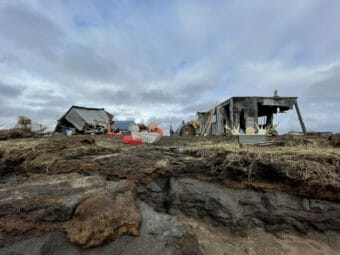
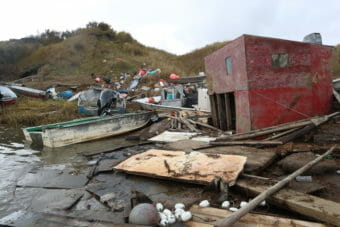
Signs of the flood are everywhere. Seaweed and debris hang shoulder high off fences in the middle of town. A steel culvert rests on top of a building got pushed off its frame. Fishing boats lie stranded on the tundra.

Parts of Hooper Bay were without power for about 36 hours over the weekend as a storm surge flooded the coastal community of about 1,300 people. But the situation could have been far worse — and threatened the town’s winter subsistence stock — if not for the work of two local power plant operators.

On Sept. 20, at the airstrip, cousins Leemon Andrew and Leemon Bunyan were working to restore power to the airstrip’s lights.

Andrew, the older of the two cousins, said things are still in a much better shape than just a few days ago.

“Everybody’s happy that they have power,” Andrew said.

Andrew, born and raised in Hooper Bay, said he had never seen anything like the flooding that rocked the village over the weekend. He only just started his job as an Alaska Village Electric Co-op power plant operator in April. His cousin, Bunyan, has only been working as a plant operator for three weeks. Both are in their early 30’s.

The past few days have been about as intense of an initiation into the job as anyone could imagine.

When the water started to rise up to the bulk fuel tanks and the power plant on Friday night, Leemon Andrew and Leemon Bunyan were there with an AVEC contractor.

Soon, some of the empty bulk fuel tanks started to lift and tilt. One toppled over completely. The falling tank caused the gaskets of the fuel lines to rupture. Those lines bring fuel from the bulk tanks to a smaller tank that powers the generator, which in turn powers the whole town. Now that power was close to shutting off completely.

They needed to figure out a solution.

“We had a bucket brigade going to fill up the day tank so the generator wouldn’t run out of fuel,” Andrew said. “After the flood in the morning, the day tank was getting low.”

Without a functioning fuel line, Andrew, Bunyan and the AVEC contractor became a human fuel line instead. As the water rose up toward their waists, debris floating around them, they started carrying bucket after bucket of fuel to the day tank.

If the generator shut down, the whole town would lose power. Everyone’s freezers are filled with moose meat and fish for the winter. Without power, Leemon Andrew said the freezers risked thawing and spoiling all the food inside. It was more than electricity — it was a matter of food security.

As the team worked, Robert Lohman, the AVEC contractor, kept an eye on the rising waters pummeling the bulk fuel tanks. With the water around his waist, he started unlocking the gates further up the hill, creating an escape route for the crew in case they needed to abandon the plant.

I asked Lohman if he was worried for his life.

“No,” Lohman said. “I’m old.”

Eventually the group came up with a workaround for the bucket brigade. They ran a garden hose from the valve at the bottom of the tank to a pump, then ran another garden hose from that pump to the tank feeding the town’s generator. That MacGyvered solution is still powering the village.

AVEC leadership visited the power plant on Wednesday to look for a more permanent solution.

‘Some of them just disappeared’: Essential pieces of life in Nome were lost in the storm

Plywood, lumber, and other debris strewn along a treeless coast, with a single small house in the background
The storm left trash and debris along the coast in places where the ocean surged and rivers topped banks. Some people were looking for possessions that washed away, including cabins and outbuildings that were moved or shifted. This debris is by the mouth of the Nome River along the Nome-Council Road. (Photo by Zachariah Hughes/ADN)

NOME — The storm that slammed Western Alaska over the weekend has reorganized the land.

There was no loss of life, but the landscape of Nome is physically altered for the foreseeable future, with raw material scattered wildly, the coastline reconfigured, the camps and shore-side compounds anchoring generations of subsistence either flattened or gone.

All up and down the Nome-Council Road heading east out of town, cabins used for fishing, foraging and seasonal family life are in ruin.

“Some of them just disappeared,” said Bryant Hammond, the incident commander for Nome’s emergency operation center.

Nome, a city of about 3,700 people that functions as the commercial and logistical hub for 15 smaller communities in the Bering Strait region, weathered the worst storm in decades relatively well. By Monday, business owners were unboarding windows along Front Street and shoveling muck out of gutters as heavy equipment rumbled around side streets and the seawall. Utilities are fine. Many car and truck owners are gradually discovering their vehicles were effectively totaled by partial submersion in the salty, silty floodwaters.

But the worst damage is out of town, with an as-yet-uncounted number of subsistence cabins in shambles.

To those unfamiliar with Western Alaska, the word “cabin” might conjure a hut of neatly notched logs nestled in the woods, or a euphemism for a lavish weekend home overlooking Nancy Lake. These are not those. The fish camps peppering the river mouths and shores of the southern Seward Peninsula are more like cozy shacks, neither electrified nor plumbed, buttressed by meat racks, smokehouses, saunas, cutting tables, woodpiles and utilitarian bric-a-brac for making use of the land and sea’s seasonal offerings.

A tilted, badly damaged camp with an upside-down truck lying next to it
Family camps and subsistence cabins lie in ruins, shifted off their pads, floated away, and buried in sand along the Nome-Council Road. (Photo by Zachariah Hughes/ADN)

They are essential to the region’s economy: family-scale food production and processing plants, summertime child care and education centers, a release valve for overcrowded homes and apartments in a region with an endemic housing shortage.

“My daughter’s smokehouse is gone. The outhouses, gone,” said Sterling Gologergen, standing at her second-story living room window, from where she watched the storm drown Nome’s small-boat harbor Saturday.

Even though the main cabin at her daughter’s camp remained intact, bedding and other material inside was soaked, ruined, costly to eventually replace, Gologergen said. Though she’s lived in Nome for a decade, the 67-year-old spent most of her life on St. Lawrence Island, where the communities of Gambell and her hometown of Savoonga were largely spared substantial destruction, but caches of fish and meat stored or hung from racks by the shore were trashed or gone.

“Already a lot of people are out beachcombing for edible stuff,” Gologergen said. “And to see what’s left of everyone’s camps.”

“They work faster than internet,” she said with a laugh about damage assessment and repair work. “The network of people out in the villages. And they already had it done yesterday.”

Camps are less built than accumulated over years and generations, rarely insured or registered in the formal banking system, which makes financing reconstruction or repair all the more difficult.

A woman sits at a table by a window overlooking Nome
Sterling Gologergen watched the storm pummel Nome’s small boat harbor and Front Street from the second floor of her home. “This was my third storm,” said the 67-year-old, who spent most of her life in Savoonga. “It ages you.” She worries about camps and caches of food that were lost in the storm, and what the salty ocean spray along the coastal tundra means for the berries. (Photo by Zachariah Hughes/ADN)

Gologergen said she worries about the storm’s lasting impact on vegetation. Tufts of sea foam “the size of baseballs” blanketed the street below her window. She fears the ocean salt could wither next summer’s berry crop along the miles and miles of shore.

Ruined, too, is the Nome-Council Road itself. For the first two dozen miles or so, it’s passable, especially since the state Department of Transportation has had graders and heavy equipment removing stones plucked loose from the seawall, fixing washouts, pushing driftwood to the sides and leveling drifted sand.

But then around Mile 24, there’s a massive new hole where the creek-fed Safety Sound punctured the barrier islands that supported the road.

“That lagoon became one with the ocean, where our camps are,” Gologergen said.

Camps on the far side of the new quarter-mile-wide gash are now cut off, except by plane.

“I don’t think if you had a canoe you could get across it,” Hammond said.

Tire tracks through a field of loose, recently deposited mud with small buildings in the background
The long road east out of Nome remains in states of disarray, including sections totally washed out or buried in sand. Farther down, a bridge by Safety Sound was almost impassable just two miles before a new channel broke through the barrier island, obliterating the roadway. (Photo by Zachariah Hughes/ADN)

Families with seasonal camps past Safety Sound, along with a few dozen old-timers who live most of the year out around Council, will have to find new ways of getting into town.

“We’re gonna have to build a new bridge, looks like,” Hammond said.

The storm was major: high seas, ferocious wind, powerful waves, all of it lasting for well over a day. The massive seawall that helped blunt the damage to town was reordered elsewhere along the coastline. Boulders and rocks are scattered everywhere. Swaths of beach are gone, eroded, as if erased or dropped 6 feet lower than they should be, the sand swept away and sprinkled all over the tundra on the lee side of the road.

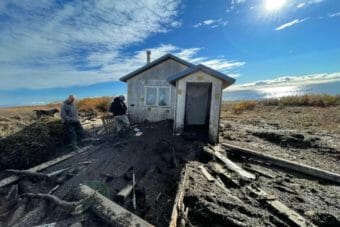
A cluster of camps, one badly damaged, and debris all around
Family camps and subsistence cabins lie in ruins, shifted off their pads, floated away and buried in sand along the Nome-Council Road. (Photo by Zachariah Hughes/ADN)

There will be major repairs and challenges ahead, not just for Nome but across the region, all the way to the mouth of the Kuskokwim River hundreds of miles south. Even communities that fared relatively well — that didn’t lose whole houses or see major infrastructure fail — will be grappling with considerable costs that are not easily or quickly tallied in the accounting of a cataclysm: family camps, familiar harvesting grounds, small boats and subsistence equipment, rebuilding pummeled weather mitigation infrastructure.

“The system reorganized. It does it normally in nature. But we humans, it kinda screws us,” Hammond said.

A pickup truck backed up to the water with a piece of mining equipment next to it
The storm churned up so much sand and beach material that shortly after the storm subsided, gold miners were dredging and panning for gold along the Nome-Council Road. (Photo by Zachariah Hughes/ADN)

In a reordering of the land, for some, there is opportunity. Along the scoured beaches heading east out of Nome, there are newly churned up plumes of red-tinged dirt, the kind known to be fertile hunting grounds for gold. As public employees smoothed the road, volunteers picked up driftwood or detritus, distant figures surveyed cockeyed cabins and a few gold miners with small dredging rigs attached to their pickup trucks panned the freshly pulped beach for treasure.

This story was originally published by the Anchorage Daily News and is republished here with permission.

Shaktoolik residents say they need aid to rebuild their berm before winter storms hit

Broken wood piled up along a battered coast
The storm destroyed Shaktoolik’s berm, all that stands between the village and the waves. (Photo courtesy of Gloria Andrew)

People in Shaktoolik are back in their homes after many evacuated to the school when the remnants of Typhoon Merbok hit Western Alaska over the weekend. But the storm washed away the berm that protects the village from the sea.

“We’re back in school,” said Agnes Takak, the school secretary and a member of the Shaktoolik Council.

“We have everyone here. Right now we’re just trying to be there for our children. Getting them back into what we are trying to say is normal.”

She says her generation built the berm after elders saw how much land was lost due to erosion. Children in Shaktoolik now have always known the protection of the berm. She says it was a symbol of their security.

She says one student asked: “What are we going to do now?

Takak says there’s a lot of clean up to do. Residents are assessing damage to their homes and properties.

She said if the next storm comes before the village can rebuild the berm, the community could get wiped out.

Shaktooliks coastal berm, before and after the storm. (Photos courtesy of Gloria Andrew.)

“Our organizations don’t have any funding to rebuild right now. We need financial assistance, ASAP. Our lives are at stake,” said Takak.

Mayor Lars Sookiyak says Shaktoolik is pressed for time. He expects a big storm in November.

He said planes can land at the airstrip, but there’s hardly any air traffic, so Shaktoolik could also use some food and water.

“The stores are getting a little bare,” he said.

He’s also concerned about erosion from the storm. The village sits on a narrow spit of land between the Norton Sound and the Shaktoolik River. If the ocean breaches the river, it could pollute it with salwater.

“There’s a risk of losing the freshwater source and Shaktoolik becoming an island,” he said.

Logs washed into the community after the berm was damaged, but water stayed out of the homes.

“My ankles didn’t even get wet — and I didn’t even have my high heels on!” Eugene Asicksik said with a laugh.

Asicksik is on the Shaktoolik Council, and he’s the president of the local Native corporation. He and his family sheltered briefly at the school. But he said the village was prepared — they’ve seen big storms before and had systems in place.

“The electrical system held up. The only thing we did was disconnect the electrical wire to our winter water pumping station, which was a good thing,” said Asicksik.

He says the village likely has enough water for the remainder of the month. By then he’s hoping the village will be able to pump water normally for winter.

Most boats weathered the storm, though Asicksik said one sank in place.

Disaster response presents an early test for Alaska’s Rep. Peltola

Mary Peltola stands at the wheel of a small boat
Mary Peltola has been fishing on the Kuskokwim since she was a child. “Small boats with outboard motors, four-wheelers, snow machines — my concern is that we make sure that government agencies know that these are not recreational vehicles, that these are critical vehicles for everyday living,” she said. (Photo by Liz Ruskin/Alaska Public Media)

As she starts her second week on the job, Congresswoman Mary Peltola is preparing to prod the U.S. House for supplemental disaster spending to help Western Alaska recover from the storm.

Peltola was one of the last representatives to leave the House chamber after a series of votes Monday night.

“I’ve been having conversations with members of the Transportation Committee, members of various subcommittees, members with more seniority than I have who have been through natural disasters, giving me advice on different approaches I can take,” she said.

It hasn’t happened yet, but President Biden is likely to sign a disaster declaration, as he did for a different storm over the weekend that devastated Puerto Rico. Gov. Mike Dunleavy said Monday night he’d send a request soon.

That would release a lot of federal money to storm victims. Congress often has to pass supplemental funds to pay for responses to major disasters.

One of her challenges will be to make other House members recognize the gravity of the Alaska disaster, especially because fewer people are hurt there compared to the three million Puerto Ricans who lost power and other infrastructure.

Peltola talks about the toll on Alaskans who hunt, fish and gather to feed their families.

“These communities, all up and down the coast, have been spending all summer long, gathering food and putting it in their freezer for the winter,” she said Monday night. “Now all of these freezers are going to have electrical damage, water damage. It remains to be seen how much of that food can be salvaged.”

Peltola says disaster relief funding for both Alaska and Puerto Rico might be needed in the continuing resolution — the legislation Congress has to pass before the end of the month to keep the government operating.

She has been elected to serve until January. She’s also running for the next full term. Politicians are often judged by how well they handle a disaster, and this is her first.

She wants people in the nation’s capital to know of all the vehicles damaged in the storm and how important they are to a family’s food security.

“Small boats with outboard motors, four-wheelers, snow machines — my concern is that we make sure that government agencies know that these are not recreational vehicles, that these are critical vehicles for everyday living,” she said.

Her Republican rivals, Sarah Palin and Nick Begich, also issued statements about the storm.

Palin said in a news release that she’s heartbroken by the devastation.

“We are seeing the real spirit of Alaska right now, with people all over the state reaching out to help their fellow Alaskans in this time of need,” her release said.

Begich, in an emailed statement, said his prayers go out to the people affected by the tragedy. As did Palin, he spoke of appreciation for first responders and the Red Cross.

Bering Sea storm should be a ‘wakeup call for Alaska,’ climatologist says

A storm tracking map showing an intense red area covering most of the Bering Sea
Storm Track from Rick Thoman with UAF ACCAP.

The storm that slammed into western Alaska over the weekend was the result of several factors that converged to make it so destructive.

That’s according to Rick Thoman, a climate scientist at the University of Alaska Fairbanks, who says Tropical Storm Merbok initially formed farther to the east of Japan than one would expect and picked up energy from water that was much warmer than it used to be, based on historical records.

Then, as Typhoon Merbok became an “ex-typhoon,” low pressure aloft picked it up and pushed it north into the Bering Sea. The orientation of the Jet Stream — a high-altitude band of strong wind — was such that the storm’s edge tracked right along hundreds of miles of Alaska’s coastline, causing severe damage.

Thoman says that as ocean temperatures keep climbing, similar devastating storms could become more likely in Alaska.

Listen:

The following transcript has been lightly edited for clarity.

Rick Thoman: Without the very warm ocean water, you just don’t get these tropical cyclones. Now, as it moves north over cooler water, it transitions to the “ex” portion of Merbok, or like a typical mid-latitude storm structure. That might sound like just a meteorological technicality. But in fact, it’s incredibly important, because typhoons, hurricanes, are actually fairly small features as far as storms go. They’re compact. And when they transition to the mid-latitude structure, they expand greatly. They grow in size. And that was a key portion of the impact. The center is passing west of St. Matthew Island, and we’re getting this tremendous flooding hundreds of miles east, on the Alaska coast.

Casey Grove: Tell me more about that. What did we see as far as the wind speeds and the water levels?

Rick Thoman: Wind speeds in most places, Well, to the extent we know, were not super high. The highest gusts, for instance in Nome, 59 miles an hour at the airport. In some places we don’t actually know what the highest gusts were, because power went out at the airport. But, certainly, many places had winds of 55 to 65 miles an hour. Some exposed places had wind gusts up above 80 miles an hour. But more than the peak wind speeds, it was really the duration of very high winds, of gale-force winds, 30 to 50 miles an hour sustained winds, for 18 to 30 hours, depending where you’re at. And that’s really what drove the water up, those strong sustained winds, pushing the water, acting as a plow, if you will, just moving that water. And where that moved into south- or west-facing coastlines, that water just piles in there and is pushes it up. So it was really the duration of the winds in most places, rather than the absolute highest gusts.

Casey Grove: Gotcha. Yeah, that’s interesting. So there were major impacts, obviously. We haven’t heard about any deaths at this point. But certainly people lost their homes, and there was quite a bit of advance warning. Really, I mean, you could see this coming from a long ways away. There were computer models. But does it seem like there was much of a response, I guess, before the storm?

Rick Thoman: Yes, this was very, very well forecast by the large scale models. Was every detail correct? Of course not. But certainly the models were showing the threat of a major Bering Sea storm. By Monday afternoon, it was clear that something big was going to happen somewhere in the western Alaska coast. And by Tuesday, the models had converged on a track that was very close to what actually happened. But to the extent that that information got out there, a lot of information on social media, there’s always ways to improve the communications. But I think the important thing that we need to keep in mind is in rural Alaska, we need to provide as much lead time as we can. We need to give people the heads up. And I think, you know, this is a stormy part of the world. Storms happen in western Alaska. They’re gonna happen again. And when something is really out of the ordinary, we need to make sure as many people know about that as long in advance and know this was not just another storm.

Casey Grove: Yeah, speaking of another storm, I guess, just in the sort of short-term future, there was some speculation that there was another typhoon forming that may come towards us. What is that storm called? And is that actually going to hit Alaska, do you think?

Rick Thoman: Super Typhoon Nanmadol, affecting southern Japan. At this point, though, that does look like that is going to dissipate long before it gets to Alaska. There is a slight chance that it could move along the Aleutians as a very weak storm, but definitely nothing like what we just saw.

Casey Grove: Well, then, looking forward further into the future, you know, years into the future, can we expect these kinds of storms to happen more as the climate continues to warm?

Rick Thoman: Well, to get a storm like this, as we talked about, you have to have all the pieces fall in place. And of course, most of the time they don’t. However, I think this is a really important wakeup call for Alaska, in the sense that Merbok formed in an area that we just simply don’t ever expect tropical systems to form. It’s, historically, the water is not warm enough. But the water is warm enough this year, and we are certain that in the coming years, coming decades, the oceans will continue to warm. And so, although Merbok formed in an area where it’s extremely rare, it’s very likely going forward, over years, decades, we will see more storms in that part of the Pacific, and that is much closer to Alaska than storms curving east of Japan.

In Golovin, Alaskans shovel sand out of their homes after historic storm

“Inside my house is a sandbox,” Golovin resident Willow Olson posted on Twitter. “If I don’t smile about this I will cry.”

Golovin residents are in clean-up mode as their community works to restore power, phone service and clear debris. After the flood waters receded from the weekend’s historic fall storm, some locals are left with feet of sand in their homes.

“At my place we’ve got 3 feet of sand we’re still shoveling out with the crew here — trying to get the sand out of the living area so we can get the sheetrock to go ahead and dry off,” said Alaska Sen. Donny Olson of Golovin.

Other residents in his hometown are dealing with the same issues, according to Olson. But some of his neighbors were not as lucky and their homes were moved across town or floated away completely.

“Housing is still the major issue down here cause so many buildings have been shifted or knocked off their foundations. There are now debris including houses in the middle of the road, blocking the way, that need to be cleared before we can get the roads back open,” Olson said.

Golovin is about 70 miles east of Nome and home to roughly 180 people. The state says it’s one of the communities hardest hit by this weekend’s powerful storm, remnants of Typhoon Merbok. Once the storm hit the Friday night into the next morning, water levels rose rapidly to 9-10 feet above the normal high tide line. The National Weather Service forecast highest water levels for Saturday evening .

That same day, resident Dwight Amaktoolik posted on social media that half the community was under water and Golovin had lost power.

https://twitter.com/AlaskaWx/status/1571197657259057152

As of Monday afternoon, power was partially restored in the community but not at the Golovin school, Olson said. The priority is to maintain electricity for as many homes as possible so residents can save the subsistence food stored in their freezers, he said.

“Because we had a number of people who had to evacuate because there was no heat in their homes,” he said. “Now that we’ve got power back on we want to make sure it stays there. And then after that we make sure there’s some kind of food security situation, that we have something to eat as well as something to drink.”

Outside agencies and organizations have been sending relief to Golovin directly, whether through the World Central Kitchen delivering food, Northern Air Cargo and Ryan Air bringing in bottled water, or even via online donations.

A GoFundMe page was started for the community by a former teacher in Golovin. It had already raised over $5,000 in the first six hours of being posted.

“That was something to boost our… like we hadn’t been forgotten here in Golovin,” Olson said.

The Alaska National Guard has deployed to Western Alaska to assist with recovery efforts over the coming days.

Site notifications
Update notification options
Subscribe to notifications