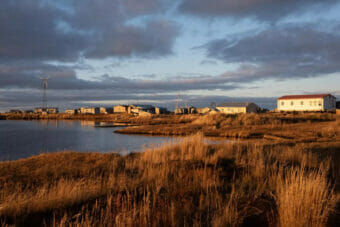
The ANICA Stebbins store, the only store in the Western Alaska village, burned down after catching fire on Tuesday. (Photo courtesy of Linda Greta Camillus)
A fire burned down the only store in the Western Alaska village of Stebbins Tuesday morning.
Lydia Raymond-Snowball is president of the Stebbins Community Association, the local tribal government. She said her daughter Gwen, who lives right next to the ANICA Stebbins store, told her about the fire at around 6 a.m.
“Looking at the store, I mean I grew up with it all my life, and so did practically everyone here. It was our only store standing,” Raymond-Snowball said. “Now it’s gone.”
The ANICA Stebbins store. (Photo courtesy of Linda Greta Camillus)
Raymond-Snowball said a few homes near the store sustained minor damage to windows. She said she’s grateful it wasn’t a windy day in Stebbins, a Yup’ik community of roughly 630 people.
“There was no wind at all, and when it did catch wind, it was blowing toward the ocean, which is the west,” Raymond-Snowball said.
Gov. Mike Dunleavy said the state’s emergency operations center is coordinating with the village on a response. Emergency center spokesman Jeremy Zidek said the store was the main supplier of fuel in the village.
“They don’t have electrical fuel pumps at this time, but they are able to do gravity feed and still get fuel out of that facility,” Zidek said.
Zidek said between 60 and 70 homes lost power during the fire, but Alaska Village Electric Cooperative officials have restored power to most of the homes. He said the store was insured, and the community is using an old washeteria as a temporary store. As of now, he said, it’s not known what caused the fire.
Raymond-Snowball said late Tuesday afternoon that the fire was out, but the site of the store is still smoky, with only one of its walls still standing. She said she’s hopeful that goods will still be able to be flown in from the local hub village of Unalakleet.
City crews scrambling to find the break in the lines. (Photo courtesy of Anastasia Kashevarof)
On Oct. 22, the water pressure in St. George — a community of about 35 in the Pribilofs — suddenly dropped, and the water became unfit to drink.
“It’s been pretty murky,” Anastasia Kashevarof said. “It’s brown even boiling it. I don’t trust it to wash my dishes.”
She said supplies of bottled water went fast. Some homes were unaffected, but most had to haul 5-gallon buckets of water from the public safety building to their homes to flush toilets and mop floors.
As a working mom and a mother of two, Kashevarof said it became difficult to keep up with it all.
“Trying to find your friend’s house that has a good supply of running water so I can borrow their shower to bathe my family,” she said.
Tribes, Native corporations and other groups donated bottled water, which helped. But as the days wore on, city crew still couldn’t pinpoint the leak.
Mark Merculief, the mayor of St. George, said the problem was a mystery until Nov. 16, when water engineers arrived to track it down.
“We’ve narrowed it down to a break, like a one-inch line to the old houses,” Merculief said.
When the crew dug into the ground, they were shocked at what they found — a clean break in the pipe that was right on top of a huge rock.
Merculief began to wonder if the line was damaged in an earthquake that gave St. George a stiff jolt just a few days before the water system failed.
“The way the break was, you couldn’t have a cleaner cut go through,” he said. “We thought, ‘Wow, it wouldn’t take much to break this with the amount of stress this was under.’”
It took a day to repair the line. But the problems aren’t over yet.
The Alaska Department of Environmental Conservation has issued a boil water notice. Cindy Christian, a drinking water program manager for DEC, said it takes time to lift an order.
“They’ll be running chlorine through the system to disinfect the water lines,” she said. “As soon as we get three satisfactory samples, we will be able to lift the boil water notice as long as they maintain pressure.”
It may be a while for things to go completely back to normal, but Kashevarof said she feels grateful to the city crew and engineers for their hard work.
“I know it’s frustrating for everyone in the community, especially the city workers trying to resolve this issue,” she said.
As for the mayor, he sees this incident as a learning experience.
“You got to know the ins and out of your systems here, and that’s a great way to learn it, and also to be able to in the future in meetings with — whether it’s federal or state agencies — to be able to explain situations like that,” said Merculief.
The exact cause of the water line failure may never be known.
Leaders in the Western Alaska community of Kipnuk say the principal of nearly a decade there bullied Native school staff members, put residents in jeopardy by ignoring COVID-19 restrictions and oversaw a decline in education quality. That’s why in October, according to documents obtained through a public records request, they voted to banish her.
School officials and tribal leaders involved in the banishment order and subsequent search by tribal police officers at the Chief Paul Memorial School at the end of last month have largely declined to comment on what happened beyond brief written statements. But in documents submitted to the Alaska Department of Public Safety and obtained by the Anchorage Daily News, new details emerged about longstanding tensions between community members and principal LaDorothy Lightfoot, who began work in Kipnuk in 2013.
Lightfoot did not responded to multiple emails and phone messages seeking comment.
“We are kindly encouraging you to leave your position as Kipnuk Site-Administrator at Chief Paul Memorial School. We, the Native Village of Kipnuk, have received many calls from the local Kipnuk Tribal members about you,” said the banishment order, signed in early October. “You have neglected important parts of being a leader in Kipnuk. The relationship with (a) variety of people was not positive.”
According to the document, tribal leaders voted 6-0 on Oct. 4 to permanently expel Lightfoot from the community of around 700 mostly Yup’ik residents near the mouth of the Kuskokwim River on the Bering Sea coast.
After the vote, the problems escalated, with a formal resolution to keep kids out of school. It came to a head in the weekend before Halloween, when tribal officials signed a document authorizing a search of school buildings and homes. By Saturday, Alaska State Troopers were on the ground in Kipnuk, and the principal, along with more school employees, were flown to Bethel on planes chartered by the Lower Kuskokwim School District.
Now, instruction for the school’s roughly 200 students is happening online for the foreseeable future, with teachers staying temporarily in Bethel while conducting lessons online for students almost a hundred miles away back in Kipnuk.
Banishment has long been a way for Alaska Native communities to protect collective well-being in places where state and federal law enforcement barely exist, sending away tribal members and outsiders whom local leaders deem to pose significant threat.
On Friday, Tribal Administrator Nick Slim said the Kipnuk Traditional Council was not ready to comment on the situation.
Along with its banishment order, the traditional council included a list of problems during Lightfoot’s tenure. Many of the complaints relate to how the school was run, including claims that in her leadership role she neglected traditional language instruction and values, communicated poorly with local leaders, violated COVID-19 health measures, showed disrespect toward indigenous school staff, and mishandled extracurricular programming.
“More of the Kipnuk language is being lost since she arrived here,” the council wrote.
According to the complaint, more local students were opting to leave the community for better educational opportunities elsewhere.
“The school and leadership is not promoting and supporting student performance and school effectiveness,” according to the Kipnuk Traditional Council.
“Communication between KTC and LaDorothy is nil. For close to 10 years, LaDorothy (has) refused to meet with Kipnuk Traditional Council,” the council wrote. “School administration does not truly listen. Kipnuk Traditional Council in the past shaped the school vision and mission together.”
The banishment order mentions disrespectful treatment of residents, including those working at the school, though does not go into detail on specific instances.
“Treatment of Native faculty and staff by LaDorothy is very poor. She loves to humiliate Native staff,” according to the complaint.
“She is known to bully people in the past,” said another document from the council included along with the banishment order.
Tribal leaders also faulted Lightfoot for a decline in educational outcomes and fewer options for extracurricular programs like Native Youth Olympics, academic competitions, shop and music classes.
Another major flashpoint related to COVID. The Kipnuk Elders Committee sent a letter to legislators, state education officials and the Yukon-Kuskokwim Health Corp. in September 2021, angry that students were brought back to school in-person to take standardized tests at a time when lockdown measures and firm prohibitions on gathering were in place to prevent illness.
“The duty of safety and health of all students was ignored,” the elders wrote, noting that the local lockdown order barred gatherings at school, church or stores.
The letter notes that Kipnuk, like many communities across Alaska that fall, was seeing a surge in COVID cases driven by the Delta variant. Households do not have piped water or adequate sewage infrastructure, and already “families are having (a) hard time with it.”
“In total we lost seven local members since January 2021,” the elders wrote of the coronavirus. “The school authorities should know that COVID-19 spreads easily, and guidelines shouldn’t be ignored, especially for a village that doesn’t have running water and disinfectants available in their homes. The welfare of Kipnuk is more important than taking a test.”
“There is clearly (an) imbalance between the school and local authorities,” the letter said.
A week after the banishment order was signed, the traditional council held a public meeting on Oct. 12 with parents of students that culminated in a resolution ordering pupils “not to attend school until further notice,” with the exception of participating in athletic programs. According to a copy of Resolution 22-52, 32 parents supported the measure, none opposed.
“Despite this resolution, approximately 80% of students continued to attend school at CPMS,” said the Lower Kuskokwim School District in a press release issued last week. “Unfortunately, on October 28, 2022, a large group of people purportedly representing KTC entered and occupied the school building and refused to leave, greatly disrupting the educational environment in the school. Thereafter, tribal police attempted to enter LKSD teacher housing units.”
The next day, state law enforcement officers arrived in Kipnuk to find the boardwalk from the airport into town blocked.
“Alaska State Troopers were able to deescalate the situation and travel to the school,” the Department of Public Safety wrote in a dispatch on Halloween. “Troopers met with the principal and school staff to determine what was happening. Troopers were able to determine that no crimes had been committed and worked with the school district to facilitate assisting those that wanted to leave the village in doing so. The principal along with other school staff chose to leave and were flown out of the village on two aircraft chartered by the school district. No threats were made towards Troopers or school district staff.”
The Lower Kuskokwim School District did not respond to detailed questions regarding the incident, allegations against Lightfoot, or when educators might go back to Kipnuk. Instead, Superintendent Kimberly Hankins pointed to the previously issued press release and offered a brief statement.
“The safety, health, and wellbeing of our students and staff is and always will be our primary priority. LKSD takes seriously and investigates specific community member complaints as thoroughly and expeditiously as possible. We have done so in all circumstances related to this school and staff, and all prior allegations have been reviewed and addressed,” Hankins wrote. “We are committed to maintaining an open line of communication with KTC to work together and towards a resolution.”
Hankins could not comment on whether Lightfoot would be returning to her position in Kipnuk, as the district is “not able to provide additional information about confidential personnel matters.”
No charges have been filed against anyone in connection with last weekend’s incident.
A group of Western Arctic Herd caribou pause in front of mountains in Kobuk Valley National Park during fall migration in 2016. The Western Arctic herd, one of the largest in the world, has been in decline for the past two decades. The 2022 census shows that the decline is continuing. (Photo by Kyle Joly/National Park Service)
One of the world’s biggest caribou herds is continuing a long-term population slide, according to new numbers released this week by the Alaska Department of Fish and Game.
The Western Arctic Caribou Herd is down to 164,000, a decline of 24,000 from the population count made last year and roughly a third of the peak herd populations last reached in the early 2000s, according to the numbers.
There is no obvious reason for the past year’s decline, but it is not surprising, said Alex Hansen, a Kotzebue-based Alaska Department of Fish and Game biologist who is part of the team monitoring the herd. “We’ve seen, for the last number of years, reduced cow survival,” Hansen said.
The Western Arctic Caribou Herd is, in most years, the largest of Alaska’s 32 herds. Its range covers a nearly California-sized swath across Northwest Alaska that stretches from the North Slope in the summer to the eastern Seward Peninsula in the winter.
The annual census is the product of radio tracking, on-site North Slope observations and high-resolution aerial photography that allows biologists to count and categorize individual animals. The work is meticulous, Hansen said. “If we report a number, it’s a good estimate,” he said, noting that the population figures reported include a range known as a confidence interval.
Caribou herds are known to fluctuate widely in size, and the Western Arctic herd’s record since 1970 shows it is no exception. Since then, the herd has veered between a low of about 75,000 in the late 1970s to a high of nearly 500,000 in 2003.
The herd is important to Indigenous villagers in northern Alaska who depend on the animals for food and for cultural traditions. That potentially makes the herd’s decline a problem.
“I can’t say that it isn’t concerning. It depends on what your needs and purposes in life are,” Hansen said. There has been local concern expressed about the caribou’s present population, he said, “because folks rely on them.”
The herd has been at the center of a debate over the proposed Ambler Mining District Industrial Road, a 211-miles project that would cut through the Brooks Range foothills – and a large swatch of the caribou’s range – to connect an isolated copper-mining district with Alaska’s existing road system.
The road, proposed by the Alaska Industrial Development and Export Authority, is needed to make mining commercially viable, argue proponents. But tribal governments and other organizations have consistently opposed the road, citing threats to the Western Arctic herd. In the past, members of the Western Arctic Caribou Herd Working Group, which comprises community residents, hunting guides, environmentalists and other interested parties, have expressed opposition.
The working group makes recommendations about hunting regulation and other management issues. It is scheduled to hold its annual meeting in December.
Caribou and reindeer populations have been declining around the circumpolar north.
The 2018 Arctic Report Card issued by the National Oceanic and Atmospheric Administration noted that the migrating populations of caribou and reindeer have declined 56% over the prior two decades. . Only two of the cited 22 regularly monitored herds had populations at or near historic highs, and some once-large herds in Canada have collapsed almost entirely, that report said.
Arctic climate change is considered to be a likely culprit. Threats from climate change include vegetation changes and a shift in both summer and winter conditions. Through “shrubification,” plants covering tundra are transitioning from the lichen and mosses that are ideal caribou food to woody shrubs that are not, scientists have said. Warmer winters increase the frequency of dangerous rain-on-snow events, and warmer summers increase risks of disease spread, scientists say. Other threats to caribou populations come from development that has fragmented habitat, they say.
The decline of the Western Arctic herd may leave the Porcupine Caribou Herd, which has a range that straddles northeastern Alaska and northwestern Canada, as the state’s largest. The most recent census, conducted in 2017, put that herd population at between 202,000 and 235,000. The Porcupine herd has long been at the center of another development controversy: long-proposed oil drilling in the coastal plain of the Arctic National Wildlife Refuge. That coastal plain is the heart of the herd’s calving grounds.
The village of Kipnuk in summer 2018 (Photo from Department of Commerce, Community and Economic Development; Division of Community and Regional Affairs’ Community Photo Library)
Students in Kipnuk are without some of their school staff, after Alaska State Troopers responded over the weekend to the principal’s banishment from the village, located about 85 miles southwest of Bethel.
Starting this week, students at the Chief Paul Memorial School will shift to remote learning following an apparent dispute between the Lower Kuskokwim School District and the Kipnuk Traditional Council.
Two weeks ago, the council sent a letter to all Kipnuk households prohibiting children in the village of around 700 people from attending school, citing concerns for students’ safety.
On Monday, the school district released a statement announcing the school’s closure. It also cited concerns for the safety of students and staff. Kipnuk’s Traditional Council has not agreed to comment.
The reasons for the dispute are unclear, but class was canceled Monday and Tuesday. Students will shift to remote learning beginning Wednesday until further notice.
The school closure comes just days after the Kipnuk Traditional Council wrote a formal banishment letter to the school’s principal, LaDorothy Lightfoot, calling for her to leave the village on the noon flight on Friday.
According to a trooper dispatch, troopers received a call from the school district reporting that Lightfoot had locked herself in her office after village law enforcement tried to take her into custody “by serving a banishment order for unknown reasons.”
“It was reported that local community members and Kipnuk Tribal Police Officers were inside the school as well as LKSD teacher housing searching for the school principal,” the dispatch said.
Troopers said they tried to get in contact with local law enforcement and tribal leadership, but it was unsuccessful. Troopers arrived in Kipnuk Saturday to find the boardwalk between the airport and the village blocked. They were able to deescalate the situation and meet with the principal and staff at the school. The principal and other school staff chose to leave the village, according to troopers, and the district charted two flights for them.
The state district attorney’s office has been contacted. No crimes have been committed and no threats were made, according to troopers.
Kipnuk’s school will be closed to the public during remote learning. Some staff will teach remotely from Bethel.
A subsistence camp in the Nome area after the historic September storm hit Western Alaska. FEMA says it cannot cover damaged or destroyed fish camps, but State of Alaska assistance can. (Courtesy Bridie Trainor)
The Federal Emergency Management Agency has disbursed more than $3.3 million to help Western Alaskans rebuild after ex-typhoon Merbok struck the coast a month ago.
According to a recent email update from FEMA, 422 Alaskans have been approved to receive individual assistance thus far. A third of the awarded funds — $1.12 million — has gone to housing assistance while over $2.1 million has been disbursed to cover other needs, such as subsistence equipment and replace furniture.
FEMA notes it cannot cover damaged or destroyed fish camps, but State of Alaska assistance can go towards rebuilding those structures.
During last week’s Alaska Federation of Natives convention, some attendees told KNBA radio that the individual assistance being awarded by FEMA is just a drop in the bucket. It isn’t enough to cover a four-wheeler or snowmachine, let alone the cost of building materials.
Officials with FEMA are also in the process of doing home inspections and helping residents register for assistance across the region. They were in Hooper Bay and Chevak over the weekend and currently have officials in Golovin.
Those seeking disaster funds as a result of Merbok should apply for both the State of Alaska assistance and FEMA assistance. The deadline to apply for federal assistance with FEMA is Nov. 22, while the State of Alaska deadline is Nov. 17.
According to the agency, storm survivors without a physical street address may have challenges applying via the FEMA online application. These survivors are advised to apply by calling FEMA’s Alaska disaster assistance hotline listed above.
Close
Update notification options
Subscribe to notifications
Subscribe
Get notifications about news related to the topics you care about. You can unsubscribe anytime.