Alaska Native Arts & Culture

Final Friday marks last public day for Alaska State Museum

Your last chance to see the Eagle Tree, Science on a Sphere, the Tlingit house posts, and other permanent exhibits at the Alaska State Museum is Friday. The facility in downtown Juneau will be permanently closed to the public this weekend as staff continue boxing up artifacts for this summer’s big move.

The 24,000 square foot museum will be torn down to make way for a new 118,000 square foot facility that is now under construction on the same site.

The museum’s Bob Banghart said they’ll begin moving artifacts into the new vault in May. All of the permanent exhibits on the second floor of the Museum have already been packed up in wooden crates and metal cases, or covered and stacked on pallets. Salvaged animals and flora from wall dioramas along the ramp that spirals around the Eagle Tree have been set aside. Artifacts in the basement collection are being carefully packed up and prepared for the move.

That six weeks is our actual moving time. So, we have to have everything done in advance. Think of it like a play. You’ll spend months and months and months in rehearsal, development, and everything. The play only lasts like six weeks and then it’s done.”

The second floor of the existing facility is currently arranged as part storage area, part art salon with the display of notable pieces in the museum’s collection produced by Alaskan artists with familiar names like Boxley, Schoppert, Davis, Woodie, Baltuck, Craft, DeRoux, and Laurence.

Banghart said the original schedule for demolition of the current museum was pushed back several weeks after gusty winter winds played havoc with the new vault’s tent or a temporary, inflatable roof covering. They also have to wait for the paint, floors, and other interior materials to release manufacturing gasses before they can condition the air and begin safely moving any artifacts inside.

“The downstairs collection vault is enormous. It’s three times bigger than what we have currently,” Banghart said. “It’s going to be the finest collection facility north of Seattle anywhere.”

The physical structure of the building doesn’t encapsulate the spirit and necessity of collecting and preserving history. It’s just a place to do it. As time moves forward, the buildings need to change because they wear out. But the obligation doesn’t change. It still has to be there and it has to be preserved and collected in the best possible fashion.”

A Final Friday event will feature food, music, and a Five Decade timeline where patrons, artists, staff, and volunteers can add their memories to a new display along the museum’s spiral ramp.  The event starts Friday, Feb. 28th at 5 p.m. and runs until 9 p.m.

Admission for the entire month of February is free.

Walter Soboleff: “He fed the spirit of people from many walks of life”

Walter Soboleff
The Rev. Dr. Walter Soboleff. (File photo)

A bill to establish a Walter Soboleff Day in Alaska cleared a state House committee on Thursday, after lawmakers on the panel heard heartfelt testimony from the late Tlingit elder’s friends and family.

Alaska Native Brotherhood Grand President Bill Martin recalled listening to Soboleff’s church services on the radio as a child growing up in Kake.

“His delivery was low key and his message was simple: Love your neighbor, for love is God,” Martin said.

Soboleff was the first Alaska Native minister in Juneau, at a time when the town was segregated. He became a cultural and spiritual leader in the community and statewide, impressing both Natives and non-Natives with his teachings.

Selina Everson with the Alaska Native Sisterhood said Soboleff meant everything to the Native community in Southeast Alaska.

“He performed marriages of our people. He gave comfort when there was sorrow. He stood by us. How else can we honor him?” Everson asked.

All four of Soboleff’s children testified before the House State Affairs Committee. Son Ross said his father always told him to feed his spirit.

“I think he fed the spirit of people from many walks of life,” Soboleff said. “In his church and in his service, and sometimes as chaplain at this legislature.”

House Bill 217 would establish Nov. 14 as Walter Soboleff Day in Alaska. That was the day he was born in 1908.  Soboleff died in 2011 at the age of 102.

“He truly was a towering figure in the Native community, statewide through the Alaska Federation of Natives, through the early Native civil rights movement,” said Rep. Jonathan Kreiss-Tomkins, D-Sitka, prime sponsor of the legislation.

Kreiss-Tomkins envisions Soboleff Day as similar to Elizabeth Peratrovich Day, just celebrated on February 16th. It marks the day territorial Gov. Ernest Gruening signed the 1945 Alaska Anti-Discrimination Act, which Peratrovich championed.

“That’s noted in a lot of schools – the history of anti-discrimination legislation in the state or territory of Alaska,” Kreiss-Tomkins said. “It’s really how groups, schools, institutions, choose to honor or observe the person and what the person represented.”

There’s recent precedent for the legislation. Last year, lawmakers created Jay Hammond Day to honor Alaska’s self-proclaimed “Bush Rat Governor.” In 2011, the legislature established Ted Stevens Day, honoring the state’s longtime U.S. Senator.

HB 217 has several co-sponsors, including every House member from Southeast Alaska. After the hearing, State Affairs Committee Chair Rep. Bob Lynn, R-Anchorage, and Vice Chair Rep. Wes Keller, R-Wasilla, said they would sign on, too.

Supporters cheer Alaska Native languages bill

The Barnes Committee Room erupted in applause after an Alaska House committee advanced legislation that would make 20 Alaska Native languages official state languages. Photo by Kyle Schmitz/Gavel Alaska.
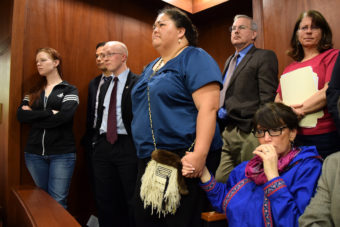
The audience of a House Community & Regional Affairs Committee erupted in applause after the committee advanced legislation that would make 20 Alaska Native languages official state languages. (Photo by Kyle Schmitz/Gavel Alaska)

The Barnes Committee Room at the Alaska Capitol erupted in cheers Tuesday morning, as a panel of lawmakers unanimously moved a bill that would make 20 Alaska Native languages official state languages.

Dozens of people testified in favor of the measure, House Bill 216.
University of Alaska Southeast Native Languages Professor Lance Twitchell greeted the House Community and Regional Affairs Committee in Tlingit.

While English is the only official language of Alaska, Twitchell said this is not an English-only state.

“For over 10,000 years there have been other languages here, and they are still here today,” Twitchell said.

He described a crisis point in the effort to save Native languages. The average Alaska Native tongue has fewer than 1,000 speakers, the vast majority of whom are over the age of 70. The last fluent speakers of Eyak and Holikachuk Athabascan died within past decade.

Twitchell said language loss is tied to a history of repression and discrimination against Alaska Natives.

“I see dying languages and escalating suicide rates, and think, how can those things not be connected? I see the end result of cultural genocide, and think, how can we just decide to accept this?” he said. “There is no magic solution for language loss. But there is the promise of unity and recognizing that solutions exist.”

He said House Bill 216 is one of those solutions.

“I sit here as your peer. I sit here as your equal. We may speak different languages, but mine is just as valuable, just as necessary, and just as useful as yours,” said Twitchell.

Bethel elder Esther Green taught Yup’ik in the Lower Kuskokwim School District before she retired. Green said learning a language is a form of cultural preservation.

“Language and culture go together and they cannot be separated,” she testified.

Alaska Native Languages map
Map: Native People’s and Languages of Alaska by Michael Krauss. Map courtesy of the Alaska Native Language Center. Click to enlarge.

Savoonga High School students Beverly Toolie and Chelsea Miklahook introduced themselves in Siberian Yup’ik. The language is no longer taught in their school, but the girls said they learned to speak it from their grandparents.

Nome Democrat Neal Foster asked if they would be interested in taking Native language classes.

“If the classes were to be reintroduced into the school, are those classes that you would want to take?” Foster asked.

“Yes,” the girls responded in unison.

Barrow Democrat Ben Nageak is the only member of the legislature who’s a fluent speaker of a Native language, Inupiaq. Fittingly, he made the motion to send HB 216 to the next committee.

Prime sponsor and Sitka Democrat Jonathan Kreiss-Tomkins said he was moved by the support for the bill.

“This is a bill that very much felt as though it’s of the people, belongs to the people who testified today, and belongs to people across Alaska who believe in the cultural importance of Native languages,” Kreiss-Tomkins said.

Nobody testified against the legislation. Its next stop is the House State Affairs Committee.

Watch Gavel Alaska‘s coverage of the hearing:

Mallott gives keynote speech at Elizabeth Peratrovich Day event

Juneau residents marked Elizabeth Peratrovich Day on Sunday, celebrating the Alaska Native civil rights hero with speeches, songs, and dance performances at Thunder Mountain High School.

Democratic candidate for governor, Byron Mallott, gave the keynote speech.

Like Peratrovich, Mallott is Tlingit. He’s expected to get his party’s nomination, and will try to unseat Republican incumbent Sean Parnell this fall. If he succeeds, Mallott would be the first Alaska Native governor in state history.

The 70-year-old said that when he was a young man he worked with Elizabeth Peratrovich’s husband, Roy, on Alaska Native land claims.

“And dare I say this, he possibly might have thought that someday in the future, a Tlingit man might stand as a candidate for the governor of Alaska,” Mallott said.

The Peratrovichs were leaders of the Alaska Native Sisterhood and Brotherhood in the early 1940s, a time when segregation and open prejudice against Native people were commonplace in Juneau. Elizabeth’s testimony to the Alaska Territorial Senate sparked passage of the territory’s Anti-Discrimination Act.

Elizabeth Peratrovich Day marks the anniversary of the act being signed into law on February 16th, 1945.

Sunday’s celebration was sponsored by ANS and ANB Camp 70, ANS Camp 2, and the Juneau School District.

Juneau Representative Cathy Munoz, a Republican, served as emcee.

Public Affairs Hour

Thursday at 7 p.m., the Tlingit & Haida Central Council presents a Native Issues Forum featuring Rep. Harriet Drummond talking about helping women and children, protecting seniors and food security. And Rep. Bob Herron discusses the Arctic Policy Commission and what it means for indigenous people.


Taku River Tlingit sue to stop Tulsequah Mine

Water treatment plant at Tulsequah. It operated for a few months to treat acid rock drainage, but Chieftain shut it down due to the high costs.  Photo courtesy Chieftain Metals.
Water treatment plant at Tulsequah. It operated for a few months to treat acid rock drainage, but Chieftain shut it down due to the high costs. Photo courtesy Chieftain Metals.

The Taku River Tlingit First Nation has filed suit in the Supreme Court of British Columbia to stop the Tulsequah Chief Mine.

For years, the old mine at the headwaters of Southeast Alaska’s most prolific salmon stream has been an issue for Native groups, commercial fishermen and others on both sides of the border.

Now the Tlingit First Nation says British Columbia authorities failed to consult with them, and believe that voids the mine’s environmental permit.


Precedent

In 2004, the Supreme Court of Canada ordered the British Columbia government  to consult with the Taku River Tlingit First Nation on decisions surrounding the Tulsequah Chief Mine.

The Taku River watershed in northwestern B.C. and Southeast Alaska is the Tlingit’s traditional territory.

 “The consultation is an ongoing obligation.”

Randy Christensen is a lawyer for Ecojustice Canada, the donor-funded  environmental law firm handling the case.

He says the obligation is clearly spelled out in the 2004 decision.

 “At the end of the day the Supreme Court of Canada declared that our client was owed a duty of consultation and accommodation on this project.”

At the time, Redfern Resources owned the mine. The company went bankrupt in 2009 and Chieftain Metals picked up the property and environmental permits.

Substantially started

In the current lawsuit, the Taku River Tlingit allege they were never consulted about a government decision that the Tulsequah was “substantially started.”

Under the B.C. environmental process, once a mine is approved, the owners have a limited amount of time to get mobilized. In this case, 10 years.

Substantially started does not mean mining. Though Chieftain Metals says it’s ready to mine the Tulsequah, in reality the company is still looking for financing.  But in June 2012, the B.C. Environmental Assessment Office declared the mine was substantially started.

Christensen says the First Nation wants the B.C. Supreme Court to declare that Chieftain Metal’s environmental permit has expired.

“Without an environment assessment certificate, they can’t proceed with any on-the-ground construction of this project, so what we’re seeking from the court would be an order that the environmental certificate has expired. That would halt activities on the ground,” Christensen says.

Such a declaration would void all Tulsequah permits.

“My primary feeling is one of relief,” says  Chantelle Hart, a member of Children of the Taku. The society is not party to the lawsuit, but members are all Tlingit born in the Taku River watershed.

I’m glad the lawsuit is now out because at least it’s another firm very clear stance that shows that Taku River people are not going to allow Chieftain into the territory.

Hart says Chieftain Metals has ignored her people.

The transboundary group Rivers Without Borders says the same goes for the B.C. Ministry of Environment. Chris Zimmer is Alaska spokesman for the international group.

The clear implication here is if this lawsuit is successful, the mine is dead in the water and will have to go back to environmental assessment, because it can’t proceed without that certificate.

Chieftain Metals did not return calls for this story.  In its year-end financial report  to the Ontario Securities Commission the company acknowledged the lawsuit, stating the “Corporation believes the petition is without merit.”

Chieftain Metals’ stock closed Monday at 28 cents a share  on the Toronto Stock Exchange.

Site notifications
Update notification options
Subscribe to notifications