Alaska Native Arts & Culture

Domestic violence prevention comes in many forms

Several Alaska Native communities participated in the second annual domestic violence Prevention Summit that wrapped up Thursday in Juneau.

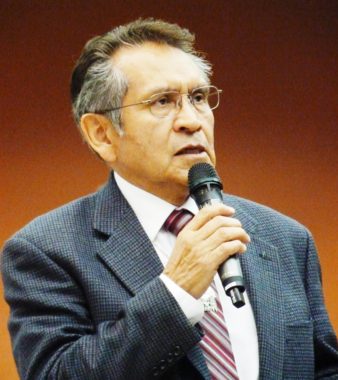
Reverend Ishmael Andrew works at the Tundra Women’s Coalition in Bethel and lives in Napaskiak. (Photo by Lisa Phu/KTOO)

The goal of the state-sponsored Prevention Summit was for communities to share strategies for how to prevent domestic violence and sexual assault.

In Bethel, Reverend Ishmael Andrew works as the Engaging Men and Boys Coordinator for Tundra Women’s Coalition, a non-profit that runs a women’s shelter and provides educational outreach.

For Andrew, prevention is about practicing a traditional way of life

“Prevention to us is shooting a moose and bringing it home and giving it to the whole community,” Andrew says. “That’s what prevention means to us – keeping ourselves busy instead of being idle at home.”

After three days of attending workshops, networking, and hearing about prevention strategies used throughout the state, Andrew is even more confident about the work he’s doing.

“The Prevention Summit has really opened my eyes and made me believe that I can speak up for the people in our region now,” he says. “We have resources in our communities that we really need to be going to, which are the elders and those who have been authentically living the way of life.”

When he’s not at work, Andrew is at home in the nearby village of Napaskiak where he tries to spread the same values.


Ernestine Hayes releases a new book about Juneau

This Friday at Hearthside Books, Juneau writer and UAS assistant professor of English, Ernestine Hayes, will release her book “Juneau” from Arcadia Publishing. A departure from her customary work in prose, “Juneau” is primarily a pictorial history of what is now Alaska’s capital.

Photo by Liz Dodd
Photo by Liz Dodd

“I had no idea what I was getting into,” Hayes says laughing at a talk about the new book at the downtown library. Conforming to the publisher’s strict, formulaic guidelines, word counts, and finding the right high-resolution photographs was challenging.

“With my other books I just sat down and wrote and then I revised, and revised, and revised, and I thought that was a lot of work. But I didn’t know anything,” she says.

She says the second reason she chose to do the project was more proactive.

“Just as we have to be together going into the future, we have been together from the past—at least from contact forward, we’ve been together. The history of Alaska is too often presented as a whole bunch of  prehistory and then the Russians came. Right? And then is started to be history. I’ve seen too much of that and I didn’t want that to happen again. That’s why I accepted the project.”

While the book illustrates Alaska Native life in what is now Juneau and colonial attitudes that were present, Hayes says she does not focus on this. In fact, many of the pictures, and much of the written history are from Russian and US history forward.

“But I did put in one of the chapters and made it clear in other captions and comments and discussions that, you know, I acknowledge the history of the original people that have been here since time immemorial and do it as though it is an unremarkable fact. Which it is. It’s just something we should all know.”

Speaking of knowledge, Hayes says the most rewarding part of the project was learning.

“Even though I’d played in the mine when I was a girl, and run up and down the stairs at the A.J. and explored tunnels and trestles all over of Mt. Juneau and Mt. Roberts, I didn’t really know about the history and the people who were part of that all those mining efforts. Learning about that history was rewarding for me. I learned a lot about Juneau.”

Hayes writes about being a little girl in Juneau in another book of hers, the 2006 American Book Award winning memoir Blonde Indian—perhaps her best known work. When asked if that’s the work she’s most proud of, she mentions an essay titled “Winter in Lingit Aani Brings Magpies and Ravens.”

Here’s an excerpt from the piece:

“My grandmother instructed me about spiders, don’t hurt them she warned, learn from them. Watch them. Learn. Spiders greet the world early, they wake and get busy early in the day and early in spring. While the more familiar admonition for those that would lead a correct life is to wake before the ravens, rising before the spiders behooves us even more. The industry of spiders exemplifies right living.”

She says to pay attention to the metaphors in that essay.

“I think that’s the indigenous understanding. It’s not so much being able to see the connections, or being able to appreciate or experience the natural world, but it’s being able to recognize all those metaphors.”

It’s not uncommon for Hayes to speak of metaphors and similes—she teaches a full load of composition and creative writing courses at the university. Student Richard Radford has taken several courses from Hayes.

“I’ve really enjoyed all the classes and everything I’ve done with her. She’s really, really talented. She’s a really gifted writer, and a really gifted reader, and a very gifted editor. I would say she’s the most talented I’ve ever worked with,” says Radford.

With the holiday break coming up, Hayes is excited about some free time to work on a fictional extension of the character Old Tom in Blonde Indian, and a contemplative memoir called the Dao of Raven that retells one of the raven stories from a different perspective. And for those of you who are excited for more prose from Hayes, look in the new book Juneau. Even in the captions and short narratives one can hear Hayes’s literary voice.

As part of Gallery Walk, Hayes will be signing copies of Juneau” this Friday at Hearthside Books from 5 p.m. to 7 p.m..

Sealaska Heritage Institute plans art auction fundraiser for Soboleff Center

Soboleff Center December 2013 construction update
The steel framework for Sealaska Heritage Institute’s Walter Soboleff Center went up in Juneau this week. Photo by Casey Kelly/KTOO.

Construction workers this week began erecting the steel frame for Sealaska Heritage Institute’s Walter Soboleff Center in downtown Juneau.

The 29,000 square foot facility is scheduled for completion in January 2015.

SHI has raised about $17.5 million of the $20 million project cost. The nonprofit is planning a major fundraiser early next year to get closer to the overall goal.

Project manager and Sealaska Heritage Institute Chief Operating Officer Lee Kadinger says construction is moving quickly.

“Not too many $20 million facilities are built in a year and half, two year time frame. But we’re doing what we can to try and make that happen,” says Kadinger. “The foundation has been poured, it’s done. Now the steel is going up. By mid-January you are going to see the overall structure, the framework in all of its glory, showing the size of the facility.”

The facility is being named for the late Dr. Walter Soboleff, a Tlingit spiritual leader and educator who passed away in 2011. It will house Sealaska Heritage offices, as well as education, arts and language programs. It also will allow the

Lee Kadinger
Lee Kadinger. Photo by Casey Kelly/KTOO.

institute to bring all of its artifacts under one roof, where now many objects are stored at off-site locations.

“Our archives and our ethnographic collections, we really have some of the world’s most amazing treasures, hidden and tucked away,” Kadinger says.

He says SHI has received contributions for the project from more than 680 individuals, businesses, government agencies, and other nonprofits, including the State of Alaska, the City and Borough of Juneau, and the Rasmussen Foundation.

With less than $2.5 million still to raise, the heritage institute is planning an art auction fundraiser in February. Media and Publications Specialist Christy Eriksen says they’re calling it the Tináa Art Auction. The Tináa is an hourglass shaped symbol used in Southeast Native art that signifies wealth and trade.

“It’s a symbol that we wanted to use in our auction, because what often happened is when you would give it to somebody, it would be worth more than the actual value of the piece,” Eriksen says. “So we wanted to kind of think about that sense of reciprocity we have with the community and the community has with us, and the idea of creating something, having something with more valuable than the actual physical thing.”

Eriksen says several highly regarded Southeast Native artists are donating pieces to the auction, including Preston Singletary, David Boxley, and Delores Churchill. The auction will be held February 1st at Juneau’s Centennial Hall.

Eriksen and Kadinger spoke Thursday to the Juneau Chamber of Commerce.

Native leader appears in court on theft charge

Robert Loescher is checked over by security as he arrives at the Dimond Court Building on Thursday for arraignment on a theft charge. Photo by Matt Miller/KTOO News

A former Sealaska corporation executive accused of taking money from a subsistence fund is scheduled to appear in court again in January.

A ‘not guilty’ plea was entered on behalf of Robert ‘Bob’ Loescher, 66, in Juneau District Court on Thursday.

Loescher, who appeared in court in a wheelchair, agreed to a temporary waiver of a preliminary hearing and temporary waiver of a speedy trial until his January 7th court date.

He’s been charged with theft in the second degree for allegedly taking $21,515 in funds that were managed by the Alaska Native Brotherhood and Alaska Native Sisterhood Grand Camp. The funds were part of the Alaska Subsistence Defense Fund and Alaska Traditional Foods Security Council which were set up to protect Southeast Native subsistence rights. Loescher was head of the groups when the money allegedly was taken. Charging documents allege that Grand Camp officials had asked Loescher to repay the funds, but he eventually refused and then stopped communicating with them altogether.

Loescher was released on his own recognizance with no bail set.

Loescher worked for Native corporation Sealaska for over 22 years, rising to the position of chief executive officer before he left in 2001.

Participants voice hopes and realities at domestic violence Prevention Summit

Alaska Native Brotherhood grand president Bill Martin speaks during opening remarks of the Prevention Summit sponsored by the Council on Domestic Violence and Sexual Assault. (Photo by Lisa Phu/KTOO)

The Second Annual Prevention Summit kicked off Tuesday in Juneau. Sponsored by the state Council on Domestic Violence and Sexual Assault, the three-day summit at Centennial Hall brings together teams from 19 communities with the goal of exchanging ideas about prevention.

At the start of the summit, participants told KTOO about what is working in their community and what they hope to gain over the next couple of days.

Tasha Bird (Photo by Lisa Phu/KTOO)

Tasha Bird is a rural outreach coordinator for the women’s shelter in Emmonak, a Yupik village of about 800 people. “My job is to educate youth and young women to stop domestic violence from happening to them and their children, their neighbors,” she says.

Bird also reaches out to 13 surrounding villages. She says the nine-bed shelter has been busy all year. The six extra cots have also gotten a lot of use. Bird says domestic violence and sexual assault in Emmonak is often caused by drinking or jealousy.

“We try to ask them to go get marriage counseling or to go talk to the elders, and they could also come to the shelter and talk to us,” Bird says, “but it’s the men who don’t want to participate or they don’t want to come forward and deal with everything.”

Being able to reach the men in her community is part of what Bird hopes to get out of the Prevention Summit. She’s heard about the statewide program Alaska Men Choose Respect and wants to learn more.

Winifred Kelly-Green (Photo by Lisa Phu/KTOO)

“Lots of the guys at home like to play basketball and maybe I’ll work with the city league and see if they could help me with something because I know lots of the young boys, they look up to those guys,” says Bird.

Bethel resident Winifred Kelly-Green is the healthy families coordinator for the Association of Village Council Presidents. She says she has started working on healing historical trauma, “The attempt to assimilate Yupik people – with that there was a lot of traumatizing things that happened, including the great death, but there were other things – boarding schools, taking children away.”

Historical trauma, Kelly-Green says, is linked to domestic violence and sexual assault in Bethel, “We have parents now who don’t know how to be parents because they weren’t home. They weren’t being parented because of the boarding schools.”

Through forced assimilation, Kelly-Green says Yupik men lost their capacity to pass knowledge to younger generations.

“In the Yupik culture, our men had a place that they called the qasgiq. It’s the men’s house where they gathered and worked together, taught the young boys. And that was their way of maintaining whole health,” Kelly-Green explains. “And with the Christianity that came, they saw that as something bad, so they went up and down the river in every village and burned the qasgiqs down, and leaving our men lost.”

Greg Marxmiller (Photo by Lisa Phu/KTOO)

In Dillingham, Greg Marxmiller works at SAFE, a domestic violence prevention agency, and runs the youth program called Myspace. “The youth program there is huge,” he says. “Getting kids a place to go that’s consistent, that they’re able to have somebody that cares about them and have advocacy and being trained to become leaders and lead in their town and making it a better place.”

In Marxmiller’s opinion, everybody in Dillingham comes from a place where there’s domestic violence and sexual assault.

“It’s something that everybody in the community has to deal with because we’re a community and we all have to deal with our ills, so in essence, everybody from Dillingham comes from an issue of domestic violence and sexual assault,” Marxmiller explains. “So knowing that, there are a lot of people who are working to do something about it and try to stop this domestic violence and sexual assault epidemic.”

Marxmiller’s goals for the Prevention Summit is to network, take new ideas back to Dillingham, and get resources to continue the prevention efforts that are already taking place.

Learning Tlingit culture through action figures

While many were still shopping Friday, a workshop for kids to make Tlingit-themed action figures was overbooked at the Alaska State Museum.

The free program was part of a series of workshops that the Friends of the Alaska State Museum pays for through a youth activity grant from the City and Borough of Juneau.

There were 50 slots for kindergarten- and elementary school-aged children at the event Friday afternoon.

Surrounded by Tlingit and Haida artifacts in the clan house exhibit of the state museum, Native storyteller Ishmael Hope kicked things off. He told a Tlingit story about how Raven brought freshwater to the land.

Hope said it was an apt setting.

“To have something that relates a little bit to it being inside this beautiful clan house, it’s the at.óow, it’s the sacred objects of the Gaanaxteidí clan, the frog house, Xíxch’i hít. And so I wanted to have some sense of being in that clan house,” he said.

As a storyteller and a listener, Hope said knowing and communicating the words and beats of a story is only part of challenge.

“You need to be in the physical presence of the elder to really, really get it,” he said.

After the story, the kids were off to a series of crafting stations around the museum where they made miniature Tlingit items and regalia.

Trevor Daniels was running a hair dryer over a paper basket about the size of a big toe. He was drying the stain he brushed on earlier that gave it a more natural color.

“There’s glue and coffee mixed in. I got some on my fingers and it’s pretty sticky,” Daniels said.

All of the items were roughly scaled to fit to a man-shaped action figure they made out of fuzzy chenille stems (or pipe cleaners).

Each child left with a 1-gallon Ziploc bag with their own personal action figure and accessories.

Cahal Burnham, 9, ran through the contents of his bag.

“I have a sailor style hat, umm, and a drum with a Native American pattern on it. Raven tail robe, a beaded robe. And I have a dance paddle and that’s about it,” he said.

He said his favorite part was making the action figure itself.

Museum visitor services manager Lisa Golisek coordinated the workshop. She says they’ve been going on for at least 15 years, and the action figures are always very popular. This time around, she had to turn away about 25 kids.

The next workshop is December 27. Pre-registration is required.

Site notifications
Update notification options
Subscribe to notifications