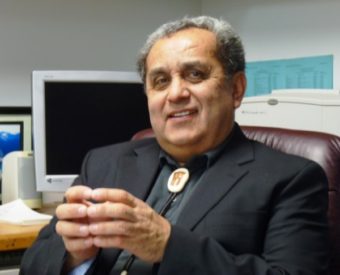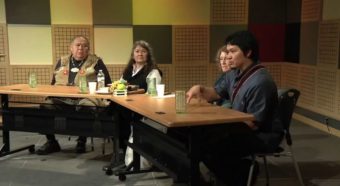
University of Alaska Anchorage Anthropology Professor Steve Langdon discusses Tlingit Spirituality during a Native American Heritage Month program.
Traditional Tlingit culture is filled with spiritual presence and powers that exist within and beyond direct experience.
That’s according to University of Alaska Anchorage Anthropology Professor Steve Langdon.
He spoke Tuesday about Tlingit spiritual connections and obligations. It was the first of five Native spirituality programs sponsored by the Juneau-based Sealaska Heritage Institute as part of Native American Heritage Month.
Here, he uses a traditional salmon story to illustrate different dimensions of the beliefs.
That was an excerpt from a lecture on Tlingit spiritual connections and obligations given by University of Alaska Anchorage Anthropology Professor Steve Langdon.
He spoke Tuesday (this week) in the first of five programs on Native spirituality sponsored by the Sealaska Heritage Institute during Native American Heritage Month.
Clan leaders wear traditional regalia during the 2012 Clan Conference in Sitka. (Peter Metcalfe photo)
Scholars and culture-bearers gather in Juneau this week for a clan conference focusing on Tlingit knowledge and traditions. It runs Wednesday night through Sunday morning at the capital city’s Centennial Hall.
The event is called “Sharing Our Knowledge.” It includes dozens of workshops and presentations.
Juneau’s Peter Metcalfe is one of the organizers.
“There’s both academic presentations as well as non-academics who might be Tlingit speakers or might be artists. Otherwards, people who aren’t necessarily credentialed academically but have deep knowledge of the topic or subject and can speak knowledgably about it,” Metcalfe says.
Sessions include linguistics, archaeology, art and music, Alaska Native history, museum studies, indigenous law and traditional ecological knowledge.
Sitka’s Gerry Hope, the conference’s executive director, says the language is disappearing.
“And it was a concern of one of the organizing committee members that a number of elders are passing away. And we need to be able to talk to them while they’re here,” Hope says.
The theme is also evident in sessions on building a Tlingit library, regional language programs and a Tlingit spelling bee.
Hope points to sessions on gathering Tlingit phrases to use with children and bringing Tlingit into the home.
“I have a strong belief that language in the home is something that is often overlooked,” he says.
Metcalfe says it’s for more than just tribal members.
“The best part about it from my point of view is you can walk into or out of a workshop and you’ll feel welcome and understand what’s going on, with the exception perhaps of some of the Tlingit language workshops that are happening,” he says.
The Tlingit clan conferences began about 20 years ago under the leadership of the late Andy Hope III. After a 10-year pause, they resumed in 2007.
Walter Harper and Frances Wells, who died in the Princess Sophia disaster, Oct. 25, 1918, were among only a few people buried in Juneau. Most other passengers and crew were buried elsewhere. Photo by Matt Miller/KTOO News
A new plate was placed over the old gravestone for Walter Harper and Frances Wells so that the original inscription is now readable. Photo by Matt Miller/KTOO News
Gravesite at Evergreen Cemetary in Juneau for Walter Harper and Frances Wells who died in the Princess Sophia disaster, Oct. 25, 1918. Photo by Matt Miller/KTOO News
Juneau residents and descendants of those aboard the ill-fated Princess Sophia remembered the sinking on Friday with a small memorial service and a new plate for the top of a gravestone at Evergreen Cemetary.
Walter Harper and his wife Frances Wells both died when the steamship Princess Sophia grounded on Vanderbilt Reef late on Oct. 23 and then sank on Oct. 25, 1918.
All aboard the ship — at least 343 and as many 356 passengers and crew — perished in the disaster that is still considered as the greatest maritime tragedy in Alaska waters.
Walter Harper and Frances Wells were headed south so that he could train to become a medical missionary or military doctor, according to Bill Morrison and Ken Coates in The Wreck of the Princess Sophia: Taking the North Down with Her.
Walter was the son of an Irish immigrant, the noted prospector Arthur Harper who partnered with Jack McQuesten and Alfred Mayo in the Yukon. Walter was educated by Episcopalian missionaries and Frances was a nurse from Philadelphia serving at the Fort Yukon mission. Harper served as the archdeacon’s private secretary and accompanied him on a pioneering expedition to the top of Denali (Mt. McKinley). Harper is believed to be the first person to set foot on the true summit in 1913.
The new plate for the top of the gravestone once again makes legible the stone’s engraving that has worn away over the last century. It reads:
Here lie the bodies of Walter Harper
and
Frances Wells, his wife
drowned on the Princess Sophia 25th Oct. 1918
May light perpetual shine upon them
They were lovely and pleasant in their lives
and in their death they were not divided.
II Samuel 1:23
Retired Juneau Toni Mallott has been named the Alaska Federation of Natives 2013 Citizen of the Year. The annual AFN convention is being broadcast live from Fairbanks on KTOO’s cable channel 360 North. The convention ends Saturday.
Juneau’s Toni Mallott is the AFN Citizen of the Year.
Mallott was selected for the award because of her work in education as a public school elementary teacher and her work with students who speak English as a second language. She taught for more than 30 years in Anchorage, Juneau and Yakutat.
Mallott received the award Friday morning during the annual Alaska Federation of Natives convention being held in Fairbanks.
AFN president Julie Kitka said Mallott was given the award for the impact she has had on so many young children’s lives.
“Toni Mallott is such a remarkable person that you can see her character through the lives of the children she has loved and taught,” Kitka said. “Toni embodies our traditional Native values and all that we admire in a teacher, an educator and a citizen of our community.”
Mallott said she was shocked to receive the award. She said she accepted it on behalf of all teachers, who spend every day trying to make a difference in the lives of their students. Mallott also called for a strong partnership between teachers and parents.
“The parents are the primary teachers of their children, and it’s really crucial that we have a teacher and parent relationship that’s cemented,” she said.
She accepted the award flanked by a number of family members, including a sister and brother, two of Mallott’s five children, several grandchildren, and her husband, gubernatorial hopeful and former Juneau Mayor Byron Mallott.
Toni Mallott grew up in Rampart and has a master’s degree in education from the University of Alaska Fairbanks.
Thousands of Alaska Natives will miss out on benefits they qualify for under the Affordable Care Act if the definition of Alaska Native under the law isn’t changed.
American Indians and Alaska Natives are exempt from the law’s individual mandate to buy health insurance or face a tax penalty.
They also qualify for additional help paying for out of pocket expenses in some cases and can purchase or drop coverage on a month to month basis.
Valerie Davidson, with the Alaska Native Tribal Health Consortium, estimates the law’s definition excludes about 14,000 Alaska Natives because it says they have to be enrolled in a tribe or belong to a Native corporation.
“In some tribes, you’re not eligible for tribal enrollment unless you’re 18,” Davidson said. “So that’s a problem for children.”
“Other tribes have residency requirements, so you may not be eligible to enroll unless you live in that community.”
Mark Begich.
Davidson is working with Senator Mark Begich’s office to make the definition much broader in the law, to include all Alaska Natives. Begich has introduced a bill that makes the change and he’s looking for larger legislation to attach it to. He says he’s confident there’s enough support in Congress to pass it.
“It’s not reopening the whole debate over Affordable Health Care Act and I think a lot of people recognize that,” Begich said. “And as you know there are over 4 million American Indians, Alaska Natives throughout the country so I think there’s a lot of interest to just resolve this and kind of move on.”
Begich says the Obama Administration knows the definition is a problem and they’re highly motivated to get it fixed.
Alaska Natives have until December 2014 to apply for an exemption from the law’s individual mandate. It will be a paper application.
Yukon College president Karen Barnes and UAS chancellor John Pugh sign an agreement renewing the partnership between the two institutions. UAS provost Richard Caulfield oversees the signing. (Photo by Lisa Phu/KTOO)
University of Alaska Southeast and Yukon College signed an agreement this weekend that renews a more than 25-year relationship. The two institutions will continue to work together in various academic fields, including resource development and Native languages.
The agreement says both schools are committed to finding future academic cooperation for the benefit of the region’s people. Chancellor of the University of Alaska Southeast John Pugh and Yukon College president Karen Barnes signed a memorandum of understanding during the Al-Can Summit at UAS hosted by the Juneau World Affairs Council.
“We’ve been working together for 25 years plus and we have lots of relationships in the program areas, but it’s a bit of a push for us,” explains Barnes. “We wanted to resign it to say we’re really serious about this relationship and we can see lots of future possibilities that we want to explore so I think it was a bit of an incentive for us to keep moving and keep growing.”
Barnes hopes to collaborate more with UAS on scientific research, “particularly climate change research and cold climate technologies and I think that there’s been some discussion with our faculty across the line and I think that’s an area that we could see some activity. We’re building a new graduate certificate in climate change and I think that might be a place we could really share,” she says.
Pugh says UAS’s strong expertise on climate change allows it to offer an inter-disciplinary course on it, “Our faculty are looking at that from many different areas, not just the science of it but also the economics of it, the political science of it, and I think that’s something we can really do together in the future.”
Both schools are already teaming up in the area of natural resource development.
“Mining has taken off in both the Yukon and in Southeast Alaska, and we’re both using high tech equipment in terms of training folks and we’ve been able to share the expertise back and forth between Alaska and Yukon, and I think that’s been a really good learning experience and sharing experience,” chancellor Pugh says.
Tosh Southwick spoke at the Al-Can Summit on “Yukon First Nations: Histories, Cultures, and Contemporary Issues.” (Photo by Lisa Phu/KTOO)
Another established partnership is language instruction. UAS Native language faculty members have visited Yukon College to share teaching materials and strategies.
“I think the partnership between Alaska and the Yukon is a natural one that’s existed before that border was ever there. My people are evidence of that. The stronger that we make that, the more beneficial it’ll be in every area, including language,” says Tosh Southwick, a citizen of the Kluane First Nation in Canada and director of First Nation initiatives at Yukon College.
Southwick says the condition of first languages in the Yukon is at a crisis point, similar to what it is in other indigenous countries. She’s impressed with the language offerings at UAS.
“When I walked past the sign in the hallway that said Tlingit 101 or whatever it is, we’re not doing that,” says Southwick. “That’s great. The fact that anybody in Alaska can come here and take a class in Tlingit is amazing to me.”
Besides Tlingit, UAS also offers classes in Haida and Tsimshian. Southwick thinks the relationship between UAS and her institution will increase the opportunity for the indigenous languages to stay alive
“What we do at an academic institution is share knowledge. Language is a form of knowledge, so that empowerment is crucial. So all of the Yukon First Nation languages will benefit from the stronger partnership here,” explains Southwick. “The Tlingit that’s spoken here – the more fluent speakers we have of Tlingit anywhere – makes it better for my family and for my son.”
Representatives from UAS and Yukon College met in Whitehorse in August. A new component of the agreement commits the two schools to hold an annual meeting to discuss ways of how to keep building the relationship.
Close
Update notification options
Subscribe to notifications
Subscribe
Get notifications about news related to the topics you care about. You can unsubscribe anytime.