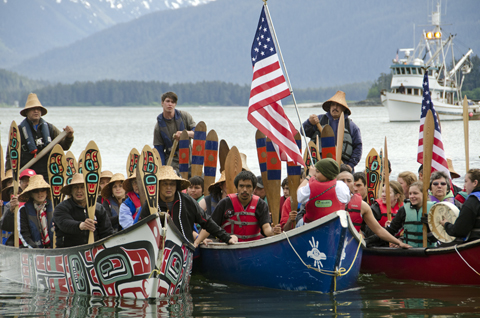
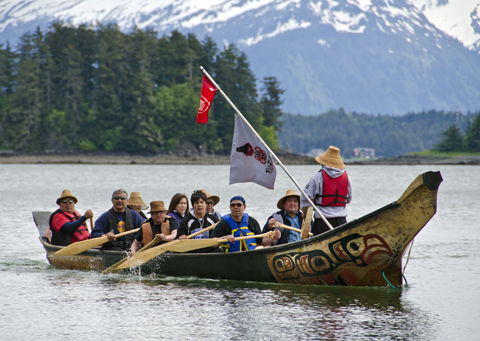
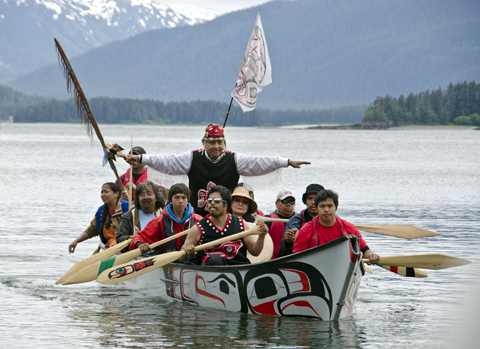
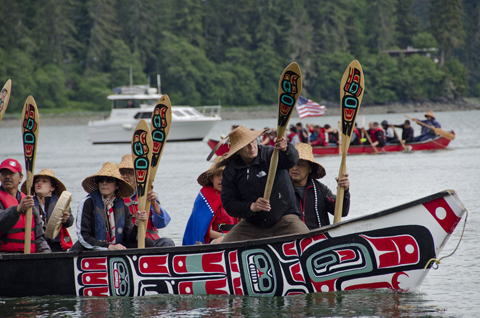
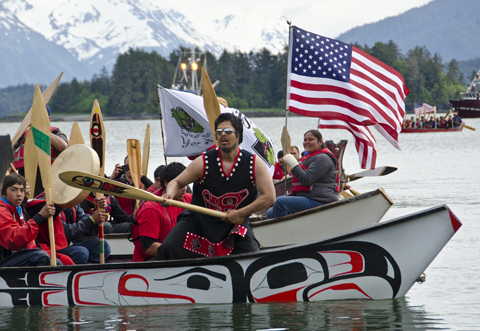
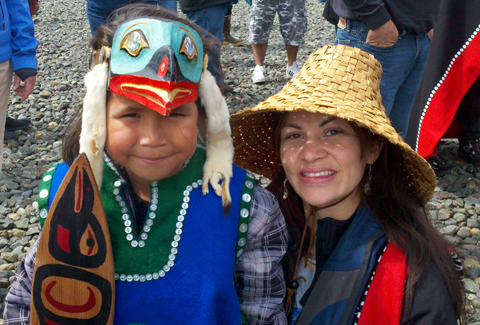
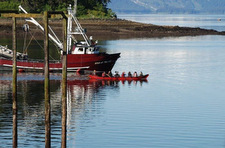
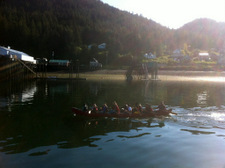
Three canoes gather off shore. (Photo by Heather Bryant/KTOO)Several hundred people welcomed seven canoe teams Wednesday who paddled to Juneau for Celebration 2012.
The biennial cultural event begins today (Thursday). It brings together Southeast Alaska Natives from all over the state, the Lower 48 and Canada to share their art, dance and stories. This year the SouthEast Alaska Regional Health Consortium (SEARHC) joined with the One People Canoe Society and other canoe teams to paddle to Celebration. The teams also used the stops along the way to raise awareness about suicide prevention.
The first teams left Kake on Saturday for Angoon, where another canoe team joined them. On Monday, a team from Hoonah joined in Funter Bay. They camped along the way, spending Tuesday night at Portland Island for the short paddle yesterday to Juneau’s Auke Recreation Area.
About 90 people made the trip and came from Angoon, Hoonah, Hydaburg, Juneau, Kake, Sitka, and Wrangell. They ranged in age from 10 to 70, and all seemed to relish the traditional mode of travel.
Rosemarie Alexander was at Auke Rec when the canoes paddled to shore, and spoke to observers & paddlers about the significance of the journey.
Three canoes gather off shore. (Photo by Heather Bryant/KTOO)
The first canoe arrives. (Photo by Heather Bryant/KTOO)
Nels Lawson of Sitka awaits the arrival of the canoes. (Photo by Heather Bryant/KTOO)
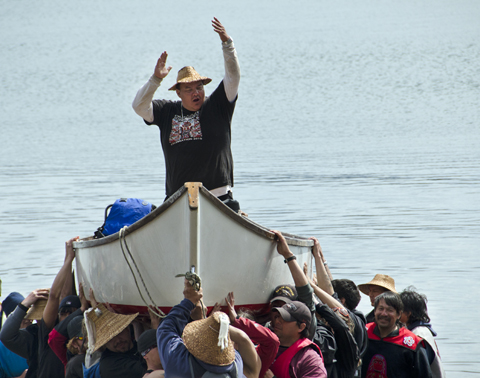
Each group carried their canoe ashore. Terrance Peele was captain of the Hydaburg canoe.(Photo by Heather Bryant/KTOO)
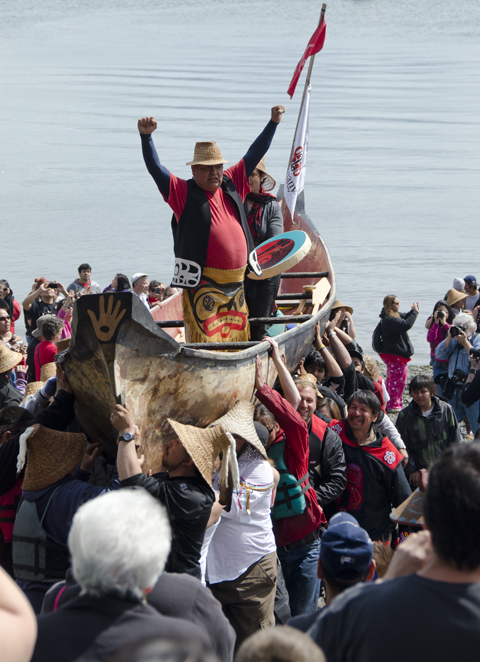
The group leader cheers as people carry the canoe ashore. (Photo by Heather Bryant/KTOO)
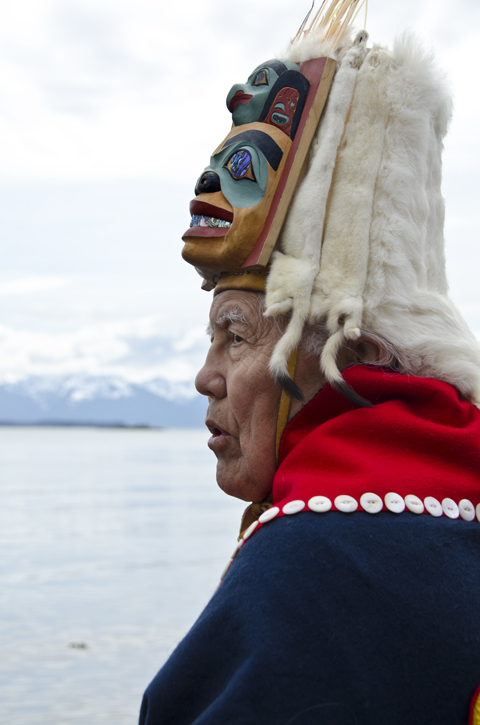
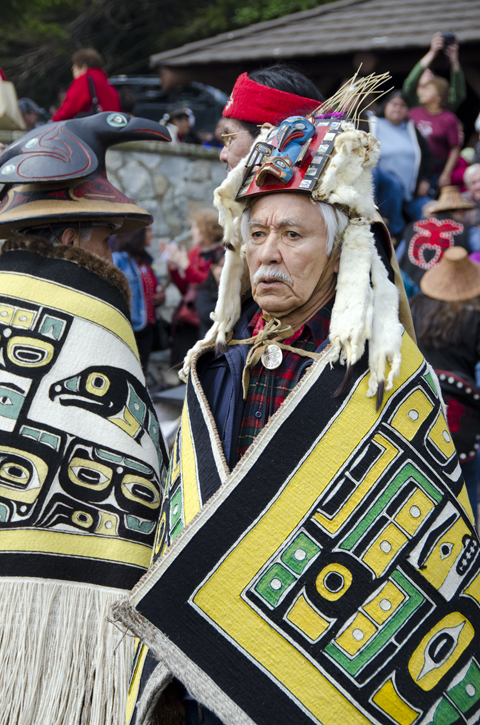
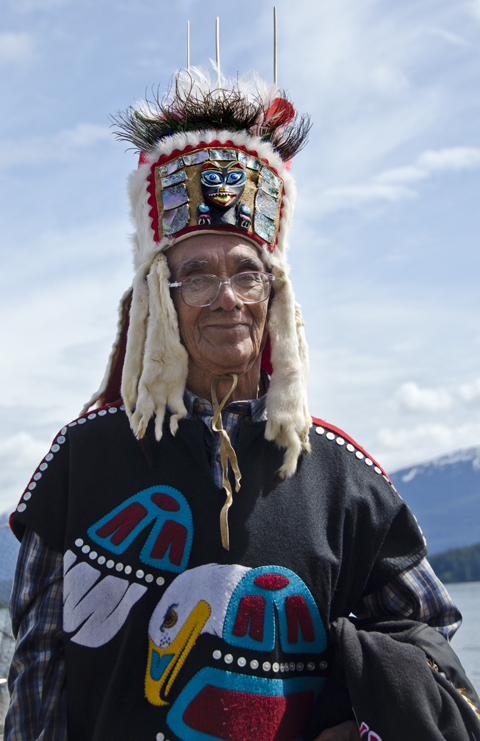
An elder oberves as people gather on the shore. (Photo by Heather Bryant/KTOO)
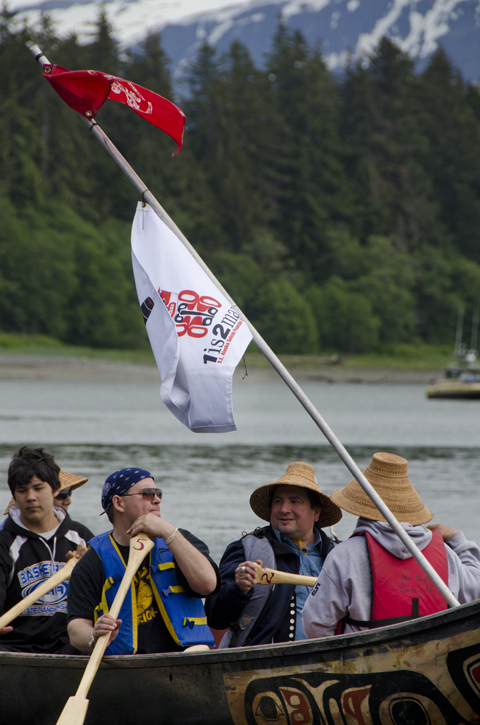
The paddlers cheer as they pass by the shore. (Photo by Heather Bryant/KTOO)
The lead canoe displays the flag for the 1 is 2 many program. The canoe trip was part of a suicide awareness campaign. (Photo by Heather Bryant/KTOO)
Paddlers cheer as they reach the shore to the crowd's applause. (Photo by Heather Bryant/KTOO)
Drums played as the canoes get closer. (Photo by Heather Bryant/KTOO)
Tavin Chilton and Ronda Butler, Juneau, were on the Angoon canoe for part of the trip.
Charlie Daniels, Sitka, watches the events. (Photo by Heather Bryant/KTOO)
About 90 Southeast Alaskans are making their way to Celebration 2012 by traditional canoe.
The paddlers range in age from 10 to 70 and come from Wrangell, Hydaburg, Juneau, Sitka, Kake, Angoon and Hoonah.
The Paddle to Celebration journey is expected to arrive at Juneau’s Auke Recreation area about noon on Wednesday.
Boats left from Kake on Saturday, Angoon on Sunday, and Hoonah on Monday.
Norval Nelson, on the F/V Star of the Sea, is operating one of three safety boats accompanying the canoes. He’s backing up a group from Hoonah.
“They traveled through Icy Straits and they crossed Chatham Straits into Funter Bay and reported up there and greeted the rest of the group that showed up from Angoon. They left there Sunday morning, traveled along and stayed the night in a cove called Square Cove and then Monday joined us. We were greeted by a large pod of killer whales,” Nelson says.
He says the weather and seas have mostly cooperated.
Nelson calls it a healthy, spiritual journey, which includes people of Tlingit, Haida, Aleut, Filipino and Norwegian descent.
Celebration is Southeast Alaska’s largest cultural gathering, held in Juneau every two years. It starts Thursday and runs through Saturday.
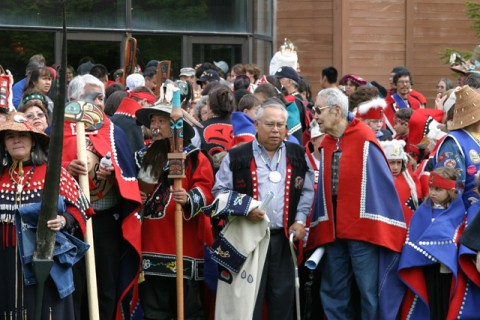
Dancers and leaders line up outside Juneau's Centenial Hall during Celebration 2006. Photo courtesy Ben Paul/Sealaska Heritage Institute.
Every Celebration, a different dance group leads the grand entrance parade into Juneau’s Centennial Hall. Dozens more follow in a procession that fills the street for several blocks and sets the stage for the every-other-year event, which began three decades ago.
Celebration 2012’s grand entrance will be led by the Xudzidaa Kwáan Dancers of Angoon. More than 50 other groups from Alaska, Canada and the Lower-48 will take the stage during the Thursday-through-Saturday event, which is Southeast Alaska’s largest Native cultural gathering.
It’s organized by the Sealaska Heritage Institute, the cultural arm of Southeast’s regional Native corporation.
“Celebration is a time when we come together as Tlingit, Haida and Tsimshian people to celebrate the survival of our cultures,” said institute president Rosita Worl, in a press release.
But it’s not all about song and dance.
There’s a Native Artists Market, showcasing Tlingit, Haida and Tsimshian traditions. The market will be held this year in a new, outdoor venue, with more space for a wider variety of art and contemporary goods.
“We want to be able to accommodate as many Native artists as we can because developing Juneau as a Native art center is one of our long-term goals,” Worl said.
Related events include a pre-celebration artists’ gathering and juried show, plus films, lectures and demonstrations. (See the schedule.)
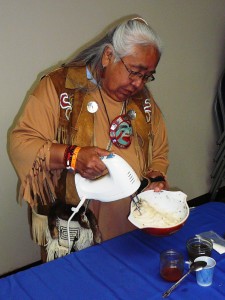
Helen Abbot Watkins whips up soapberries during Celebration 2010's contest. Photo by Ed Schoenfeld.
Then there are the traditional food events, such as the soapberry contest. Cooks from Alaska and the Yukon use hand- and electric-mixers to whip up the frothy treat.
There’s also a dried black seaweed contest, as well as an oyster festival focusing attention on Native-owned shellfish farms.
Other events include a toddler regalia revue, plus workshops on formline design and song-writing.
But for many, it’s all about the singing and dancing, which will bring about 2,000 people to the stage.
Celebration 2012’s theme is “Strengthen Yourself.” It’s spelled Ayanaltseenáa in Tlingit, Án hl is daguyáa in Haida and Lip sha gotgyednshm in Tsimshian.
Up to 7,000 thousand people are expected to attend. For those who can’t, the festivities will be broadcast on 360 North, the cable and internet channel that also broadcasts Gavel Alaska legislative TV coverage.
Schedules and other details are available through the sponsor’s website. There is an entrance fee.
Hear earlier reports and watch slideshows from other Celebrations:
Gov. Sean Parnell has signed legislation creating an Alaska Native Language and Advisory Council.
It will be charged with evaluating the state’s indigenous languages and making recommendations for preservation, restoration and revitalization.
Parnell signed the legislation on Monday, May 28, at a statewide conference in Dillingham on Native sobriety.
Senate bill 130 was sponsored by rural Senator Donny Olson, but quickly drew co-sponsors from urban and other urban legislators from both the Senate and House.
Parnell said the state now joins with Alaskans to make sure Native languages are preserved.
“We know that without language preservation, a culture dies. That is intolerable. That is not acceptable. And as Alaskans we honor and celebrate our traditional cultures. And we do this by ensuring that the state is now all in making sure that these languages live on,” Parnell said.
The legislation was supported by Alaska Native organizations, including Alaska Federation of Natives and Southeast’s regional corporation, Sealaska.
Tlingit elder Isabella Brady passed away early Wednesday, April 11th at the Alaska Native Medical Center in Anchorage, after suffering a fall in her Sitka home on Monday.
At the time of her death Brady was the president of the Alaska Native Sisterhood Camp No. 4, and a national advocate for Native issues.
Brady was born in Sitka in 1924, into the Raven Kik.sadi clan. She graduated from Sheldon Jackson School in 1942, began attending Jamestown College in North Dakota, but then interrupted her education to join the Navy at age 19.
The cultural prejudices and discrimination she experienced in her youth would continue to inform her advocacy as an adult. In her lobbying efforts before the Sitka School Board and other legislative bodies, Brady often recounted stories of her own struggle to arrive at school every day, sometimes running a gauntlet of anti-Native sentiment in white neighborhoods.
Her grandfather, Peter Simpson, encouraged her to pursue her education. After the war, she completed college on the GI Bill, earning a BA in Social Studies, and returned to Sitka where she married William Brady in 1950. The couple had five children.
When William Brady was hospitalized for tuberculosis in the late 1950s, Isabella supported her family by taking a job teaching at Mt. Edgecumbe High School in Sitka. She taught US History, World History, Alaskan History, Civics, PE, Health, and coached basketball and volleyball.
Following her career at Mt. Edgecumbe, Brady would go on in 1974 to write the grant establishing the Sitka Native Education Program, which integrates cultural studies into the standard district curriculum, and has been a model for many similar projects nationwide.
Brady would later serve a long tenure on the board of trustees of Sheldon Jackson College. She eventually became a Presbyterian elder, and a board member for the Native American Consulting Committee of the Presbyterian Church. She also served as a board member for the American Association of Retired Persons, and the state’s Native Education Board.
Isabella Brady was 88 years old. She is survived by 17 grandchildren and 8 great-grandchildren. Many of her family were present when she died.
Memorial services are pending in Sitka. But, her long-time friend Jean Arnold says, “No building is big enough.”
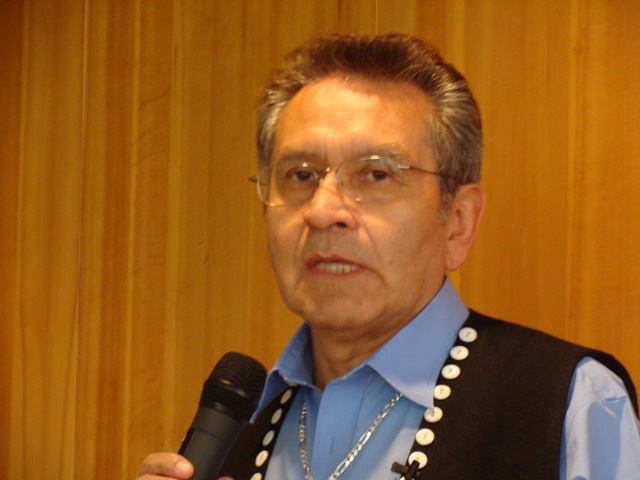
Ed Thomas. Click to enlarge. (Photo by Casey Kelly/KTOO)
Rural Alaska’s economic and social problems require greater cooperation between Native Corporations and federally recognized tribes, says Tlingit and Haida Central Council President Ed Thomas.
“We have very weak rural economies, we have high cost of energy that leads to high cost of living, higher cost of survival in our communities,” he says.
Thomas says past conflicts between Native tribes and corporations have largely risen from the belief by some that the Alaska Native Claims Settlement Act was a termination policy. That is, an act designed to make Native people assimilate into American society.
“Some of those folks that were anti-ANCSA felt that, well if we get rid of ANCSA then the land probably would go to the tribes,” says Thomas. “That really is very far-fetched, if not impossible.”
For one thing, Thomas says there’s no political will to take land from ANCSA corporations and give them to tribes. For another, corporate land is very different from tribal land, which is usually locked up in some sort of trust.
Subsistence is another issue that has divided tribes and corporations. ANCSA basically extinguished Alaska Native hunting and fishing rights, which Congress tried to address with the Alaska National Interest Lands Conservation Act. But Thomas says there are still those who think doing away with ANCSA is the way to restore full subsistence rights.
“While I generally agree that we can probably get rid of that one provision and it would improve things. I don’t agree that you have to throw everything out in order to accomplish that issue with subsistence,” he says.
Rather than debate the merits of the 30- and 40-year-old laws, Thomas says tribes and corporations should work together to accomplish what’s best for Native communities. It won’t always be easy, he says, but it’s essential for those communities to survive.
“We are a broad state, we have a lot of differences geographically and culturally, and lifestyle. So, it’s in our best interest to try to find areas of commonality and agree upon it. And where we disagree, agree to disagree and move on,” he says.
Thomas spoke yesterday (Thursday) at Sealaska Heritage Institute’s annual Native American Heritage Month lecture series.
The Tlingit and Haida Central Council is the sovereign tribal government for more than 27-thousand Southeast Alaska Natives worldwide.
Close
Update notification options
Subscribe to notifications
Subscribe
Get notifications about news related to the topics you care about. You can unsubscribe anytime.