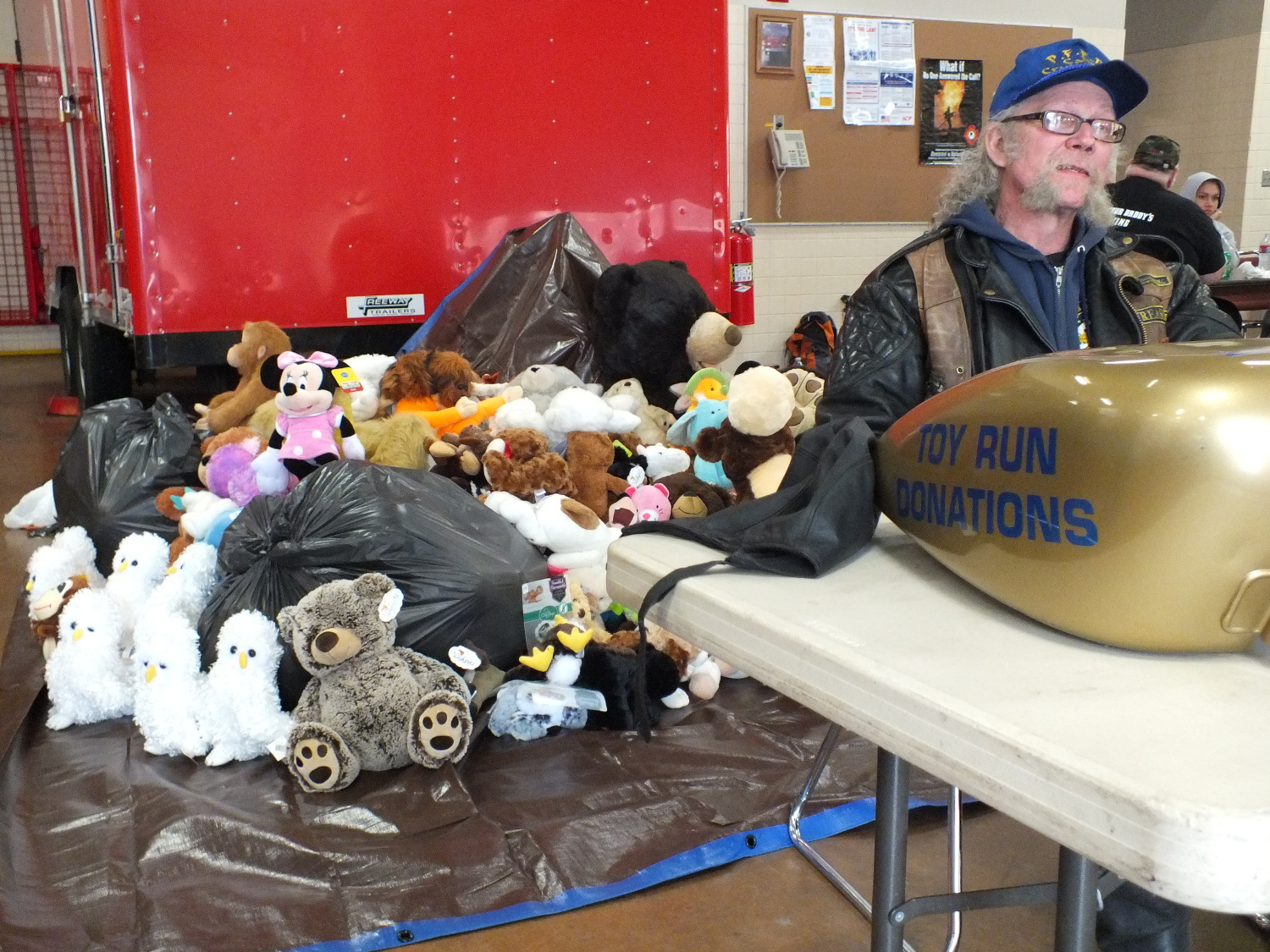
Panhandlers MC Treasurer Mark “Brillo” Chitty accepts donations at Sunday’s Toy Run. (Photo by Matt Miller/KTOO)
Members of the Panhandlers Motorcycle Club and Capital City Fire/Rescue held their annual Toy Run Sunday. About 40 Juneau riders started at McGivney’s in the valley and rode through the wind and rain. They first stopped at the Triangle in downtown and then went on to the Douglas Fire Station. Riders collected bags of toys and stuffed animals from the Triangle and Louie’s in Douglas.
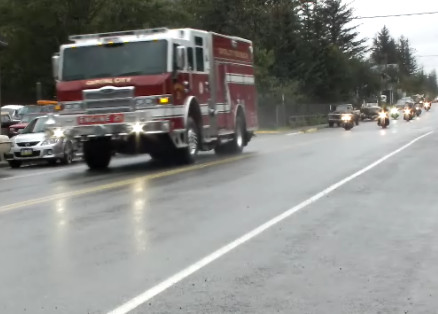
Douglas Engine 21 leads the Toy Run on Sunday. (Photo by Matt Miller/KTOO)
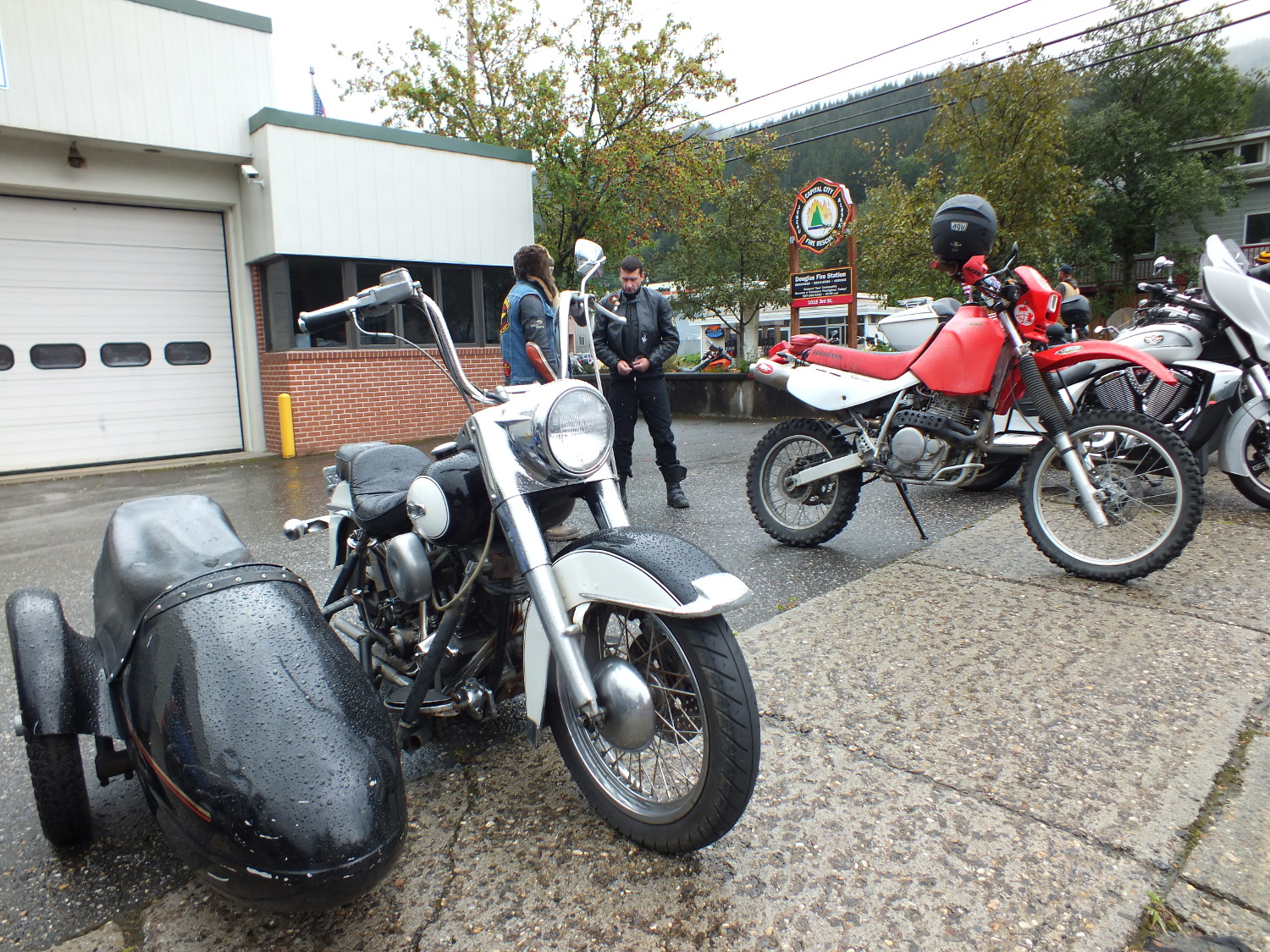
You don’t have to ride a Harley or be a member of the Panhandlers MC to participate in the Toy Run. (Photo by Matt Miller/KTOO)
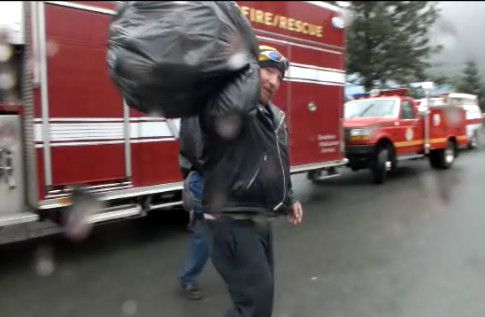
Sometimes Santa comes in August, rides a Harley, and wears biking leathers. (Photo by Matt Miller/KTOO)
Panhandlers MC Treasurer “Brillo” Chitty says children who stay at Bartlett Regional Hospital will be able to pick a toy as a comfort item. Police cruisers and fire engines will also get a stuffed item to hand out to children involved in emergencies.
(Photo by Matt Miller/KTOO)
(Photo by Matt Miller/KTOO)
The Toy Run wrapped up on Sunday with a barbecue at the Douglas fire station. The toys will be delivered to Bartlett Regional Hospital on Wednesday.
New Orleans Mayor Mitch Landrieu speaks about New Orleans’ emergence as a model of urban renewal and economic recovery 10 years after Hurricane Katrina during a visit Tuesday to the National Press Club in Washington, D.C. Mandel Ngan/AFP/Getty Images
After the levees broke 10 years ago in New Orleans, tens of thousands of residents fled the city and never returned. They resettled in 32 states around the nation, many of them landing in Houston.
New Home Family Worship Center also relocated to that city and became the spiritual family for a dislocated and homesick congregation. Most of the people who came to a special worship service Thursday night were born in New Orleans. With “Katrina 10” projected on the screen behind the altar, Pastor Robert C. Blakes introduced his special guest.
“So tonight our mayor, the mayor of our beloved New Orleans, Louisiana,” he said to applause. “Yeah. I don’t care where you put your head down at night, you’re 504 at heart, aren’t you?”
This week, Mitch Landrieu made stops in Washington, D.C., Atlanta and Houston to proclaim that New Orleans is not only surviving, but thriving, as well as to thank America — and the two southern cities in particular — for helping his city after it was nearly obliterated. But, also to call his people home, to tell them their hometown is a better place today than it was when they left.
“I know y’all are over here, and y’all are in Houston, I appreciate it. I do,” he said. Y’all know y’all can come home whenever y’all want.”
Around the country, Landrieu has evangelized for post-Katrina New Orleans, recounting the long, hard road from 2005 to 2015.
“And we have started to rebuild your city in a way that you should be proud of and that you would love,” he said.
New Orleans has rebuilt many of its neighborhoods. It’s encircled by a new nearly $15 billion flood protection system. There’s a new network of primary health clinics. Academic performance in public schools has improved. And Forbes Magazine listed New Orleans as America’s No. 1 “brain magnet.”
Problems remain, to be sure. Parts of the city are still blighted — such as New Orleans East and the Lower Ninth Ward. And real estate prices have soared, meaning some families cannot afford to come back. But, as the mayor says again and again, there’s no place like New Orleans.
“We don’t talk the way anybody else talks, we don’t dance the way anybody else [dances],” he said. “They don’t eat the way we eat, they don’t hug the way we hug, they don’t love the way. It’s just different. And it’s wonderful. Because you know what? I love Houston. Houston’s one of the great cities in the world. I love Atlanta.
“But you know what? New Orleans does not want to be Houston or Atlanta. What we want to be is the best version of our real selves, because we are unique.”
And that’s what the people who came to church Thursday night said they missed most about their native city, which is six hours away.
Chantel Hodges Jones is originally from New Orleans East and has a good job at MD Anderson hospital in the Texas Medical Center. When she’s in her kitchen, she said she tries to enlighten Houstonians.
“Well I’m a cook and I’ve introduced a lot of things to Houston, like I’ve introduced good gumbo to Houston. I’ve introduced good red beans and rice to Houston,” she said. “When I go home I’m lookin’ for a po’boy. I’m lookin’ for shrimps that come out of the Gulf or out of Lake Pontchartrain.”
Their reasons for staying in Houston have to do with practicality, not lifestyle.
Houston has more jobs, higher salaries, better housing, less crime and Houston had better public schools when they arrived.
But when Latrice and Terry Lowery go home to New Orleans — which is frequently — they bring back a big bag full of things they can’t find in Houston, such as pralines, pecan popcorn, Elmer’s Chee Wees snack food, and thin-crust French bread.
“There’s no place like home, especially New Orleans,” Latrice said. “I tell people at my job all the time, they say, ‘You’ve been here for 10 years, this is your home.’ I tell ’em, ‘No, New Orleans will always be my home, no matter what.”
The Lowerys miss home terribly, but they cannot answer Mayor Landrieu’s plea to come back — at least not now. Their kids are enrolled in Houston schools. They both have solid jobs. They bought a home here.
But when they retire, their fervent dream — the thing they think about all the time — is to move back to the city of their birth.
Copyright 2015 NPR. To see more, visit http://www.npr.org/.
Read Original Article – Published AUGUST 21, 2015 4:15 PM ET
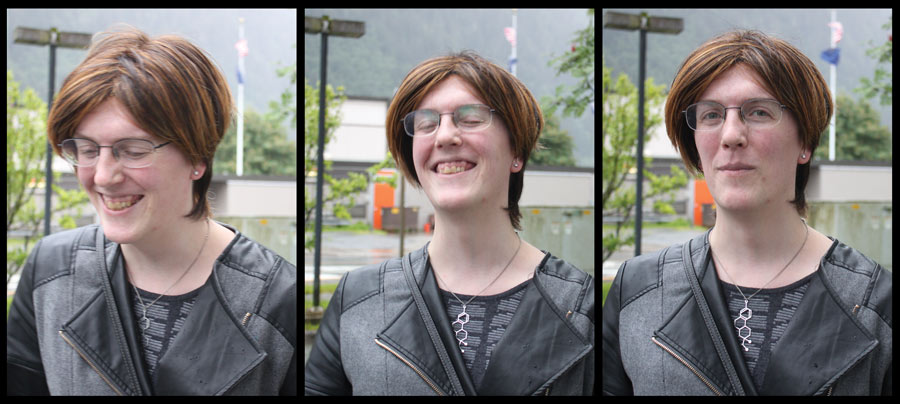
In the past, Jennifer Fletcher refused to believe transitioning would make her happy. “I’m very pleased to note that I was absurdly wrong,” she says. (Photo composite by Lisa Phu and David Purdy/KTOO)
It’s been a year since Juneau resident Jennifer Fletcher started to publicly present herself as a woman, less than two years since she first started to shed her male identity and rebuild herself as female. But the inner journey to get to that point began long before then.
Jennifer Fletcher used to spend up to five hours a day escaping reality. She’d play games on the computer, visit websites for the transgender community, “Pretty much anything I could do to not focus on the present, not focus on how things actually were so I could actually at least attempt to function throughout the rest of the day,” she says.
She’d go through binge and purge cycles of cross dressing. She regularly thought about suicide. Fletcher was severely depressed.
“I was continuously hiding who I was and trying to quite literally leave no mark on the world,” she says.
Fletcher is 33 and moved to Juneau as a teenager.
On any given Friday night now, you can almost always find her at social night run by SEAGLA, the Southeast Alaska lesbian, gay, bisexual and transgender organization in Juneau.
But it took her a long time to realize she was transgender, even though signs throughout her life pointed to it.
“Let’s just say that I had consistently wished from the time I was about 12 on every star, on every birthday that I’d wake up as the female version of myself,” Fletcher says.
As an adolescent, she’d wear her mother’s clothes when she was home by herself, taking items from the laundry so no one would notice.
Fletcher was 14 when she first tried to castrate herself. She tried again when she was 15.
“I was actively envying all the girls who were going through their own puberties, their own processes and just not very happy with what was going on. While I have occasionally, temporarily, appreciated having things like facial hair or greater strength or things of that sort, they just aren’t me,” Fletcher says.
But in her teens, she refused to consider she was transgender. Fletcher went to high school in Juneau, but was born in Laramie, Wyoming, where gay college student Matthew Shepherd was murdered in 1998. She learned being different wasn’t safe.
She saw transgender individuals on talk shows where they were mocked and laughed at.
“At that point in time, society was teaching individuals like myself that no, it’s not OK to be. That if you wanted to actually have any chance of happiness that you had better suppress what’s going on and you had better hope that you aren’t really,” Fletcher says.
She says finally deciding to transition almost two years ago didn’t stem from courage, but from an utter sense of fear.
“I was faced with what I thought were basically two alternatives – death or transition. Whether it would’ve been death by suicide or by the slow gradual path of alcoholism or whatever other coping mechanisms I attempted to use that would’ve inevitably failed,” Fletcher says.
She chose transition. Fletcher dropped what she calls the male mask and started rebuilding herself. She came out to close family and friends and started dressing as a woman at social functions. Fletcher eventually started the medical process and taking hormones. At each step, she was so afraid of rejection.
“Almost all of the hurdles I’ve experienced in my transition have been self-imposed. They’ve all been fears that may have had a legitimate base, but had invariably been blown completely out of proportion into these vast monsters that seemed like I’d be incapable of standing against,” Fletcher says.
When I ask Fletcher what her prior first name was, she doesn’t tell me, “Not particularly relevant, I don’t think.”
She says there tends to be an overemphasis on who people once were or appeared to be.
“I had been looking at some old photos of myself and actually opted to post some of them on Facebook just to kind of show how very different a person I am now. One of my friends actually said outright that they felt they were looking at a dead person, which I think actually sums up how I was feeling in those photos as well,” Fletcher says.
She does a lot of things she used to do before she transitioned, like rock climb, play board games, read. But she says her priorities have shifted.
“Before I actually started this process, I was merely existing in the world and, to be honest, waiting to die. Now I am actually alive and the difference is quite amazing,” Fletcher says.
And she wants to make a difference. Fletcher helps run a transgender support group in Juneau called the Trans* Alaska Pipeline. She wants to make finding medical and professional resources easier. She wants to help others avoid some of the internal conflict she had and help them face their fears, one monster at a time.
Harley Davidson motorcycles are lined up before a recent event at the Panhandlers MC clubhouse. (Photo by Matt Miller/KTOO)
The Panhandlers Motorcycle Club has their annual Toy Run this weekend. It’s a benefit to round up toys for children at Bartlett Regional Hospital.
“People around the community have helped us so much. With open arms, they welcome the Toy Run, says Craig Fowler, president of the Panhandlers. “If you have a kid that goes into the hospital or in an ambulance and has any kind of fear, they say “What do you like? You like Barney? You like dinosaurs?” We always stockpile them every year.”
The toy run starts Sunday at 1 p.m. with the motorcycle line-up at McGivney’s and will proceed to the Douglas Fire Hall. There, ribs and pulled pork sandwiches will be served up from 2 to 4 p.m.
You can participate by donating a new stuffed toy worth at least $10 or make an equivalent cash donation.
Stuffed toys can also be dropped off at Louie’s in Douglas or the Triangle in downtown Juneau.
The certificates for the 2015 Mayor’s Awards for the Arts feature Timi Johnson’s “Reflections on Sailing.” It won the 2015 Best in Show award at a juried art show through the Juneau Arts and Humanities Council.
When the awards started in 2007, Bruce Botelho was mayor. Botelho said it was Nancy DeCherney’s idea. She was the newly-appointed executive director of the Juneau Arts and Humanities Council.
“And I think largely to emulate what has been a long standing practice in the state by the State Arts Council with the Governor’s Awards for the Arts,” he said.
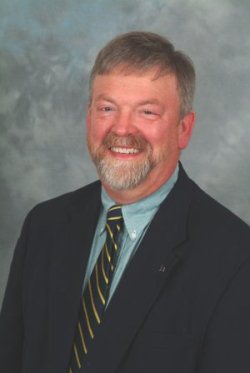
Bruce Botelho was mayor when he helped conceive the Mayor’s Awards for the Arts in 2007. (Photo courtesy CBJ)
DeCherney remembers it differently.
“The arts council was in the basement up on Franklin Street and Mayor Botelho came in and just wanted to chat and suggested that one of the things that might be really nice would be if we did a Mayor’s Awards for the Arts to sort of highlight all the wonderful things that go on in the community. So we did,” said DeCherney.
I told her Botelho’s version, and she laughed out loud.
“OK, memory fades. You know how it is,” she said.
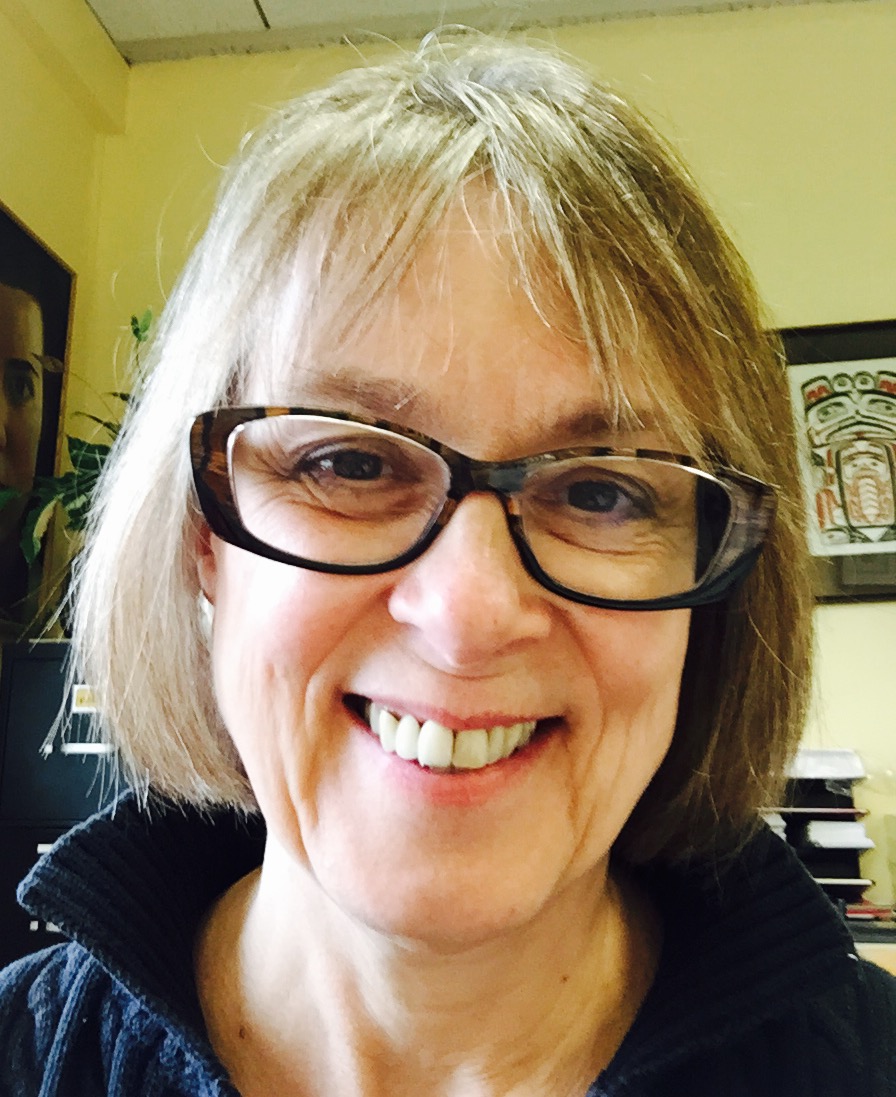
Nancy DeCherney began as the Juneau Arts and Humanities Council’s Executive Director in 2006 and helped start the Mayor’s Awards for the Arts. (Photo courtesy of Nancy DeCherney)
The Arts Council chooses the awardees based on nominations from the community. Since 2007, it’s given 48 awards. Photographer Ron Gile will receive this year’s innovation award. He says he might have been chosen because of a Facebook page he helped develop to alert fellow photographers when Romeo the wolf was out and about. Or maybe it’s because of the themed competitions the Juneau Photography Group hosts.
“One of the things about photography is that people get into a niche; they’ll get into a rut is a better way of looking at it,” said Gile. “They’ll shoot one thing and one thing only. Like they’ll go shoot airplanes or they’ll just shoot landscapes. We started a challenge, a bi-weekly challenge, there’s no awards given other than you get to be the next judge for the following challenge.”
The latest challenge is called “Tales from the Jungle.” It urges participants to “capture stories and players in the forests of Southeast.”
“But is was to try and get people to go out of their comfort box, and to try and find new ways of looking at things around us. To break that mold, and to expand and grow as a photographer,” said Gile.
The other six other awards are going to:
• Dancer and teacher Pat Belec,
• arts educator Heather Ridgway
• Juneau Lyric Opera
• Annie Kaill’s for business leadership
• ConocoPhillips Alaska for being a patron of the arts, and
• Juneau Jazz and Classics Executive Director Linda Rosenthal for lifetime achievement.
The free event is casual, begins at the JACC at 5:30. Assemblywoman Debbie White will present the awards in lieu of Mayor Merrill Sanford.
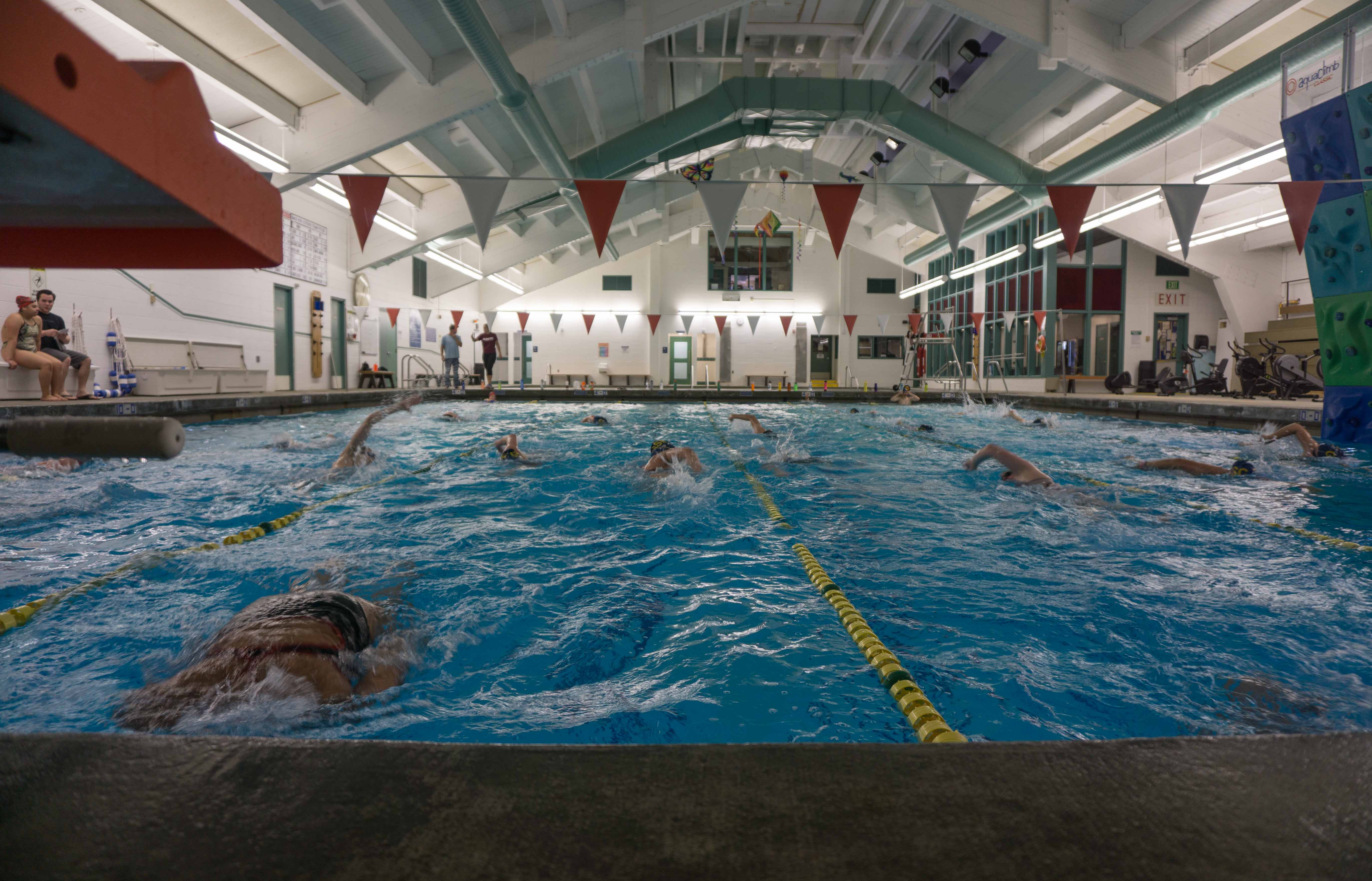
The JDHS swim team practices at Augustus Brown Swimming Pool, Aug. 19, 2015. (Photo by Jeremy Hsieh/KTOO)
Classes in Juneau are just starting on Thursday, but some high school activities have been underway for weeks. This school year, the district has drastically cut funding for activities and athletics, leaving some parents paying hundreds of dollars more for their kid to participate.
Michelle Norman has two kids at Thunder Mountain High School. Her daughter is on the swim and dive team. At the first parent meeting for the activity, she was asked to pay “an activity fee of $600 and approximately $150 travel fee for each meet out of Juneau.”
Last year, Norman paid $275.
She says this higher fee struck her as ridiculous. So Norman did her own research on travel costs to meets in Ketchikan and Sitka, and says the $600 activity fee only makes sense if her daughter qualifies for state competition.
“My daughter has a good chance of qualifying for state and I expect if that happened that I’d contribute more, but I’m not comfortable with paying $600 now for a $200 expense,” Norman says.
According to Juneau School Board policy, individual activity fees for participation and travel must be approved by the activities director and the superintendent. For students who are in financial need, the district has a scholarship fund.
Superintendent Mark Miller says he hasn’t approved any activity fees.
“To my knowledge we do not have actual individual fees,” he says.
Miller doesn’t call the costs put on students or parents “fees.”
“Different sports are going about fundraising in different ways and some are asking for contributions from participants in order to limit or defray the amount of fundraising that they do,” Miller says.
Thunder Mountain High School Activities Director Jake Jacoby says every fall sport does have an activity fee.
“This is an individual fee that varies from activity to activity and it’s very low for activities that have low budget needs and it’s pretty darn high for the more expensive programs,” Jacoby says.
He says $600 for the swim and dive team isn’t the highest. The coaches come up with the fees, and Jacoby approves them, but he hasn’t taken them to the superintendent.
Jacoby says the fees go toward gear and travel, but the cost shouldn’t be coming out of pocket.
“There are fundraising opportunities that need to be provided by the teams in order for students to raise the money,” Jacoby says.
In an email from the swim and dive booster board at Thunder Mountain High School, parents were instructed to “bring your checkbook” to an Aug. 4 meeting. The main fundraising event is selling Christmas trees and parents were asked to think of other ideas.
Due to district budget cuts to activities, Jacoby says everyone – coaches, booster clubs, parents, activities directors – is working through a new process this year.
“I have had conversations with various coaches within the last week about fundraising and funding and we’ll continue to do so as all teams figure out what this means as far as funding all of their own travel,” Jacoby says.
Last school year the district budgeted about $1.5 million for the high school activities program, including staff. About $600,000 of that went toward travel.
For this school year, the district budgeted less than a million dollars for high school activities. Close to $600,000 of that came from the Juneau Assembly, and the majority of it goes toward administrative costs.
Superintendent Miller says in the past, the district covered the majority of travel costs for high school activities.
“Unfortunately we’ve been dipping into the bank in order to cover those costs and our bank account ran dry last year and so this is really the first year that we’ve had to say we can’t go over what we’ve allocated under any circumstance and we can’t allocate what we used to,” Miller says.
The district has set aside $150,000 of the Juneau Assembly money for potential travel to state competitions, travel that teams don’t necessarily budget for because it’s last minute. It’s hard to say if that’s enough money because it depends on how well teams do. There will likely still be fundraising post-postseason.
Close
Update notification options
Subscribe to notifications
Subscribe
Get notifications about news related to the topics you care about. You can unsubscribe anytime.

9(MDEwMjQ0ODM1MDEzNDk4MTEzNjU3NTRhYg004))