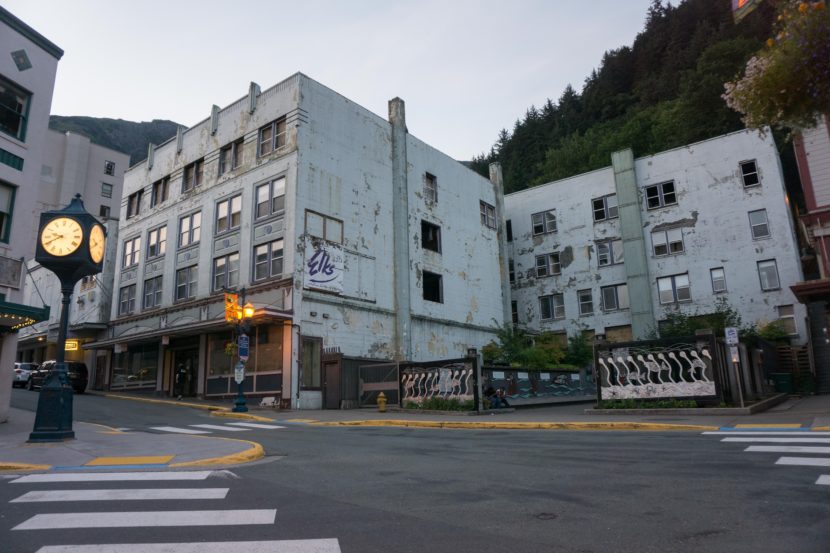
The derelict Gastineau Apartments, July 21, 2015. (Photo by Jeremy Hsieh/KTOO)
Demolishing a downtown Juneau eyesore may also be an opportunity to demolish another problematic property, Gunakadeít Park.
“The park itself, I think, it’s no secret, is not a particularly successful park,” said city Engineering Director Rorie Watt, addressing the Juneau Assembly on Monday.
That was an understatement. Litter, fistfights, intoxicated loiterers, open container violations and sundry calls for emergency services are common at the pocket park in the shadow of the Gastineau Apartments.
Watt was circumspect when describing the park’s “long-term disposition.”
“The more we’ve looked at it, we wonder how much of the park to preserve. So, quite frankly, if a contractor has to dance around the park and preserve it, the demolition will go slower and be more expensive,” he said. “And I think there’s a persuasive argument that appears to be lining up that demolition of the park effectively might be the best path forward.”
Gunakadeít Park opened at the corner of South Franklin and Front streets in 1984. It’s been a sore spot for downtown businesses for decades. In 1998, the Juneau Assembly officially banned alcohol from it after police had been issuing drinking citations in or near the park for years.
None of the members of the assembly spoke up in defense of the park.
“I will say that Parks and Rec staff is not particularly attached to preserving the park as it exists today,” Watt said. “It may be property that can end up some time in the future on the tax rolls as a better utilized parcel.”
The city hopes to recoup some of the demolition costs, budgeted at $1.8 million, from the property owners. Watt said the city’s aiming for demolition to be complete by Dec. 31.
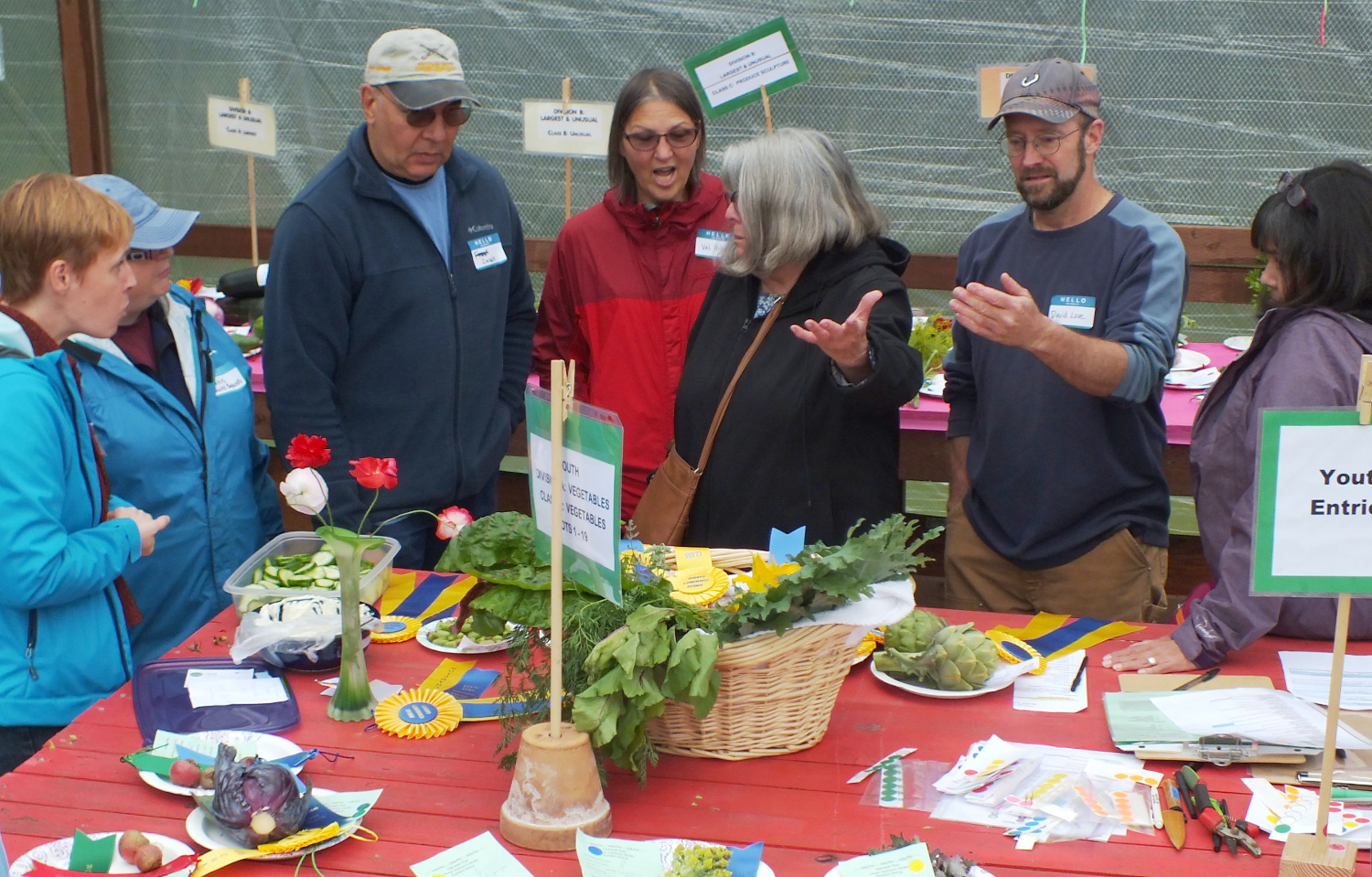
Judges debate criteria and potential awards for one entry. (Photo by Matt Miller/KTOO)
Award-winning flowers, vegetables and garden plots were on display during the annual Harvest Fair and Farmers Market held recently at the Community Garden on Montana Creek Road.
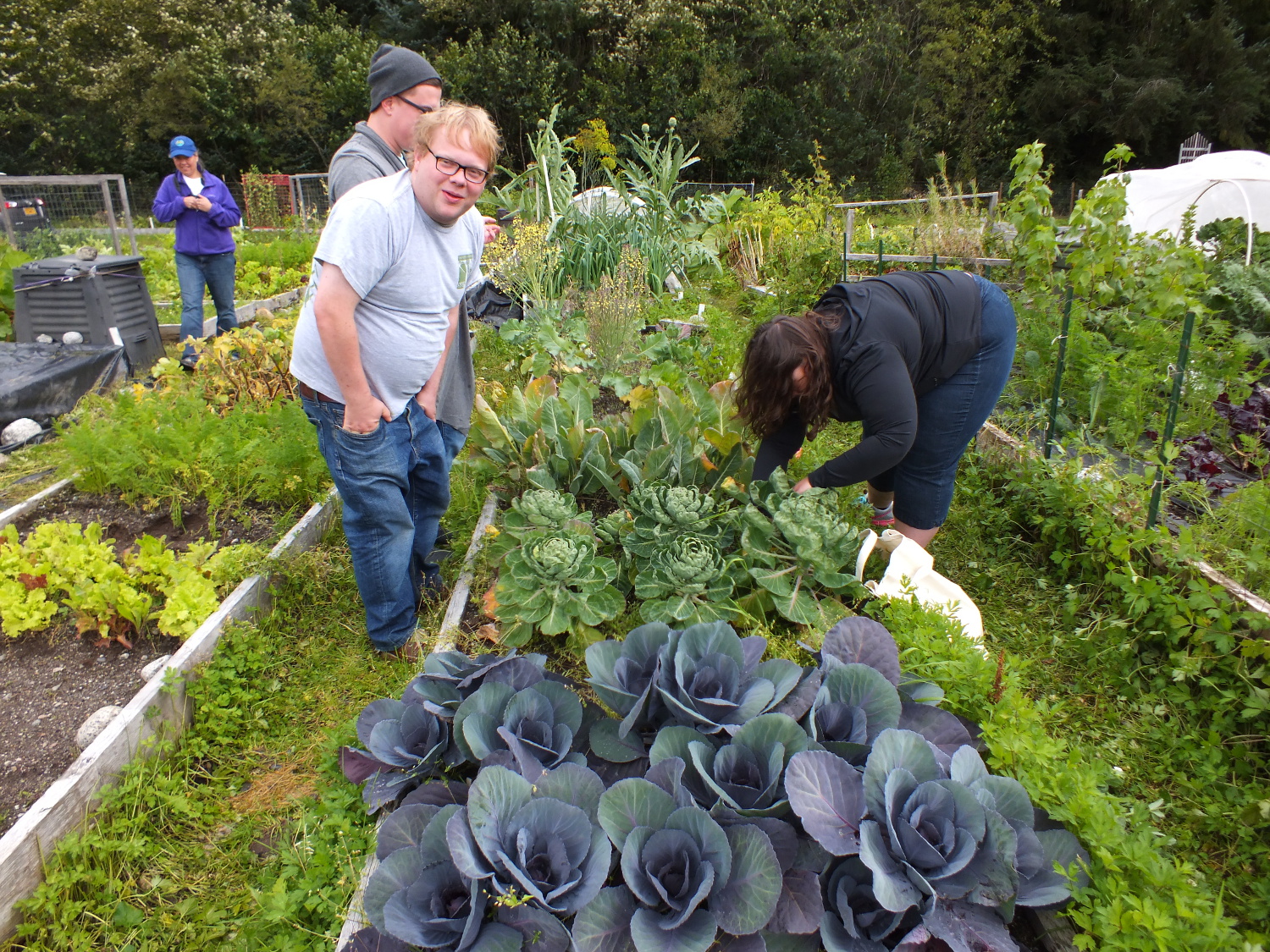
Picking Brussels sprouts. (Photo by Matt Miller/KTOO)
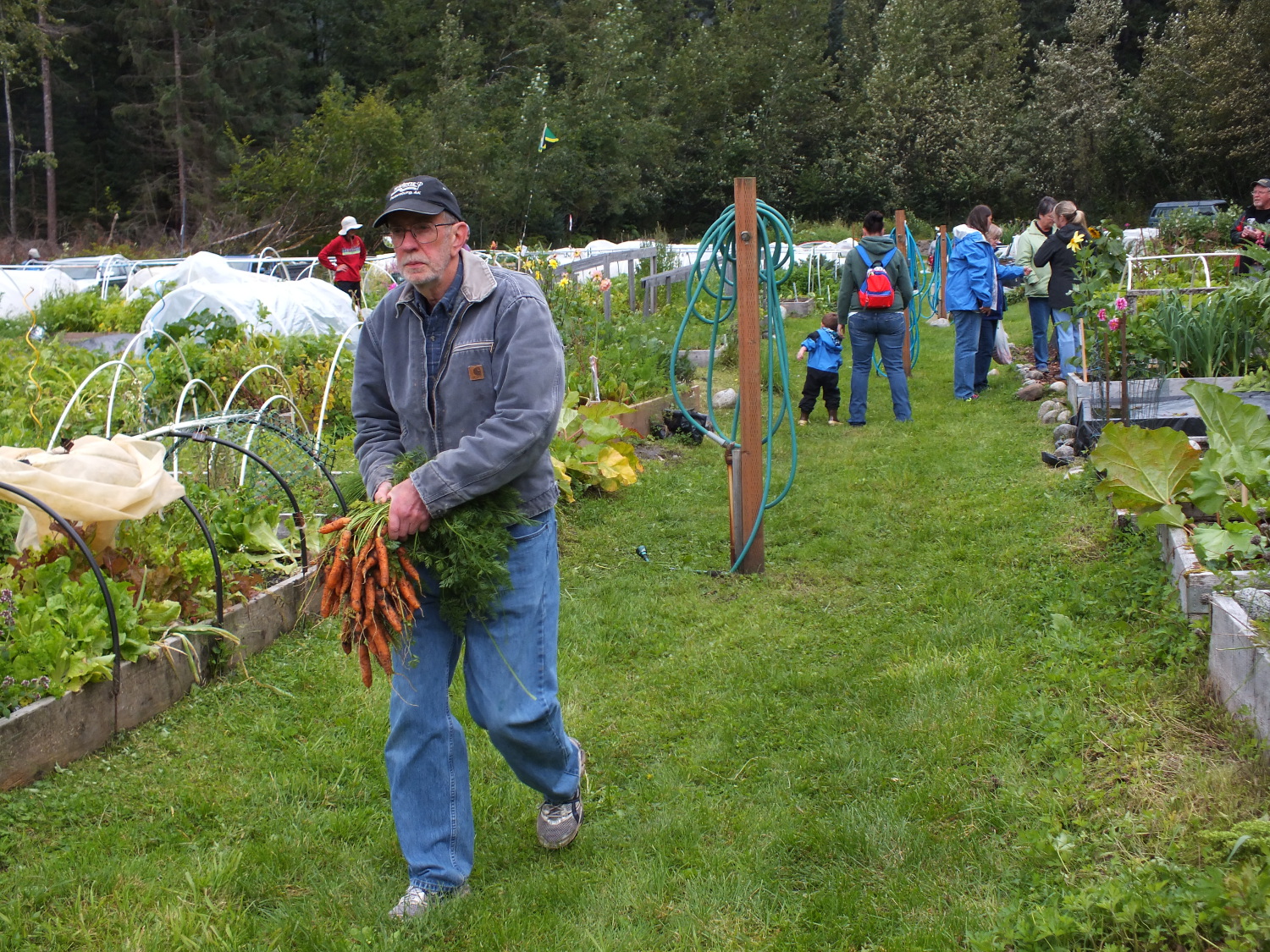
More carrots! (Photo by Matt Miller/KTOO)
Judges say residents of the Johnson Youth Center submitted many of the entries in the various youth categories. (Photo by Matt Miller/KTOO)
Residents of the Johnson Youth Center submitted numerous entries. (Photo by Matt Miller/KTOO)A basket submitted by a resident at the Johnson Youth Center. (Photo by Matt Miller/KTOO)
An award-winning herb patch. (Photo by Matt Miller/KTOO)
Not a single sign of slugs in this award winning green patch. (Photo by Matt Miller/KTOO)
A dahlia entered in the contest at the annual Harvest Fair and Farmers Market. (Photo by Matt Miller/KTOO)
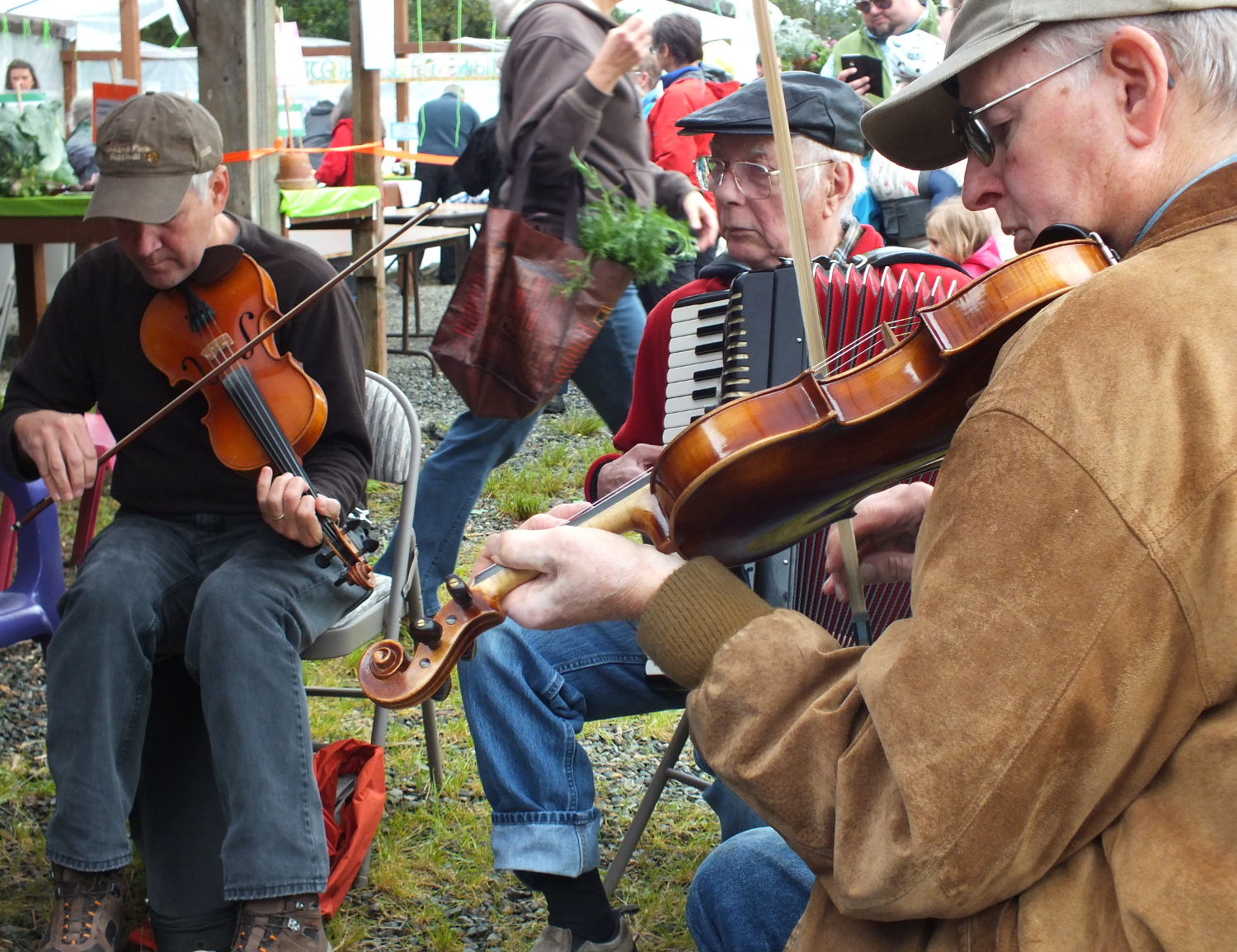
Fiddlers entertain the crowd at the annual Harvest Fair and Farmers Market. (Photo by Matt Miller/KTOO)
Carrots are went at the Farmer’s Market. (Photo by Matt Miller/KTOO)
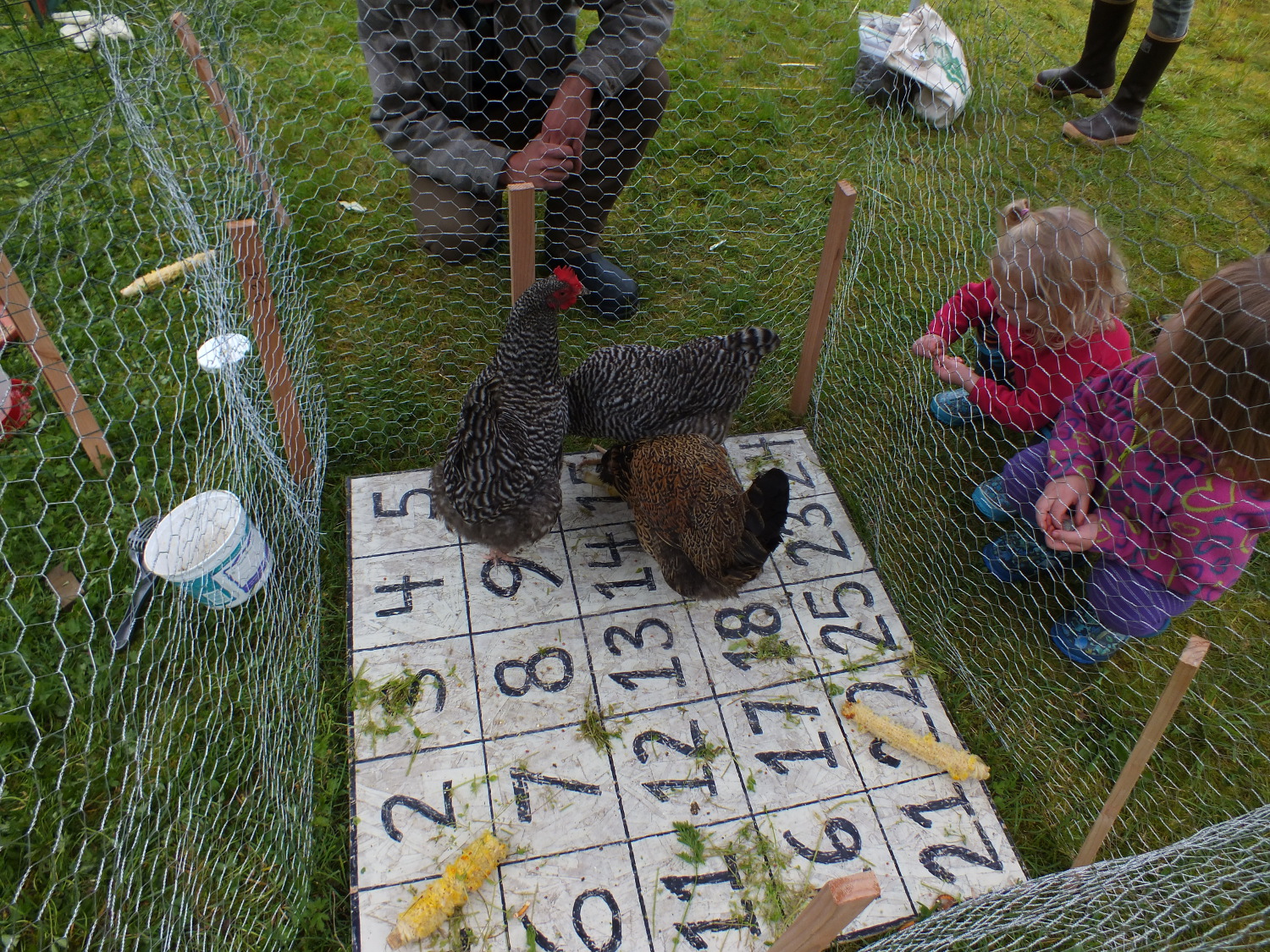
Children learn how to play chicken bingo. (Photo by Matt Miller/KTOO)
Purple kale at the annual Harvest Fair and Farmers Market. (Photo by Matt Miller/KTOO)
Mini pumpkins at the annual Harvest Fair and Farmers Market. (Photo by Matt Miller/KTOO)
More entries at the annual Harvest Fair and Farmers Market. (Photo by Matt Miller/KTOO)First place carrots at the annual Harvest Fair and Farmers Market. (Photo by Matt Miller/KTOO)
These award-winning cabbages are about the size of volleyballs. (Photo by Matt Miller/KTOO)
Artichokes in a garden plot at the community gardenson Montana Creek Road. (Photo by Matt Miller/KTOO)
The Great Pumpkin continues to grow in a mini hoop house. (Photo by Matt Miller/KTOO)
A fairgoer admires the dahlia entries. (Photo by Matt Miller/KTOO)
Potato entries at the annual Harvest Fair and Farmers Market. (Photo by Matt Miller/KTOO)
Canned entries at the annual Harvest Fair and Farmers Market. (Photo by Matt Miller/KTOO)
People gather for the annual McPherson County All Schools Day parade. Kansas is among the states seeking to counter shrinking population in rural counties with tax incentives and other programs. (AP)
Bill Longnecker grew up in rural Nebraska and, after trying life in Kansas City, Missouri, and other urban areas, returned to his home state to start a jewelry store in Red Willow County, population 10,867.
He loves it there.
“All we need is more people,” he said. Every year when high school graduates head off to college, locals present them with a mailbox imprinted with a map of the area. “We’re hoping they’ll find their way back,” Longnecker said. Few do.
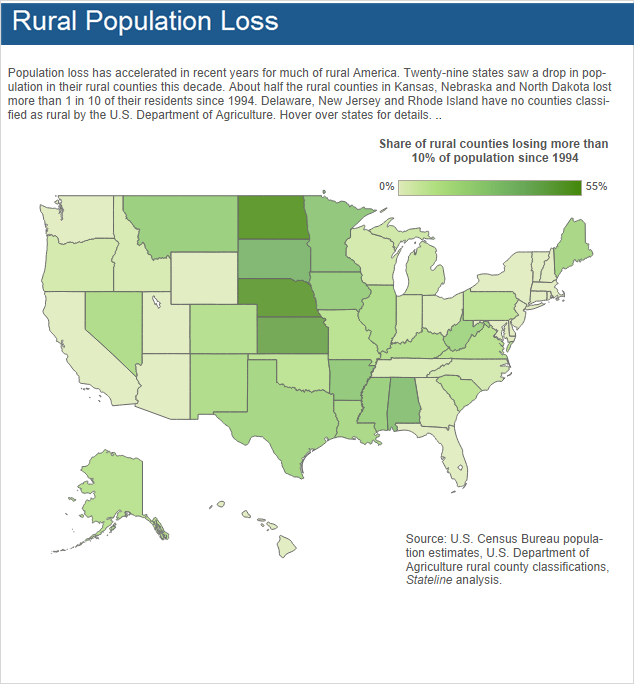
Population loss is a long-term trend in much of rural America, and it’s gotten more acute since 2010, according to a Stateline analysis. Although 759 rural counties in 42 states lost population between 1994 and 2010, more than 1,300 rural counties in 46 states have lost population since 2010.
As a result, some states with dwindling rural populations, such as Nebraska and Kansas, are trying to lure people with tax incentives, and small, shrinking localities are looking for ways to share services or cut back as the pool of taxpayers shrinks.
They’ve tried shifting schools online in Colorado, and reverting to gravel roads in North Dakota and Michigan. The 251 residents of the village of Brokaw, Wisconsin, have launched an online campaign to raise $2.5 million toward a $3.8 million budget shortfall.
“[Population losses] are immediately a slap to the local funding base for rural counties, because of the loss of property taxes,” said Arthur Scott, who works on rural issues for the National Association of Counties.
“Counties are regionalizing and sharing resources in the face of this rural flight, which is the long-term impact when the younger generation just leaves after college, because there’s no job opportunities that make it fiscally viable for you to return back home,” Scott said.
rural population loss
Enticing College Grads
Faced with declining rural populations, Kansas decided in 2011 to offer incentives to people who move to a rural county with population losses. Kansas is offering state income tax breaks to people from out of state and will repay a portion of the student loans of Kansans.
Dr. Rachael Cavenee took advantage of the program. She moved to Greeley County in 2013 after attending college in Colorado and graduate school in eastern Kansas. She started anaudiology clinic, which allows her time at home with her husband and two children.
Greeley County lost about a quarter of its population between 1994 and 2010, but has gained slightly since 2010, to about 1,300 people. Cavenee said she quickly came to love the area’s friendliness.
“My fear of moving here has evolved into a fear of ever having to move away,” Cavenee said. “This is where you can find genuine, supportive people. This is where we chose to raise our family.”
In a report earlier this year, Kansas estimated that the 330 people who got income-tax breaks in 2014 brought in more than $44 million in economic benefits. That year, 993 people got student-loan subsidies.
Some analysts are skeptical about the plan’s strategy of paying people to move to rural areas.
The program “may help a few families here and there, which is of course very important for those people and can give positive examples to some communities,” said László Kulcsár, a demographer at Kansas State University. “But we have to remember that it was designed to counter long-term depopulation, in which it is terribly ineffective.”
Nebraska started accepting applications this year for enterprise zones that would encourage new businesses in areas with declining population and high rates of poverty and unemployment.
In another effort aimed at rural Kansas, where aging business owners may have trouble cashing out when they retire, the University of Kansas School of Business has a program called RedTire that helps match college graduates to opportunities to buy rural businesses.
Michelle Reed, who moved to rural McPherson from Orange County, California, this month, said she was struck by the number of help wanted signs, businesses that closed several days a week for lack of employees, and business owners unable to cash out and retire. McPherson is a city of 13,322.
“There are older business owners who would like to sell, but there are no buyers in town,” Reed said. “We need to somehow make it hip to have chickens and farm to table in the heartland, and get the young adults to move east.”
Root Causes
Historically, despite losses in agricultural and mining areas, rural population has grown as suburbia has expanded or retirees sought scenic, low-cost destinations, according to a Junereport from the U.S. Department of Agriculture (USDA). The department excludes from itsdefinition of rural and small-town areas all commuter areas clustered around cities of 50,000 or more.
Overall, the country’s rural population dipped for the first time between 2010 and 2014, the USDA report said, as the number of people moving to economically hard-hit areas dropped. There were sharp contrasts within individual states. An oil boom gave North Dakota the largest rural population gain in the nation at 10 percent, but 16 agricultural counties on the east side of the state lost population.
Coal- and timber-dependent counties have also been hard-hit as those industries founder in the face of less expensive natural gas and as electronic, digital information reduces the need for paper.
High school students in rural Coos County, New Hampshire, a major pulp and paperproducer, were asked by researchers if it was easy for somebody their age to get a job in the county (population 31,653). In 2008, two-thirds said it was easy. Three years later, only one in five said so.
Some of the biggest rural losses are in coal country. The largest population decline from 1994 to 2010 was in West Virginia’s McDowell County, historically the state’s coal capital, which lost 38 percent. It fell another 8 percent since 2010 and the county now has about 20,000 people.
About half the rural counties in Nebraska, North Dakota and Kansas have lost more than 1 in 10 people since 1994.
Some analysts argue that simple math keeps rural college students from going home: Is there a job for me that will pay my student loans, or enough income from a small-town business or farm to support a family? Often the answer is no.
Population decline has been a fact of life in parts of Kansas for 50 years, Kulcsár, the demographer, said. What’s made it worse recently is that there aren’t enough babies to replace people who are moving out and retiring baby boomers are depriving rural areas of a large part of their workforce.
If there’s a chance to lure people back, it may be later in life, after they’ve had children, according to a USDA report released last month. This is especially true for those whose parents still live in their hometowns.
“Conversations about returning home centered on the value of family connections for child raising in a small-town environment,” the report concluded.
About 350,000 people moved out of rural counties between 2010 and 2014. In that time, only 250,000 people were born there. Counties that are more urban had more than 4 million people move in and almost 6 million births.
Effect on Government
Diminished revenue is an ongoing strain on local governments, one that the National Association of Counties thinks should be addressed by counties consolidating services and applying for grants together.
“With regional partnerships, you realize the assets of your neighbors and count on them together,” Scott said. Last year, the group put out a guide to creating regional partnerships, citing examples such as five Minnesota counties that worked to restore a railroad to get crops to market.
School has largely shifted online in Branson, Colorado, where a regional school system has just 52 students remaining in a brick-and-mortar school building, said Lori Green, the school district’s assistant business manager. The system has helped to preserve jobs in a district with shrinking enrollment, Green said. Branson is in Las Animas County, which had one of the biggest rural population losses between 2010 and 2014, with almost one in 10 of its 14,000 residents leaving.
As early as 2010, towns and counties in North Dakota and Michigan were converting paved roads to gravel—and some counties in Ohio were simply letting them erode—to save on maintenance costs, according to a Wall Street Journalreport.
Meanwhile, the residents of Brokaw, Wisconsin, which saw its population drop and tax revenue plunge since a paper plant closed in 2012, have raised $756 in their online crowdfunding effort to close the $3.8 million budget gap.
“Without money coming in, you don’t pave the roads, you don’t pick up the trash, you don’t upgrade the sewer system,” said Doug Farquhar, a program director at the National Conference of State Legislatures.
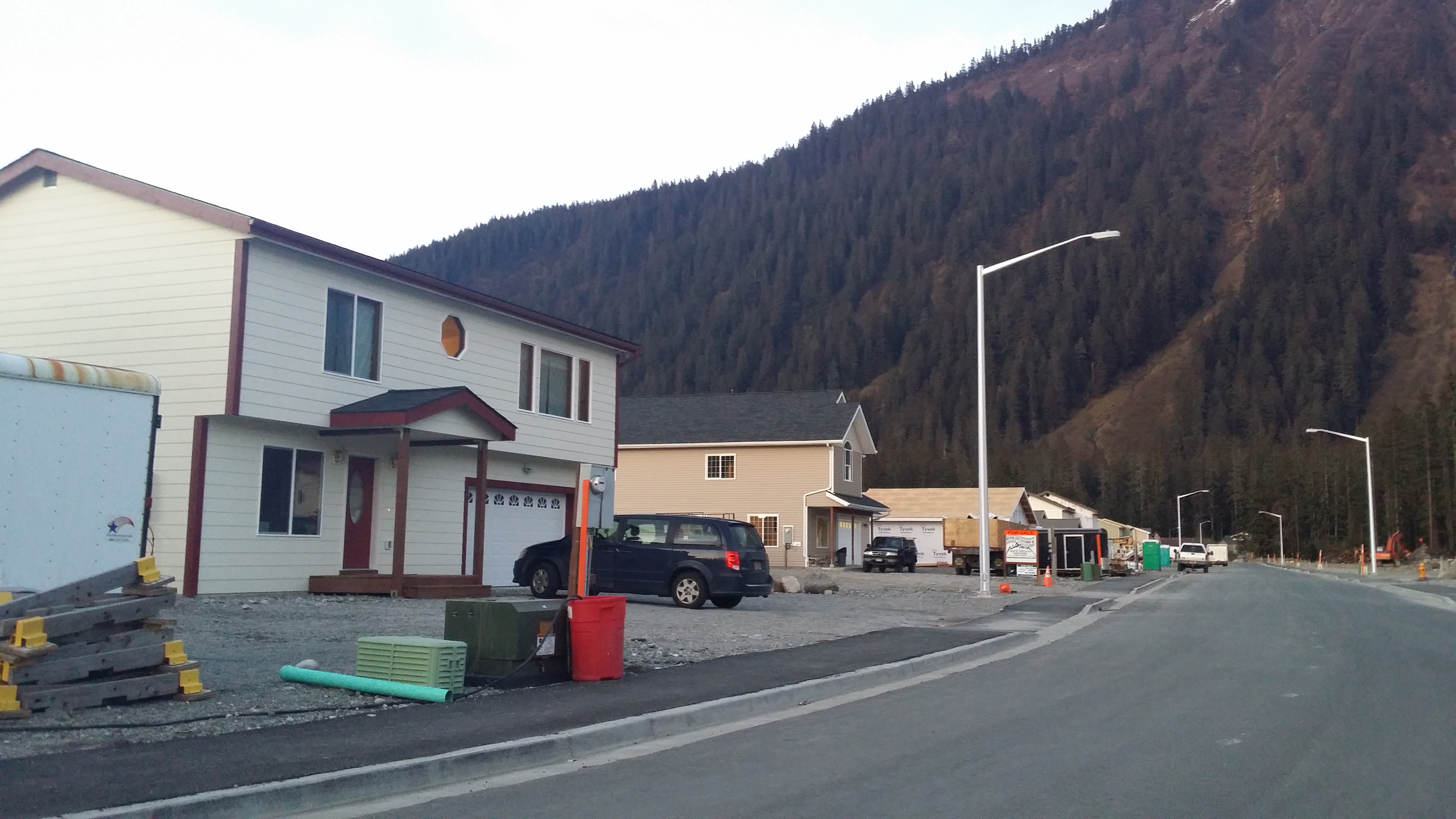
A Mendenhall Valley subdivision under construction in May. (Photo courtesy Hal Hart/CBJ Community Development Department)
The Juneau Assembly wants to draft ordinances creating new property tax breaks that incentivize denser development and redevelopment of blighted properties.
The assembly discussed it Monday in committee and also wants input from the Downtown Business Association and city staff.
Assemblymember Karen Crane asked if the redevelopment ordinance would do enough. It would allow for property tax exemptions or deferments for major building overhauls and demolition.
“When I first read this, I don’t see the incentives there for the development of housing,” she said. “I’d like to have some more discussion along that line, too. It’s one of the conclusions everyone has come to that has studied what we need downtown.”
City Finance Director Bob Bartholomew said it comes down to what level of public investment Juneau wants to make.
“It’s in addition and outside the scope of this. This could help in one little piece. But there’s a lot of other things out there,” he said.
A second ordinance would allow for property tax breaks after subdividing land for five years.
But some assembly members questioned the length of time–wondering if they could be giving tax exemptions for developers not motivated to sell. Assemblymember Debbie White said that’s often not the case.
“It’s really not as much time as you think and by the time you get the subdivision recorded and you start advertising and marketing these properties and then you design homes and then you have to take plans to permits center, five years is not that long,” she said.
White, a real estate broker, called the Montana Creek West subdivision successful and said it took about six years to develop.
Hoonah students balance a small ball on two strings as a part of a team building exercise. (Photo by Lakeidra Chavis/ KTOO)
Last Friday morning, more than 50 students tossed hoops, dribbled basketballs and hustled feet in the Hoonah High School gymnasium. But this wasn’t a gym exercise. It was a part of a three-day anti-bullying awareness program.
“It takes different kinds of forms. It can be very subtle; it can be very physical and upfront in your face. It can happen on the playground, it can happen in the home,” according to coach Andy Lee.
In the last 10 years, Lee has been to more than 30 villages in Southeast and the Northwest Arctic to raise awareness about bullying and substance abuse.
School started last Wednesday, and Lee spent the first three days of the school year teaching the students about teamwork, career-building and anti-bullying awareness. He uses basketball to teach these fundamentals.
Coach Andy Lee poses with Hoonah kindergartners during their lunch house. (Photo by Lakeidra Chavis/KTOO)
“Kids need to be resilient enough to resist bullies, and people have to allow them to stand up and say ‘no’ to it, and I think it’s important to address it from both ends of the spectrum,” Lee said.
Hoonah High School is the 13th school he’s visited in the past 15 weeks. Friday evening he returned home to Sitka, where he is the basketball coach at the local high school.
“Well, I think the key thing is that I come and go, but the issues remain,” Lee said.
According to results from the 2013 Youth Risk Behavior Survey, ninth graders were most likely to report being bullied within the past year, regardless of ethnicity. Female students were more likely than male students to experience bullying.
Two of the students at first wanted to talk about how one of them had been bullied, but after our conversation she returned to ask her experience not be shared for fear that someone might recognize her voice.
Hoonah School District Principal Lorrie Scoles, right, discusses Coach Lee’s program with teacher assistant Bob Barton and counselor Nung Dinh. (Photo by Lakeidra Chavis/KTOO)
Hoonah School Principal Lorrie Scoles thought the program was a good way to start off the year.
“We have several new teachers here with us this year. We wanted to do some community building and let the kids build some leadership skills,” Scoles said.
This year, Hoonah’s enrollment is high at 120 students. There are about 13 new students and eight new teachers out of a staff of 13. Scoles says that in a school this small, bullying may take on the form of teasing and if it’s been normalized, students might be hesitant to speak up.
Nung Dinh is one of the new hires. She’s the school’s new counselor and art teacher. Dinh says she enjoyed the program.
“I believe it was a powerful program to get the kids thinking about their future, and thinking about why are they here at school and putting a since of purpose in that,” Dinh said.
Bob Barton, a seasoned parent-teacher assistant for the special education department, agrees.
“I liked the way he didn’t pull any punches or try to sugarcoat anything, but tried to give the students of the real world, and what’s it’s going to be like to try to reach whatever goals they set,” Barton said.
All the students agreed that they enjoyed the program, but when asked about their experiences with bullying and how it was dealt with in the school?
When asked they experience bullying or if the teachers intervene, the students didn’t respond.
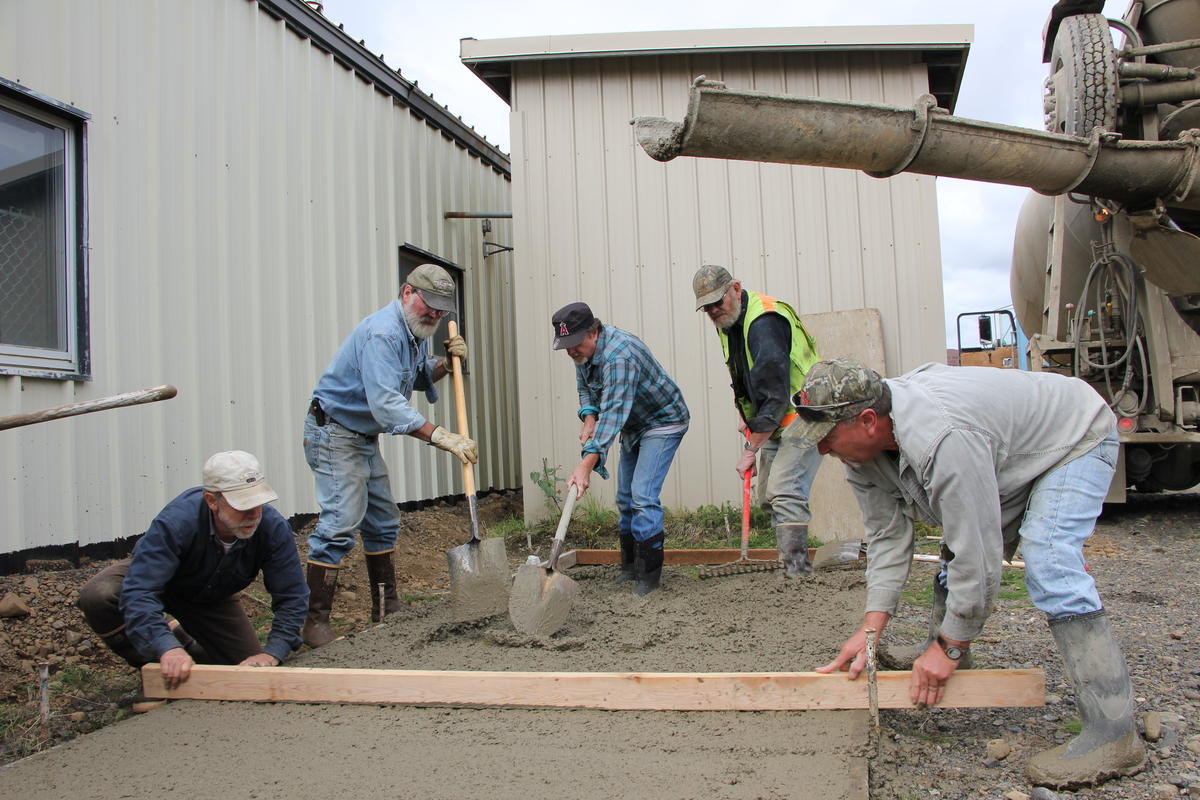
Paul Liedberg and Rick Dallmann level a new concrete slab while Jim Woolington, Bob Henry, Kendall Judge move the mud into place at the Dillingham Animal Shelter Aug. 19, 2015. (Photo by Molly Dischner/KDLG)
We’ve all seen things in our respective hometowns in this region that need fixing. Who among us hasn’t thought, “If we could just get some people together and maybe a little money or material, I bet we could fix that.” Recently six guys and a truckload of donated cement made a major fix at Dillingham’s Animal Shelter, and it didn’t cost the city a dime.
Last year, two dogs died and another was sent to Anchorage after an outbreak of parvovirus at the animal shelter. Parvo is highly contagious, mostly affects dogs, and can be deadly. The old outdoor pens had dirt floors and couldn’t be easily cleaned.
So this week a group of volunteers got together to do something about it, to make the shelter a little better.
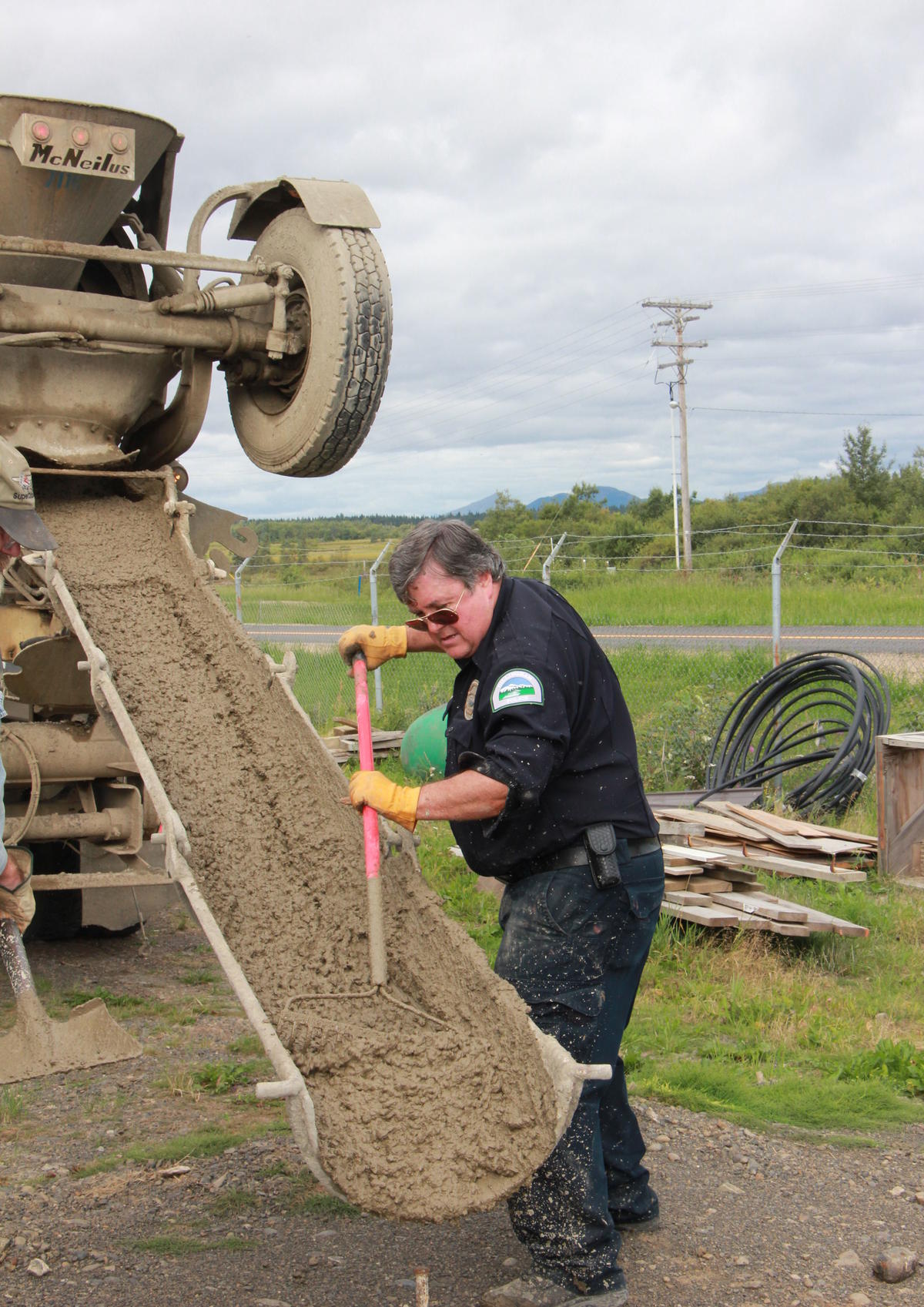
Dillingham Animal Control Officer Dan Boyd helps pour cement into a frame at the animal shelter Aug. 19, 2015, as part of an effort to upgrade the four outdoor pens. (Photo by Molly Dischner/KDLG)
Dillingham’s animal control officer Dan Boyd guided the city’s move from the old shelter up Lake Road to the location at the harbor where, hopefully, more people will notice the impounded dogs as they come and go from downtown. That’s part of the purpose of the outdoor pens.
“But we weren’t able to clean and sanitize them like you really should do at an animal shelter like we can do on the inside,” Boyd said. “We got a concrete floor in there that I can sanitize every day, just make it a clean environment for the animals.”
Budgets are tight, so Boyd was thrilled when the volunteer group opted to take on the task. The price tag was basically $0, except for his hours on the clock as a city employee.
“Everything’s been donated, volunteer-wise,” Boyd said. “The lumber, the pegs that hold the forms in the place, the wire, has all been donated. The help has all been donated.”
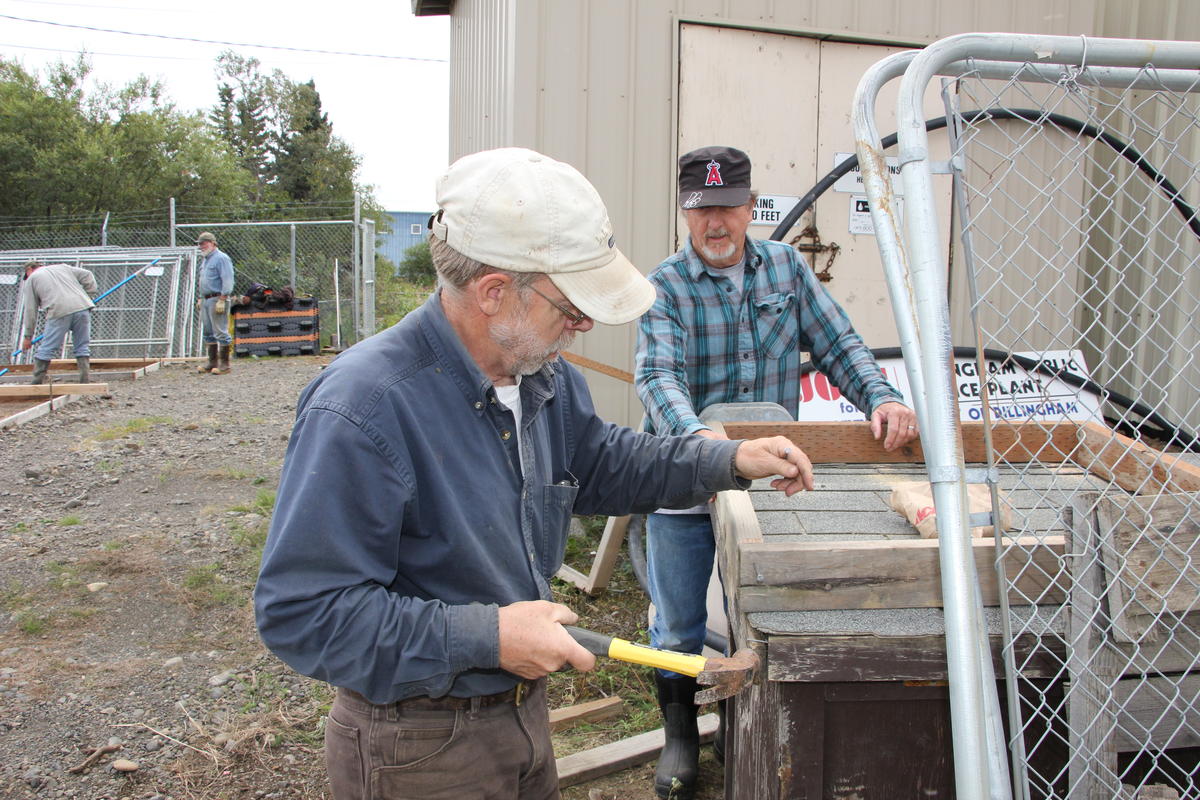
The effort was spearheaded by Paul Liedberg, who’s retired except for his role as a city councilman. He could’ve tried to push this project through officially, put it out to bid, see the contract awarded. Instead, he rounded up helping hands and asked around for some cement. As he and another volunteer nailed a frame together he seemed proud to see it happen.
“I think the key things are, there’s just lots of support for this facility, lots of volunteers that do many things to help the community,” Liedberg said. “And this is just one of them.”
Liedberg said about a dozen or more people helped, including folks who gathered supplies and prepped the pen sites, and the guys who showed up for the concrete pour.
Paul Liedberg and Bob Henry build a wooden frame at the animal shelter in Dillingham’s harbor on Aug. 19, 2015. (Photo by Molly Dischner/KDLG)
After a few hours Wednesday, Liedberg said there’s not much left to do.
“Take the forms off, and then we’ll add a little material around the edge of the forms just to slope it, material being gravel, just like this, and that’ll be about it. So in a few days it should be totally complete,” Liedberg said.
It may be a simple project – pouring concrete slabs at the dog shelter. And it may go largely unnoticed. The volunteers don’t want credit or attention. They do want to see this job done and maybe set a small example on how to tackle the next ones.
Close
Update notification options
Subscribe to notifications
Subscribe
Get notifications about news related to the topics you care about. You can unsubscribe anytime.