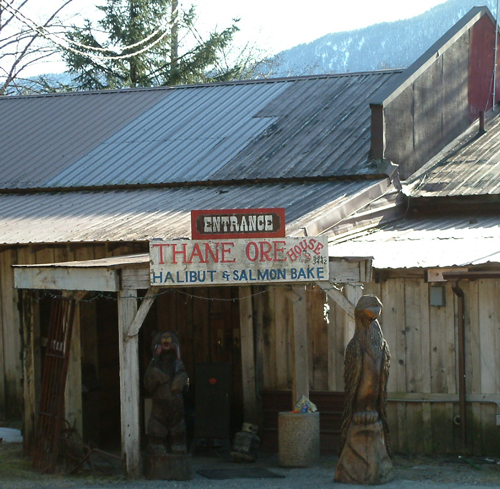
The Central Council of Tlingit and Haida Indian Tribes of Alaska announced plans on Thursday to open a cultural immersion park. Next year, the shuttered Thane Ore House is expected to be transformed into a new Juneau tourist destination.
Myrna Gardner, the council’s business and economic development manager, said the park could offer teachable experiences for Native youth and guests. They’ll see weaving and master carvers working with apprentices on totems and canoes.
Thane Ore House is located at about mile 4 of Thane Road just before Sheep Creek. (Photo by Matt Miller/KTOO News)
“They’ll not only see a living culture, they’ll be able to talk to the artists,” Gardner said. “We’ll have cultural guides with them. Our plan is to not only strengthen our culture and the connection with our youth but also share our culture with the guests that travel into Juneau.”
Plans include a gift shop and restaurant that serves traditional foods–like blueberries, salmon and Hudson Bay tea. As many as 100 permanent jobs could be created.
President Richard Peterson said that’s part of the business model. The immersion park will draw employees from the Central Council’s existing vocational program. He hopes, eventually, it will help Central Council become more self-sufficient.
“You can’t have a program live off grants forever. Part of that sustainability is that economic development engine kicking in for tourism, kind of solves each others’ problems,” he said.
The city owns the land and solicited project proposals. Central Council beat out pitches from caterer Abby’s Kitchen and Liquid Alaska Tours.
Peterson said, as the final design plans come together, it’ll be done with careful thought and planning.
“I want to make sure that what we do is culturally sensitive and culturally appropriate,” Peterson said. “I don’t want to do something that’s a parody of our culture. This has to be something that’s done right.”
The $1.3 million Tlingit-Haida immersion park is slated to open next summer.
Alaskans voted in 1998 to define marriage in the state constitution as only between a man and a woman. Now that the U.S. Supreme Court has invalidated that definition, Alaska and the entire country has marriage equality.
To some it may seem like things are changing fast, but Alaska’s fight for gay rights began half a lifetime ago.
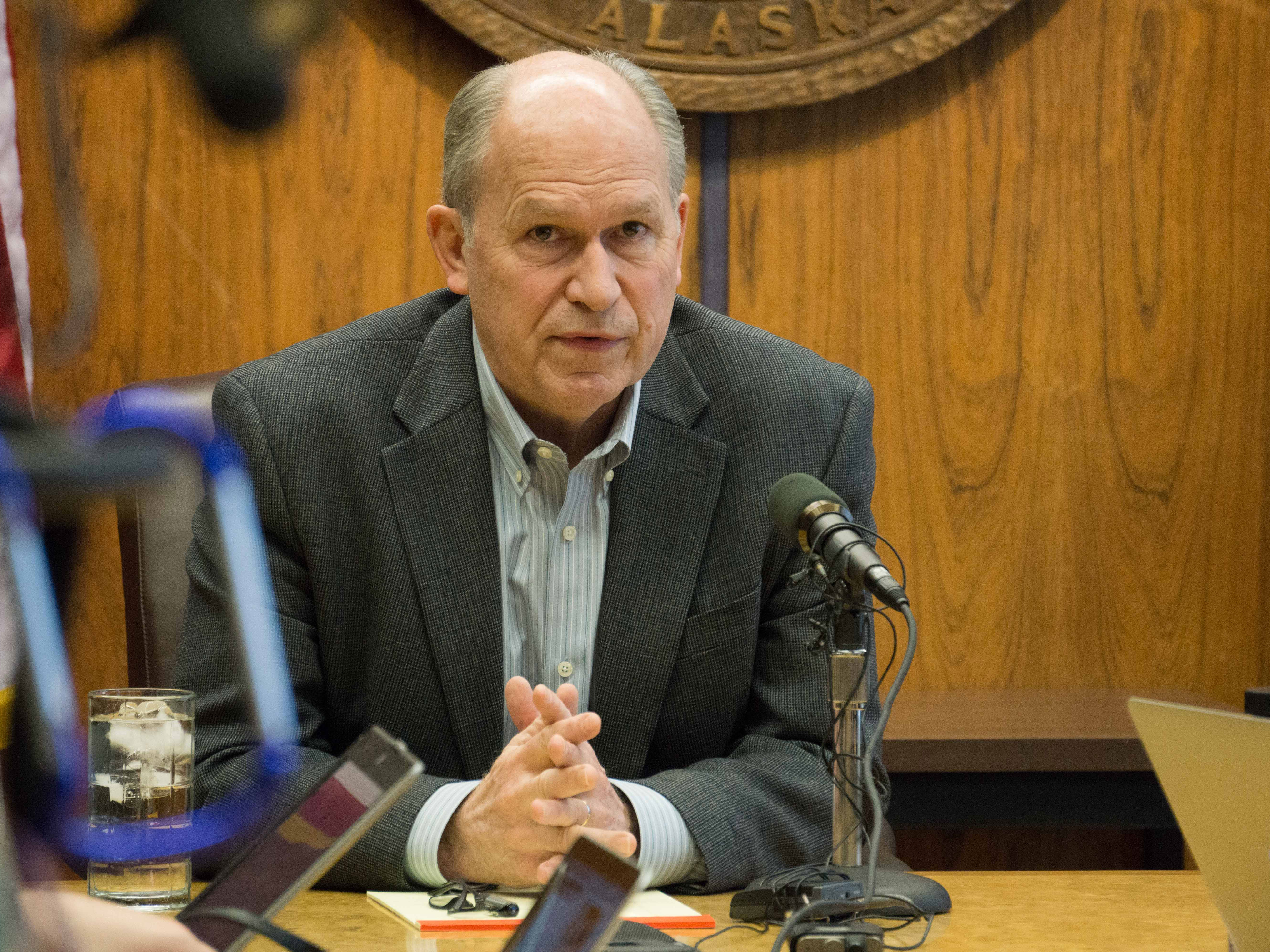
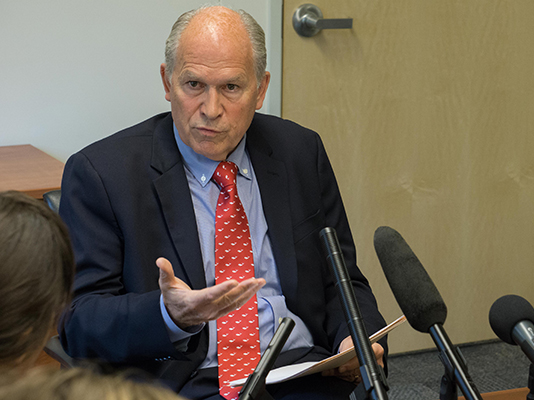
Walker has not given a direct answer when questioned about his position on LGBT rights. He’s only stated that he believes marriage is between a man and a woman. When questioned further in this interview about his stance on LGBT rights, he still did not provide a direct answer.
“Just imagine if you couldn’t call the fire department because you were LGBT. If you are LGBT you should be able to call any state agency and get the same service,” says attorney Caitlin Shortell. She represented the same-sex couples that sued the state for the right to marry. “This is an injustice that needs to be corrected.”
Politicians and activists weigh in
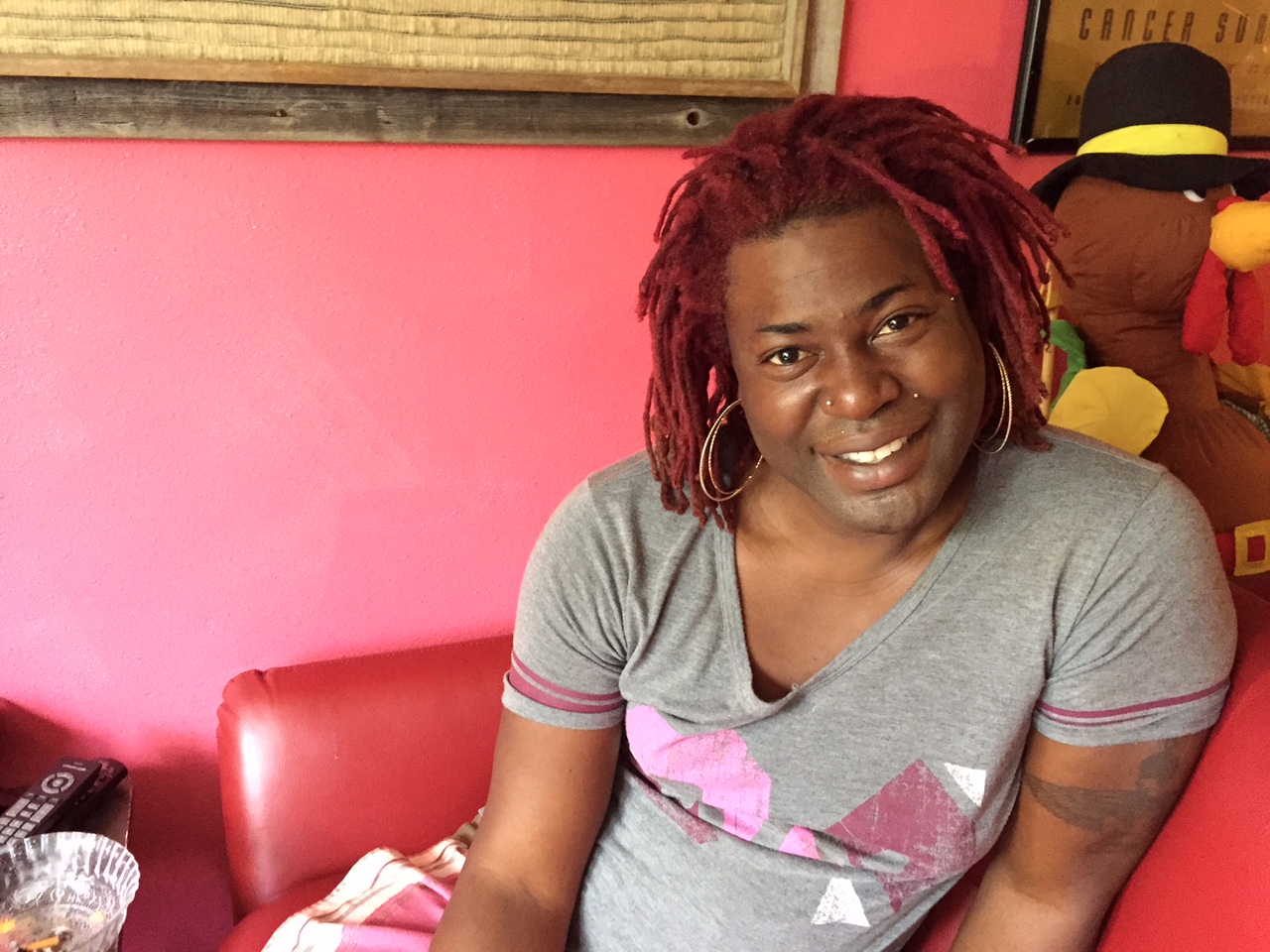
Anchorage activist MoHagani Magnetek
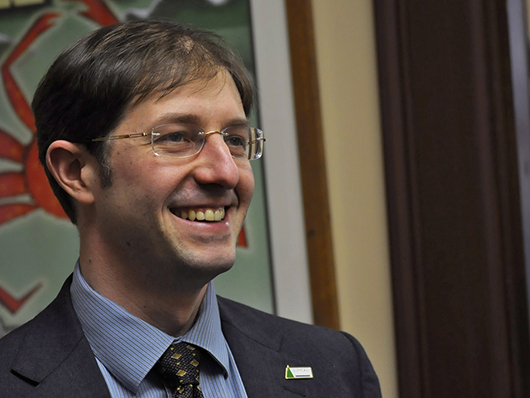
Juneau Assemblyman Jesse Kiehl on LGBT protections in Juneau.
Gov. Walker on handling LGBT rights during his tenure.
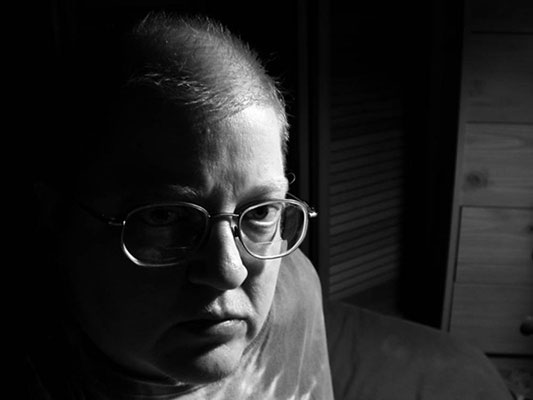
Activist and Researcher Melissa Green.
Documents
This list includes the official files from bills that have included sexual orientation or gender identity in drafts of legislation dating back to 1975. The grid also includes links to significant court cases and video focusing on LGBT rights.
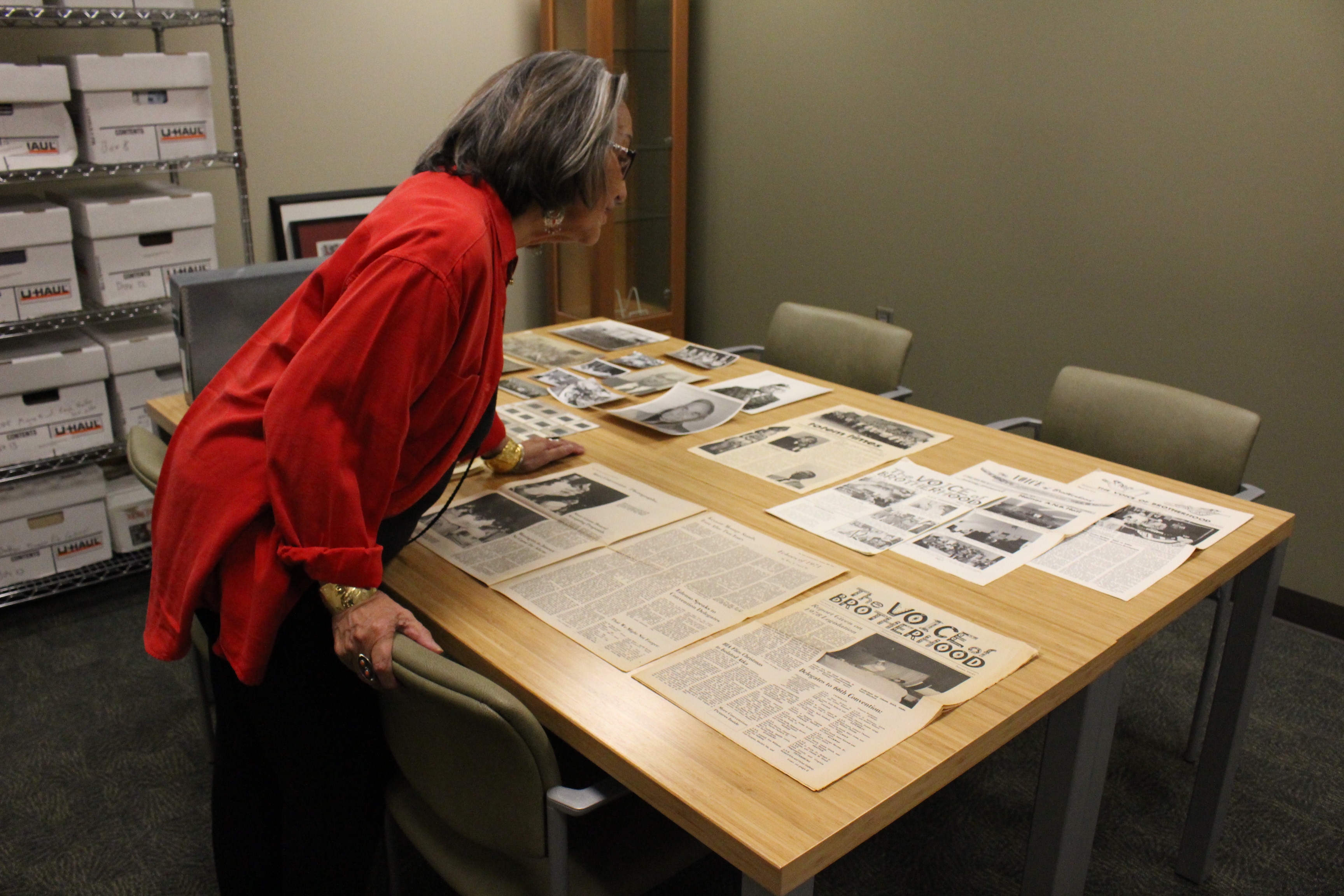
Rosita Worl marvels over the donated collection in the William Paul Archives. (Photo by Elizabeth Jenkins/KTOO)
A recently donated collection of letters, essays, photographs and newspapers is shedding new light on the history of Alaska Native civil rights. One particularly controversial figure in the documents spent half a century advancing Alaska Native causes. He’s the namesake of Sealaska Heritage Institute’s new William Paul Archives.
SHI President Rosita Worl stands over a table of photographs of ancestors in regalia, Alaska Native Brotherhood meetings and less formal gatherings–relaxing around a table for dinner.
“Here look at this. ANB people and traditional leaders. Ooo, I see my grandmother over there!” she exclaims.
The collection spans from the 1940s all the way to the 70s and was donated by brothers Ray and Cy Peck. The sons of Cyrus Peck Senior, who published the newspaper Voice of the Brotherhood.
“Remember at this point and time we don’t have social media. We don’t even have TV,” she said. “So the newspaper print is really important in terms of educating people about what was going on, coalescing people into political action.”
Some of the photos were taken by Ray Peck. He remembers his father giving him a Polaroid camera when he was a teen and asking him to take pictures of the Alaska Native Brotherhood.
“I used a Polaroid ‘cause I could always tell and take another one right away. And they were black and white and they’d turn out perfectly for printing,” said Peck.
At the time, he didn’t know he was capturing history. He would paste the photos on the freshly typed sheets from his dad’s typewriter and run them off to the printer at The Juneau Empire. After his dad passed away, he found boxes full of old newspapers and letters and thought, “Get ‘em to a safe place instead of sitting in my house. And maybe people will get some information out of it.”
Peck turned over the boxes to the William Paul Archives in the Walter Soboleff Building. He donated correspondence between his dad and Paul, who was an important but sometimes divisive leader in the brotherhood.
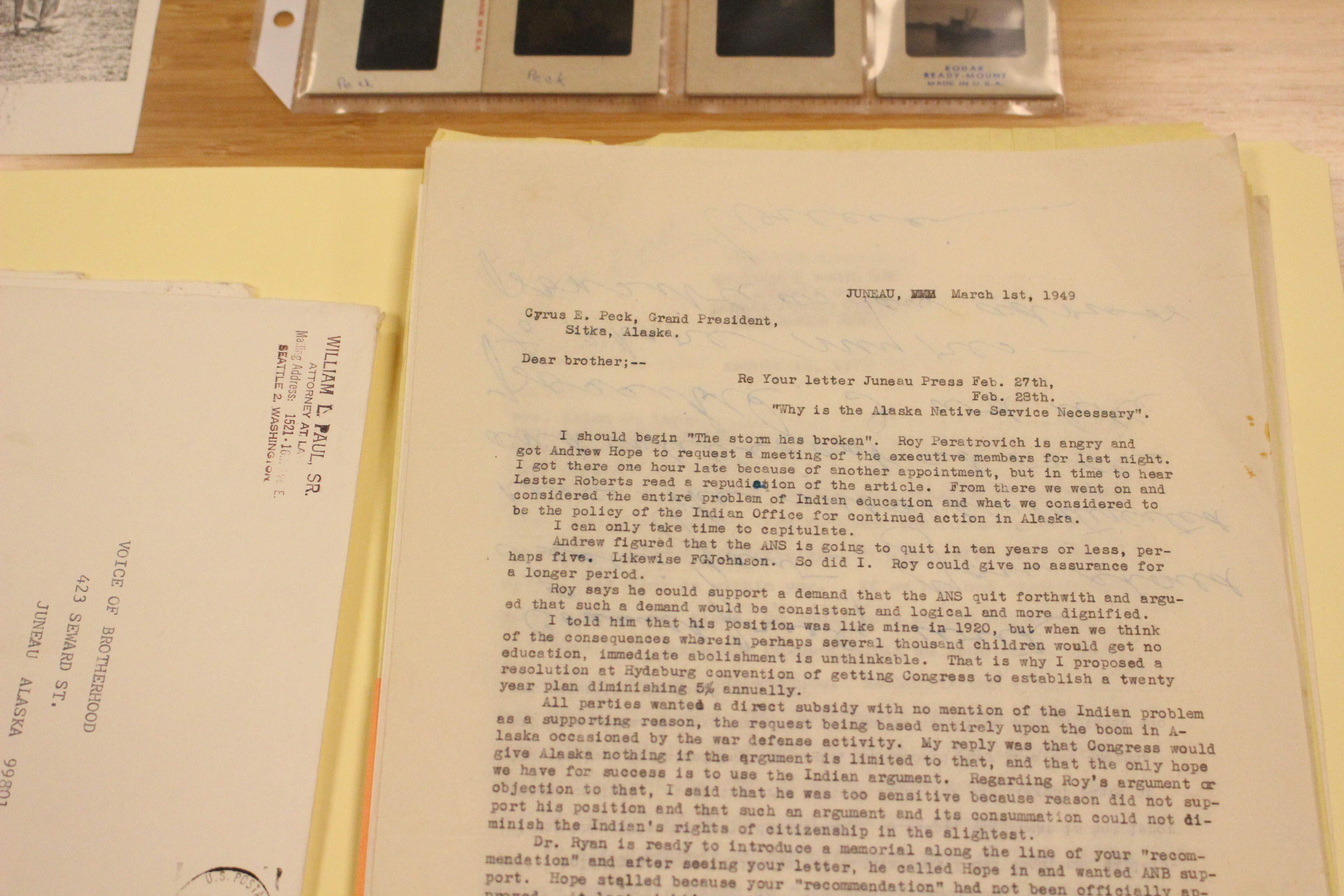
A letter dated March, 1 1949, from William Paul to Cyrus Peck Senior. (Photo by Elizabeth Jenkins/KTOO)
“He had progressive ideas and he stepped on a lot of feet,” said Peck.
You might not know attorney William Paul by name. But you’re probably familiar with some of stuff he did: fighting for voting rights and the Alaska Native Claims Settlement Act.
Rosita Worl calls him the father of land claims.
“He really brought it to the forefront,” she said.
A Tlingit, Paul was the first Native elected to office when Alaska was a territory, and he was a leader in the Alaska Native Brotherhood. The organization formed in 1912 to combat segregation and racism. Paul was later instrumental in this.
Worl knew him. She says he was a mentor growing up but recognizes he was also controversial.
“Both within the Native community and the non-Native community. The non-Native community thought he was arrogant and brash.”
She even calls some of his political activity unethical.
In the 1920s, a historian says Paul became politically powerful by helping Alaska Natives vote — for exactly whom he wanted them to vote for. He prepared cardboard cutouts that covered ballots and left only his picks. With the cutouts, literacy wasn’t a barrier.
He was also accused of taking campaign donations from salmon canneries, an industry whose unsustainable practices he vilified. Worl says tactics like this might be part of the reason he’s not more well known. Still, he’s an important figure.
“Here you have an indigenous population taking the laws of the oppressor to protect themselves,” she said.
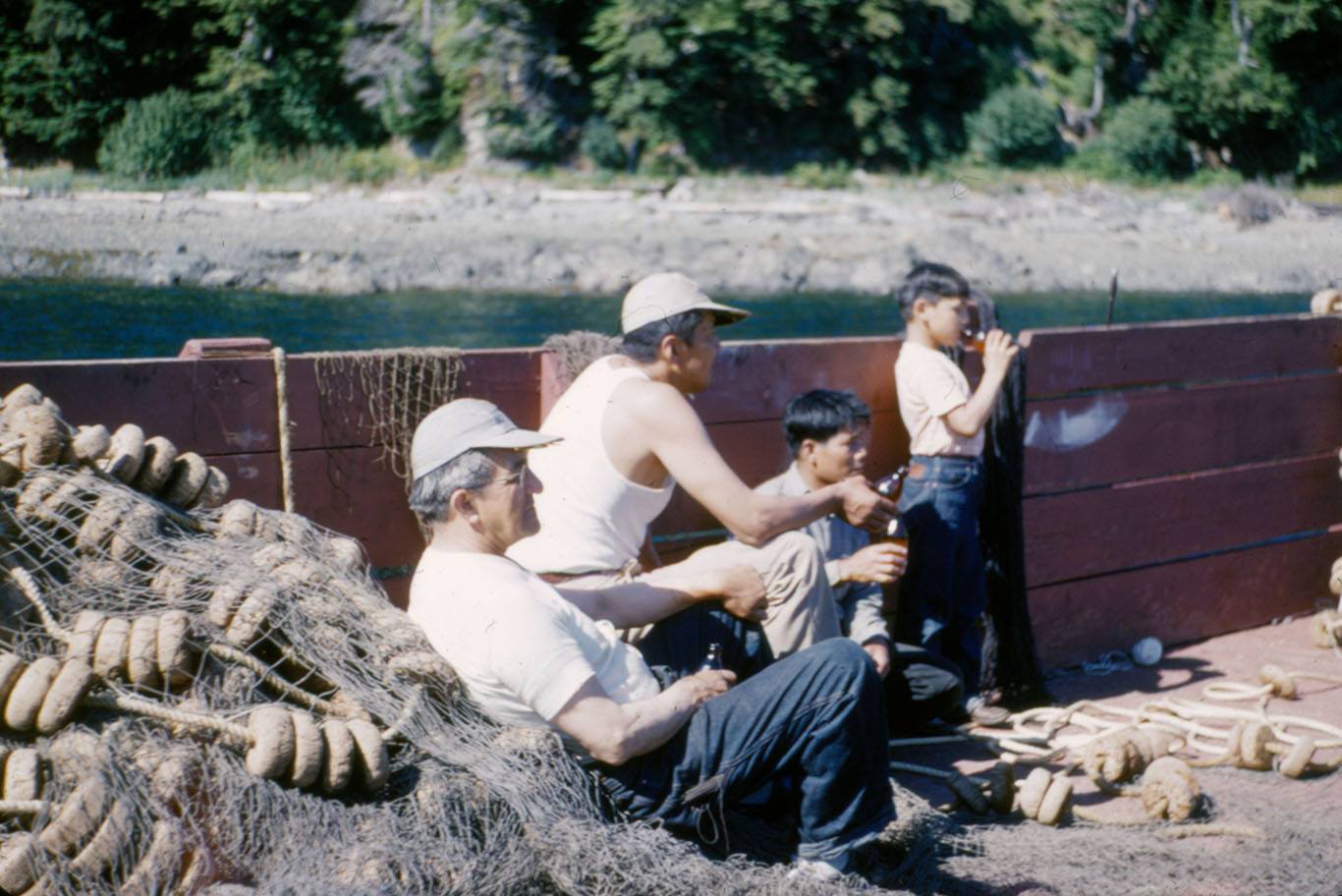
William L. Paul Sr. (left) with Walter Soboleff, M. Quinto and Ray Peck on a boat. (Photo courtesy of Sealaska Heritage Institute)
“I should begin ‘The storm has broken,'” the letter about Native boarding schools and education begins. “… From there we went on and considered the entire problem of Indian education and what we consider to be the policy of the Indian office.”
With the newly acquired materials, Worl hopes scholars and individuals can piece together a complex narrative of Alaska Native Civil Rights.
“More often when you read histories, Native people are seen as passive recipients of Western culture, they aren’t viewed as the active individuals in pursuing these rights,” she said. “With these documents, we’re able to demonstrate that. We’re able to portray history from our perspective.”
Worl encourages the public to donate items as they find them. Ray Peck says he may have a few more boxes to rummage through back home.
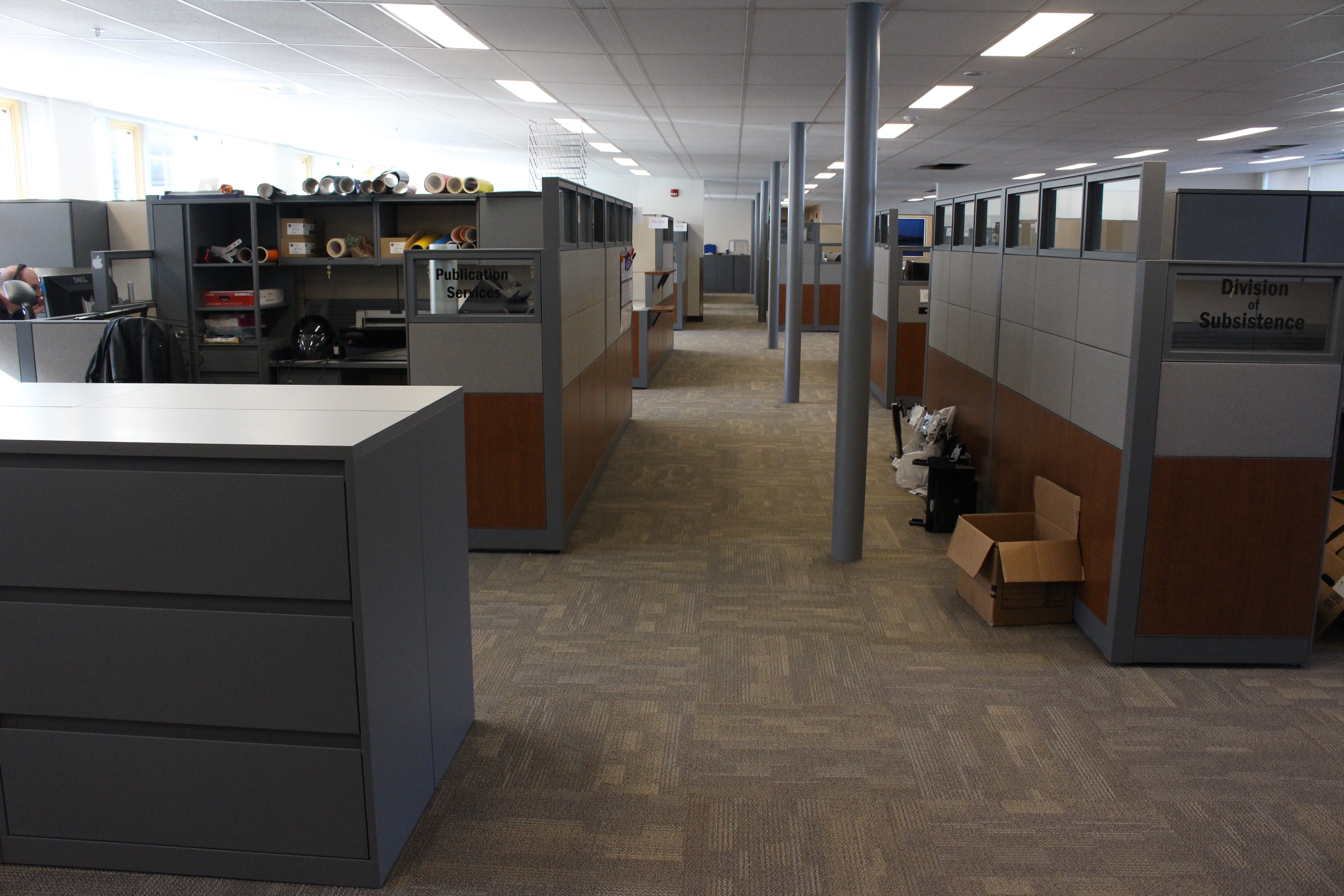
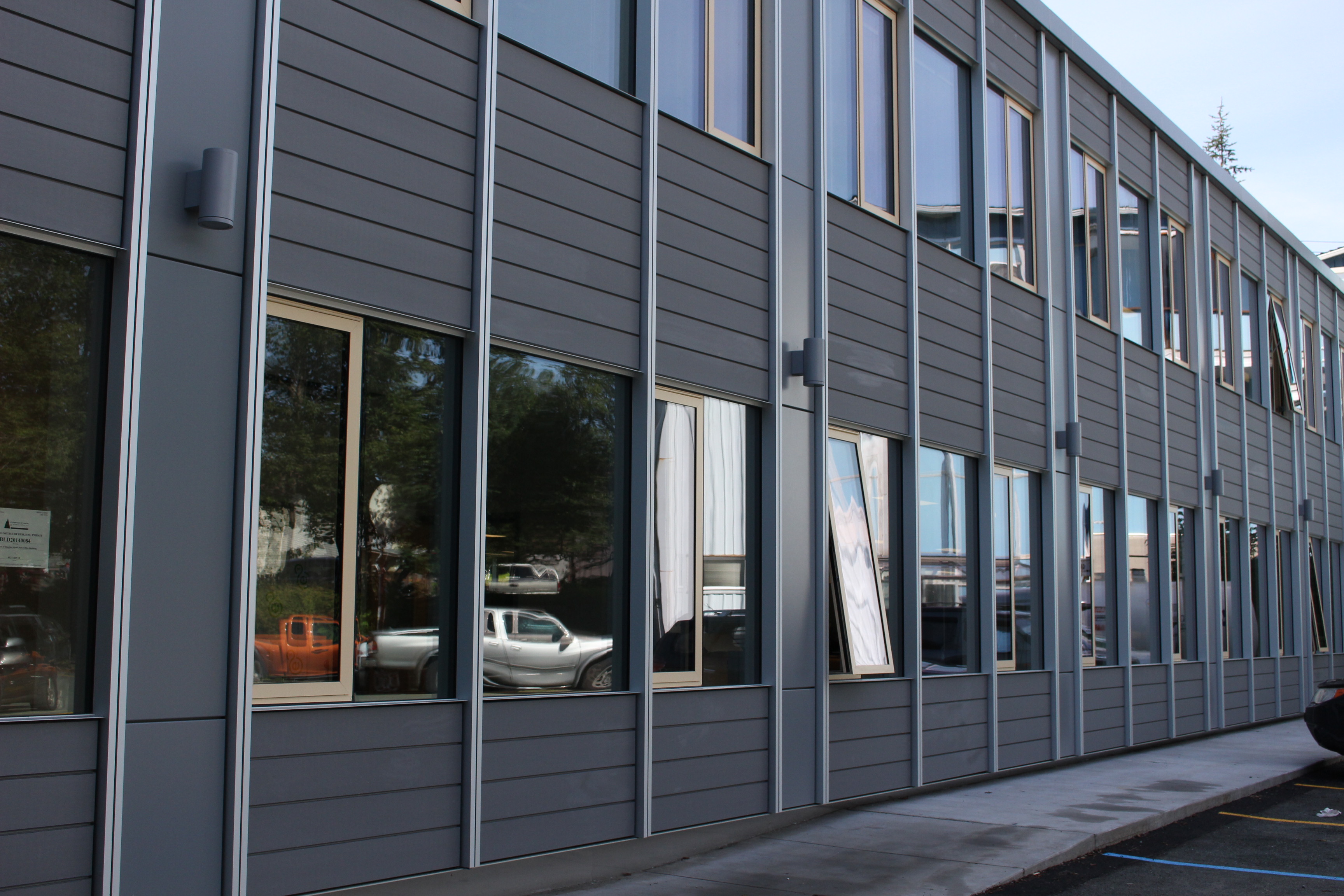
The state’s newly renovated offices in Douglas follow the universal space standards. Note the angled ceiling. (Photo by Elizabeth Jenkins/KTOO)
After a class action grievance, a regime change, a year of renovations and buying hundreds of $8,000 workstations, state employees are finally moving into their new offices in Douglas. Although the dust has settled, concerns over the new layout have not gone quiet.
Brian Frenette is the regional supervisor for sport fish. He recently moved back into the renovated building and likes how the new space is flooded with light. Gone are tall cubicle partitions and dark hallways.
“Certainly is a lot brighter, there’s no question,” he said.
But there are some design choices Frenette says employees find puzzling, like how the ceiling bows toward the middle.
“Lower in the center, higher on the walls and I don’t know what that is for. Other than to maybe give the impression that more light is being drawn to the center of the building.”
He said people think it’s a mistake but it’s intentional.
“I don’t understand it. Some people look at it awhile and say it’s making me nauseous. After a while you just get used to it.”
Some changes employees may not get used to. As a supervisor, Frenette gets his own office but most won’t.
The building has been redesigned for universal space standards, a cost and space saving plan implemented by then-Gov. Sean Parnell. Some work stations were whittled down to about half the square footage. Each cost the state more than $8,000.
“Well there were a number of concerns our members had. Reduced space for them to work, less privacy,” said Jim Duncan, the executive director of the Alaska State Employees Association.
The union filed a class action grievance over the state office layout about two years ago, citing safety and health concerns for its members. But eventually reached an understanding with the Walker administration.
“The arbitration is still in place, we are just not moving it forward,” said Duncan. “We had an agreement, an understanding from the administration that they would complete the projects that were underway under the previous administration.”
The exterior of the state’s newly renovated Douglas Island Office Building. (Photo by Elizabeth Jenkins/KTOO)
The changes have already happened in Anchorage’s Atwood Building and a floor of Juneau’s State Office Building. Douglas now has 32 vacant spaces.
Andy Mills, a spokesperson, says the Walker-Mallott administration is evaluating if new standards are worth it. And he realizes if it continues, it could affect him.
“The space standards would actually entail me not having an office,” Mills said. “I certainly think that when you’re looking at difficult budget times, I think most folks understand you want to look at everything possible when it’s a decision between programs, people or space. But at the same time you need to be fair and respectful to the employees.”
He said some of the sacrifices, he wouldn’t mind. His floor of the state office building has outdated furniture and a tiny break room with no seating.
“If you came and saw it, it’s a fairly small room. It’s the size of a closet.”
The renovated offices, on the other hand, come with roomier break rooms and updated kitchen appliances. It’s designed to increase collaboration. But Mills says “universal space standards” does sound a bit drab.
“It sounds like it’s a gray box that might be uninviting. But the customizability of the systems furniture when folks get a chance to look at it is probably a little more versatile what they would have first thought,” Mills said.
With the push of a button, Brian Frenette demonstrates how he can raise his desk to work in a standing or sitting position.
He said the new layout has bit of learning curve. The front counter is intermingled with Wildlife Conservation and Sport Fish to provide easier access for the public. The Department of Corrections moves in this week.
But for some employees, he said there have been concerns.
“I think what most people will probably tell you what they’re having to give up is separation–from their coworkers in order to get work done and not be disturbed,” he said. “Whether or not that comes to light as being a big issue or a small issue we’ll see as time goes.”
Frenette says they’re looking at white noise machines as a possible solution. The state has no immediate plans to roll out more universal space standards offices.
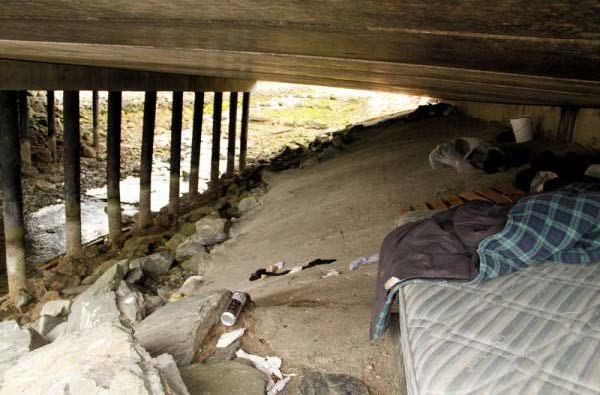
Belongings and litter under the Gold Creek overpass. (Photo courtesy The Glory Hole)
Three years ago, a group of volunteers hit the streets and interviewed some of Juneau’s most vulnerable homeless, those at the greatest risk of dying prematurely. An estimated 60 individuals fall into that category.
Juneau’s shelter and soup kitchen, The Glory Hole, is trying to find out what has changed by doing another survey.
“How many people who were on our Vulnerability Index Survey in 2012 are still on the survey? How many of them are still alive? And what happened to their lives since then?” said Mariya Lovishchuk, director of the shelter. “Also, it’ll be interesting to see if new people are now part of Juneau’s chronically homeless population,”
Many surveyed this year will likely be residents of Juneau’s 32-unit Housing First facility, which is scheduled to open June 2017.
The Glory Hole needs 40 volunteers to help conduct the survey. That entails going to where homeless people sleep in the wee hours of the morning.
“It really helps to have good manners because we are waking people up. And then the interviewers ask folks very intrusive questions about their income levels, about their history, about demographic factors, criminal history, health,” Lovishchuk said.
The experience can be profound, she said. Lovishchuk helped survey homeless people in 2012 and said it was eye opening, even for her.
“A lot of people who worked a lot of their lives lost everything and just were never able to recover. And I know those people as people who are patrons of The Glory Hole who are chronically homeless and I never pictured their life before, as not homeless,” she said.
Lovishchuk said several of the people who were surveyed in 2012 have died. But the survey also helped connect vulnerable people to social services. She hopes it can do that again.
“Winter is coming and last winter I think we had four people die, and so we really want to create this connection prior to the cold coming so people know that we are there,” Lovishchuk said.
This year’s Homeless Vulnerability Index Survey is on Sept. 29 and 30. To volunteer or for more information, contact Trevor Kellar at The Glory Hole, email tghoutreach@gmail.com or call 907-660-7466.
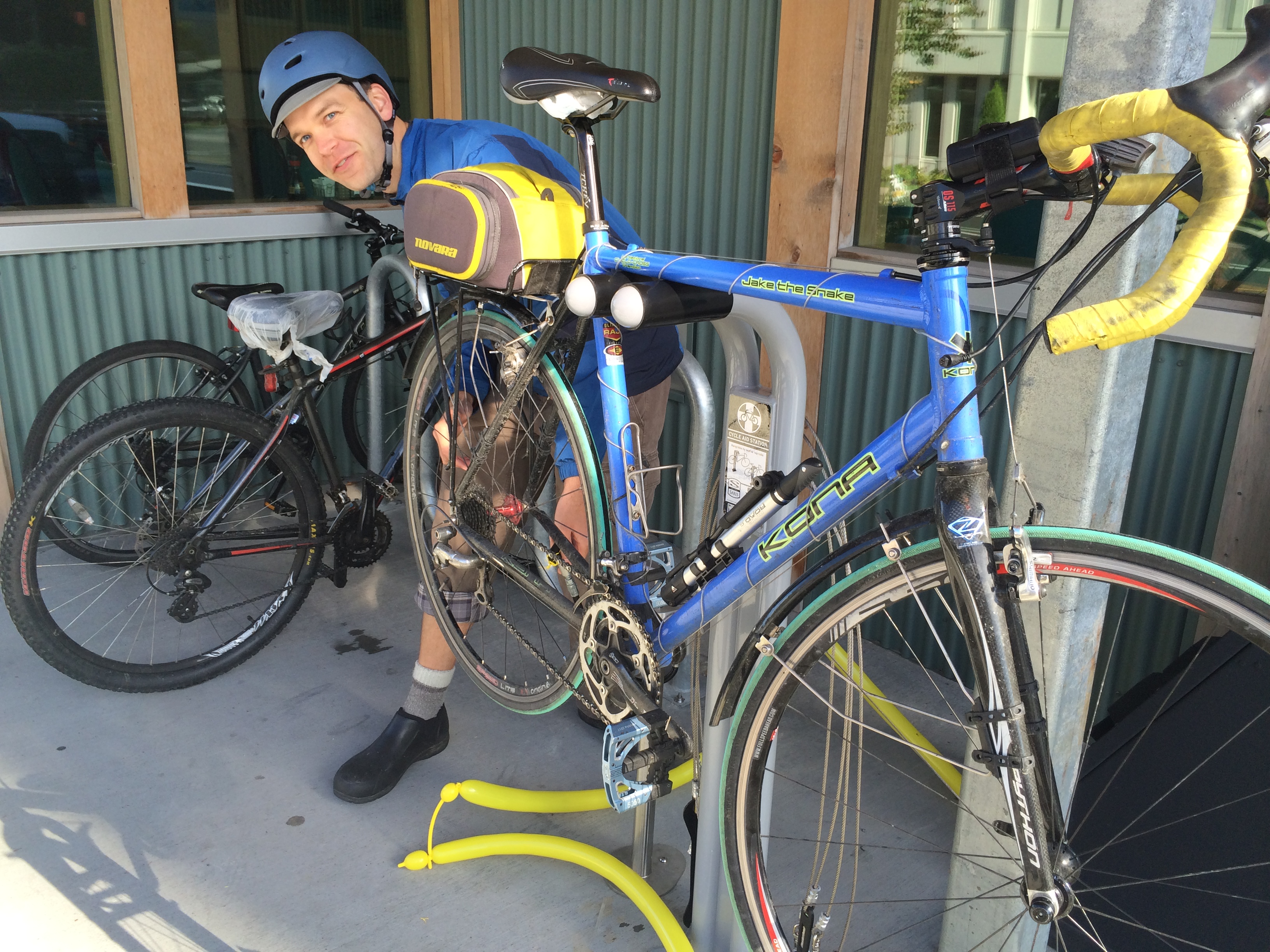
Corey McKrill uses the new bike station’s stand, tools and pump to work on his bike. (Photo by Scott Burton/KTOO)
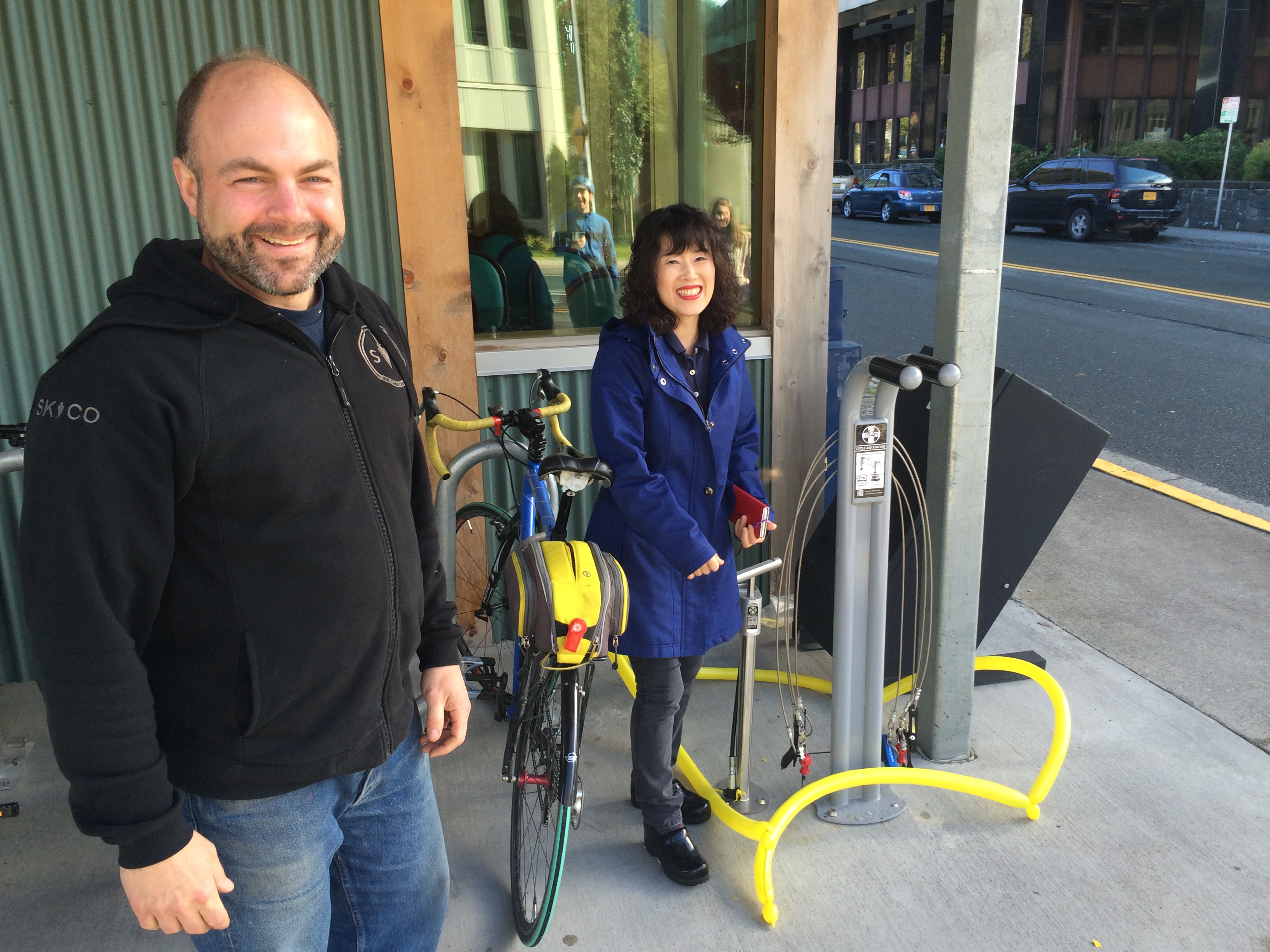
About a dozen people gathered this morning at the corner of West Ninth Street and Glacier Avenue for a balloon popping at a new bicycle repair station.
Instead of a ribbon cutting, project organizers Marc Wheeler and Jeong Kim used the new bike station’s pump to pop a balloon. (Photo by Scott Burton/KTOO)
The free, 24-hour station includes a bike rack, a bike stand, a pump and an array of tools. Corey McKrill, who is a founder of the bike advocacy group Juneau Rides, put his bike on the stand to try it out. He lives in the flats and thinks it will be a useful to him as a commuter and for neighborhood kids.
“Here’s a tire lever so if I needed to replace the tube in my tire I could use this to get the tire off and get into the bike tube. And here’s the pump I can use to inflate the tube after I replace it,” said McKrill.
The fix-it station was organized by neighborhood businesses and residents including Marc Wheeler of Coppa, Jeong Kim of Seong’s, Todd Mace of Pixel & Plume Design Co., Lacey Godkin of Capital Brew and John McConnochie of Cycle Alaska.
The public stations are trending; there’s one at Cycle Alaska, two are being installed at the University of Alaska Southeast and one is planned for the new Mendenhall Valley Public Library.
Close
Update notification options
Subscribe to notifications
Subscribe
Get notifications about news related to the topics you care about. You can unsubscribe anytime.