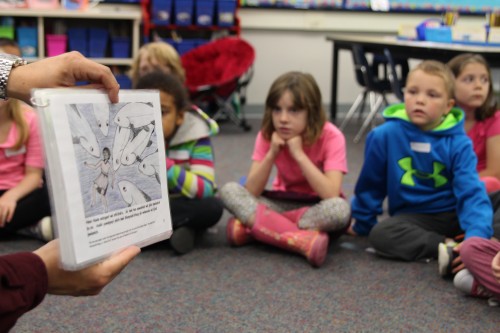
First graders in Jessica Christianson’s class are absorbed by Tlingit stories about salmon, read by Chuck Miller of the Sitka Native Education Program. (Photo by Emily Kwong/KCAW)
If you’ve ever watched salmon merge at the mouth of the river, it’s similar to the scene at Baranof Elementary School. The buses unloaded a school of students, dressed in bright coats with reflective patches, flashing silver. The kids had reason to be excited: Regular class would be suspended for a day of learning.
The school has been hosting a Salmon Celebration Day for the past 9 years.
Each class moves from room to room in 20 minute increments, taking part in different activities. Mark Lee, the principal at Baranof Elementary, said it can be pretty hectic.
“But it’s controlled chaos.” Lee said.
The kids listened to Tlingit stories, built a habitat out of construction paper and played a game about the salmon life cycle.
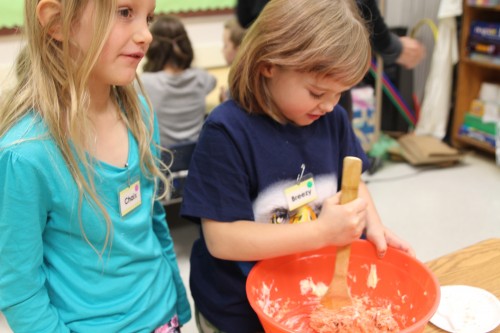
Chaix Mooney and Breezy Smathers take turns mixing salmon with mayonnaise and sour cream for salmon dip. All the fish was donated by Baranof parents. ( Photo by Emily Kwong/KCAW)
“It’s nice because the different types of learners that there are, there’s something that appeal to them in one way or another throughout the stations,” Lee said.
One way to do that is by appealing to the kids’ appetites. Teacher Jeffrey Hole wore a tie shaped like a salmon and showed the students how to make salmon dip in four easy steps. The classroom was stocked with boxes of Ritz crackers and several pounds of fish, all donated by Baranof parents.
Dylan Radziukinas, a student, wasn’t a fan of Step #1, which involved separating salmon from the bones.
“When we touched it it felt all gooey and mushy,” Radziukinas said.
But he was a fan of the final product.
Hole says that the goal of his workshop, like all the workshops, is to make this critical resource familiar and fun to first graders–even if that means making a bit of a mess.
The Juneau Police Department says it’s the sixth heroin-related death this year. James Robert Hanson, 48, was discovered by his brother in the family home. In a news release, the police department said it appears Hanson overdosed while the family was in another room.
Juneau police typically don’t release information about in-home, unsuspicious deaths, but Hanson’s mother gave specific permission. She was distressed over the large number of heroin deaths in the capital city.
The family believes Hanson relapsed. The police department is continuing to investigate the death and has requested an autopsy by the State Medical Examiner.
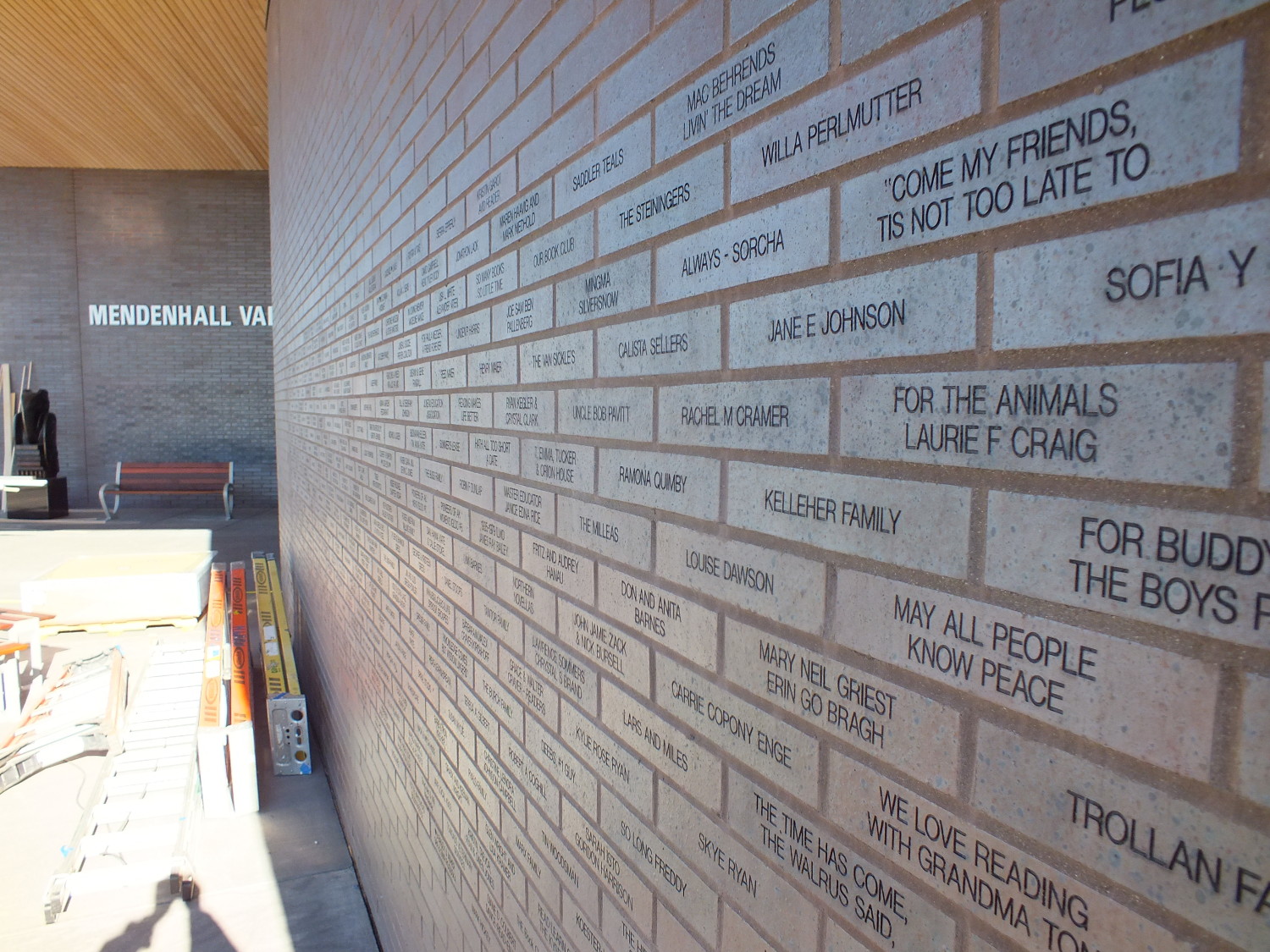
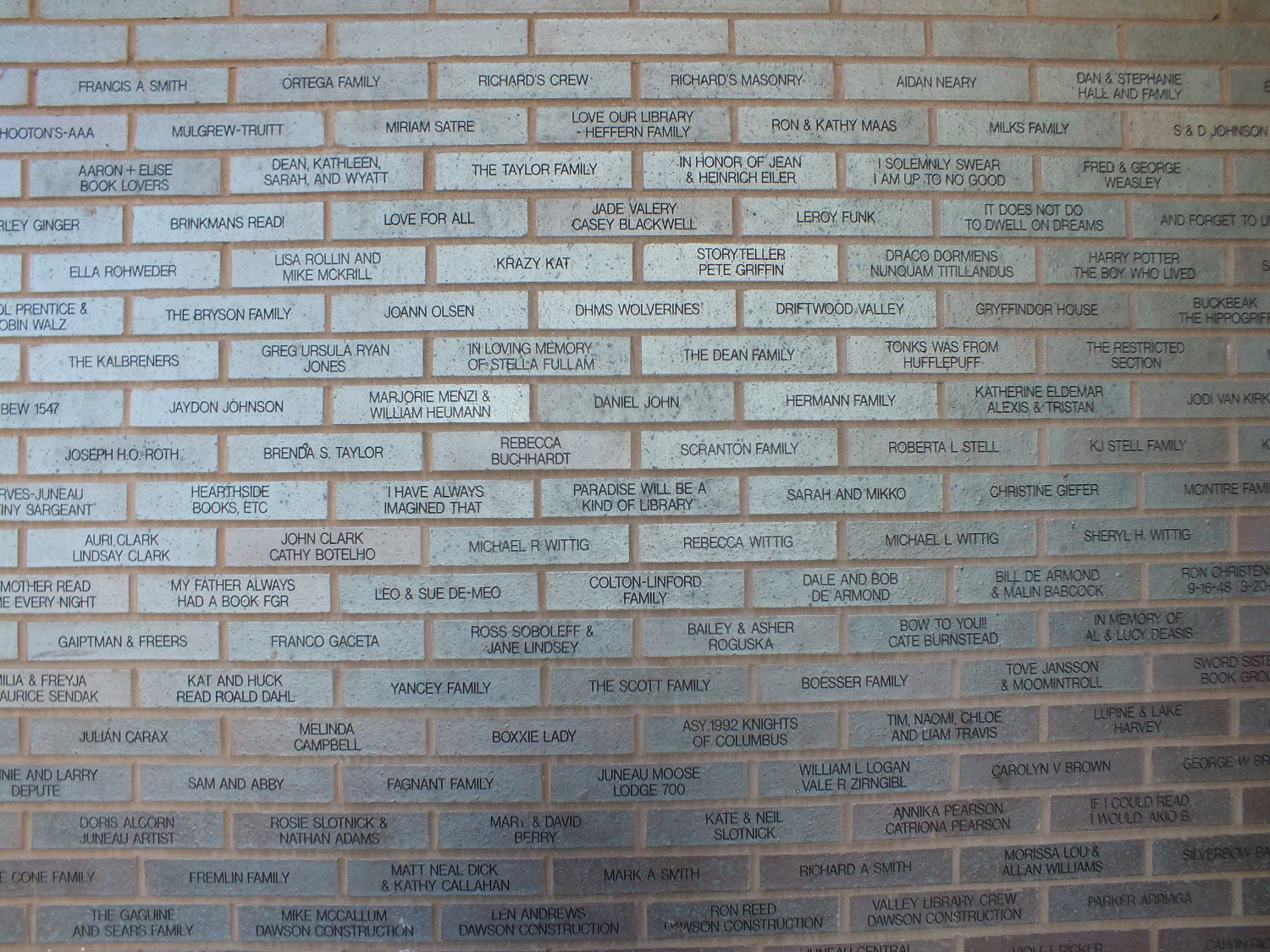
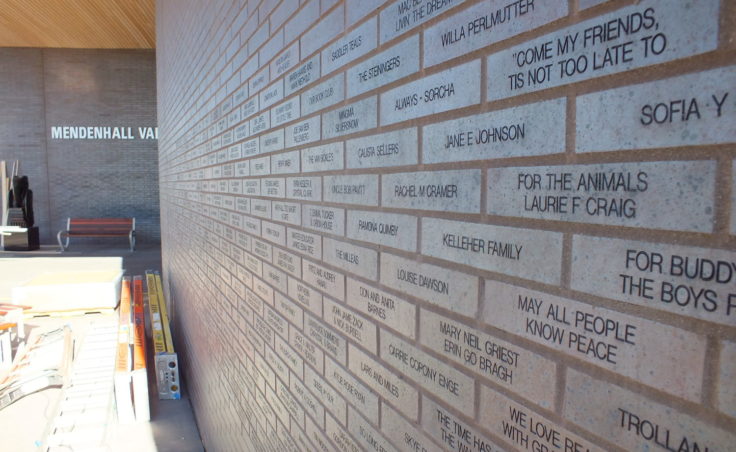
The names of donors to the new Mendenhall Valley Public Library are engraved on bricks. (Photo by Matt Miller/KTOO)
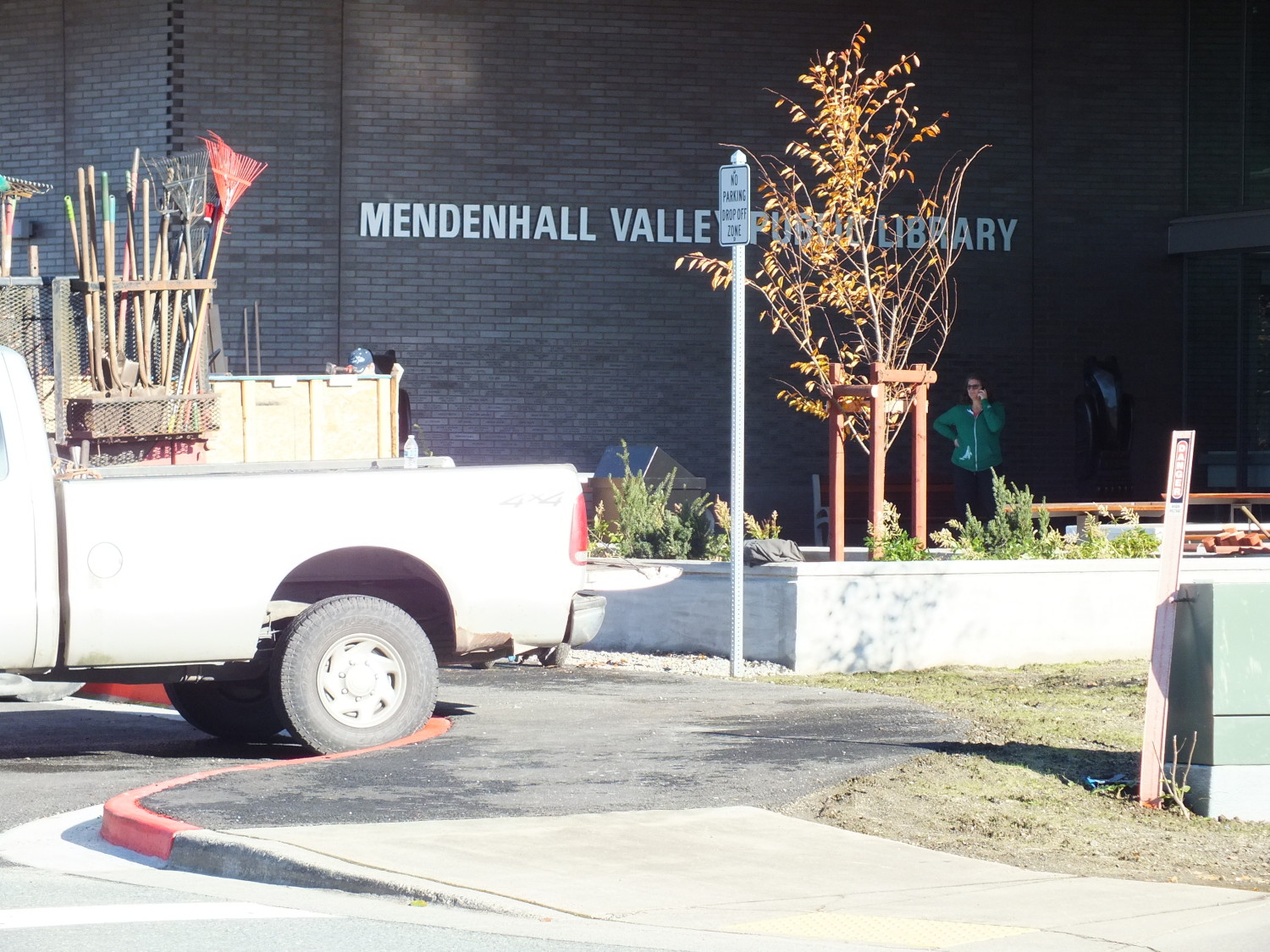
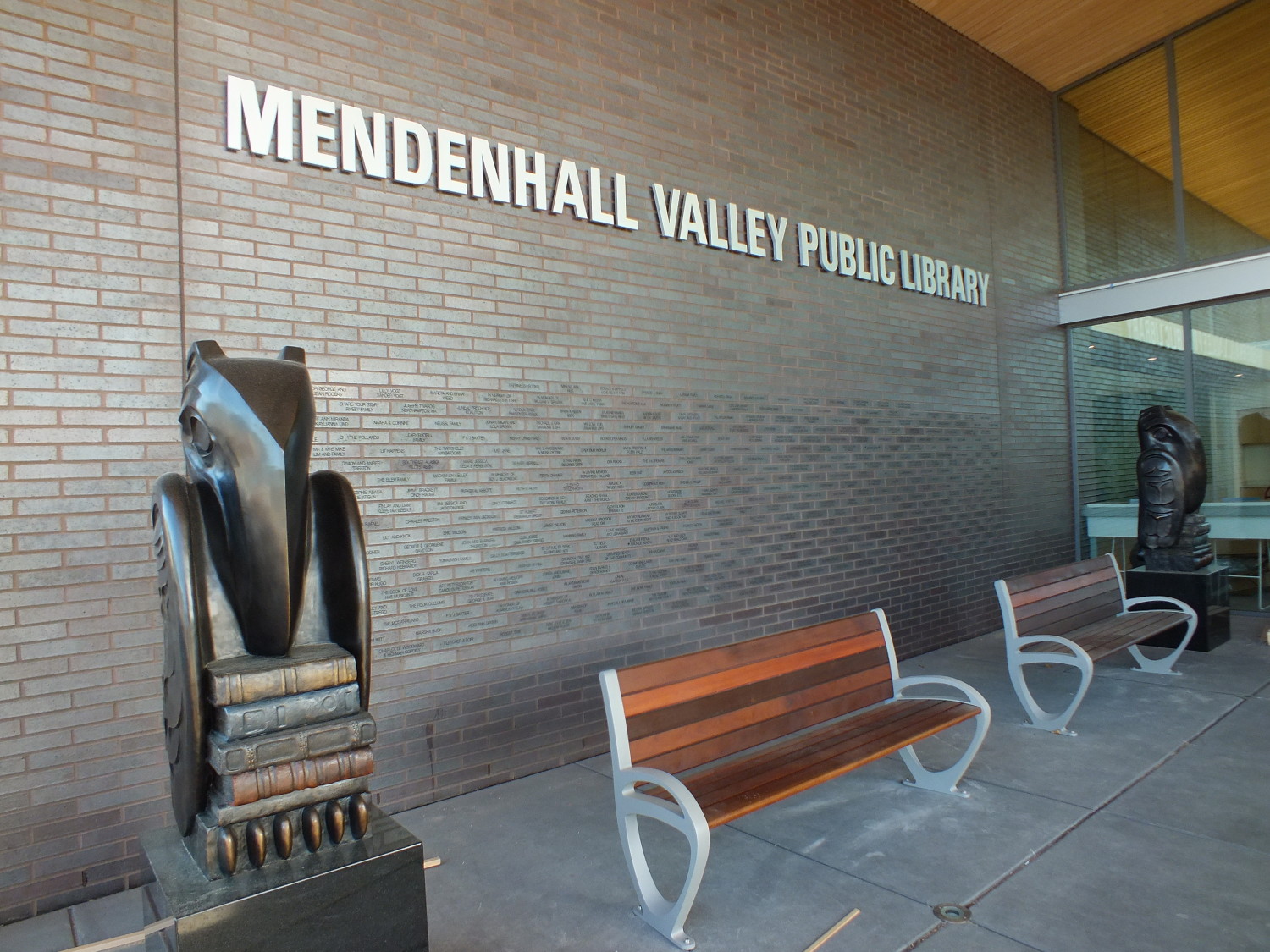
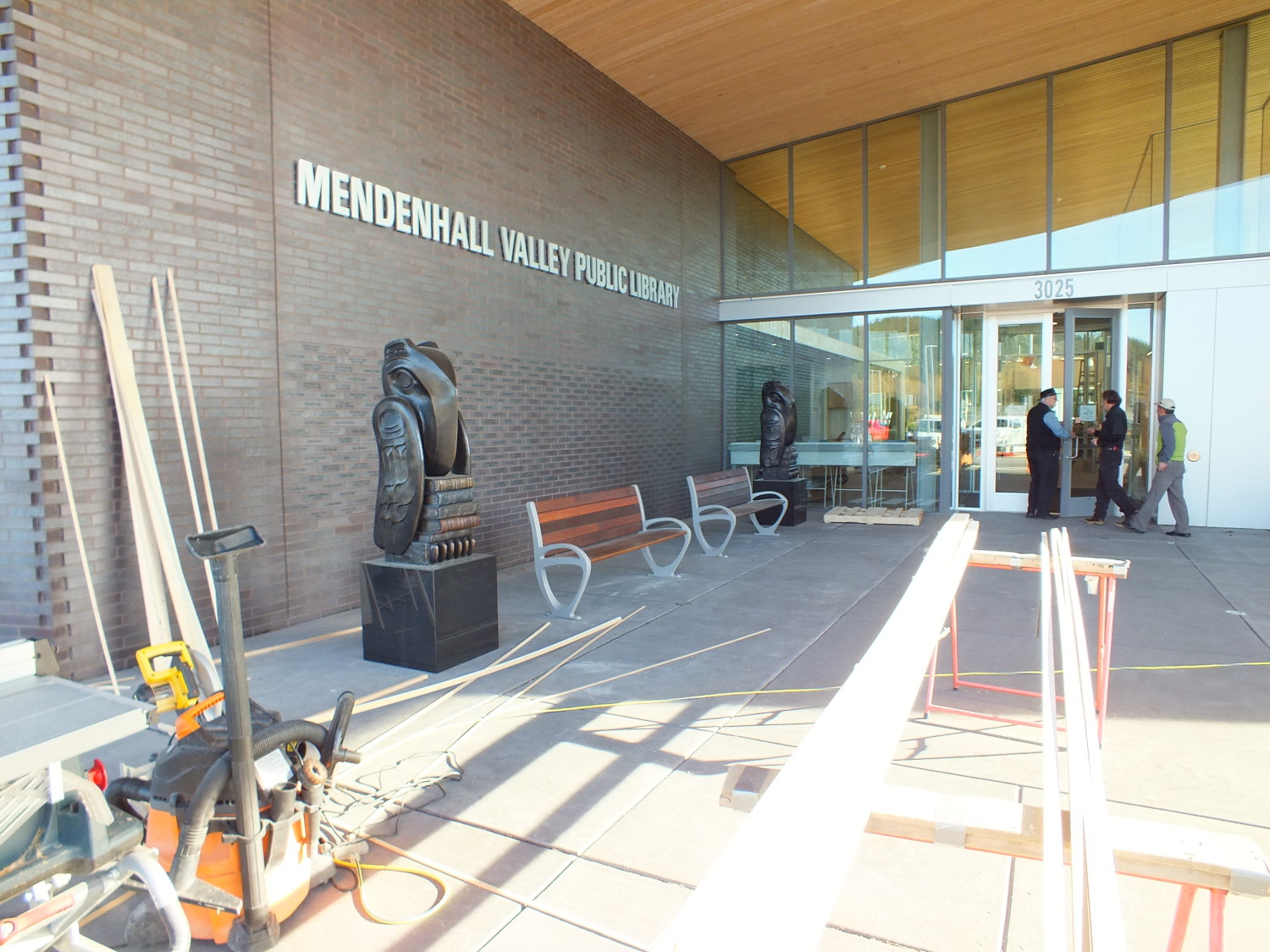
The entry to the new Mendenhall Valley Public Library. (Photo by Matt Miller/KTOO)
The new Mendenhall Valley Public Library. (Photo by Matt Miller/KTOO)
The names of donors to the new Mendenhall Valley Public Library are engraved on bricks. (Photo by Matt Miller/KTOO)
The new Mendenhall Valley Public Library. (Photo by Matt Miller/KTOO)
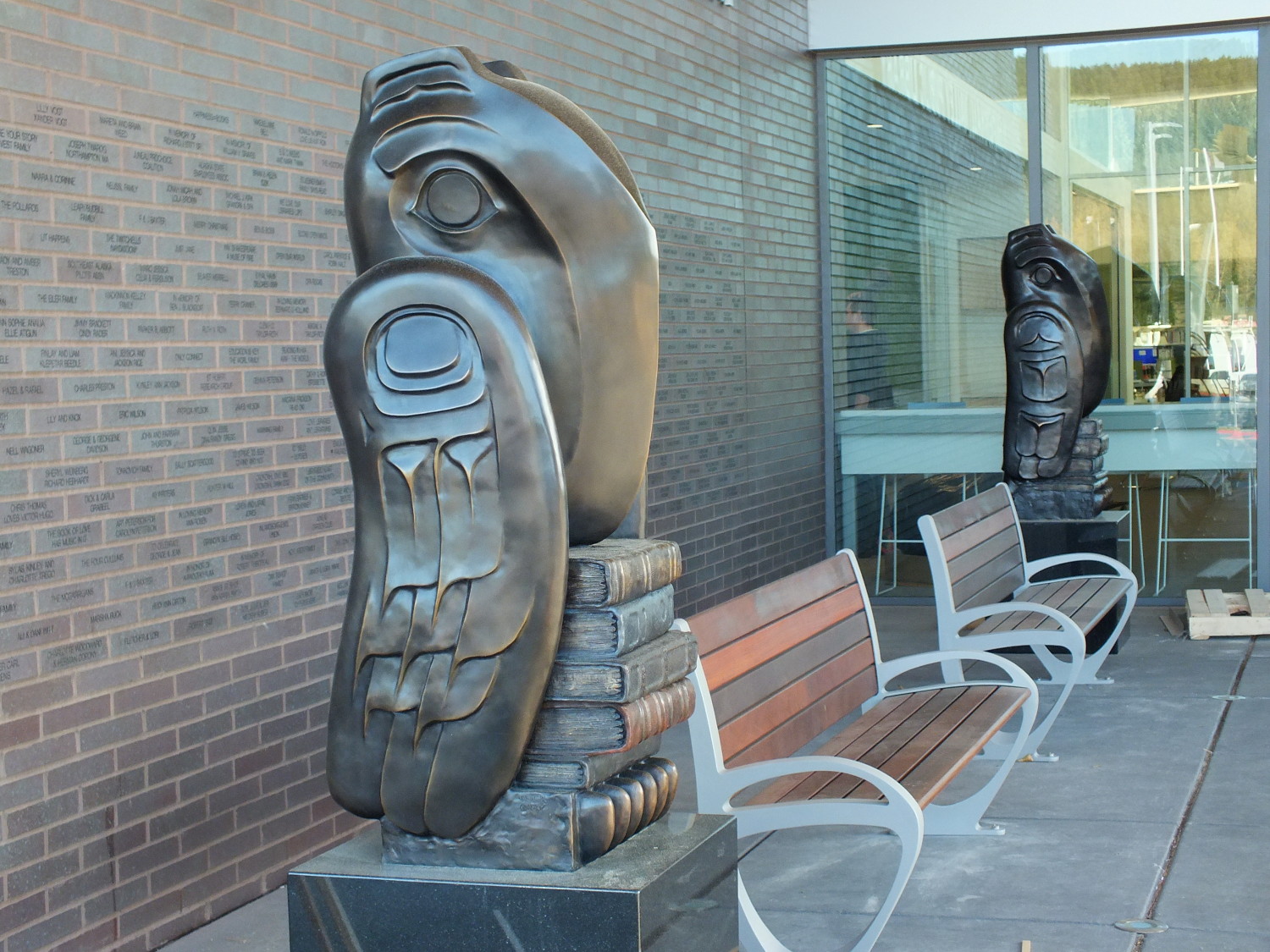
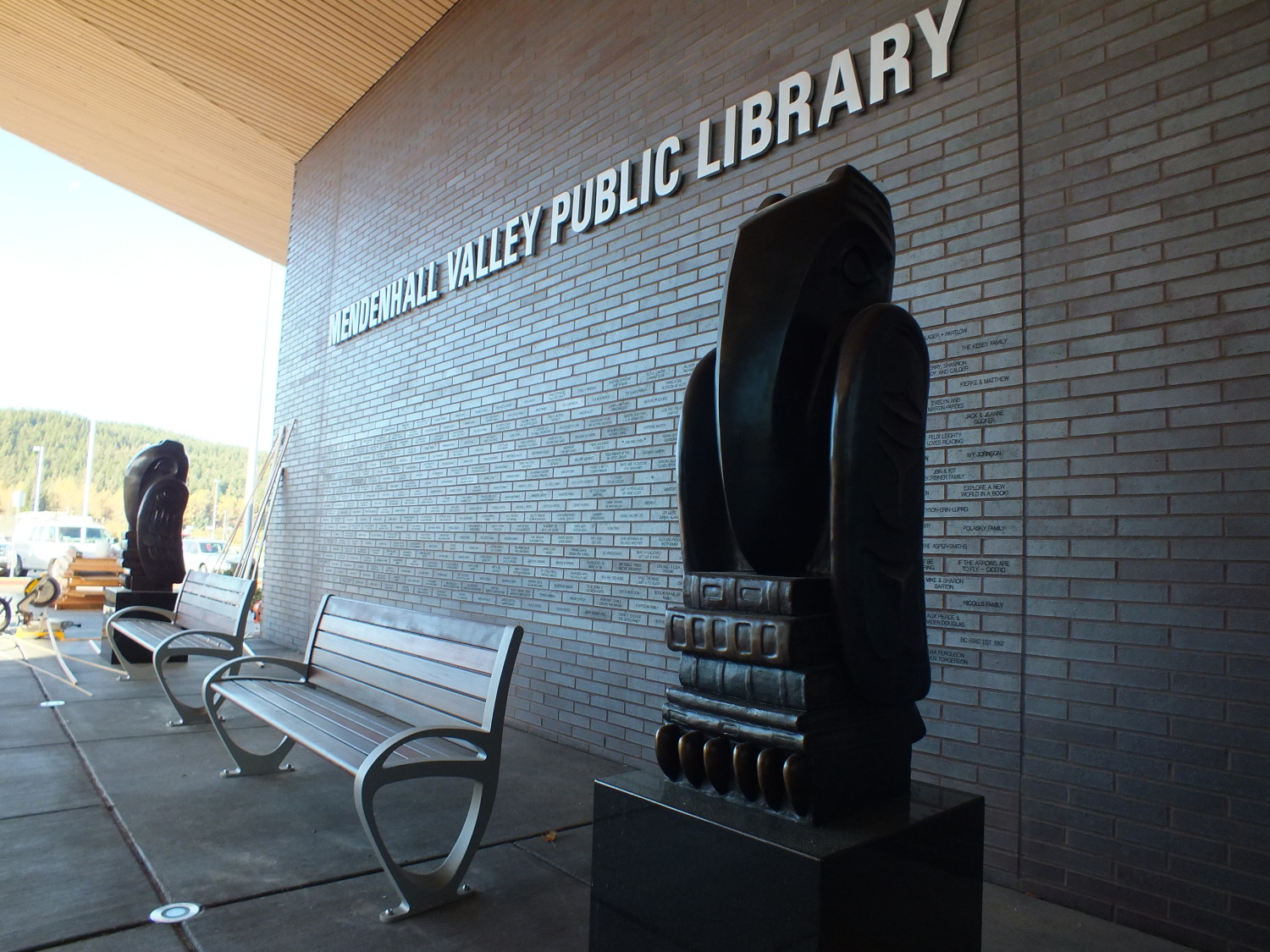
The main entry features bronze sculptures by Dan DeRoux. (Photo by Matt Miller/KTOO)
The main entry features bronze sculptures of Eagle and Raven bibliophiles by Dan DeRoux. (Photo by Matt Miller/KTOO)
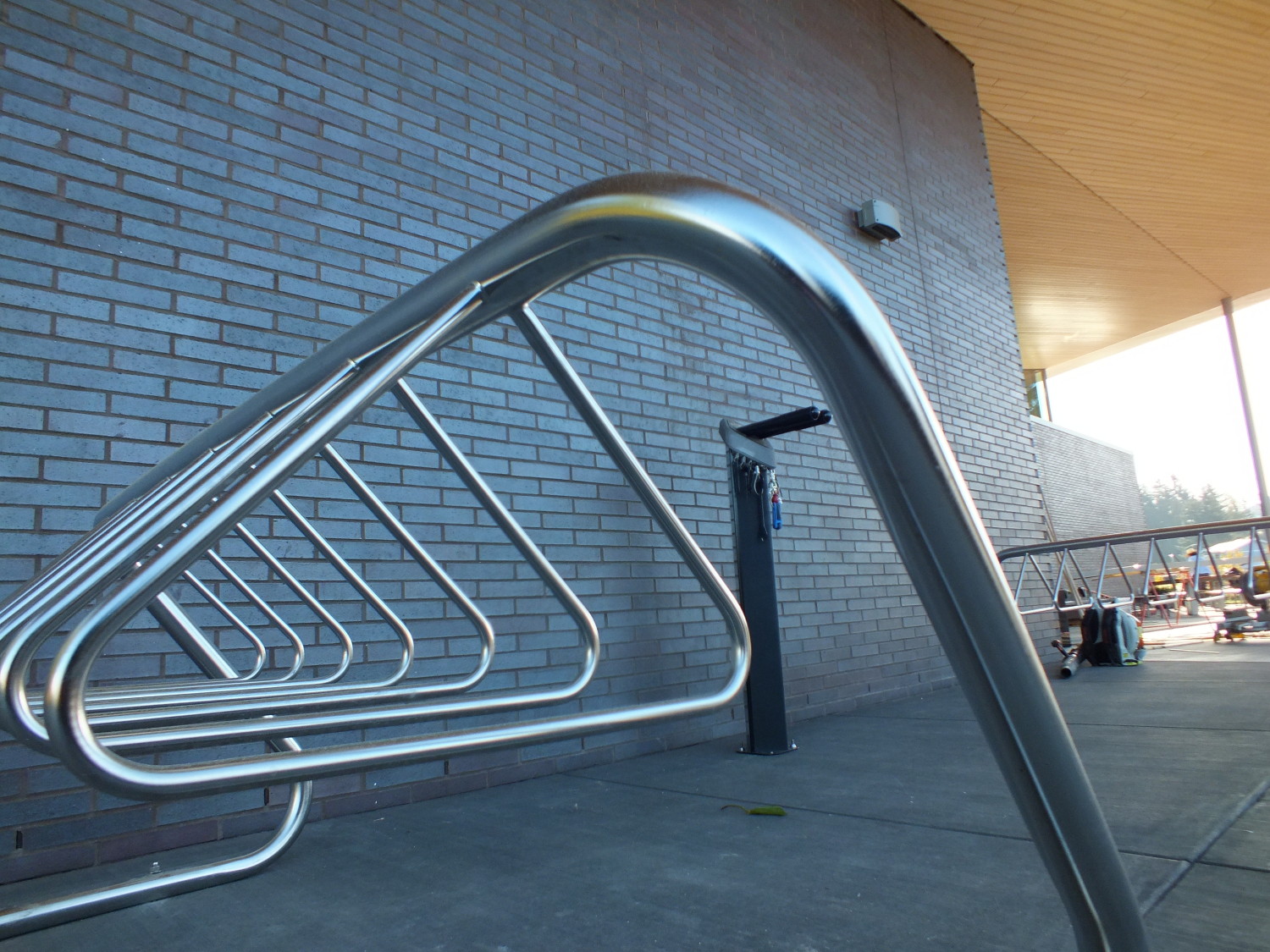
Bike rack and repair station at the new Mendenhall Valley Public Library. (Photo by Matt Miller/KTOO)
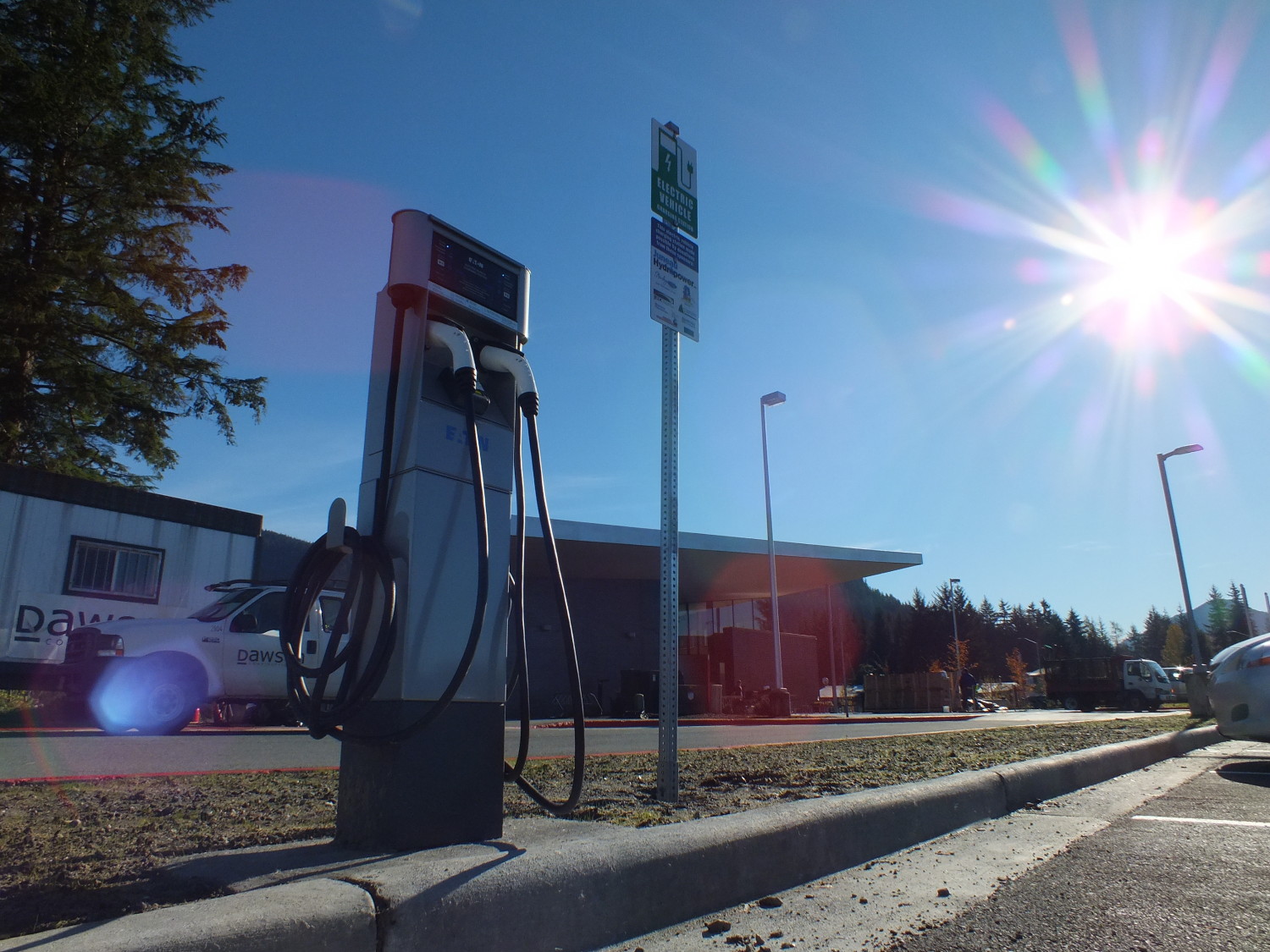
An electric vehicle charging station at the new Mendenhall Valley Public Library. (Photo by Matt Miller/KTOO)
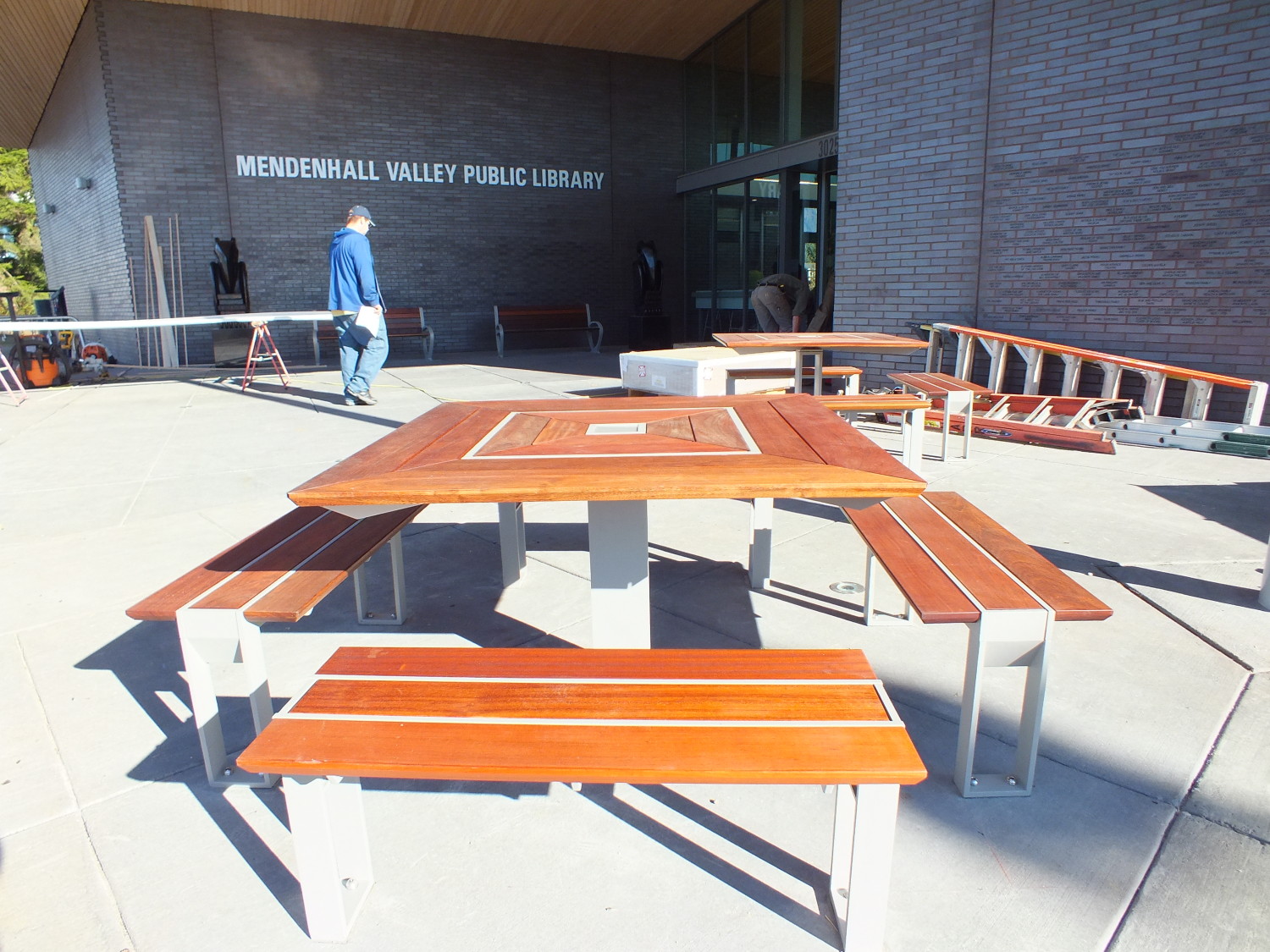
Outdoor seating at the new Mendenhall Valley Public Library. (Photo by Matt Miller/KTOO)
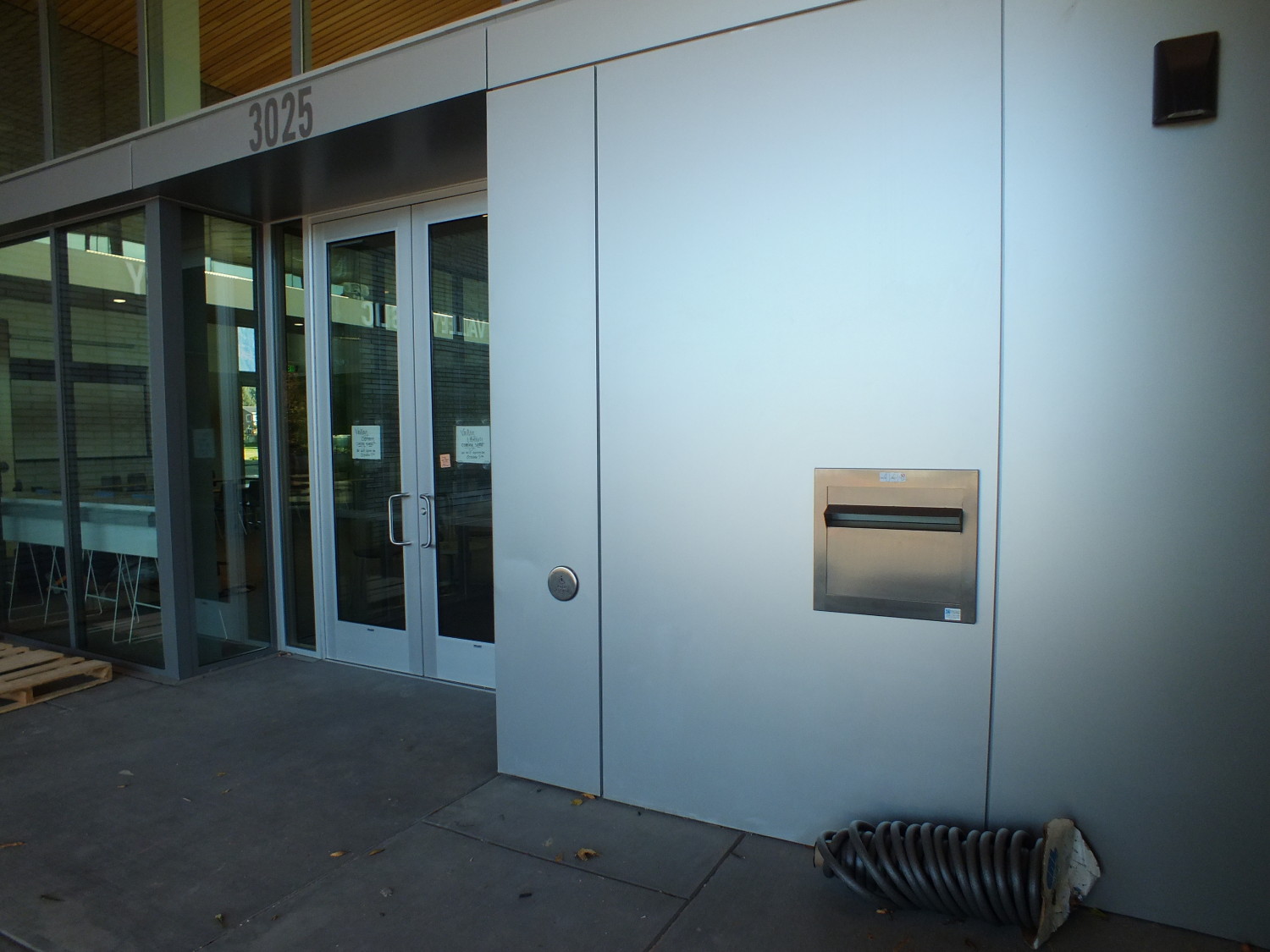
Book drop-off at the new library. (Photo by Matt Miller/KTOO)
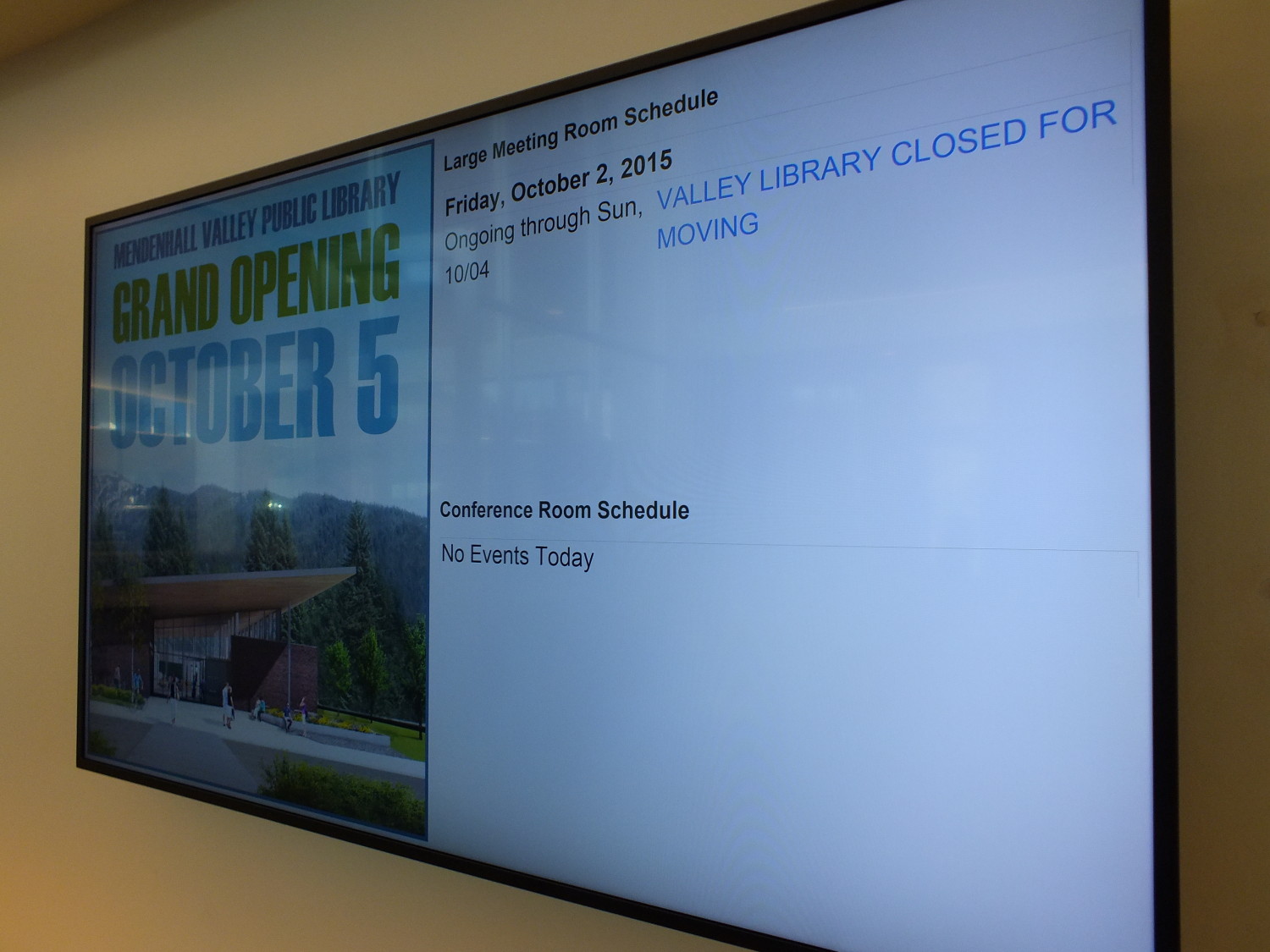
Notice display board is located in the entrance of the new Mendenhall Valley Public Library. (Photo by Matt Miller/KTOO)
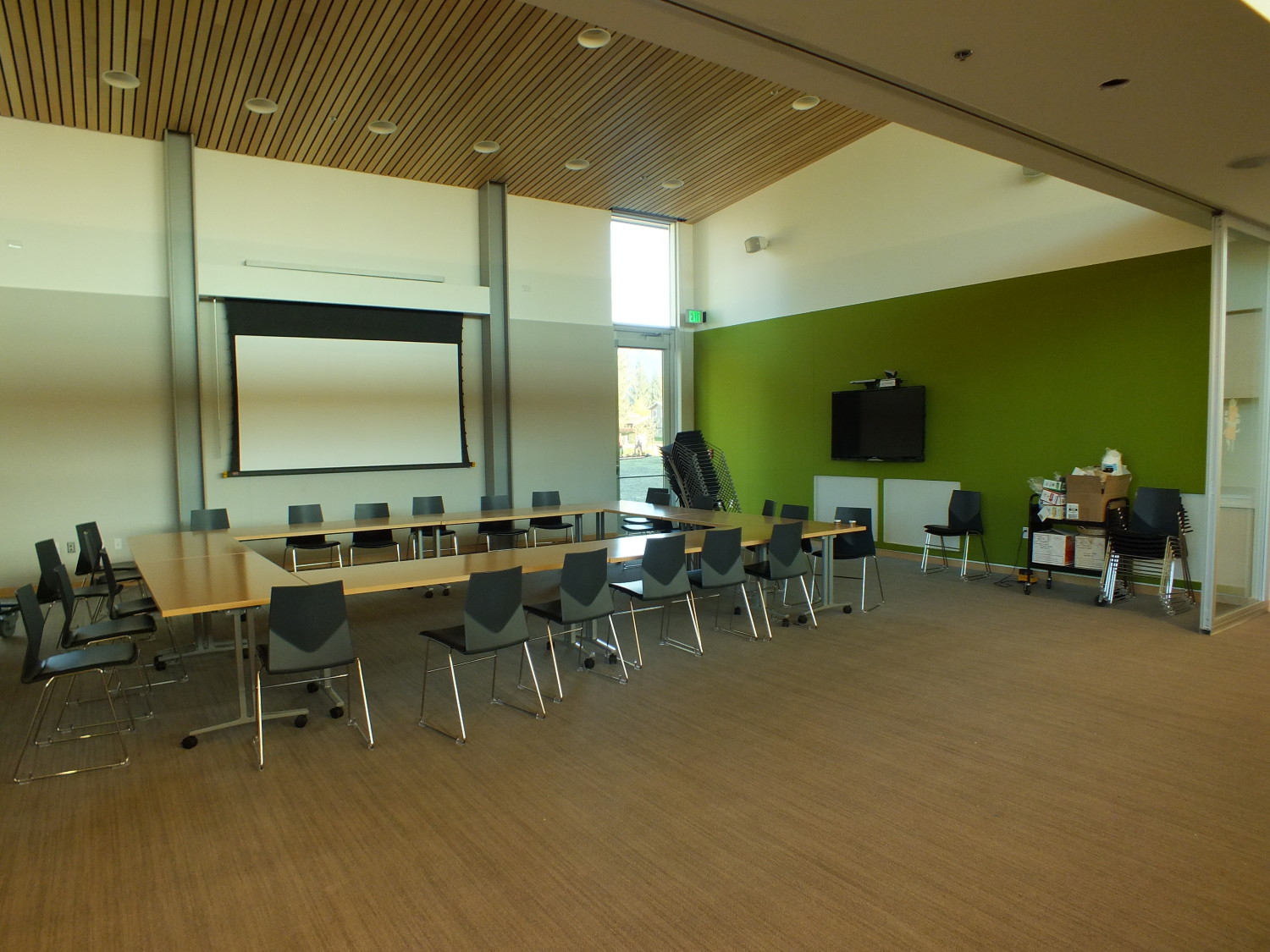
Meeting room at the entrance of the new Mendenhall Valley Public Library. (Photo by Matt Miller/KTOO)
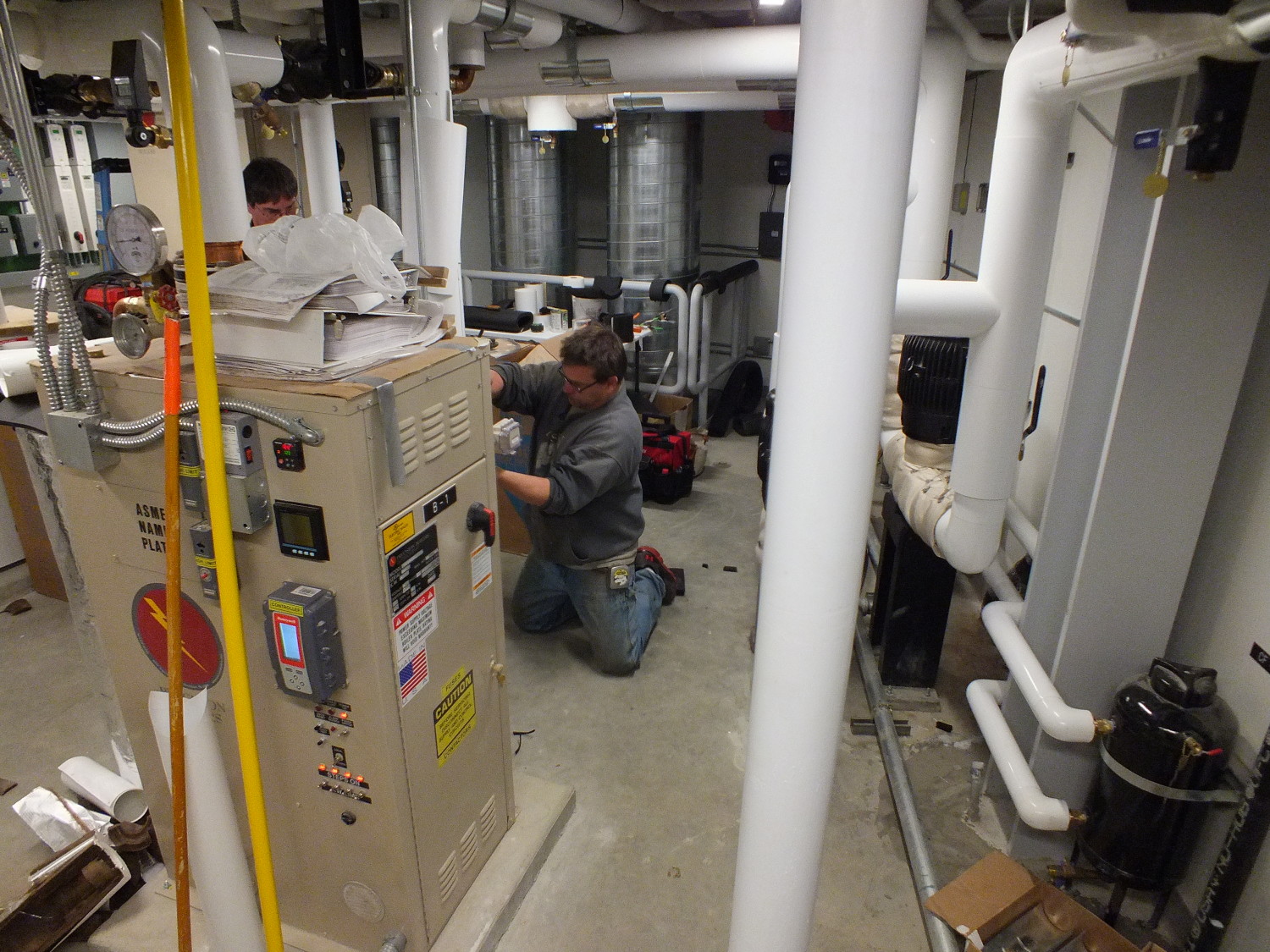
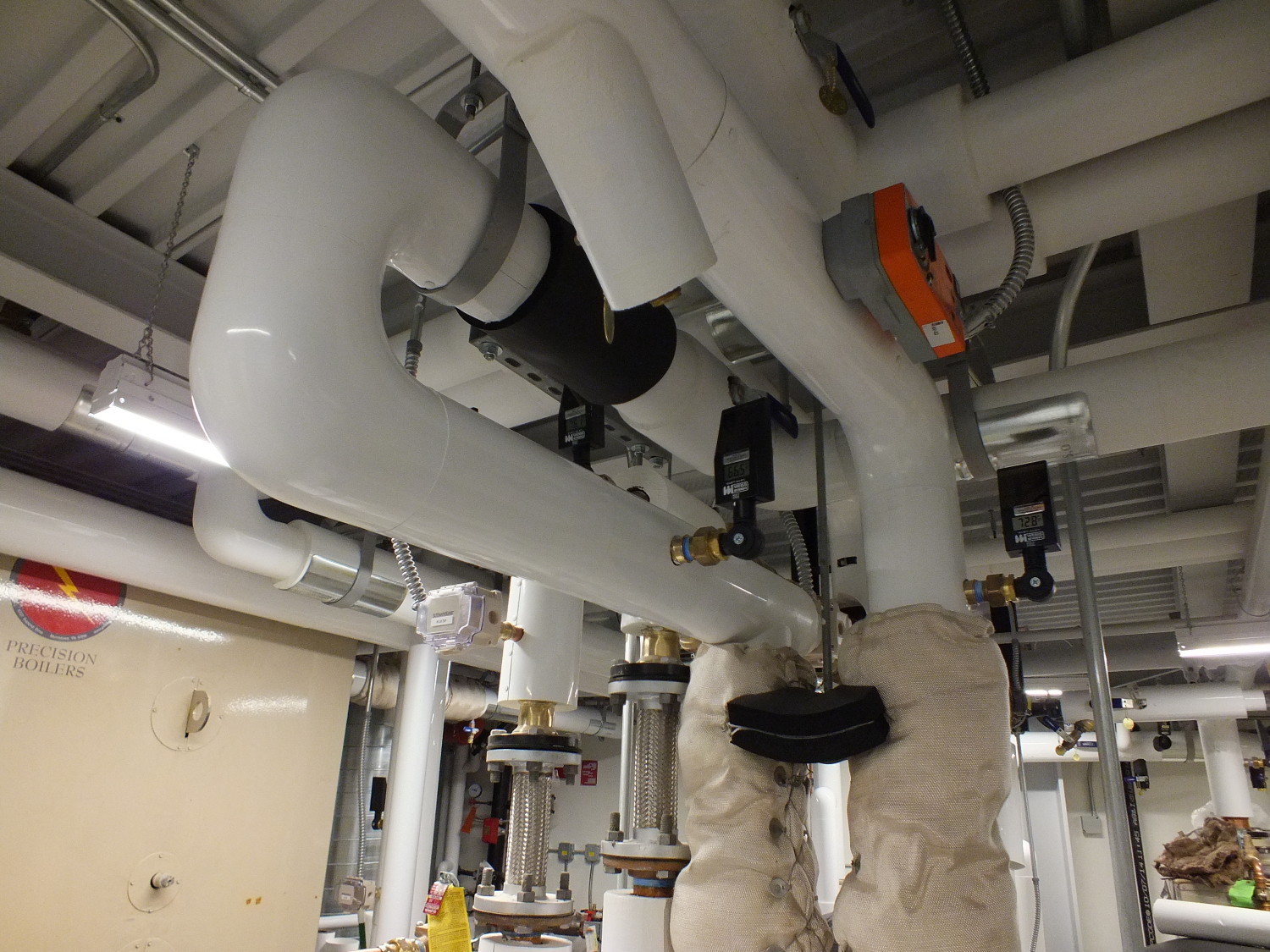
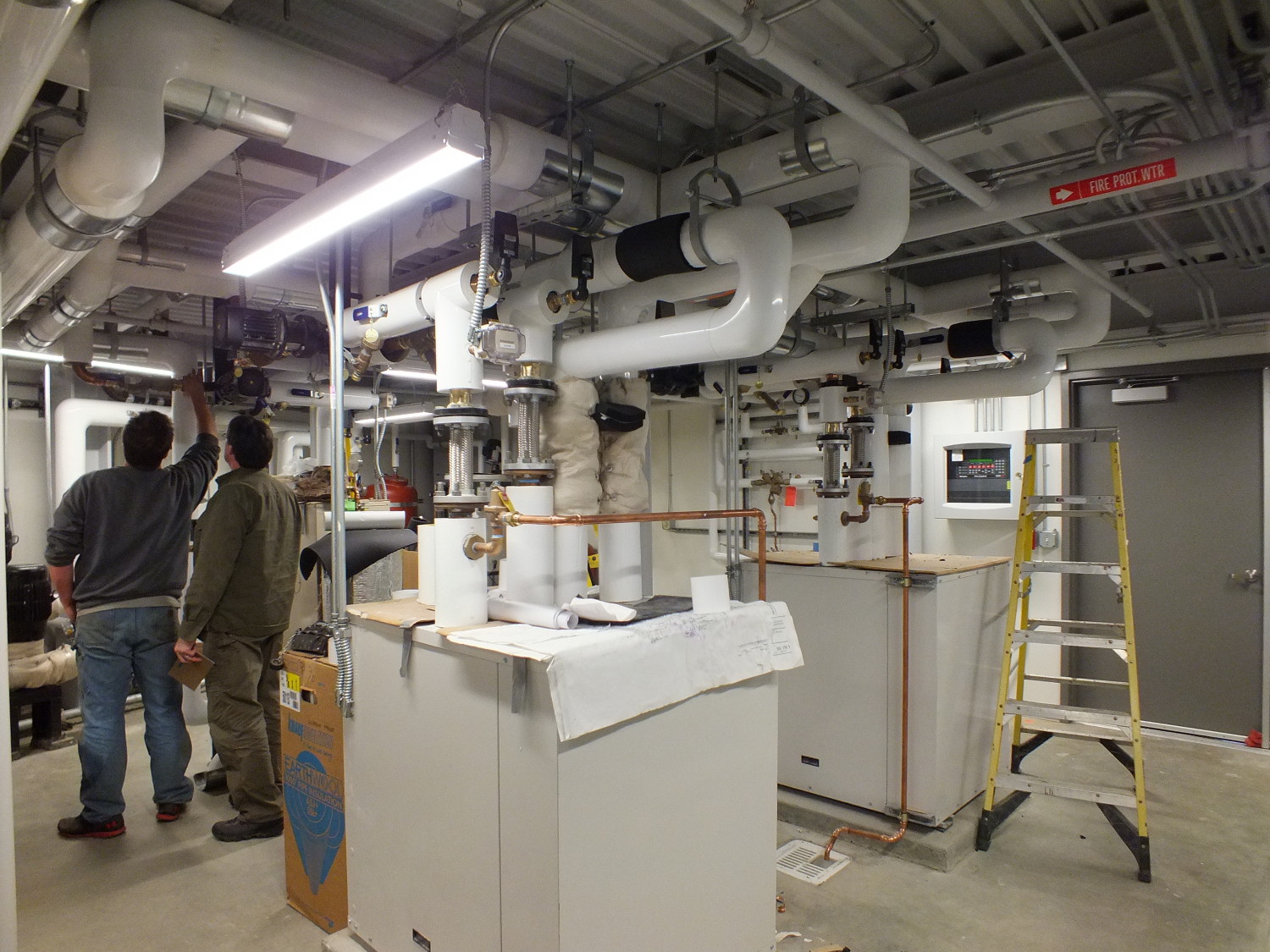
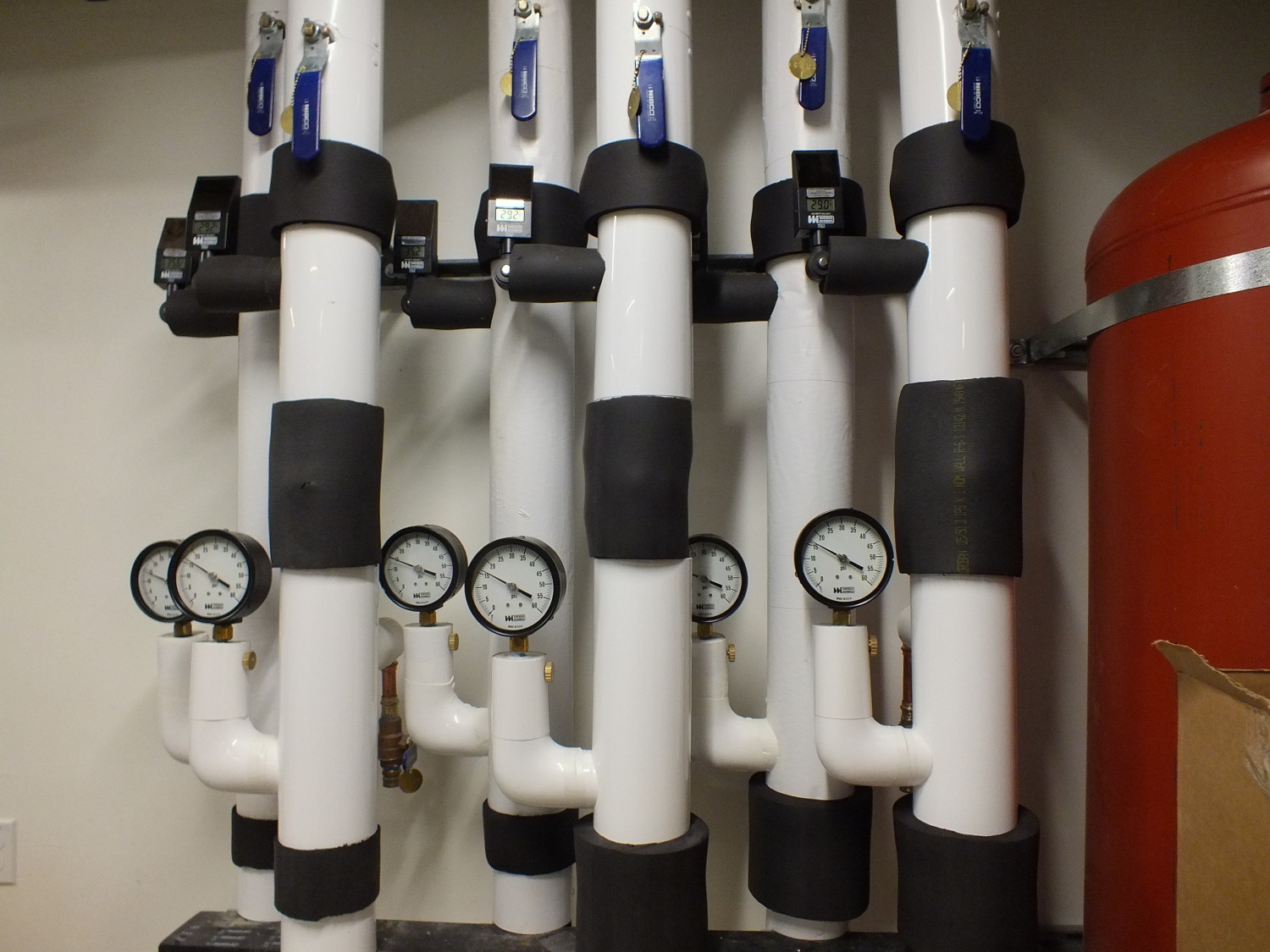
Mechanical room in the new Mendenhall Valley Public Library features a ground source heat pump system. (Photo by Matt Miller/KTOO)
Ground source heat pumps are connected to eight, 300 foot wells located under the parking lot at the new Mendenhall Valley Public Library. (Photo by Matt Miller/KTOO)
Ground source heat pump system uses a mixture of water and glycol to heat the main slab of the new library. (Photo by Matt Miller/KTOO)
Piping in the mechanical room in the new Mendenhall Valley Public Library. (Photo by Matt Miller/KTOO)
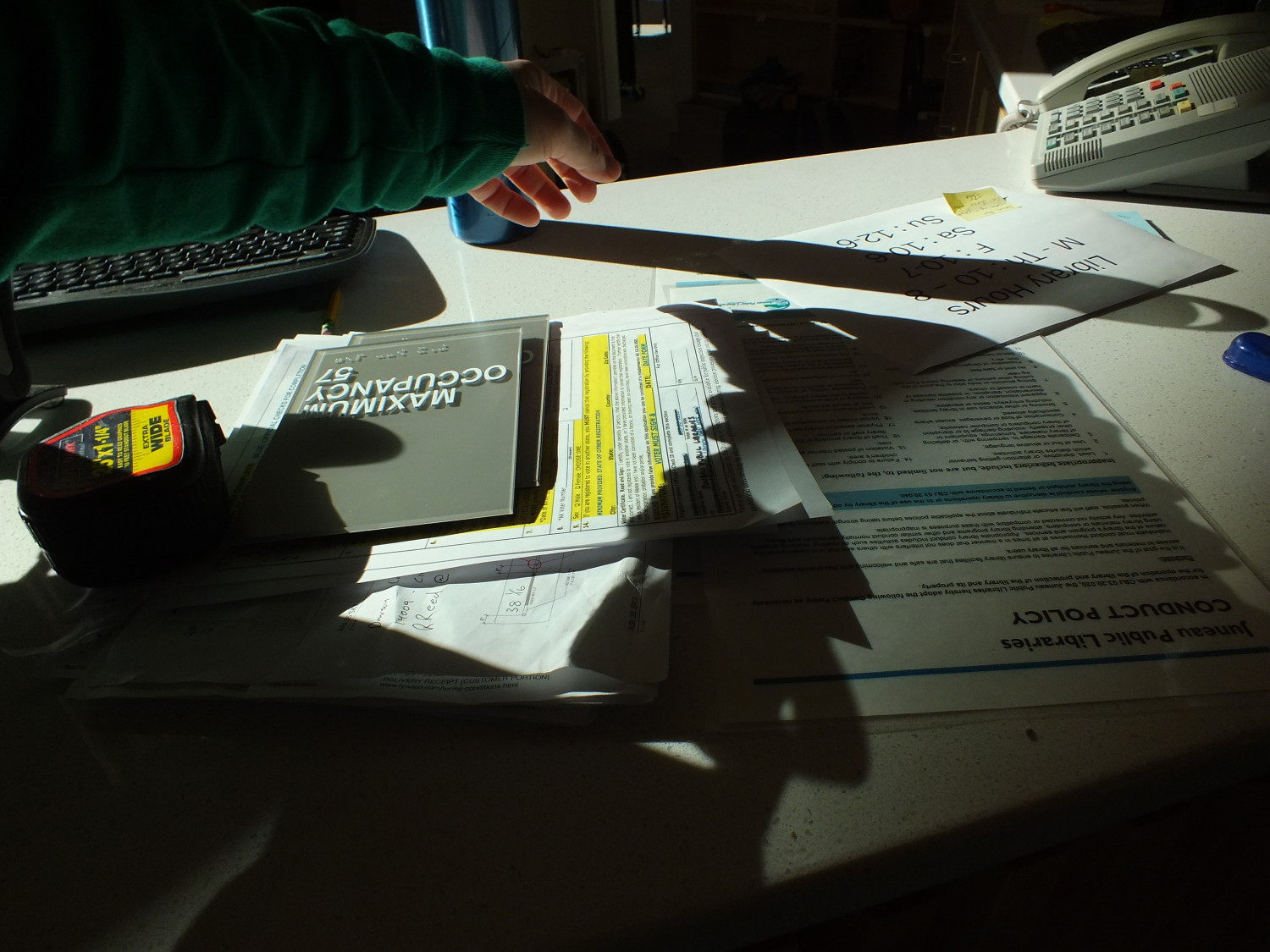
For now, opening hours will be the same as they were at the old location: 10-8 Monday through Thursday, 10-7 Friday, 10-6 Saturday, and 12-6 Sunday. (Photo by Matt Miller/KTOO)
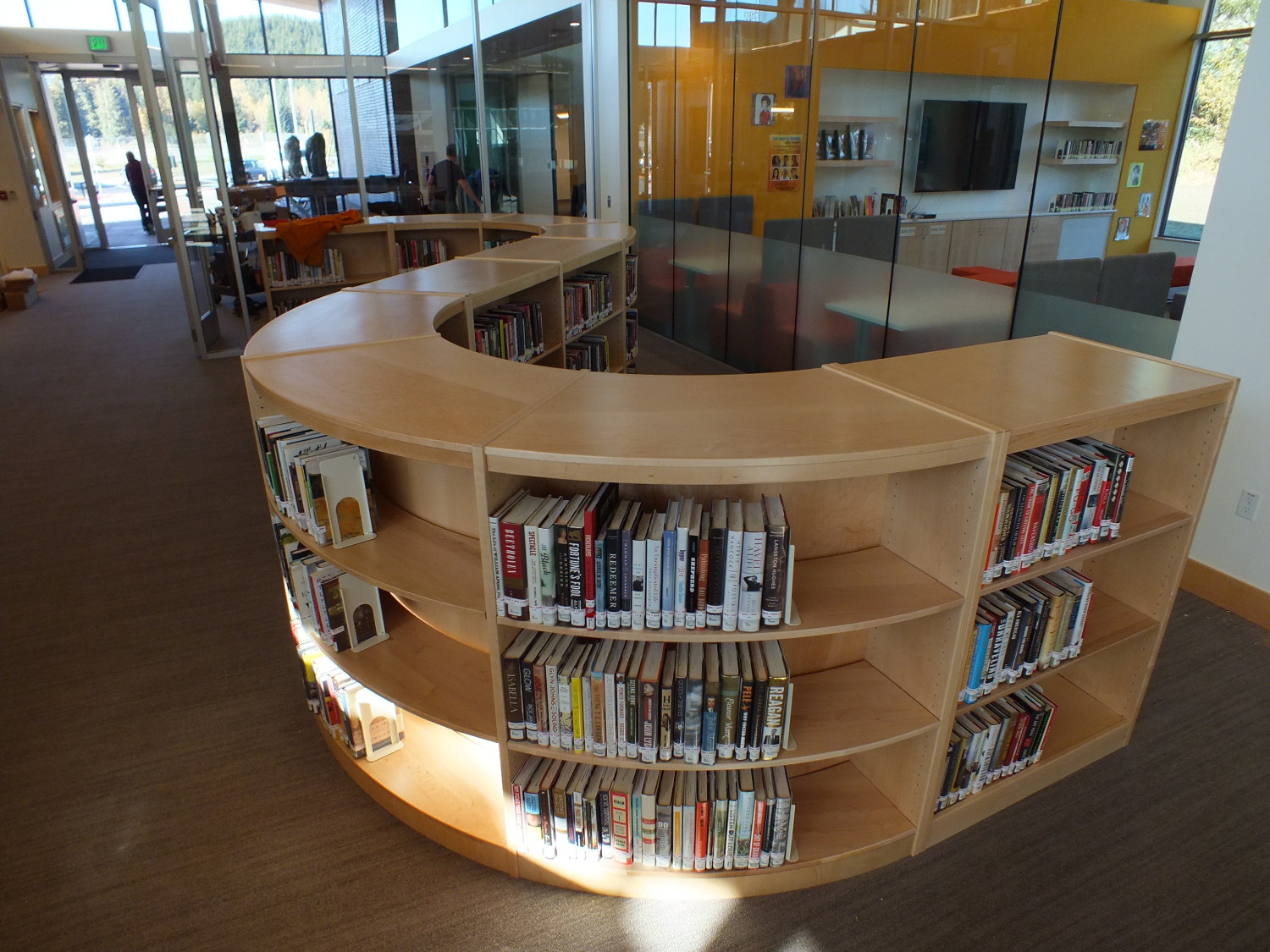
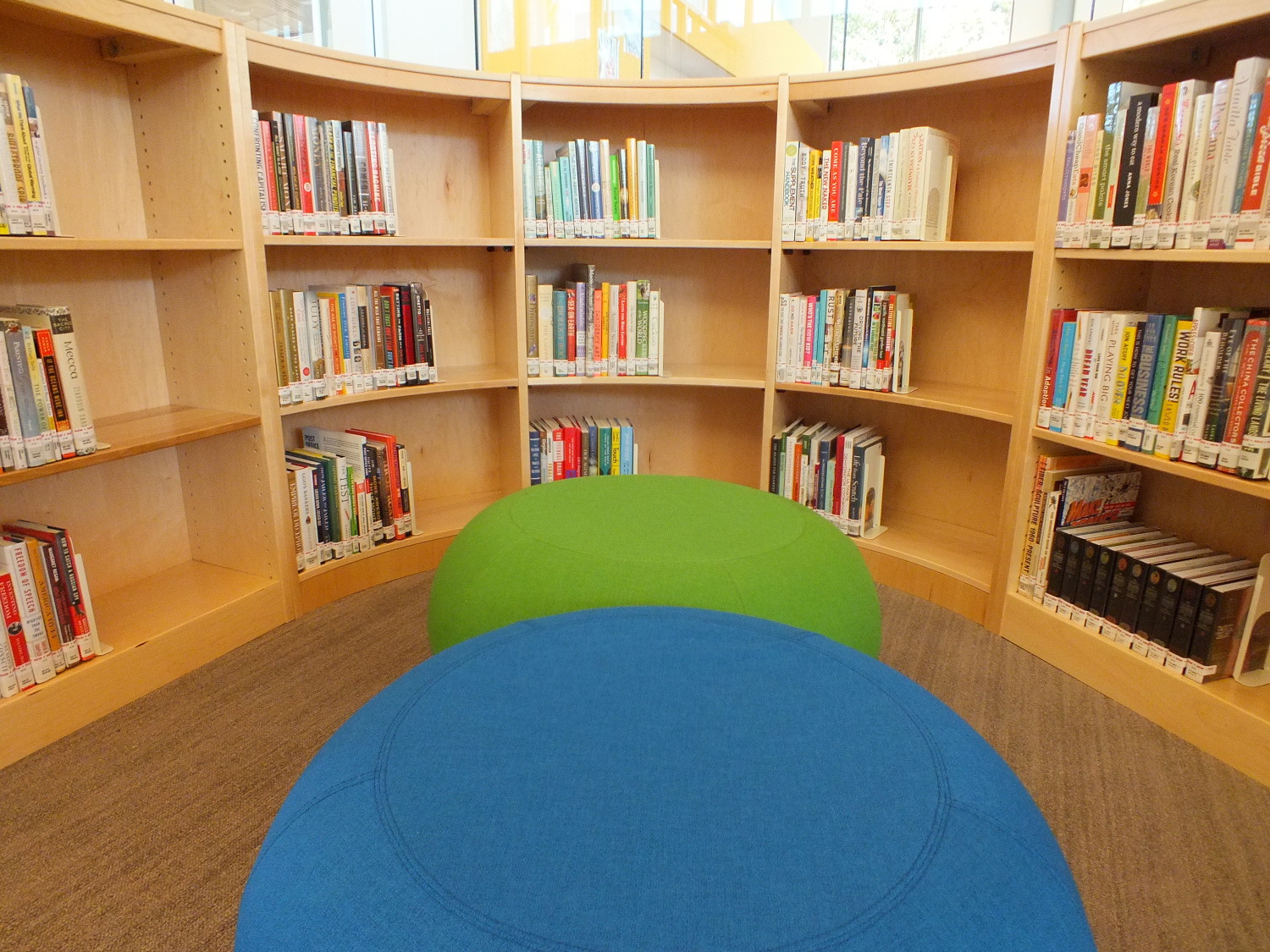
Serpentine book display feature new arrivals at the new Mendenhall Valley Public Library. (Photo by Matt Miller/KTOO)
... And you can sit while you peruse them. (Photo by Matt Miller/KTOO)
Work continues at the new Mendenhall Valley Public Library. (Photo by Matt Miller/KTOO)
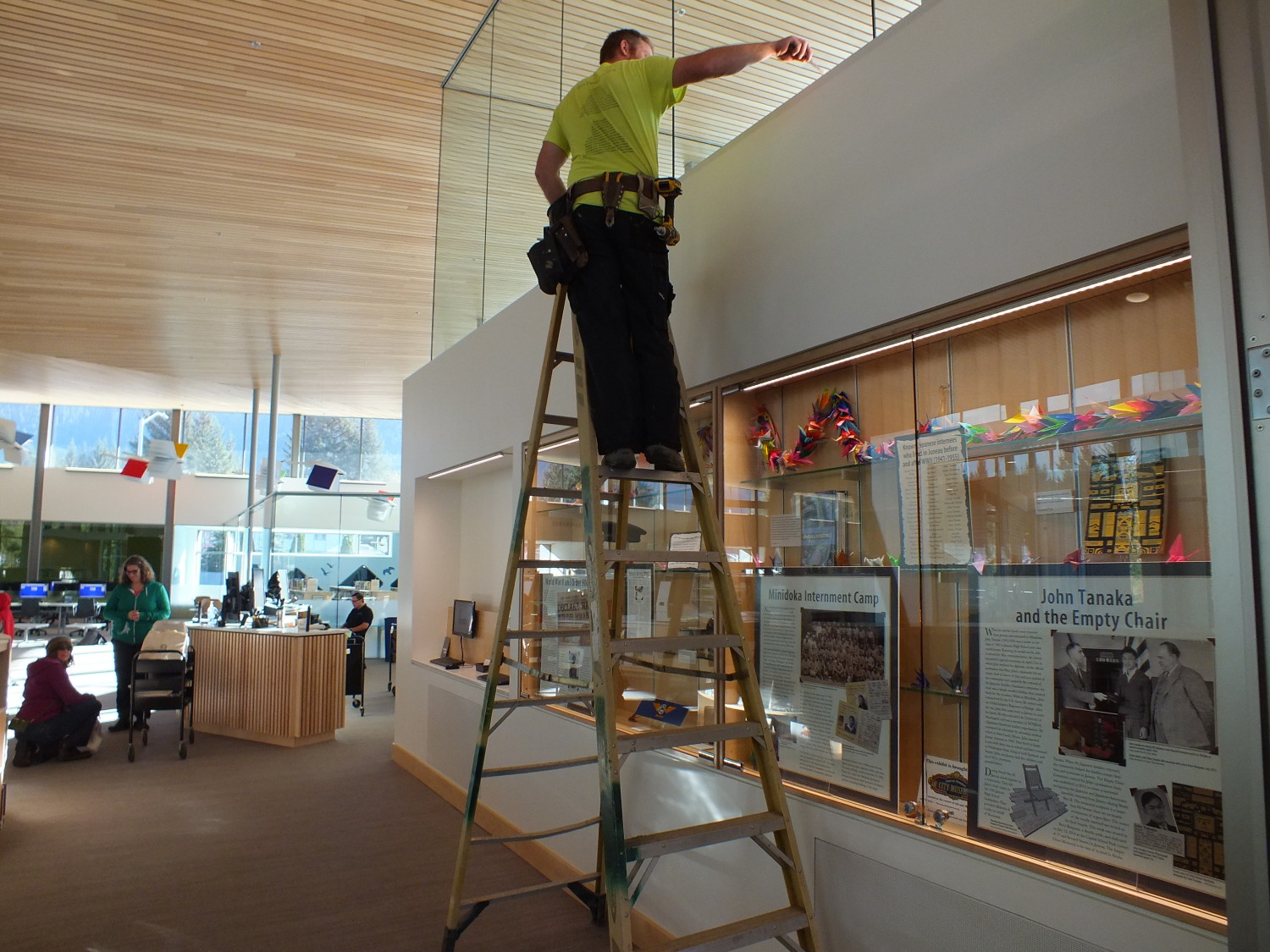
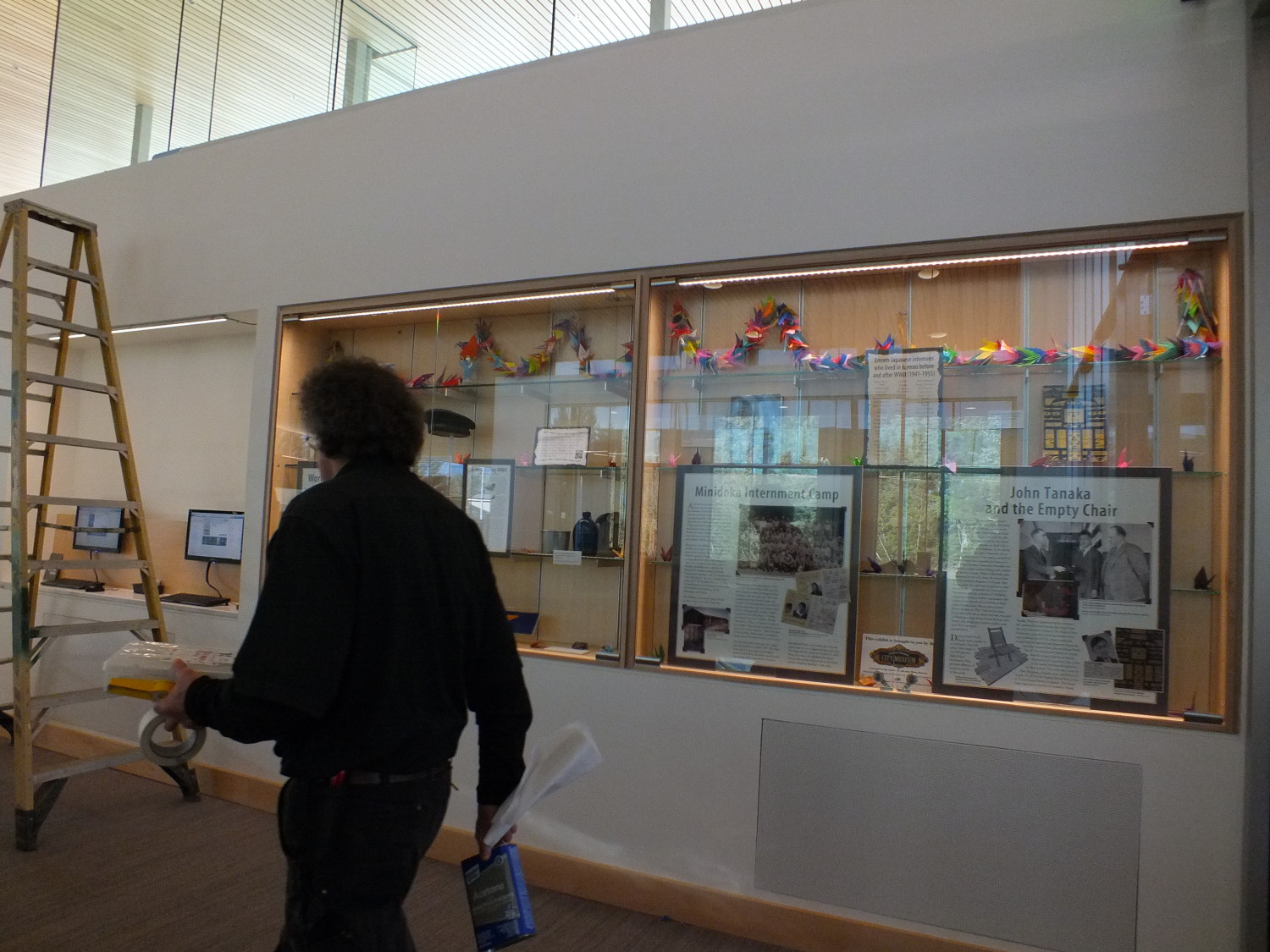
Public catalog computers are located at the left. Display cases at the new Mendenhall Valley Public Library will be stocked by the Juneau-Douglas City Museum. (Photo by Matt Miller/KTOO)
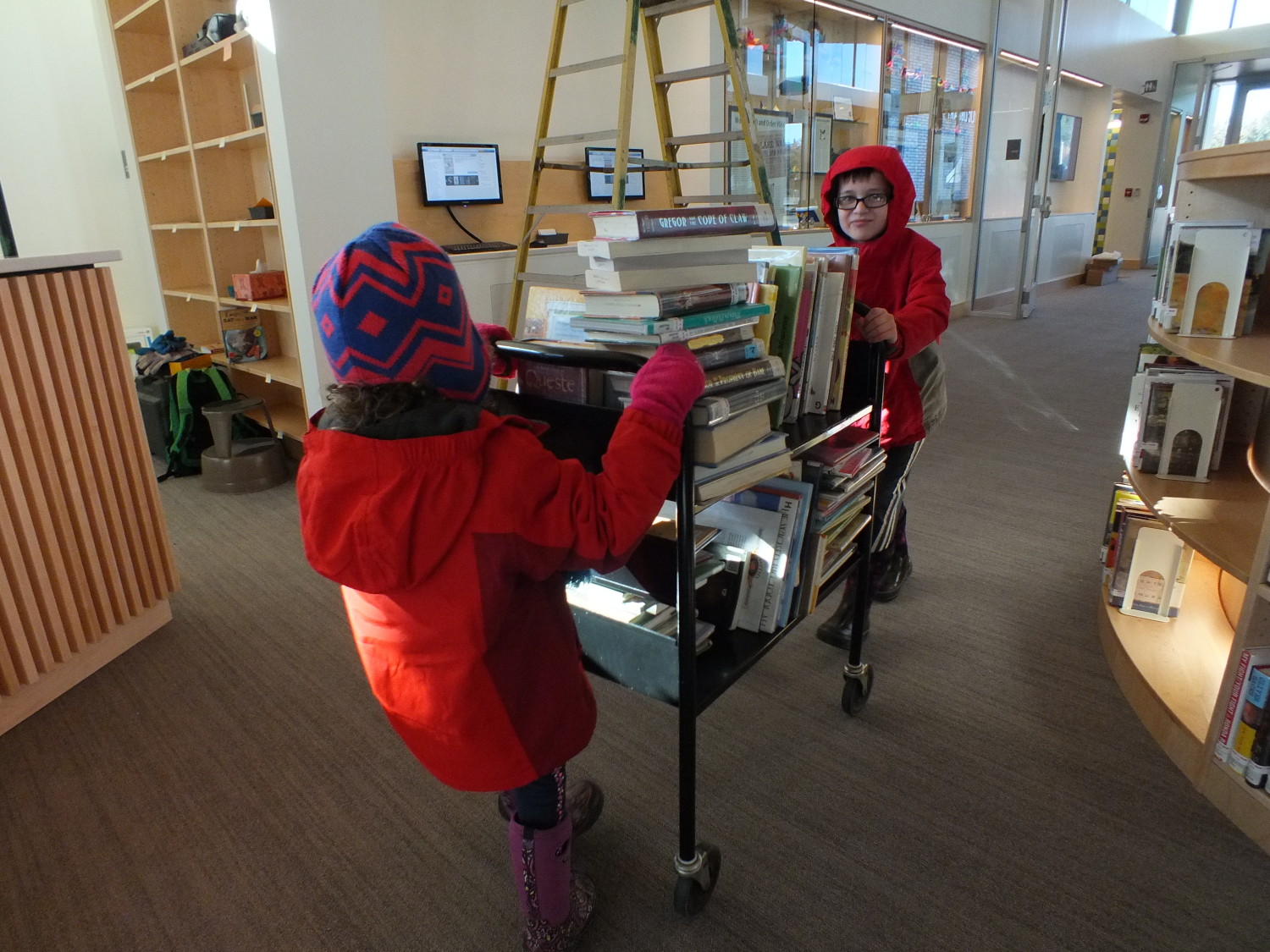
Sadie Frances Curtis, 5, and Q Curtis, 8, wheel in a cart of 119 books they checked out from the old Mendenhall Mall Library just before it closed. Along with their mom Linda Curtis, they were deemed Checkout Champions as patrons who helped with moving books from the old library. (Photo by Matt Miller/KTOO)
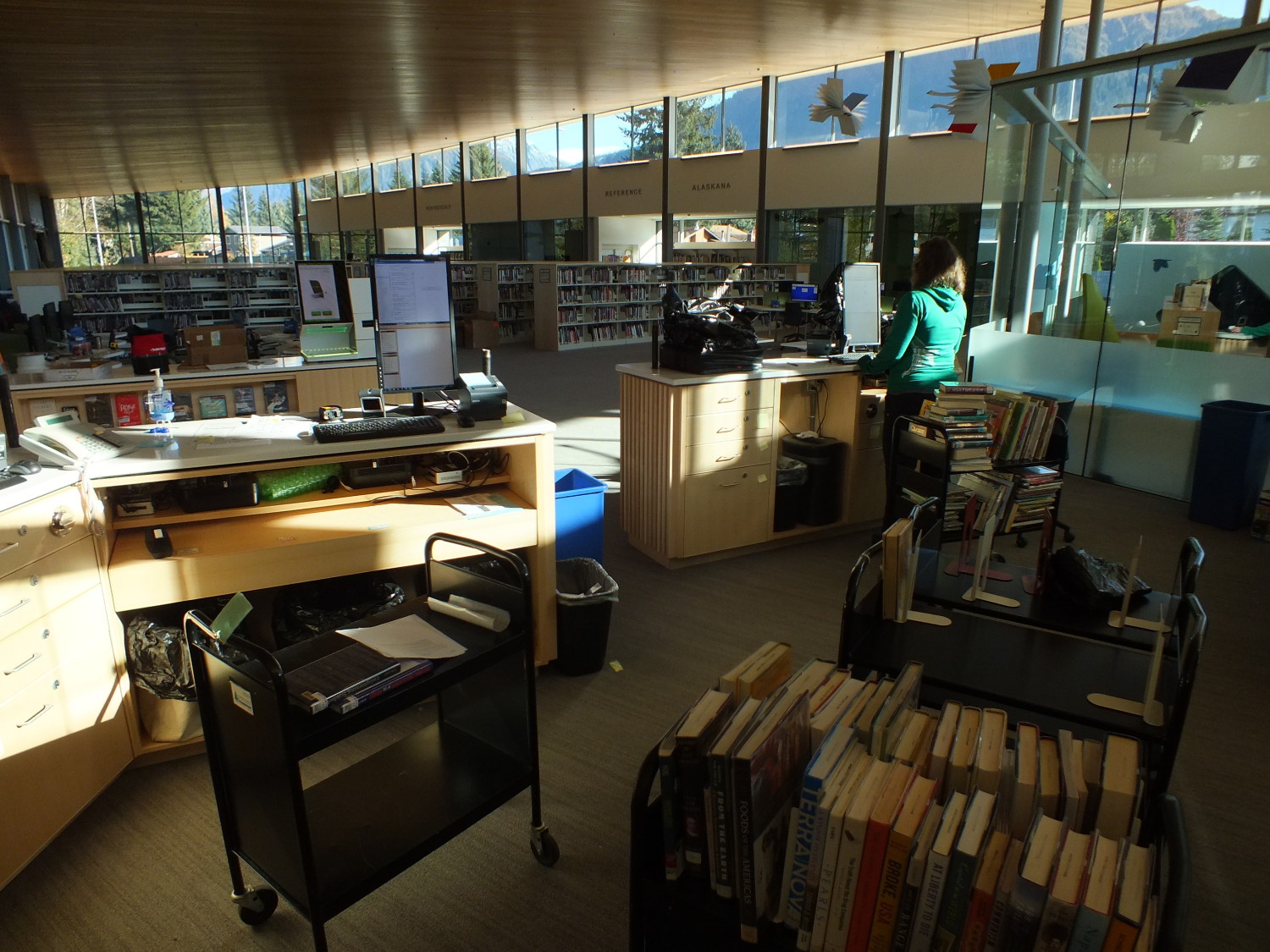
Behind the circulation desk at the new Mendenhall Valley Public Library. (Photo by Matt Miller/KTOO)
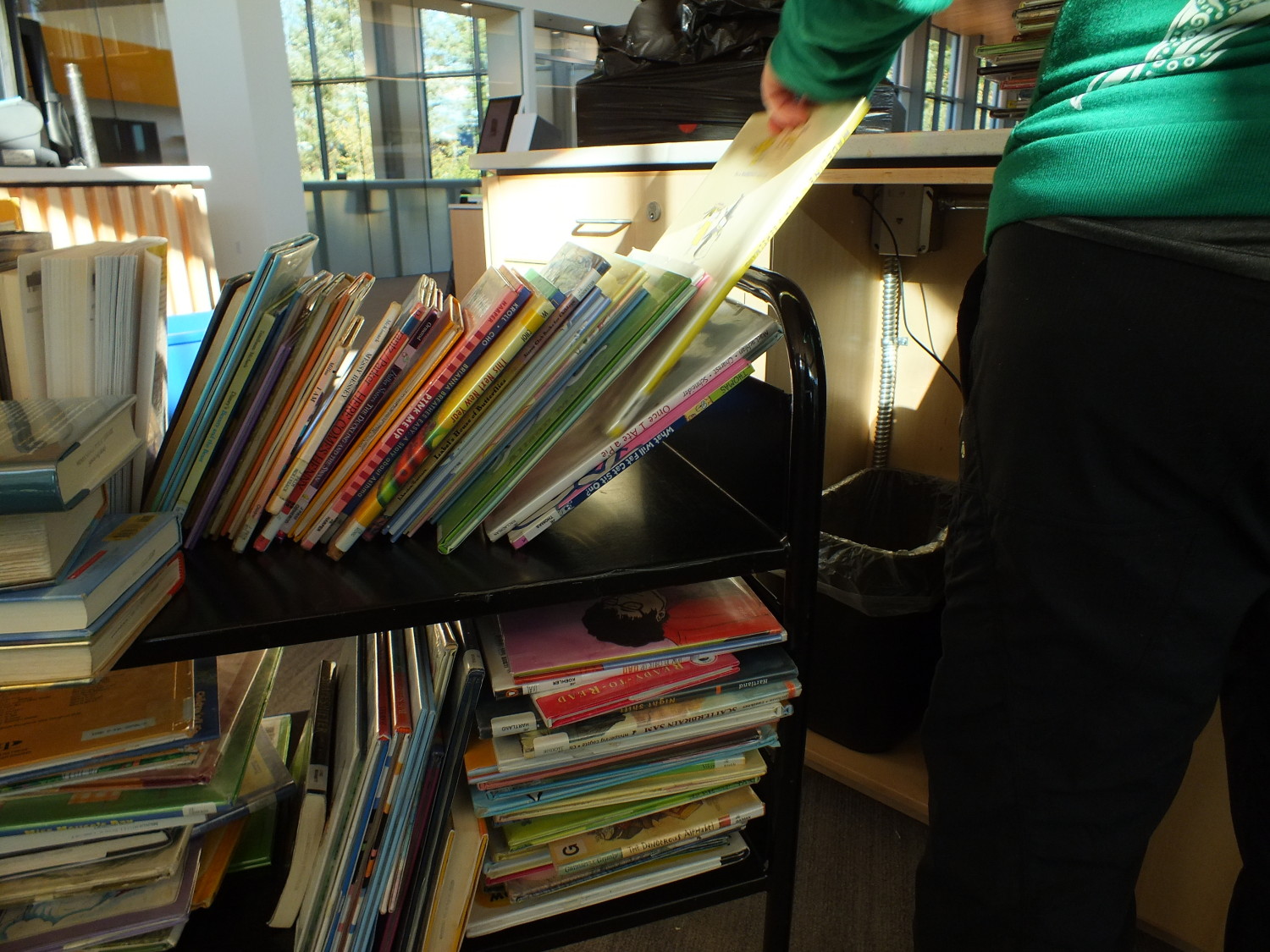
Beth Weigel checks in returned books at the new Mendenhall Valley Public Library. (Photo by Matt Miller/KTOO)
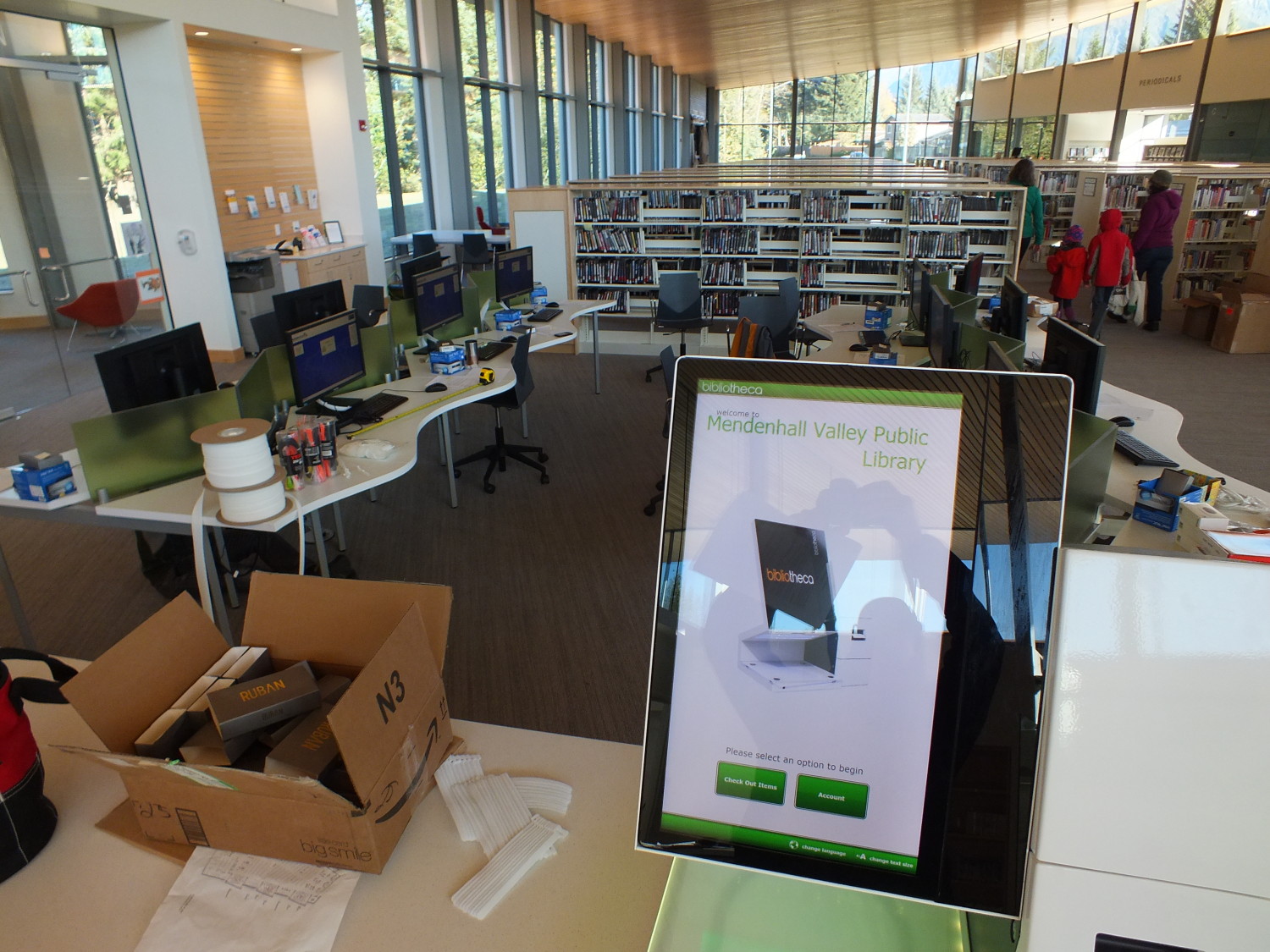
A self-checkout terminal is located between the public access computer section and circulation desk. (Photo by Matt Miller/KTOO)
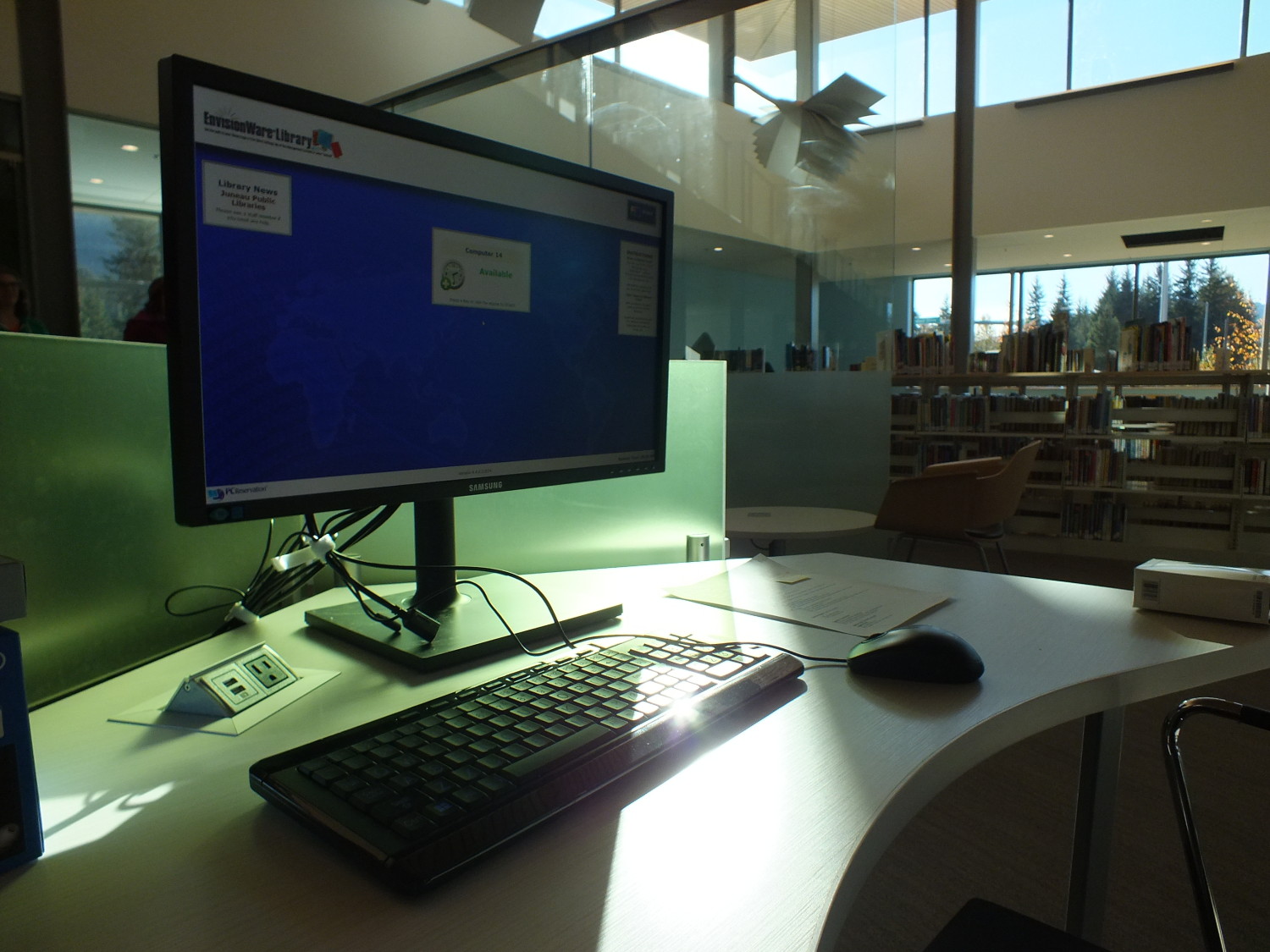
Public access computer terminals at the new Mendenhall Valley Public Library. (Photo by Matt Miller/KTOO)
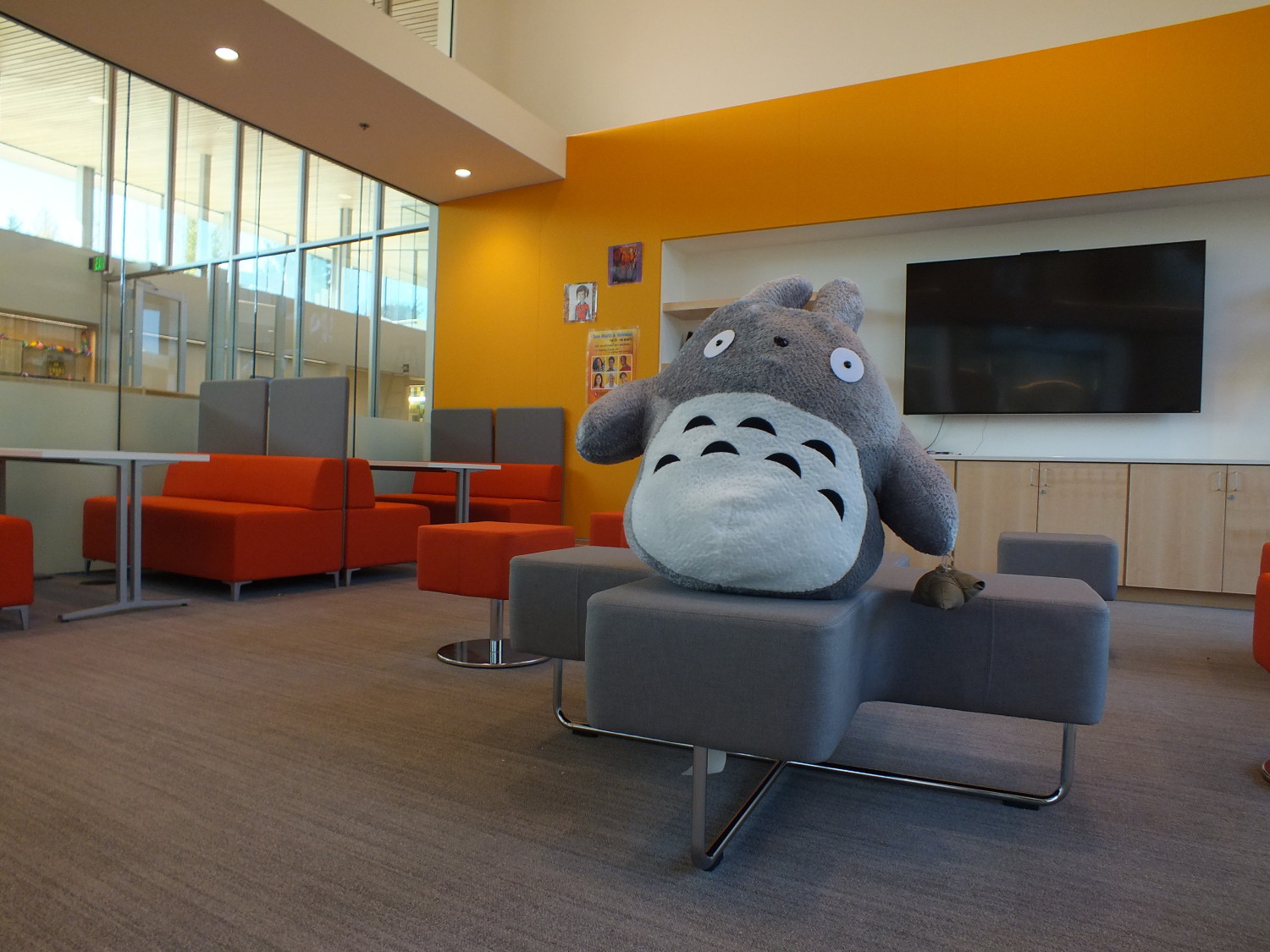
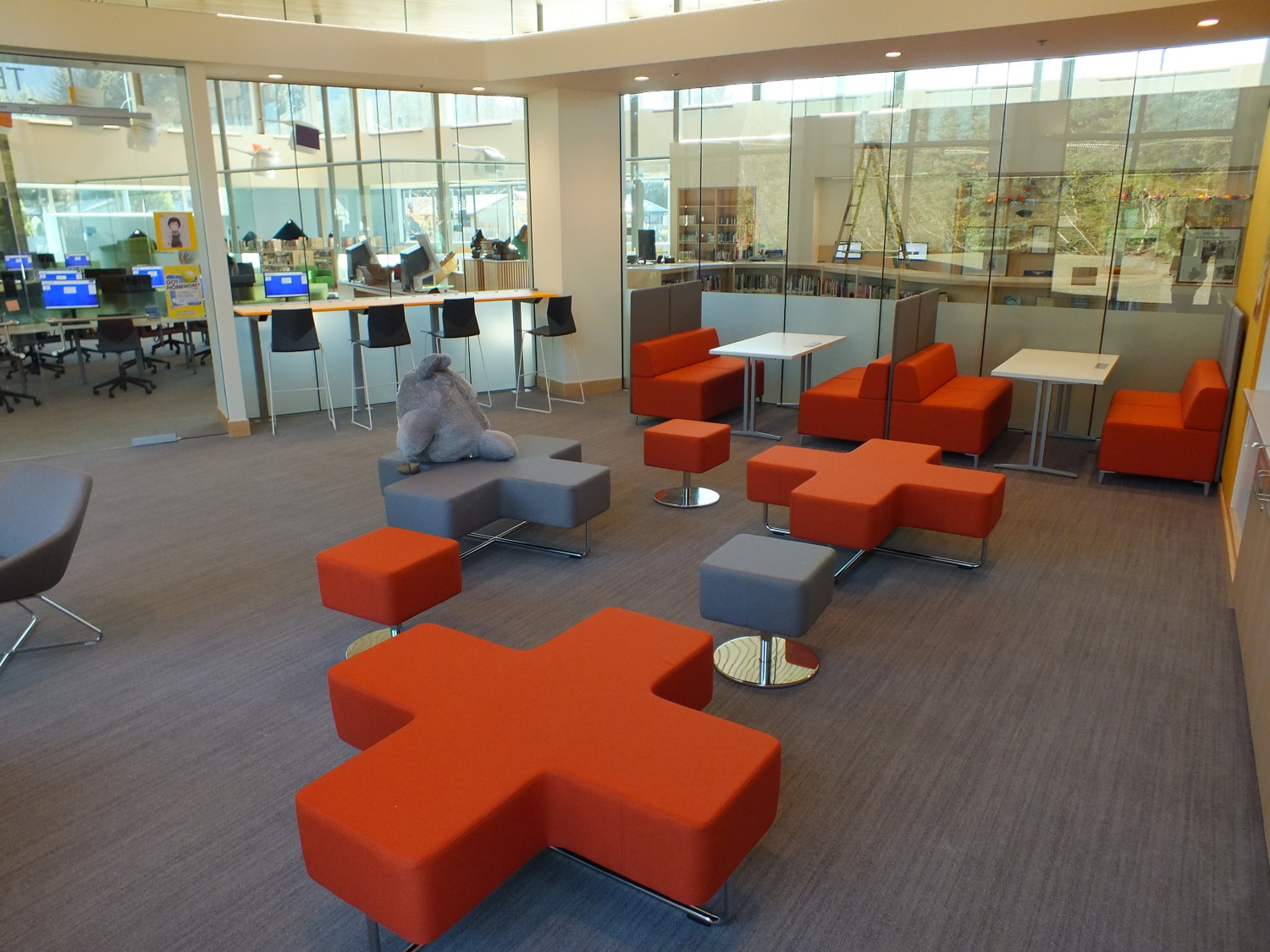
Teen section at the new Mendenhall Valley Public Library is for teenagers only and features a gaming station. (Photo by Matt Miller/KTOO)
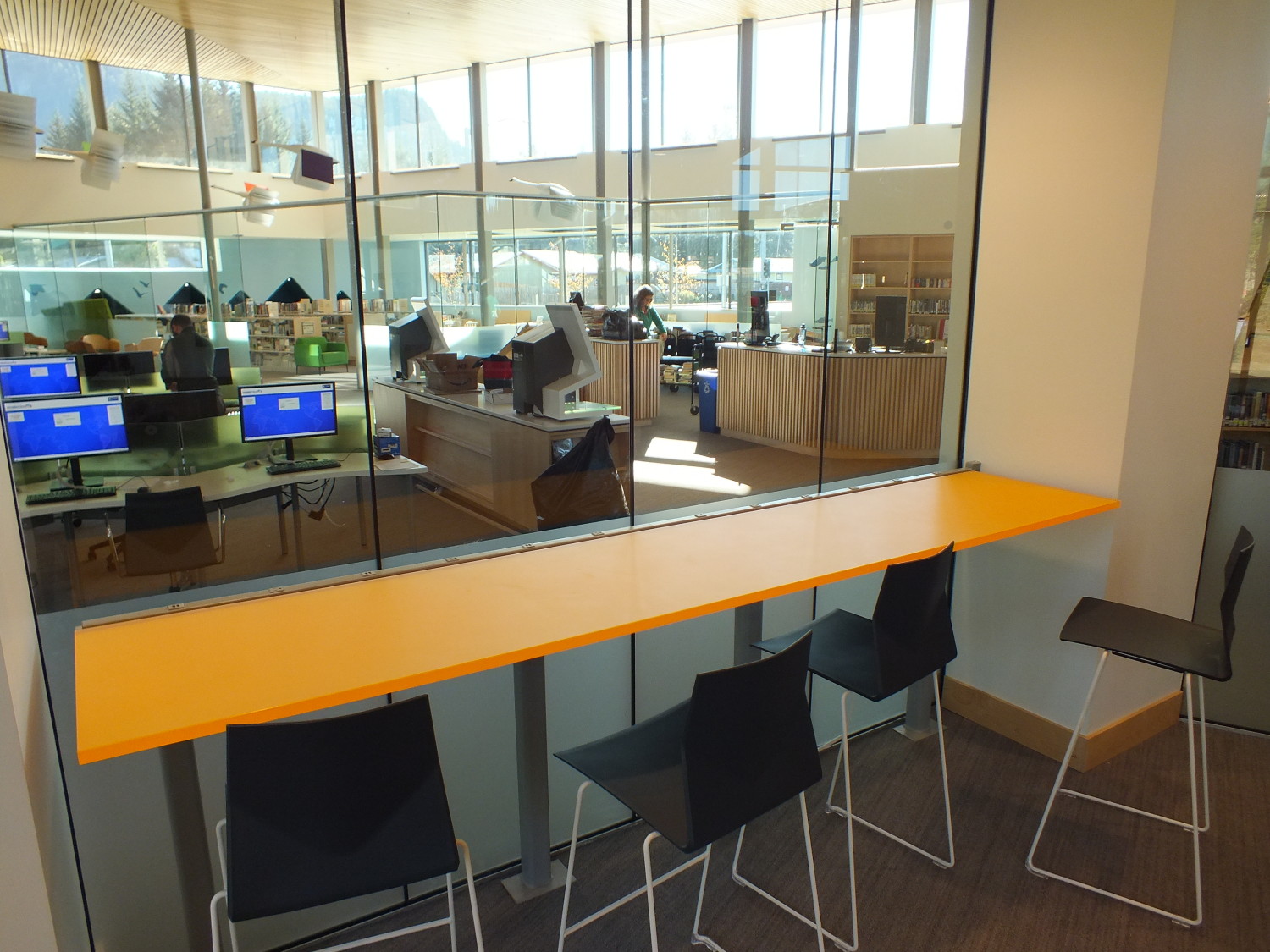
The teen section has a view of the main portion of the library. (Photo by Matt Miller/KTOO)
The teen section at the new Mendenhall Valley Public Library. (Photo by Matt Miller/KTOO)
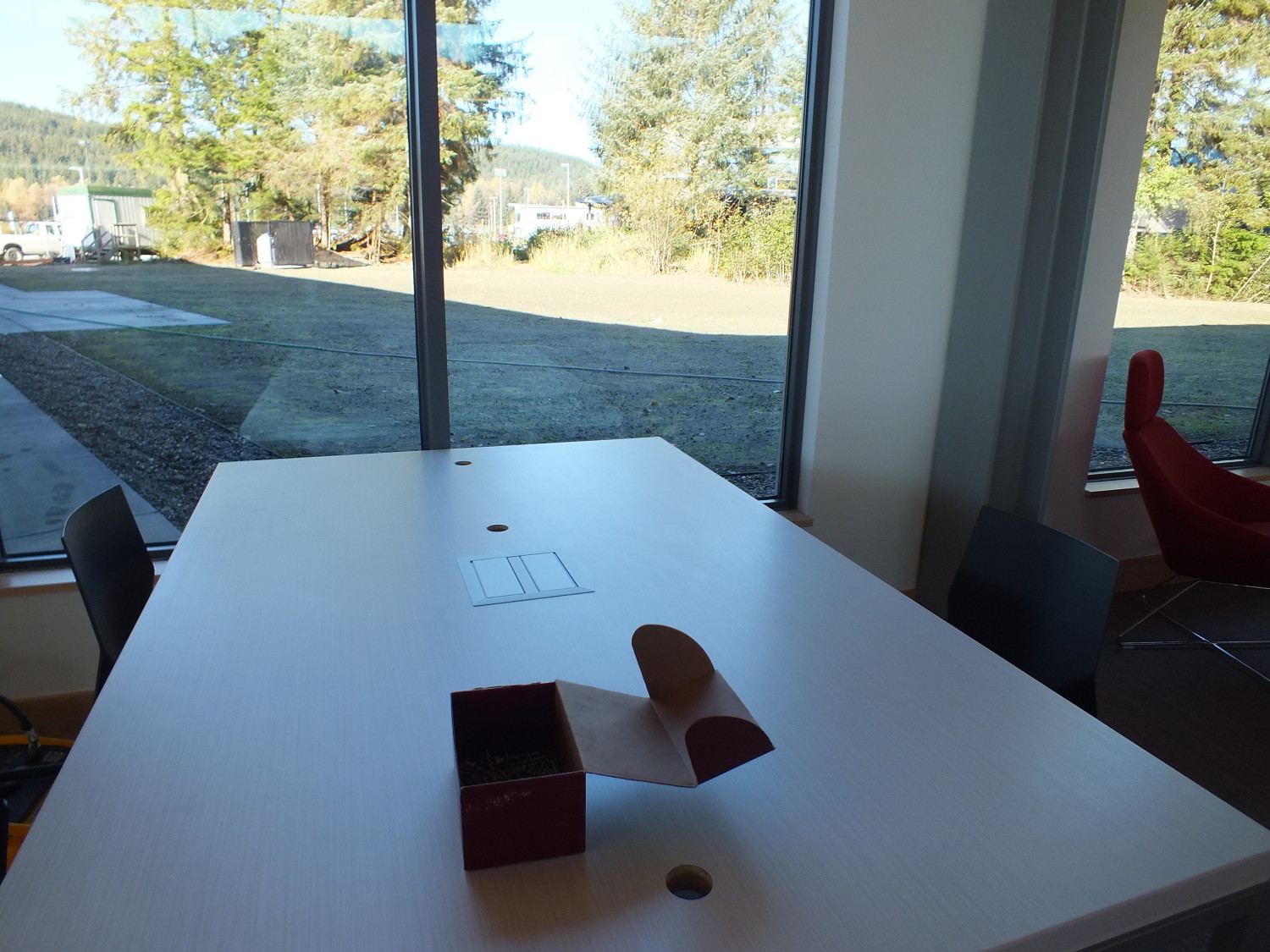
These tables with power outlets will soon have focused lighting. Landscaping is still in progress. (Photo by Matt Miller/KTOO)
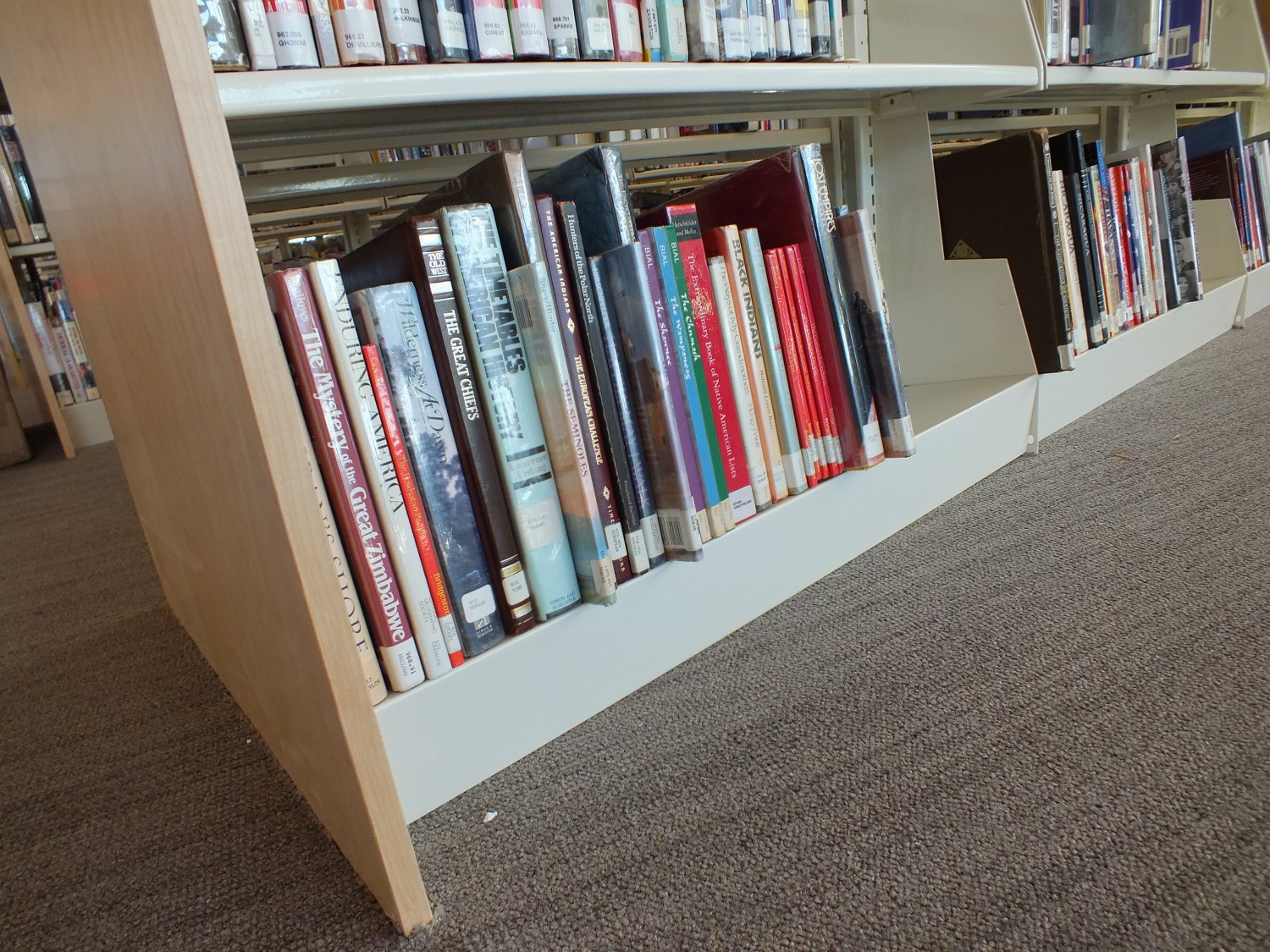
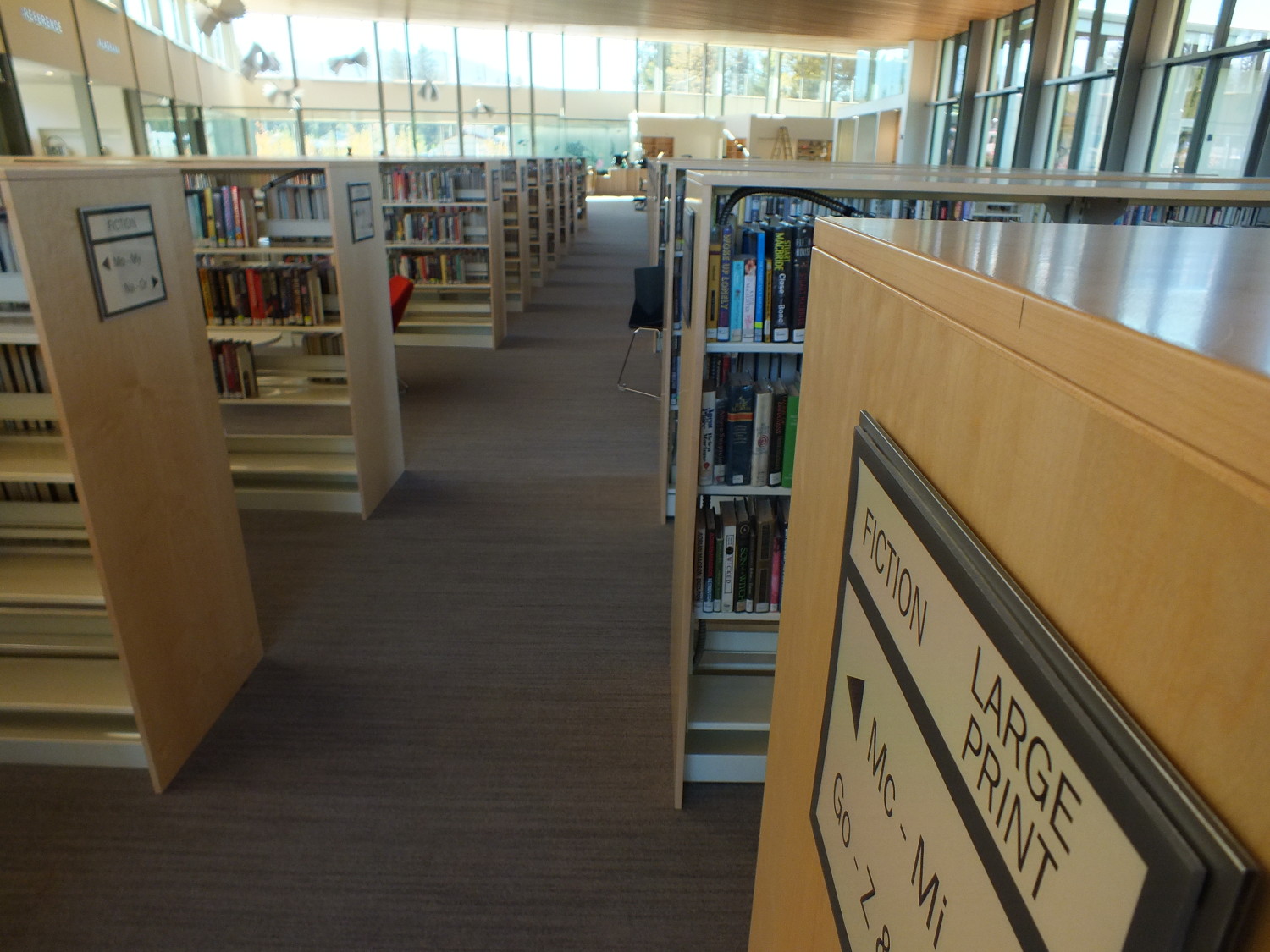
Angled book shelves will make it easier to find books on the bottom. (Photo by Matt Miller/KTOO)
Diffuse air vents are located behind the white panels at the end of some book shelves at the new Mendenhall Valley Public Library. (Photo by Matt Miller/KTOO)
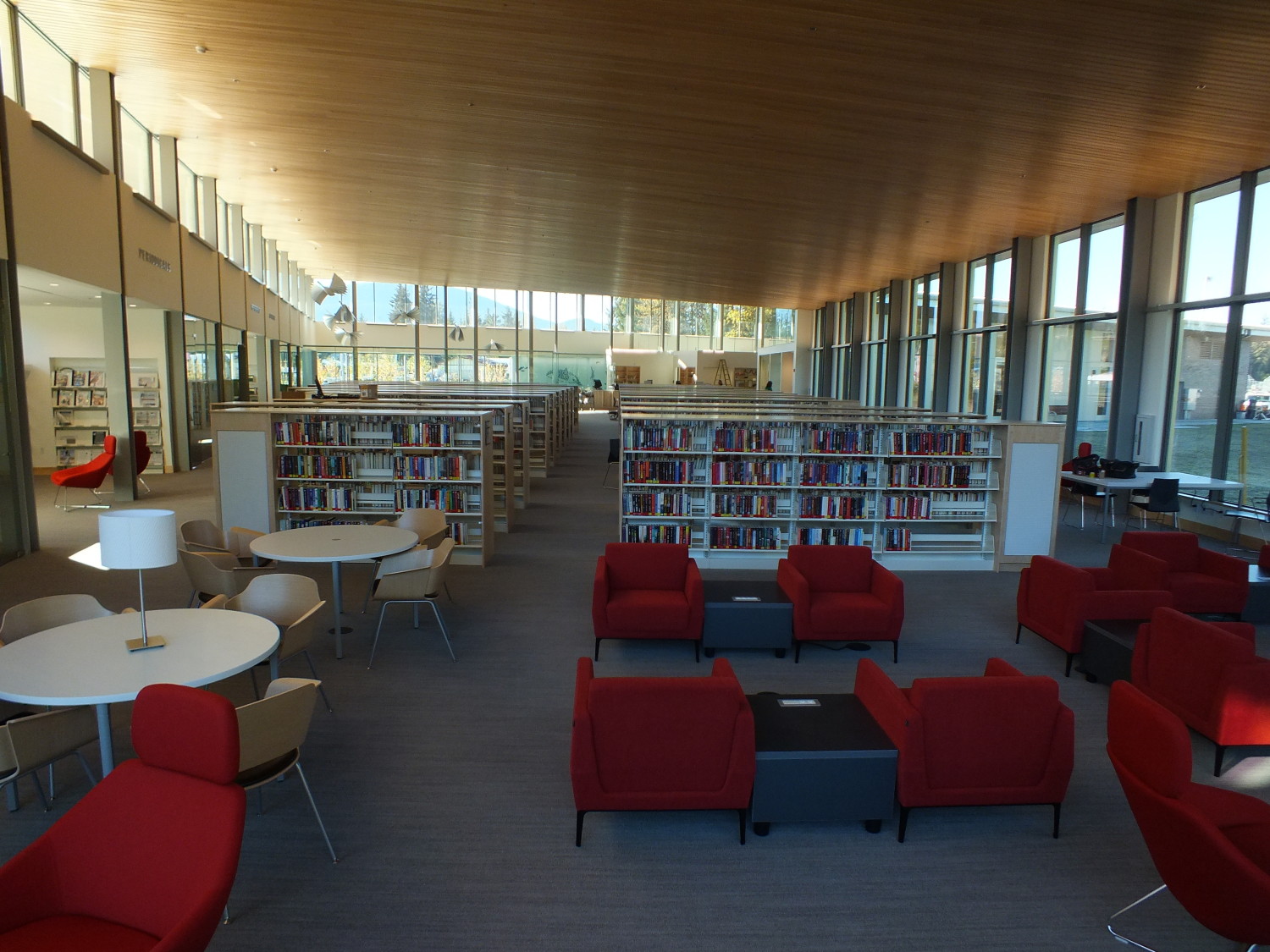
Glass and wood dominate the interior of the new Mendenhall Valley Public Library. (Photo by Matt Miller/KTOO)
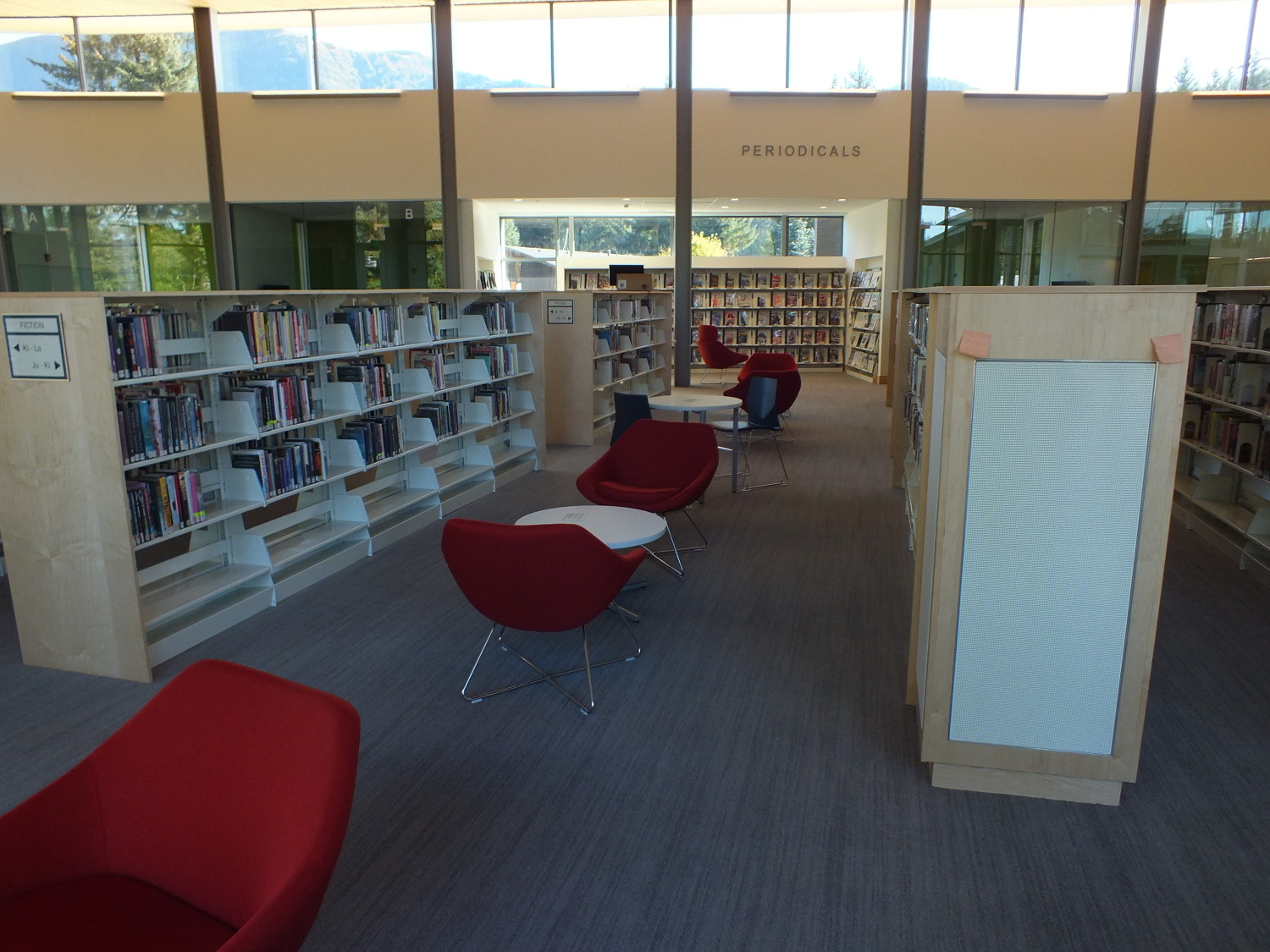
Most adults will be able to see over the book shelves at the new Mendenhall Valley Public Library . (Photo by Matt Miller/KTOO)
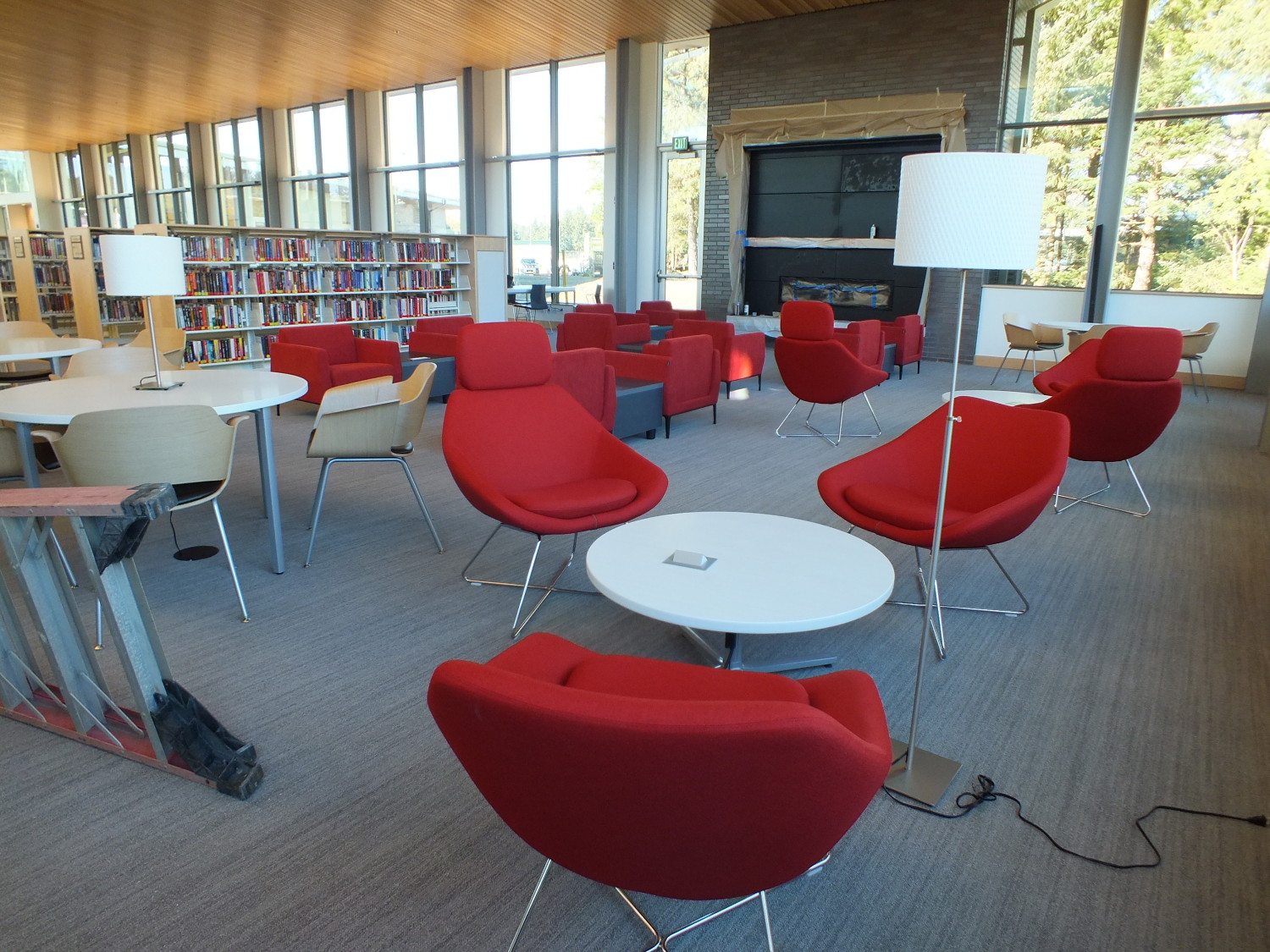
Quiet area is located at the far eastern end of the building. (Photo by Matt Miller/KTOO)
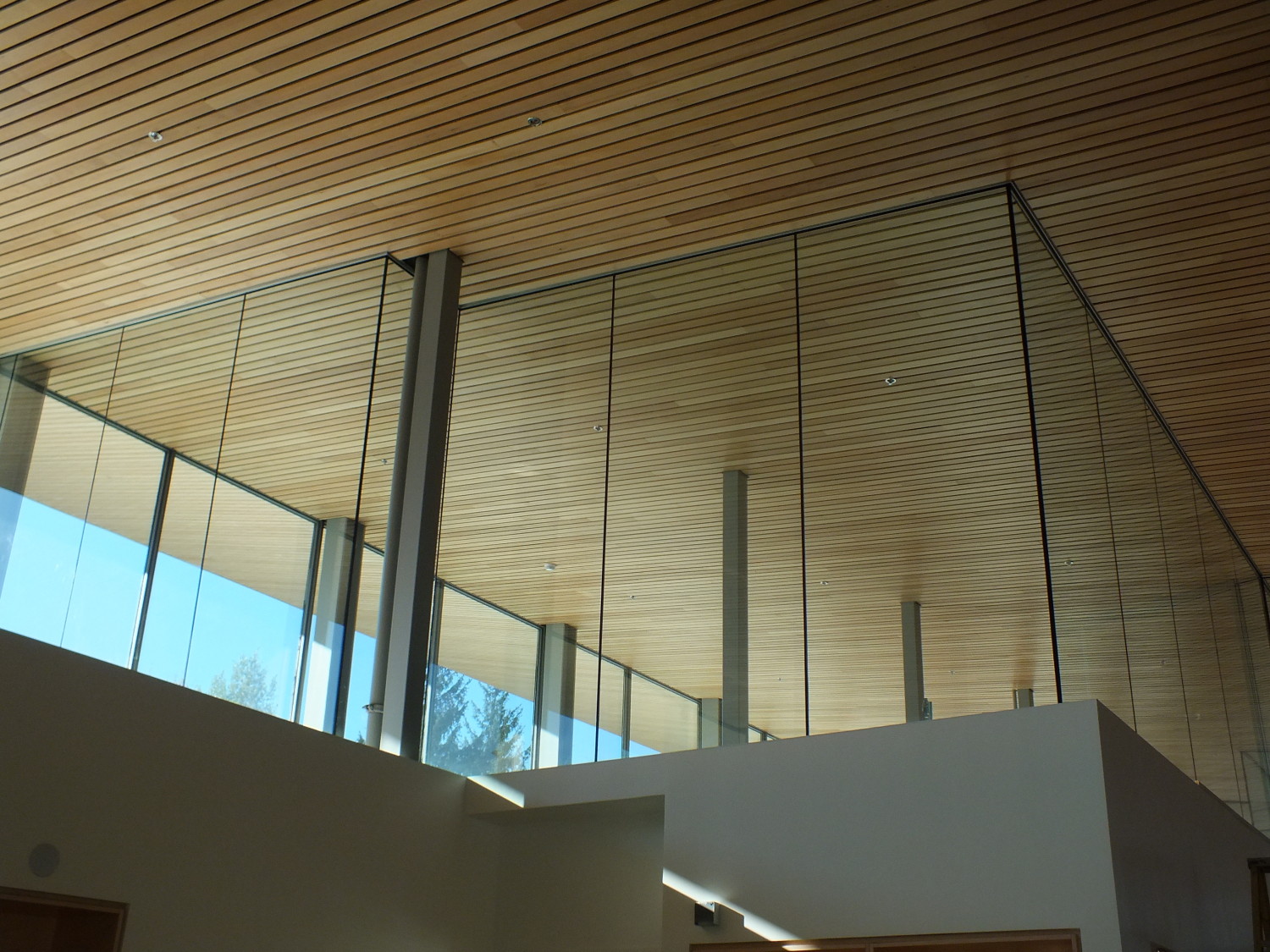
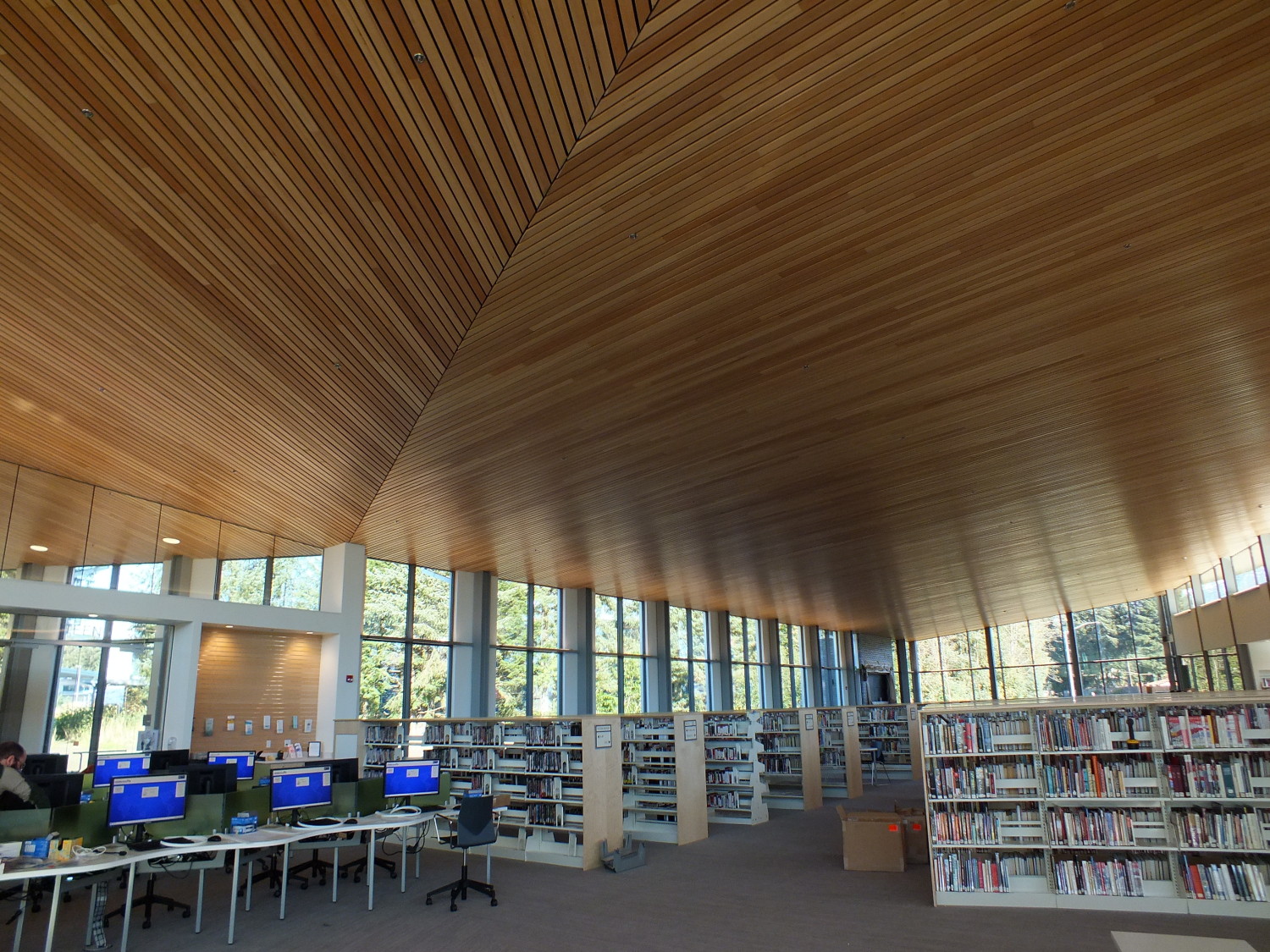
Wood strip ceiling is backed by acoustic deadening black felt. (Photo by Matt Miller/KTOO)
The new Mendenhall Valley Public Library features a wood ceiling. (Photo by Matt Miller/KTOO)
The wood ceiling at the new Mendenhall Valley Public Library is sloped to distribute light and dampen sound. (Photo by Matt Miller/KTOO)
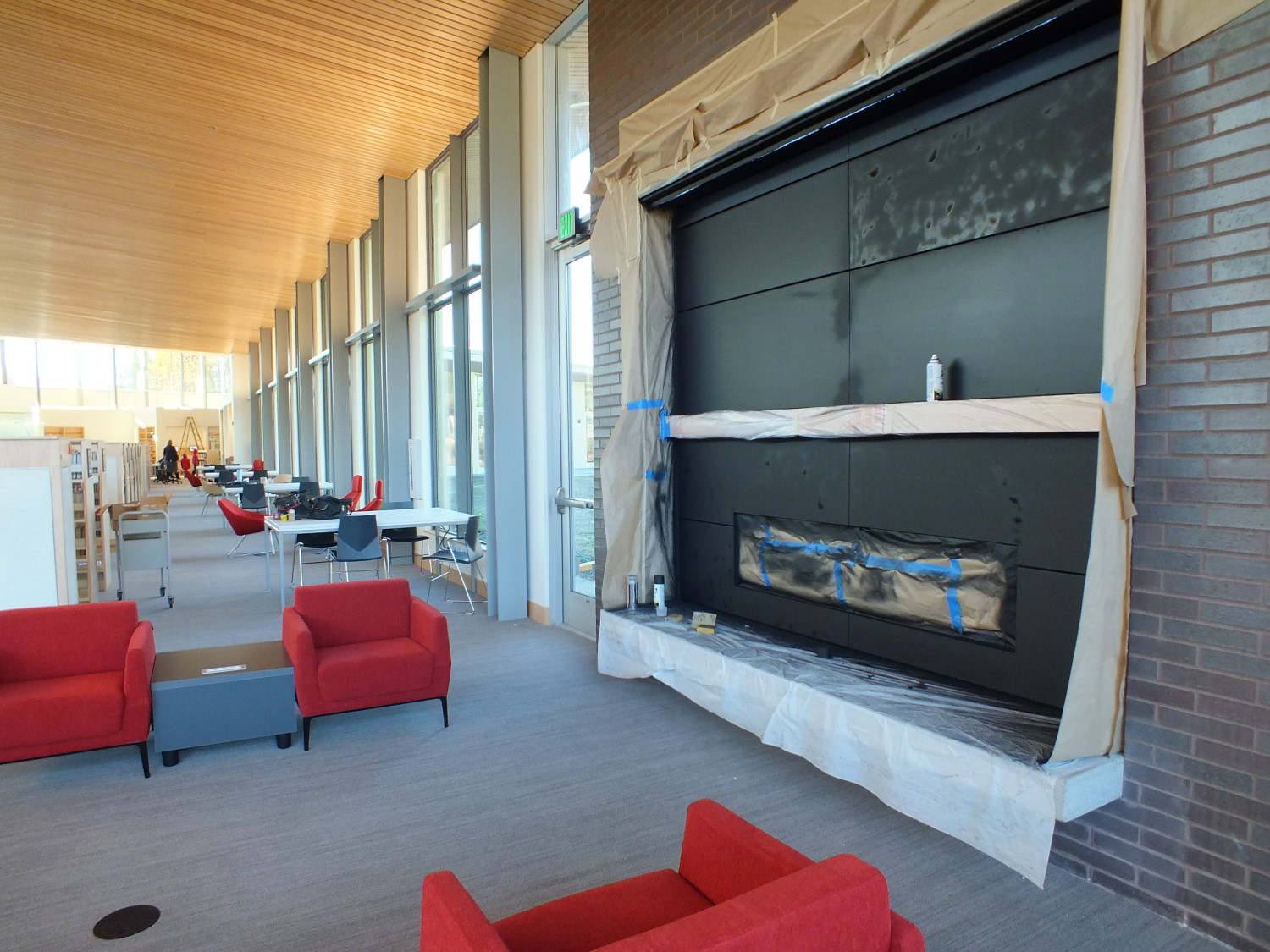
Finishing touches are in progress on the fireplace hearth located in the quiet section of the library. (Photo by Matt Miller/KTOO)
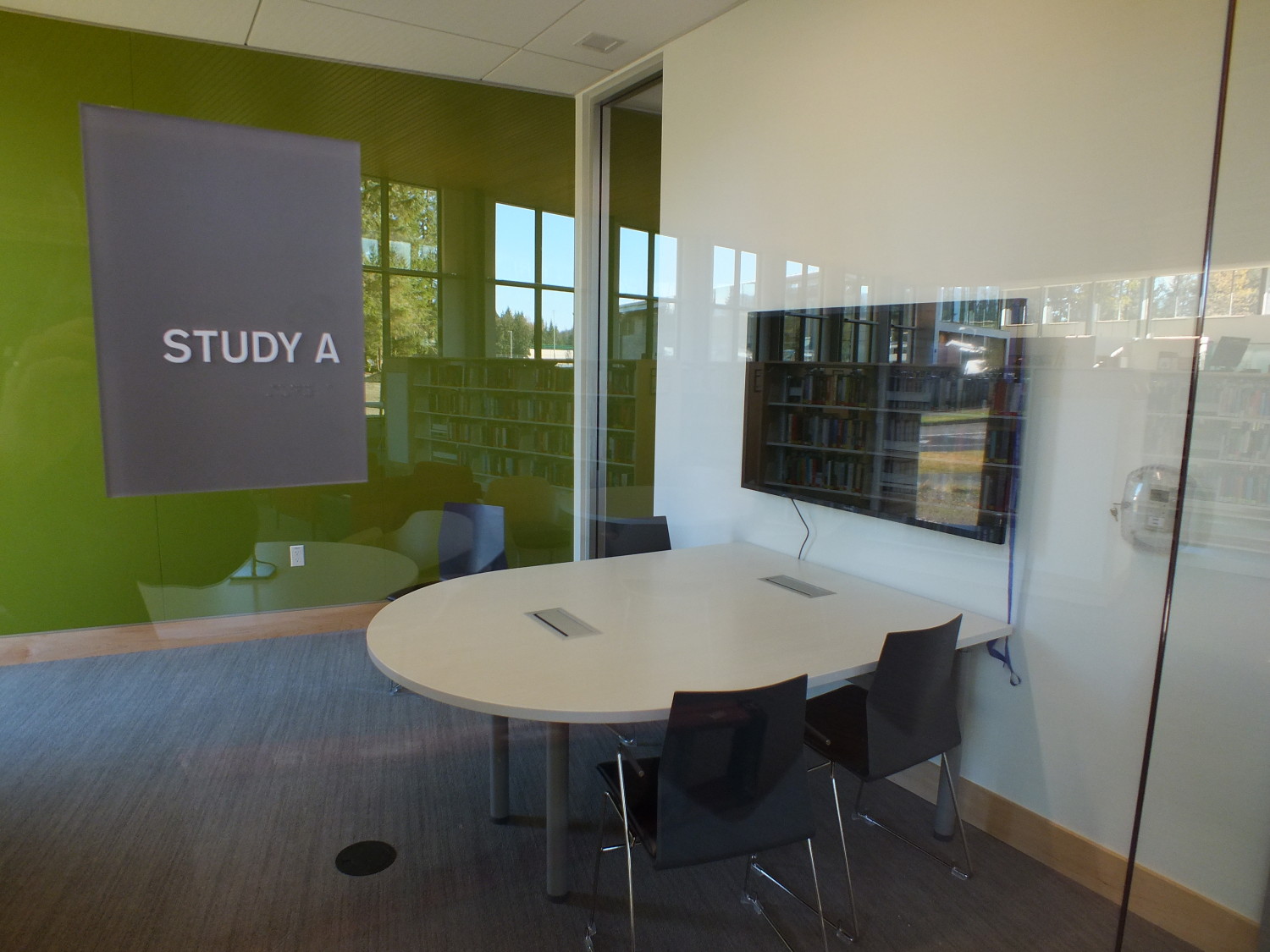
One of four study rooms at the new Mendenhall Valley Public Library. (Photo by Matt Miller/KTOO)
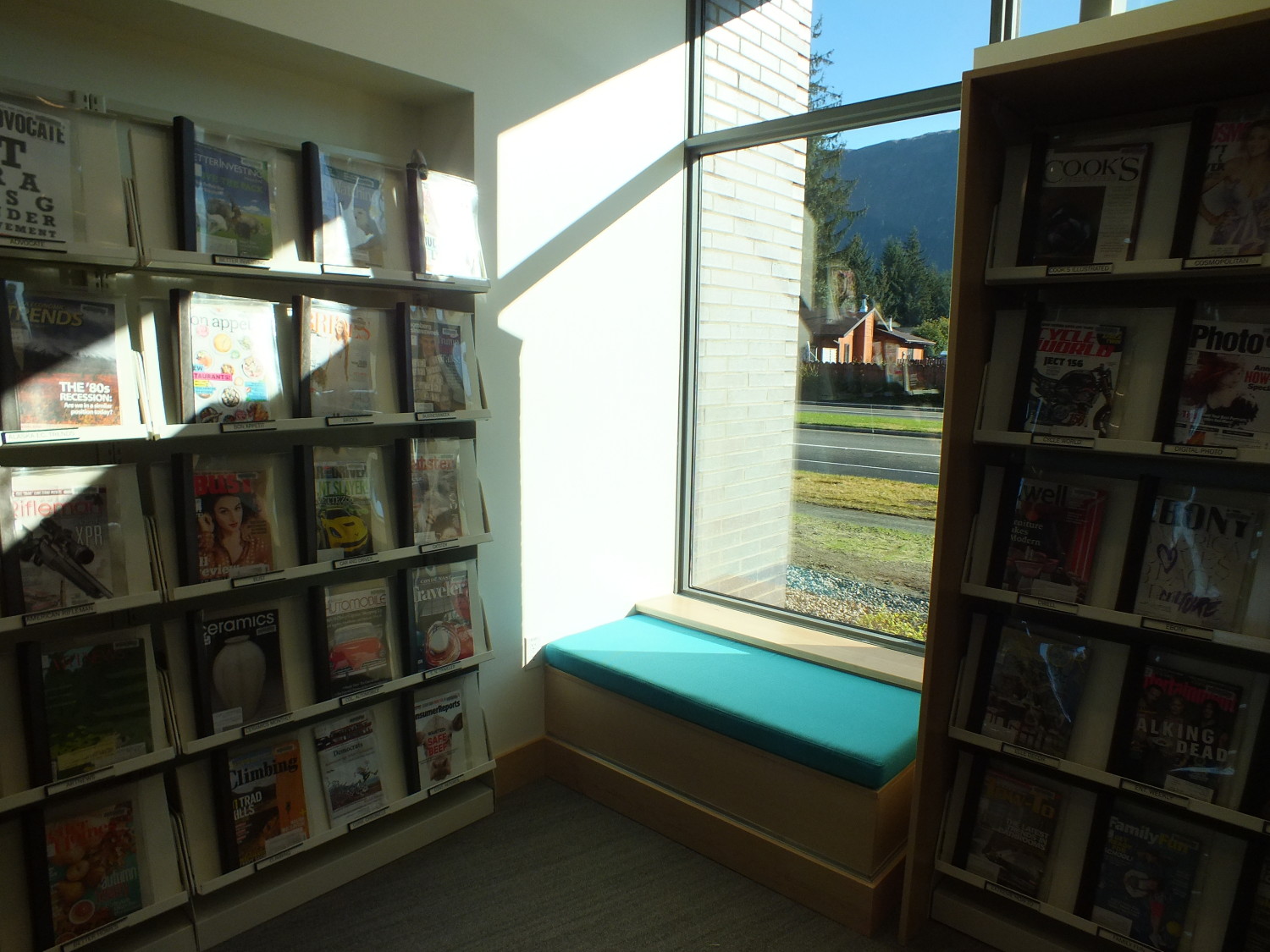
The periodical section features a window alcove for seating (Photo by Matt Miller/KTOO)
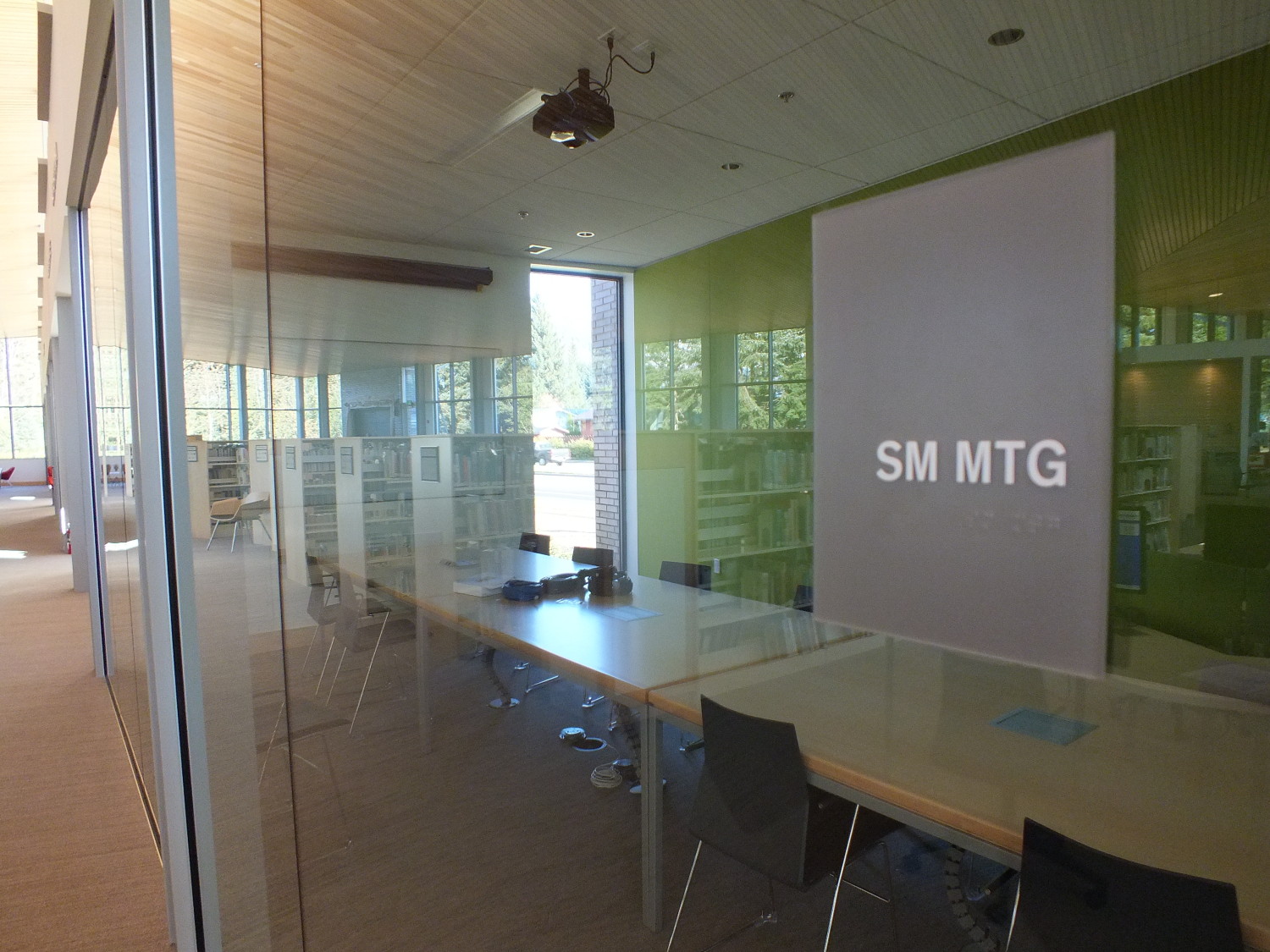
A conference room at the new Mendenhall Valley Public Library. (Photo by Matt Miller/KTOO)
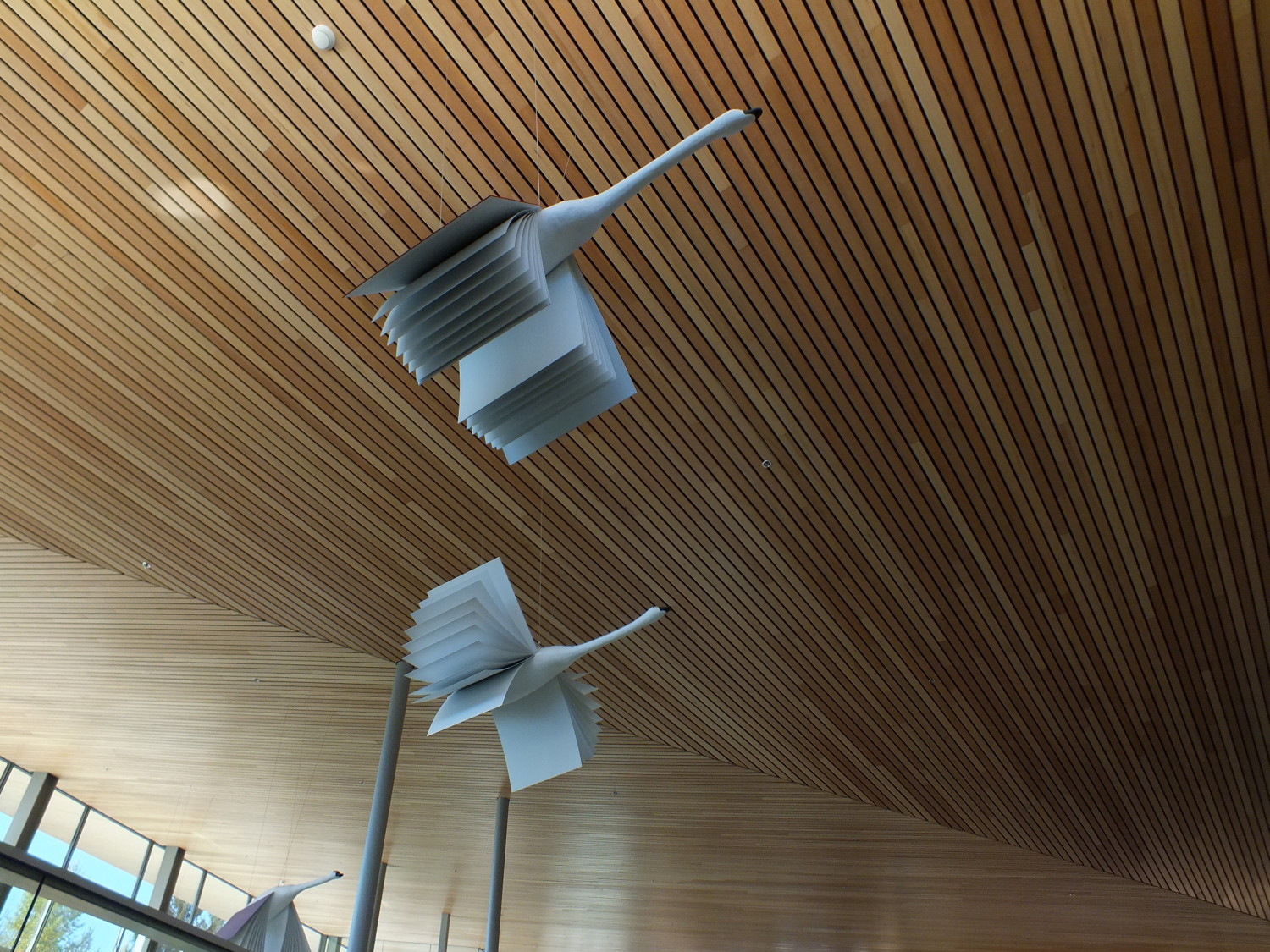
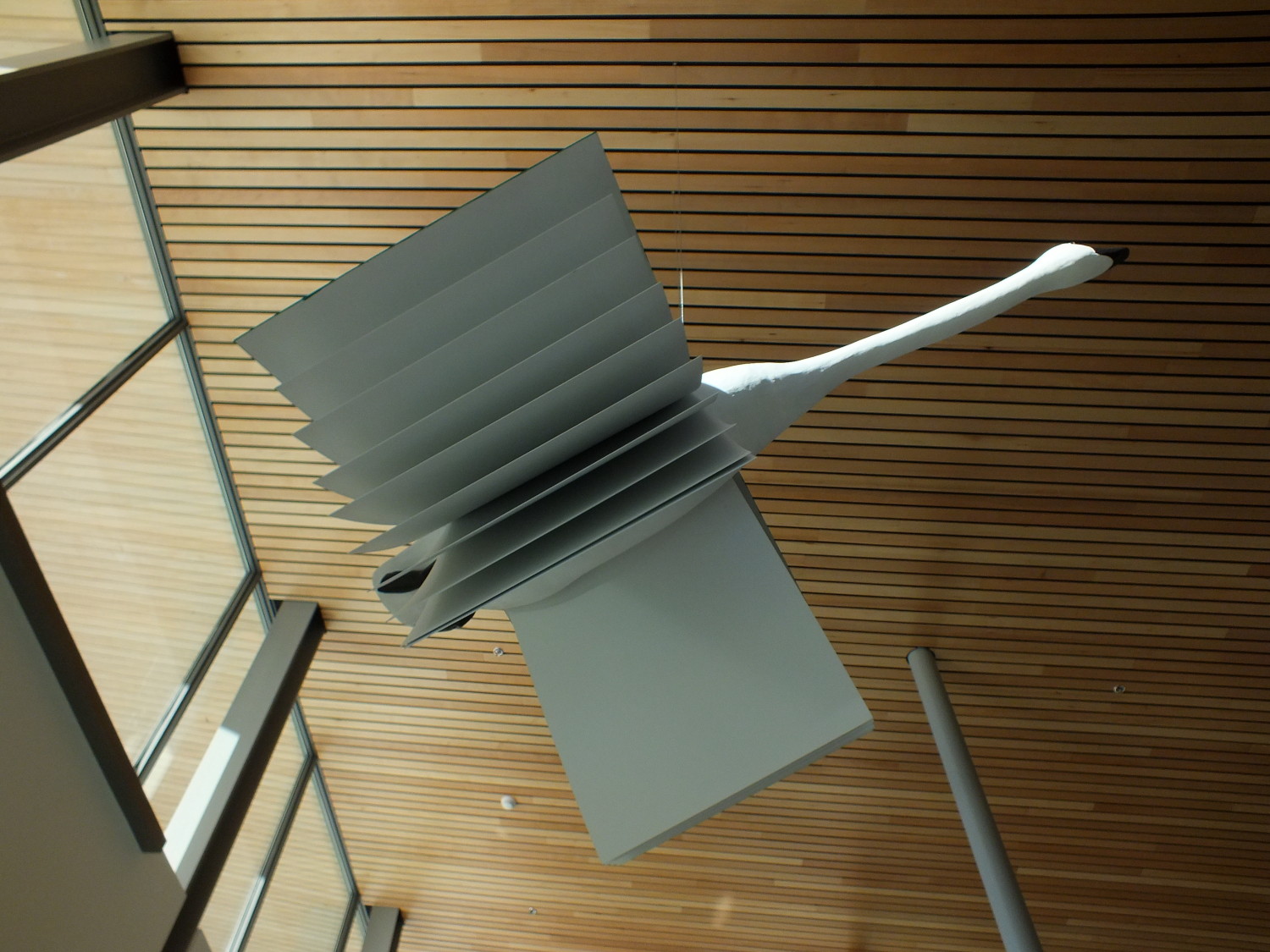
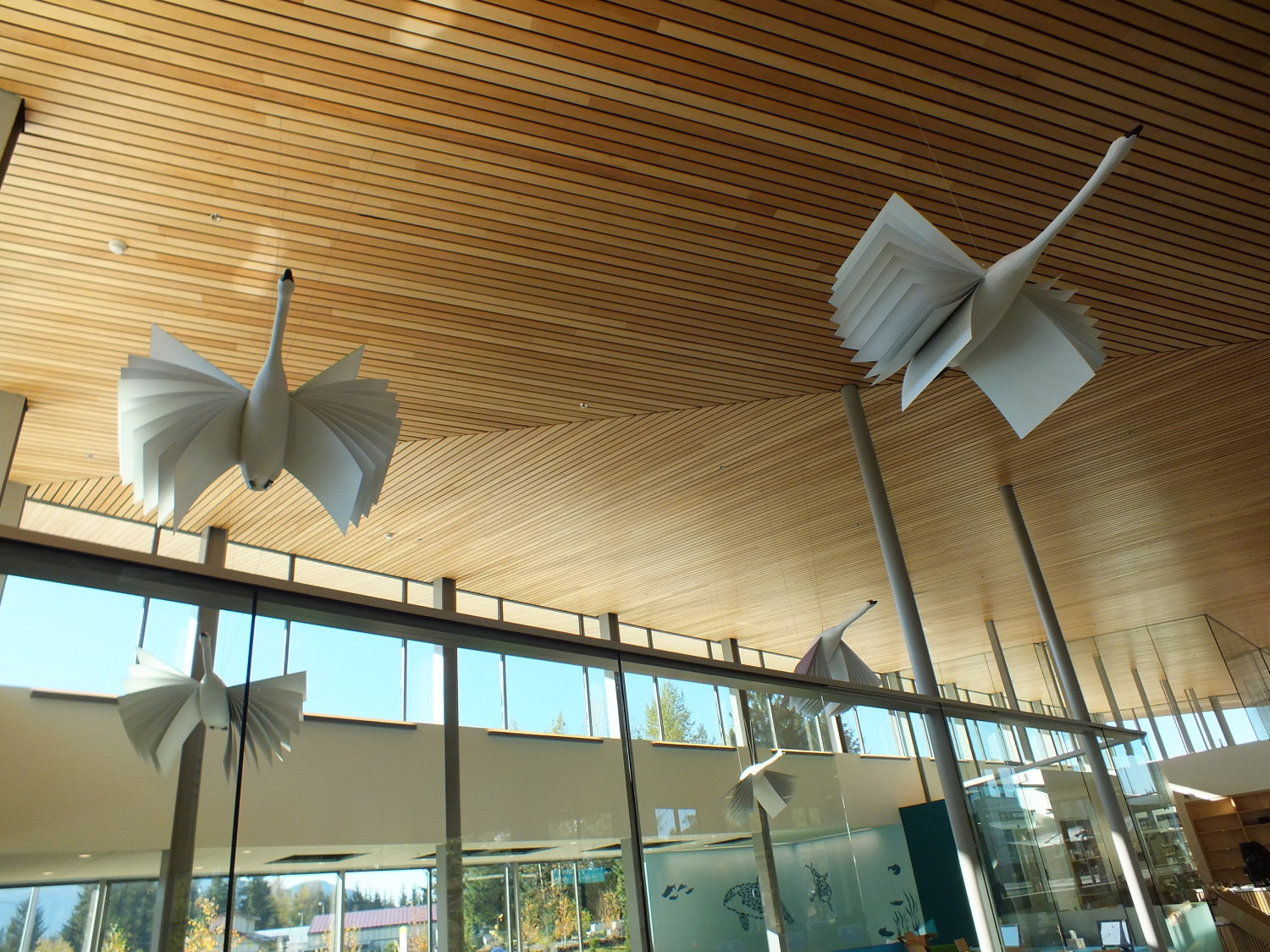
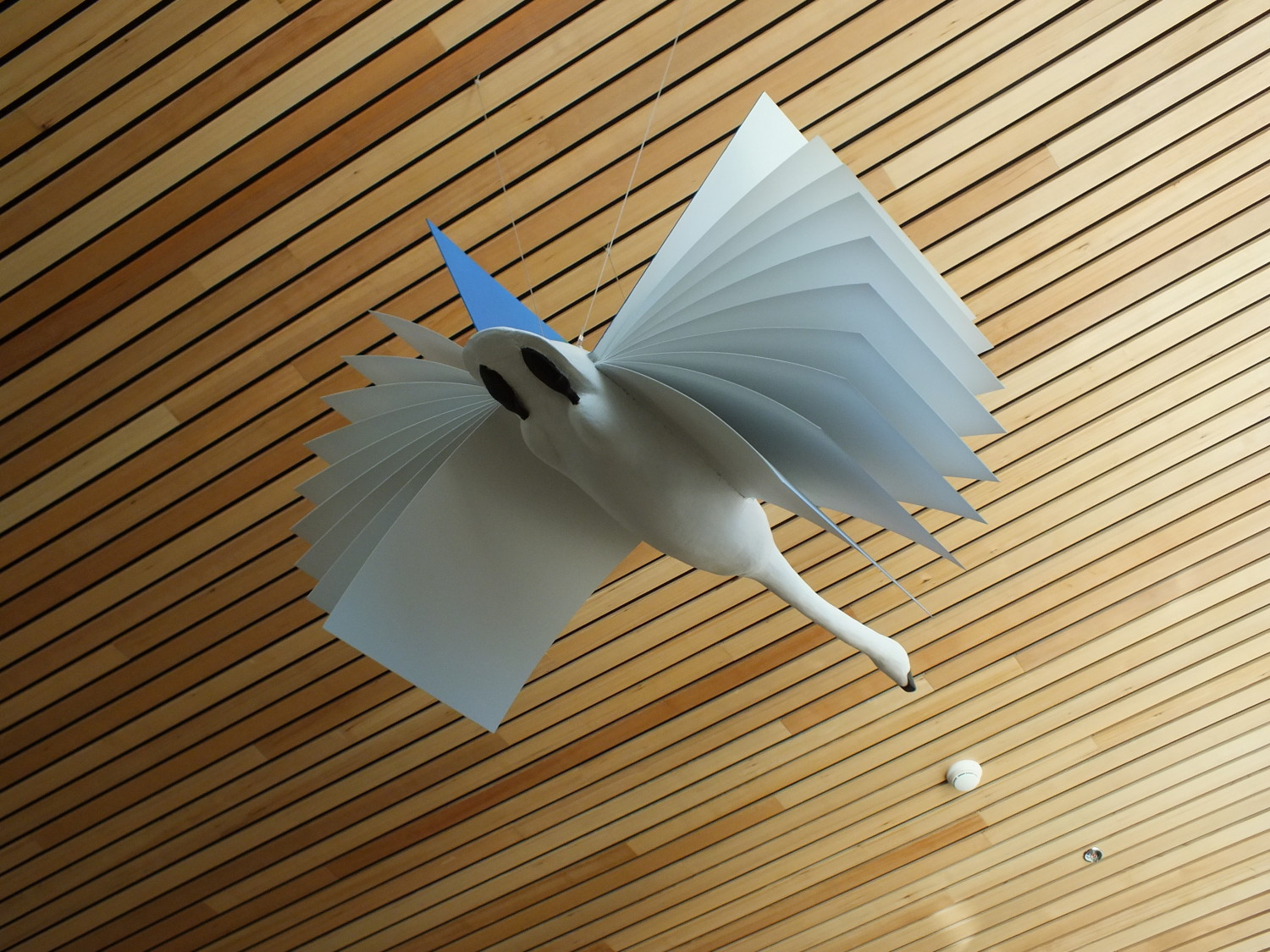
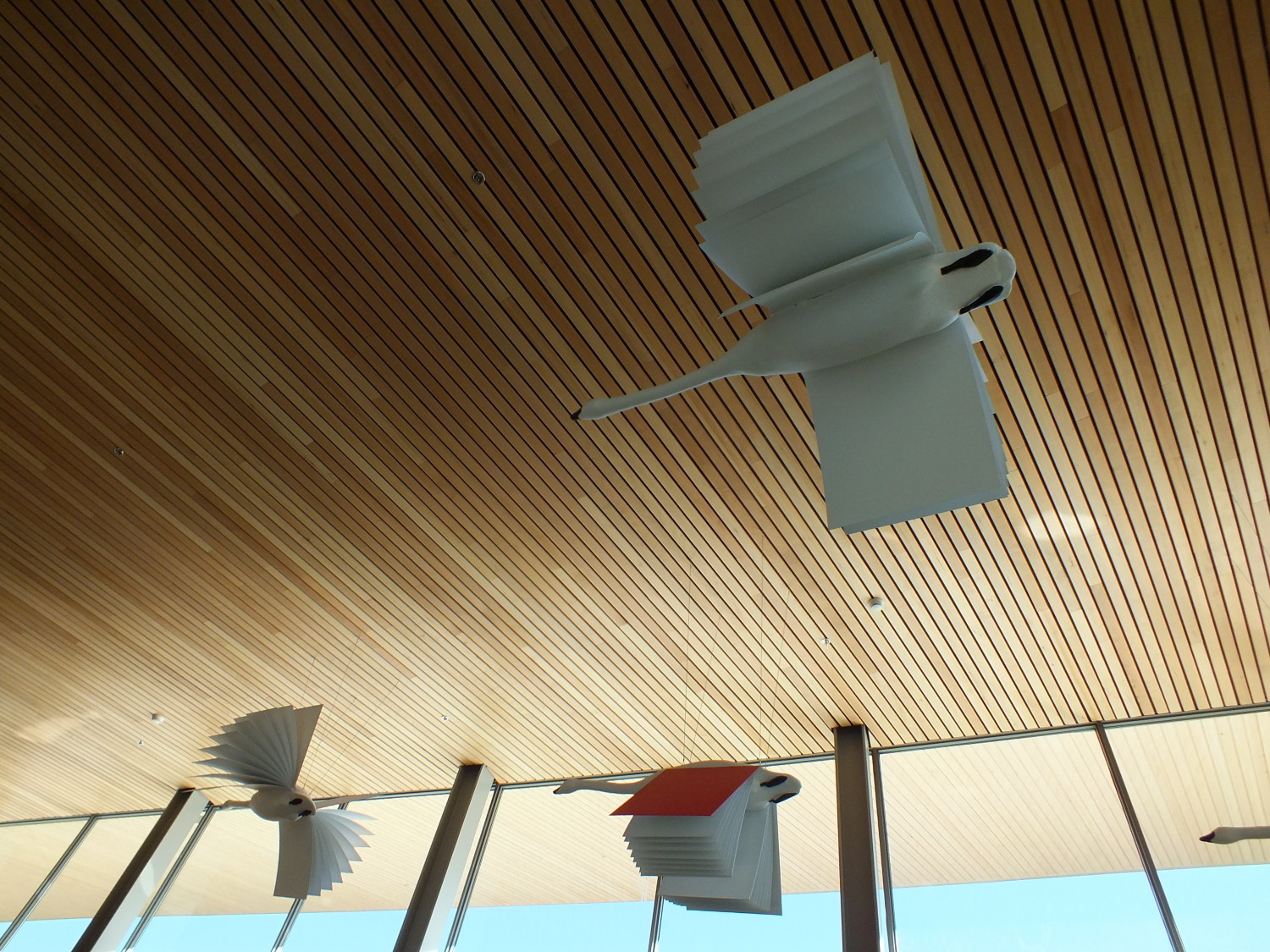
Biblioswans designed and constructed by artist Dan DeRoux at the new Mendenhall Valley Public Library. (Photo by Matt Miller/KTOO)
The swans are lifesize. (Photo by Matt Miller/KTOO)
Another view of the swans at the new Mendenhall Valley Public Library. (Photo by Matt Miller/KTOO)
The swans are a One Percent for Art commission for the new Mendenhall Valley Public Library. (Photo by Matt Miller/KTOO)
The swans are flying in formation heading north. (Photo by Matt Miller/KTOO)
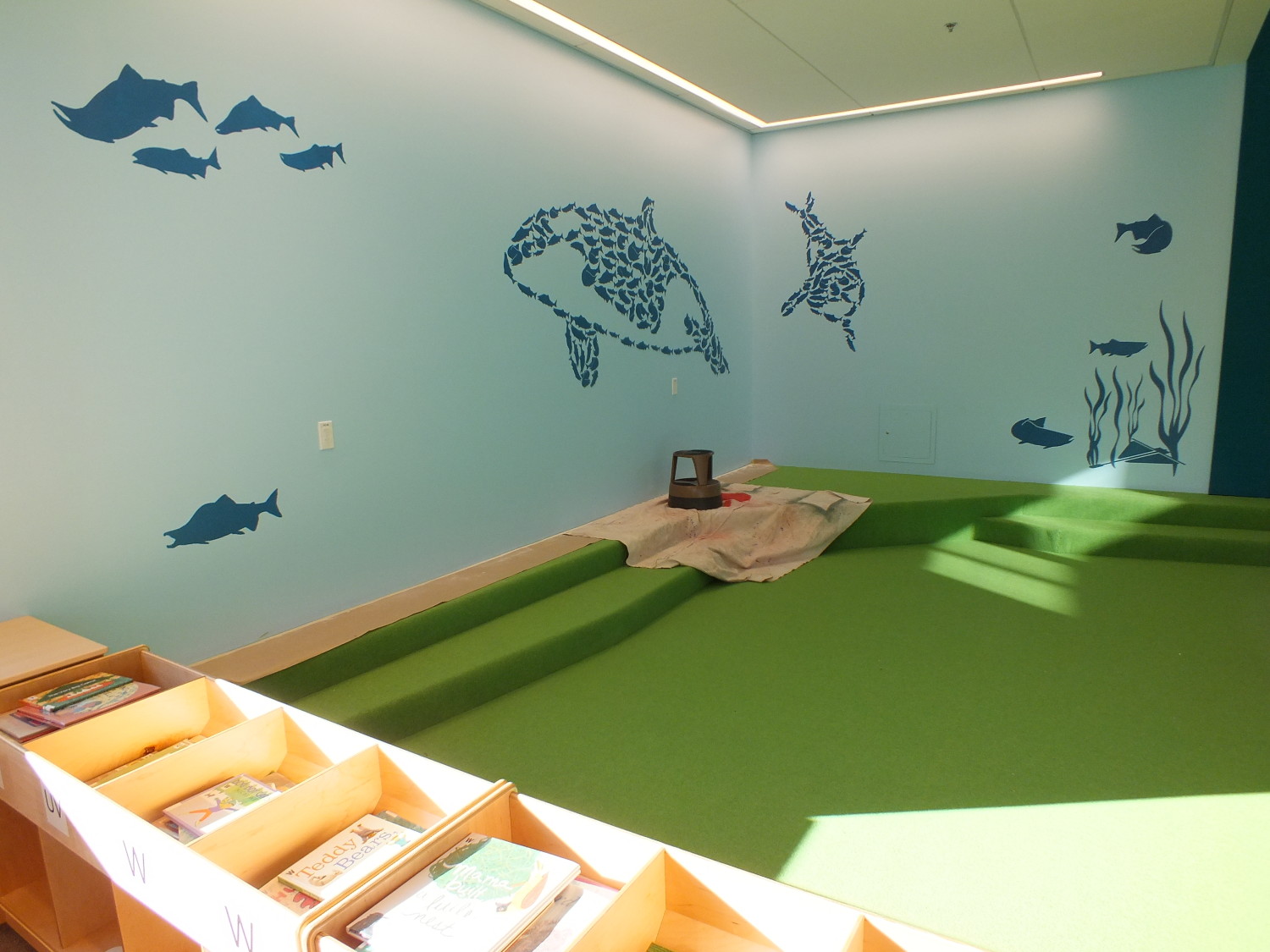
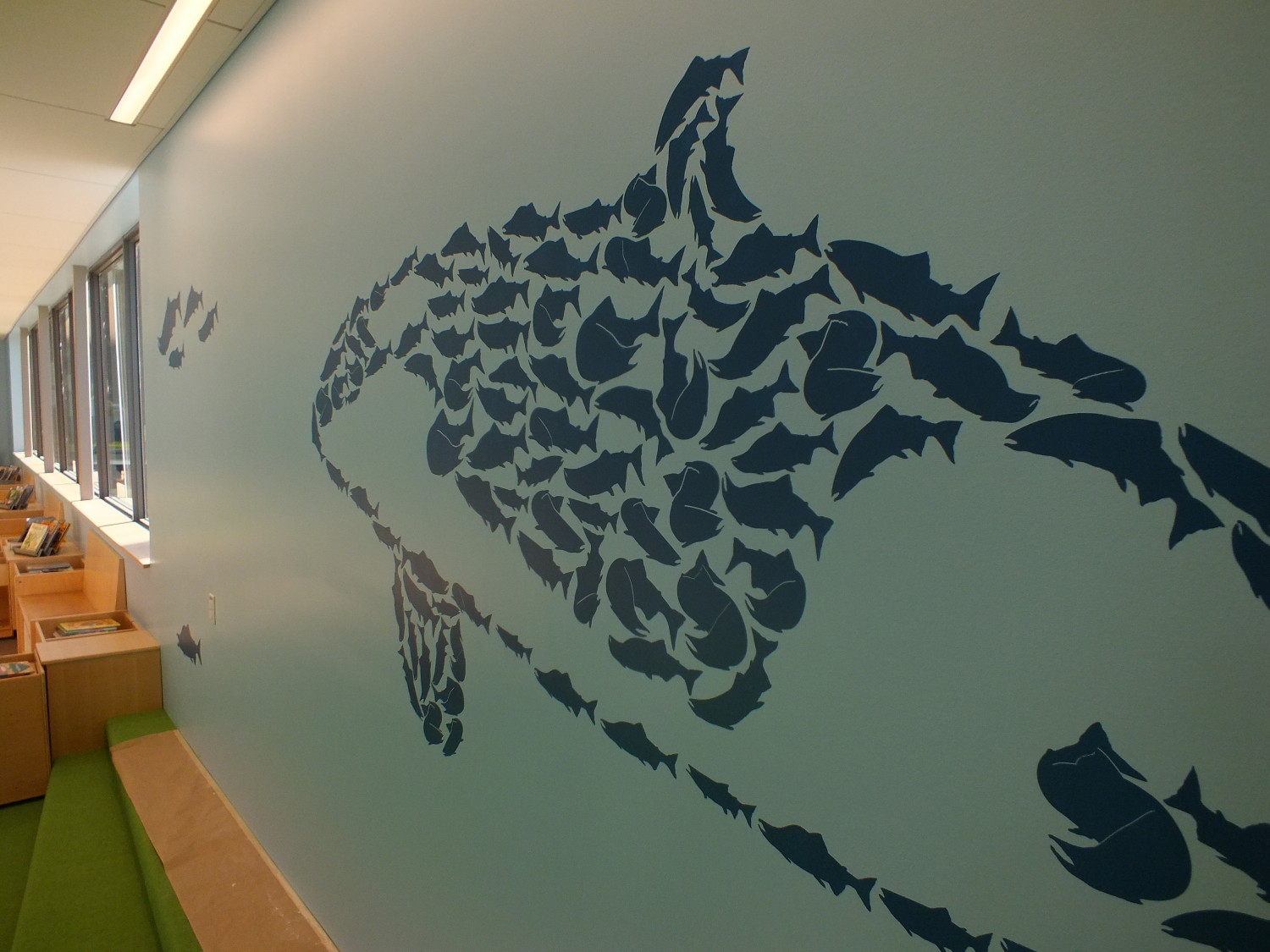
Aurora Projekt artwork dots the walls of the children's section and surround the stage for story time. (Photo by Matt Miller/KTOO)
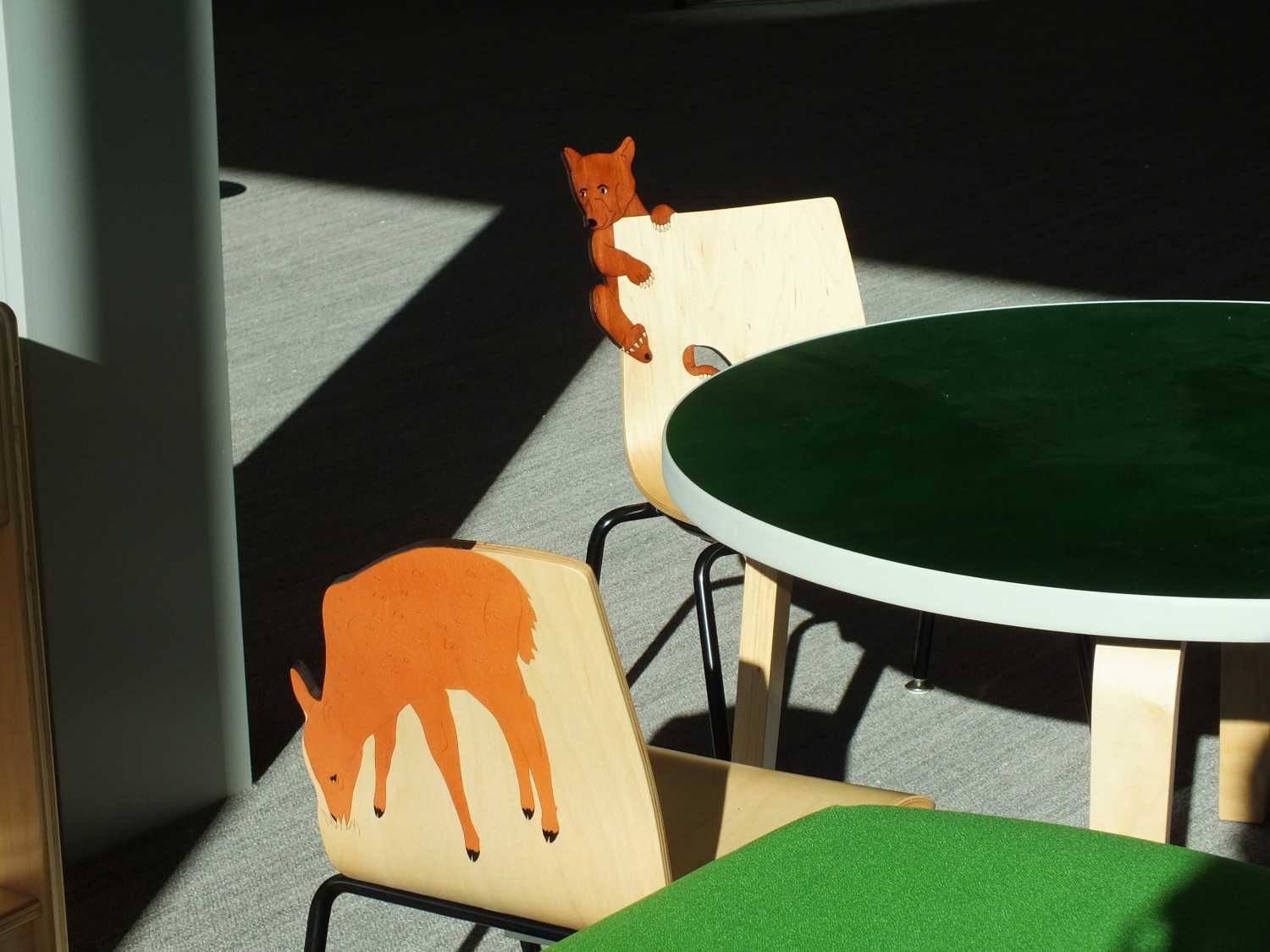
Kids' chairs feature animals commonly found in Southeast Alaska. (Photo by Matt Miller/KTOO)
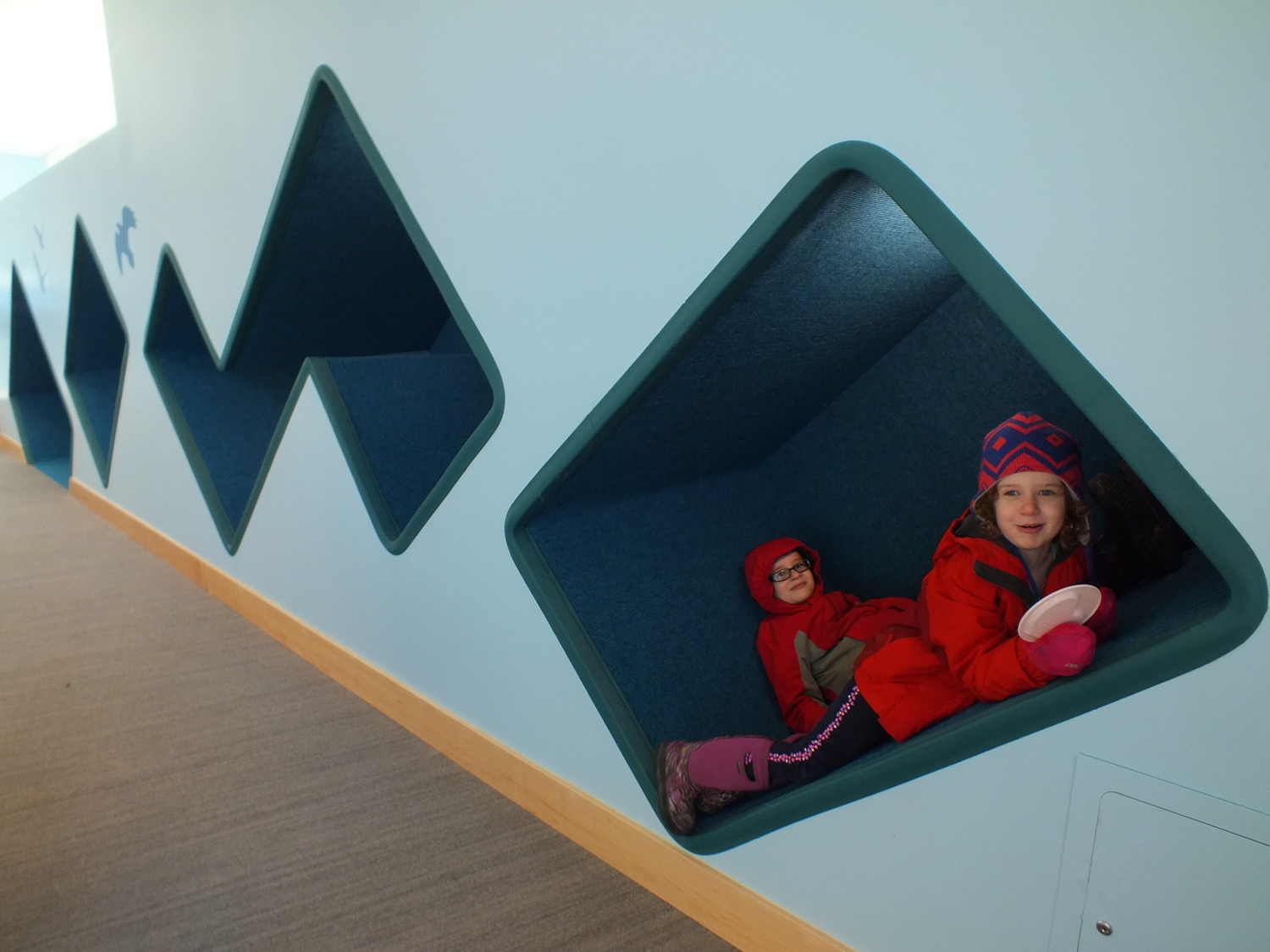
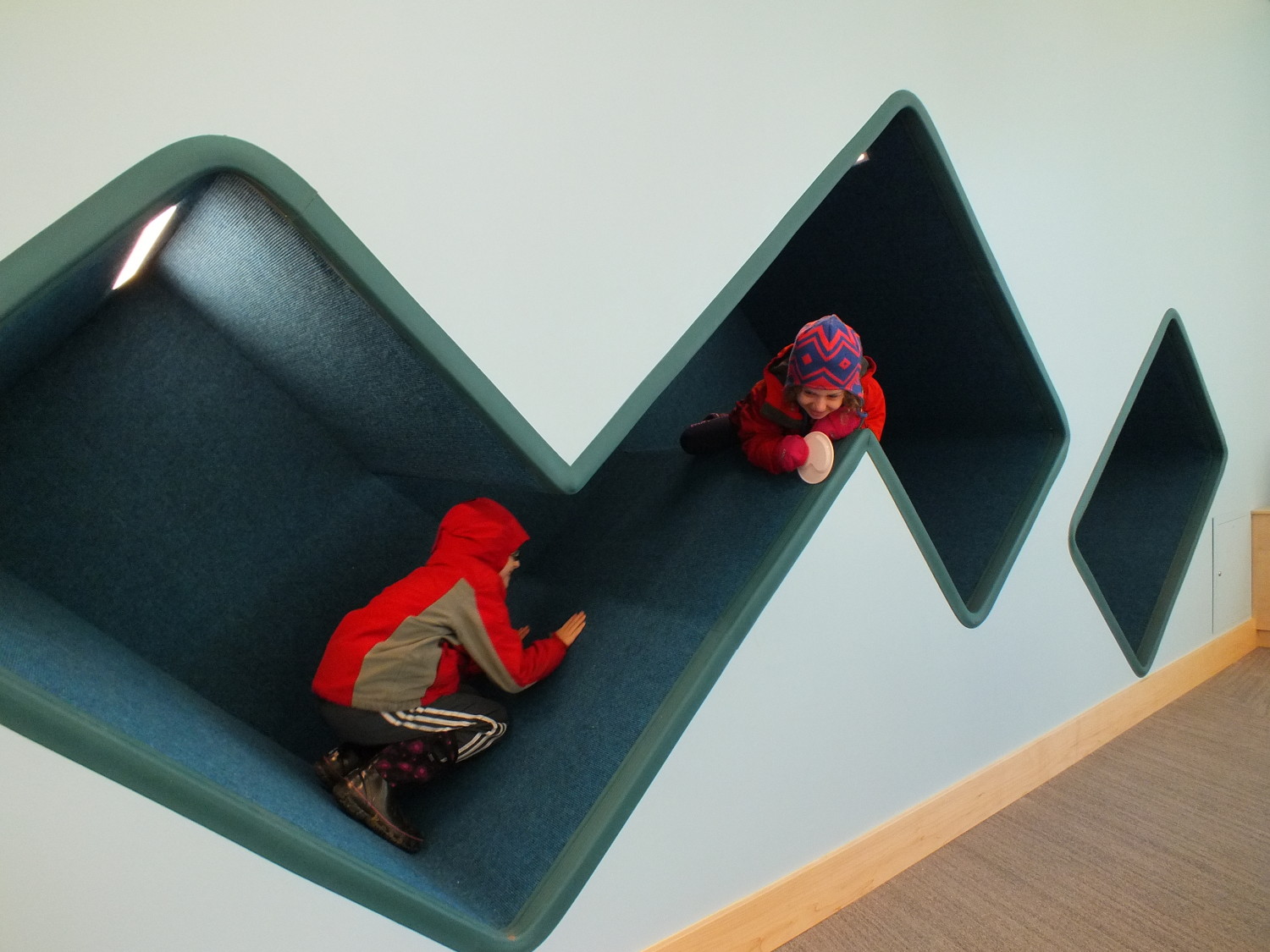
Q Curtis, 8, and Sadie Frances Curtis, 5, enjoy the new children's reading nooks. (Photo by Matt Miller/KTOO)
Aurora Projekt art is featured at the new Mendenhall Valley Public Library. (Photo by Matt Miller/KTOO)
Q Curtis, 8, and Sadie Frances Curtis, 5, enjoy the new children's reading nooks. (Photo by Matt Miller/KTOO)
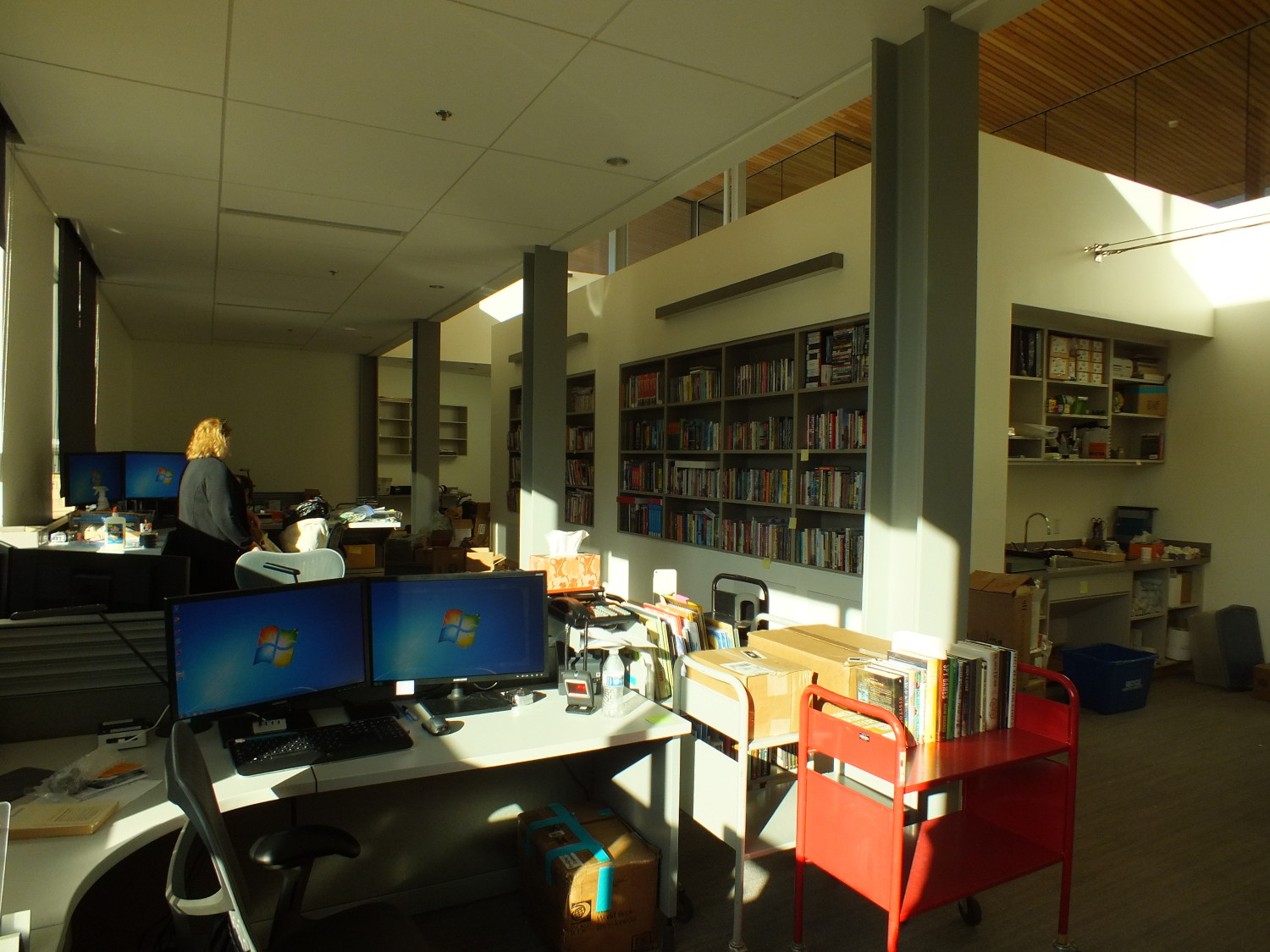
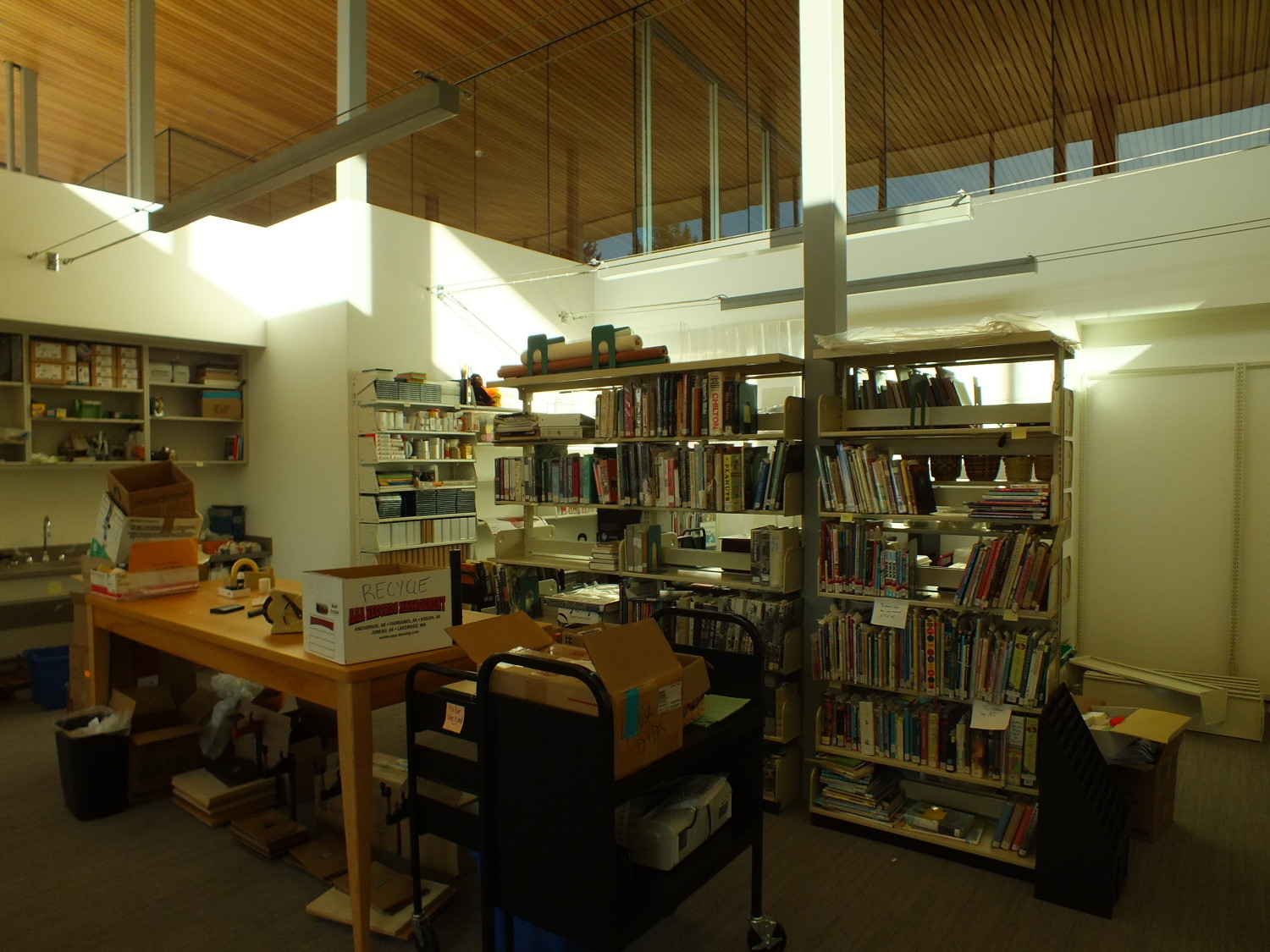
A back office for book processing. (Photo by Matt Miller/KTOO)
A back office for book processing. (Photo by Matt Miller/KTOO)
Take a virtual tour of the new Mendenhall Valley Public Library (about 13 minutes) conducted by library program coordinator Beth Weigel. Start the audio file below and click through the slideshow above:
Juneau book lovers can check out the new Mendenhall Valley Public Library in Dimond Park — and check out more books — after its soft opening Monday, Oct. 5. For more than 30 years, the old library was located in the Mendenhall Mall.
The new 24,000 square foot structure — almost twice as much space as its former location — is open and inviting with natural light streaming through exterior and interior glass that reflects off the wood ceiling.
The $14 million project was largely paid for by city sales tax proceeds, a state grant and a contribution of more than $1 million from Friends of the Juneau Public Libraries. The organization raised most of the funds from used book sales at their Amazing Bookstore in the Airport Mall.
A formal grand opening ceremony for the Mendenhall Valley Public Library is planned for November 7.
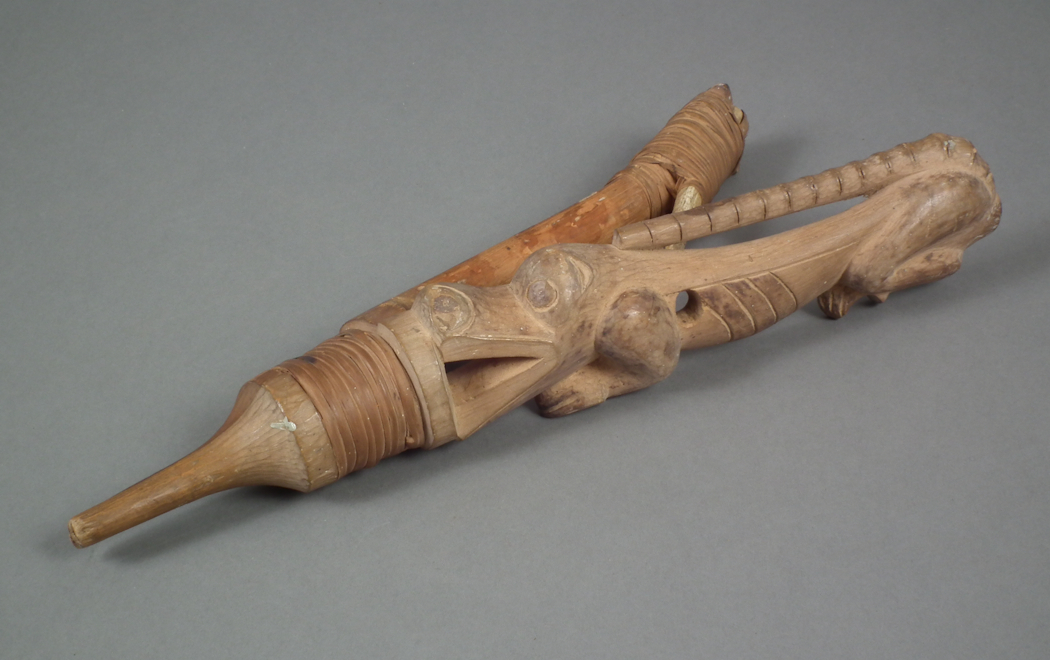
This Tlingit halibut hook with a wolf spirit was slated for auction. (Photo courtesy of Karen Kramer/Peabody Essex Museum)
A Massachusetts college that planned to liquidate its Native art collection has called it off. The pieces are from 52 tribes, including Tlingit and Haida items that might be sacred. Now the country’s oldest theology school could get dinged with penalties as feds investigate.
Over the summer, the Andover Newton Theological School, or ANTS, quietly decided it would sell 80 pieces of Native art from their collection. But their plans didn’t stay quiet for long. The museum that’s housed the collection since the 1940s alerted hundreds of tribal leaders.
Sealaska Heritage Institute was one of the organizations contacted because the school intended to auction off a Tlingit halibut hook, an item that SHI President Rosita Worl says is sacred.
“The halibut hook has spiritual dimensions to it and in this particular case, we have a halibut hook with a wolf,” she said.
Worl believes the school also has a Southeast shamanic doll. If a college or museum receives federal funds, then federal law dictates that certain items in their collection are subject to repatriation.
So, how did Andover Newton wind up with such a vast collection of Alaska Native, Native American and Hawaiian art?
“It was through their own missionaries going out into the field and collecting objects. Like, I tell the story over and over again … they collected our sins,” Worl said.
What those missionaries considered “sins” could fetch the college a million dollars now if the legality of the sale hadn’t come into question.
Peabody Essex Museum President Dan Monroe says the school was confused from the jump. It didn’t file an inventory or summary providing tribes with information. And the college assumed the museum could cherry-pick what was subject to the law, but only tribes have say in that.
“No other party can make those identifications,” Monroe said.
Even so, the school claims that information came from Peabody Essex. Monroe lets out a big laugh before responding.
“OK. Number one: we could never tell them what objects in their collection are subject to NAGPRA. … Because we have no standing in the law and we perfectly well understand that,” Monroe said.
In 2009, Monroe says the Onondaga Nation asked the school to give back a wampum belt. The school denied the request. As a private college, it thought it wasn’t subject to the law. But here’s the problem with that: some students pay their tuition with Stafford loans, which are funded by the government.
This tunic was repatriated from a museum in 2007. Although it’s of Southeast origin, the tribe is unknown. (Photo by Elizabeth Jenkins/KTOO)
“If the institution receives federal financial assistance, whether directly or indirectly, that would be receipt of federal funds,” said David Tarler.
Tarler works at the NAGPRA office in Washington, D.C. He said the school is being investigated, and in this case penalties can range from $5,000 for each failure to comply up to about $21,000, or .25 percent of the school’s annual budget — whichever is less. Then there are aggravating circumstances, like previously denying a tribe’s claim.
Monroe says he’s still not sure if the college gets it.
“On the plus side, they’ve made the commitment not to sell objects; they’ve made a commitment to comply with NAGPRA and those are admirable and very positive decisions on their part,” he said. “Regardless of the means of how they arrived at them.”
Martin Copenhaver, the school’s president, said he was too busy to comment but forwarded a letter that said “we will proceed to repatriate artifacts … if feasible and appropriate ways can be found to do so.”
“I mean, that sent up a red flag to me,” Worl said. “When I read that, ‘if feasible and appropriate.’ What does that mean? It should be if it complies with the law. Who makes that determination? If it’s feasible?”
Aside from the law, she says there’s a larger underlying issue the school doesn’t seem to understand about the collection.
“They keep referring to them as artifacts and they’re not artifacts. They’re at.oow. They’re living things to us; they’re spiritual things to us,” Worl said.
Andover Newton Theological School did recently reach out to the Onondaga about the wampum belt, Worl said. But Southeast tribes are still waiting.
Clarification: we’ve reworded details about how the school may be fined.
State budget pessimists warn that fewer barrels and a growing budget deficit could turn the state into an economic wasteland. But as some Juneau residents have learned, things could still turn around.
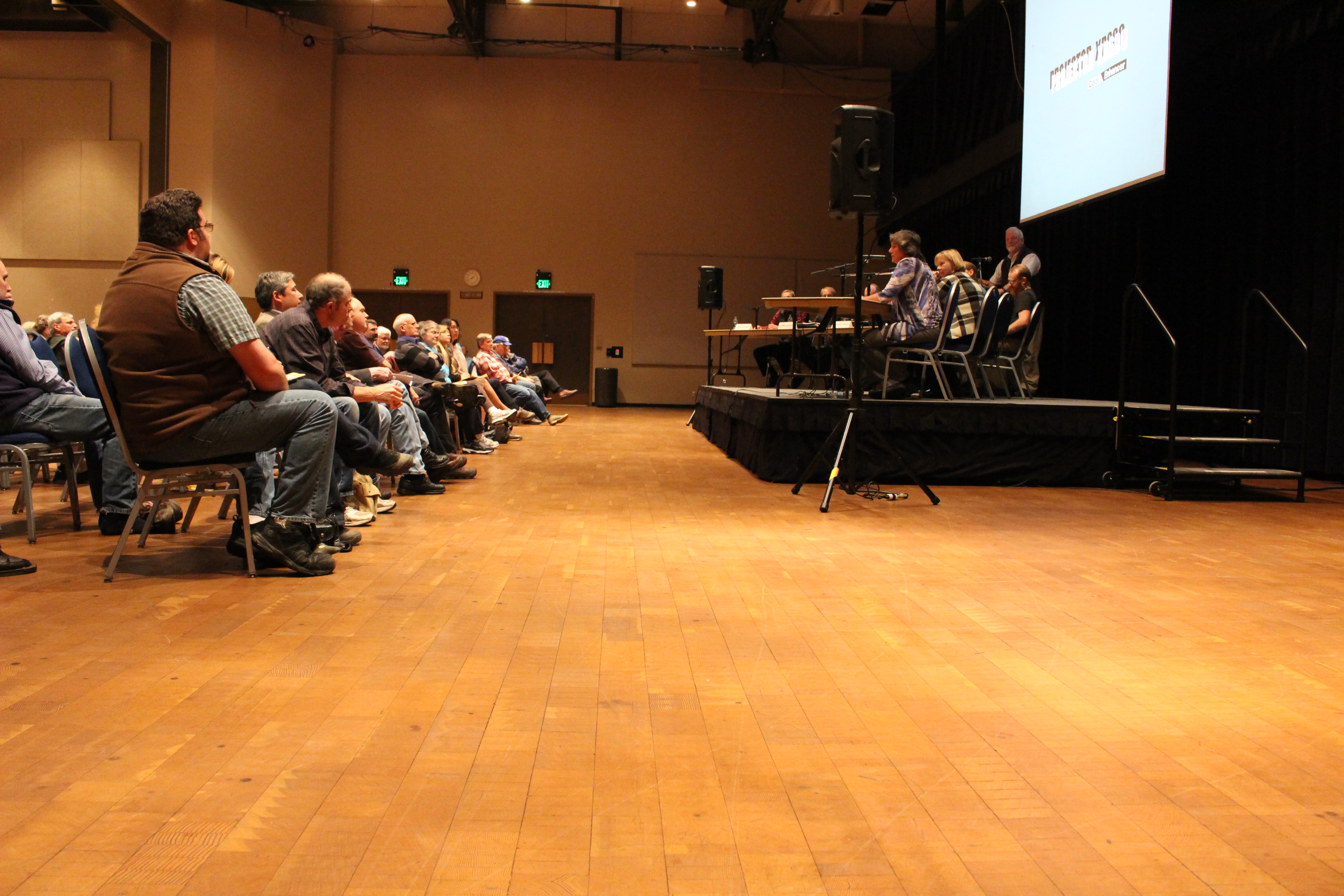
In a packed a ballroom at Centennial Hall Wednesday evening, a panel of two oil and gas consultants and two economists debated Alaska’s fiscal future.
Some of the more dire predictions inspire comparisons to Mad Max, a late 70s apocalyptic thriller in which oil reserves have been depleted, financial chaos and famine have set in, and roving biker gangs are the only law.
A warning from the movie’s trailer: “In the future, cities will become deserts, roads will become battlefields, and the hope of mankind will appear as a stranger.”
https://www.youtube.com/watch?v=c4TdPxOXuYw
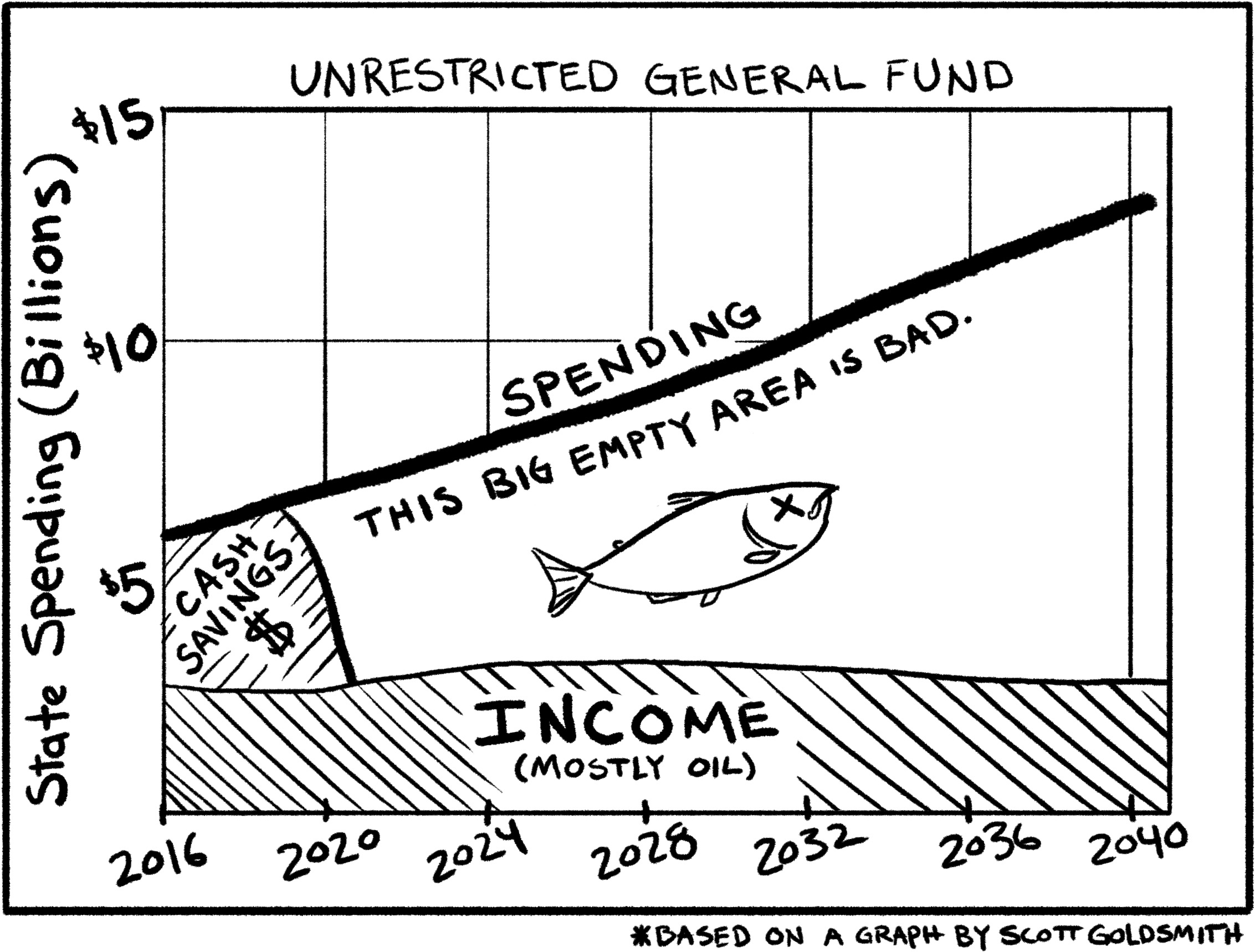
In Alaska, fewer barrels of oil are being produced and the price has dropped to under $50 a barrel — about half of what it used to be. The state is expecting a deficit of $3 billion next year.
And with deeper cuts comes a loss of jobs and school funding.
“It’s not going to take 10 or 15 years. I think two or three years, you’ll see a noticeable drop in Alaska’s population,” Larry Persily said. He, along with a panel of three, spoke at Juneau’s Forum on Alaska’s Fiscal Future.
Persily worked for the Obama Administration on Alaska’s natural gas pipeline and now works for the Kenai Peninsula Borough. He said the proposed LNG pipeline offered a glimmer of hope that could add $1.2 billion a year into the budget.
“But in and of itself, it is not going to solve our problem,” Persily said.
A big topic of conversation at the forum was the possibility of a state income or sales tax. But some of the panelists agreed a sales tax could be regressive and hurt struggling people.
Brad Keithley, a consultant firm that focuses on oil, gas and policy matters, said that’s what adding state taxes would do.
“Think about this for a second. If we’re going into a recession, the last thing you want to do is reduce personal incomes,” Keithley said. “The last thing you want to do is take money out of the private economy. Take money out of people’s hands. That’s what taxes do. ”
Persily sees it differently.
“You look at taxes as taking money out of individuals’ hands. I look at taxes as a way of paying for community services, “Persily said. “That’s how it works. That’s how communities work.”
Open seats were scarce at the Juneau’s ficscal forum. (Photo by Elizabeth Jenkins/KTOO)
Persily said some people could also afford a reduced PFD check or forgoing it altogether. I asked Josh Warren an attendant at the forum, what he thought of that.
“I love my PFD. I’ve gotten it every year since I was born here. But if that’s what the state needs to educate children, then I think that’s OK,” Warren said.
Juneau has a 5% city sales tax. Places like Anchorage and Fairbanks don’t.
To help with the fiscal crisis, panelists advised municipalities to come up with solutions on their own. Brad Keithley said that meant “thinking local.”
“Because the state’s not going to be riding over the hill to build the next school, to build the next AstroTurf football field, to build the next UAF athletic arena, to build the next crime lab. They’re not going to ride over the hill to do that,” Keithley said.
Rally goers gathered at noon on the capitol steps. (Photo by Elizabeth Jenkins/KTOO)
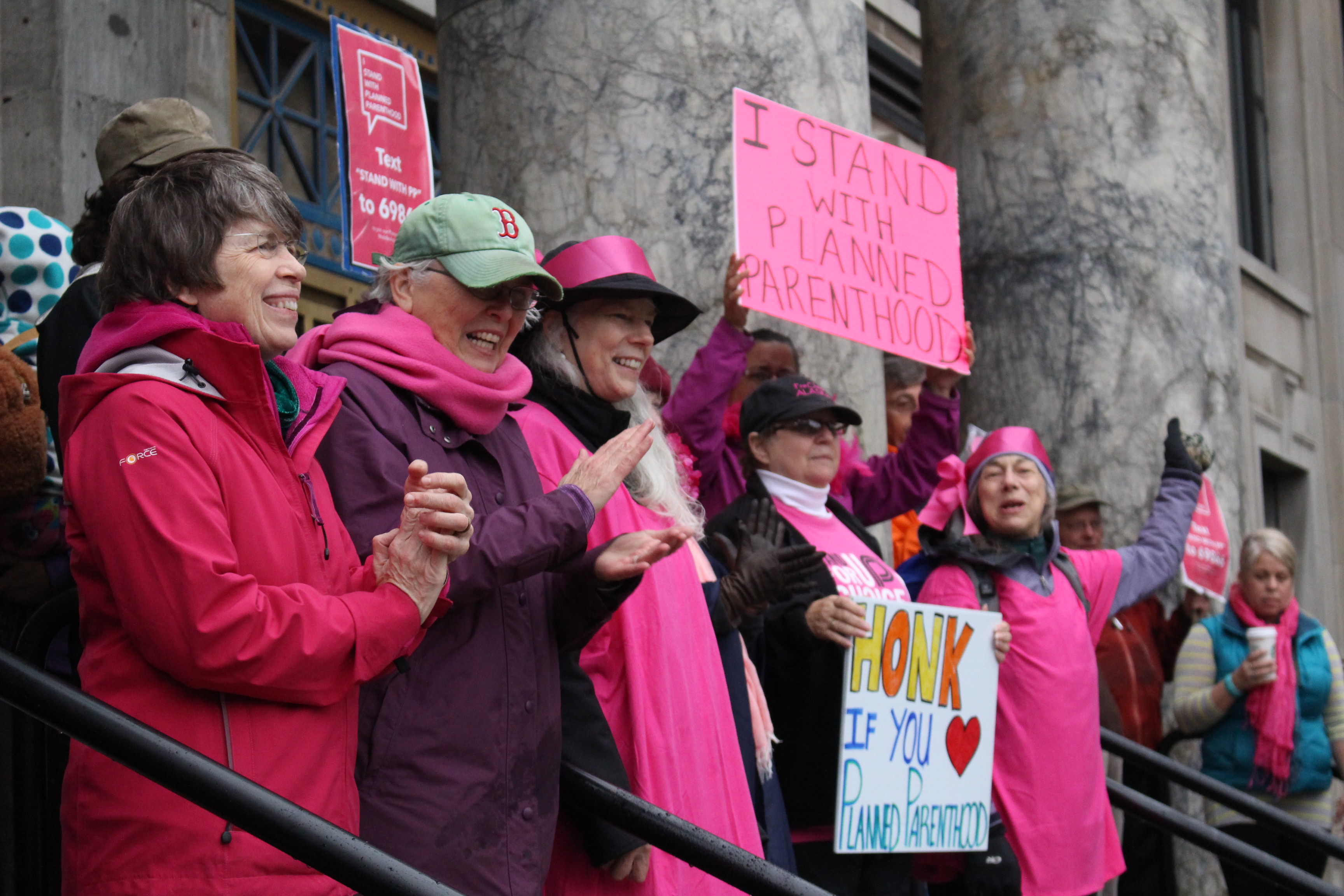
A crowd gathered on the capitol steps Tuesday to show their support for Planned Parenthood. In recent weeks, Republican lawmakers in Congress have tried to strip the organization of its federal funding.
Rally goers clutched signs that said, “Have your children by choice not chance”, “Grandpas support Planned Parenthood” and, of course, a sign to honk “if you love Planned Parenthood.”
Dave Sturdevant borrowed his wife’s hot pink scarf for the rally. He blended into a sea of pink shoes, T-shirts and knitted hats that the crowd of about 30 was encouraged to wear.
“It’s about 90 percent senior citizens like myself. You have senior citizens well past reproductive age out here to support the cause for younger women and families,” he said.
There are four Planned Parenthood clinics in Alaska. They provide STD and cancer screenings for men and women, pap smears, sex education and LGBT services. And yes, three of the clinics provide abortions.
Planned Parenthood has been in the headlines lately because of a sting video showing affiliates discussing the harvest of aborted fetal parts. And conservative Republicans are using the controversy to justify defunding federal dollars. Jessica Bogard skipped her lunch break to attend the rally.
“Today is important because the decisions being made have a deadline and a vote. And so we need to make our opposition to the decisions being made to unfund or defund known today,” she said.
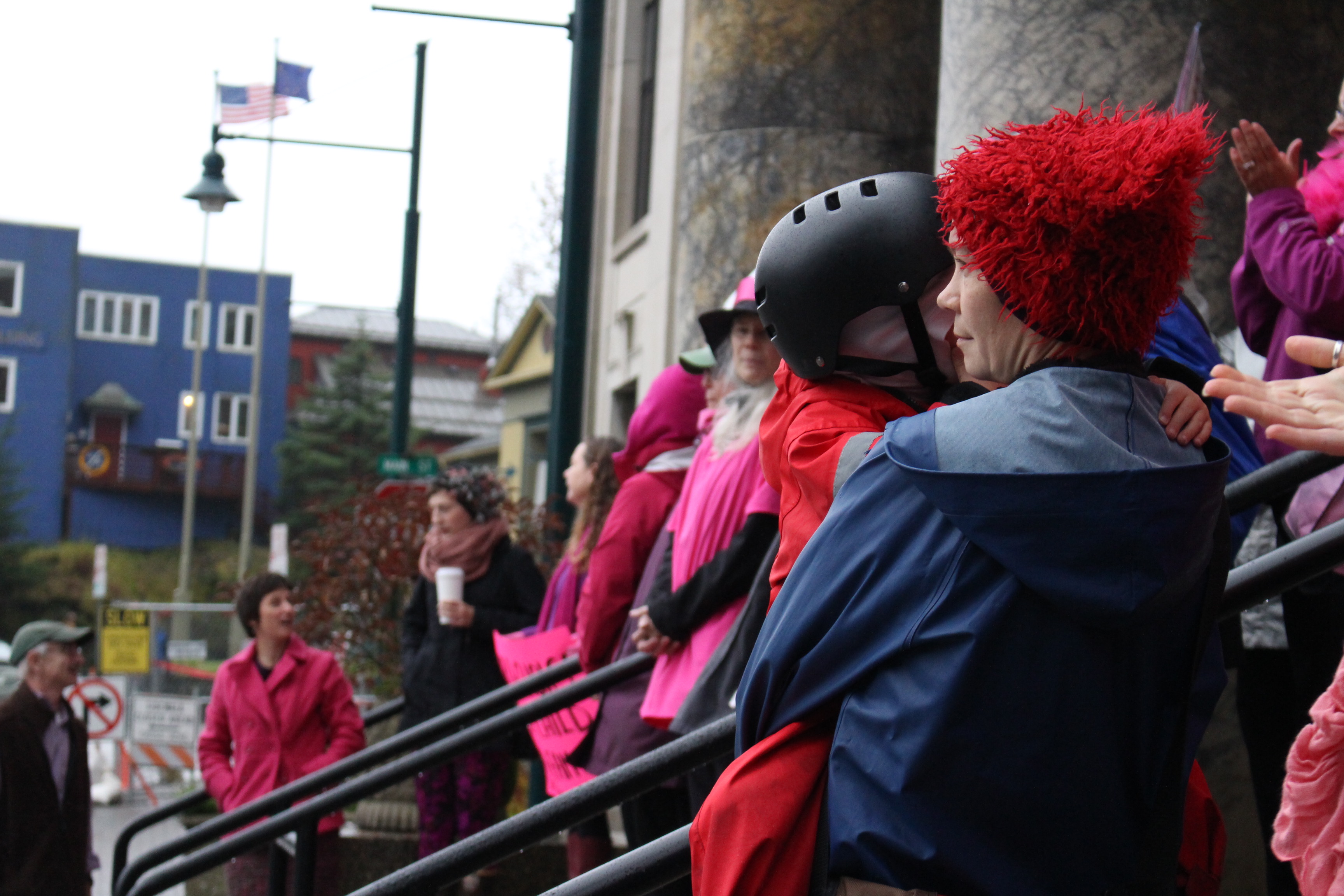
Inari Kylanen brought her child to the rally. She said it’s important for her daughter to have choices when she grows up. (Photo by Elizabeth Jenkins/KTOO)
A bill to defund Planned Parenthood failed to get enough votes in the Senate. But a potential government shut is looming if lawmakers can’t come to an agreement in the House.
Last week, Alaska’s U.S. Sen. Lisa Murkowski voted against a bill to defund Planned Parenthood, and she said she doesn’t support a government shutdown. She was one of eight Republicans to vote against the bill.
Bogard says she’s happy the senator voted with the Democrats.
“But I don’t think it’s a party issue, it’s a health issue,” Bogard said. “And if you view it that way, the decision is clear. You keep funding Planned Parenthood.”
A woman in an SUV drove by the rally, rolled down her window and shouted “no government funding for private business.” The crowd quieted for a minute before the chanting picked back up.
Amanda Krafft said she thinks most of the reaction to the rally has been positive.
“Maybe only just a couple people have not waved or just looked,” Krafft said. “Maybe one or two stink eyes. But that’s okay. That’s alright.”
Krafft leads the next chant of “Reproductive rights for all! Hurrah, hurrah!” She said she came up with it on the fly.
Close
Update notification options
Subscribe to notifications
Subscribe
Get notifications about news related to the topics you care about. You can unsubscribe anytime.