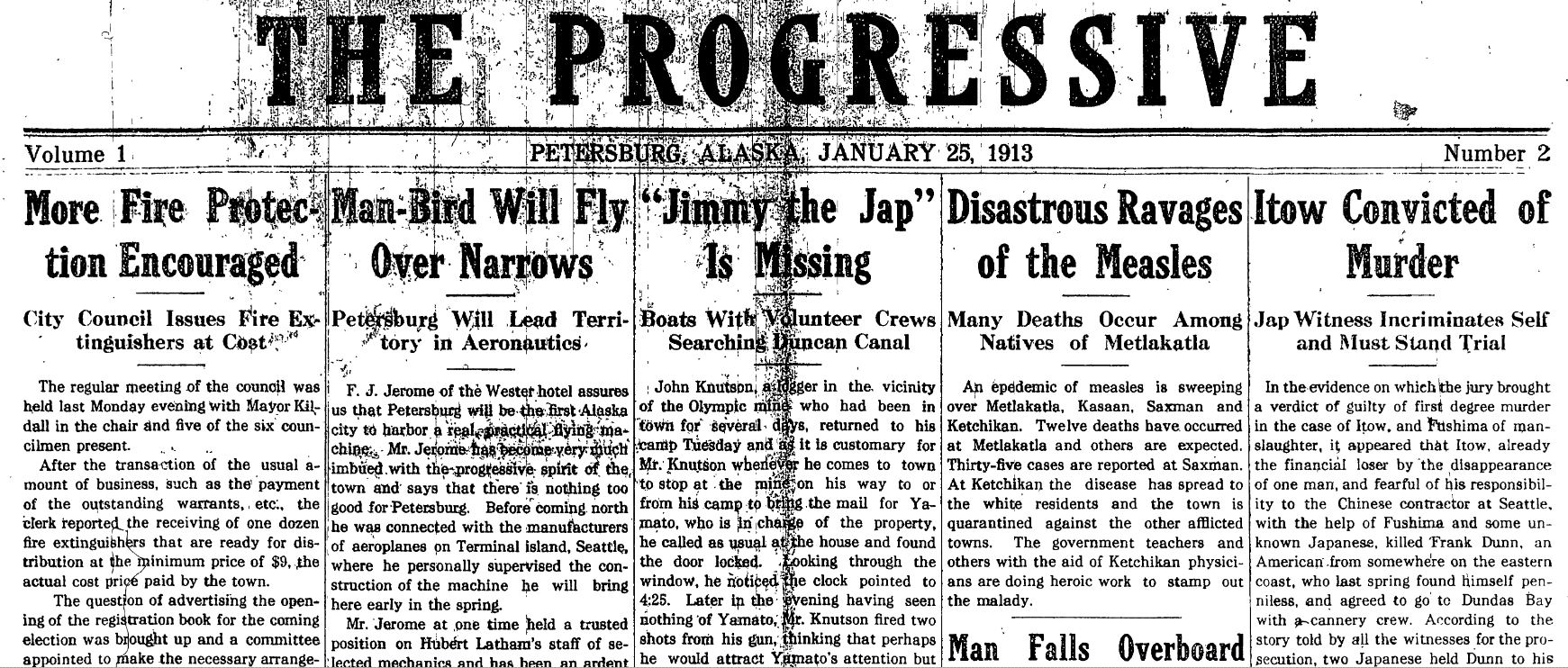
The Progressive was an earlier iteration of the Petersburg Pilot newspaper.
The Alaska State Historical Records Advisory Board has recognized The Petersburg Public Library with a certificate of excellence for partnering with the Petersburg Pilot to digitize and archive the weekly newspaper going back 100 years.
The Petersburg Public Library has hundreds of old papers from decades ago. Some are still at the old library in storage and some are in the new library’s small local history room. And for a decade the library’s director, Tara Alcock, wanted to archive those papers into some kind of searchable database. The problem was that the technology just wasn’t there.
“You would literally have to type in the newspaper,” she said.
The publisher of the Petersburg Pilot, Ron Loesch, gave the library permission to digitize and share the newspaper’s weekly issues since 1974. Loesch says the paper is a historical record of what happened in the community and preserving it is important. Also, he says, the new database makes things more efficient for both the public and the Pilot.
“We get a lot of requests for archival information and we do not have the staff to search that, so being able to send people to the library archives to retrieve various articles saves us a tremendous amount of time,” Loesch said. “On a few occasions, particularly when attorneys wanted particular information, we would charge $20 an hour to search the archives, and now the archives are available through the library for free.”
As for the future of the hard copies of the old papers, the library is working on an off-site solution to storing them because as Alcock says, they are rarely used anymore.
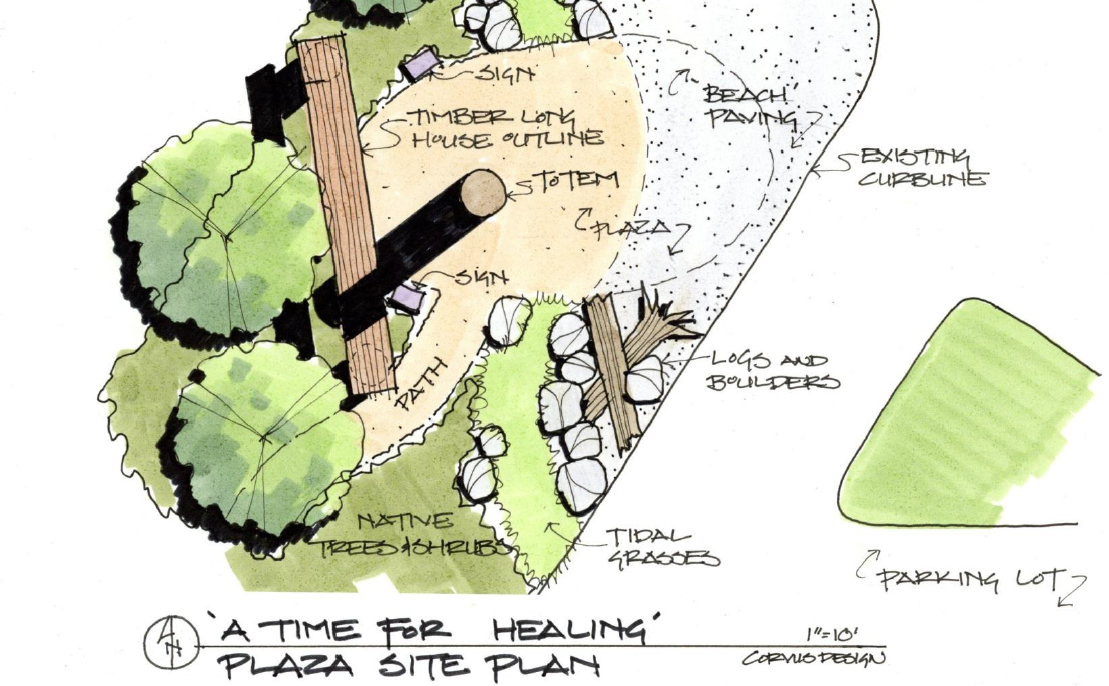
A tentative design of the Native plaza at Savikko park. (Photo courtesy of Corvus Design)
Savikko Park and Gastineau Elementary School will be the future sites of two totem poles. Plans include interpretive signs in Tlingit and English, explaining the history of the original people of Juneau and Douglas: the Aakʼw Ḵwáan and Tʼaaḵu Ḵwáan. Technology also plays a part in telling the story.
In 1956, the site of the Douglas Indian Cemetery was paved over near the elementary school. The Douglas Indian village was burned in 1962 to make way for a new harbor. Signs near Savikko Park explain the history of the Treadwell Mine, but there’s nothing about the area’s Native people.
Now there’s a project to change that. It’s called A Time for Healing: A Gaawooya Yei Shtoosneixhji.
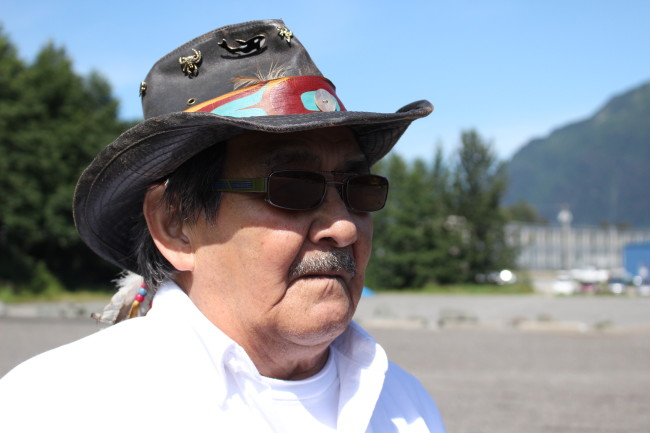
John Morris remembers the spot where his house once stood. (Photo by Elizabeth Jenkins/KTOO)
The Goldbelt Heritage Foundation was awarded over a million dollars from the U.S. Department of Health and Human Services.
John Morris of the Tʼaaḵu Ḵwáan saw his village destroyed back in 1962.
“In my lifetime, I have not seen a Native totem pole placed in Douglas, so that’s really good news,” he said.
Morris, a tribal leader in the Douglas Indian Association, is on the design team for the totems. As the final plans come together, he says he doesn’t want the poles to reflect anything negative. It’s not what the poles are historically intended to do.
“My vision of the totem pole is going to be more of a welcome totem pole with the crest figures of the Tʼaaḵu Ḵwáan Yanyeidí people, which is of the Eagle-Wolf design.”
He says the poles could include other Native people in the area, like the Aakʼw Ḵwáan and Wooshkeetaan.
The other part of the grant helps fund exhibits at the Juneau-Douglas Museum. The carving of the totems will be documented through photos and videos. Later, an $18,000 touch-table can provide museum-goers with an interactive experience.
“For example, if it were a map of the Douglas Indian Village you could touch a portion of it and it zooms into part of the screen. So it’s however you program it,” said Richard Steele, a grant writer at Goldbelt Heritage Foundation.
He’s been working with Jane Lindsay, the museum’s director, on how technology could play a role.
Lindsay came up with idea of the touch-table after seeing something similar at the Haines Library. And she’s excited the stories of the Aakʼw Ḵwáan and Tʼaaḵu Ḵwáan will be featured in a permanent exhibit.
“You know, we’re looking at some pretty important history in Douglas and for the Douglas Indian Village and for all of the local Native people here that we really need to talk about,” Lindsay said.
The totem poles are slated to go up in 2017. The touch-table is planned for 2018. A Time for Healing culminates in a community-wide celebration later that year.
Juneau has suffered six heroin-related deaths this year. The public is invited to share stories about addiction and discuss solutions at Wednesday night’s Community of Compassion gathering.
Grace Elliott, the event’s organizer, said the losses hit home. A family friend died of an overdose recently. He was dancing at her daughter’s wedding just weeks before.
“What we want is a space that people can gather in, that it’s a safe space for people to talk about their own experience, how they’re affected by this,” Elliott said. “A lot of the people who are coming already are family and friends of people who have died recently. A lot of these people are in their 20s.”
The Juneau Police Department is conducting a six-month anti-heroin initiative to help answer questions about why users start and why it’s so difficult to kick.
Police typically don’t send out press releases about heroin deaths. However, they released one on Oct. 5 after Robert James Hanson died in his family home. Hanson’s mother gave specific permission because she was distressed about the large number of overdoses in the capital city.
Grace Elliott said by talking, she hopes addiction can be de-stigmatized.
“So that we can have a realistic view of what the condition is in our community and then, thus be able to address it,” Elliott said.
Community of Compassion runs from 5 to 8 p.m. @360 in KTOO.
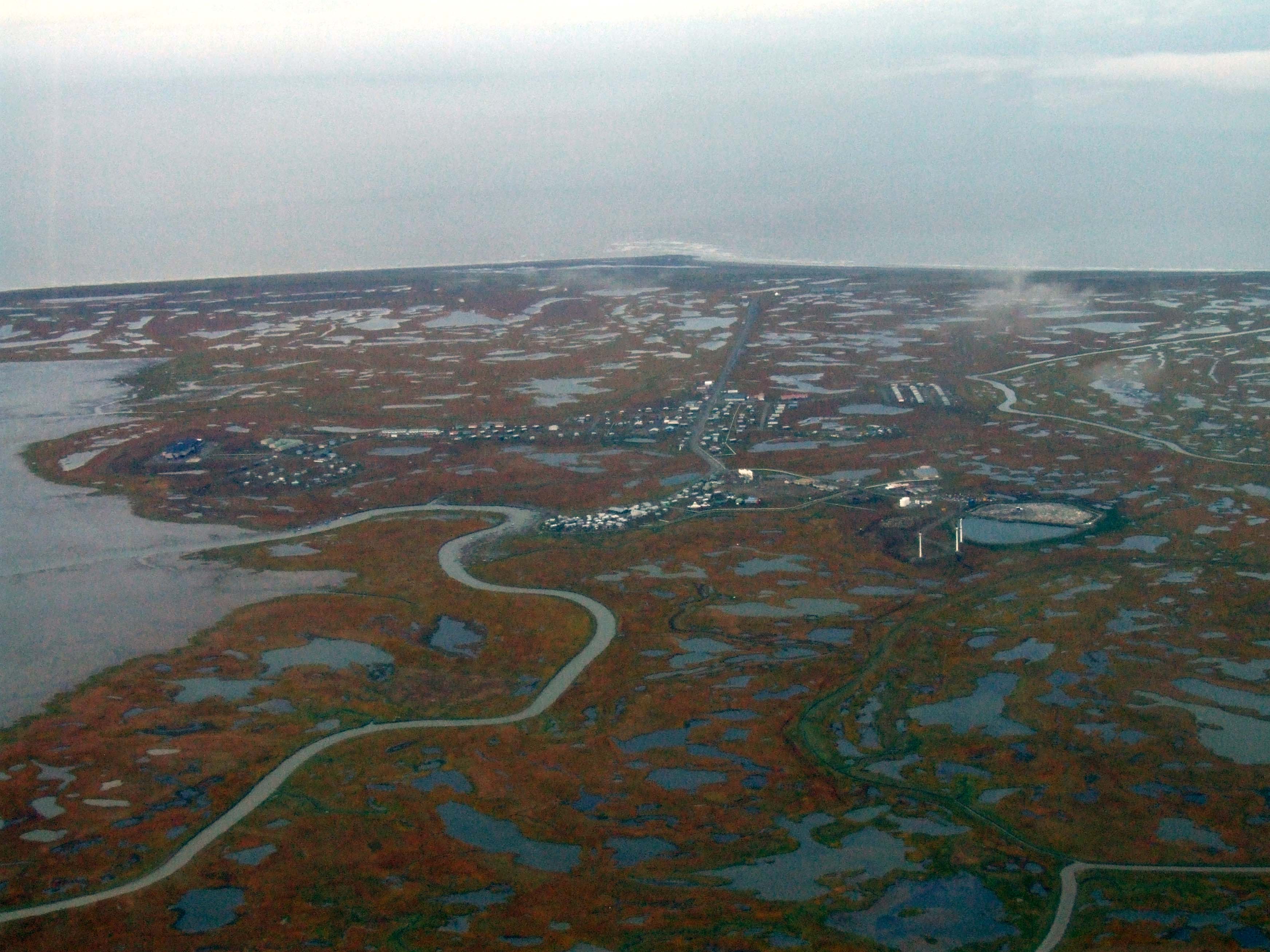
The village of Hooper Bay has suffered another loss. A fourth person has died by suicide.
Alaska State Troopers received a call that 21-year-old Carl Dominic Robert Joe had died from an apparent suicide Saturday afternoon, according to an online trooper dispatch.
Joe’s death comes less than a week after three other young adults have died.
In late September, 26-year-old Noel Tall died from suicide. Less than a week later, 24-year-old Eric Tomaganuk died by suicide, according to troopers.
Troopers believe the deaths are related.
Two days later, the village suffered another loss. Twenty-year-old Miranda Seton died by suicide after becoming distraught over Tomaganuk’s death, according to the online trooper dispatch.
The remains of all four victims were sent to Anchorage for autopsy.
Mental health experts say suicide is a complex issue and is not typically related to one event.
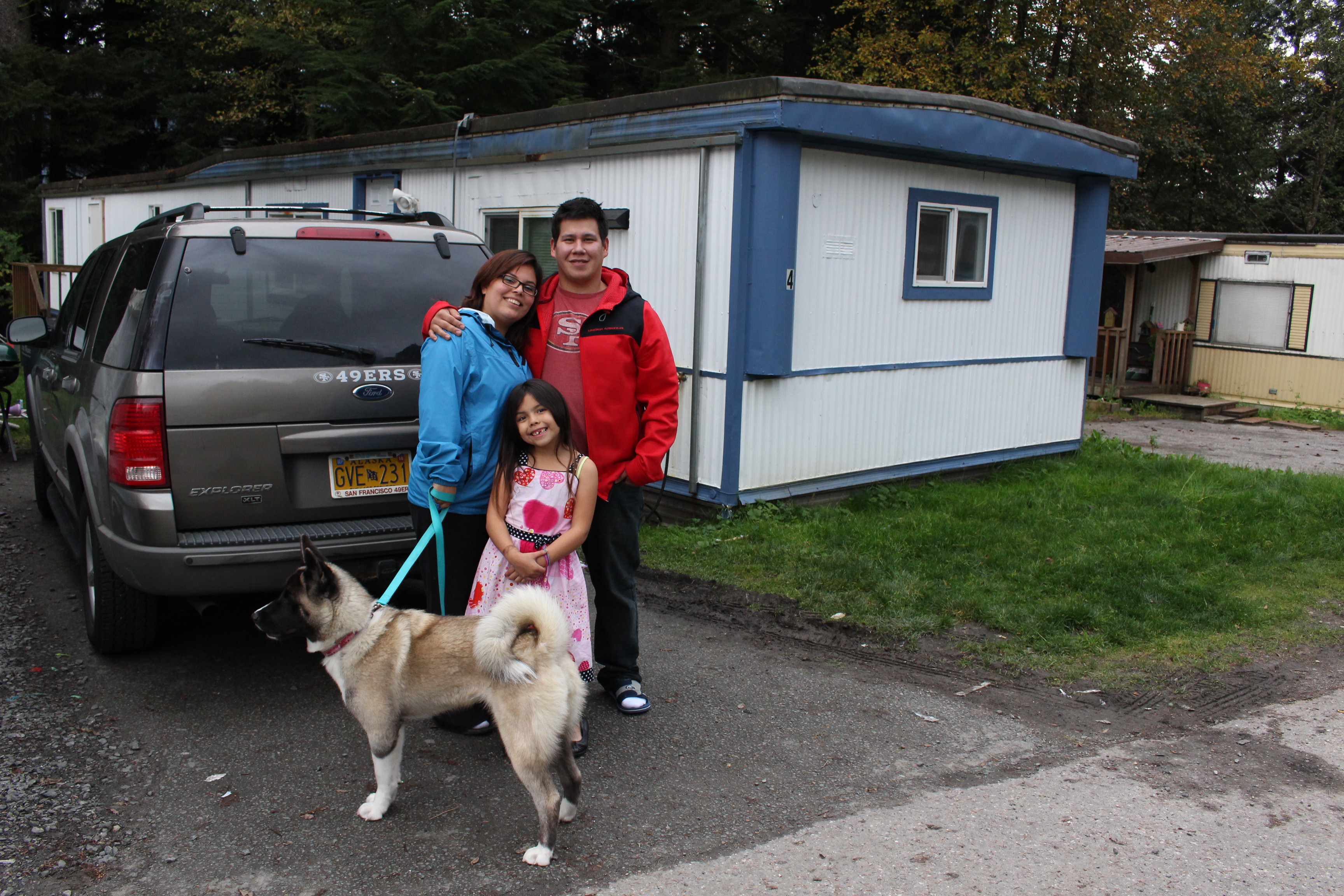
James Refuerzo and his family outside their home. (Photo by Elizabeth Jenkins/KTOO)
Medicaid expansion has been available to Alaskans for over a month, and 93 people in the capital city have enrolled. 263 in all of Southeast. It’s providing coverage for the uninsured. But it’s also offering increased care for those who qualify with Indian Health Service.
For one Juneau man, that means having options to treat alcohol addiction.
James Refuerzo says he fell on hard times when he was in his 20s, and he’s still paying for it now. Back then, he didn’t think he had a drinking problem.
“Maybe one time I’d overdo it. Then all a’sudden I find myself doing something I totally wouldn’t be doing if I was sober,” he said. “With my addiction sometimes I’d drink eight or 10 beers and make a dumb decision and say, ‘Hey I think I can drive.”
After his third DUI, he was locked up at Lemon Creek Correctional Center. Refuerzo is the father of three small kids. He spent two years away serving his sentence and had a revelation.
“Realizing, hey, this has got to stop. ‘Cause the next time I get in trouble, I’m automatically going to be in jail for five years,” Refuerzo said. “And I don’t want to do that and with my kids, something had to change and that’s when I went to Rainforest.”
He knew SEARHC was another option. That’s the tribal health care organization serving Alaska Natives in Southeast. Refuerzo is Tlingit from the Wooshkeetaan Clan. So most of his medical needs are covered. But Juneau SEARHC only offers limited outpatient care for substance abuse treatment.
“It’s tough just to ask for help but then when you ask for it and to be told to wait, it’s a little bit tougher.”
At Rainforest Recovery Center, he says he was able to fill out a form and come back that same day. The center has a sliding-scale payment policy. There’s an overnight treatment program. Refuerzo opted to do outpatient. And he says things got better. He was meeting with a counselor regularly and talking about his problems.
“When I got my job and everything I didn’t qualify for the sliding scale and I was paying 100 percent,” he said.
Refuerzo only works part-time and owes Rainforest over $1,300.
“It’s gone to collections now. I just got another letter saying this one is going to go to collections, too. It’s like I got to take care of it later on in life when I start making more money and decide to start fixing my credit,” he said.
So he stopped going Rainforest. Then he heard he qualified for Medicaid, which pays for treatment.
Bettyann Boyd, Refuerzo’s girlfriend, helped him sign up. She works at SEARHC and has been covered by Indian Health Service and Medicaid for a long as she can remember. Medicaid covers travel expenses for medical reasons and specialized care. Giving her family more opportunities.
“Just the choice, the choice to have a different option to go to a private clinic, a private dental. If you’re not feeling comfortable with the IHS services,” Boyd said.
And she’s glad those choices could extend to her boyfriend, Refuerzo. She’s proud of the work he’s done on himself. She’s going to counseling, too.
“We’re doing really good and we been doing really good. Who knew we’d be able to live in this trailer and have a trailer and own it,” she said. “Everything just keeps going up higher and higher.”
Refuerzo hasn’t heard back yet if he’s been approved for Medicaid. Some people who’ve signed up have had to wait. But after Nov. 1 new applicants will get an instant response from the Health Care Exchange that could speed up the process.
When his enrollment card does come, Refuerzo says it’ll feel good to slip it in his wallet.
“For once I’ll feel like I’ve got something in my life that means something material wise. … I’ve never carried an insurance card before. And each time I’ve been asked, I’ve never had insurance number in my life,” he said. “And it’s going to be nice knowing that I got Medicaid and I’m not just stuck seeing one person because that’s the only person I can see. I can seek out other opinions, other options.”
He’s four months sober. But he says it’ll be nice to know he can get help when he needs it.
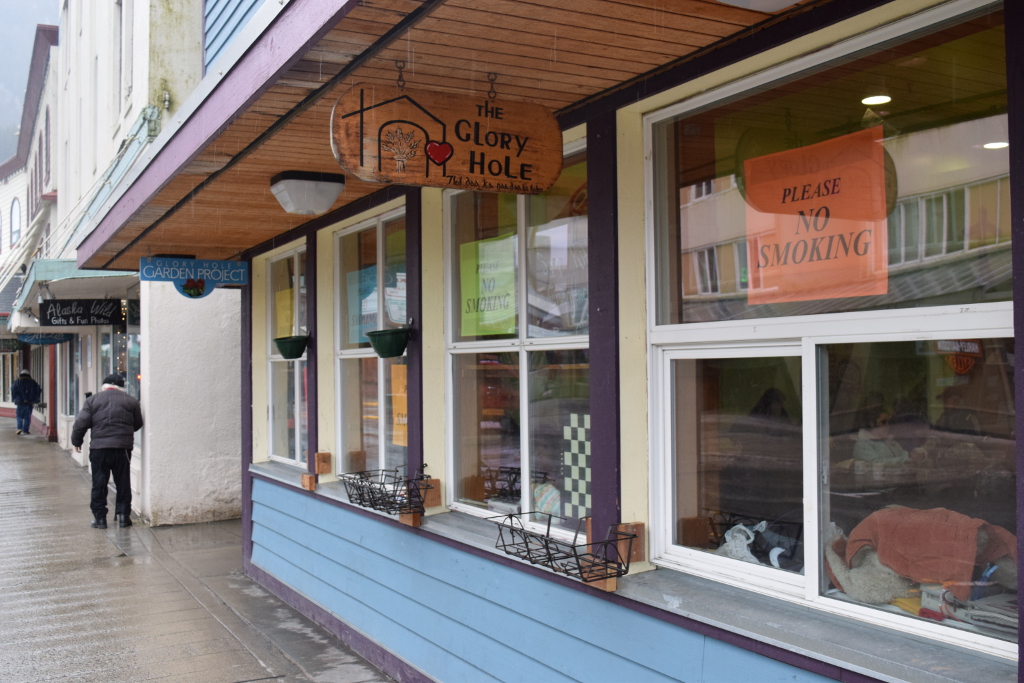
The Glory Hole, Juneau’s emergency homeless shelter and soup kitchen, organized this year’s Vulnerability Index Survey. (Photo by Casey Kelly/KTOO)
Volunteers and staff from Juneau’s shelter and soup kitchen went to the streets and interviewed 70 homeless people over the course of a few days in September. It’s been three years since the vulnerability index survey was done in the capital city.
The surveys can connect people to services, help The Glory Hole keep track of where people are sleeping, and social service agencies can use the data to guide practices and apply for funding.
It’s around 4:30 on a Wednesday morning. At The Glory Hole, groups of volunteers sip coffee and discuss plans for a second morning of surveys. Each group is assigned to search a different area of Juneau. The goal is to find homeless people who are sleeping outside and interview them.
The morning before, Brad Correia’s group didn’t find anyone in the Mendenhall Valley or out the road.
“We walked on a lot of beaches where they have shelters, like in the summer it would be really nice. We thought people would be sleeping in there, like they have fireplaces. But there was nobody,” Correia said.
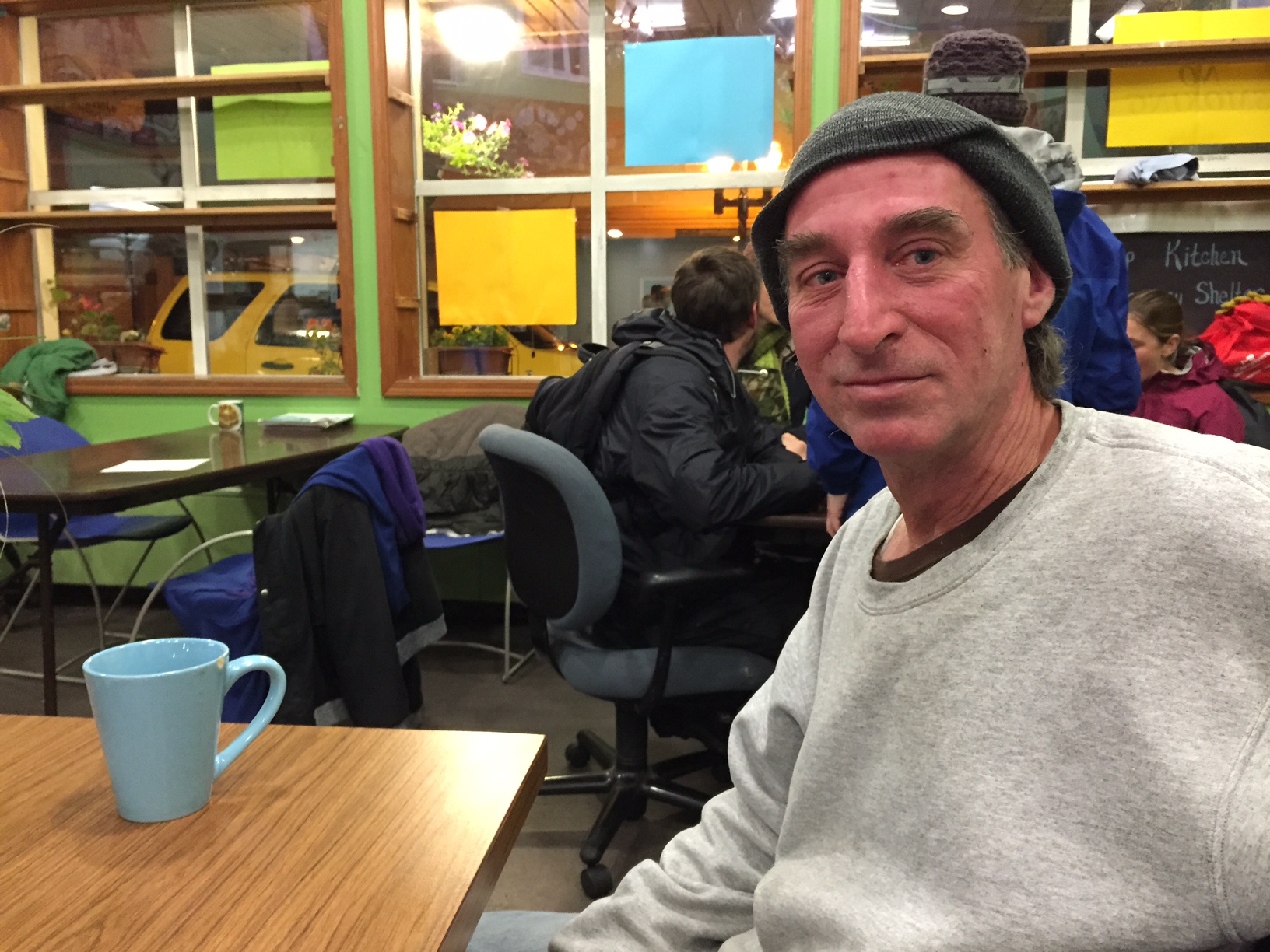
Brad Correia and his group searched for people sleeping outside in the Mendenhall Valley area and out the road. (Photo by Lisa Phu/KTOO)
The group searched behind Safeway, looked around all the stores in the valley.
“Just everywhere and we didn’t find anybody.”
Correia thought they might find people sleeping in cars out the road.
“‘Cause I thought, if I was homeless and had a car, that’s where I would go to where there wouldn’t be people bothering me, like troopers,” he said.
Correia has been homeless. When he first got to Juneau about a year ago, he didn’t have any money and stayed at The Glory Hole. He remembers another man at the shelter who talked a lot.
“I ignored him. I just acted like I was reading when he would come and talk to me. Just talk and talk and talk,” Correia said.
Days later, that man, Gregory Dockery, was found dead, submerged in water in a ditch near Twin Lakes.
This was last November. Correia is afraid Dockery died thinking nobody cared, “Last time I saw him, he was crying, ‘Nobody likes me, nobody cares about me.’”
This is why Correia is volunteering to do the homeless survey. He thinks there’s a better solution than dying in the cold.
Data from the 2012 survey has been used to apply for funding for Juneau’s Housing First Project.
Clyde Didrickson was part of that survey and was just interviewed again. He was walking to the Glory Hole with his wife when a group of interviewers found him.
“They let us know who they were and what they were up to asked me if I cared to be interviewed,” Didrickson said.
Didrickson felt fine answering personal questions about substance abuse, race, health history, mental health, money, education, how long he’s been homeless. There was one question he found intrusive and didn’t answer: What’s your social security number?
Didrickson won’t say where he and his wife spend their nights for fear of being harassed.
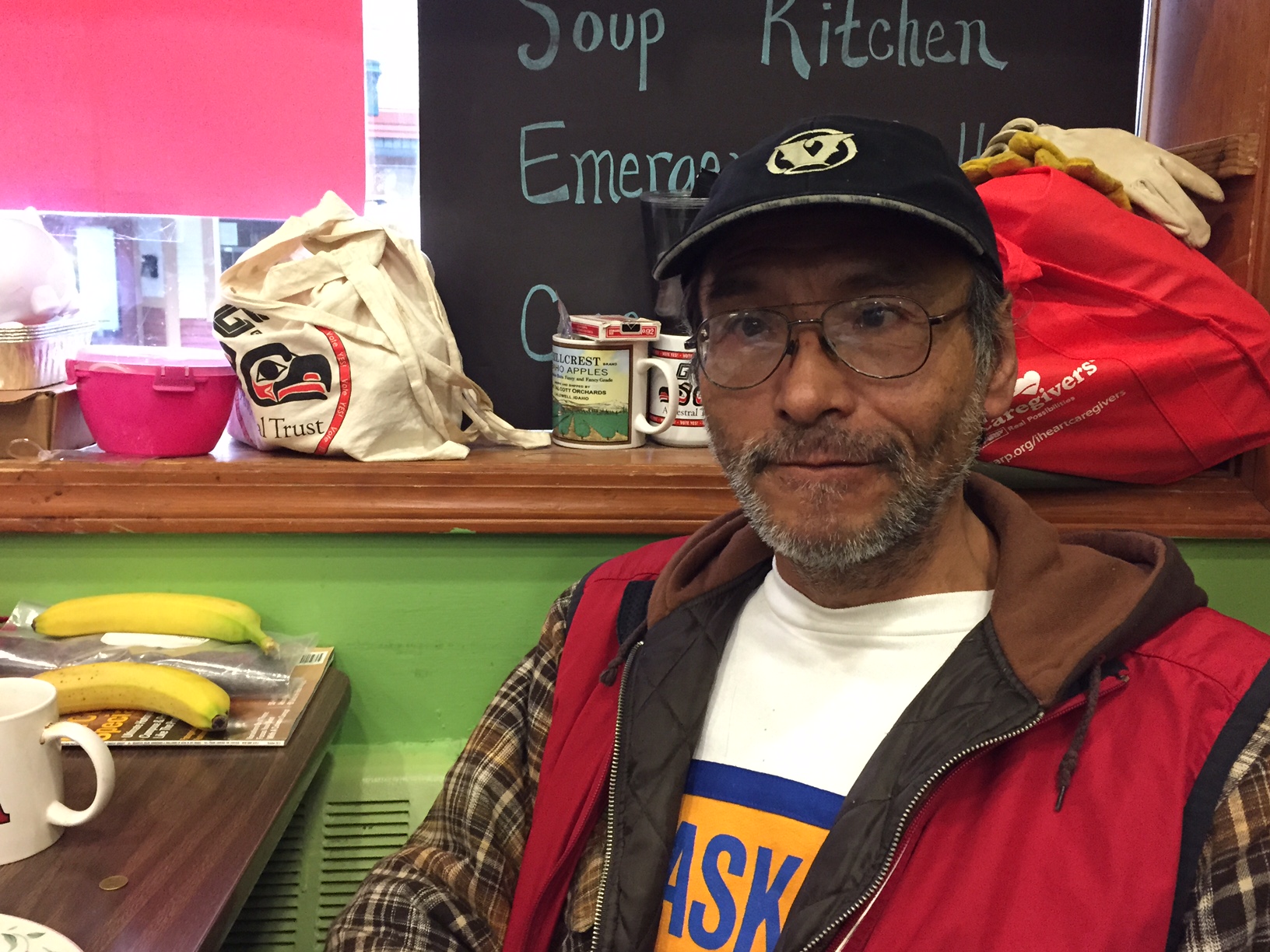
Clyde Didrickson says he’s been homeless since 1981. (Photo by Lisa Phu/KTOO)
“We found a dry spot,” Didrickson said.
Didrickson is 63, originally from Sitka and a veteran. Didrickson said he’s been homeless since the early 1980s when he was arrested for a felony. His wife is 62. He carries their bedding around in a suitcase – an old tent they use as a tarp and blankets.
“Usually after everybody closes up, basically when people stop moving around, we lay out the tarp to give us something dry to lay on and then we lay our bedding out on top of that and then the excess tarp we put over ourselves,” Didrickson said
The couple wakes up around 5 a.m. They put everything back in the suitcase and begin their day.
“Hardest part for us, especially at our age, is finding a facility to use,” Didrickson said.
Some public bathrooms lock up for good after the tourist season ends. Others don’t open until later in the morning. Didrickson said he sometimes goes to the bathroom in the woods.
At 7 a.m., he walks to The Glory Hole for coffee and warmth. The rest of the day, “Look for some place dry and warm to sit around. A lot of times wait for the library to open,” Didrickson said.
At the moment, he’s sitting with his wife, 27-year-old son, and brother-in-law at a table at The Glory Hole.
Didrickson says he’ll likely be back at the shelter for lunch and dinner before spending another night outside.
Close
Update notification options
Subscribe to notifications
Subscribe
Get notifications about news related to the topics you care about. You can unsubscribe anytime.