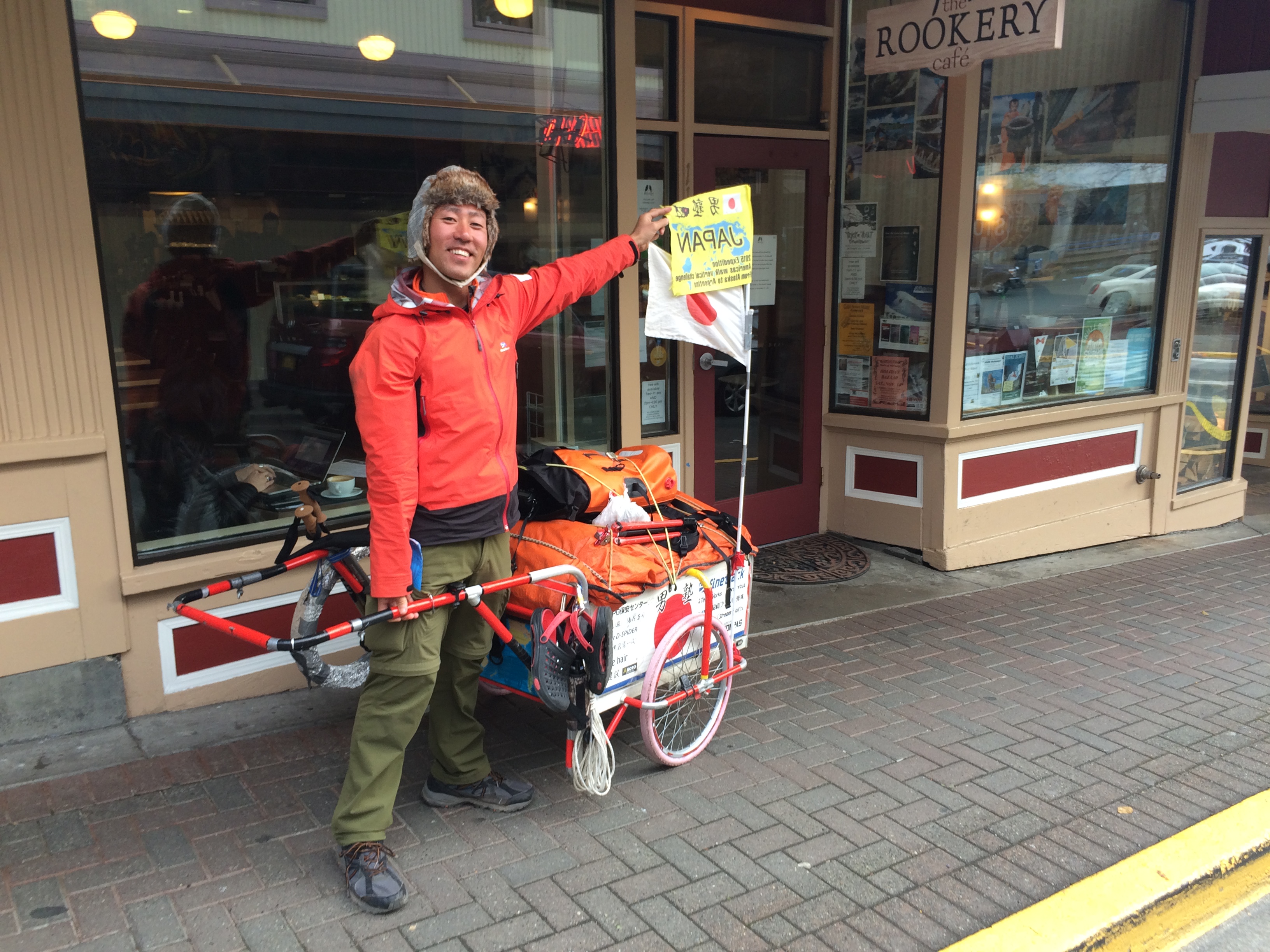
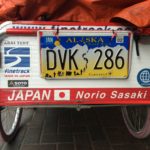
A man who is walking around the world is in Juneau through the weekend. Norio Sasaki is from Kyoto, Japan, and has been on the road for a while. I caught up with Sasaki at the Rookery Café.
Sasaki is visitng Juneau before heading to Argentina. (Photo by Scott Burton/KTOO)
“I went to Australia, New Zealand, Taiwan and Korea three years ago,” Sasaki said.
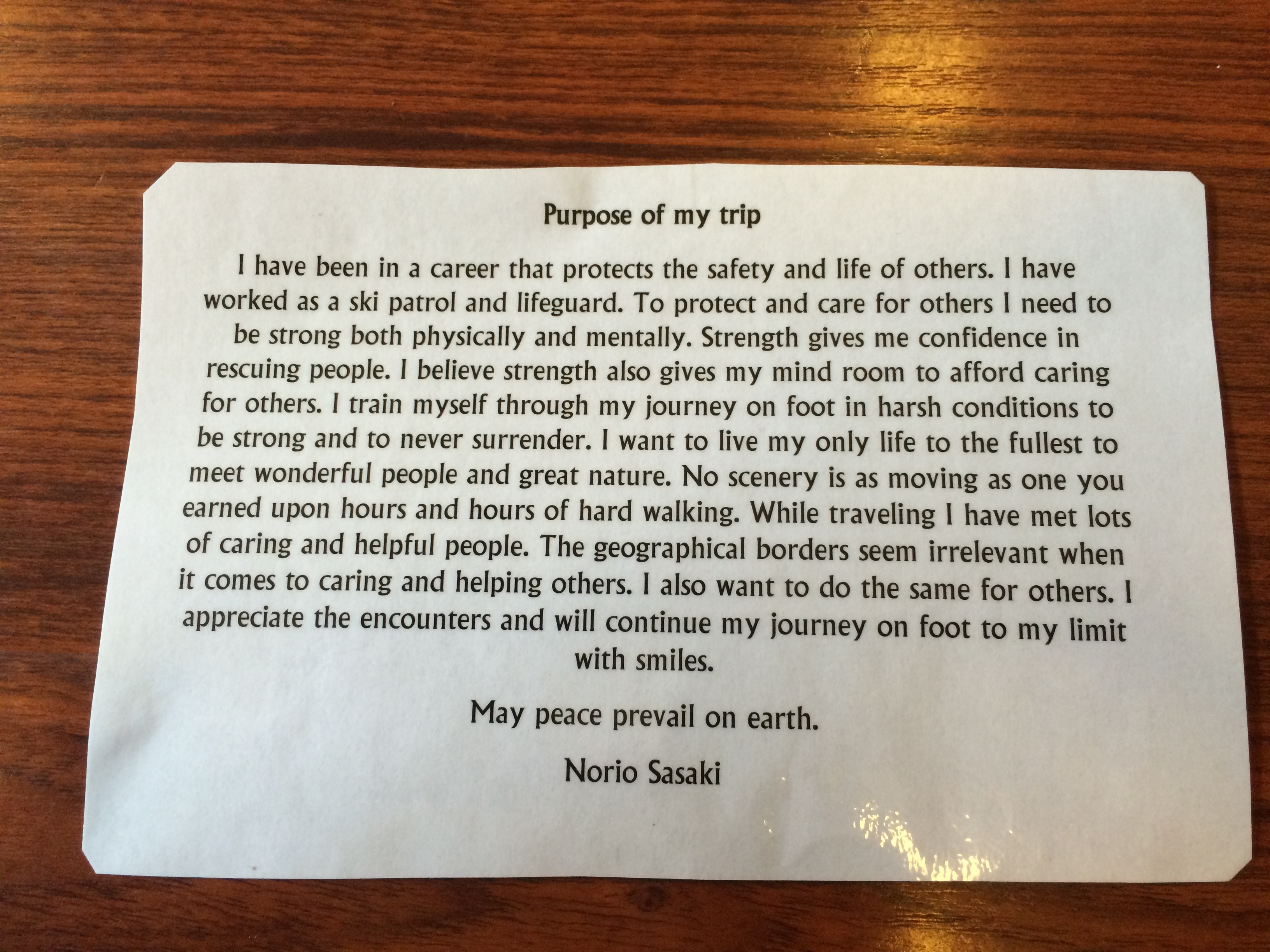
Sasaki said his English is not great, so he readily passes out a card that explains his trip. Roughly summarized, the laminated card says that he’s worked as a lifeguard and ski patroller and needs to be strong to continue helping others.
When asked why Sasaki is walking around the world he handed us this. (Photo by Scott Burton/KTOO)
Norio Sasaki spare tires, bear spray and mountain equipment. (Photo by Scott Burton/KTOO)
Sasaki says he’s been on the road for about 3 years. (Photo by Scott Burton/KTOO)
Worn tires show Sasaki’s 30 miles-per-day in the summer, and 24 in the winter. (Photo by Scott Burton/KTOO)
Walking around the world is a good way to see nature and meet people, and along the way he’s pulling a 175-pound rickshaw.
“This is my cart — all aluminum. So very light and I can carry inside an airplane. This is (my) spare tire and bear spray and mountain equipment. This is (my) speedometer. I walked 50 km in the summer season; winter season 40 km every day,” Sasaki said.
That translates to about 30 miles in summer, and 25 in winter.
“I walk through (the) pass, very hard. And downhill, very hard because my cart (has) no brake, only foot brake — (it’s) very hard,” he said laughing.
From here, Sasaki’s route includes Wrangell, Prince Rupert, Prince George, Jasper, Banff, Calgary, Yellowstone and eventually Argentina. He thinks he’ll be on the road for another three years. You can follow him on Facebook — just search for Sasaki Norio.
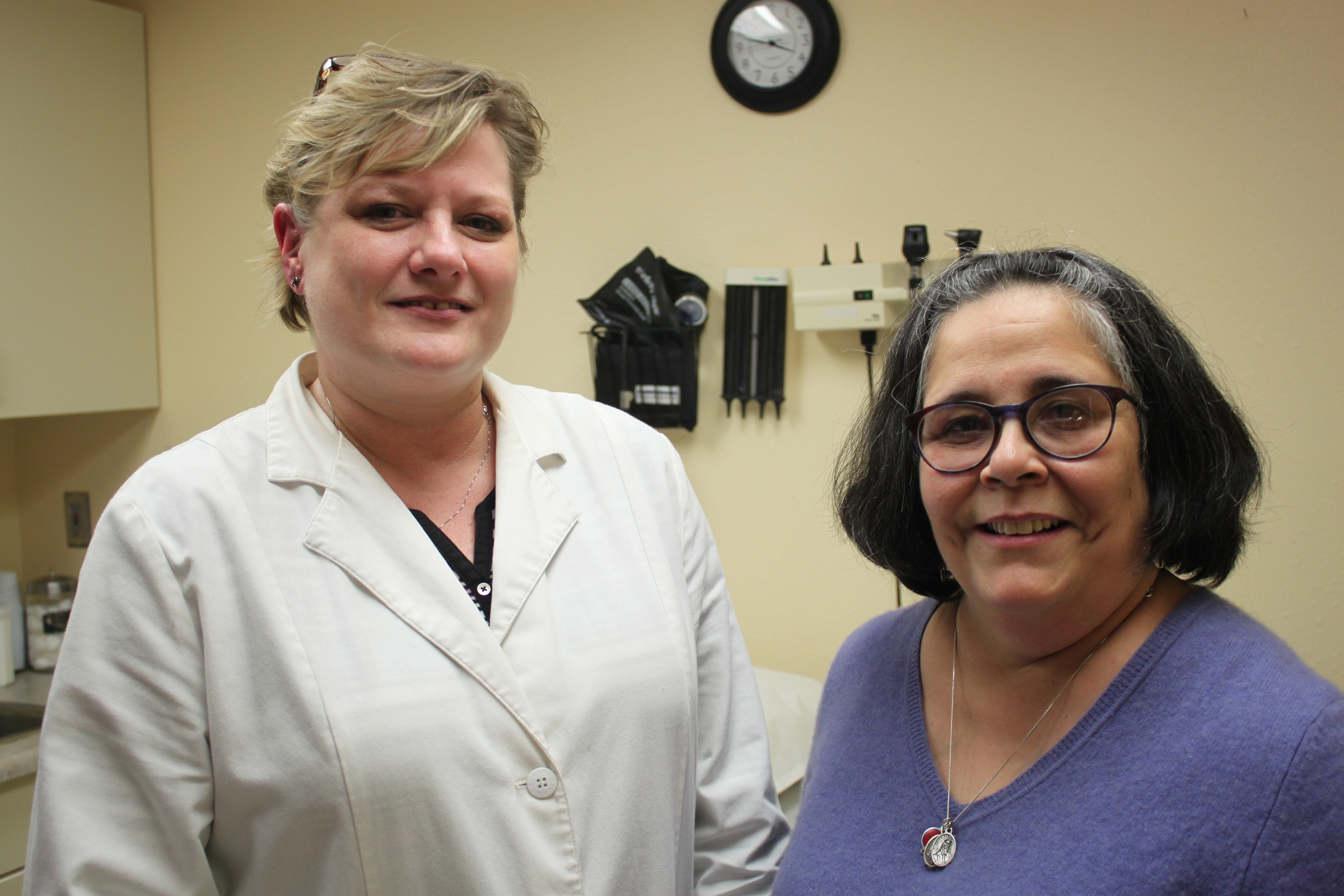
Nurse Practitioner Cynthia Mattoni (left) is the new medical provider at Front Street Community Health Center. Paula Rohrbacher is a medical assistant and works at the front desk. The health center also has a full-time case manager. (Photo by Lisa Phu/KTOO)
Front Street Community Health Center in Juneau has a new permanent nurse practitioner after a year of temporary medical providers.
Cynthia Mattoni was a temporary nurse practitioner at the Front Street Community Health Center before she decided to apply for the permanent position. She’s been on the job since Oct. 1 and is very busy.
“It’s reorganizing the clinic. It’s a lot of paperwork and a lot of education and developing those relationships with the patients, the community, the community providers, the pharmacy so they know who I am and that I’m permanent,” Mattoni said.
Mattoni is seeing up to 16 patients a day, but her schedule can vary.
“Some days are full, some days aren’t full. Some days we’re available for the walk-in who wants an appointment,” Mattoni said.
Mattoni provides general primary care. She’s certified in family practice and concussion care. She does annual checkups, childrens’ physicals and well-woman exams.
Front Street Clinic has traditionally served the homeless population. Last year, it expanded to include all low-income patients who have trouble accessing health care. There’s a sliding scale fee schedule, and a case manager can help patients sign up for Medicaid.
Serving the homeless population is still a primary focus and Mattoni finds the work gratifying.
“They’re kind of like the forgotten part of society and I treat everybody like they’re my family. It doesn’t matter who you are. We’re all human. We all have the same needs and that respect goes a long way,” Mattoni said.
Mattoni moved to Juneau from Cleveland where she used to work in the emergency room. She encountered people who were homeless there, but she says working at Front Street is very different.
“This is family practice. This is not only managing their conditions, but it’s managing chronic conditions for a long period of time. In the emergency room, you would just see them for one episodic visit. Here, I’m actually following them and following the progression of their medical care,” Mattoni said.
Mattoni is the health center’s only provider. As Front Street was transitioning from being under SEARCH to becoming its own nonprofit, it discontinued behavioral health and dental services because of budget constraints.
But the nonprofit recently received a federal grant of $220,000 and will soon recruit for a behavioral health specialist and another case manager. Dental services are still not in the near future.
Board president Dr. Carl Heine said the clinic has been outsourcing management services to Wrangell-based Alaska Island Community Services. The board is exploring the idea of completely turning the clinic over to the health care organization.
“Our main concern is that the clinic continues to exist and operate and continues to meet its mission of serving the homeless and the underserved with quality medical care. We’re not necessarily, as a board, concerned that we are the ones running it,” Heine said.
Heine said the new funding and its main federal grant of $385,000 are both renewable and will hopefully keep the clinic sustainable.
The long-term plan is to locate the Front Street Community Health Center inside the Housing First facility to be built in Lemon Creek.
Front Street Community Health Center is hosting an open house for First Friday, Nov. 6. Check out art in the lobby, get some refreshments and meet the new nurse practitioner. The clinic is located at 225 Front St., Suite 202. It’s also holding a fundraiser through the end of the year to match a $50,000 donation from Northern Light United Church.
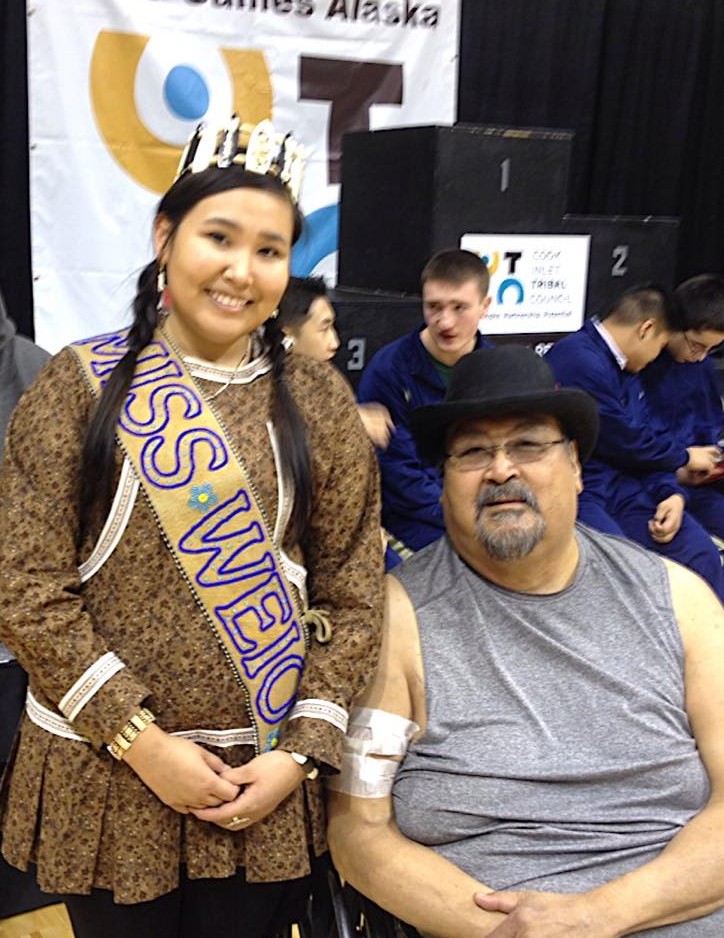
A legend of traditional Alaska Native games has died. Big Bob Aiken, known as the “The World’s Largest Eskimo” still held records for the Indian and Eskimo stick pull competitions. He believed deeply in the original purpose of the games.
In a phone conversation last July from the World Eskimo Indian Olympics, or WEIO, games in Fairbanks, he said the games were meant to be friendly competition that tested strength and revealed who would be a good hunter.
“Then if you knew exactly what you are capable of, you’d have a better chance of surviving in an incident that happens out in the wilderness. Because I hurt myself one time and I knew I was capable of by these games. So we were raised to survive whatever happens. That’s who we are, that’s how we grew up.”
Lew Freedman worked as a reporter for the Anchorage Daily News in the late ’80s and became a friend of Bob Aiken as he covered him in Fairbanks at the WEIO games. He said although Aiken didn’t have his own children, he cared for all children involved in the games and was an important diplomat.
“The kids would like swarm around him and he was interacting with everybody. You know it was sort of like, we can’t make a decision about anything without seeing what Big Bob thinks about it and he was that kind of fella, you know he just stood out with a big personality to go with his big size.”
Freedman says he thinks the final year that Aiken competed in strength games was 1989 and Big Bob intended to retire with all of his gold medals and one more win.
“There was a big surprise that year because a new guy came on the scene, Brian Walker from Eagle River, who was also a big guy but nobody was as big as Big Bob at the time. And Brian beat him, so actually Big Bob lost at the end of his career, kind of probably completing the thought process that it was time to retire.”
Bob Aiken was a lifelong Barrow resident until the last few years when he had to live in Anchorage for dialysis treatments. In recent months he had also developed a heart problem. Freedman says he was a warm man with a great sense of humor and even with his health trouble, he never missed the games, acting as an MC, or an official and remained a large figure both physically, at 6 foot 4 and as a champion of performing the games correctly.
“But more than anything else he had a sense of tradition and heritage and wanted that to be passed on to future generations. That was the most important to him. You’d have to say he was a keeper of the flame and that was what really integral to his continuing involvement with WEIO was, through the rest of his adult life.”
Big Bob Aiken was 62 years old and died in Anchorage Tuesday.
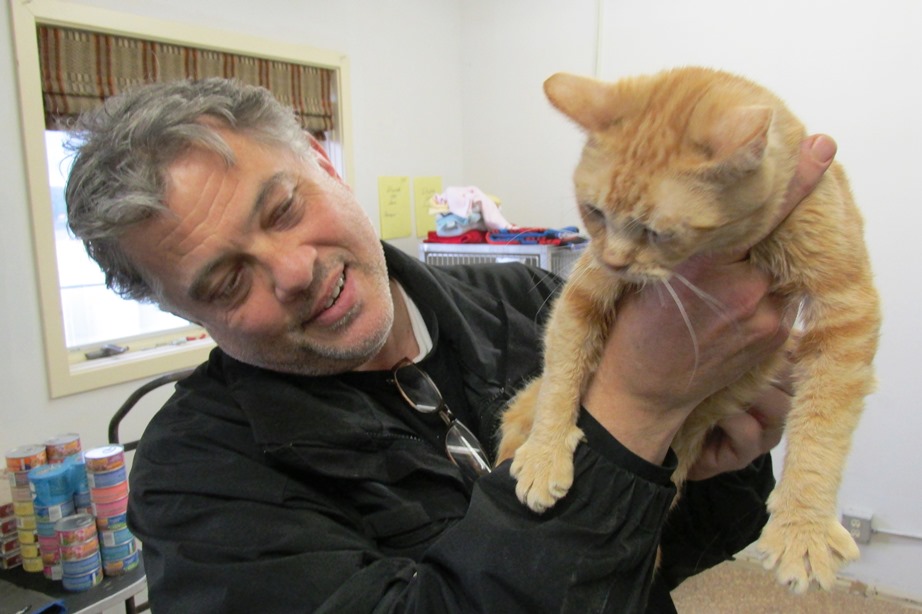
Ketchikan Animal Protection Director Eddie Blackwood holds Dora, one of six cats rescued on Oct. 9 from a North End home. Dora is recovering from infections, but will be available for adoption once she’s healthy. (Photo by Leila Kheiry/KRBD)
Ketchikan’s animal shelter has gotten some relief in recent weeks after rescuing more than 40 animals from one home in early October.
Local animal rescue groups took some of the pets from the maxed-out Ketchikan Gateway Borough-run shelter, other animals were adopted within the community, and it was announced this week that the shelter in Sitka has raised money to fly the remaining dogs to that community.
Eddie Blackwood runs the Ketchikan borough’s animal protection department. He said that of the approximately 40 animals that were rescued on Oct. 9, the Ketchikan Humane Society took four dogs, BARK Alaska rescue took two dogs, a chicken and a rooster, Southeast Organization for Animals is taking two dogs, and Sitka is taking all the remaining canines.
Blackwood said Sitka shelter director Ken Buxton told him there was immense interest in the case within that community.
“And he called and said I have people knocking on my door wanting these animals, and they’re even raising money for the flight,” Blackwood said. “As of two weeks ago, he’d raised $600 for the airfare, so he thought he could probably raise enough to cover the whole entire airfare.”
(Photo by Leila Kheiry/KRBD)
And he did. Buxton said he used his “Critter Corner” column in the Sitka Sentinel to write about the Ketchikan project, and started collecting donations.
“We’ve raised close to $1,400, so we’re going to charter a flight with Scott Harris over here and we’re going to pick up 11 of those dogs, and one of them is already spoken for,” he said.
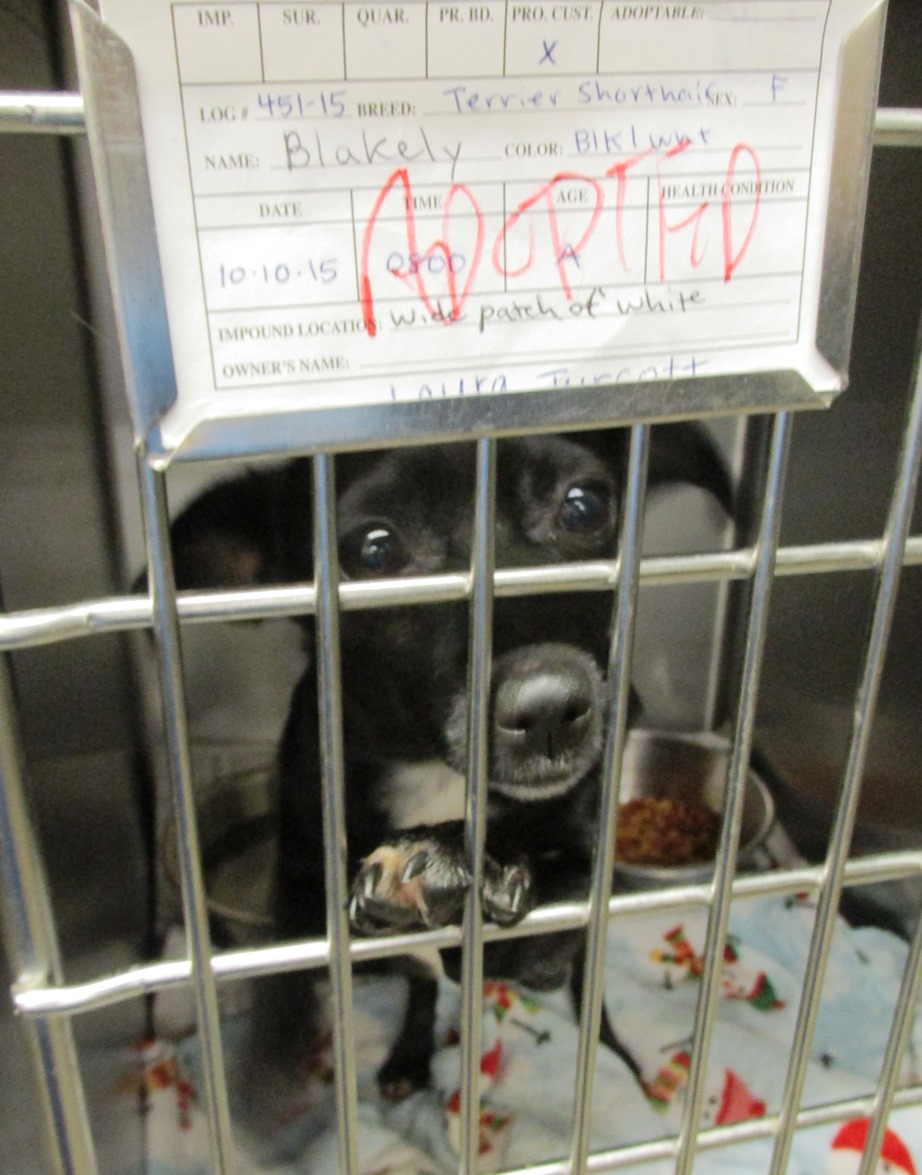
Blakely is one of the Ketchikan shelter dogs headed to Sitka, and she has a home waiting for her. (Photo by Leila Kheiry/KRBD)
Buxton said the others will either go into foster homes or the Sitka shelter, but he’s got a list of people interested in adopting as soon as the dogs are ready. He praised the Ketchikan shelter and rescue groups for their hard work, and not only for the pets rescued from the North End home.
“I think, sometimes, the media might throw the word hero around too much, but those guys are heroes,” he said. “The stuff they’re doing and, just going over the top caring for these animals, and these dogs in particular.”
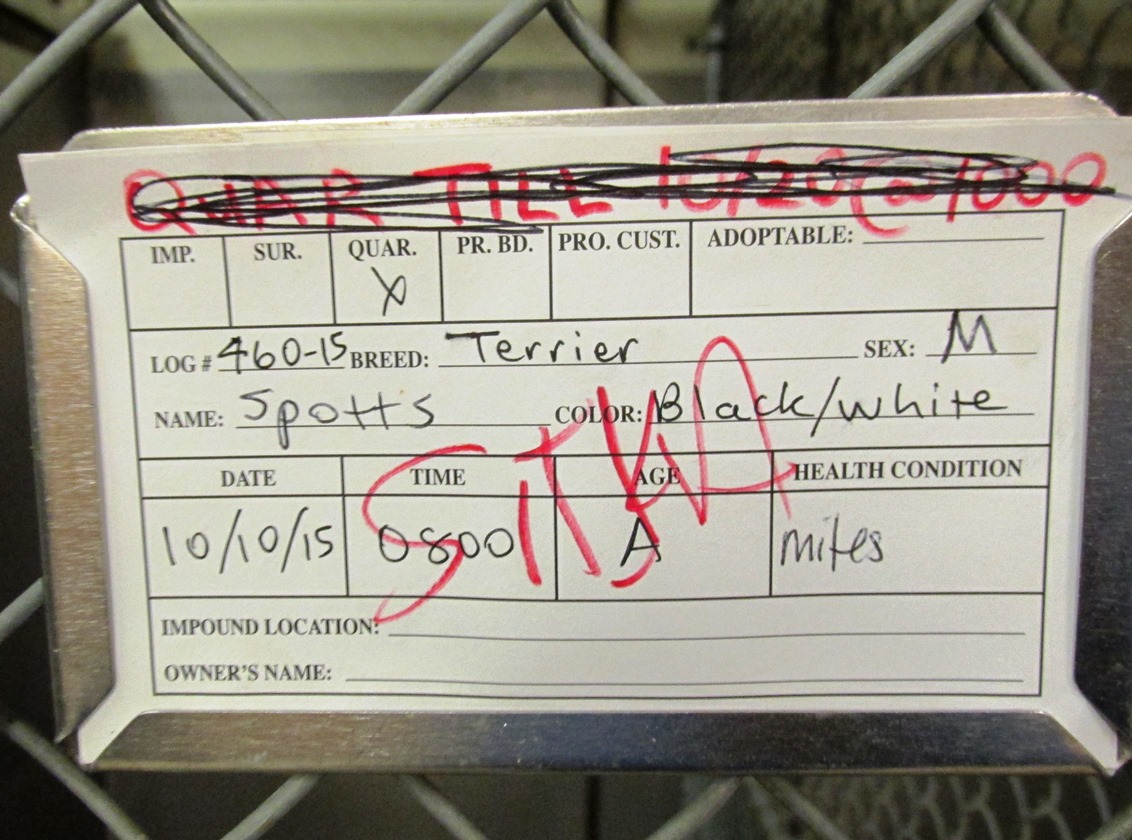
The dogs rescued from the home all were small dogs, likely terrier mixes. Most crowd up to the front of their large cages, wagging furiously, eager to sniff an outstretched hand and offer a friendly lick.
Blackwood said some of the dogs have been adopted locally, and just need to be spayed or neutered before they head to their new homes.
“So, we’ve got Prince, Chewey, Stella, Bella and Skittles that are going for surgery on Thursday,” he said, looking at a list. “They’ve all been adopted.”
Five of the six cats removed from the house are under treatment for coccidia, a parasitic infection, and upper respiratory infections. They all were malnourished and most are wary of people.
The cats are in the upstairs part of the shelter, providing a quiet atmosphere away from barking dogs.
“This cat is one of the ones from the house out north,” Blackwood said, pointing to a Siamese crouched in a corner of his cage. “He’s intractable. A little bit hard to handle and he bit one of the staff members, so we’re going to quarantine him for, I think he’s got three of four days left on his quarantine. We’re going to try and work with him, bring him around, and hopefully at some point he’ll be adoptable.”
The cats were badly matted when found, so they were shaved, too. Once they are healthy and ready to be adopted, they’ll join all the other cats in the main viewing room – about 15 in all.
When the Ketchikan shelter first took in all the animals from the North End home, resources at the shelter were stretched thin.
Blackwood said the community really stepped up, with lots of donations of food and supplies, as well as volunteers coming in to help care for and comfort the animals.
“I think they were shocked at the situation,” he said. “It’s a very sad situation. It’s very sad that the lady passed away. But I’m just glad we were able to help the animals that she had.”
The elderly woman lived in a North Tongass home. Alaska State Troopers had been called there, and found her in need of medical help. She later died. While at the home, Troopers noted the large number of animals and contacted the borough’s animal protection department.
The floor of the home was covered in feces, and three animals were found dead. Animal Protection removed 31 dogs, six cats and three chickens, but one of the chickens later was euthanized because of an injury.
While the cats are still recovering, Blackwood said that since their rescue, the dogs have improved significantly, in health and confidence. He said they won’t need much rehabilitation to become great companions.
“None of them are aggressive,” he said. “In the beginning, they were a little timid and scared, but now they seek out attention and they’re doing really well.”
Buxton said he’s eager to get the remaining dogs to Sitka, “and get them into homes, where they can do what they’re supposed to be doing: Being dogs.”
Buxton said he’s due to arrive in Ketchikan late Thursday morning to pick up the dogs.
For those who love to make things and tinker, finding the right tools and work space can be difficult and expensive.
In recent years, many people have been turning to community workshops known as “makerspaces.” Members of these organizations have access to a shared workspace and tools for their own personal projects — anything from artwork to prototyping new products.
Now, the fledgling Juneau Makerspace is bringing this movement to the capital city.
About a year ago, founder Sam Bornstein started the nonprofit as a place for like-minded creators to “come and build their dreams.” Although he currently works in finance, his passion for engineering inspired him to start the organization in his spare time.
“Anyone who wants to create or make or design anything is our goal,” he said. “We want to be able to get the widest net possible and be available for any type of project that you have that you want to work on.”
He and some volunteers are still clearing out the group’s new facility in Lemon Creek. When they moved in over the summer, it was filled wall to wall with ceramic molds from the previous occupants.
Shelves of ceramic molds still remain at the Juneau Makerspace. When they moved into the space, it was nearly full of these molds. (Photo by David Purdy/KTOO)
Juneau Makerspace’s new facility. They are in the process of clearing it out and acquiring tools. (Photo by David Purdy/KTOO)
The new 3D printer sits on a table in the new Juneau Makerspace (Photo by David Purdy/KTOO)
It’s mostly cleared now, with room for some tables and the latest addition — a donated 3D printer. Inside a big glass and metal box, the moving print nozzle lays down melted plastic in a precise pattern. As the plastic cools, more layers are added to form small objects based on a digital model.
The printer requires precise calibration. Bornstein is still getting familiar with all the different controls and adjustments.
“It sat in someone’s garage until yesterday. And they brought it over here and gave it to us and said ‘Good luck,’” he said.
Once it’s adjusted, the print head moves back and forth, laying down layers of plastic. The outline of the base emerges in a couple of minutes, but Bornstein estimates it will take 7 to 12 hours for the printer to build up the finished vase, layer by layer.
Sam Bornstein makes adjustments to a print job on Juneau Makerspace’s 3D printer. (Photo by David Purdy/KTOO)
The print head of the 3D printer at Juneau Makerspace begins to lay down the base for a plastic object it is printing (Photo by David Purdy/KTOO)
Sam Bornstein prepares the 3D printer at Juneau Makerspace (Photo by David Purdy/KTOO)
Bornstein plans to eventually teach others in Juneau to use the printer for their own projects. Juneau Makerspace is planning a Kickstarter campaign to pay for more tools and equipment, and Bornstein hopes that people with many different skills will gather to share their knowledge and experience.
“I’m hoping we can build a community of makers here,” he said. “We’ve got artists and teachers and designers all coming together and I’m hoping that we can all learn from each other.”
Soon, they’ll announce membership plans for those interested in gaining access to the space and its resources. Updates and more information are available on Facebook.
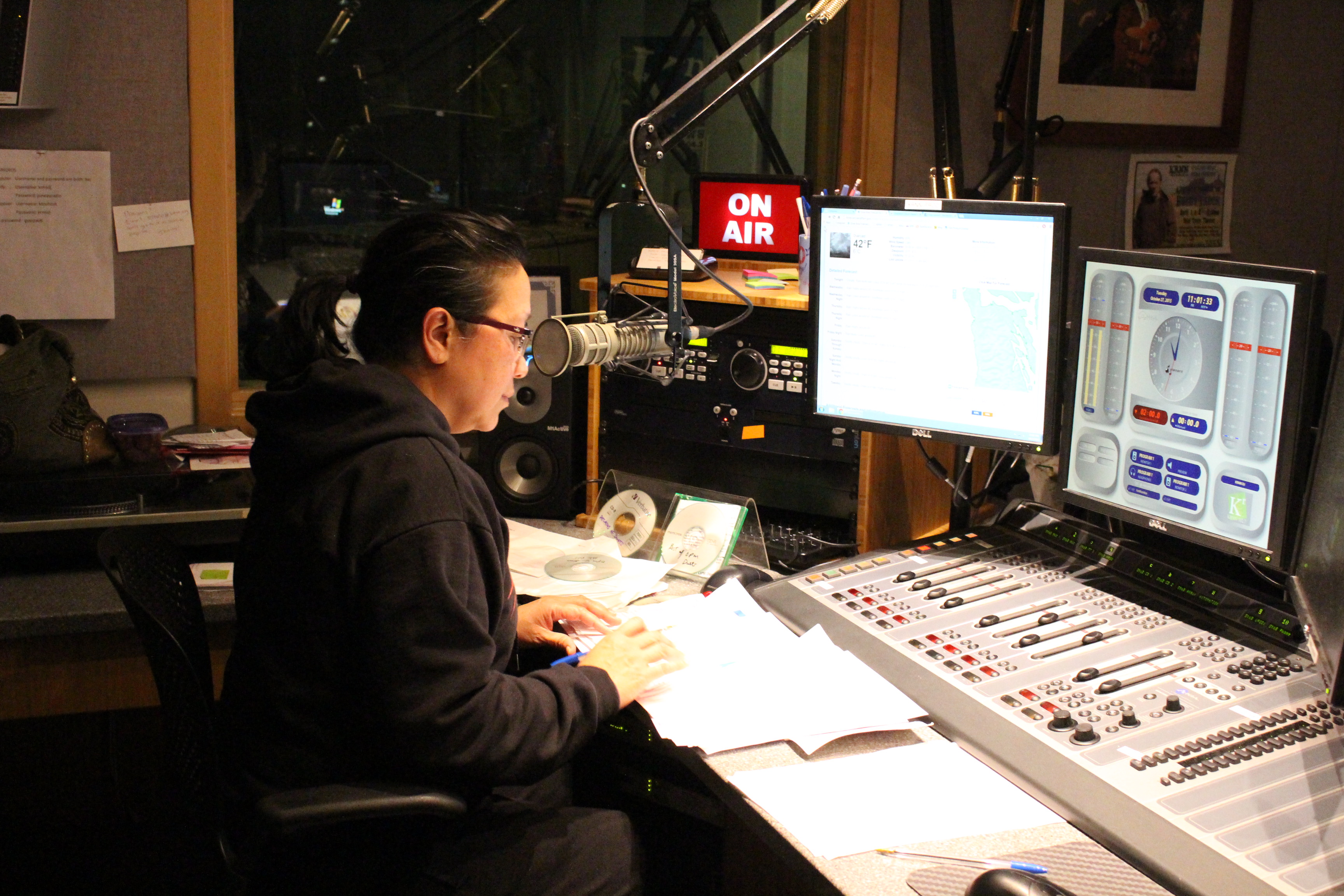
Genny Del Rosario balances work, life and being a KRNN volunteer DJ. She’s also the president of the League of Women Voters. (Photo by Elizabeth Jenkins/KTOO)
October is Filipino American History Month. In Alaska, that’s more than 26,000 people. One Juneau DJ is finding ways to connect others with their culture on the airwaves.
In the two years that Genny Del Rosario has been hosting her show “Good Evening My Friends,” she’s only been absent once. And that was because her car wouldn’t start.
In the summer, she closes her Filipino food shack early to make it here in time. The winter months, she said, are the hardest. It’s dark, the roads are slick with ice and it’s cold.
“But I have to be here, you know. It doesn’t matter. It’s like I have my alarm for this show, 9 o’clock. Even if I’m lying down. I say 30 minutes before, I come over now,” she said. “Sometimes I’m rushing in the car, ‘Ah, I gotta go!'”
During the breaks, she reads in Tagalog. The root language of the the Philippines has multiple dialects. Del Rosario can speak five.
“My father’s dialect which is Ilocano. Then I can speak Cebuano from Cebu. And then I can speak Chavacano which is from my birth city Zamboanga,” Del Rosario said.
She reads public service announcements, Filipino recipes, newsletters, even birthdays. In the summer, she fills the gaps with stories from cruise visitors. Usually, other Filipinos who work on the ships.
She started the show because she felt like her community wasn’t being represented.
“It’s a shame that we’re the second largest minority and we don’t have a show to showcase our tradition.”
Some of the music Del Rosario plays is from her youth.
“Anthony Castelo is one singer when I was in college, we used to scream like the Beatles when he goes to a certain town where we are. … He’s so handsome,” she said. “It’s like Justin Bieber or Joe Jonas. Anthony Costello was like that before.”
https://www.youtube.com/watch?v=n8xkMqhxBe4
When she visits her family in the Philippines, she brings CDs back. In Juneau, she said it’s impossible to find the music. iTunes and Spotify don’t have a great selection.
And like the food, she said the songs from home can trigger memories. Good Evening My Friends is for people who immigrated to the states. But also for their kids who might not have grown up speaking Tagalog.
“I hope that they listen, the teenagers. Because it’s good to know your mother’s or father’s language. I missed it out with my children. I just wished before that I could have taught them to speak Tagalog,” she said. “They told me every time they go home to the Philippines, they say, ‘Mom, why didn’t you teach us to speak Tagalog? Even give us a dictionary?’ I thought they weren’t interested but they were.”
Del Rosario came to the U.S. on a Rotary International scholarship. And traveled around the country as an ambassador for the Philippines in the 80s.
She went back, determined to return to the United States.
“It was like my eyes was open. And I was already 29 so I was ready to do adventure, adventure in the United States. My mom said, ‘Aren’t you scared?’ ‘No, ma. I’m 29 years old. What’s going to go wrong?’”
She met her now-ex husband, settled in Vegas. She was able to stay in the country with a green card and thought she’d remain there forever. Then the marriage split up and she needed a fresh start.
“I came to Juneau with just two suitcases. It was difficult for me for the first six months,” she said. “I was like a homeless person living from one friend’s to another friend’s house. I should have gone back to Vegas but I wouldn’t want to. I said I’m here, I will start.”
Eventually, she opened a daycare. That led to the funds to open Manila Bay Cafe with her sibling.
“We bought that store and it’s been there for six years. I used the store’s income to send my children to college.”
Del Rosario is visiting the Philippines in December. And she said it’s not easy to find a sub for the show. So far, her attempts to recruit someone who speaks Tagalog have failed. But that doesn’t mean she’s giving up.
When she does return home, she’ll collect more music for Good Evening My Friends and mourn with family. Recently, a sister passed away.
“Even though when my sister died three weeks ago. I don’t feel like coming but I said the show must go on. And you know, my sister would be proud. My family would be proud.”
KRNN is KTOO’s sister station. You can listen to Good Evening My Friends on Tuesday nights at 9.
Close
Update notification options
Subscribe to notifications
Subscribe
Get notifications about news related to the topics you care about. You can unsubscribe anytime.