Community

High school sleep-out raises $3,000 for homeless youth

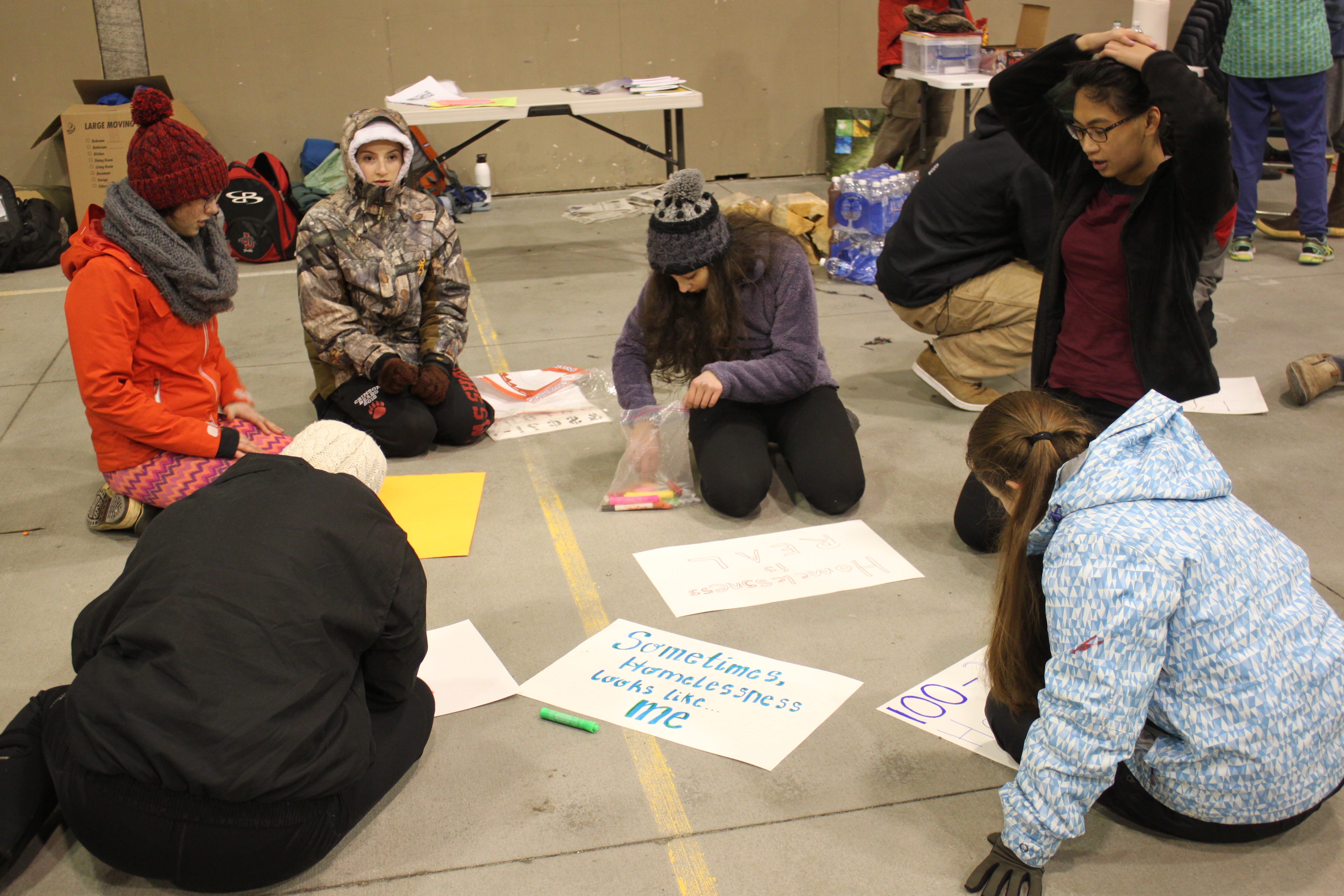
During the sleep out, students made signs about youth homelessness that they waved outside Mendenhall Mall and Safeway. (Photo by Lisa Phu/KTOO)
During the sleep-out, students made signs about youth homelessness that they waved outside Mendenhall Mall and Safeway. (Photo by Lisa Phu/KTOO)

About 200 kids and teenagers in Juneau are homeless. There are students without adequate or regular housing in every school in the district.

This past weekend, high school students slept out in the cold to raise awareness of the mostly invisible issue.

Between Saturday night and Sunday morning, temperatures dropped to the low to mid-30s. Two dozen high school students participating in the sleep-out were prepared with sleeping bags, big winter coats, blankets and extra layers.

Reilly Walsh, 17, is a senior at Juneau-Douglas High School. She and other students built makeshift shelters out of cardboard boxes and duct tape under the outdoor covered area at Riverbend Elementary School. The goal was to bring attention to their friends and fellow students who are homeless.

“Because it’s something that you can’t really tell always if someone is struggling with homelessness, so we’re just trying to spread the word that it does occur and you might not be aware of it.”
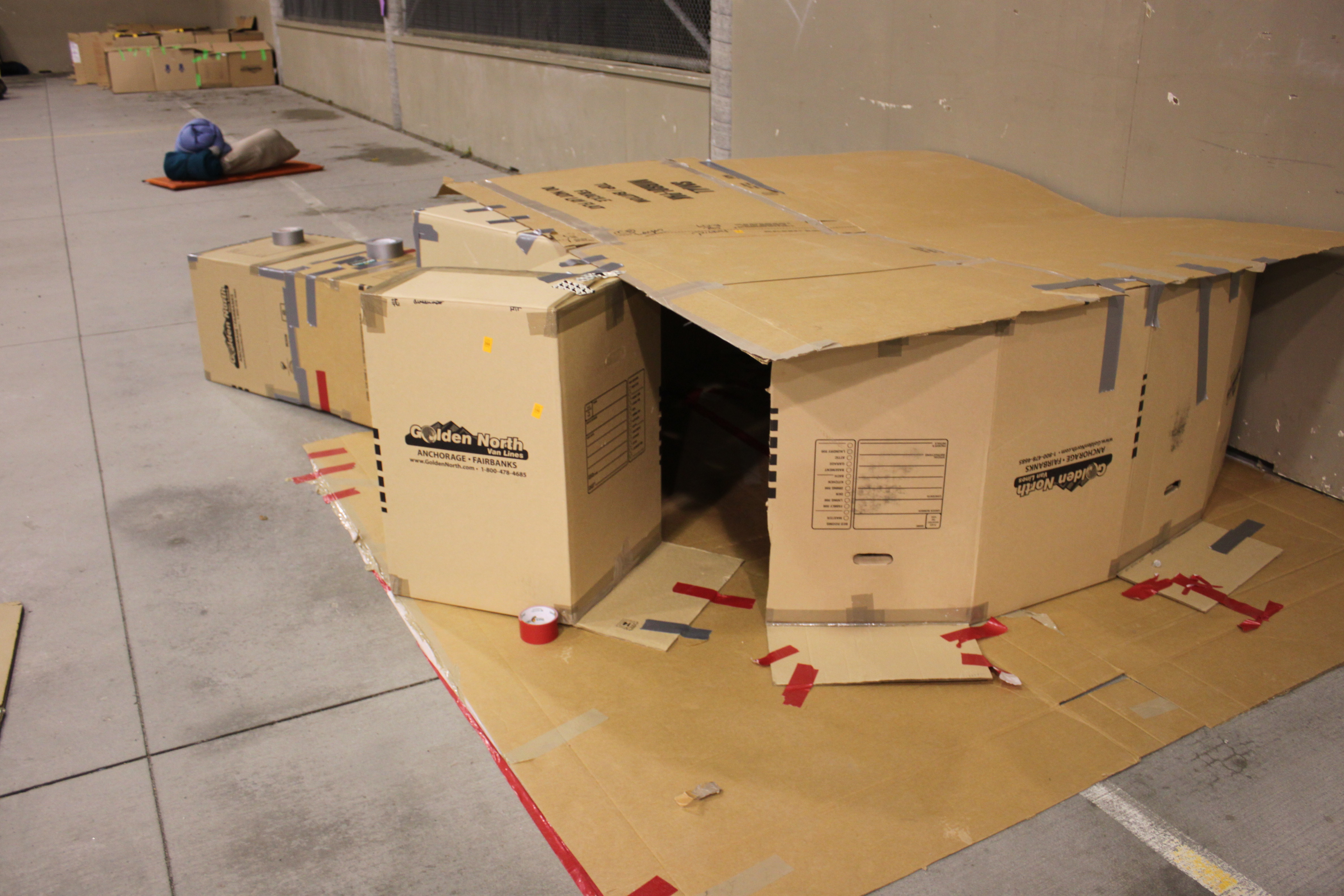
Students slept in makeshift shelters under the outdoor covered area at Riverbend Elementary School. (Photo by Lisa Phu/KTOO)

The cardboard structures are largely symbolic. Kids in Juneau who don’t have permanent housing aren’t typically sleeping outside. Gabi Kito, a 16-year-old junior, said they’re more likely to be hopping from couch to couch.

“People – when they think of homeless(ness) – they think of them sleeping outside and in boxes rather than sleeping in a house and different houses each night.”

Some homeless youth stay with families at shelters through St. Vincent de Paul or AWARE. Others turn to Juneau Youth Services, which offers a 10-bed emergency shelter at Cornerstone Residential Facility.

JYS offers counseling for mental health, substance abuse and family reunification.

The organization plans to reopen its transitional living program early next year, executive director Walter Majoros said. It’ll house six individuals ages 16-21.

Majoros said some kids and teens are homeless due to family discord and instability.

“There may be family violence going on. There may be sexual abuse. There may be alcoholism or drug abuse in the family. There may be a single-parent family that creates some instability. Oftentimes there’s a parent that is incarcerated.”

Another resource is the Zach Gordon Youth Center in downtown Juneau. It’s open every day except Sunday. Manager Jorden Nigro said homeless kids come regularly.

“We have showers here so they can take showers, and we help connect them to resources and we feed a lot of kids here,” Nigro said. “We have kids that come and get their after-school snack here and lots of kids who stay for dinner.”

Besides offering activities and services — such as basketball, tutoring and arts and crafts — Nigro said staff members work hard to build relationships.

“If kids have meaningful connections with adults, they do better in every aspect of their life and that impacts kids whether they’re homeless, whether they’re not homeless and also can help kids who are on the cusp,” Nigro said.

At school, homeless students are offered help with transportation, free meals and snacks, clothing and shoes, toiletries and assistance with activities fees.

Dixie Weiss is the faculty adviser of the service club Interact at Juneau-Douglas High School. Interact has helped organize the annual sleep-out since 2004. Besides raising awareness, the sleep-out also raises money. Weiss has seen first-hand how the funds help.

“Time and time again these kids are giving you these big bear hugs because they never imagined they’d get that yearbook or that senior hoodie or the support,” Weiss said.

The sleep-out also teaches an important lesson, “that sitting next to them in a class, day in and day out, there’s this kid that is, against all odds, making it; that they have courageous peers and this is a way to support that courage,” Weiss said.

So far, the students have raised about $3,000 and are accepting donations through the end of November. Half of the proceeds will go to the school district and the other half to the Zach Gordon Youth Center.

Youth experiencing homelessness can contact Juneau Youth Services at 789-7654, 24 hours a day, seven days a week.

How to revive an endangered language in the age of social media

In Alaska, the number of fluent Haida speakers has dwindled down into the single digits. It’s been called an endangered language. But in Juneau, one group is trying to change that. Haida Language Learners is using YouTube, Snapchat and Instagram to reach a wider audience.

Emily Rose Edenshaw-Chafin shows me her phone. She’s been using a flashcard app to practice Haida. It’s totally customizable. She can create the cards and share them with teachers and friends. On one of the cards is a picture of a horse grazing in a field, and it’s broken down into cuts of meat — labeled Gyuudáan Kiʼíi eehl Hl ʼwáadaagang.

Haida Language Learners use the app Snapchat to connect with others. The app deletes shared videos after a few seconds, which they say is perfect for practicing the language.

“And then the second one is a cartoon, the one in English that says ‘I have horse meat for sale.’ It’s a picture of a horse head inside a burger,” Edenshaw says.

Not a real horse head, part of a costume.

“For me, it makes it funny and it makes it more interesting,” she says.

The Haida arrived in Southeast a few hundred years ago. Some left their ancestral home of Haida Gwaii, which is now part of Canada. They settled in villages on Prince of Wales Island. Edenshaw says the Haida language’s grammar structure is similar to Spanish. And like Spanish, it can sound like a foreign language.

“And being Native you’re disappointed that you don’t know your own heritage and language. It’s hard to work past that sometimes,” she says.

Edenshaw has practiced Haida for over a decade. Her family moved to Hydaburg when she was a kid, and she started picking words up.

“You know, like thank you: Háw’aa. Hágwsdaa: hurry up. You hear that one a lot.”

But she says it was hard to learn more complex phrases. In college, she was able to take a free class taught by a linguist.

“I really fell in love with the language. I wanted to write poetry in Haida. I wanted to dream in Haida, so I continued to practice with it.”

She says part of that meant finding someone to speak Haida with, to use words and phrases that are relevant in conversation today. Edenshaw met Susie Lee Edwardson in Haida class.

In their YouTube video, a picture of Grumpy Cat flashes on the screen. You know, Grumpy cat. The feline celebrity meme. Edwardson repeats the word híndaa or “go away.”

It has more than 200 views. Their YouTube Channel has about 145 subscribers, which may not seem like a lot. But remember, Alaska’s fluent Haida speakers are in the single digits. Edwardson has only been studying it for about three years, and says she didn’t grow up speaking the language. Her parents spoke a word here and there.

“It didn’t really connect with me as it was a part of me,” Edwardson says. “But when I got into college and I started learning the language with my family, it felt really good and it felt like you were going into a community that you were a part of all your life.”

The number of fluent Haida speakers has been declining for the past 100 years. Many boarding schools run by the federal government and missionaries enforced strict bans on Native languages. Edwardson says it’s a serious topic, but they’re trying to make learning Haida fun. It’s involved some compromise.

She took down one of their YouTube videos because some found it offensive. In that video, she says the Haida word for penis. OK, maybe they went a little farther and said “tiny penis.” But Edwardson says they don’t want to offend anyone.

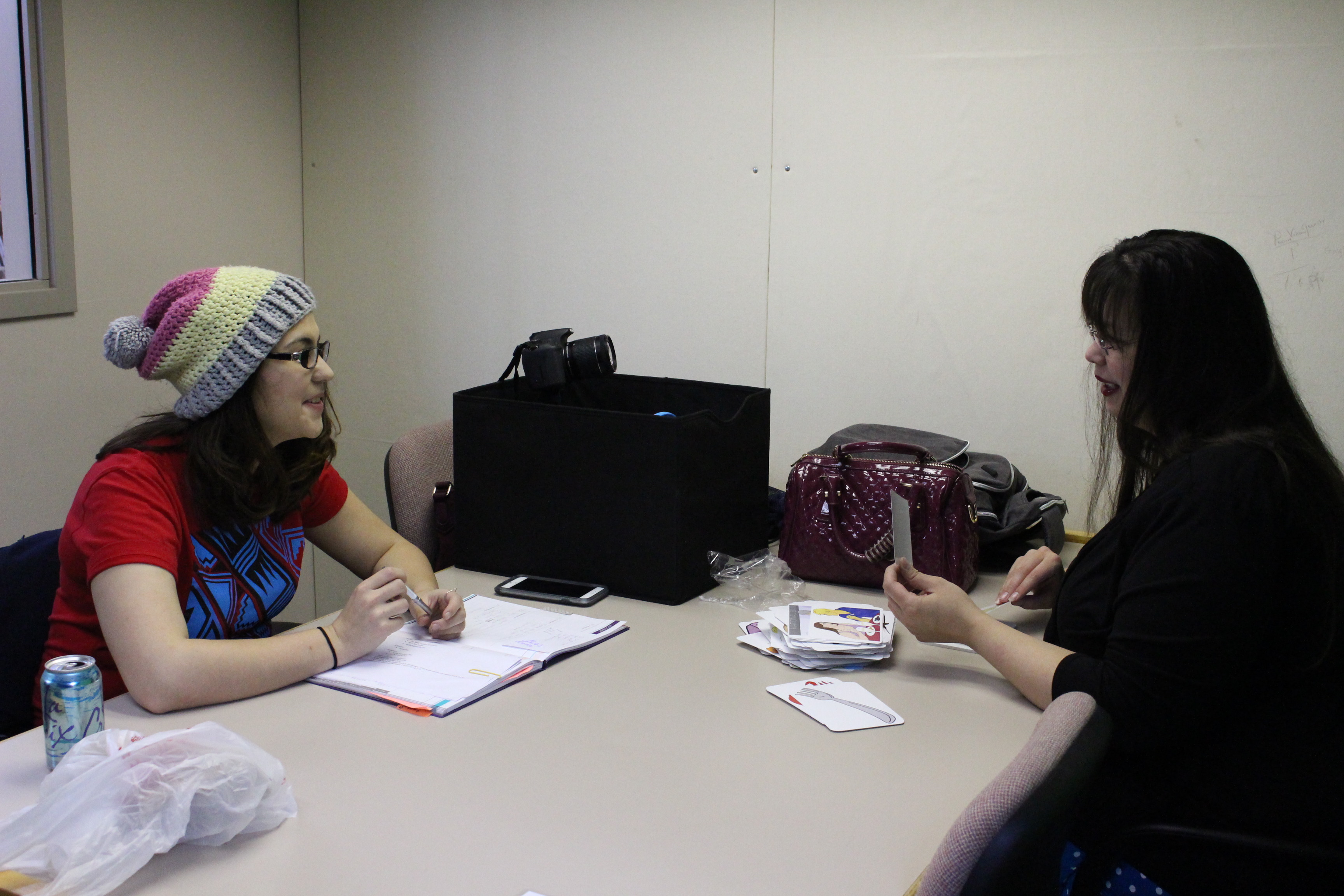
Emily Rose Edenshaw-Chafin and Susie Lee Edwardson plan out their next YouTube video. (Photo by Elizabeth Jenkins/KTOO)Emily Rose Edenshaw-Chafin and Susie Lee Edwardson plan out their next YouTube video. (Photo by Elizabeth Jenkins/KTOO)
Emily Rose Edenshaw-Chafin and Susie Lee Edwardson plan out their next YouTube video. (Photo by Elizabeth Jenkins/KTOO)

“Like the little radical in me is like, ‘it’s the language,'” Edwardson says. “But at the same time we want it to be accessible. And if families are going through the YouTube videos and there’s something they don’t want them to learn yet, I don’t want them to stay away from the language.”

Then there’s also the issue of finding ways to express modern notions. But Edenshaw says that’s totally doable.

“We ask the elders what would make this work. What can we do to translate this into Haida?” Edenshaw says. “So we’ll all understand it and then we can use just Haida vocabulary and our thoughts and what we’re doing nowadays.”

The Haida phrase for computer literally means “the box that knows everything.” A cellphone is a “purse phone” or “wallet phone.” Spinach is “iron leaf.”

And she says having the web to connect with others has been huge. Haida Language Learners has received messages from a teenage fan in New York. They’ve helped people in remote communities say goodbye to a loved one at a funeral in Haida.

Edenshaw recently quit her day job to focus on language revitalization full-time. She wants people to know Haida isn’t dead.

“We can bring back the language. We can’t bring back every single part of the culture but we can bring back the important parts that will make us feel whole and make us feel right in the world.”

She hasn’t dreamed in Haida yet. But she is writing poetry.

Correction: A previous version of this story said that Edwardson had been studying the language for about one year. She’s actually been studying it for three years. We regret the error. 

Dillingham youth center to close due to lost grant funding

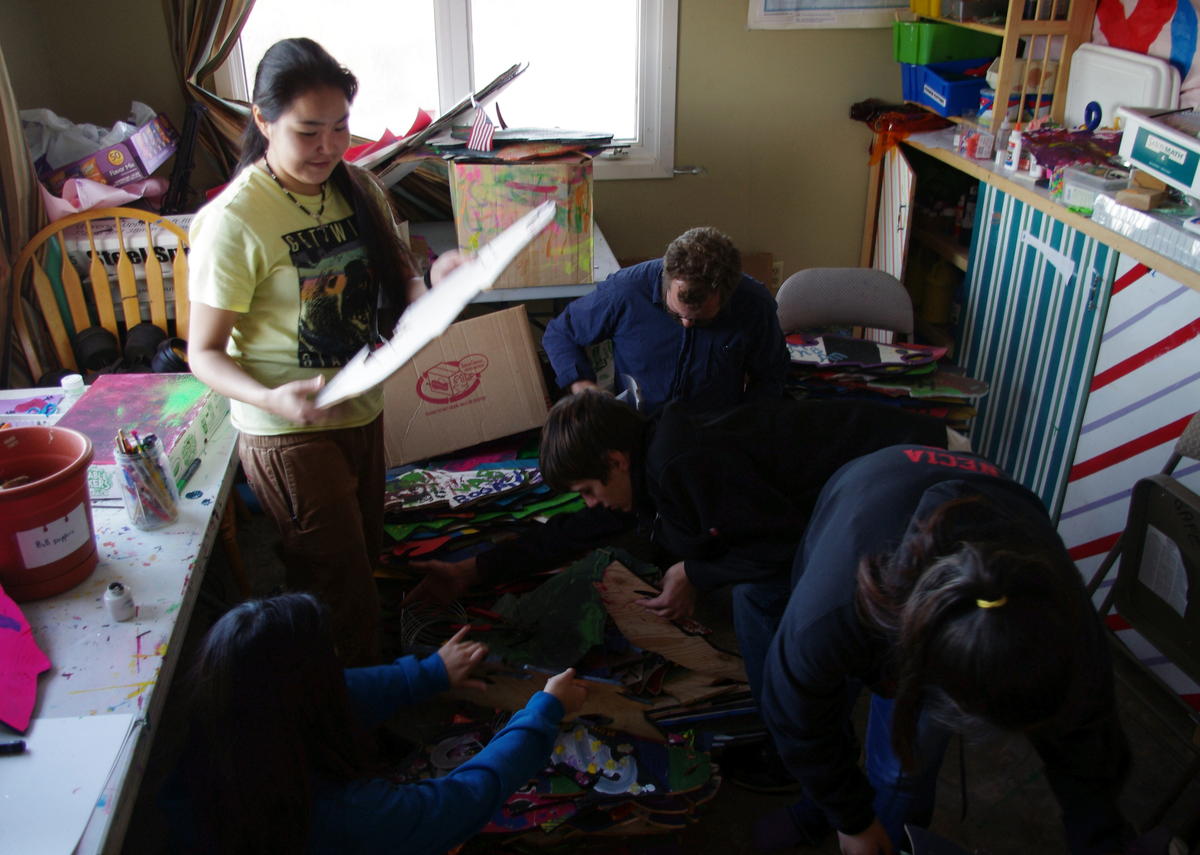
Myspace employee Darren Petla organizes supplies in the art room in preparation for the center's close in a few weeks. (Photo by Hannah Colton/KDLG)
Myspace employee Darren Petla organizes supplies in the art room in preparation for the center’s close in a few weeks. (Photo by Hannah Colton/KDLG)

The Myspace Youth Wellness Center in Dillingham will likely close its doors at the end of the month, as its grant funding has run out.

Myspace is a series of rooms geared toward teens – an art room, a kitchen stocked with snacks, a living room with a TV and video games.

On a recent afternoon, the rooms were neat and quiet, but Myspace employee Darren Petla says it’s not always like that.

“We have days when we are like brothers and sisters, like ‘OK you need to put that down, quit being’ mischief! No running’ around! Turn down that music!’ … You know, something like that every so often. So it’s good,” he said.

Petla enjoys working at Myspace. He talks to teenagers about their school day, cooks with them, helps them with homework. But come Nov. 30, Petla may be out of a job.

“The grant ended June 30, so SAFE has funded this, and now we’re at a hard deadline because we don’t have the money,” he said.

Karen Carpenter is the outreach and education coordinator at SAFE. She says Myspace was funded as part of the $373,000 “CANDU” grant that a group of Dillingham organizations received in 2011. It was awarded under former Governor Sean Parnell’s campaign against domestic violence and then extended through June 2015.

It’s the same grant that put fish art on buildings downtown and bus shacks in neighborhoods.

Anna Rae Petla, employee Gregg Marxmiller, and other teens organize the art room at Myspace. (Photo by Molly Dischner/KDLG)

Carpenter says the goal of all the CANDU projects was to make the community feel safer and more positive, especially for young people.

“Children are going go where the door’s open,” she said. “That’s the bottom line. So which door (are you going) to leave open for them? It’s going to be the home of the drug dealer. Or the drinking, the parents fighting and screaming, and no food in the house, with no electricity, no heat… So if we provide this safe environment and surround them with good, healthy options, it affects them. It changes them. So our goal has been to keep the right doors open.”

And children have made good use of that doorway. SAFE records show that Myspace activities drew about 150 children in the last year.

One of them was 17-year-old Brandon Dyasuk.

“There’s not a lot of stuff to do. I used to get in trouble a lot … I’m gonna be getting out of treatment soon, you know? This place can help keep me out of trouble and keep me in school. It helps me stay around sober people,” he said.

Keeping children off drugs is a high priority at Myspace. Even smelling like cigarettes is against the rules. But 15-year-old Anna Rae Petla says the center can also help with just the day-to-day challenges of being a teenager.

“I like Myspace because they help you with schoolwork and how to understand things when you’re alone — when you feel alone but you’re not alone. I don’t what I would do if Myspace has closed,” Petla said.

Petla, Dyasuk, and others may have to hang out elsewhere this winter, unless SAFE can raise the $6,500 a month it takes to keep Myspace staffed.

SAFE is currently planning fundraising efforts, including a table at the Christmas bazaar, soliciting private donations and applying for more grants.

Juneau sweeps Alaska Municipal League awards

Deputy city clerk, Beth McEwen, said she wasn't expecting the award. (Photo by Elizabeth Jenkins)
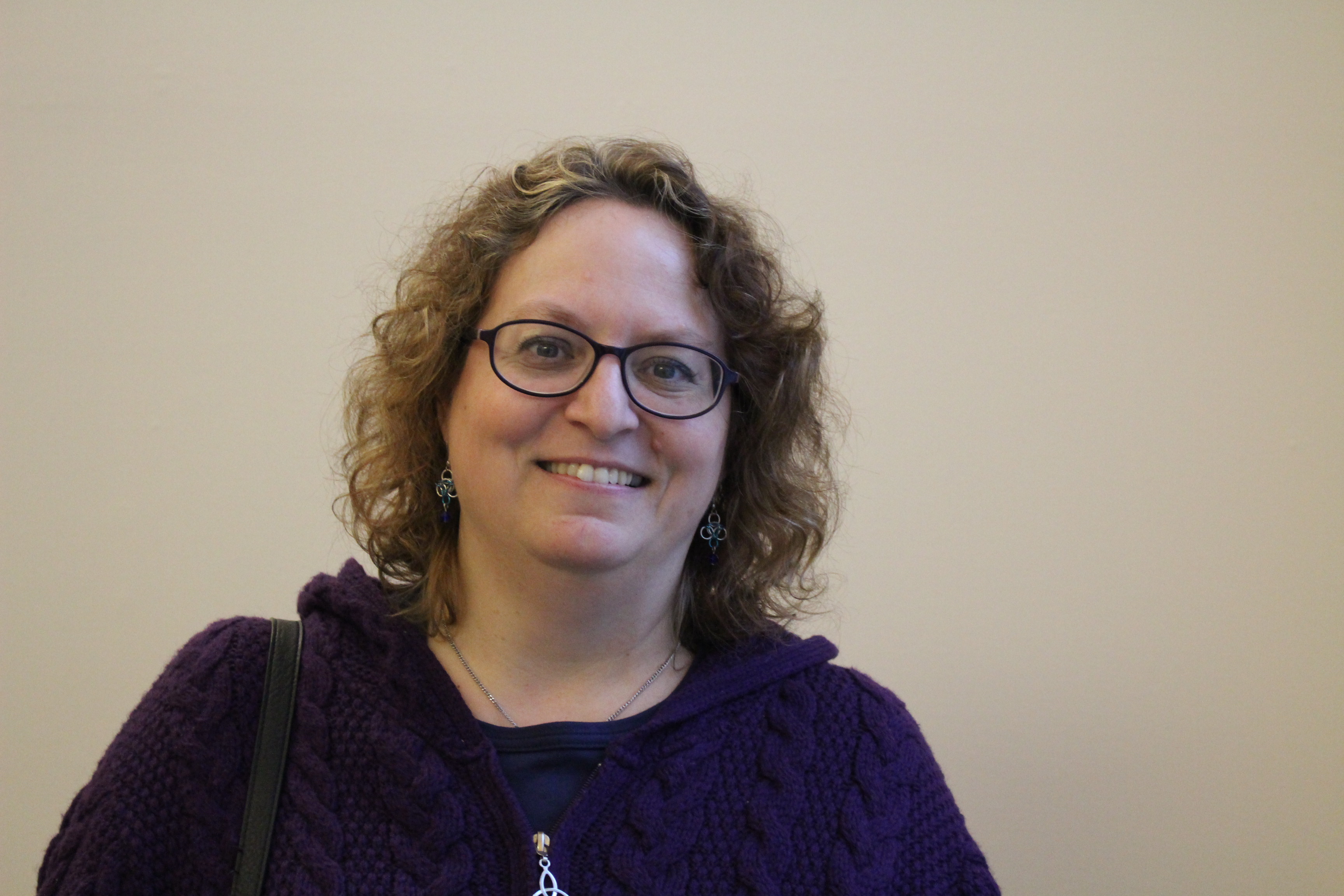
Deputy city clerk, Beth McEwen, said she wasn’t expecting to be named municipal employee of the year. (Photo by Elizabeth Jenkins)

Juneau picked up four of six awards at the Alaska Municipal League ceremony Thursday in Anchorage, including Municipal Employee of the Year. Beth McEwen, deputy city clerk, said she wasn’t expecting to win. The presenter started listing off McEwen’s achievements, and that’s when she realized.

“I’m sure my face was just as shocked as could be because I was blindsided and had absolutely no idea this was something I had even been nominated for,” she said.

McEwen works with about three dozen local boards and commissions. She’s active with the statewide municipal clerk’s association. Juneau Assembly member Jesse Kiehl called her one of the most knowledgeable people regarding the state’s liquor laws.

He presented the award to McEwen. Kiehl also serves on the league’s board.

“As a board member, you would present an award to whoever won it,” Kiehl said. “But for it to be someone you work with so closely is really an extra honor.”

The public works award went to the Juneau airport runway rehabilitation. The Juneau Police Department picked up one for their bicycle safety project. And the Zach Gordon Youth Center won in the spirit category for a kitchen remodel.

Ketchikan and Dutch Harbor were also recognized for people and projects in their communities.

McEwen says there are about 35,000 municipal employees in Alaska.

“It does take a village of public servants to be able to accomplish all the work of a government,” she said. “And I’m just honored to be one of those public servants.

This is the second year in a row someone from Juneau has won Municipal Employee of the Year.

Alaskan Bonnie Carroll among Medal of Freedom recipients

Presidential Medal of Freedom
The general badge of the Presidential Medal of Freedom, with its various components. This specific medal was presented to Bob Hope. (Public domain photo)

The White House has announced that President Barack Obama will award the Medal of Freedom to Alaskan Bonnie Carroll.

Carroll founded an organization called TAPS to help family members grieving the death of a military service member.

She is the widow of Gen. Tom Carroll, who was commander of Alaska’s Army National Guard when he died in a plane crash near Juneau in 1992.

The Medal of Freedom is the nation’s top honor for civilians.

Carroll is among 17 who will receive it next week.

Others include singers Barbara Streisand and Gloria Estefan, film director Steven Spielberg, Sen. Barbara Mikulski of Maryland, and baseball great Willie Mays.

Moccasins take over social media for ‘Rock Your Mocs’ 2015

Crystal Nelson holds up a pair of moccasins passed down to her from her grandmother (Photo by David Purdy/KTOO)
Crystal Nelson holds up a pair of moccasins passed down to her from her grandmother. (Photo by David Purdy/KTOO)

November is Native American Heritage Month, and people across the world are celebrating on social media with an online event called Rock Your Mocs.

Now in its fifth year, the event encourages indigenous people everywhere to post pictures of themselves wearing moccasins. Social networks are full of people sporting an array of moccasins of all shapes, sizes and colors.


Crystal Nelson in Juneau posted a picture of her moccasins to the group’s Facebook page this year. For her, they represent a common symbol for Native people no matter where they are.

“I think moccasins are such an iconic image for indigenous people on this continent and they look different from different regions, but we all have a version and it’s probably one of the easiest things we can use to represent us all, ‘cause we can just slip them on and go about our day,” she said.

Her moccasins have intricate bead work and fur, but their significance goes far beyond their aesthetic  appeal – they make a statement.

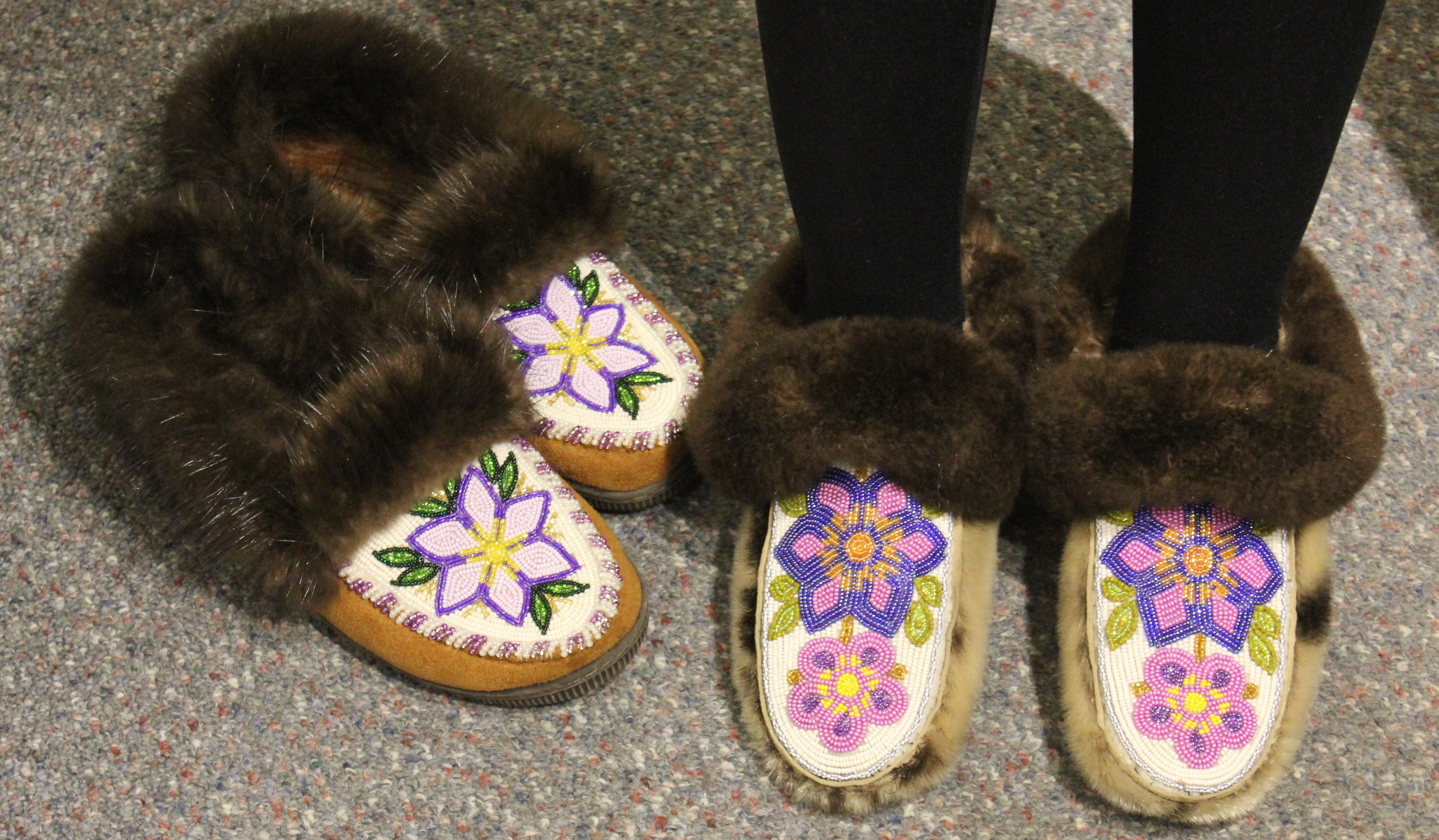
Two pairs of moccasins Crystal Nelson has worn for Rock Your Mocs 2015 (Photo by David Purdy/KTOO)
Two pairs of moccasins Crystal Nelson has worn for Rock Your Mocs 2015. (Photo by David Purdy/KTOO)

“It’s about family, it’s about heritage, it’s about solidarity,” she said. “To make people remember, we are still here and we still hold the parts of us that they could never take away.”

Each pair has a special meaning for her and a story that goes with them. The most significant to her are a pair that has been in her family for generations. When her aunt gave them to her as a graduation gift, she was overwhelmed.

“I was like ‘oh my god, you’re giving these to me?’ And she said, yeah, your grandmother put a lot miles on those, and then your mom put a lot of miles on those and now they’re for you to dance in because I know that you’ll use them and I know you’ll take care of them.”

Crystal uses these moccasins for dance performances, but for other occasions and every day wear, she has other pairs as well – each with their own story.

Site notifications
Update notification options
Subscribe to notifications