“Together we are so much stronger than if we are alone and in a corner somewhere hurt, but coming together we can overcome this violence in our lives,” Westman said.
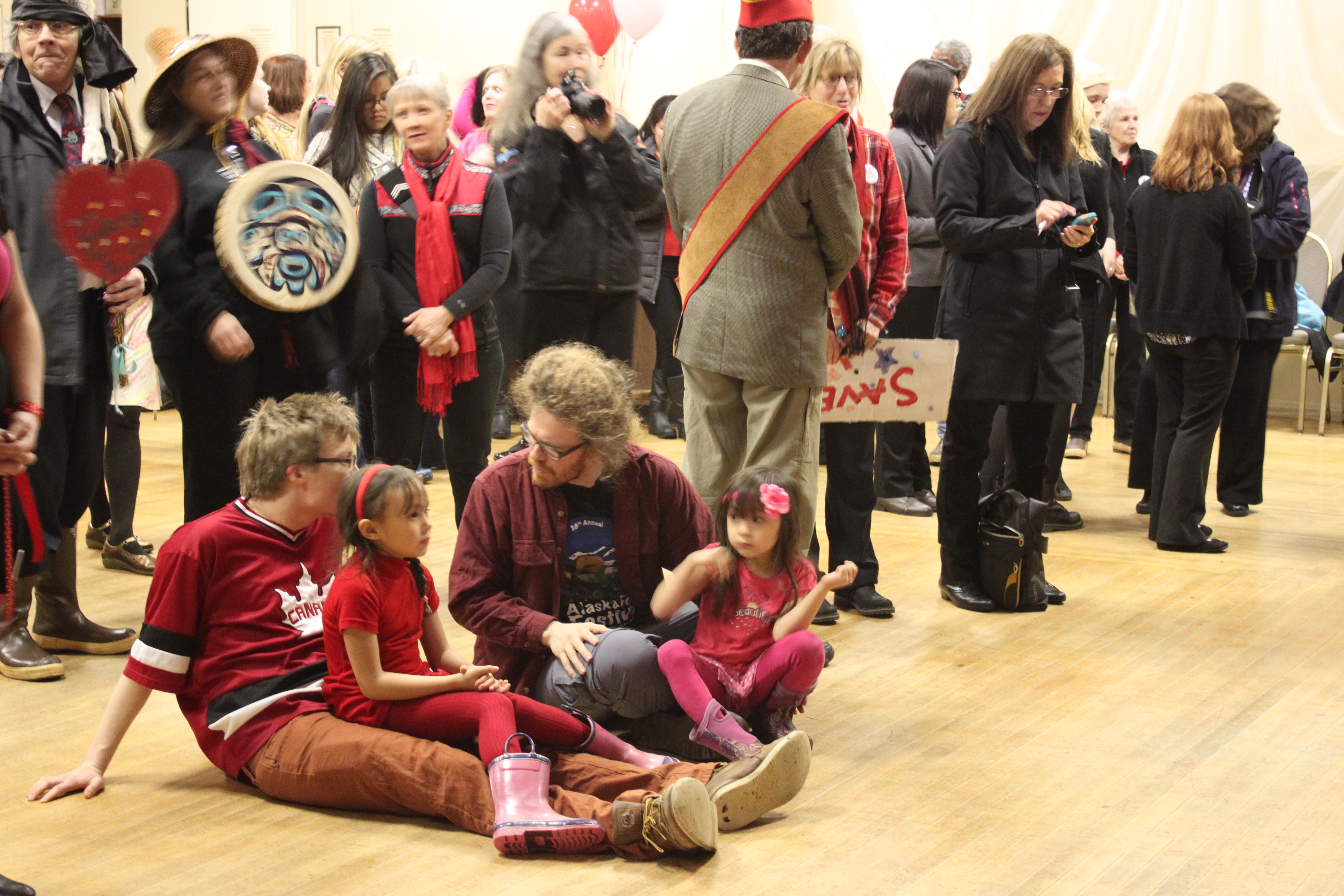
Yana Warner and Chantel Eckland, seniors at Juneau-Douglas High School, participated in the rally. (Photo by Lisa Phu/KTOO)
Community groups organized a march through downtown from Marine Park to Rockwell where people sang, danced and listened to speakers like Lt. Gov. Byron Mallott.
Chantel Eckland, 18, had the day off from school. She says One Billion Rising is an important way to educate people on the prevalence of violence toward females.
“It’s kind of like an uncomfortable topic to talk about for some people and I think, like, making it more public and getting more people involved will make a difference,” Eckland says.
This was the third year Juneau has participated in One Billion Rising.
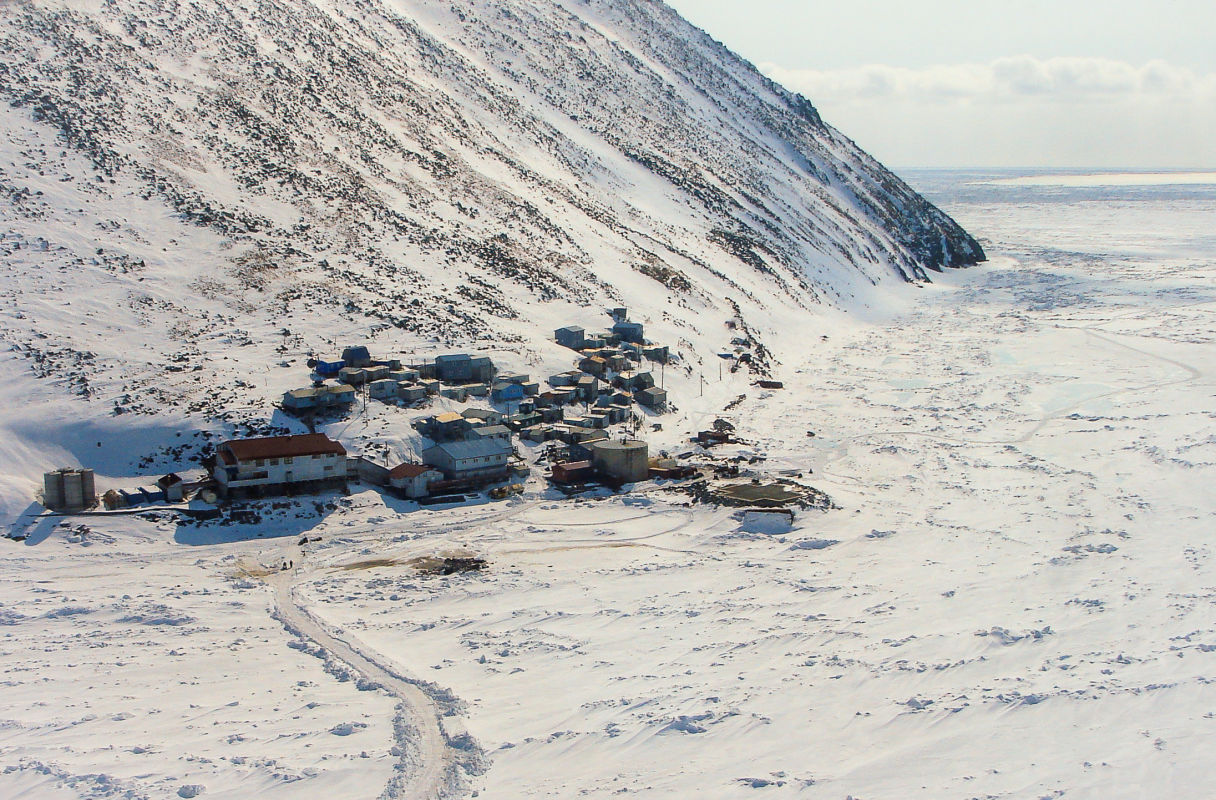
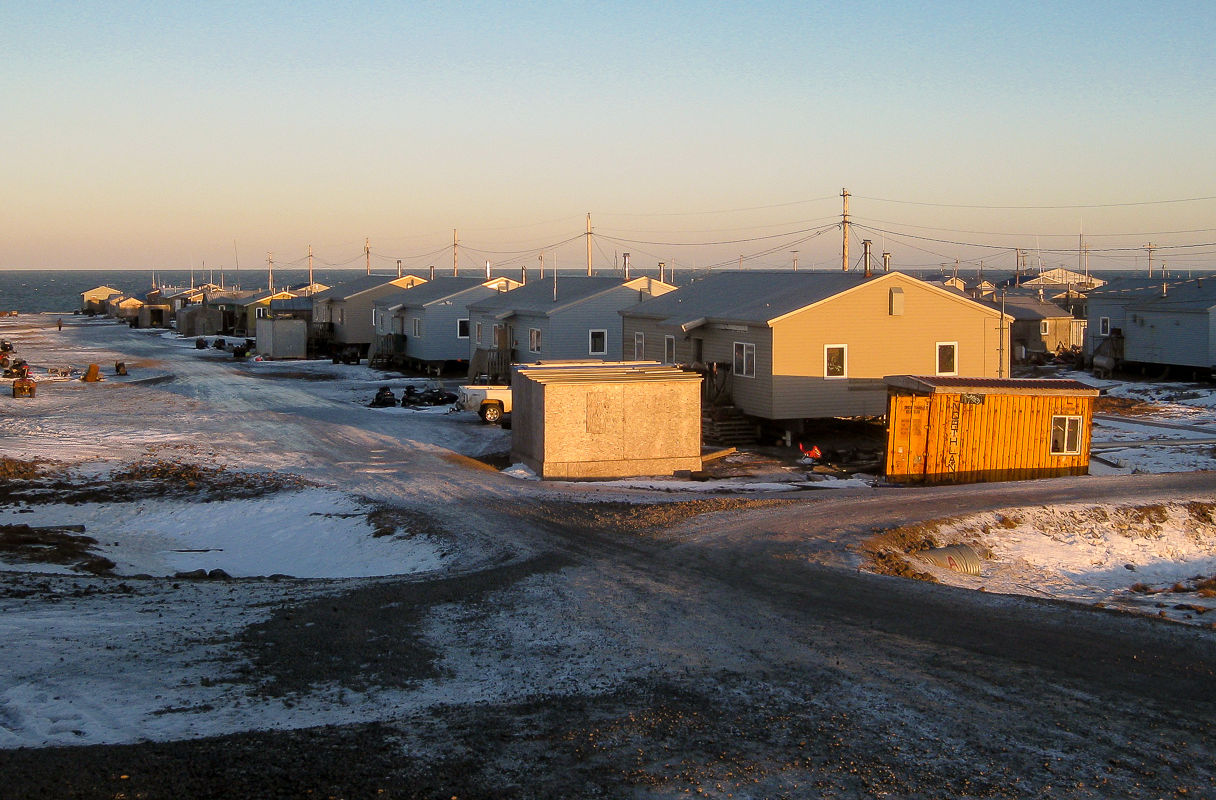
Little Diomede in April 2008. Photo: Susanne Thomas, Bering Strait School District. Used with permission.
The only aircraft flying to one of Alaska’s most remote communities has been down for maintenance for nearly three weeks—leaving residents of the Bering Strait community of Little Diomede with empty mailboxes, bare grocery store shelves, and no way on or off the island.
Andrea Okbealuk works at the Diomede school, and on Tuesday afternoon she was escorting children to lunch. The kids were eating alongside classmates, but also other members of the community, parents and aunties and grandfathers. No mail or cargo deliveries since Jan. 22 has left store shelves empty, and with no checks coming in the mail, wallets are thin and essentials hard to come by. So the school has opened its doors, serving nearly 300 lunches and dinners to Diomede residents since Saturday.
“In our store, it’s pretty bare. We do have a bunch of food here at the school, which will last for a while,” Okpealuk said. Hunters have been on the ice daily, she said, but strong winds, rough water, and poor ice conditions have made catching game difficult. “In our home,” she added, “I think the hardest part is having milk for the babies.”
Even with the school sharing its food, Okpealuk said, for mothers with young babies, no new stock on the shelves means there are few alternatives.
“It is hard when there’s no milk,” she said. “When you’ve switched your baby to regular canned milk to whole milk, to nonfat milk, to two percent milk, and then to nonfat milk again, and then now to powdered milk, it upsets the baby’s stomach.” She sighed. “A couple of us are going to that now.”
The needs go beyond the right food on the shelves. Late Friday night and into Saturday morning, an Army National Guard Blackhawk had to be dispatched to medevac a pregnant 18-year-old from Diomede to Nome’s Norton Sound Regional Hospital. While on the ground the Blackhawk crew and four medical providers were alerted to a two-month-old with an airway issue. That infant was identified as a “critical patient” and medevaced to Nome as well.
Diomede’s remote location means there are not many options when it comes to passenger and freight service to the island. Its unique geography—set along the shore of an island that’s little more than a mountain jutting sharply from the Bering Sea—means there’s no runway, save for the occasional ice runway that can be carved into the sea ice.
Erickson’s program director Chris Schuldt said the company only keeps a single helicopter—a twin-engine Bölkow BO-105—for service to Diomede. That helicopter has been down for routine maintenance in Anchorage since its last flight to Diomede in January.
“We’ve had some maintenance on the aircraft, but the goal is to return it to service in the next one to two days,” Schuldt said Tuesday. “Pending weather, [the helicopter] will return to Nome and begin operations as soon as that’s complete, [and] make sure our aircraft are in the top condition before we begin flying passengers and cargo again.”
Shuldt said Erickson’s customers, including DOT, are aware of the company’s maintenance status and plans to return to service this week. Erickson also contracts with the U.S. Postal Service for weekly mail service to Diomede.
According to Kawerak’s Pearl Mikulski, who worked on the EAS contract for the nonprofit in the past, the contract requires Erickson to make a certain number of trips each year, but otherwise allows the company to set its own schedule when it comes to flights, as well as stoppages for weather and repairs.
Kawerak can do little, Mikulski said, beyond cautioning Erickson to use the funds in such a way as to ensure flights last all year. That’s an especially difficult proposition during winters with poor ice conditions, Mikulski added, as the contract assumes an ice runway for part of the year. Last winter, that ice around Diomede wasn’t thick enough to support a runway.
Andrea Okpealuk said, for her and the residents of Diomede, every day without a helicopter means people are closer to not having what they need.
“Some of us do have meds that were supposed to come a couple weeks ago,” she said. “I’ve had meds that I ordered a couple weeks ago, and I just ran out.”
She sighed again. “Hopefully, in the next few days, we’ll get chopper service here.”
Northeast Cape is a Formerly Used Defense Site situated on the eastern tip of St. Lawrence Island. A former subsistence camp for island residents, the base established there was active during the Cold War and closed down in the early 70s. Recently in Savoonga, residents of St. Lawrence Island met with the Army Corps. of Engineers to discuss the cleanup of environmental contaminants left by the site. KNOM’s Kristin Leffler and Jenn Ruckel attended and filed this report:
It was a clear and bright day on St. Lawrence Island when representatives of the Army Corps. of Engineers landed in Savoonga. Two meetings slated that day would address the process for cleaning up Northeast Cape, inactive since 1972, but harboring a slew of environmental contaminants, including the toxin PCB.
According to Kevin Maher with Jacobs Engineering, the meetings aimed to introduce how the CERCLA process was used at Northeast Cape.
“The CERCLA is really a federal act that helped to deal with legacy contamination at abandoned contaminated sites,” said Maher. “And really, it was the first comprehensive way a process was implemented to handle these large contaminated sites.”
CERCLA stands for Comprehensive Environmental Response, Compensation, and Liability Act. It’s basically a multi-step process by which contaminants are assessed and actions are planned to remediate them. According to the Army Corps., the remedial actions at Northeast Cape (including excavating contaminated soil, removing debris, and installing landfill caps) are nearing completion.
But St. Lawrence Island residents aren’t completely satisfied, and they have qualms with the process itself: citing lack of transparency, poor communication, and exclusion of tribal governments.
Delbert Pungowiyi says there hasn’t been good government-to-government cooperation between the tribal governments and the federal government with the cleanup process. When the base was first established, Pungowiyi says island residents didn’t have much of a choice…
“At least our government, the United States government, had the courtesy to ask for permission to use our island. And our grandparents back then agreed that we really had no choice,” he said. “We’re in between these two big giants—America and Russia. It was the Cold War era. If World War III had taken place, we would’ve been wiped off the face of this earth.”
But now, cleaning up the site proves an aggravating process for Savoonga and Gambell residents who recount striking cancer rates among their people, which they attribute to military sites. According to a study funded by the National Institute of Environmental Health Sciences in 2002, the average level of the toxin PCB measured in St. Lawrence Island residents was 7.5 parts per billion, compared to the national average of 0.9-1.5 parts per billion for the rest of the nation. The highest levels of PCBs were found in those who spent most of their time at the former military site at Northeast Cape.
Many residents who attended the meeting expressed dissatisfaction with the cleanup process. Muffy Iya is worried that the federal government didn’t invest enough money in remediation, and used a metaphor to express her concern:
“Just to put it in perspective, you know, women have a certain way of washing dishes. So does everybody. Sometimes we don’t even have to use hot water because it’s a cost-saving thing. You use cold water, and that works, too,” she said. “And the same thing with Army Corps. of Engineers—you know, sometimes they take the least amount of money to correct the problem.”
However, the meeting was simply held to explain the CERCLA process. As Kevin Maher conceded, there were many more issues than the Corps. representatives could address, and there were questions they didn’t have the answers to.
“There’s bigger issues here today than we’re going to be able to solve at this time,” said Maher. “But there still is opportunity for public comment throughout the process, and we’ll touch on that again later, but thank you for your comments.”
But what follows “the process” for a federal agency translates to a frustrating amount of red tape for island residents who don’t feel they’re being heard.
“My concern is, you know, we’re making all of these public comments about the Northeast Cape site, and I don’t know if our public comments change the record of decision with the Army Corps,” said Iya.
The Record of Decision is the document that initially established what type of remediation would be implemented at the site. Though the document was finalized in 2009, Aaron Shewman with the Army Corps. says it can be modified as new information about the site becomes available. To this end, Restoration Advisory Boards (or RABs) were established to keep the public involved.
“The RAB functions as a way for the public to give us input. And if you find things out at Northeast Cape over the years that we’ve been doing remedial actions out there, we’ve addressed them,” said Shewman. “You know, Bryan came up with the fuel pipeline break down near Site 6, for example. That’s definitely one function of the RAB. The other one is to keep everybody up-to-date on where we are in the process.”
The next RAB meeting will be later this month in Savoonga, and federally mandated 5-year reviews will occur until the site is considered clean.
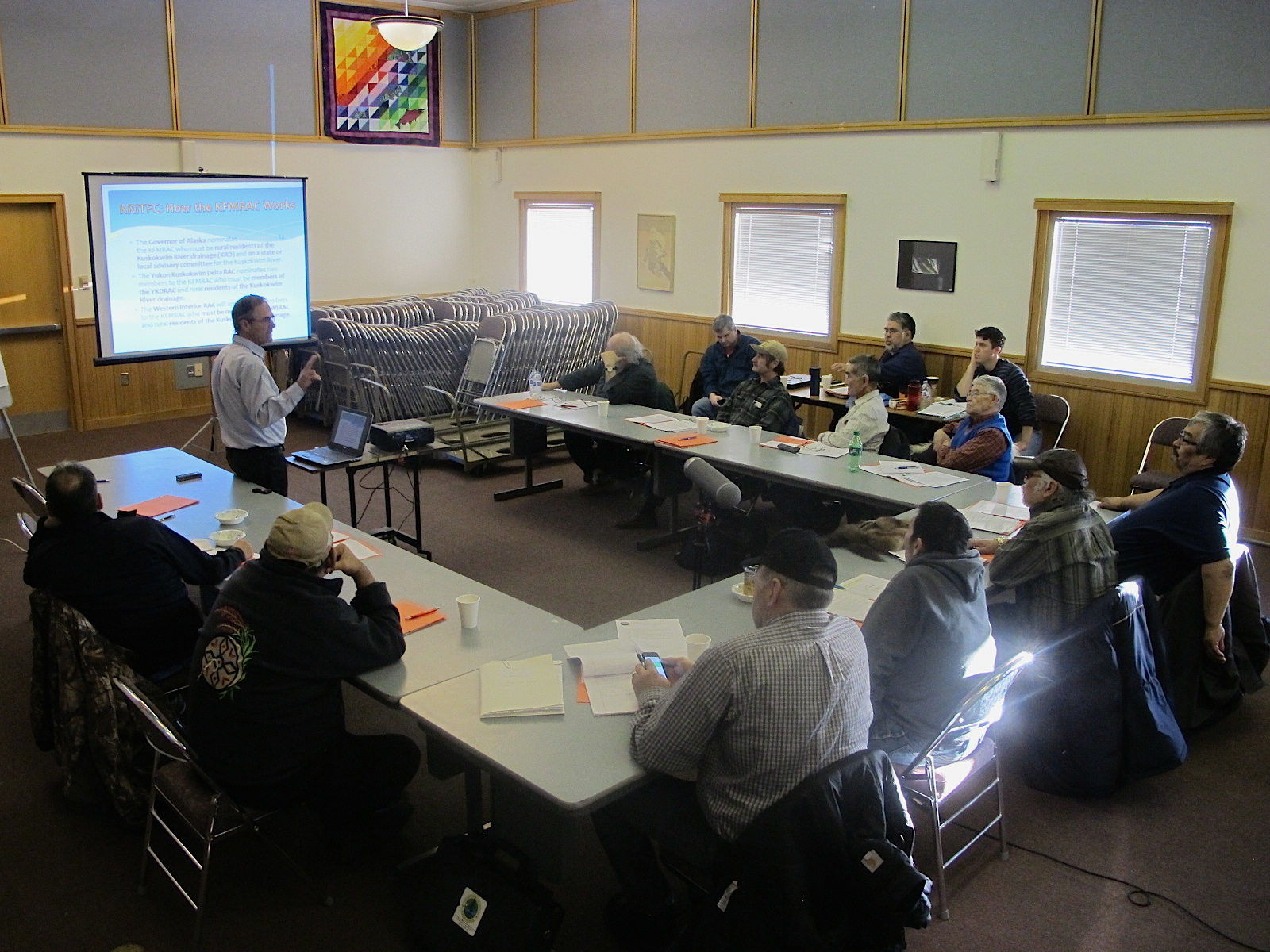
Kuskokwim River Inter Tribal Fisheries Commission steering committee members hear from AVCP attorney Sky Starkey. (Photo by Ben Matheson / KYUK)
Efforts to establish tribal co-management of Kuskokwim salmon are slowly progressing. A steering committee is in Bethel to sketch out the future of who regulates the river. Kuskokwim fishermen are eager to be managers, instead of simply advisers.
10 members of a steering committee met for the first time in Bethel Thursday. Fisherman from Nikolai at the headwaters down to the mouth began to define what they want to see in tribal co-management. Committee member Bob Aloysius from Kalskag emphasized tribes need to be more than simply advisers.
“Recommendations to go a point, and nothing happens. We need to have authority to implement, maintain, monitor, and enforce whatever we come up with,” said Aloysius.
The steering committee for the Kuskokwim River Intertribal Fisheries Commission is being facilitated by the Association of Village Council Presidents and Tanana Chiefs Conference, building off of tribal resolutions passed last year. Kuskokwim king salmon runs have been in decline for several years and unprecedented restrictions have hit subsistence fishermen hard. That’s led to conflicts among communities along different parts of the river. Jacob Black from Napakiak said for tribal management to succeed, everyone has to be on board.
“Our elders used to say, there may be a lot of people on the Kuskokwim or Alaska, but if you’re not united, you’re never going to accomplish nothing, that’s 100 percent true, to me. Right now we are not united,” said Black.
The full commission someday would include representatives from all Kuskokwim tribes choosing to take part. The smaller steering committee is trying to determine next steps and outline the mission and goal. They elected Bob Aloysius and Mike Williams as interim co-chairs while more members are expected to join. The long-term vision in some capacity includes equal footing among tribes, state and federal managers.
In the meantime, a federal demonstration project for co-management could build capacity for the change. Gene Peltola Junior, the assistant regional director for the Federal Office of Subsistence Management described a possible new committee under the federal subsistence board. He says if it’s structured properly it could have more input.
“But if they were to give it weighted opinion, or whatever you call it, I truly feel the local individual would have a lot more say in management than they have had in the past,” said Peltola Junior.
Sky Starkey, an attorney who works for AVCP presented a vision of how the committee could push the boundary of the law in order to maximize co-management potential.
To give it teeth, Starkey says tribes should seek broad application of a section of the Alaska National Interest Lands Conservation Act, or ANILCA, that governs subsistence on federal lands. That would force the federal board to defer to their committee’s plan, unless the proposal fails to meet strict criteria.
“Trying to use that and trying to strengthen it so the recommendations carry a lot of weight,” said Starkey.
One idea is to create a new regional advisory council that replaces the fish responsibilities of two current regional committees. In the very preliminary conception, tribes would make comprehensive management plans and take responsibility for researching and monitoring fish, while giving traditional knowledge equal footing.
The meeting continues Friday at the cultural center in Bethel. A meeting for Yukon tribes is scheduled for next week in Fairbanks.
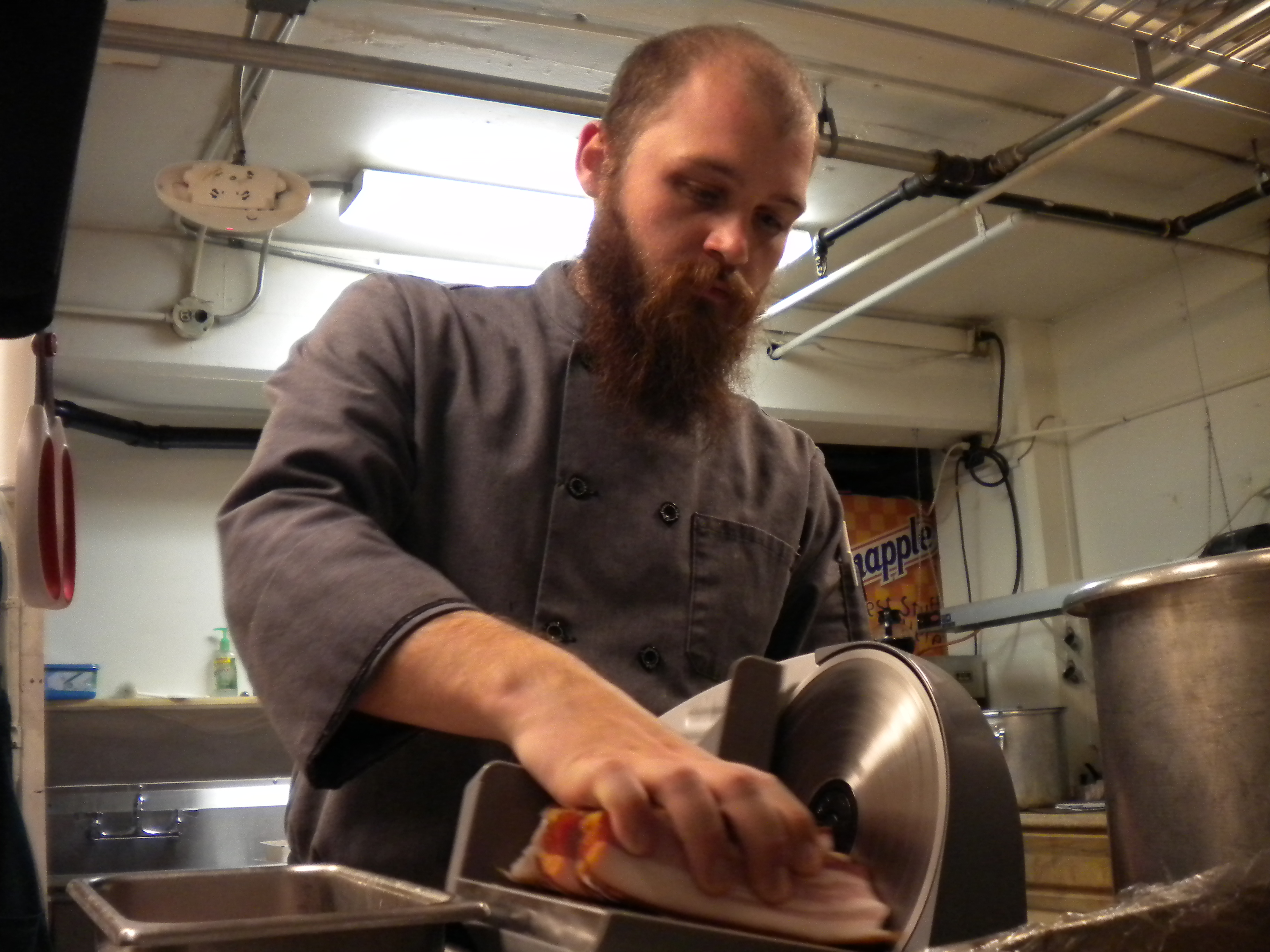
Brian Keeney, kitchen manager of V’s Cellar Door, slices bacon for one of the dishes the restaurant is entering in Baconfest. (Photo by Kevin Reagan/ KTOO)
Juneau’s Baconfest brings together local culinary talent to manipulate America’s beloved pork product. Bacon-infused ice cream, popcorn and cocktails are a few dishes attendees can taste on Saturday at the annual fundraiser.
The sound of slicing bacon is not quite what you’d expect to hear in the kitchen of an ice cream parlor. But Baconfest requires local restaurants to get inventive with the crispy breakfast-staple.
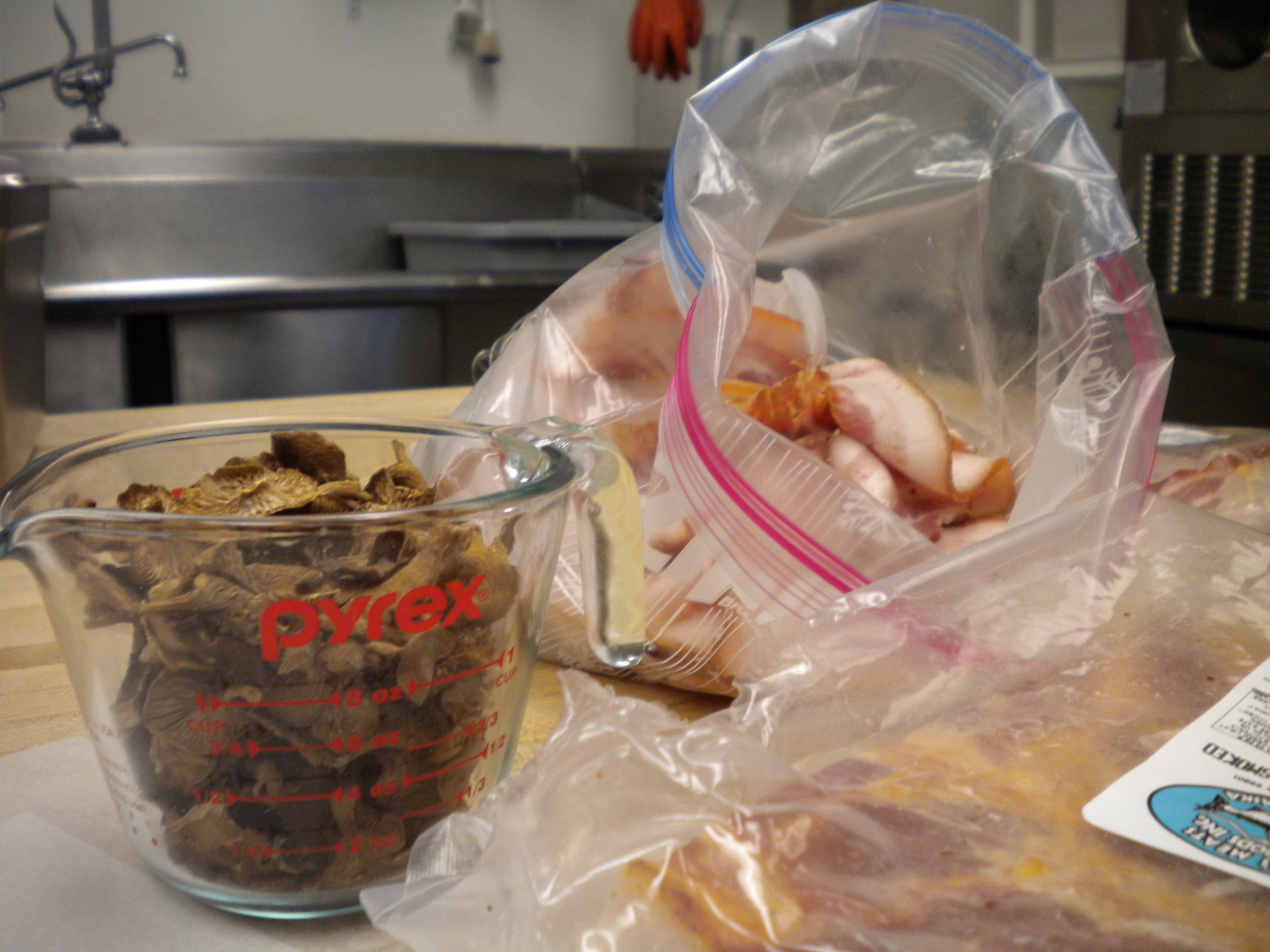
Coppa is a coffee shop specializing in homemade ice cream. Co-owner Marc Wheeler and staff are serving up a candy cap mushroom-flavored ice cream with six pounds of sliced, candied bacon mixed into the custard.
“Ice cream is kind of a medium that can be bent and twisted and done all sorts of things with,” Wheeler says.
Coppa’s head cook Isaac Stern begins the process by grinding up the candy cap mushrooms. He then whisks the grinded mushrooms into a simmering pot of sweet custard. The mushrooms have a similar flavor compound as maple syrup. Once dissolved into the custard, Stern says their natural sweetness will complement the salty bacon.
Candy cap mushrooms and bacon are central ingredients to the homemade ice cream Coppa is serving at this year’s Baconfest. (Kevin Reagan/ KTOO)
“You can buy all kinds of flavors in jars, buy flavors in cans, and it’s not real flavor,” Stern says. “This is something made in nature that we’re putting into it. It symbolizes our need to use the environment.”
Coppa is one of 20 vendors to make bacon-inspired dishes for the 400 Juneau residents to attend Baconfest. This is the shop’s first year participating in the competition.
The annual fundraiser originated three years ago when the Juneau Glacier Valley Rotary Club was looking for a new, unique way of raising money. Baconfest co-chair Mandy Massey says the event is an outlet for restaurants to experiment.
“We’ve been so surprised by items that we would regularly never see out there,” Massey says. “These people, these professionals just keep coming up with incredible, creative items. It’s just an explosion of flavors.”
Massey says the event sold out a full week before Saturday. Attendees vote for their favorite bacon dishes in separate ‘sweet’ and ‘savory’ categories. The vendor with the most votes receives an advertising package from Juneau Radio Center valued up to $1,000.
Venietia Santana, owner of V’s Cellar Door, came in third place last year for her bacon wonton dish made with smoked Alaskan halibut. This year, she’s combining 4-5 different types of bacon into a dish that will include savory smoked fruits and bacon soaked in duck fat.
A finished batch of Alaska Fudge Company’s bacon caramelized popcorn for this year’s Baconfest. (Photo by Kevin Reagan/ KTOO)
“I wanted to push the envelope even further, and see what exactly we could do with bacon,” Santana says.
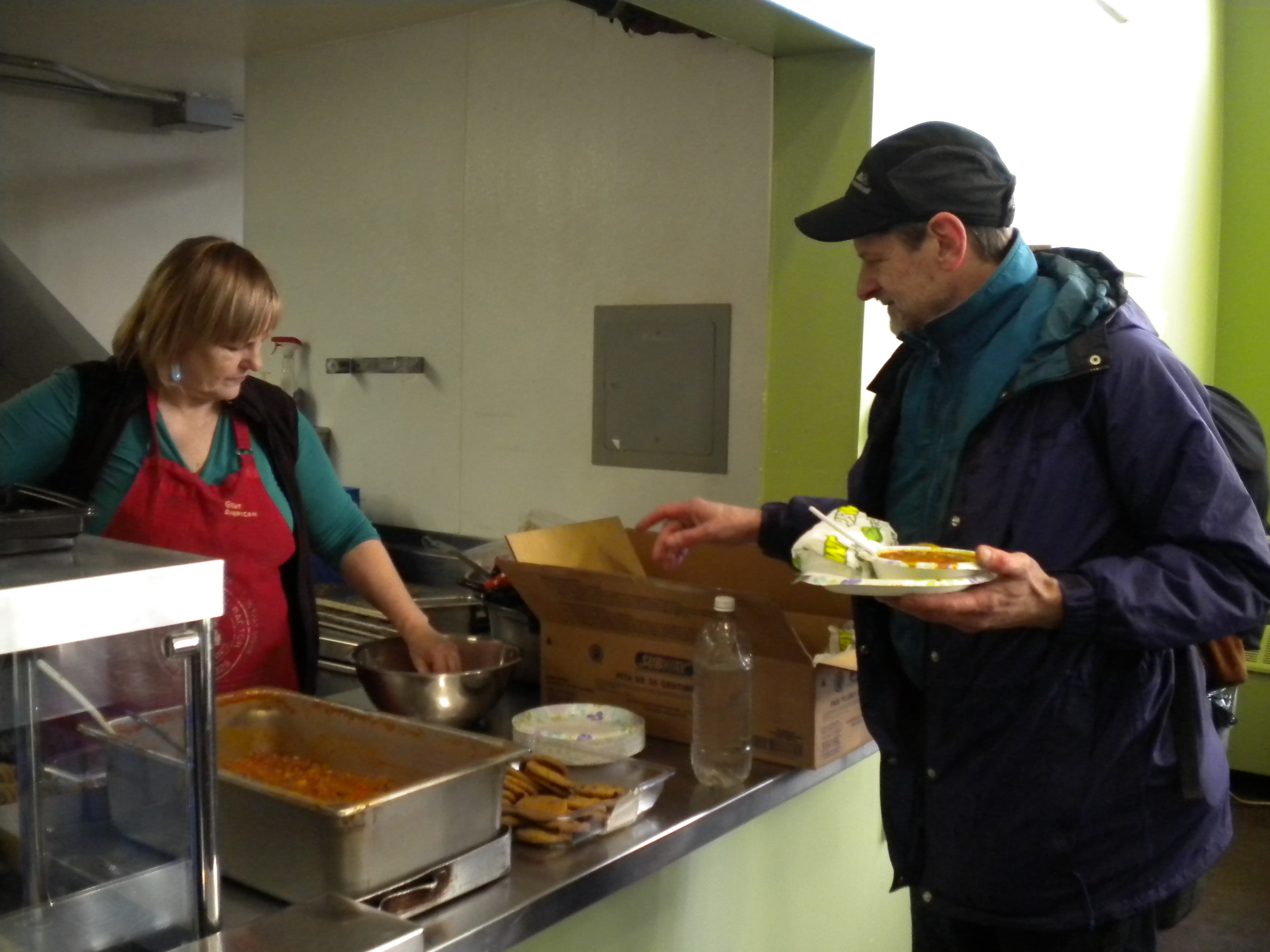
Glory Hole staffer Mindy Lee serves the first meal at the shelter’s headquarters since the building shut down for repairs two months ago. (Photo by Kevin Reagan/KTOO)
The Glory Hole Shelter and Soup Kitchen reopened its doors Wednesday morning after plumbing repairs closed down its headquarters for the last two months.
Wednesday was move-in day for Mariya Lovishchuk at the Glory Hole.
The executive director of Juneau’s nonprofit homeless shelter has not worked at a desk of her own since a broken pipe flooded the building two months ago. Lovishchuk and her 10-person staff recently returned to their headquarters on Franklin Street to continue offering their full services.
“The transition period will be over pretty soon, it’s just really great to have the building back,” Lovishchuk says.
The shelter stayed in operation while its building was under repair. The Salvation Army and Holy Trinity Church helped the Glory Hole provide basic services to its regular patrons.
Lovishchuk says insurance covered most of the repair costs, and community donations allowed the Glory Hole building to undergo some much needed upgrades. New cabinet panels, kitchen stove and plumbing system were installed while the building was being serviced.
“Fortunately we have a lot of partners in the community and the state,” Lovishchuk says, “because of the help of our great partners it has not as been as horrible as it could have been.”
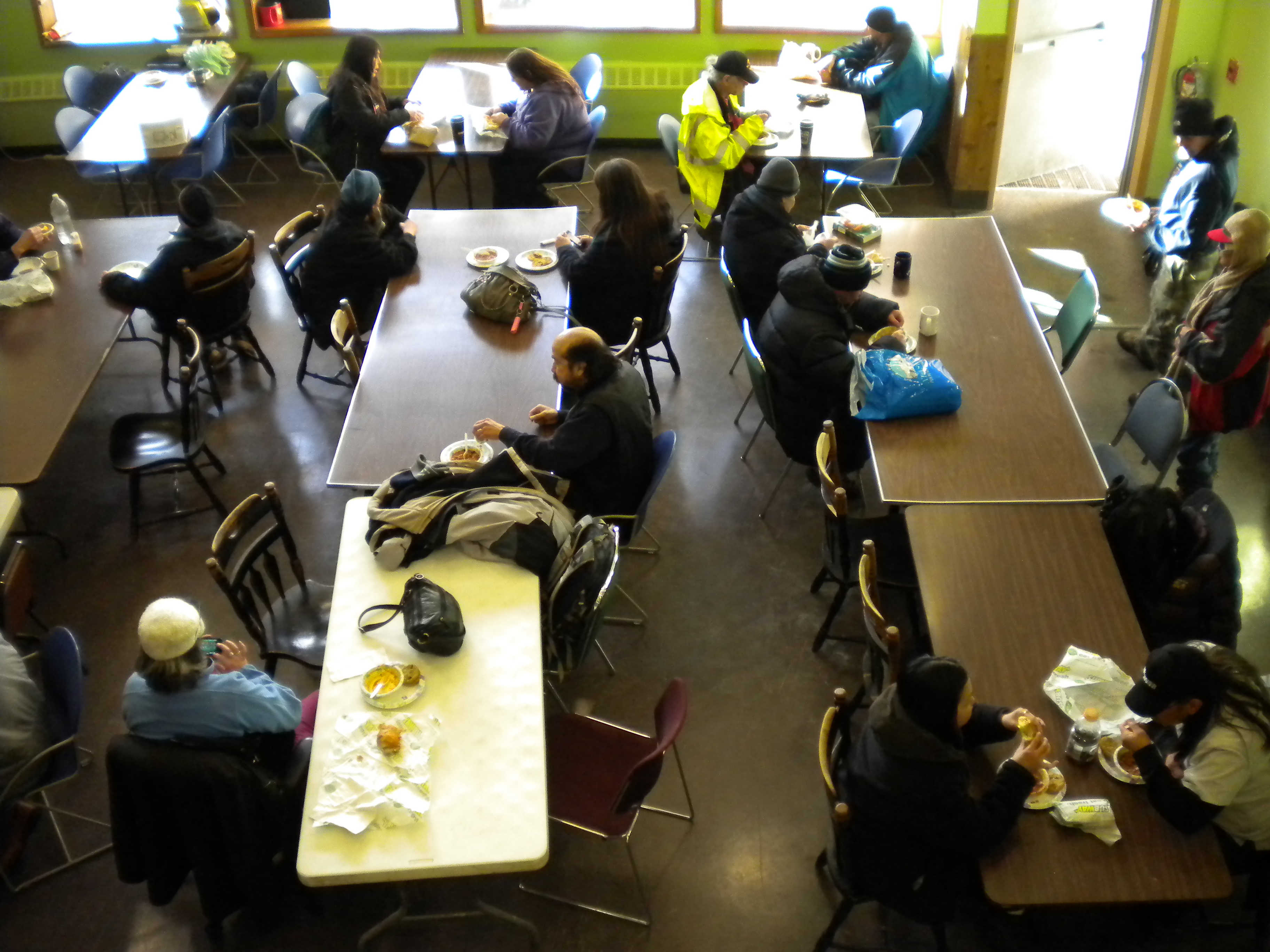
Lovishchuk’s staff prepared the first meal in the Glory Hole since re-opening on Wednesday to a crowd of about 20 people. On the menu was homemade chili and Subway sandwiches.
For Mike Davis, the chili wasn’t quite strong enough. He sprinkled some garlic salt on top — but it’s a ritual he does with all his food.
“Cold medicine is what it is actually,” says Davis, who has lived in Juneau since 1974.
Roughly twenty people arrived at the Glory Shelter for lunch on Wednesday. The shelter collaborated with the Salvation Army to continue offering meals while the building was under repair. (Photo by Kevin Reagan/KTOO)
Davis had been staying at Juneau International Hostel with other Glory Hole clients during the repairs. He doesn’t plan to stay in the shelter for very long but he’s glad to see it reopened for those who have nowhere else to go.
“I know it’s really important for a lot of these people,” Davis says. “They feel a lot more comfortable here, it’s a sense of security I guess.”
The Glory Hole is capable of housing 40 people at a time in its dormitories, and clients have been moving back in for the last couple of weeks.
With the building back in operation, Lovishchuk says it should be easier for the Glory Hole to continue its involvement with developing the capital city’s Housing First project to address chronic homelessness.
Close
Update notification options
Subscribe to notifications
Subscribe
Get notifications about news related to the topics you care about. You can unsubscribe anytime.